
A complete issue · 18 pages · 1893
Life — August 31, 1893
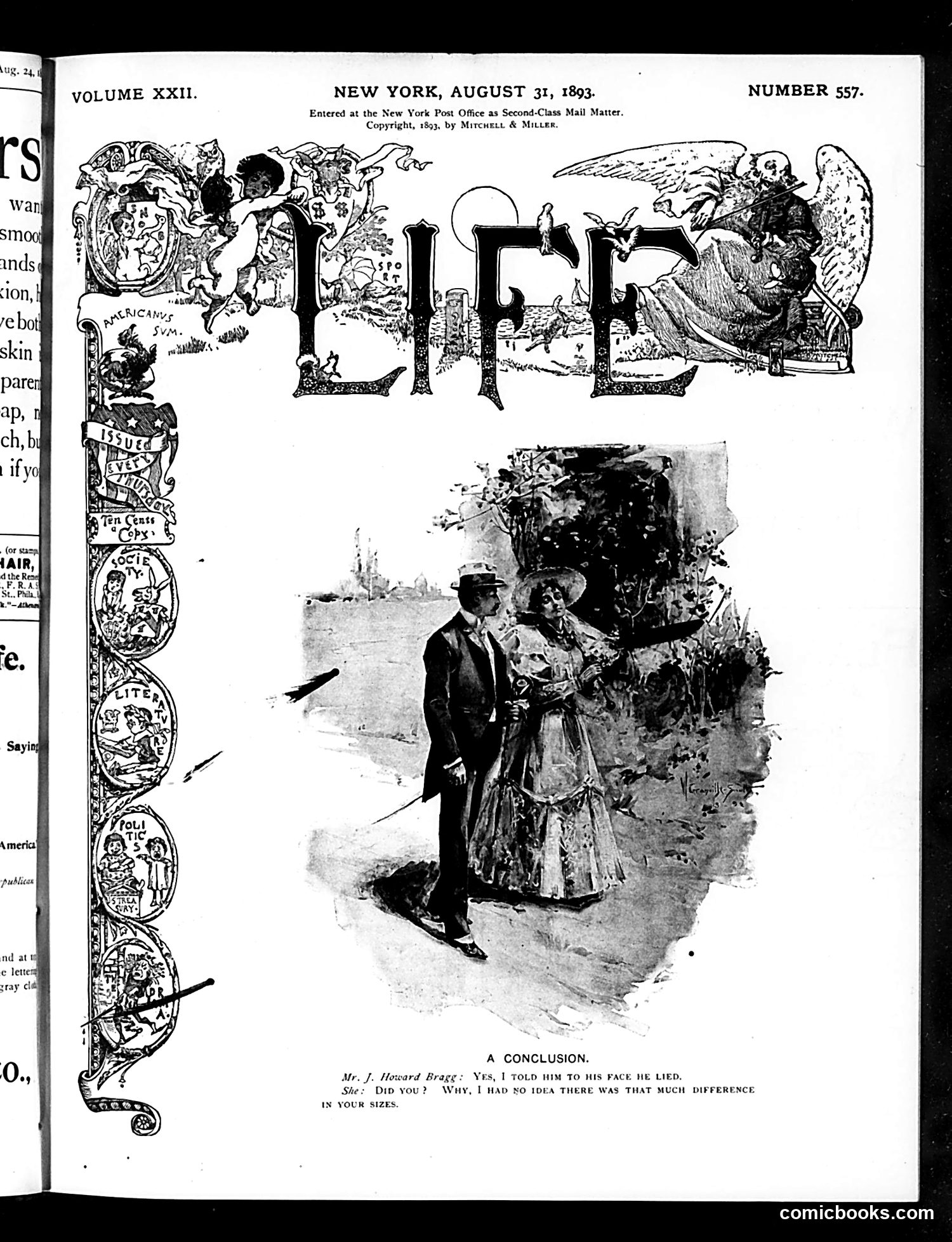
This page features "A Conclusion," a cartoon dialogue between two figures. The caption reads: "Mr. J. Howard Bragg: Yes, I told him to his face he lied. / She: Did you? Why, I had no idea there was that much difference in your sizes." The humor relies on a size difference joke—the woman expresses surprise that Mr. Bragg is large enough to have confronted someone in person ("to his face") rather than hiding behind written accusations. The implication is that Bragg appears small or unimposing physically, making his bold confrontation unexpected or laughable. The decorative left border contains small illustrated vignettes, typical of Life's ornamental design from this era. Without additional context about who "J. Howard Bragg" was, the specific incident referenced remains unclear.
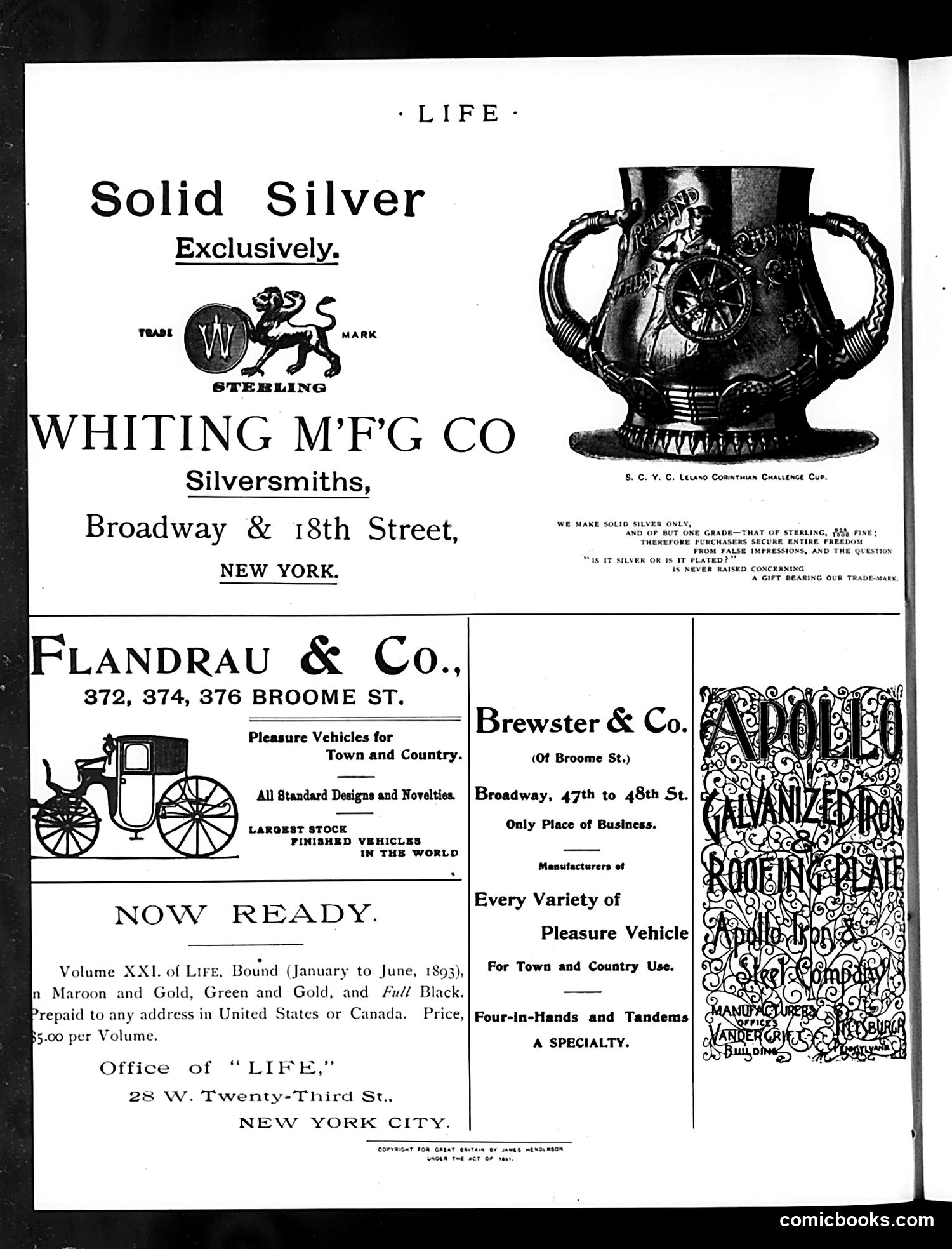
This page is primarily **advertising**, not political satire or comics. It contains four advertisements from 1893: 1. **Whiting M'FG CO** - A silversmith promoting solid silver goods, located in New York 2. **Flandrau & Co.** - Selling horse-drawn pleasure carriages for town and country use 3. **Brewster & Co.** - Manufacturing pleasure vehicles and specialty four-in-hands and tandems 4. **Life Magazine itself** - Advertising Volume XXI (January-June 1893) available in three color binding options The only illustration with potential symbolic content is the **S.C.Y.C. Lipton Corinthian Challenge Cup** shown atop the Whiting ad—a decorative silver trophy featuring a sailing ship. However, this appears to be simply product display rather than editorial commentary.
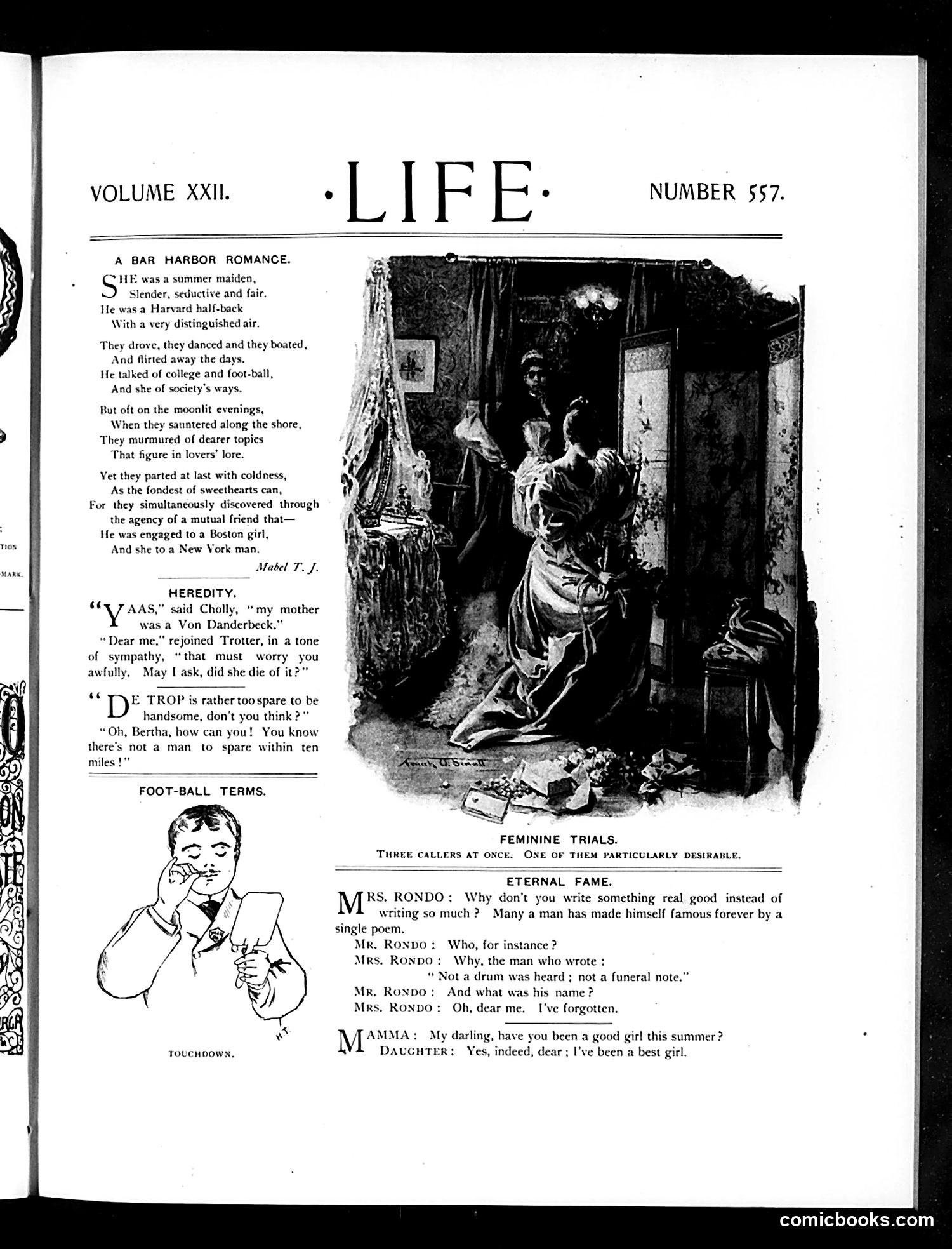
This page contains three distinct pieces of period humor: 1. **"A Bar Harbor Romance"** (poem): A satirical love story about a summer romance between a Harvard student and a woman, ending with the revelation that he was from Boston and she from New York—suggesting their different social standings made their relationship ultimately incompatible. 2. **"Heredity" and "De Trop"** (dialogue): Social satire mocking class pretensions, with characters discussing lineage (Von Vanderbeck ancestry) and social acceptability. 3. **"Football Terms" cartoon**: A simple visual pun showing a figure labeled "Touchdown"—likely playing on the double meaning of the football term. The overall theme reflects early 20th-century American satirical humor about social class distinctions and romantic misadventures among the wealthy leisure class.
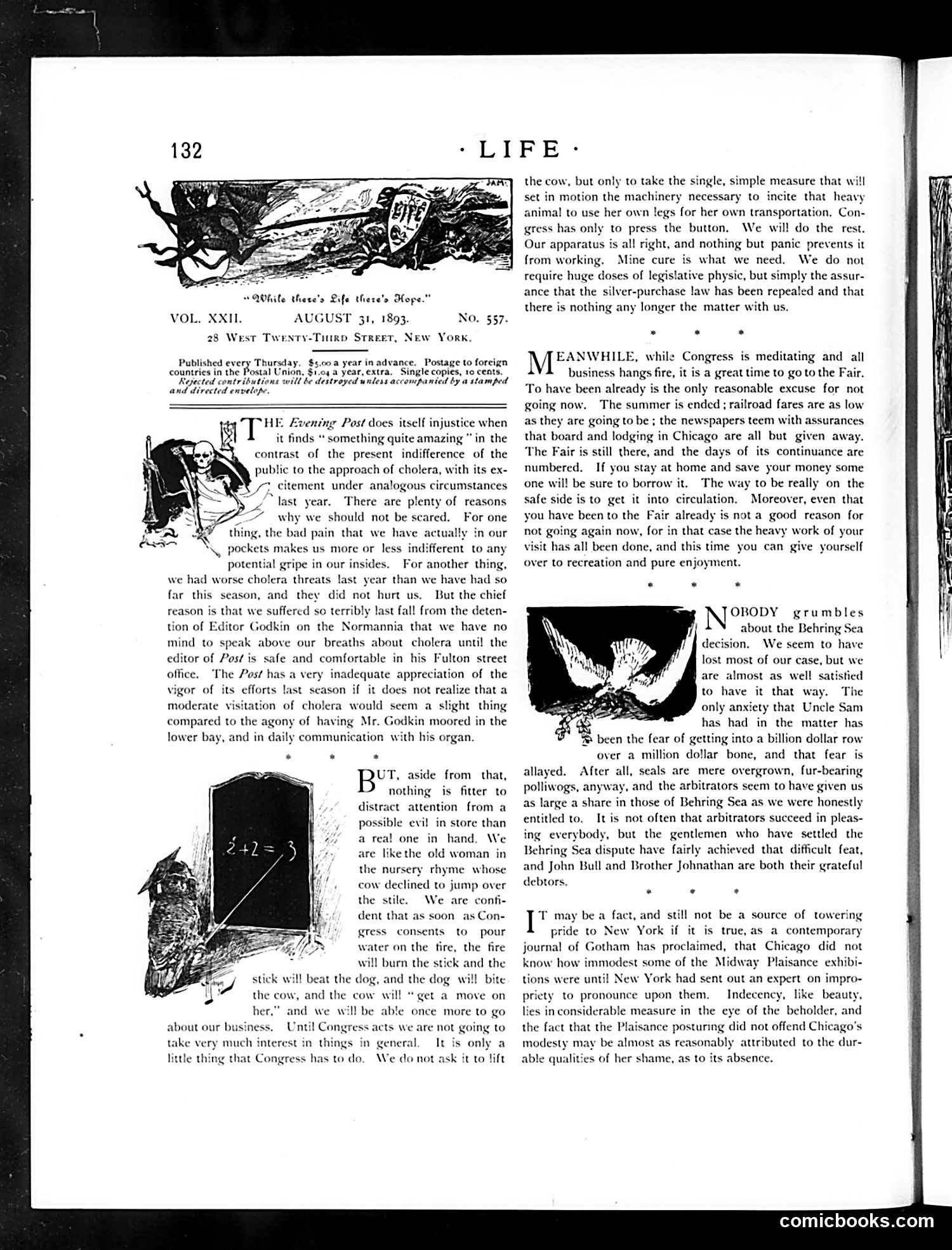
**The Main Cartoon:** The top illustration shows a cow labeled "White House's Elk Hose's Hope"—likely a satirical reference to a contemporary political figure or situation involving the White House during President Cleveland's administration (1893). **The Editorial Content:** The page discusses cholera fears, Congress's inaction, and the World's Columbian Exposition ("the Fair") in Chicago. The author sarcastically suggests that while Congress debates, citizens should visit the Fair since railroad fares are temporarily reduced. **Social Context:** References to the Behring Sea arbitration dispute and mentions of "Uncle Sam" suggest anxieties about U.S. sovereignty and business interests. The tone combines contemporary political frustration with promotional enthusiasm for the Chicago World's Fair.
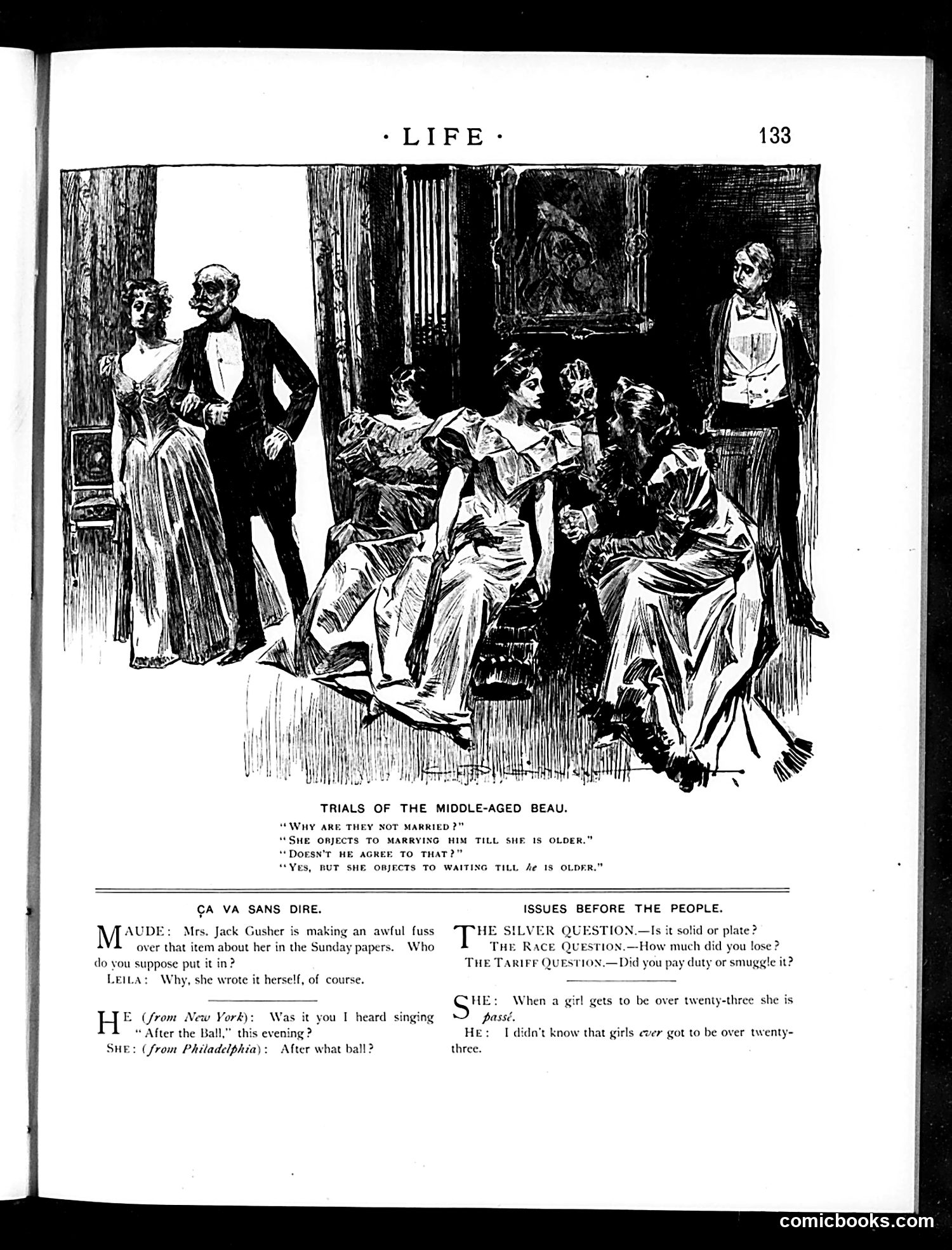
The top cartoon, "Trials of the Middle-Aged Beau," satirizes marriage dynamics and age gaps. It depicts a man courting a woman while she objects to marrying him until she's older—a paradoxical scenario poking fun at women's marital expectations and the absurdity of postponing marriage for age-related reasons. Below are three brief joke exchanges labeled "Ça Va Sans Dire" (goes without saying) and "Issues Before the People," which reference contemporary political debates: the "Silver Question" (monetary policy), the "Race Question," and the "Tariff Question." The final joke plays on the phrase "over twenty-three," with a man expressing surprise that girls ever reach that age—likely mocking women's aging anxieties or suffrage-era discussions about women's roles. The humor relies on social commentary about gender, marriage, and politics.
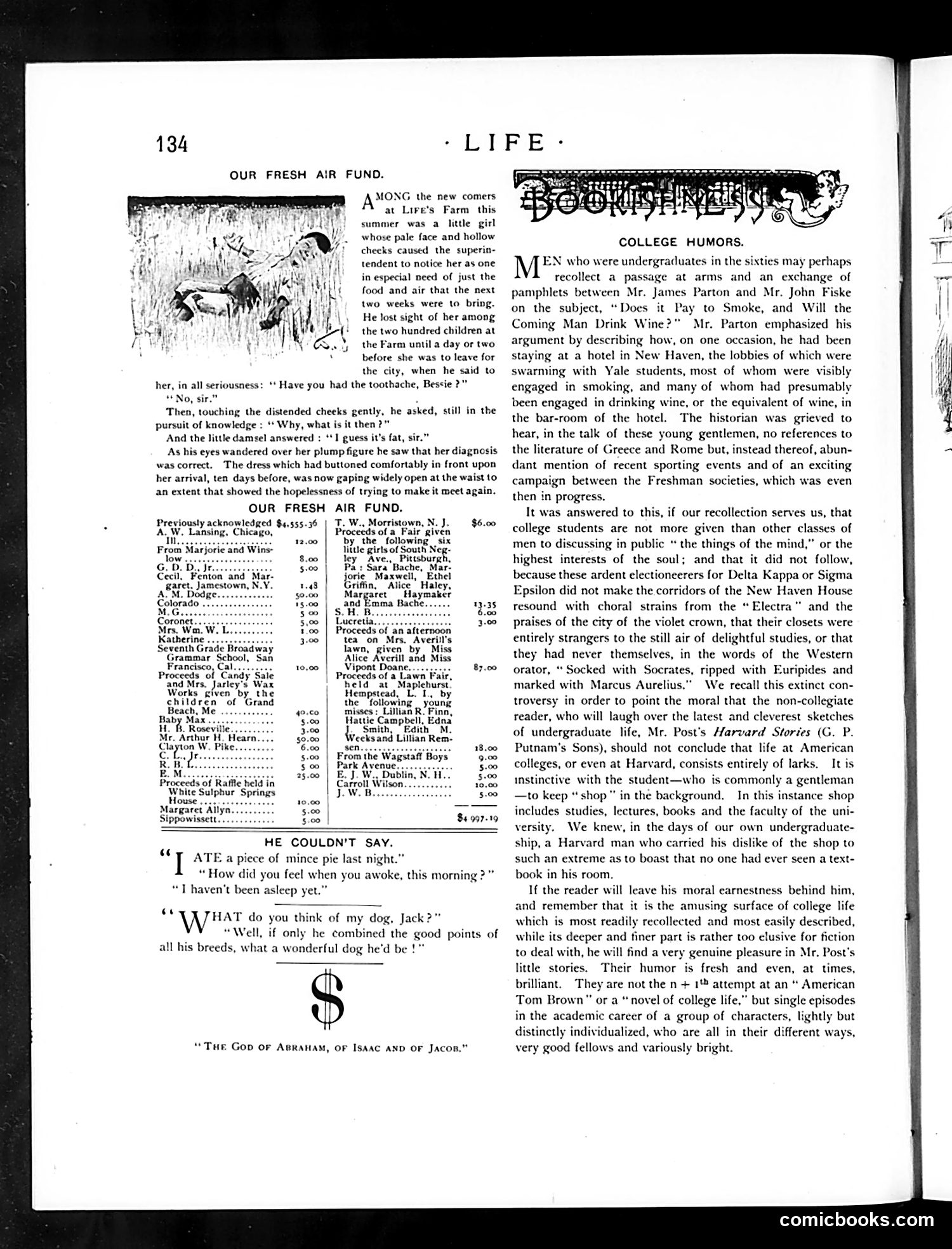
This page contains three distinct sections: **"Our Fresh Air Fund"** (top left): A sketch depicting a pale, sickly city girl brought to a farm. The girl's thin appearance and weak constitution contrast with the farm setting, illustrating the Progressive Era "fresh air movement"—a charitable program sending urban children to rural areas for health benefits. **"College Humors"** (right column): A satirical discussion of undergraduate life, referencing debates between Yale and Harvard students about smoking and drinking. The text critiques non-collegiate social pretensions while praising Mr. Post's *Harvard Stories* for authentically capturing student life through humor rather than novelistic ambition. **"He Couldn't Say"** (bottom): Brief humorous dialogues about dogs and family relationships, representing typical light comic fare of the era. The page primarily targets educated, urban readers familiar with collegiate culture and Progressive charitable movements.
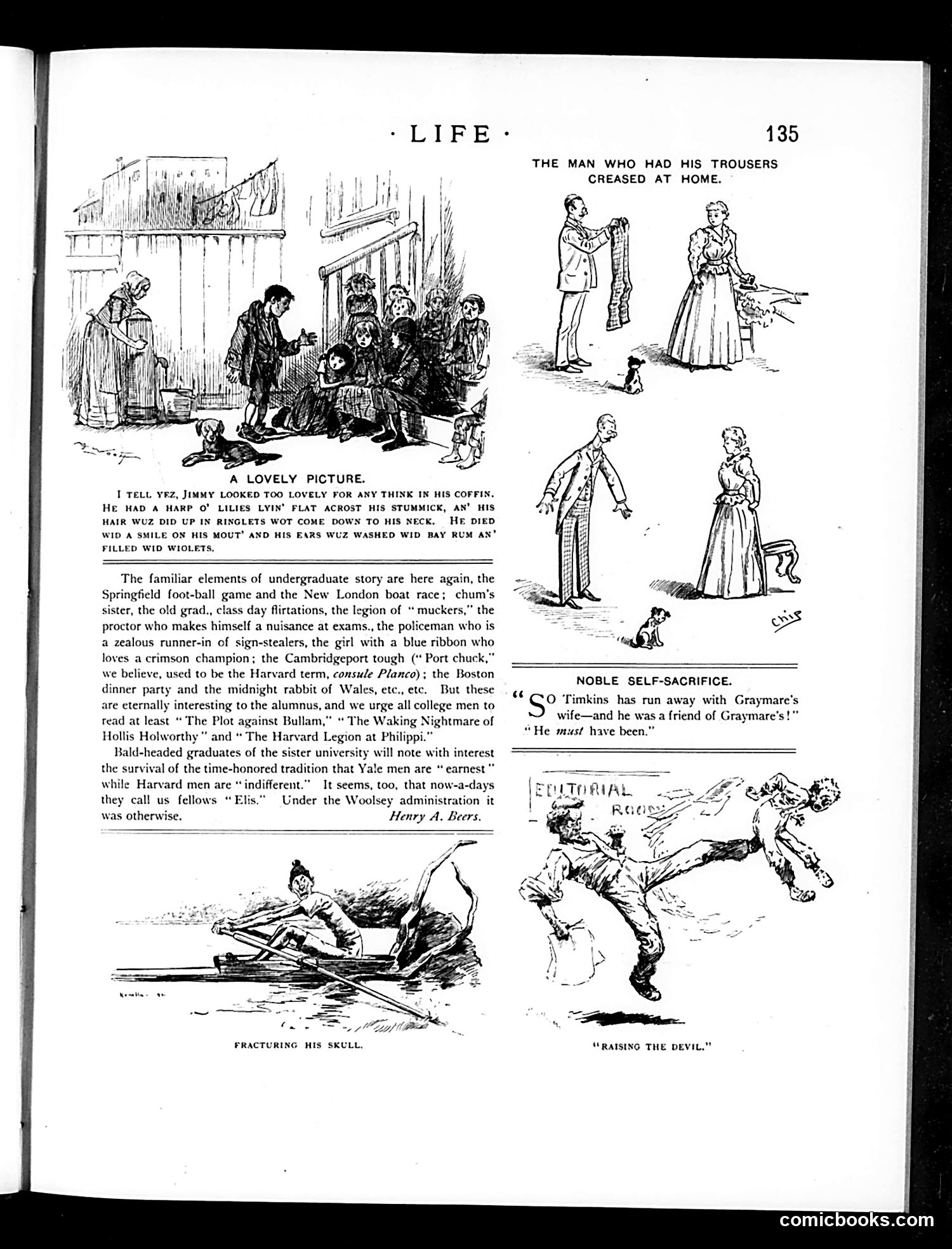
This page contains satirical illustrations about undergraduate life and social conventions of the era. The top section, "The Man Who Had His Trousers Creased at Home," mocks the pretensions of maintaining proper dress standards—showing various scenarios of a man's carefully pressed trousers becoming disheveled through normal activities (sports, socializing, etc.). Below, "Noble Self-Sacrifice" jokes about romantic entanglement, while the lower cartoons depict physical mishaps ("Fracturing His Skull," "Raising the Devil"), illustrating common undergraduate dangers and misbehavior. The accompanying text by Henry A. Beers references familiar college traditions: football games, boat races, hazing, class distinctions, and compares the "earnestness" of Yale men versus Harvard's supposed indifference. The satire targets both youthful excess and class-consciousness in Ivy League culture.
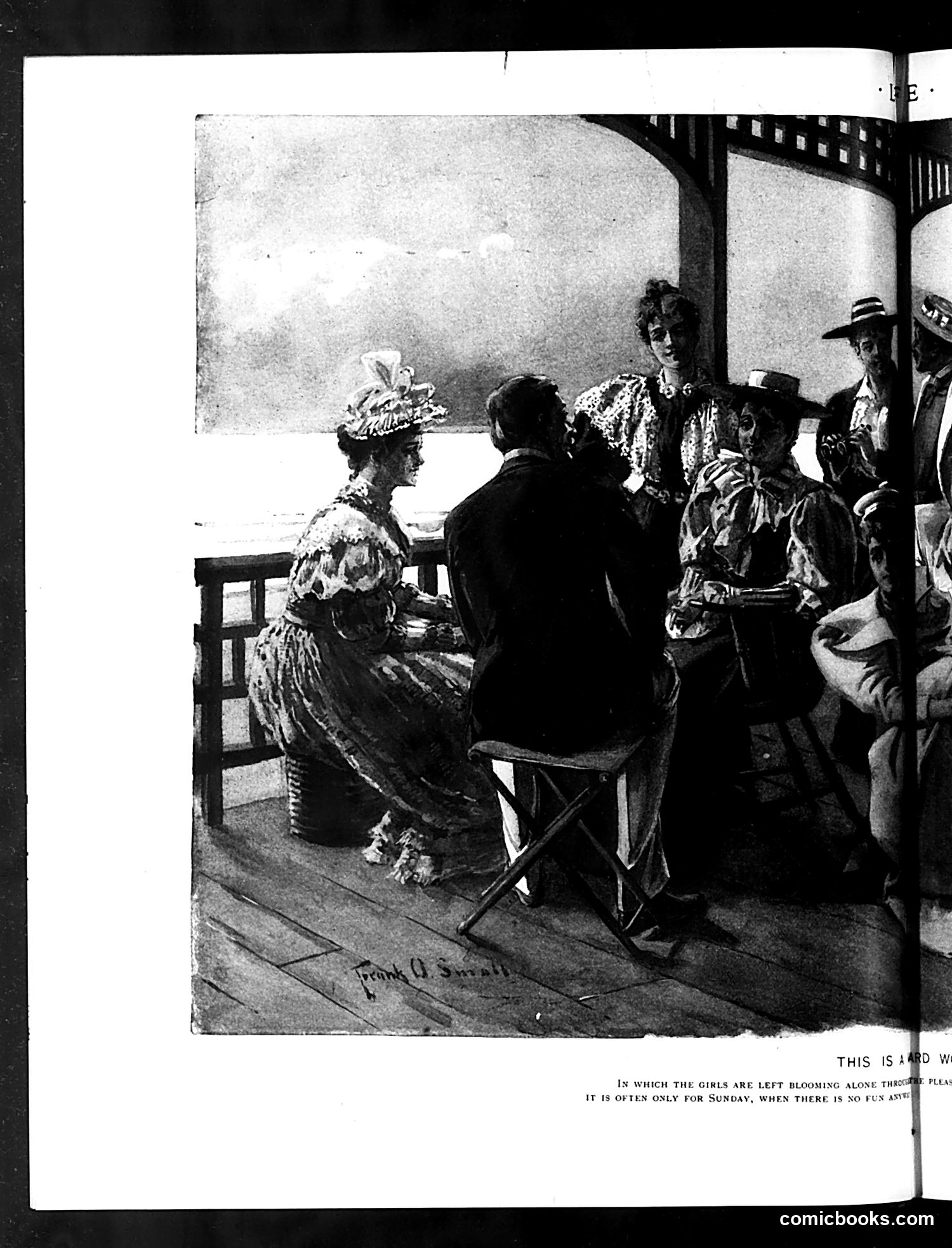
This appears to be an illustration from Life magazine depicting a social scene on what looks like a ship's deck or pavilion. The visible caption references "a yard wherein the girls are left blooming alone" and mentions that "it is often only for Sunday, when there is no fun any—" (text is cut off). The image shows elegantly dressed women in early 20th-century fashion (elaborate hats, ornate clothing) interacting with men in suits and straw hats. The satire appears to target gender segregation in social spaces—specifically, the limitation of women's social activities and autonomy. The caption suggests this is commentary on how women are confined or restricted to certain spaces/times, permitted public socializing only on Sundays when "there is no fun" (meaning men are absent or activities are limited). The illustration satirizes the social constraints placed on women during this era.
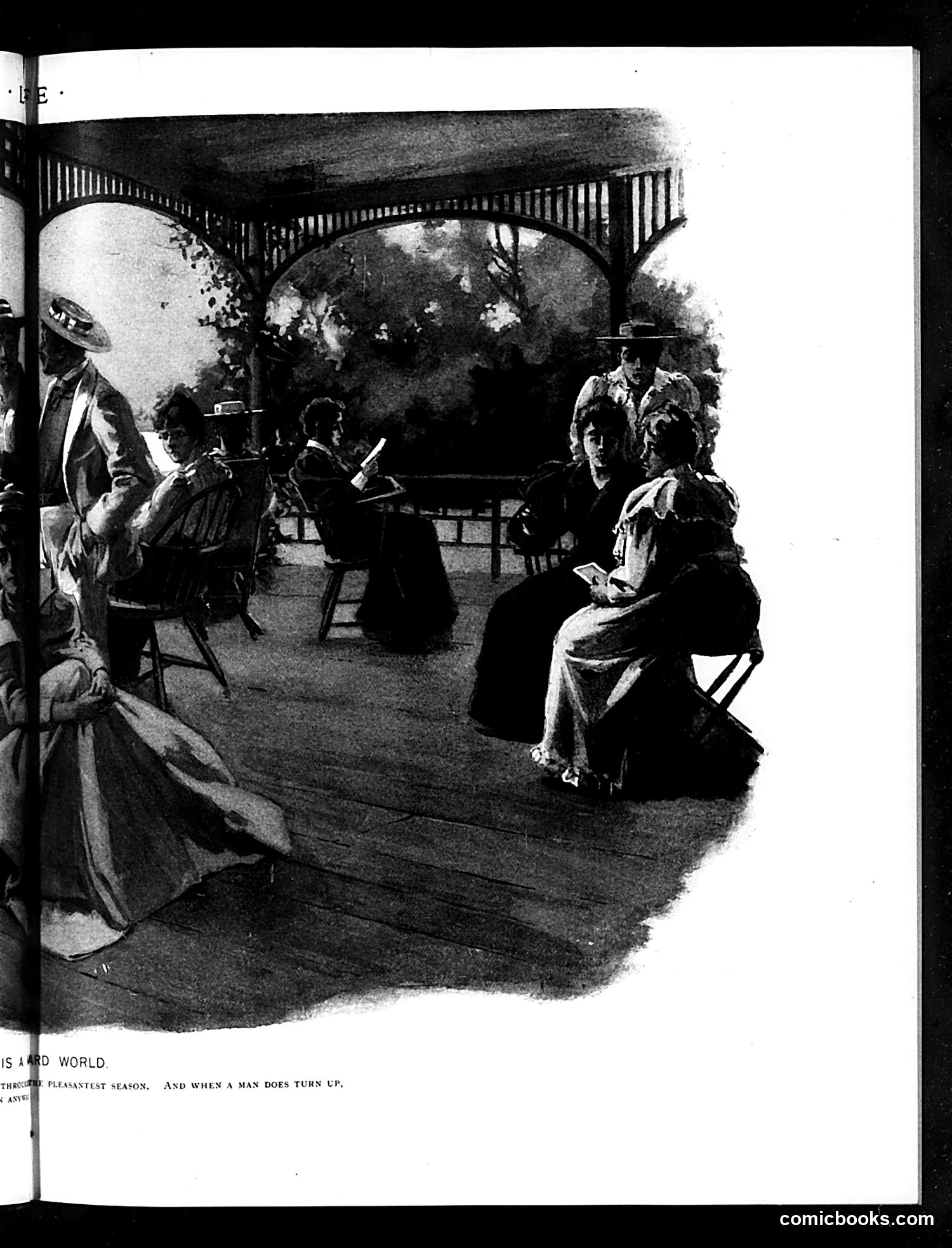
This appears to be a satirical illustration from Life magazine showing a social gathering on what looks like a gazebo or pavilion. The image depicts several figures in period clothing (appearing to be late 19th or early 20th century based on the dress styles) engaged in conversation or leisure activity. The visible text fragment reads "IS A SAD WORLD" and references "THE PLEASANTEST SEASON, AND WHEN A MAN DOES TURN UP," though the complete caption is cut off, making the specific satirical point unclear. Without the full caption and context, I cannot definitively identify the specific figures or the precise social/political commentary being made. The cartoon appears to satirize some aspect of social behavior or seasonal customs among the upper classes, but the exact target of the satire is not determinable from the visible text alone.
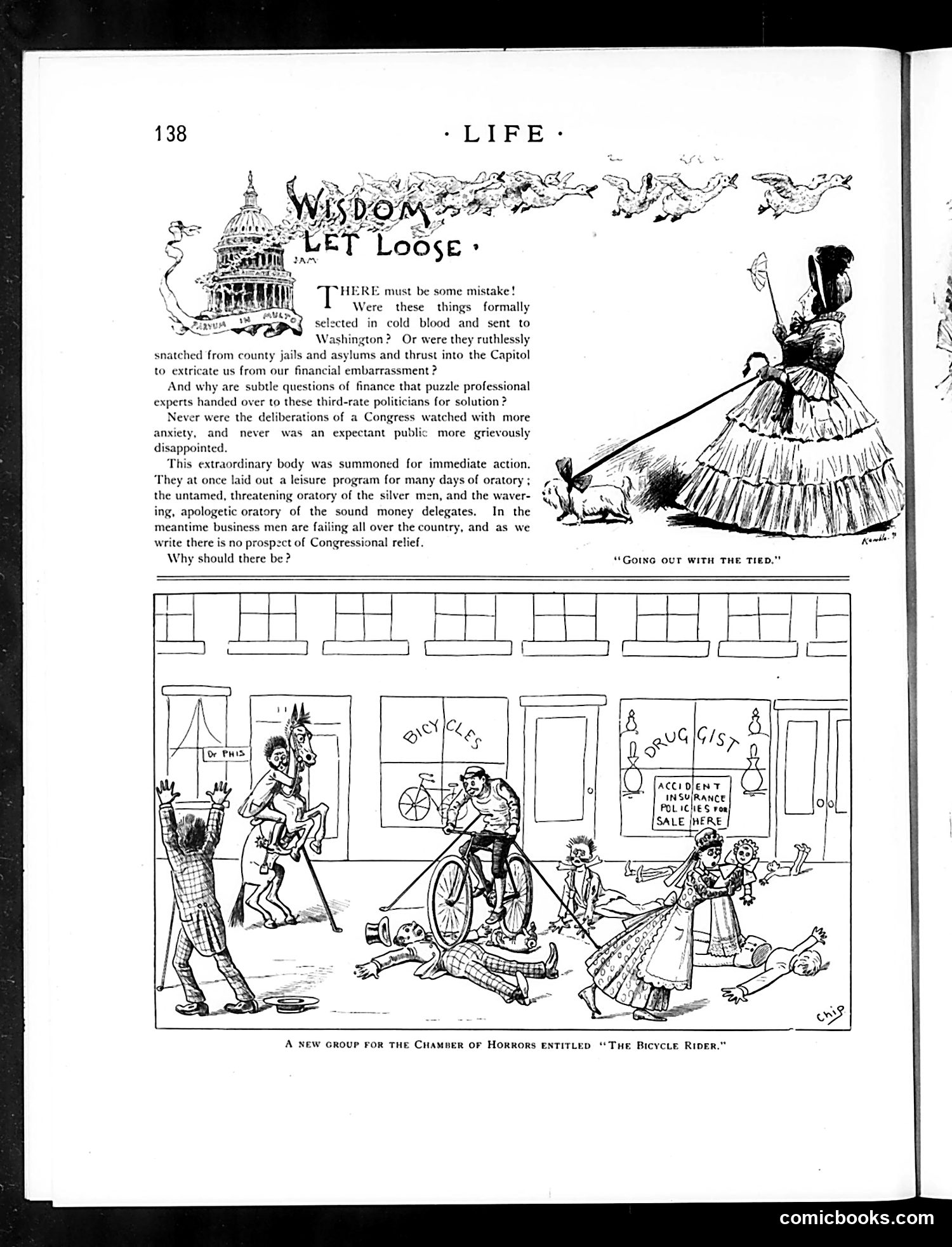
This page satirizes Congress's response to financial crisis. The editorial argues that incompetent politicians were improperly tasked with solving complex economic problems—suggesting they were "snatched from county jails and asylums" rather than selected through proper channels. The cartoon below, titled "The Bicycle Rider," depicts a chaotic street scene where a reckless cyclist causes mayhem among pedestrians and shopfronts (including a drug gist and accident insurance office). This appears to be a metaphor: the bicycle rider likely represents Congress or government, carelessly creating damage while citizens suffer the consequences. The satire mocks governmental incompetence in handling financial matters, suggesting Congress causes harm rather than solutions.
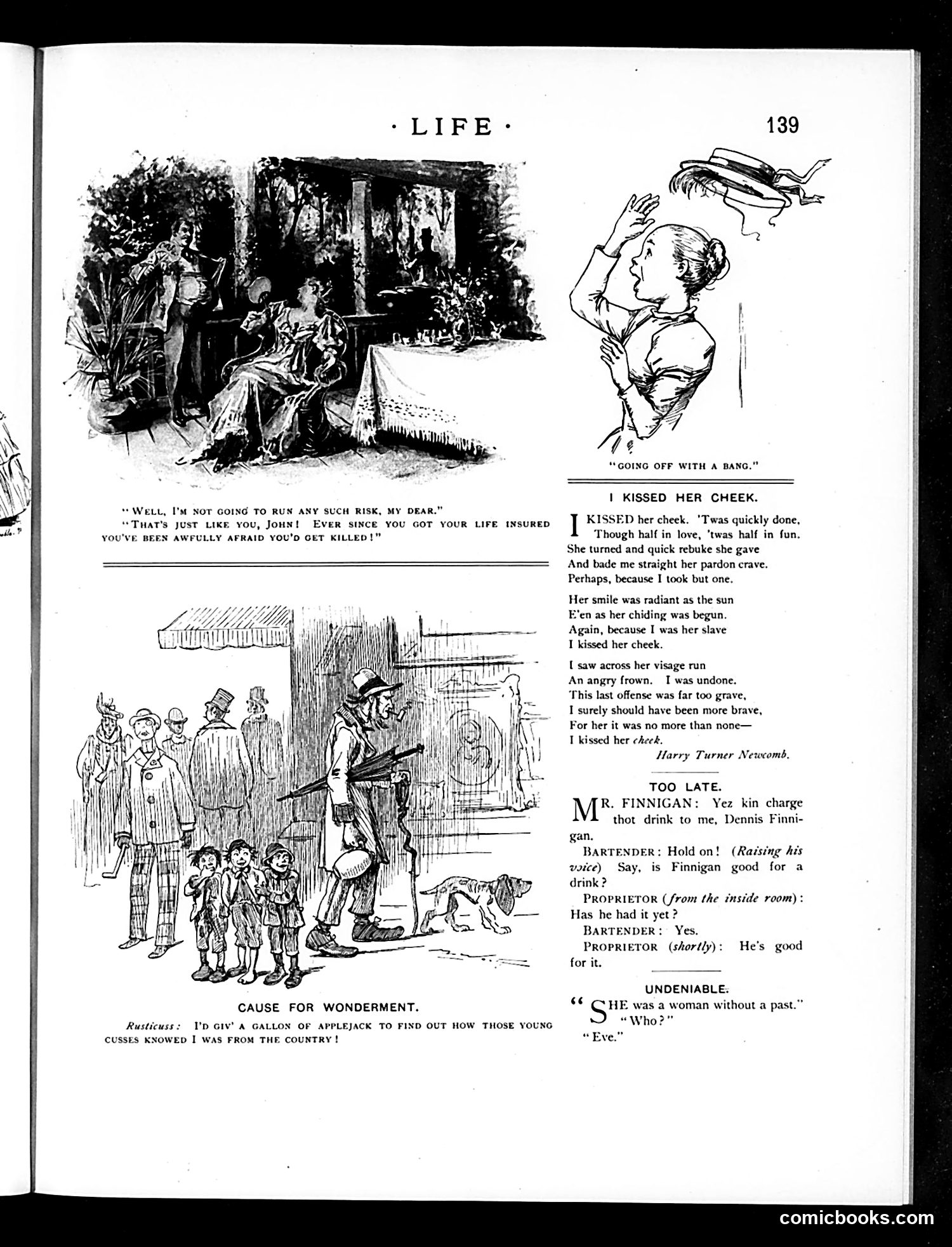
This page contains three separate satirical pieces: 1. **"Well, I'm Not Going to Run Any Such Risk"** - A domestic humor cartoon showing a man refusing his wife's request, citing insurance concerns about taking life risks. 2. **"Going Off with a Bang"** - A sketch of a woman tossing her hat, paired with Harry Turner Newcomb's poem "I Kissed Her Cheek," romantic verse about a stolen kiss. 3. **"Cause for Wonderment"** - A street scene where a man with a gun puzzles over recognizing young street urchins, suggesting he's unfamiliar with urban children—likely satirizing rural/urban cultural disconnect. 4. **"Too Late" and "Undeniable"** - Brief comedic dialogues about drinks and women's pasts, typical of the era's quick-joke format. The magazine emphasizes domestic humor and social observation typical of early 20th-century American satire.
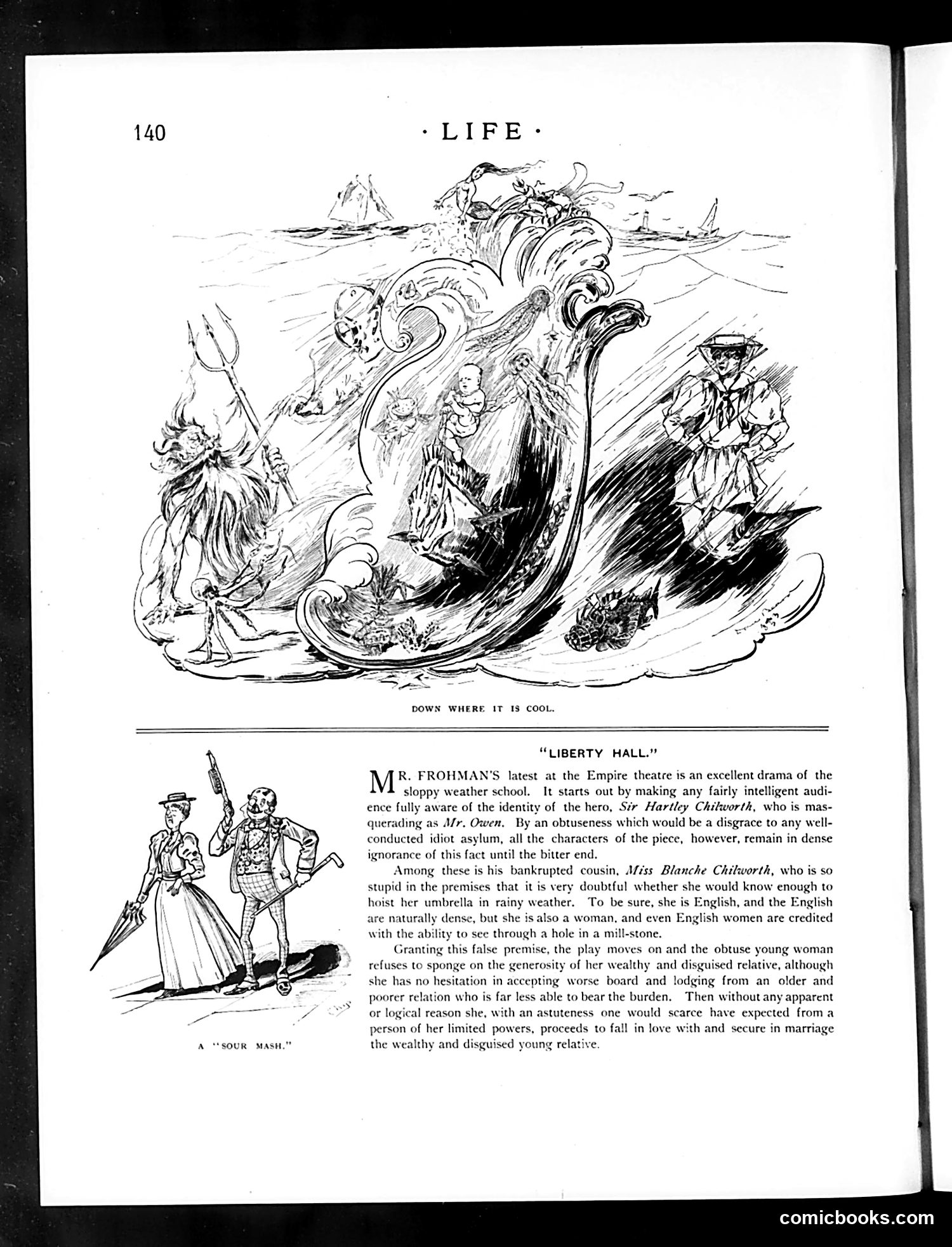
This page reviews R. Frohman's play at the Empire Theatre, combining text criticism with satirical illustrations. The top cartoon ("Down Where It Is Cool") depicts Neptune and sea creatures, likely mocking the play's "sloppy weather school" theme. The review savagely critiques the plot's logical inconsistencies: Sir Hartley Chilworth disguises himself as "Mr. Owen," yet apparently intelligent characters fail to recognize him until the end. The critic particularly ridicules Miss Blanche Chilworth's stupidity—she's so dense she wouldn't "know enough to hoist her umbrella in rainy weather," yet she somehow possesses enough "astuteness" to secure marriage to the wealthy disguised relative. The "Sour Mash" illustration shows two figures, likely representing the play's absurd character dynamics. The satire targets both the implausible plot mechanics and the stereotypical characterization of English women as naturally foolish, while exposing the playwright's inability to maintain consistent character logic.
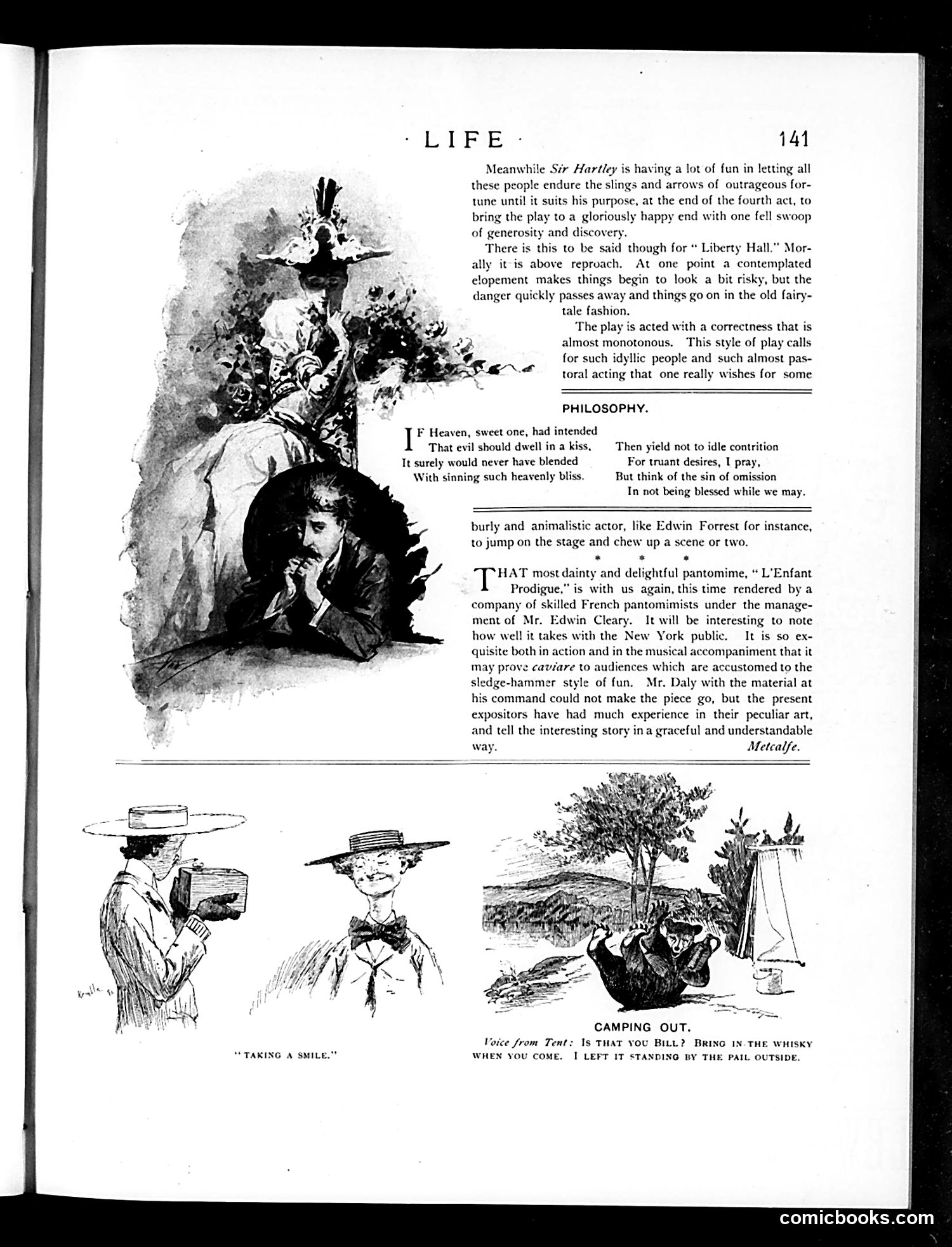
This page reviews theatrical productions. The main text discusses "Liberty Hall," a play directed by Sir Hartley, praising its moral correctness but noting its acting style is monotonously correct—calling it overly refined for audiences wanting more energetic performance (referencing Edwin Forrest, a famously vigorous 19th-century actor). The page also reviews "L'Enfant Prodigue," a French pantomime under Edwin Cleary's management, describing it as delicate and artistic but potentially too refined ("caviar") for audiences accustomed to cruder comedy. The bottom illustrations are lighter vignettes: "Taking a Smile" shows someone in a hat, while "Camping Out" depicts a humorous exchange where someone asks a tent-mate to bring whisky left outside—typical period camping humor. The satirical point targets pretentious theatrical productions versus audience preferences for rougher entertainment.
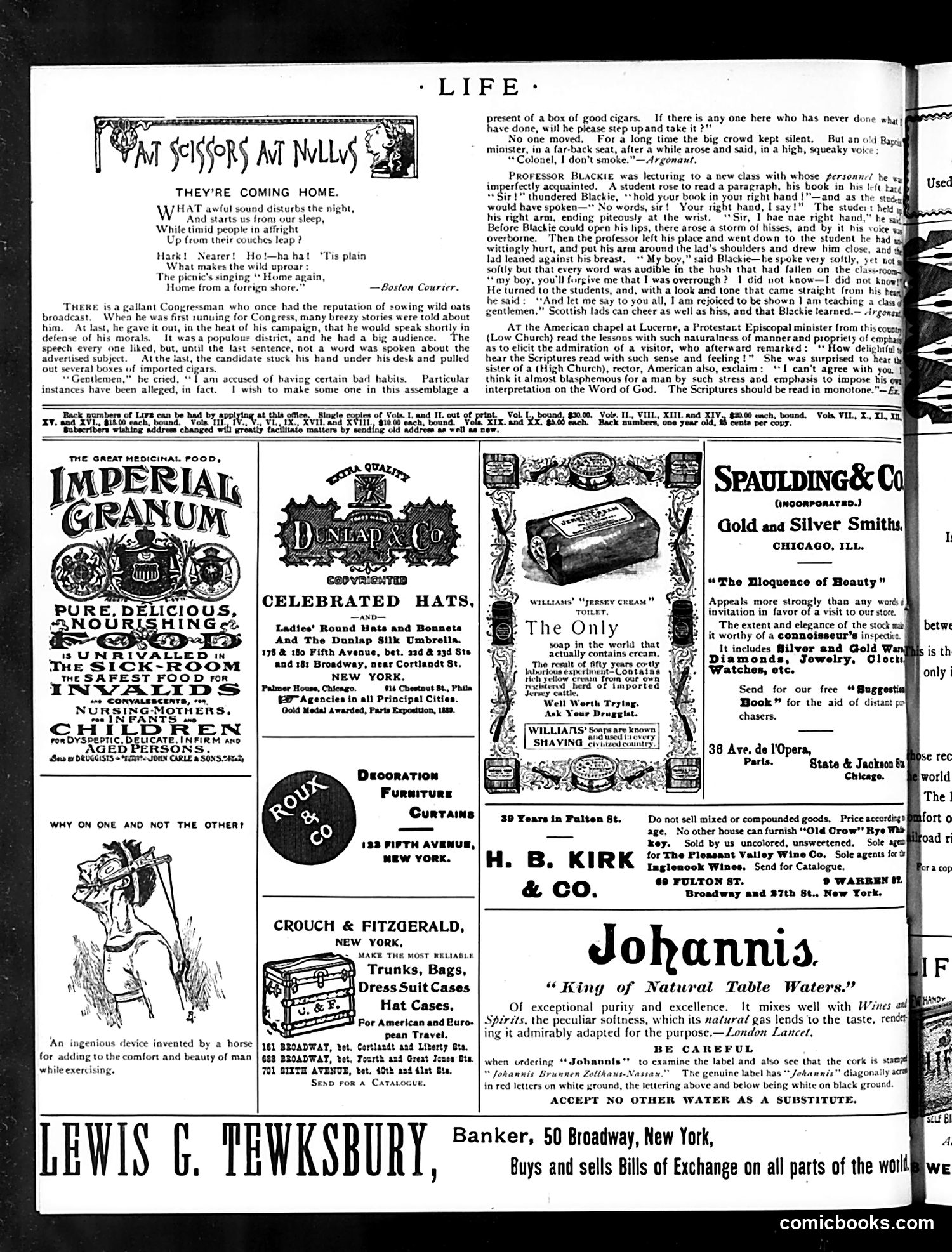
This page contains **three satirical anecdotes** rather than visual cartoons: 1. **"Coming Home"**: A humorous poem about nighttime disturbances, likely mocking domestic or urban noise complaints. 2. **The Congressman's Cigar Story**: Satirizes political hypocrisy. A politician accused of moral failings tries to silence critics by offering imported cigars to anyone who claims sinlessness. Only an elderly Baptist declines, exposing the Congressman's self-righteous ploy as hollow—the joke being that no respectable person steps forward, suggesting everyone present shares similar failings. 3. **Professor Blackie's Lesson**: A Scottish academic anecdote about teaching manners and humility. After harshly ordering a one-armed student to hold his book with his right hand, Blackie realizes his cruelty and publicly apologizes, winning back student respect. The remaining content is **period advertisements** for Imperial Granum food, hats, water, luggage, and banking services—typical of Life's revenue model.
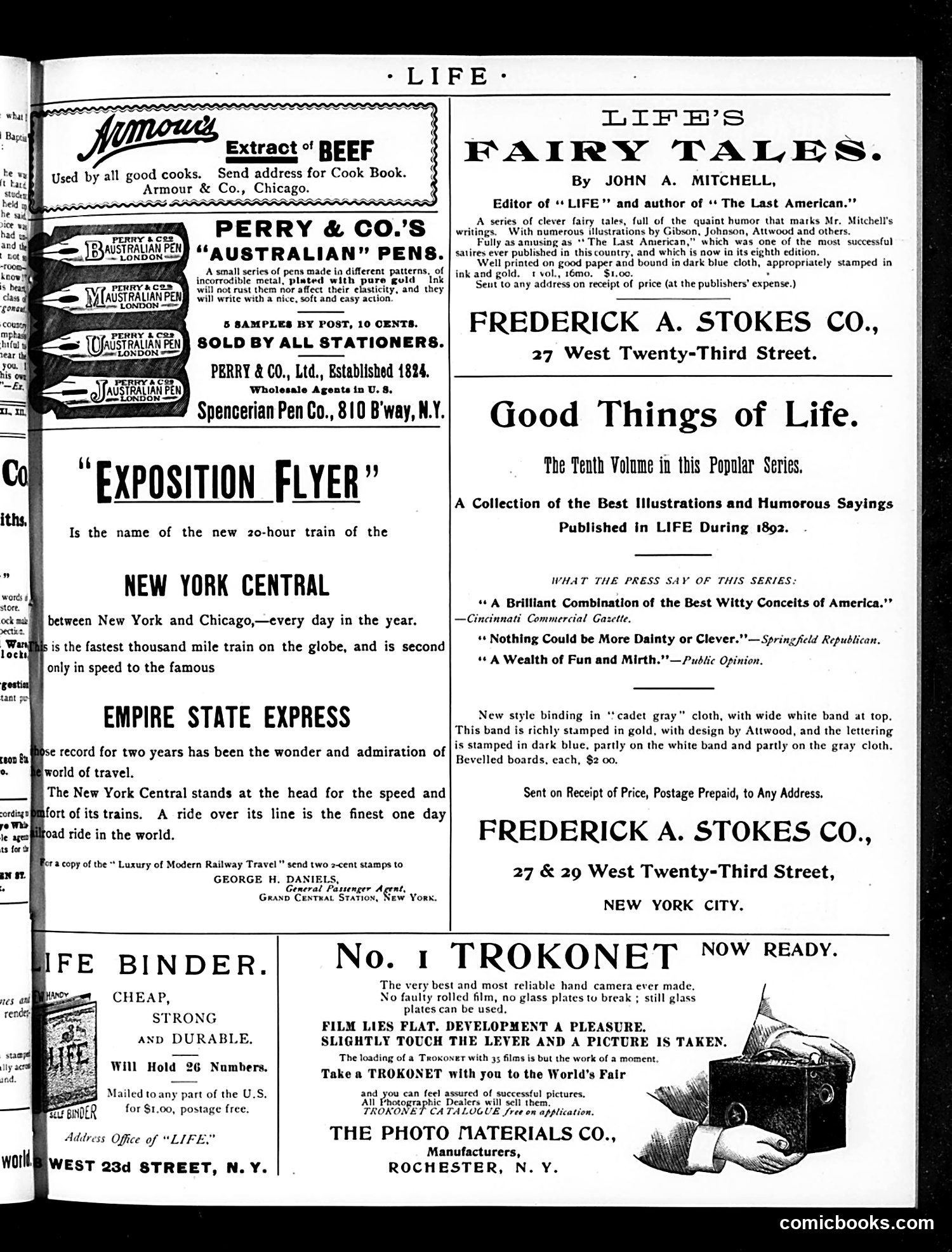
This is primarily an **advertising page** from Life magazine, circa 1892-1893, with no political cartoons or satirical content visible. The page features commercial advertisements for consumer products typical of the era: - **Armour's Beef Extract** (cooking ingredient) - **Perry & Co. pens** (writing instruments) - **New York Central Railway trains** ("Exposition Flyer" and "Empire State Express") - **Life Binder** (magazine storage) - **Trokonet camera** (early hand camera for the World's Fair) The only editorial content is an advertisement for "Life's Fairy Tales" by John A. Mitchell (Life's editor), described as humorous illustrated stories. The page reflects late-Victorian consumer culture and emerging technologies (photography, rail travel). There is **no political satire or social commentary** evident—this is straightforward commercial promotion aimed at Life's affluent readership.
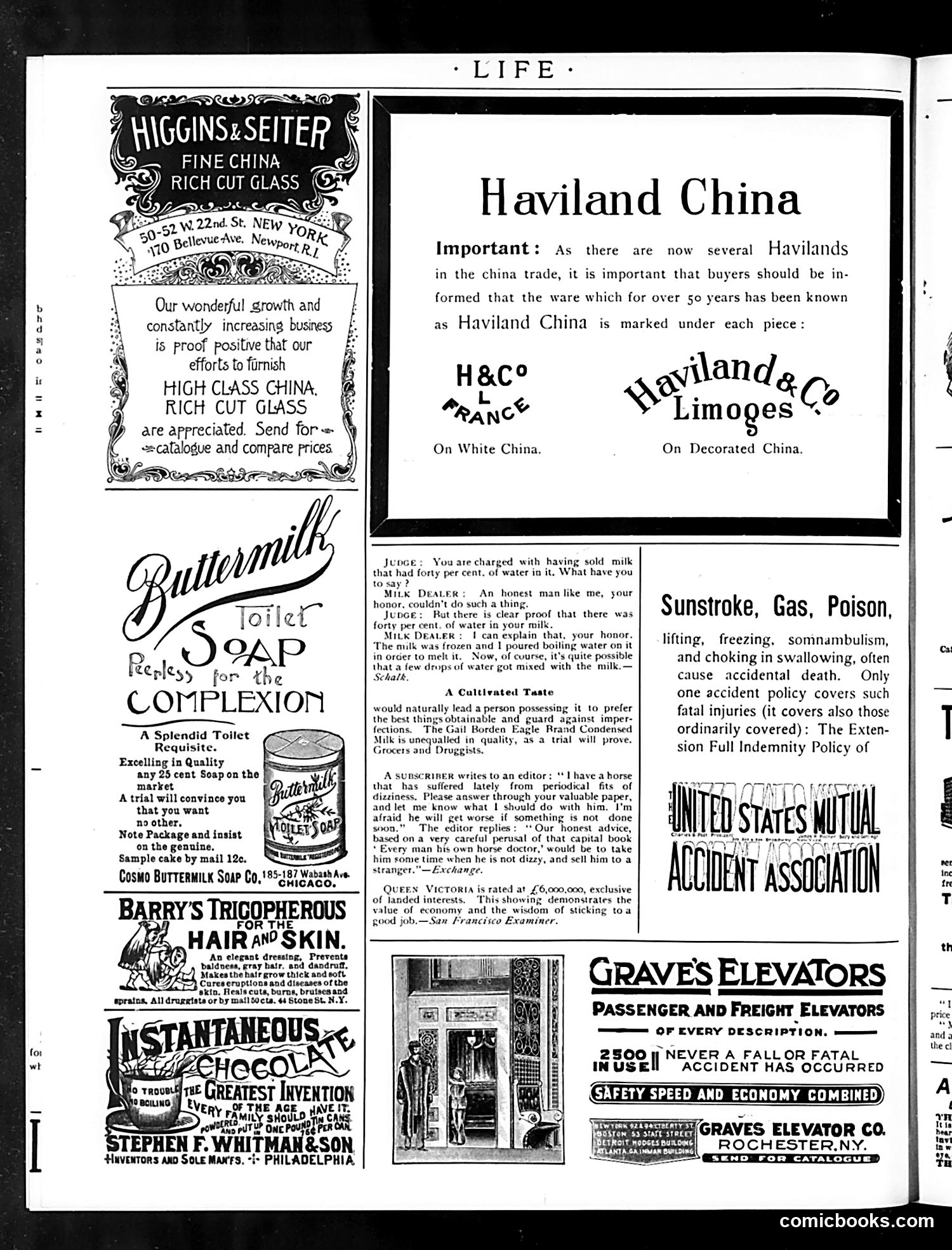
This is primarily an **advertising page** from Life magazine, not a satirical cartoon section. The page contains multiple product advertisements typical of early 20th-century publications. Notable content includes: **The "Milk Dealer" dialogue** (center): A brief satirical exchange mocking dishonest milk sellers who water down their product. When caught selling milk that's 40% water, the dealer absurdly claims the water accidentally mixed in when he thawed frozen milk with boiling water. The joke exposes fraudulent dairy practices and consumer deception—a genuine public health concern of the era. **Reader letter about a horse**: A humorous advice column where someone asks what to do with a dizzy horse; the editor sarcastically suggests consulting a "horse doctor" book or just selling the animal to someone else. The remaining content is straightforward advertising for china, soap, hair products, and elevators—reflecting consumer goods marketed to middle-class readers. No political figures or major social satire appears on this page.
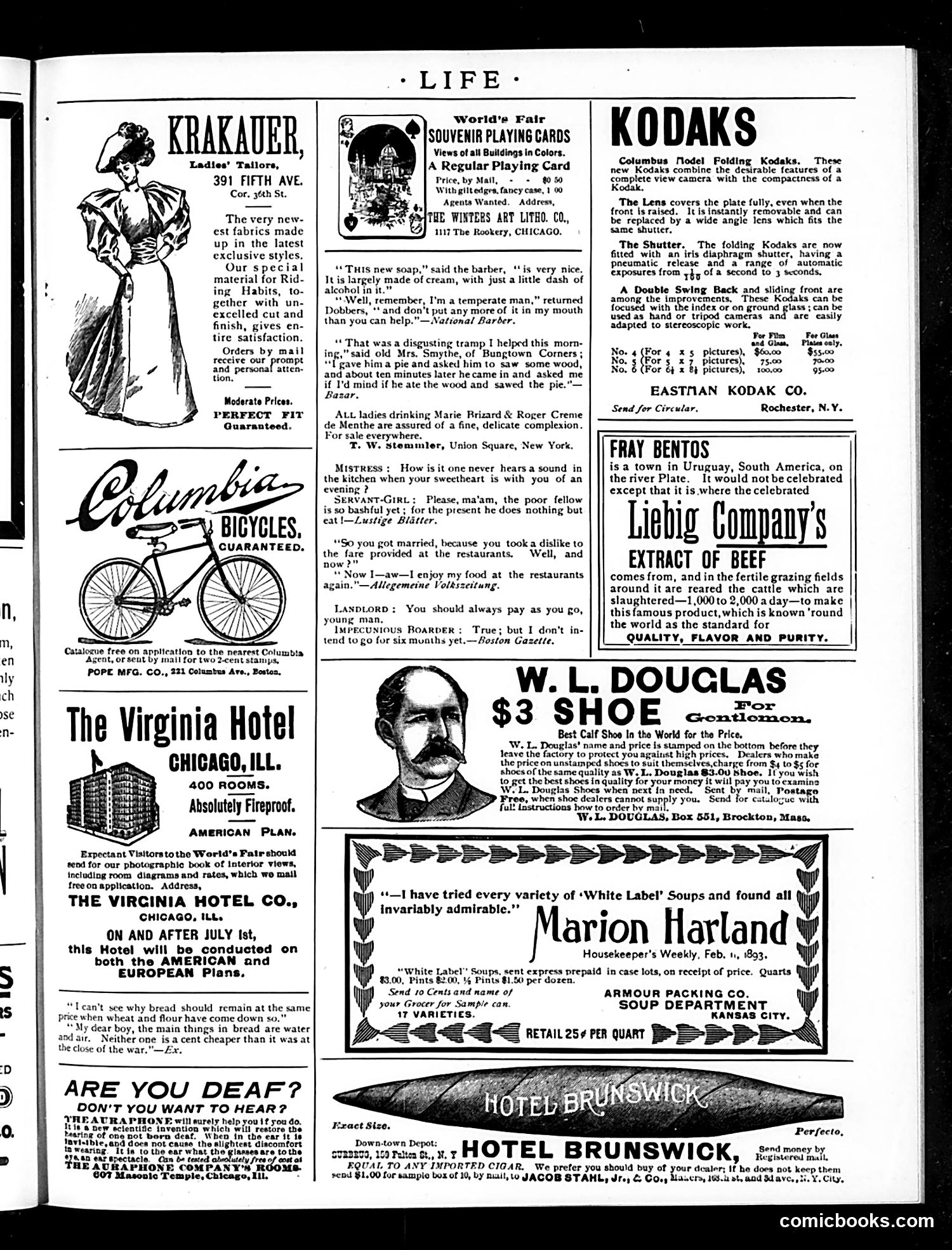
This page is primarily **advertising**, typical of early 1900s Life magazine. Rather than political cartoons, it features commercial product ads interspersed with small humorous anecdotes (a magazine staple). The brief comedic dialogues scattered throughout—about a barber's soap, a tramp seeking firewood, servants and employers—are gentle domestic humor reflecting period class attitudes and social conventions. They're not satirical commentary but rather relatable vignettes for readers of the era. The advertisements promote products still recognizable today (Kodak cameras, Douglas shoes) alongside period-specific items (the Virginia Hotel in Chicago, Fray Bentos extract of beef). The large portrait accompanying the W.L. Douglas shoe ad appears to be the company founder/namesake, a common advertising practice. The Krakauer ladies' tailor advertisement emphasizes fashionable "exclusive styles," reflecting early 1900s interest in refined clothing. Overall, this page documents commercial culture and domestic humor of the period rather than political satire.
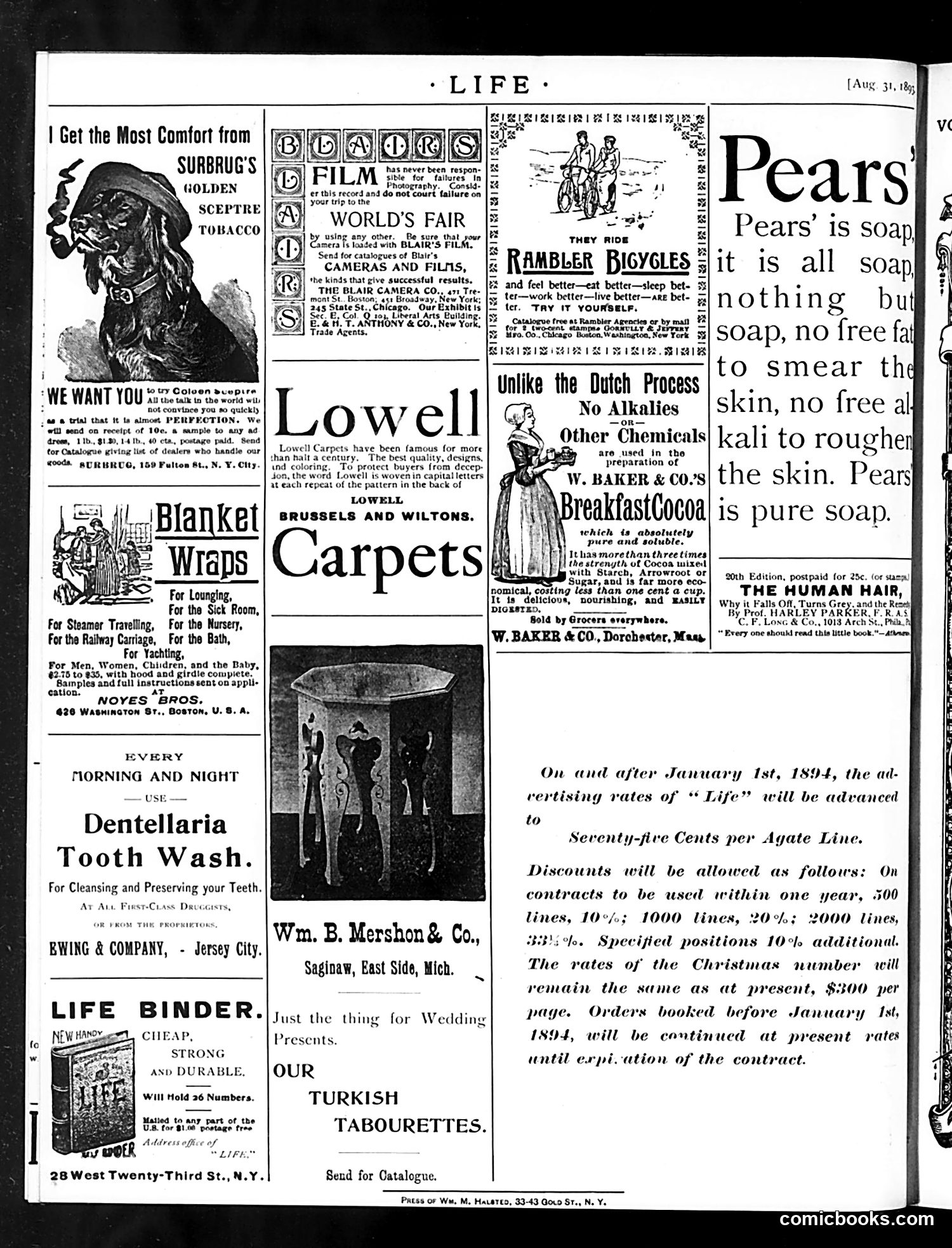
This page is primarily **advertising with an administrative notice**—not satirical content. The visible cartoon appears minimal. The key editorial item announces that **Life's advertising rates will increase January 1, 1894**, from an unstated current rate to 75 cents per agate line, with volume discounts available. The advertisements reflect 1890s consumer goods: tobacco, carpets, cameras (promoted for the 1893 World's Fair), bicycles, cocoa, soap, and tooth wash. These represent typical products marketed to middle-class readers. One advertisement references "WORLD'S FAIR"—likely the 1893 World's Columbian Exposition in Chicago, a major cultural event referenced for marketing cameras and film. The **Pears soap ad** claims the product is "pure soap" with no alkalies or harsh chemicals—typical health-conscious marketing of the era. Overall, this is a commercial page with minimal satirical content, showing what Life's advertisers valued and what the magazine's audience purchased.