
Life, 1893-08-31 · page 6 of 18
Life — August 31, 1893 — page 6: what you’re looking at
What you’re looking at
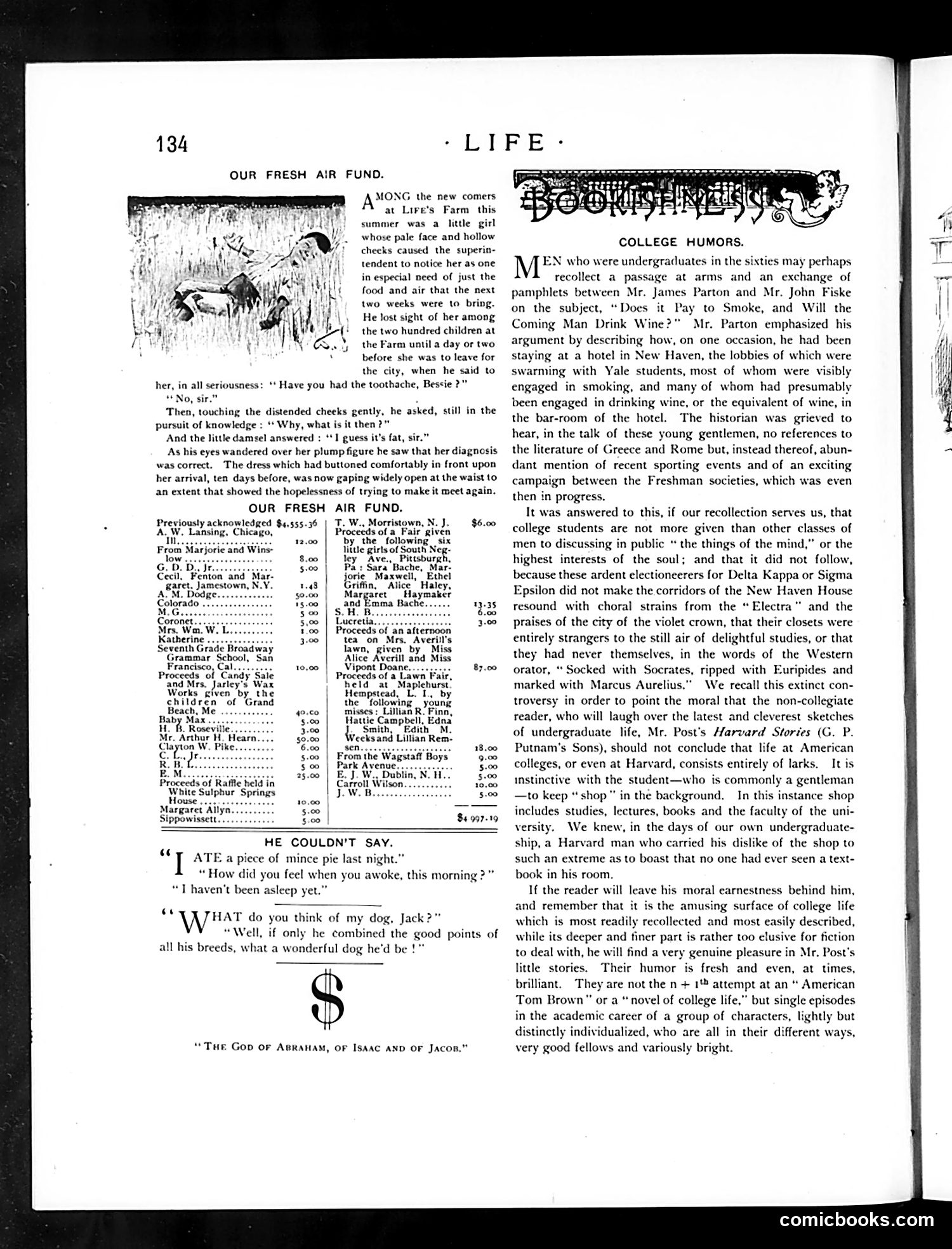
This page contains three distinct sections: **"Our Fresh Air Fund"** (top left): A sketch depicting a pale, sickly city girl brought to a farm. The girl's thin appearance and weak constitution contrast with the farm setting, illustrating the Progressive Era "fresh air movement"—a charitable program sending urban children to rural areas for health benefits. **"College Humors"** (right column): A satirical discussion of undergraduate life, referencing debates between Yale and Harvard students about smoking and drinking. The text critiques non-collegiate social pretensions while praising Mr. Post's *Harvard Stories* for authentically capturing student life through humor rather than novelistic ambition. **"He Couldn't Say"** (bottom): Brief humorous dialogues about dogs and family relationships, representing typical light comic fare of the era. The page primarily targets educated, urban readers familiar with collegiate culture and Progressive charitable movements.
📄 Transcribed text from this page (OCR, searchable)
Machine-transcribed from the original scan — historical spelling and the odd misread are preserved.
OUR FRESH AIR FUND. MONG the new comers at Lire’s Farm this summer was a little girl whose pale face and hollow cheeks caused the superin- tendent to notice her as one in especial need of just the food and air that the next two weeks were to bring. He lost sight of her among the two hundred children at the Farm until a day or two before she was to leave for the city, when he said to her, in all seriousness: ** Have you had the toothache, Bessie ?” “No, sir.” ; Then, touching the distended cheeks gently, he asked, still in the pursuit of knowledge : * Why, what is it then? And the little damsel answered : “1 guess it's fat, sir.” As his eyes wandered over her plump figure he saw that her diagnosis was correct. The dress which had buttoned comfortably in front upon her arrival, ten days before, was now gaping widely open at the waist to an extent that showed the hopelessness of trying to make it meet again. OUR FRESH AIR FUND. Previously acknowledged $4,555.36 | T. W., Morristown, N. J. $6.00 A.W. Lansing, Chicago, Proceeds of a Fair’ gi mM A by the following. six From Marjorie and Wins- little girls of South Neg- low. E ley Ave., Pittsburgh, 5. D. D. yr. 8 Pa : Sara’Bache, Mar- Cecil. Fenton ‘and jorie Maxwell, Ethel garet. Jamestow: A riffin, Alice ' Haley, A.M, Dodge. i Margaret. Haymaker Colorado . i and Emma Bache. d S.-H. B. Coronet Lucretia. Mrs. Wm. W. 1 Proceeds of an afternoon Katherine tea_on Mrs. Averill’s Seventh Grade Broadway lawn, given by Miss Grammar School, San Alice Averill and Miss Francisco, Cal . pont Doane. Proceeds of Candy Sale Proceeds ols Lawa Fair, and Mrs. Jarley’s Wax held at Maplehurst Works given by. the Hempstead, L. 1, by children of Grand the following young Beach, Me misses: Lillian R- Finn, Baby Max. : s.co | Hattie Campbell, Edna, H. B. Rosevitie: sco | fi Smith, Edith M. Mr. Arthur H. Hearn $0.00 Weetsand Lillian Rem: Clayton W, Pike. 6.00 fe tee : s.co | From the Wagstaff Boys’ ar Soo | Park Avenue. ELM. 25.00 Proceeds of Rafile held in White Sulphur Springs House . 10.00 Margaret Ailya 5.00 Sippowissett...2.21 3.00 HE COULDN'T SAY. s6 I ATE a piece of mince pie last night.” “ How did you feel when you awoke, this morning ?” “T haven't been asleep yet.” “SY XTHAT do you think of my dog, Jack?” “Well, if only he combined the good points of all his breeds, what a wonderful dog he'd be “Tue Gop OF ABRAHAM, OF ISAAC AND OF Jacos,” COLLEGE HUMORS. EN who were undergraduates in the sixties may perhaps recollect a passage at arms and an exchange of pamphlets between Mr. James Parton and Mr. John Fiske on the subject, “Does it Pay to Smoke, and Will the Coming Man Drink Wine?" Mr. Parton emphasized his argument by describing how, on one occasion, he had been staying at a hotel in New Haven, the lobbies of which were swarming with Yale students, most of whom were visibly engaged in smoking, and many of whom had presumably been engaged in drinking wine, or the equivalent of wine, in the bar-room of the hotel. The historian was grieved to hear, in the talk of these young gentlemen, no references to the literature of Greece and Rome but, instead thereof, abun- dant mention of recent sporting events and of an exciting campaign between the Freshman societies, which was even then in progress. It was answered to this, if our recollection serves us, that college students are not more given than other classes of men to discussing in public “ the things of the mind,” or the highest interests of the soul; and that it did not follow, because these ardent electioneerers for Delta Kappa or Sigma Epsilon did not make the corridors of the New Haven House resound with choral strains from the “Electra” and the praises of the city of the violet crown, that their closets were entirely strangers to the still air of delightful studies, or that they had never themselves, in the words of the Western orator, “ Socked with Socrates, ripped with Euripides and marked with Marcus Aurelius.” We recall this extinct con- troversy in order to point the moral that the non-collegiate reader, who will laugh over the latest and clevere: ‘tches of undergraduate life, Mr. Post's Harvard Stories (G. Putnam's Sons), should not conclude that life at American colleges, or even at Harvard, consists entirely of larks. It is instinctive with the student—who is commonly a gentleman —to keep “shop” in the background. In this instance shop includes studies, lectures, books and the faculty of the uni- versity. We knew, in the days of our own undergraduate- ship, a Harvard man who carried his dislike of the shop to such an extreme as to boast that no one had ever seen a text- book in his room. If the reader will leave his moral earnestness behind him, and remember that it is the amusing surface of college life which is most readily recollected and most easily described, while its deeper and finer part is rather too elusive for fiction to deal with, he will find a very genuine pleasure in Mr. Post's little stories. Their humor is fresh and even, at times, brilliant. They are not the n + 1% attempt at an * American Tom Brown” or a “ novel of college life,” but single episodes in the academic career of a group of characters, lightly but distinctly individualized, who are all in their different ways, very good fellows and variously bright. comicbooks.com