
Life, 1893-08-31 · page 5 of 18
Life — August 31, 1893 — page 5: what you’re looking at
What you’re looking at
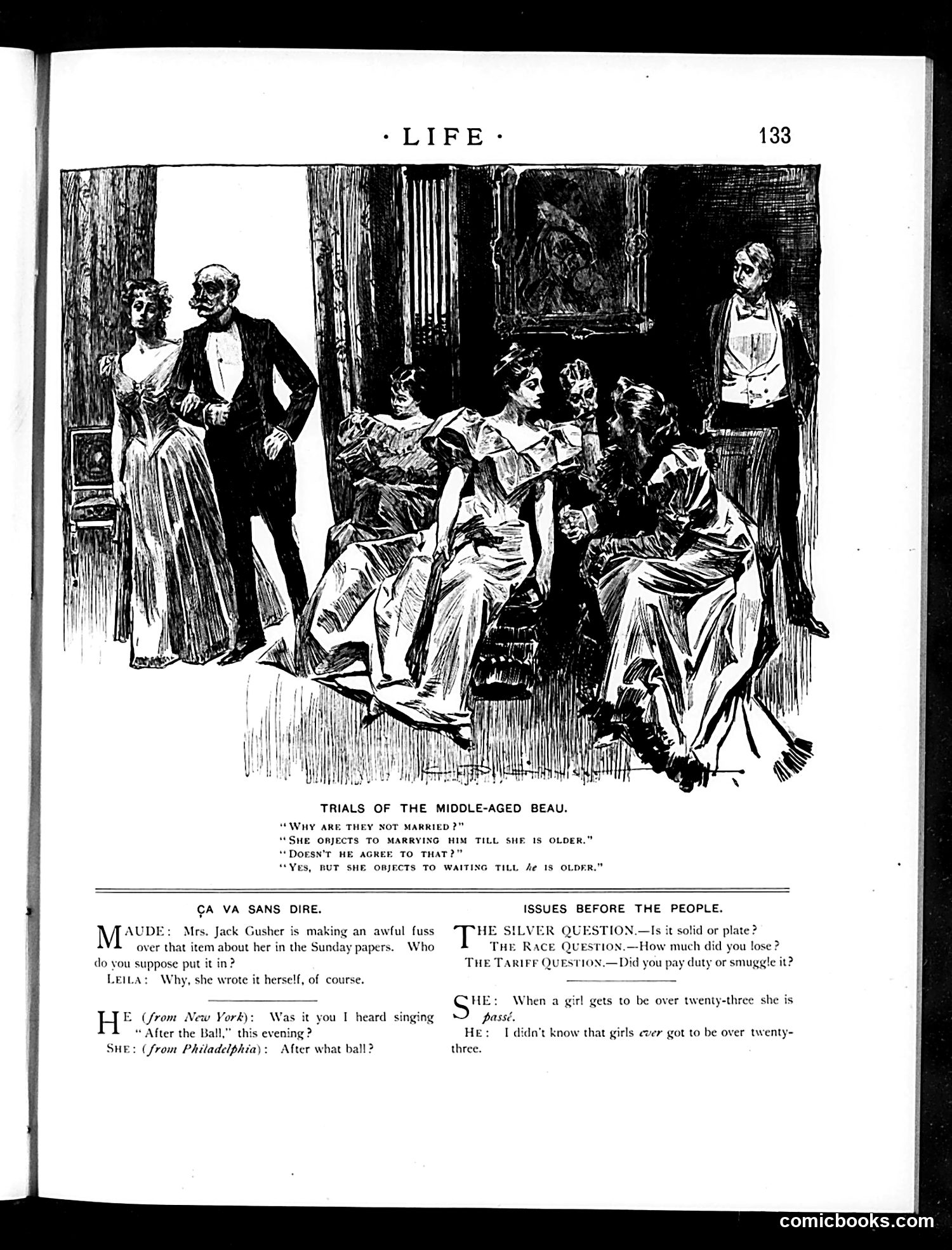
The top cartoon, "Trials of the Middle-Aged Beau," satirizes marriage dynamics and age gaps. It depicts a man courting a woman while she objects to marrying him until she's older—a paradoxical scenario poking fun at women's marital expectations and the absurdity of postponing marriage for age-related reasons. Below are three brief joke exchanges labeled "Ça Va Sans Dire" (goes without saying) and "Issues Before the People," which reference contemporary political debates: the "Silver Question" (monetary policy), the "Race Question," and the "Tariff Question." The final joke plays on the phrase "over twenty-three," with a man expressing surprise that girls ever reach that age—likely mocking women's aging anxieties or suffrage-era discussions about women's roles. The humor relies on social commentary about gender, marriage, and politics.
📄 Transcribed text from this page (OCR, searchable)
Machine-transcribed from the original scan — historical spelling and the odd misread are preserved.
TRIALS OF THE MIDDLE-AGED BEAU. “WHY ARE THEY NOT MARRIED?” ““SHE OBJECTS TO MARRYING HIM TILL SHE IS OLDER.” “DOESN'T HE AGREE TO THAT?” “Yes, BUT SHE OBJECTS TO WAITING TILL Je 18 OLDER.” CA VA SANS DIRE. ISSUES BEFORE THE PEOPLE. AUDE: Mrs. Jack Gusher is making an awful fuss E SILVER QUESTION.—Is it solid or plate? over that item about her in the Sunday papers. Who THER QUESTIO. How much did you lose ? do you suppose put it in? THE TARIFF QUESTION.—Did you pay duty or smuggle it? LEILA: Why, she wrote it herself, of course. —-- LS HE: When a girl gets to be over twenty-three she is E (from New York): Was it you I heard singing passé, “ After the Ball,” vening ? HE: I didn’t know that girls ever got to be over twenty- SHE: (from Philadelphia): After what ball? three. comicbooks.com