
A complete issue · 20 pages · 1893
Life — August 17, 1893
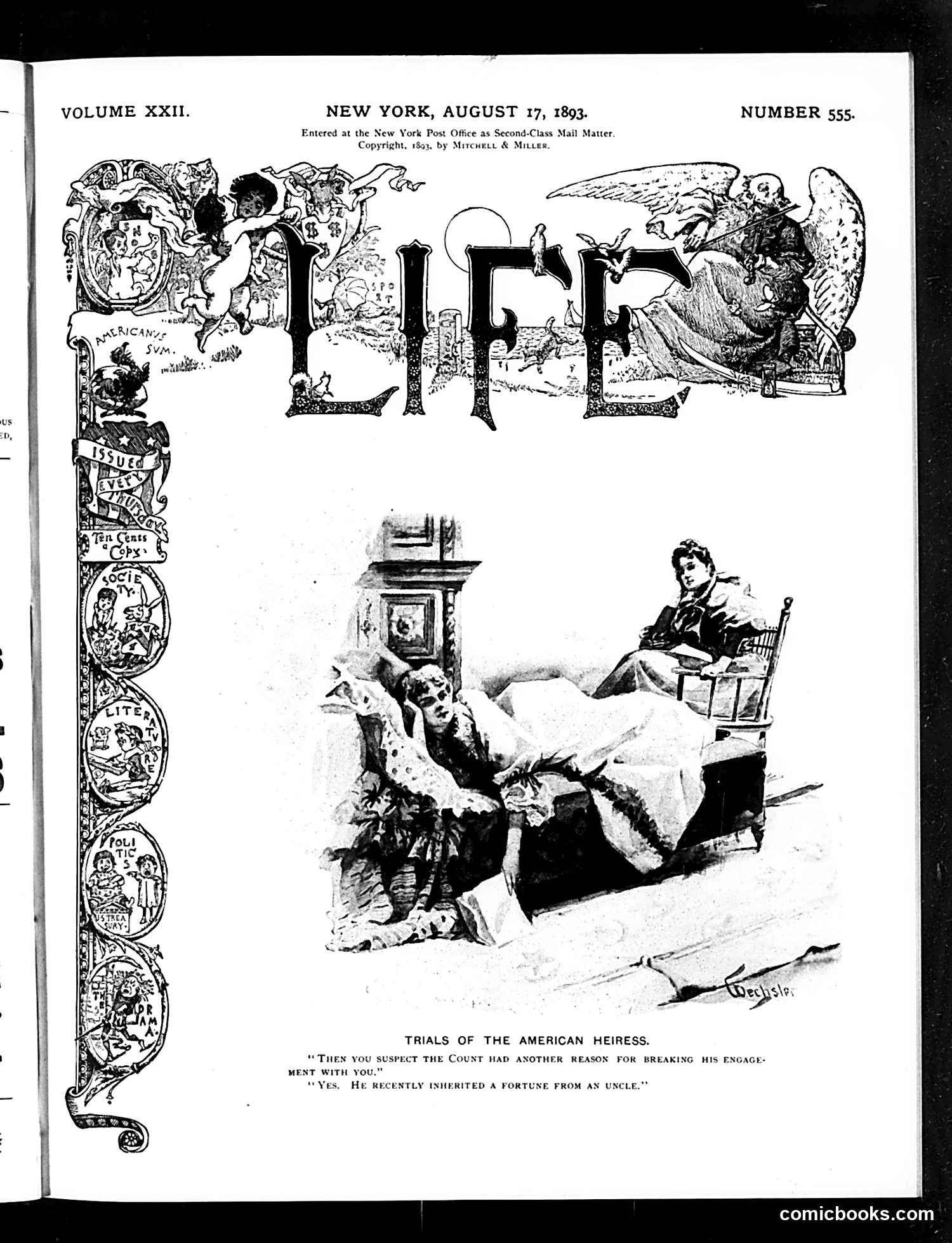
This satirical illustration from *Life* magazine (August 17, 1893) mocks wealthy American heiresses and their romantic entanglements. The scene depicts a young woman reclining dramatically while a man sits nearby, suggesting a romantic or marital dispute. The caption's dialogue—"Then you suspect the Count had another reason for breaking his engagement with you" / "Yes. He recently inherited a fortune from an uncle"—satirizes a common phenomenon of the 1890s: European aristocrats (often titled "counts") pursuing wealthy American heiresses for their fortunes, then abandoning them when better financial prospects appeared. The joke targets both the superficiality of such transatlantic marriages and American society's obsession with acquiring European titles through wealth. This reflects actual social anxieties about American heiresses being exploited by fortune-hunting European nobles.
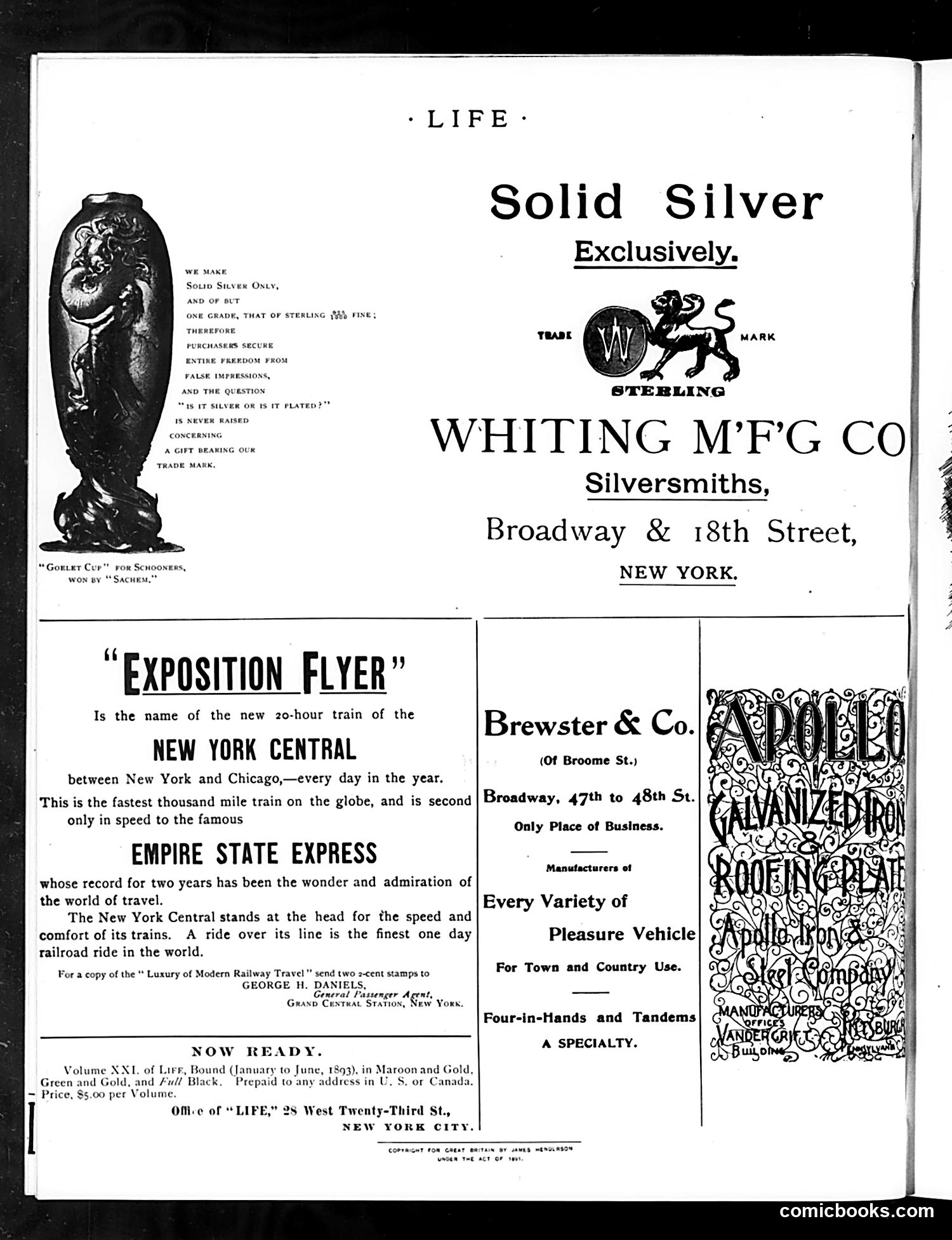
This page is primarily **advertising**, not satirical content. It contains four distinct ads: 1. **Whiting M'F'G Co.** (top right): Promotes solid sterling silver goods, emphasizing quality and authenticity to prevent customer deception. 2. **New York Central Railway** (center-left): Advertises the "Exposition Flyer," a 20-hour train between New York and Chicago, claiming it's the world's fastest thousand-mile train after the Empire State Express. 3. **Brewster & Co.** (center-right): Manufactures pleasure vehicles (carriages/wagons) for town and country use, specializing in four-in-hands and tandems. 4. **Life Magazine** (bottom): Announces Volume XXI availability in maroon/gold and full black bindings. The decorative silver vessel image (top left) serves the Whiting ad. No political satire or caricature is present on this page.
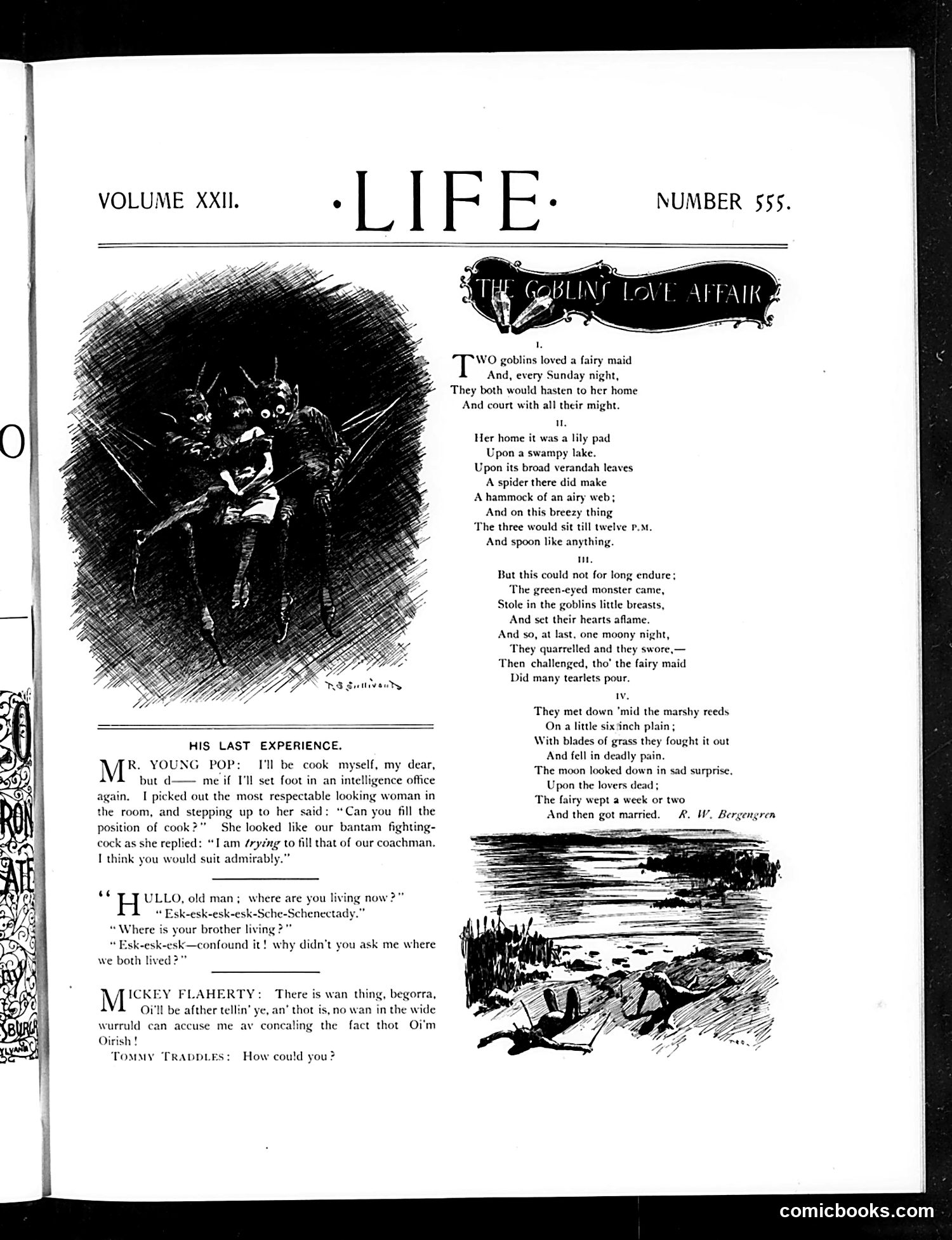
This page contains two distinct pieces: 1. **"His Last Experience"** (lower left): A brief comedic dialogue between "Mr. Young Pop," an older man, and "Mickey Flaherty" and "Tommy Traddles." The humor involves Mr. Pop's attempted cockfighting—he picked a "respectable looking woman" to fight his rooster, only to have her thoroughly beat him. It's a straightforward slapstick joke about mistaken identity and cockfighting culture. 2. **"The Goblin Love Affair"** (right): A whimsical illustrated poem by R.W. Bergengren about two goblins who court a fairy maid. Their rivalry attracts a jealous "green-eyed monster," leading to a duel where the fairy ultimately marries someone else. This is purely imaginative fantasy literature, not political satire. Neither piece appears to reference contemporary politics or events.
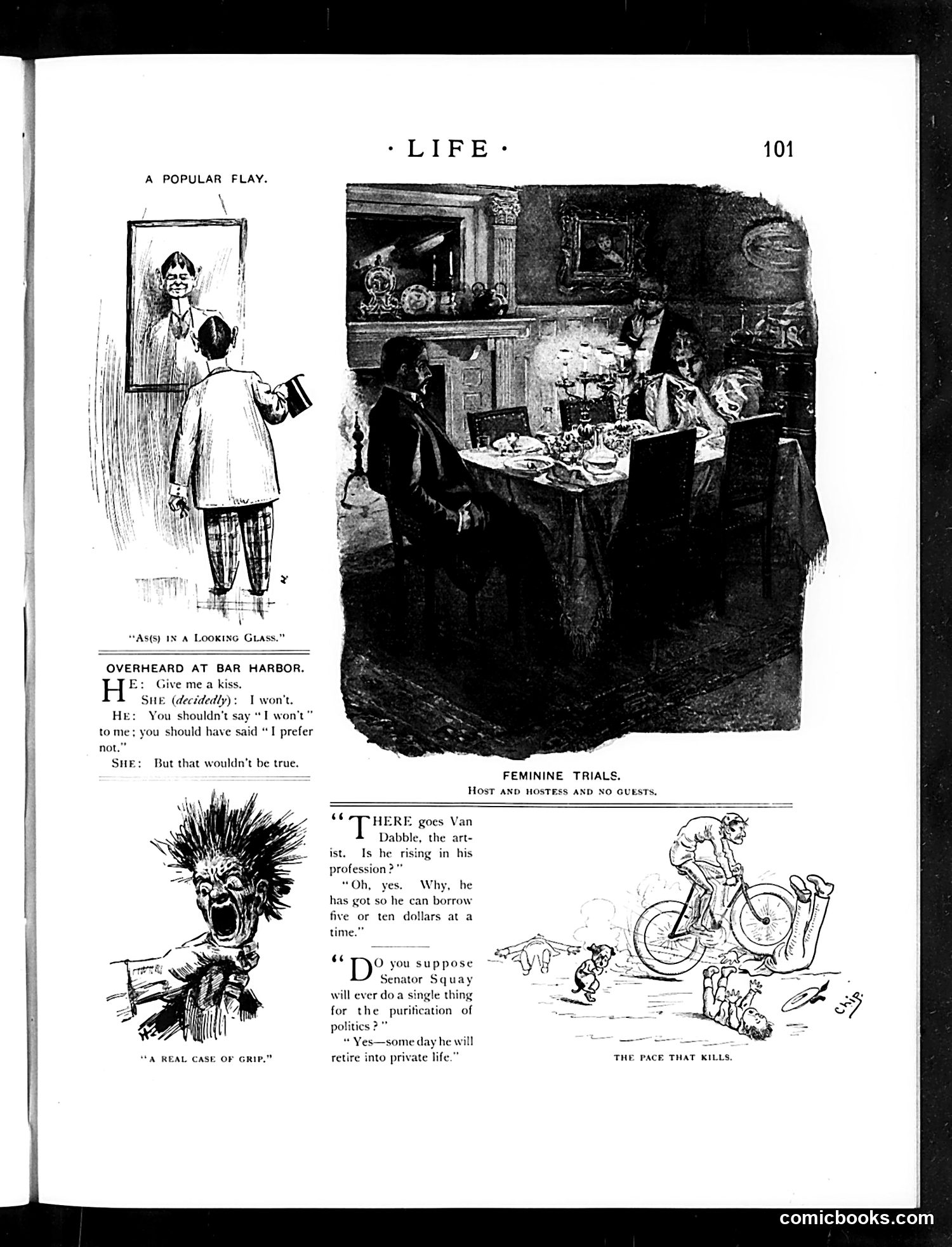
This page contains early 20th-century humor about gender relations and social behavior: **"A Popular Flaw"** mocks women's vanity—a man gazes at his own reflection in a mirror labeled "Asis in a Looking Glass," satirizing narcissism. **"Overheard at Bar Harbor"** presents a domestic dispute where the woman refuses a kiss, leading to a pedantic argument about conditional language—humor derived from female stubbornness and male frustration. **"Feminine Trials"** shows a formal dinner party where the hostess and guests appear awkward without male guests present, suggesting women cannot manage social situations independently. **"The Pace That Kills"** depicts a cyclist amid chaotic street activity, likely referencing bicycle craze dangers or reckless modern behavior. The overall tone reflects period anxieties about changing female roles and emerging "New Woman" independence.
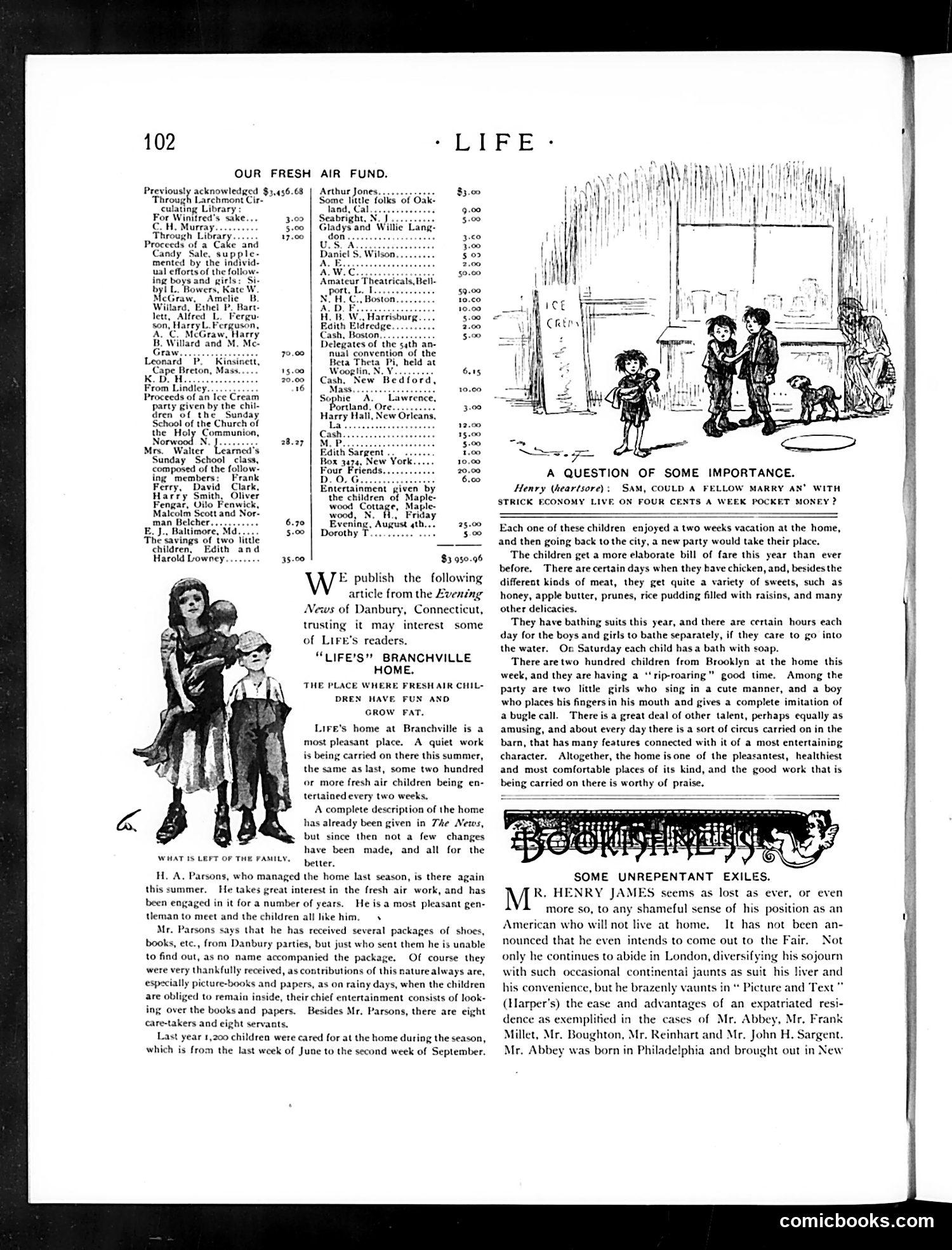
This page from *Life* magazine features two distinct sections: **Upper section:** A cartoon titled "A Question of Some Importance" depicts children at leisure, with a caption asking whether "a fellow" could marry and live on a cent per week pocket money. The satire comments on economic hardship and impossible living standards—likely referencing post-WWI economic conditions or Depression-era poverty. **Lower section:** An article about "Life's Branchville Home," describing a summer retreat where two hundred poor children from Brooklyn receive fresh air, food, and recreation. The accompanying illustration shows a woman with children. The page also lists donors to the "Our Fresh Air Fund," a charitable initiative providing relief to urban children. Together, these pieces exemplify *Life*'s progressive-era advocacy for social welfare and child welfare reform.
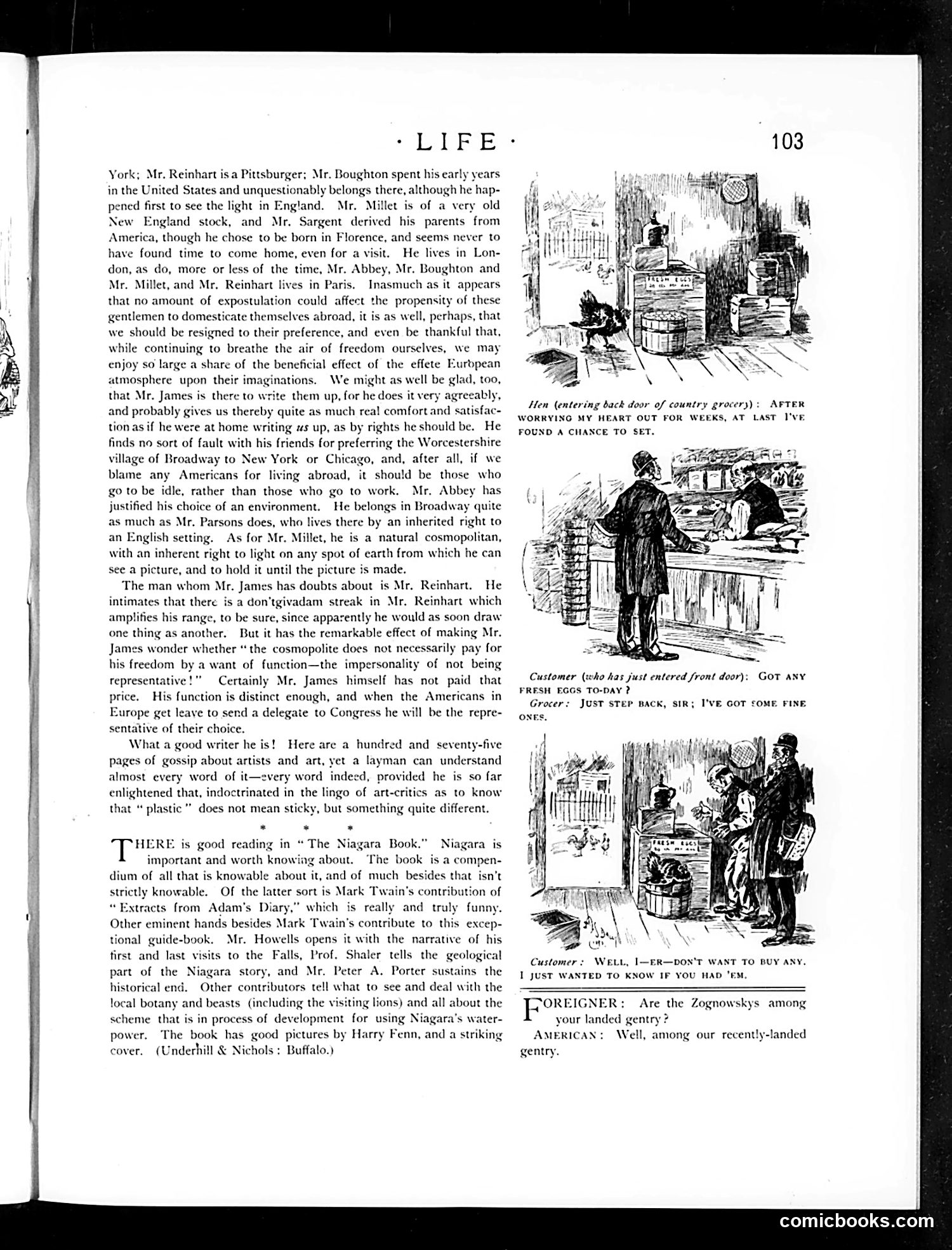
This page contains three satirical cartoon vignettes depicting everyday interactions in a country grocery store, likely from the early 20th century. The cartoons mock social pretension and class attitudes among Americans. The first shows a hen entering a back door—labeled as someone who "found a chance to set" after weeks of worry. The second depicts a grocer refusing fresh eggs to a customer. The third shows a customer entering, with dialogue suggesting they're inquiring whether the grocer has "come fine ones." The final dialogue between a "Foreigner" and "American" about "Zygmowskys among your landed gentry" satirizes American attitudes toward newly-arrived immigrants, suggesting Americans view recent arrivals as somehow beneath established social classes—despite America's reputation as a nation of immigrants.
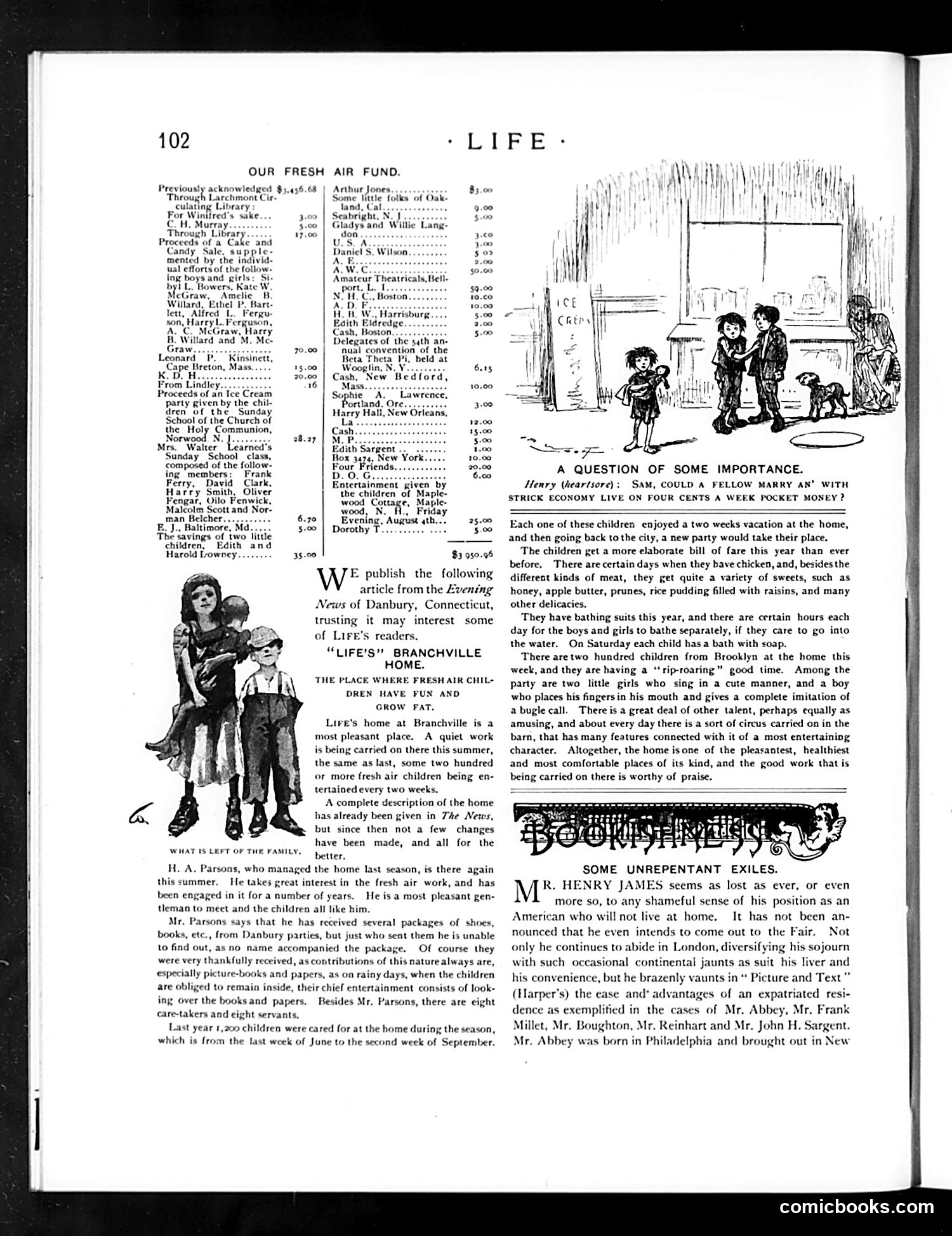
This page contains two distinct pieces: **"A Question of Some Importance"** (top): A cartoon illustrating children's summer activities at a home called "Life's Branchville." The accompanying text humorously details the meals and entertainment provided to approximately 200+ children during a season, emphasizing the abundance and variety of food (meats, sweets, puddings, honey) and structured daily activities like supervised bathing. **"Some Unrepentant Exiles"** (bottom): This section critiques American expatriates living abroad, specifically naming Henry James. The text sarcastically notes such individuals refuse to live in America despite claiming American identity, instead enjoying "continental jaunts" in Europe. It references James's residence in London and his resistance to returning home, using this as exemplary of broader expatriate behavior the era viewed as unpatriotic or shameful. Both pieces reflect early 20th-century American attitudes toward domesticity and national loyalty.
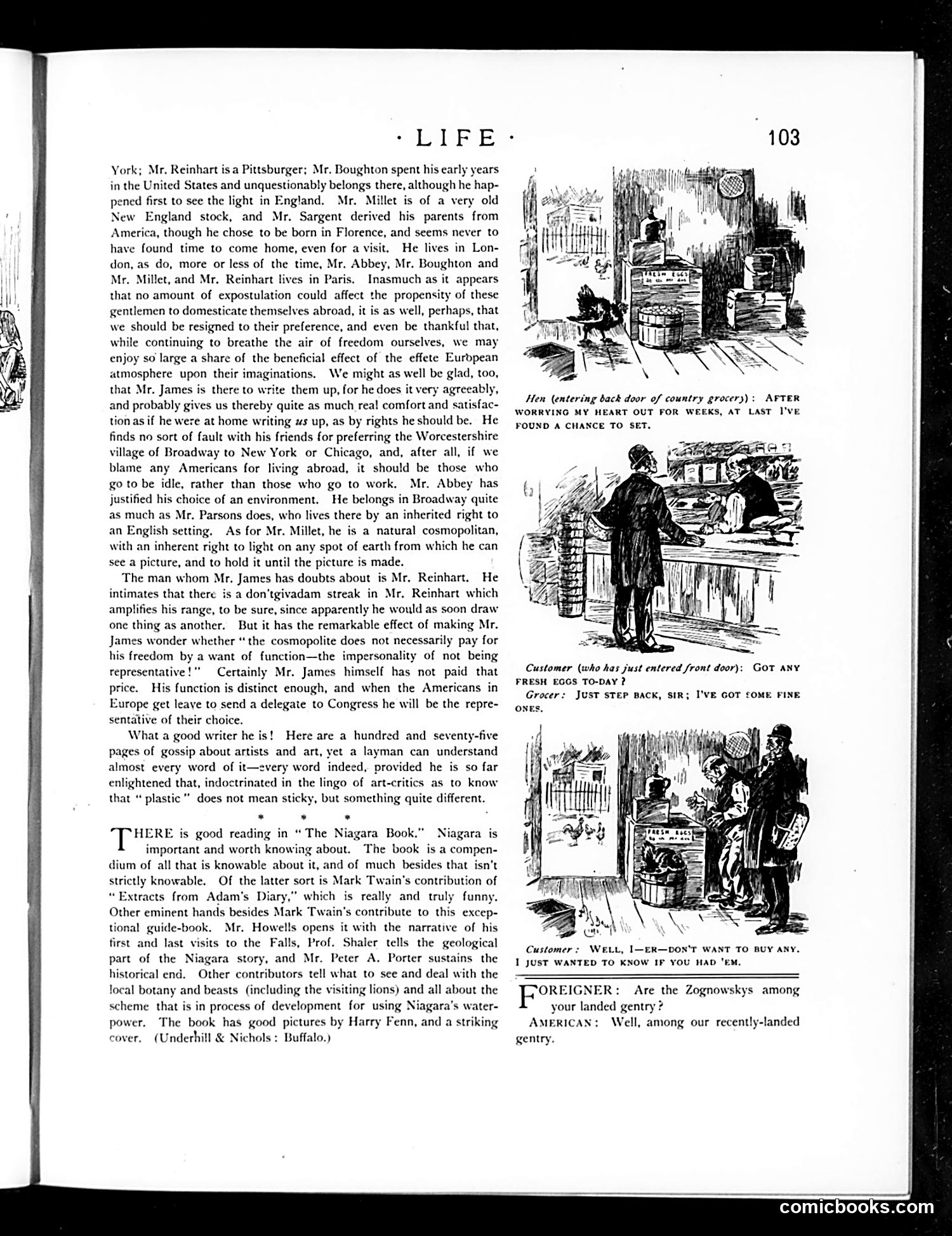
This page contains three small illustrated vignettes with captions, appearing to be humorous social observations rather than political cartoons. The first shows someone entering through a back door, captioned about "worrying my heart out for weeks" and finally finding "a chance to set." The second depicts a grocer interaction where a customer asks about fresh eggs, and the grocer responds about having "some fine ones." The third shows what appears to be a social interaction, with a caption beginning "I just wanted to know if you had 'em" and a response about "Zognowskys" among "recently-landed gentry." These appear to be gentle satirical sketches of everyday American life and social pretensions, likely from the early 20th century based on the illustration style. The humor seems to target class consciousness and the aspirations of newly arrived immigrants or social climbers.
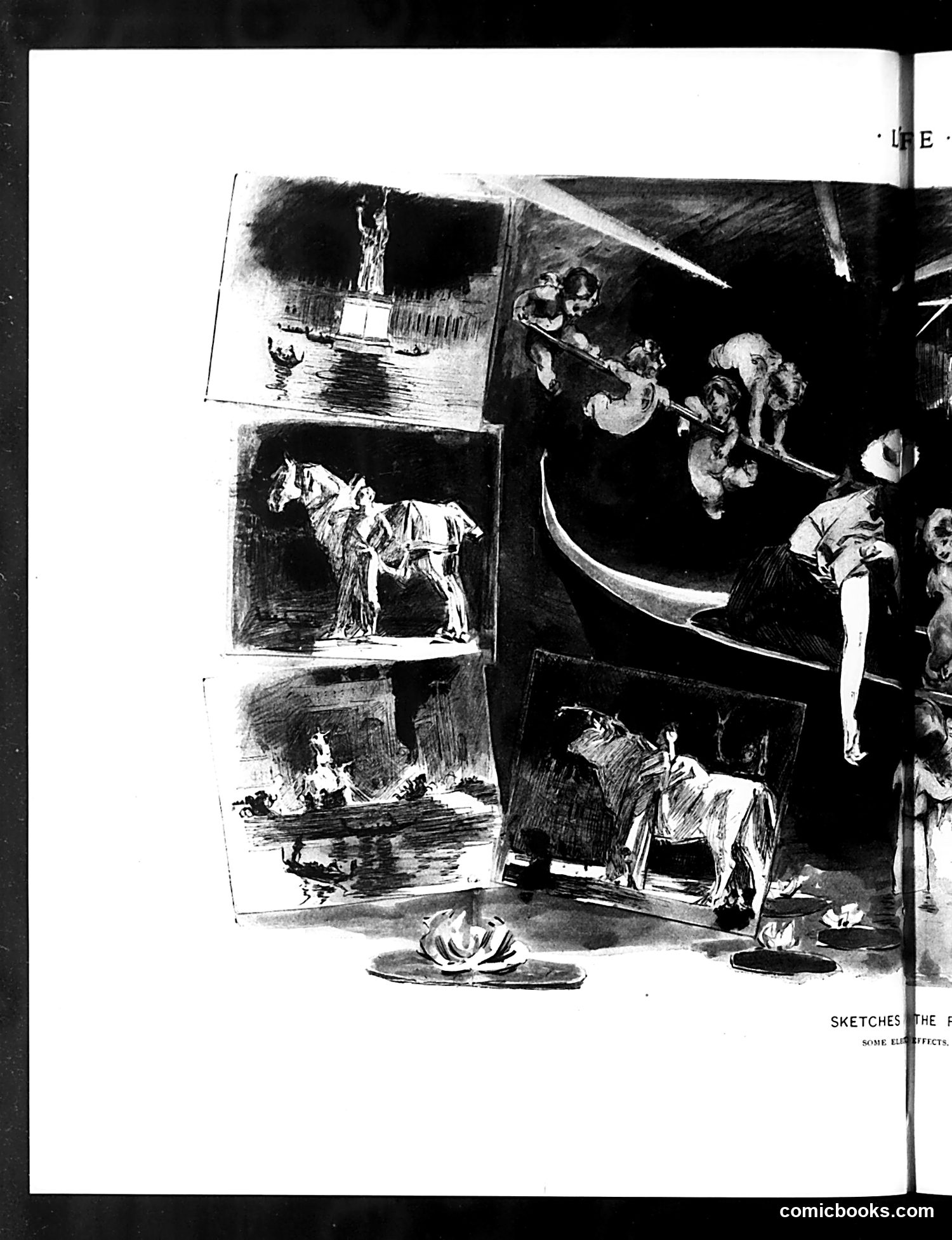
This page shows "Sketches The F[...] Some Eff[ects]" — the caption is partially cut off. The image displays theatrical or operatic sketches arranged in a collage format. On the left are three smaller sketches showing figures in dramatic poses, including what appears to be a horse and people in various theatrical situations. The larger right panel depicts figures in Venetian dress (including a gondola), suggesting operatic Italian settings, likely from a classical opera production. The overall presentation suggests this is satirizing theatrical or operatic performances popular with Life's contemporary audience. The sketches appear to be commenting on dramatic conventions or the exaggerated nature of stage performance. Without the complete caption visible, the specific satirical point remains unclear, though the juxtaposition of disparate scenes suggests critique of theatrical artifice or melodrama.
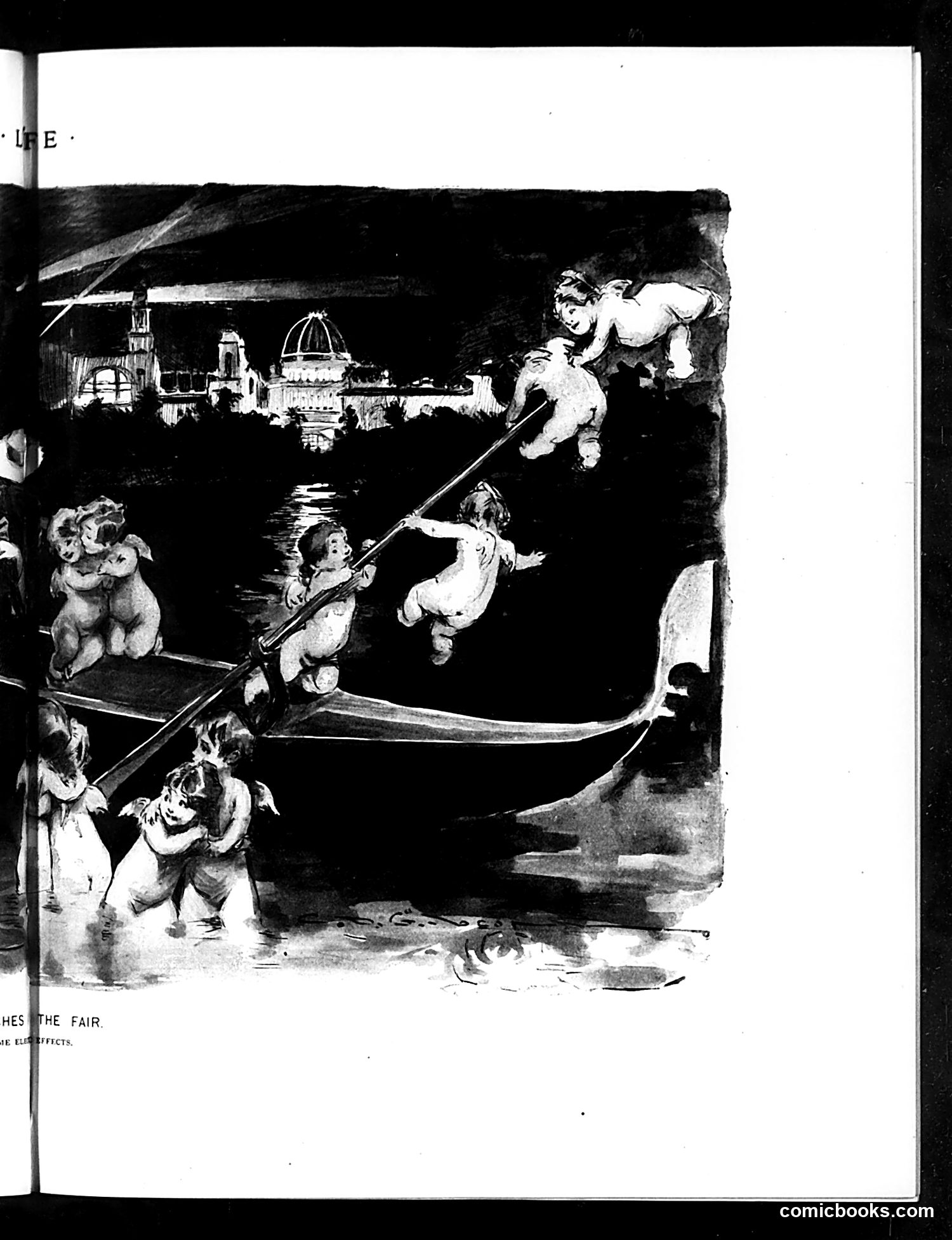
This appears to be a satirical illustration from *Life* magazine depicting cherubs or putti (classical figures) engaged in various activities on and around a gondola in Venice. The background shows the iconic Venetian cityscape with its distinctive dome (likely St. Mark's Basilica). The visible text fragment mentions "THE FAIR" and references to "EFFECTS," though the full context is unclear from this page excerpt. The satire likely comments on tourism, leisure, or perhaps romantic ideals associated with Venice. The cherubs' playful antics suggest a commentary on frivolous or decadent behavior, though without additional text or context, the specific political or social target remains uncertain. The classical artistic references may be mocking contemporary attitudes toward European travel or culture.
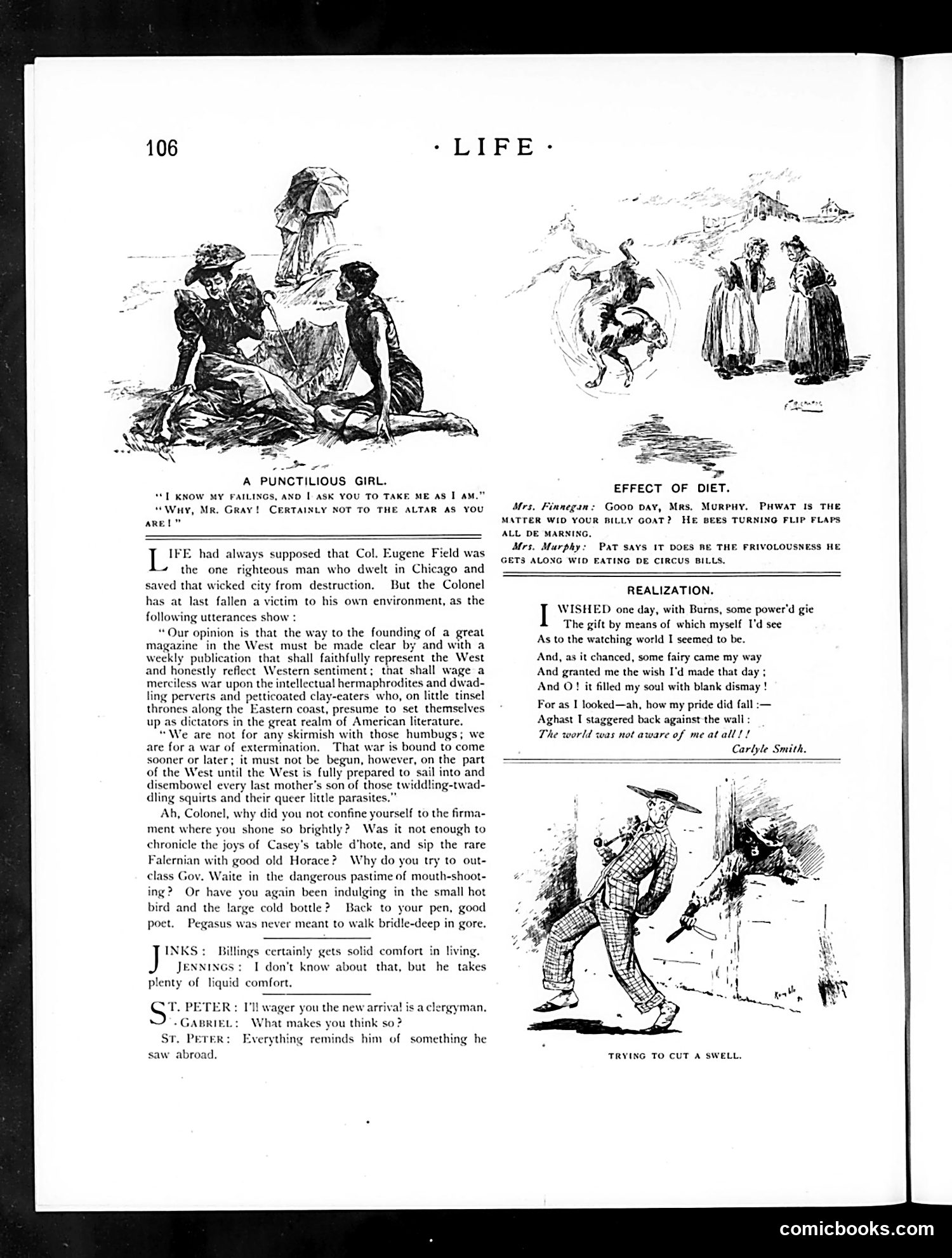
This page contains several satirical pieces typical of Life's format: **"A Punctilious Girl"** (top left): A young woman refuses a suitor's proposal, rejecting him "not to the altar as you are"—humor based on her demanding he improve himself before marriage. **Col. Eugene Field critique**: The main article mocks Chicago writer/editor Eugene Field for abandoning poetry to make inflammatory statements about Eastern literary "hermaphrodites" and cultural elites. Life ridicules his aggressive rhetoric as hypocritical posturing, urging him back to his gentle "Casey's table d'hote" poetry rather than "mouth-shooting" (aggressive speechmaking). References to "Gov. Waite" suggest contemporary political conflict. **"Effect of Diet"** (right): Irish immigrant humor—a billy goat acts frivolously from eating circus bills (advertisements), a pun on the animal's dietary misbehavior. **"Realization"** (poem): A morality tale about vanity—someone wishes to see themselves as the world sees them, only to discover they're completely unnoticed. **"Trying to Cut a Swell"** (bottom): Illustration of someone attempting to appear impressive or fashionable ("cutting a swell"), likely depicting failure at social pretense.
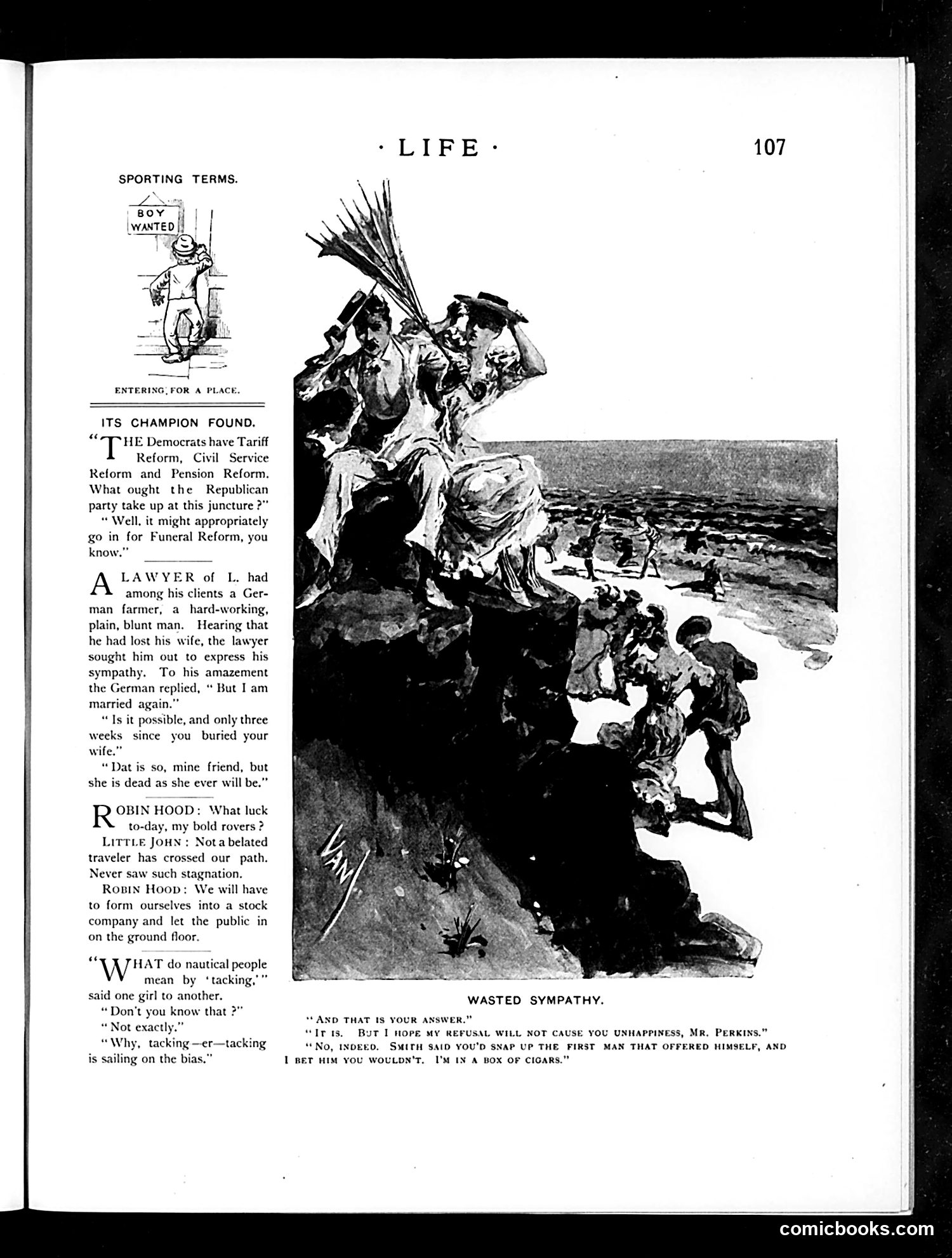
This page contains several unrelated humorous sketches typical of *Life* magazine's format: **"Its Champion Found"**: A political joke where Democrats are credited with various reform initiatives, and the Republican Party is sarcastically urged to adopt "Funeral Reform"—suggesting they're politically dead. **German Farmer Anecdote**: A lawyer sympathizes with a German farmer over his wife's death, only to learn he's remarried within three weeks. The farmer's deadpan response ("she is dead as she ever will be") is the joke—implying his new wife is equally lifeless/unpleasant, mocking hasty remarriage and marital unhappiness. **Robin Hood**: The outlaw gang discusses forming a "stock company" to let "the public in on the ground floor"—satirizing the era's corporate financial schemes and stock market manipulation. **"Wasted Sympathy"**: A woman rejects a man's proposal, revealing she was the subject of a bet. The man won cigars by correctly predicting she'd refuse the first suitor—mocking both courtship customs and men's frivolous wagering over women. All employ period-typical humor about politics, marriage, and social climbing.
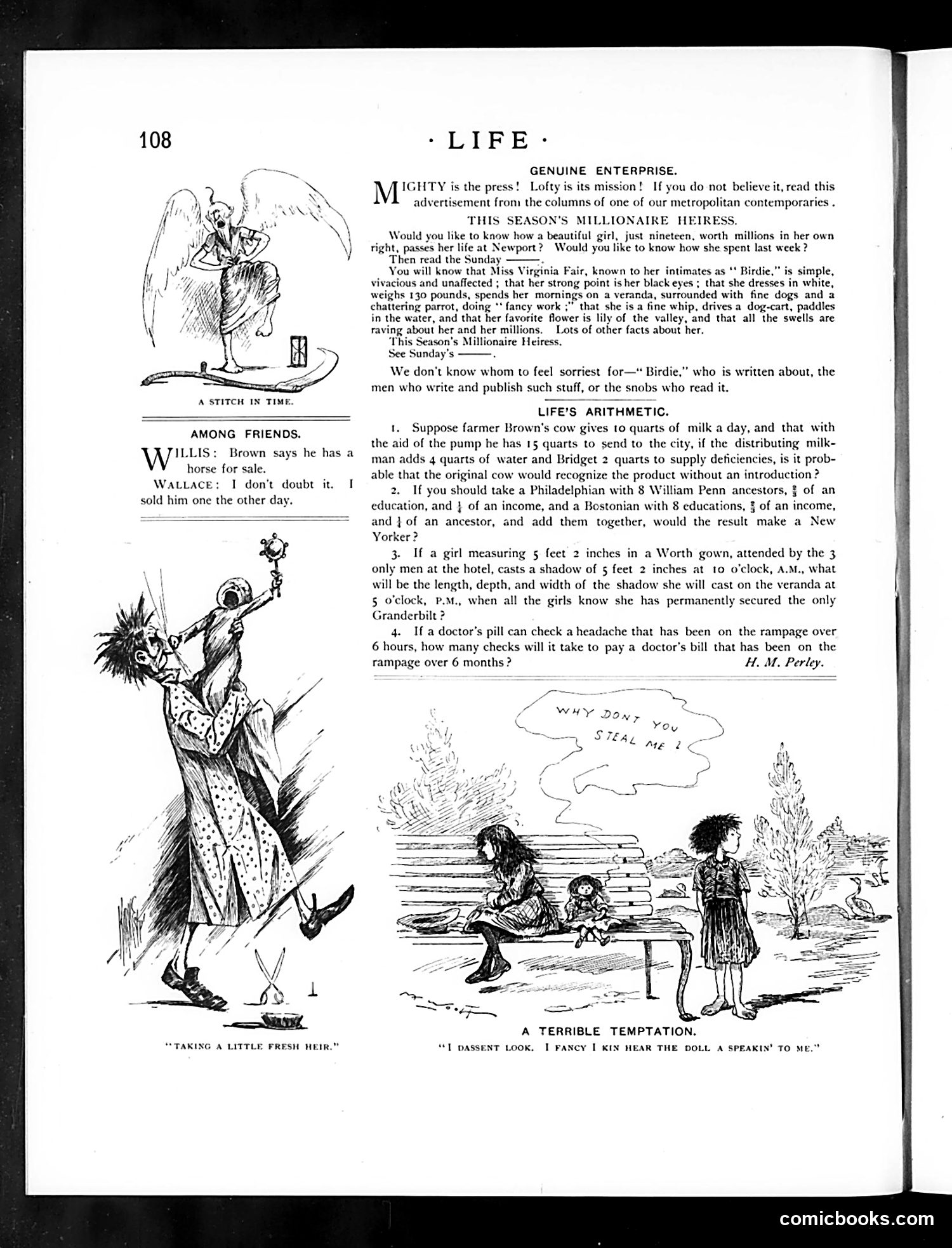
This *Life* magazine page satirizes **sensationalist newspaper coverage of wealthy heiresses**. The main article mocks how metropolitan newspapers breathlessly chronicle the trivial details of Virginia Fair ("Birdie"), a 19-year-old millionaire heiress—her weight, clothing, flowers, dogs, and social activities—treating mundane gossip as newsworthy. Life's editors sneer at all parties involved: the shallow heiress being written about, the journalists who produce such "stuff," and the readers who consume it. The "Life's Arithmetic" section uses mock-mathematical problems to satirize social absurdities: milk diluted through distribution chains, genealogical pretension among East Coast elites, and doctors' inflated billing practices. The cartoon "A Terrible Temptation" depicts rural poverty—children eyeing a doll they cannot afford—contrasting sharply with the heiress coverage above, emphasizing Life's critique of class inequality and misplaced media priorities.
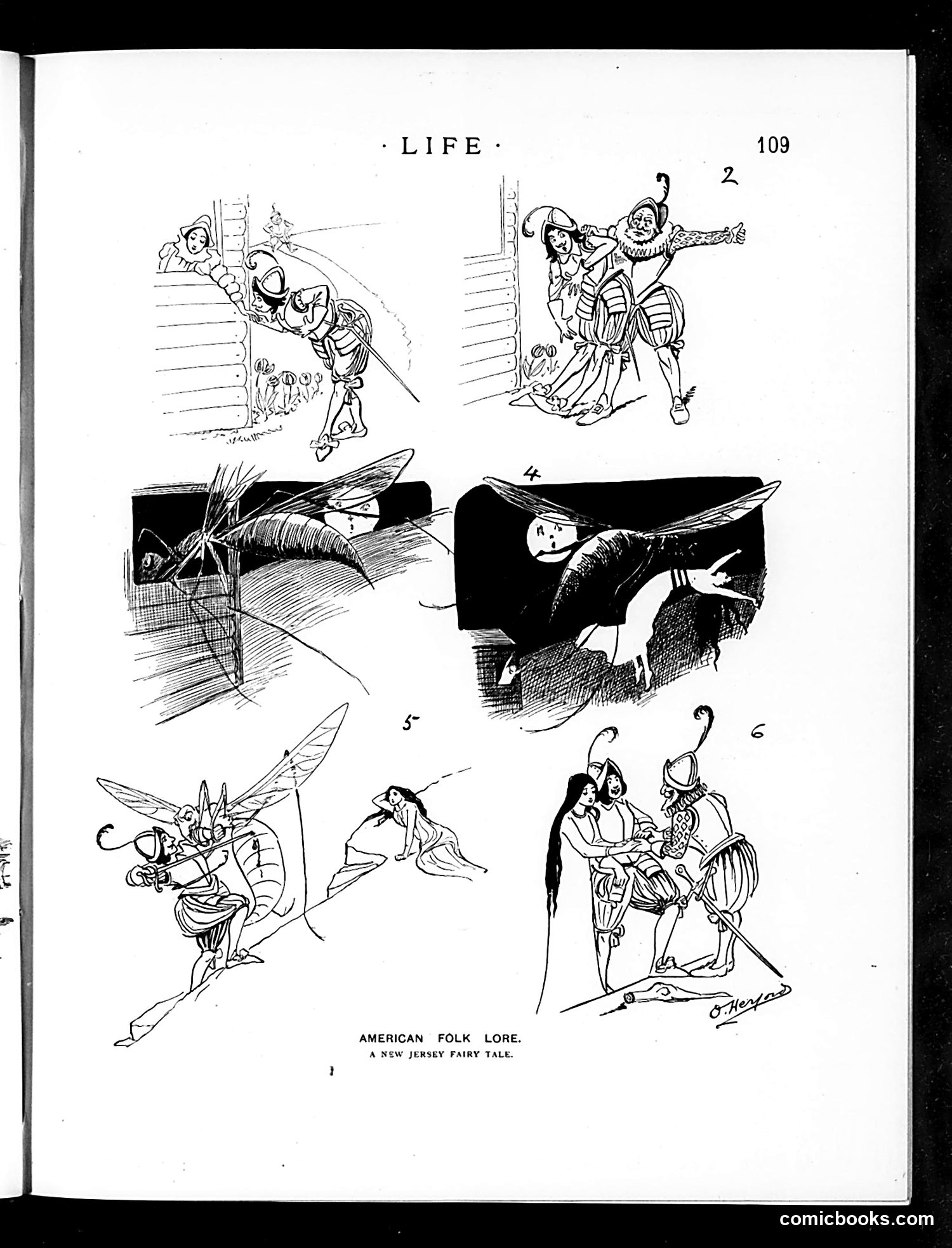
This page presents six numbered comic illustrations depicting what appears to be a satirical "fairy tale" set in New Jersey. The drawings show various fantastical characters—including figures with elaborate costumes, wings, and exaggerated features typical of fairy tale imagery. The satire likely mocks either New Jersey's reputation or a specific contemporary New Jersey scandal or situation by reframing it as folk mythology. Without additional context about Life magazine's publication date or specific New Jersey events referenced, the exact target remains unclear. However, the juxtaposition of "American Folk Lore" with "New Jersey" suggests ironic commentary on the state's public image or a particular local story being elevated to legendary status. The artwork's style is consistent with early-to-mid 20th century magazine illustration and humor.
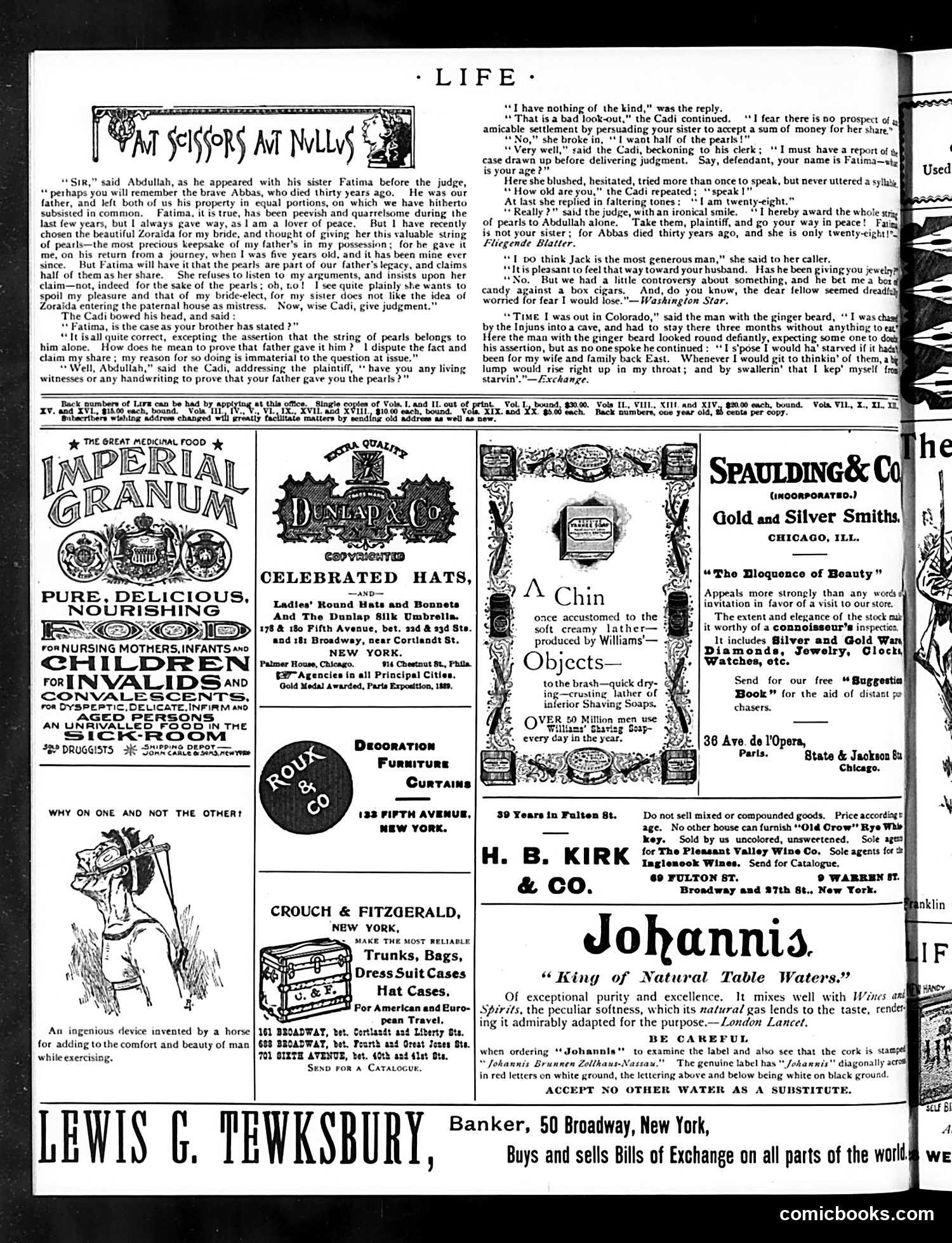
This page is primarily **advertisements** with three brief humorous anecdotes interspersed. The main content consists of: 1. **"Scissors at Nullus"** — A lengthy story about a legal dispute where Abdullah sues his sister Fatima over an inheritance of pearls. The joke's punch line: the Cadi (Islamic judge) awards all pearls to Abdullah, reasoning that Fatima cannot be Abbas's daughter since Abbas died 30 years ago but Fatima claims to be only 28 years old—exposing her lie about her age. 2. **Three short jokes** about marital dynamics: one about a generous husband who bet candy against cigars; another about a man stranded in Colorado who survived by thinking of his family back East. The page is otherwise filled with period advertisements for Imperial Granum (infant food), hats, luggage, diamonds, and banking services—typical of Life magazine's revenue model. The humor relies on wordplay, logical paradoxes, and domestic comedy—standard turn-of-century magazine fare.
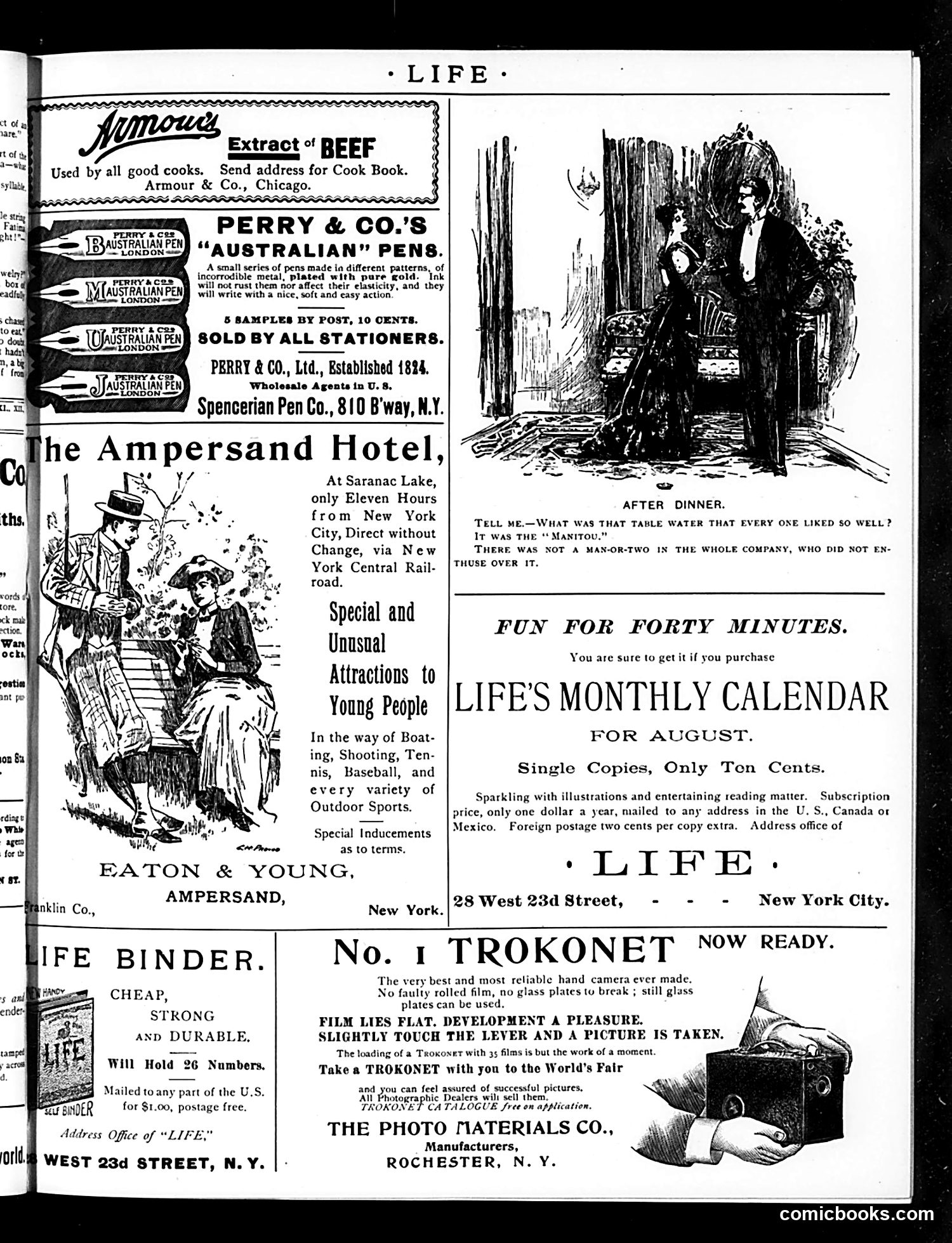
This page is primarily **advertising**, not political satire. It showcases late-19th/early-20th-century consumer products and services. The single illustration—captioned "After Dinner"—depicts two well-dressed figures (likely a man and woman in formal attire) discussing table water. The accompanying text jokes that everyone at their dinner praised "Manitou" brand water, with the punchline that "not a man-or-two in the whole company" failed to enthuse over it. This is straightforward product placement disguised as social commentary. The bulk of the page advertises goods reflecting period leisure and technology: Australian pens, a Saranac Lake resort, Life's monthly calendar, camera equipment (the Trokonet), and a magazine binder. The Trokonet camera advertisement references the World's Fair, likely the 1893 or 1904 exposition. The cartoon carries no political message—it's merely humorous advertising copy emphasizing the universal appeal of a branded product.
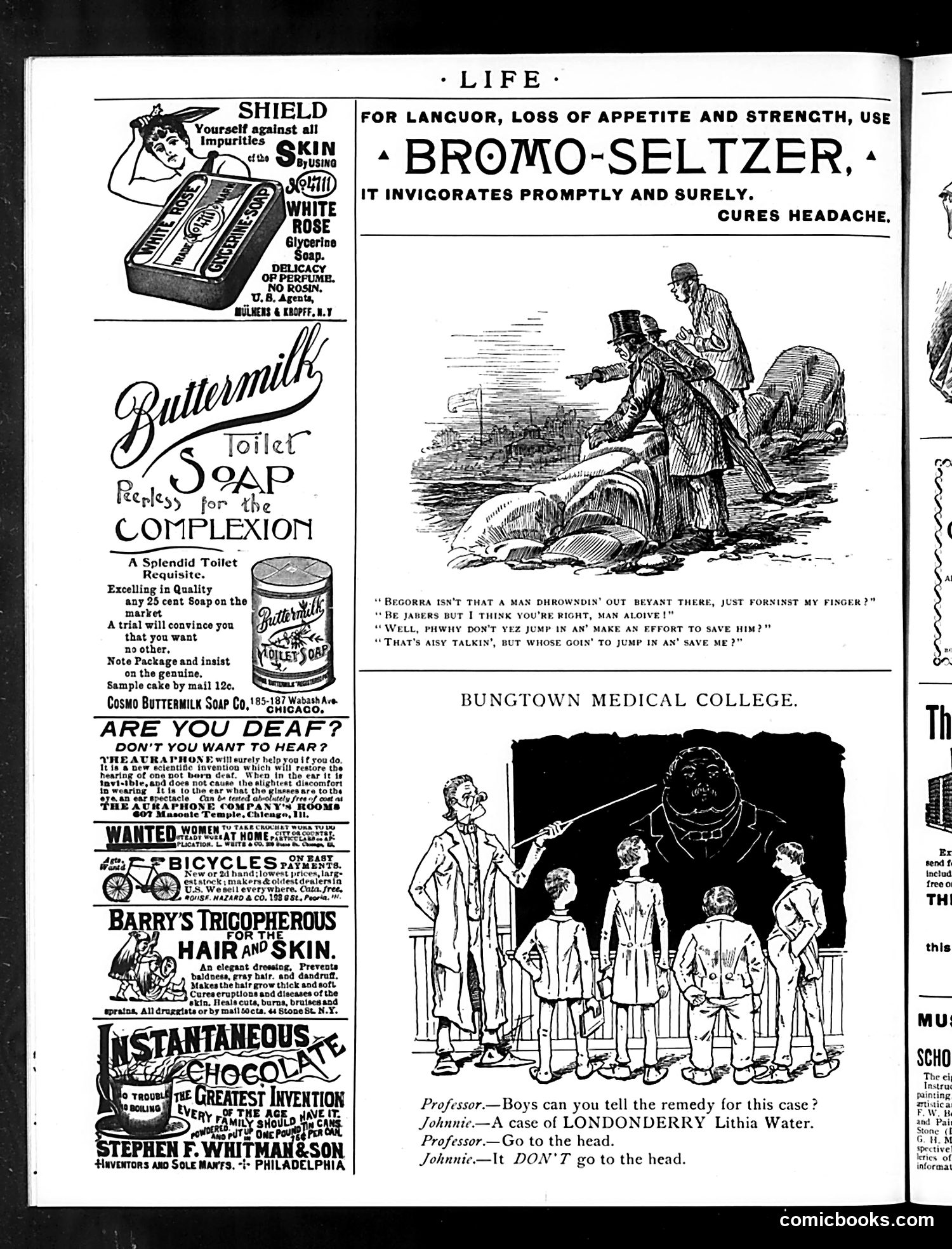
This page is primarily **advertisements** with one significant cartoon. The main cartoon depicts a medical college classroom scene satirizing Irish immigrant speech patterns. A professor asks students to identify a remedy for an unnamed condition; "Johnnie" responds that it's a case of "Londonderry Lithia Water." When told to "go to the head" (a reward for correct answers), Johnnie replies "It DON'T go to the head"—the joke being a play on the product name and a crude reference to bodily functions. The cartoon uses heavy Irish dialect ("Begorra," "Be Jabers," "Phwhy") and stereotypical pronunciation to mock Irish immigrants, a common satirical trope in early 20th-century American humor. The page is otherwise filled with patent medicine advertisements (Bromo-Seltzer, Lithia Water) and dubious health products typical of the era, when medical claims were largely unregulated.
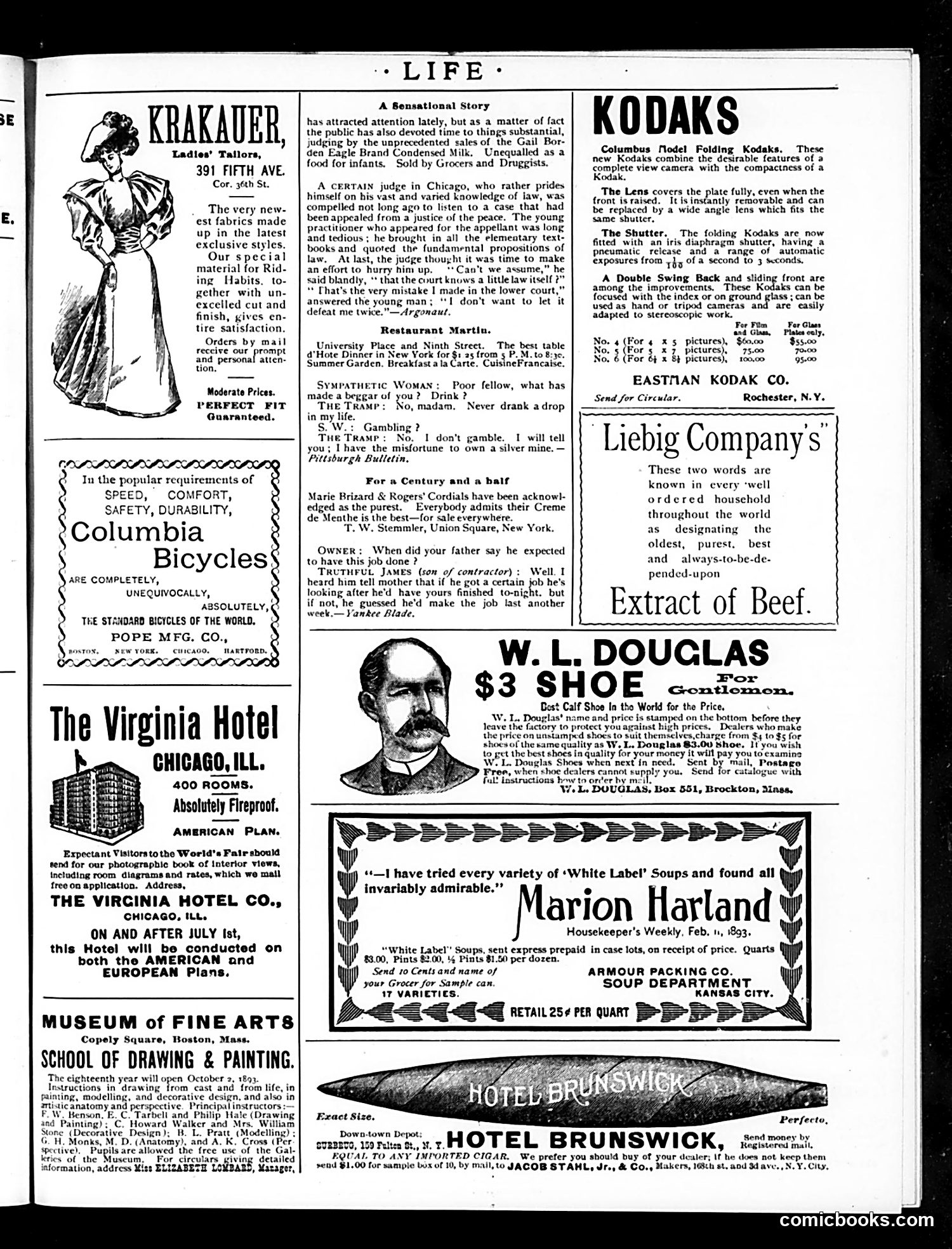
This is primarily an **advertising page** with minimal editorial content. The few satirical items present are brief anecdotes typical of Life's humor section: **The Cartoons/Stories:** - A judge in Chicago is lectured by a young lawyer about basic law—satirizing pedantic legal argumentation - A sympathetic woman asks a beggar what ruined him; he denies drinking or gambling, implying bad luck or circumstance caused poverty - A contractor's son explains his father will finish a job "tonight" unless he decides to stretch it out—mocking contractor delays **The Context:** These are mild social satires about professional incompetence and working-class misfortune, typical of 1890s humor. They require minimal historical knowledge to understand. **The Advertisements:** The page is dominated by ads for Kodak cameras, Columbia bicycles, W.L. Douglas shoes, and various hotels and services—representing products marketed to middle-class Americans of the era. The Liebig Company's beef extract ad is notably prominent. This appears to be from Life's early period (likely 1890s), when the magazine balanced satire with substantial advertising revenue.
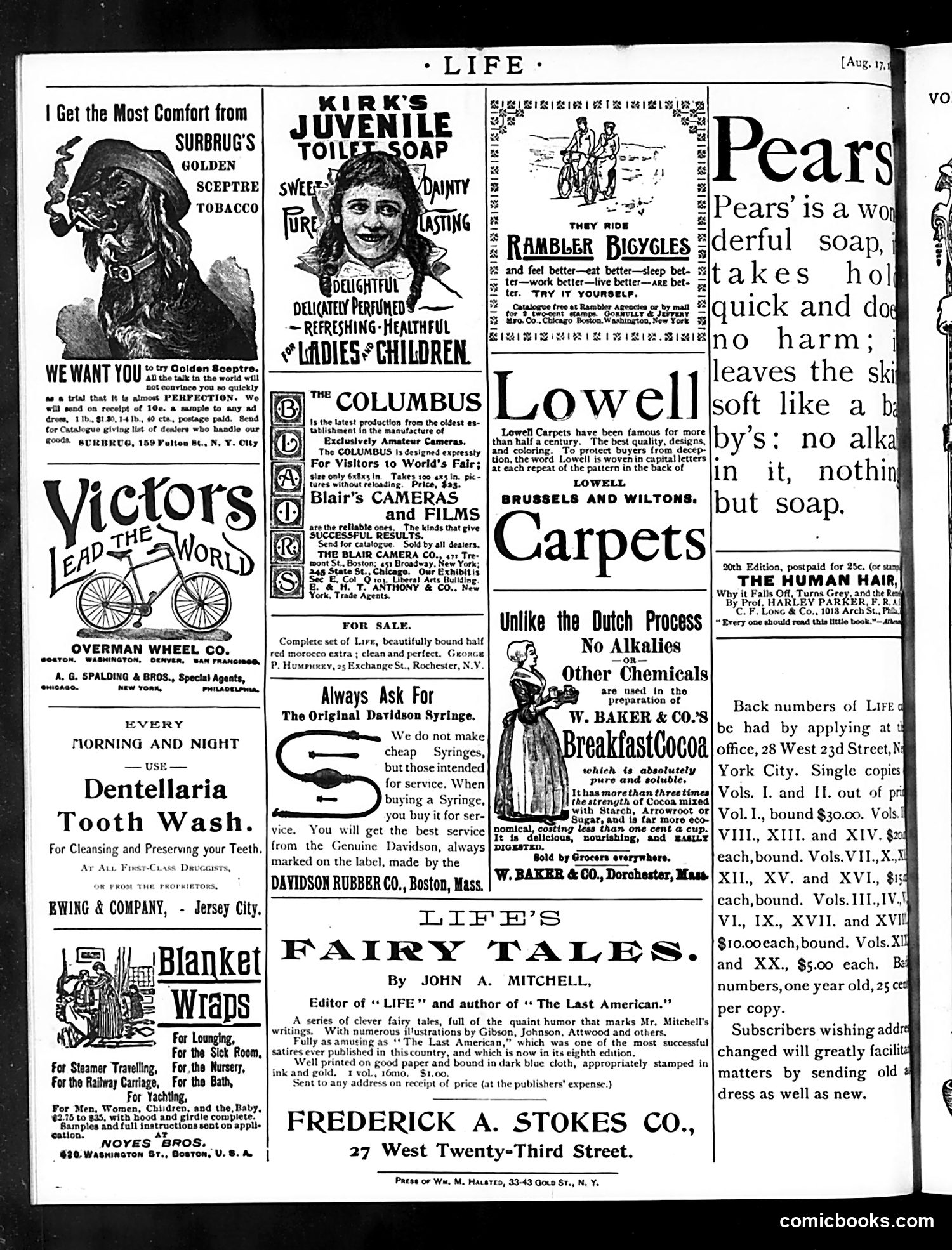
This is primarily an **advertising page** from Life magazine, containing no political cartoons. Instead, it features product advertisements typical of the 1890s, including: **Notable ads:** - **Surbrug's Sceptre Tobacco** - appeals to comfort/quality - **Rambler Bicycles** - promote health benefits ("feel better—eat better") - **Columbus amateur cameras** - marketed to World's Fair visitors - **Lowell Carpets** - emphasize authenticity (name woven in) - **Dentellaria Tooth Wash** - dental hygiene product - **Overman Wheel Co. bicycles** - **W. Baker & Co.'s Breakfast Cocoa** - claims superiority over competitors **Social context:** These ads reflect late-Victorian American consumer culture—bicycles as new leisure technology, photography equipment for fair tourism, and an emerging emphasis on personal hygiene products. The page also advertises Life's own *Fairy Tales* book by John A. Mitchell. The page documents what middle-class Americans bought rather than satirizing politics.