
Life, 1893-08-17 · page 9 of 20
Life — August 17, 1893 — page 9: what you’re looking at
What you’re looking at
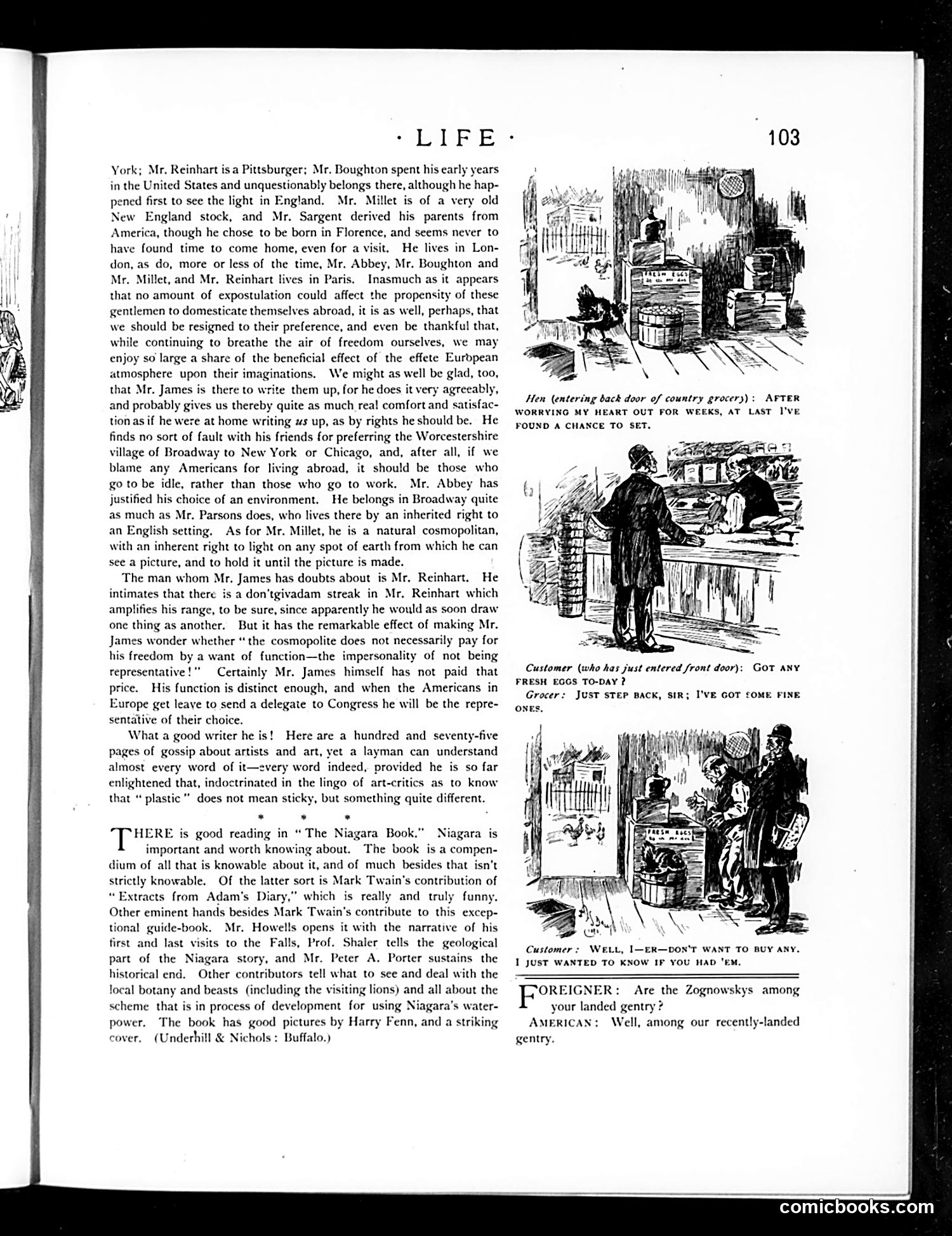
This page contains three small illustrated vignettes with captions, appearing to be humorous social observations rather than political cartoons. The first shows someone entering through a back door, captioned about "worrying my heart out for weeks" and finally finding "a chance to set." The second depicts a grocer interaction where a customer asks about fresh eggs, and the grocer responds about having "some fine ones." The third shows what appears to be a social interaction, with a caption beginning "I just wanted to know if you had 'em" and a response about "Zognowskys" among "recently-landed gentry." These appear to be gentle satirical sketches of everyday American life and social pretensions, likely from the early 20th century based on the illustration style. The humor seems to target class consciousness and the aspirations of newly arrived immigrants or social climbers.
📄 Transcribed text from this page (OCR, searchable)
Machine-transcribed from the original scan — historical spelling and the odd misread are preserved.
“BLUE E : York; Mr. Reinhart isa Pittsburger; Mr. Boughton spent his early years in the United States and unquestionably belongs there, although he hap- pened first to see the light in England. Mr. Millet is of a very old New England stock, and Mr. Sargent derived his parents from America, though he chose to be born in Florence, and seems never to have found time to come home, even for a vi: He lives in Lon- don, as do, more or less of the time, Mr. Abbey, Mr. Boughton and Mr. Millet, and Mr, Reinhart lives in Paris. Inasmuch as it appears that no amount of expostulation could affect the propensity of these gentlemen to domesticate themselves abroad, it is as well, perhaps, that we should be resigned to their preference, and even be thankful that, while continuing to breathe the air of freedom ourselves, we may enjoy so large a share of the beneficial effect of the effete European atmosphere upon their imaginations. We might as well be glad, too, that Mr. James is there to ¢ them up, for he does it very agreeably, and probably gives us thereby quite as much real comfort and satisfac- tion as if he were at home writing ws up, as by rights he should be. He finds no sort of fault with his friends for preferring the Worcestershire village of Broadway to New York or Chicago, and, after all, if we blame any Americans for living abroad, it should be those who go to be idle, rather than those who go to work. Mr. Abbey has justified his choice of an environment. He belongs in Broadway quite as much as Mr. Parsons does, who lives there by an inherited right to an English setting. As for Mr. Millet, he is a natural cosmopolitan, with an inherent right to light on any spot of earth from which he can see a picture, and to hold it until the picture is made. The man whom Mr. James has doubts about is Mr. Reinhart, He intimates that there is a don’tgivadam streak in Mr. Reinhart which amplifies his range, to be sure, since apparently he would as soon draw one thing as another. But it has the remarkable effect of making Mr. James wonder whether “the cosmopolite does not necessarily pay for his freedom by a want of function—the impersonality of not being representative!" Certainly Mr. James himself has not paid that price. His function is distinct enough, and when the Americans in Europe get leaye to send a delegate to Congress he will be the repre- sentative of their choice. What a good writer he is!’ Here are a hundred and seventy-five pages of gossip about artists and art, yet a layman can understand almost every word of it—s:very word indeed, provided he is so far enlightened that, indoctrinated in the lingo of art-critics as to know that “ plastic ” does not mean sticky, but something quite different. . * HERE is good reading in “ The Niagara Book.” Niagara is important and worth knowing about. The book is a compen- dium of all that is knowable about it, and of much besides that isn’t strictly knowable. Of the latter sort is Mark Twain's contribution of “Extracts from Adam's Diary,” which is really and truly funny, Other eminent hands besides Mark Twain's contribute to this excep- tional guide-book. Mr. Howells opens it with the narrative of his first and last visits to the Falls, Prof. Shaler tells the geological part of the Niagara story, and Mr. Peter A. Porter sustains the historical end. Other contributors tell what to see and deal with the local botany and beasts (including the visiting lions) and all about the scheme that is in process of development for using Niagara's water- The book has good pictures by Harry Fenn, and a striking (Underhill & Nichols : Buffalo.) power, cover. Hen (entering back door of country grocery): AFTER WORRYING MY HEART OUT FOR WEEKS, AT LAST I'VE FOUND A CHANCE TO SET. Customer (who has just entered front door): GOT ANY FRESH EGGS TO-DAY ? Grocer: JUST STEP BACK, SIR; I'VE GOT £OME FINE Customer; WELL, I—-ER—DON'T WANT TO BUY ANY. 1 JUST WANTED TO KNOW IF YOU HAD ‘EM, OREIGNER: Are the Zognowskys among your landed gentry ? AMERICAN: Well, among our recently-landed gentry. comicbooks.com