
A complete issue · 16 pages · 1893
Life — July 27, 1893
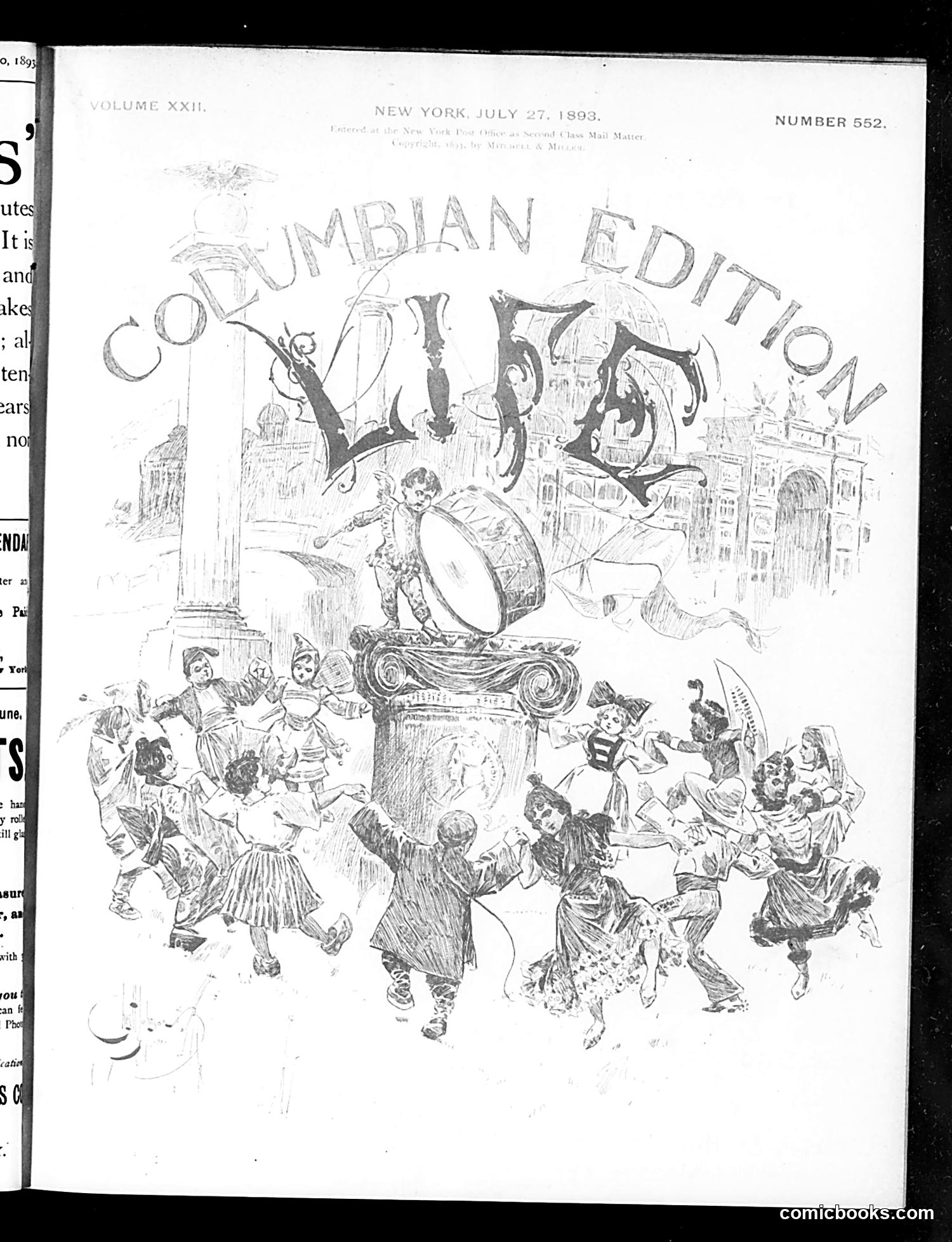
This is Life magazine's cover celebrating the 1893 World's Columbian Exposition in Chicago. The central illustration depicts a large classical column (referencing Columbus) with children and figures dancing around its base in celebration. A cherub or young figure sits atop, playing a drum. The satire appears to mock the grandeur and spectacle of the fair itself—the ornate architecture, the celebratory atmosphere, and perhaps the contrast between the fair's idealized vision and everyday reality. The dancing, playful figures suggest both genuine public excitement and potentially frivolous distraction. The "Columbian Edition" title references Columbus's voyage anniversary (400 years), which the 1893 Chicago World's Fair commemorated. This was a major cultural event of the era.
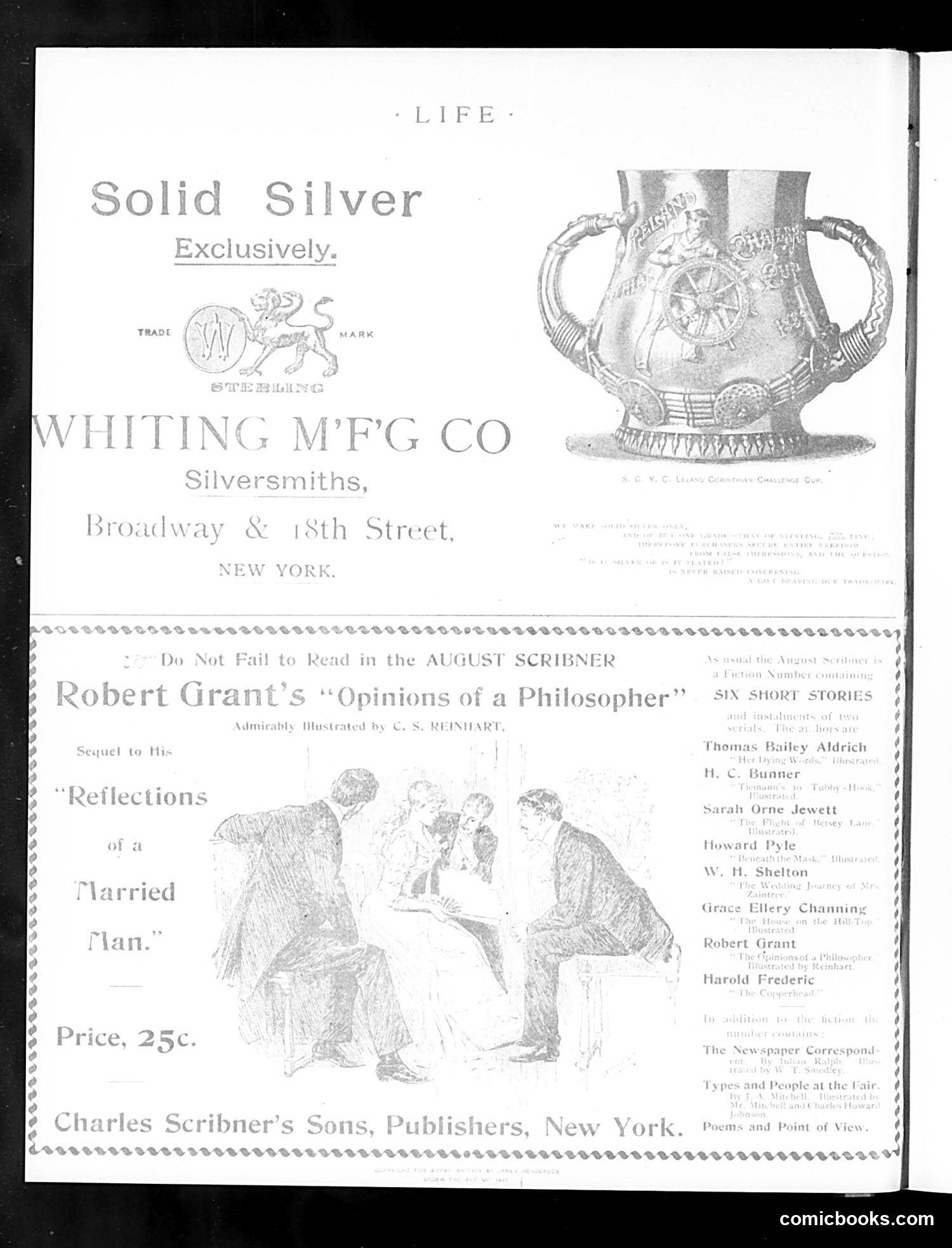
This page is primarily **advertising, not editorial content or satire**. The upper half features an ad for the **Whiting M'fg Co.**, silversmiths on Broadway & 18th Street in New York, showcasing ornate solid silver vessels with decorative handles and nautical motifs. The lower half advertises **Charles Scribner's Sons publishers**, promoting Robert Grant's "Opinions of a Philosopher" with an illustration by C.S. Reinhart. The sketch shows men in discussion—likely depicting a philosophical debate or domestic scene. The ad also lists other Scribner publications and upcoming August *Scribner* magazine content featuring short stories by various authors. There is **no political cartoon or satire** present on this page. It's a typical magazine advertising section from the era.
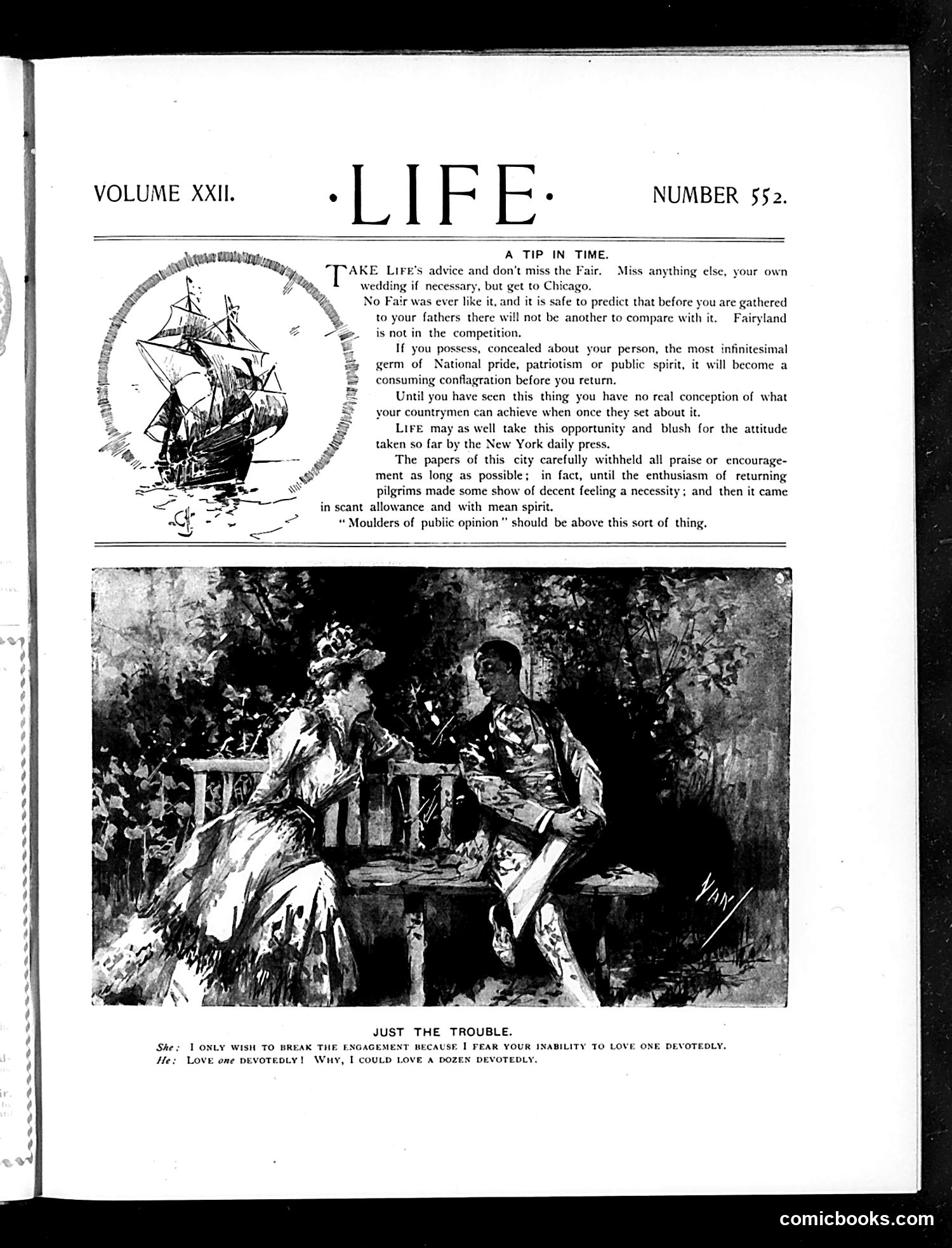
**"A Tip in Time" Editorial Section:** This article criticizes New York newspapers for withholding praise of the World's Columbian Exposition (Chicago's 1893 Fair) until visiting pilgrims returned home enthusiastically. The piece argues that patriotic restraint and public spirit should transcend local rivalries—that Chicago's fair represents a national achievement worthy of genuine pride, not begrudging silence. Life advocates for celebrating American accomplishment without petty competition between cities. **"Just the Trouble" Cartoon:** The illustration depicts a romantic dilemma: a well-dressed couple in an garden setting. The woman expresses fear of breaking their engagement because she cannot love him with single-minded devotion; the man responds he could love "a dozen devotedly." The satire targets the absurdity of romantic exclusivity—highlighting how one partner's impossible standard (absolute devotion) contrasts with the other's casual polygamous fantasy.
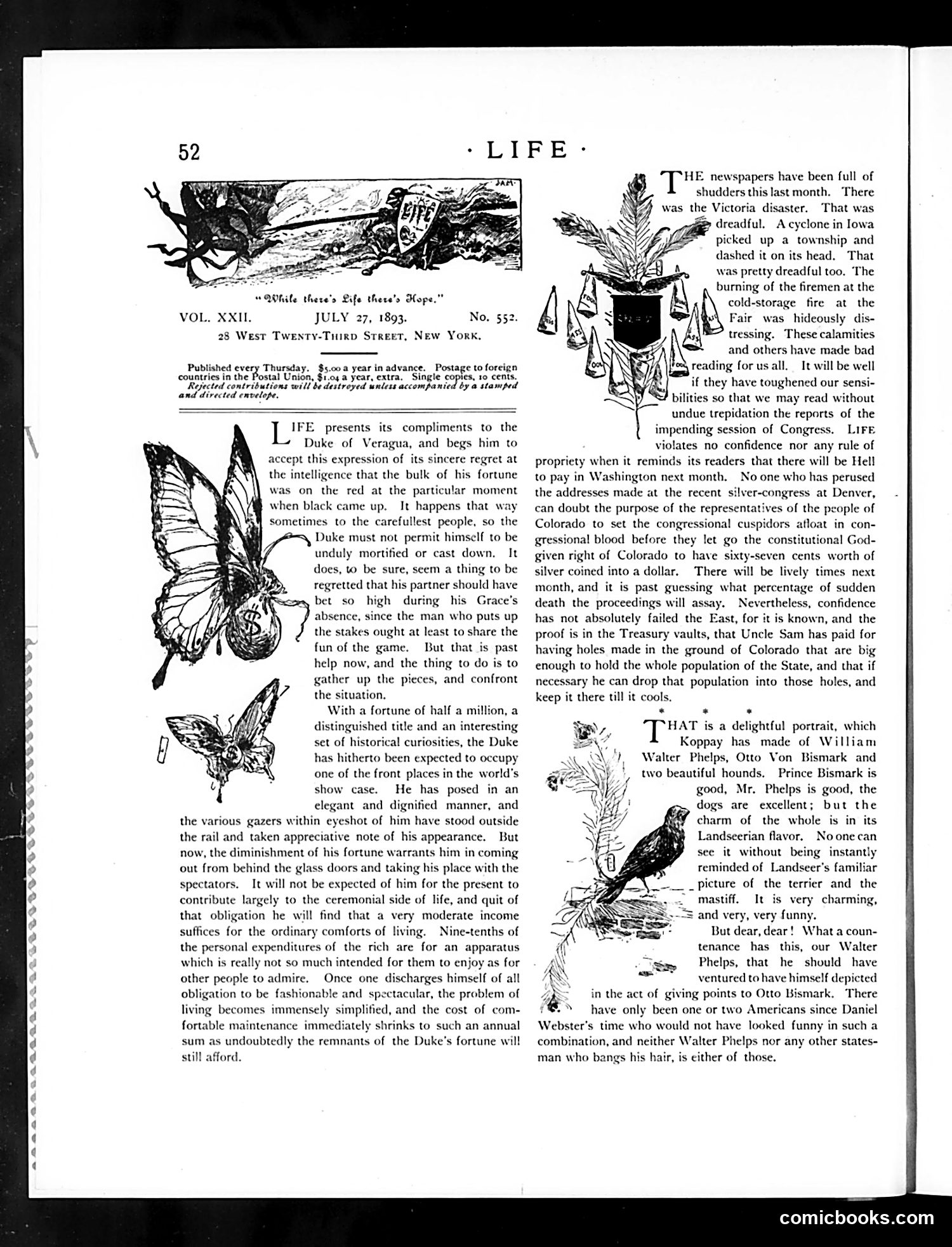
The page contains editorial commentary on contemporary disasters and society figures rather than traditional political cartoons. The text references the **Victoria disaster** (a shipwreck), a **cyclone in Iowa**, and a **cold-storage fire at a Fair**, establishing that July 1893 was marked by tragic events causing public anxiety. The editorial congratulates the **Duke of Veragua** for accepting a fortune while avoiding public mortification—suggesting aristocratic wealth and etiquette were being satirized. The decorative botanical and butterfly illustrations appear to frame discussion of a portrait by artist Landseer featuring **William Walter Phelps, Otto Von Bismarck**, and Prince Bismarck—likely commenting on American-German diplomatic relations of the period, with the author finding Phelps's inclusion humorous rather than historically significant.
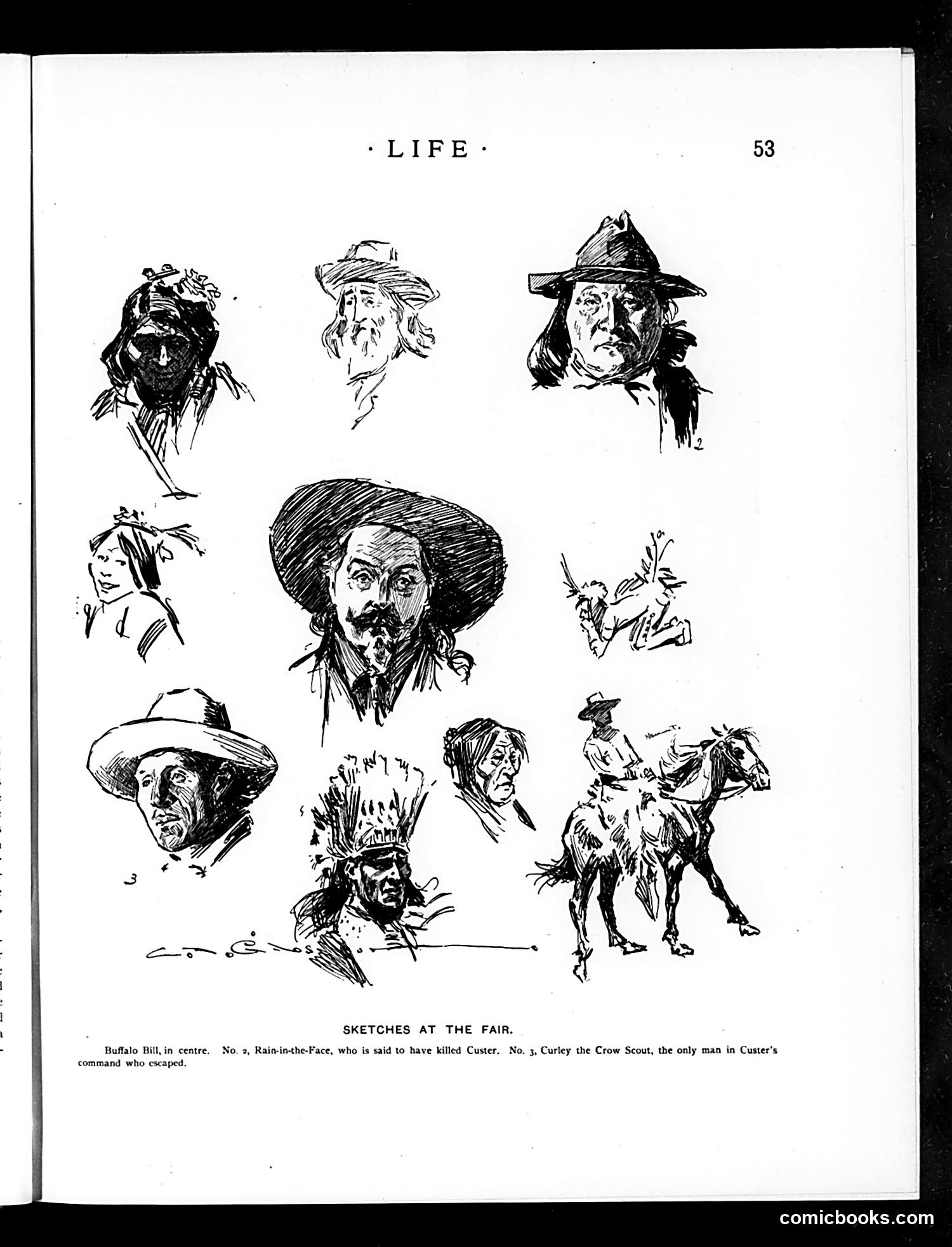
This page from *Life* magazine presents portrait sketches of figures associated with Buffalo Bill's Wild West show or exhibition. The caption identifies Buffalo Bill as the central figure (No. 2), along with Rain-in-the-Face (No. 1, credited with killing General Custer) and Curley the Crow Scout (No. 3, described as the only survivor from Custer's command). The sketches capture various personalities from the Wild West show—including Native American performers and frontier figures—rendered in expressive ink drawings typical of *Life*'s satirical style. The accompanying cowboy and horse sketch suggests the entertainment's emphasis on action and spectacle. This reflects late 19th-century American fascination with the romanticized Old West, presented as both historical documentation and popular entertainment.
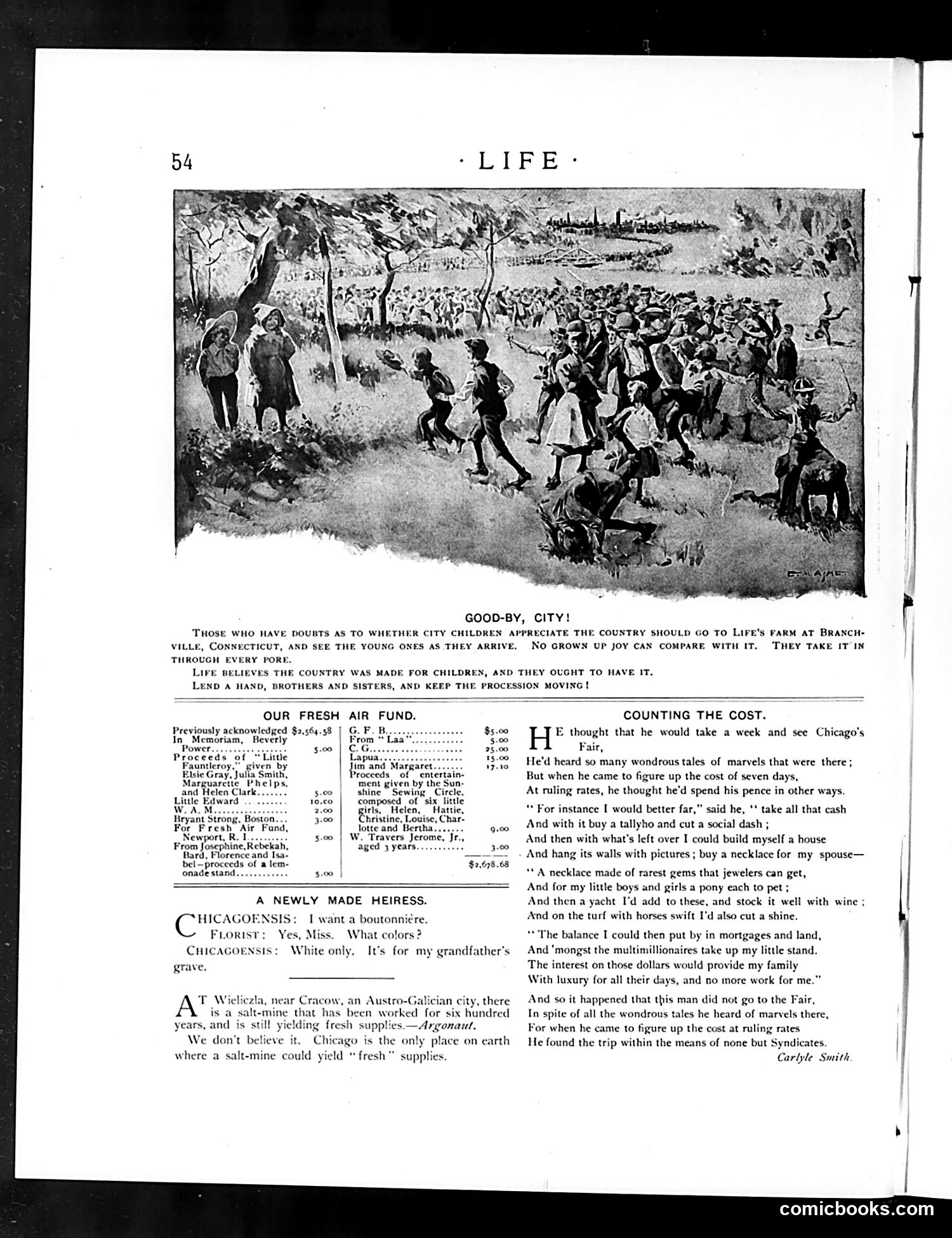
This page contains three distinct pieces: 1. **"Good-By, City!"** — An illustration showing children leaving urban areas for Life's Farm at Branchville, Connecticut. The satire celebrates rural life for children, contrasting country benefits against city existence. The accompanying text urges city dwellers to visit and let children experience nature. 2. **"Our Fresh Air Fund"** — A charitable donation list acknowledging contributions to send city children to the countryside, reflecting early 1900s Progressive-era concern for urban child welfare. 3. **"Counting the Cost"** and **"A Newly Made Heiress"** — Two brief humorous pieces about Chicago visitors and a wealthy woman seeking modest flowers, representing light satirical social commentary on wealth and urban pretension. The overall page reflects turn-of-the-century American attitudes favoring rural/pastoral experiences for children and gentle mockery of wealthy urban society.
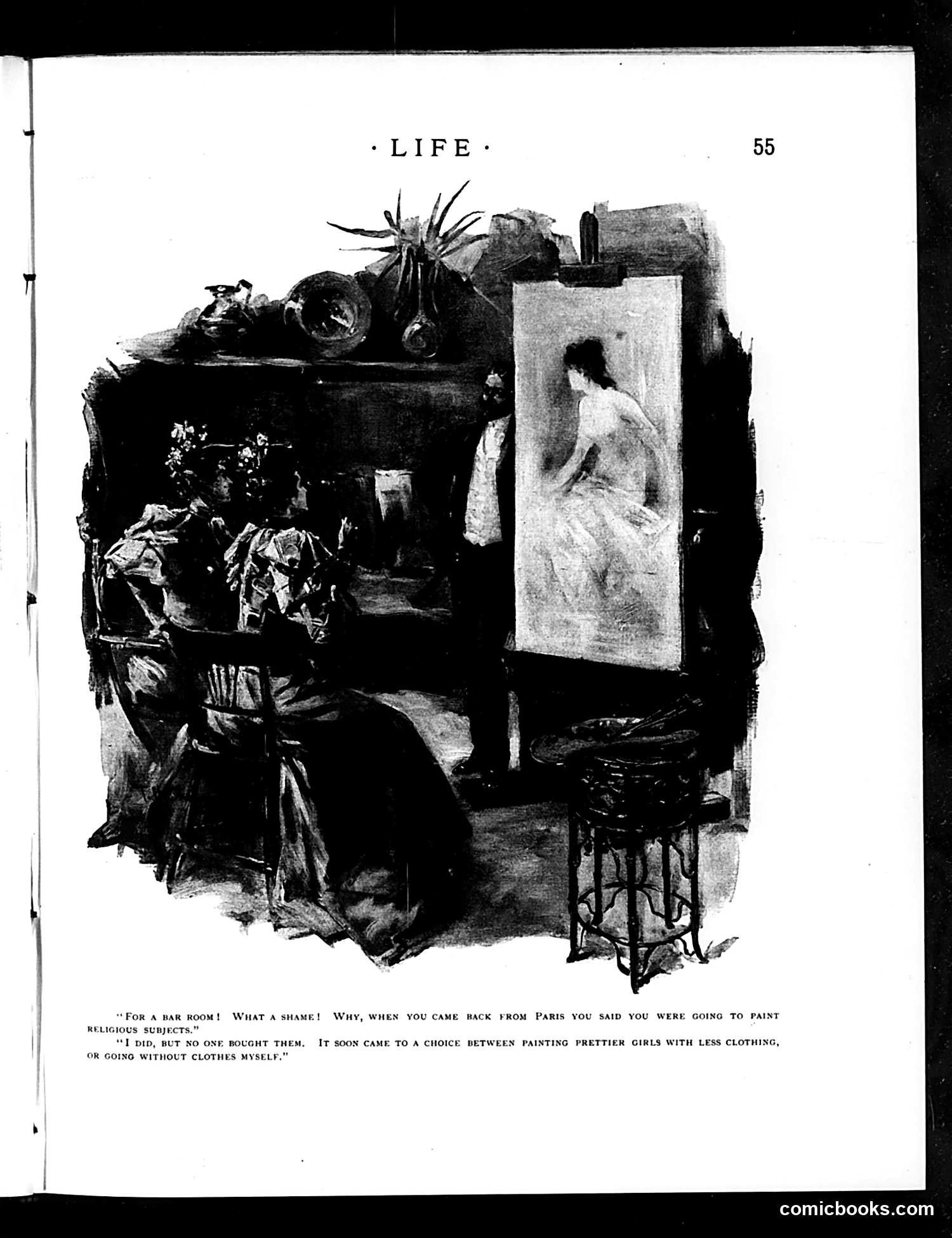
This satirical cartoon depicts an art studio scene mocking early 20th-century bohemian artistic pretensions. The dialogue reveals the joke: a woman has brought home a risqué painting of a nude female figure, claiming it's serious art from Paris. Her companion sarcastically asks why she didn't just paint nude models directly, suggesting the real motivation was "a choice between painting prettier girls with less clothing, or going without clothes myself." The satire targets two subjects: (1) artists who justify questionable work by invoking Paris as artistic authority, and (2) the transparent rationalization that nude modeling serves legitimate artistic purposes. The humor lies in exposing the gap between stated cultural aspirations and actual motivations.
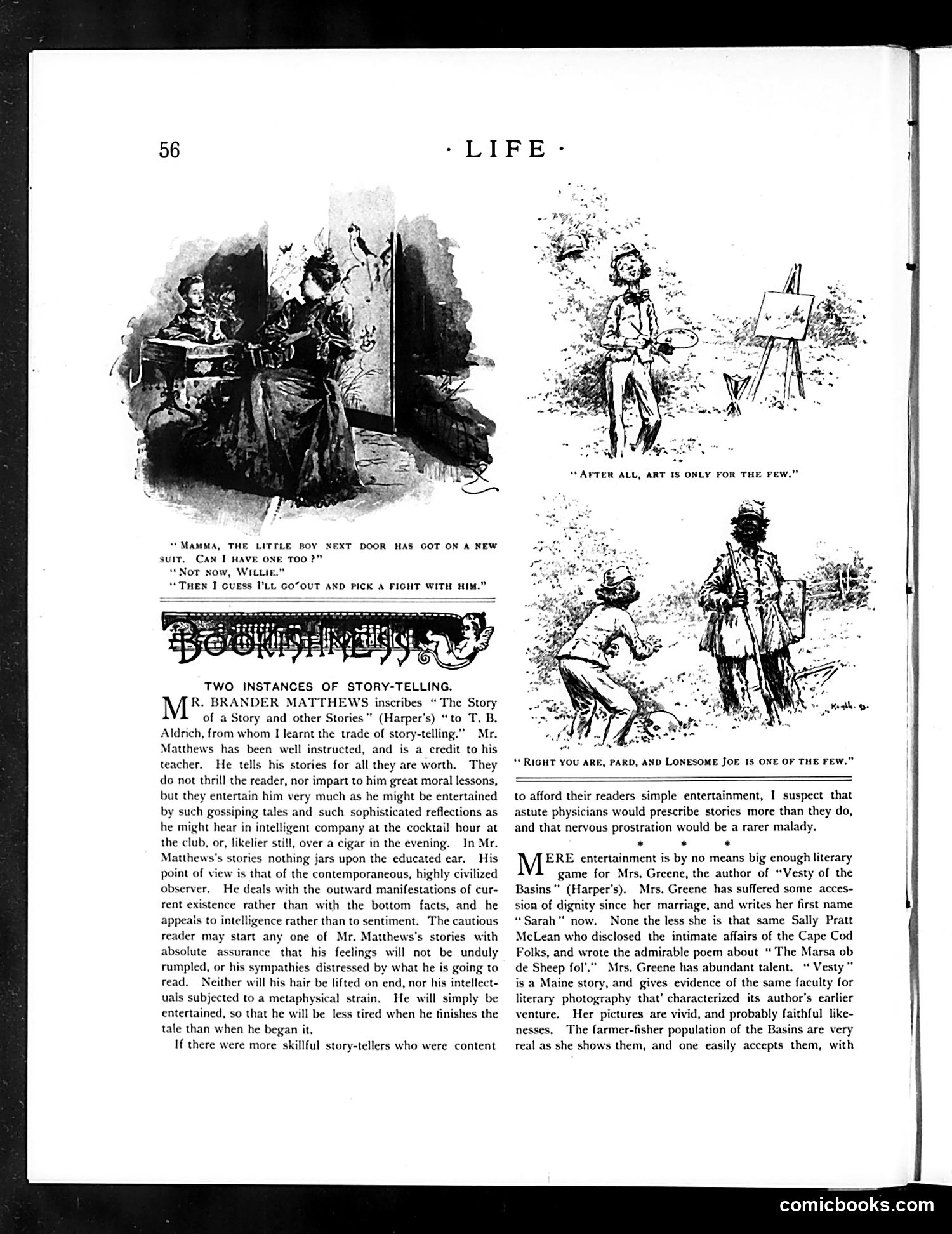
This page from *Life* magazine contains two distinct sections: **Left side:** A sketch-based comic about a child requesting a new suit by referencing a neighbor boy's outfit, with the caption suggesting the child would "pick a fight" to obtain one. This is gentle domestic humor about childhood materialism and sibling rivalry. **Right side:** Three sketches illustrating different characters with the captions "After all, art is only for the few" and "Right you are, Pard, and lonesome Joe is one of the few." These appear to satirize artistic pretension—mocking the idea that art appreciation is elite while suggesting certain "common" types (represented by the roughly-drawn figures) lack artistic sensibility. The main text discusses story-telling as entertainment, praising Brander Matthews' approach to accessible narrative over overly intellectualized fiction.
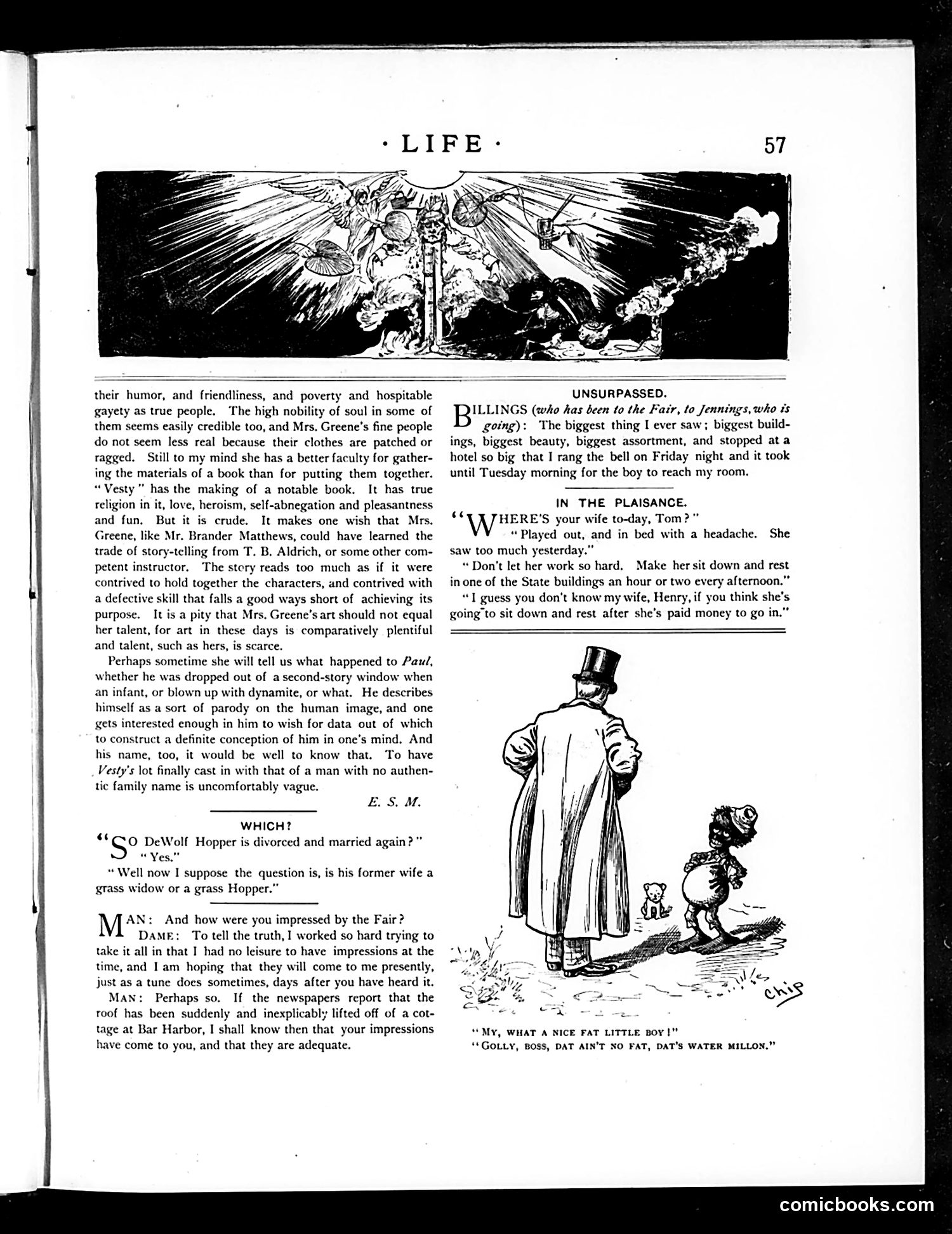
This page contains literary criticism and social commentary rather than political cartoons. The main content discusses Mrs. Greene's book about poor people, critiquing her portrayal of working-class life as somewhat superficial despite good intentions. A small illustration shows a well-dressed man in a top hat walking with a child, captioned "My, what a nice fat little boy!" with the child's reply about water melons. This appears to be gentle social satire about class differences and how the wealthy perceive poor children. The page also includes dialogue exchanges labeled "UNSURPASSED," "IN THE PLAISANCE," and "WHICH?"—typical of Life's humor format—offering witty observations about domestic life and social pretensions. The overall tone is satirical commentary on late 19th or early 20th-century American society and literature.
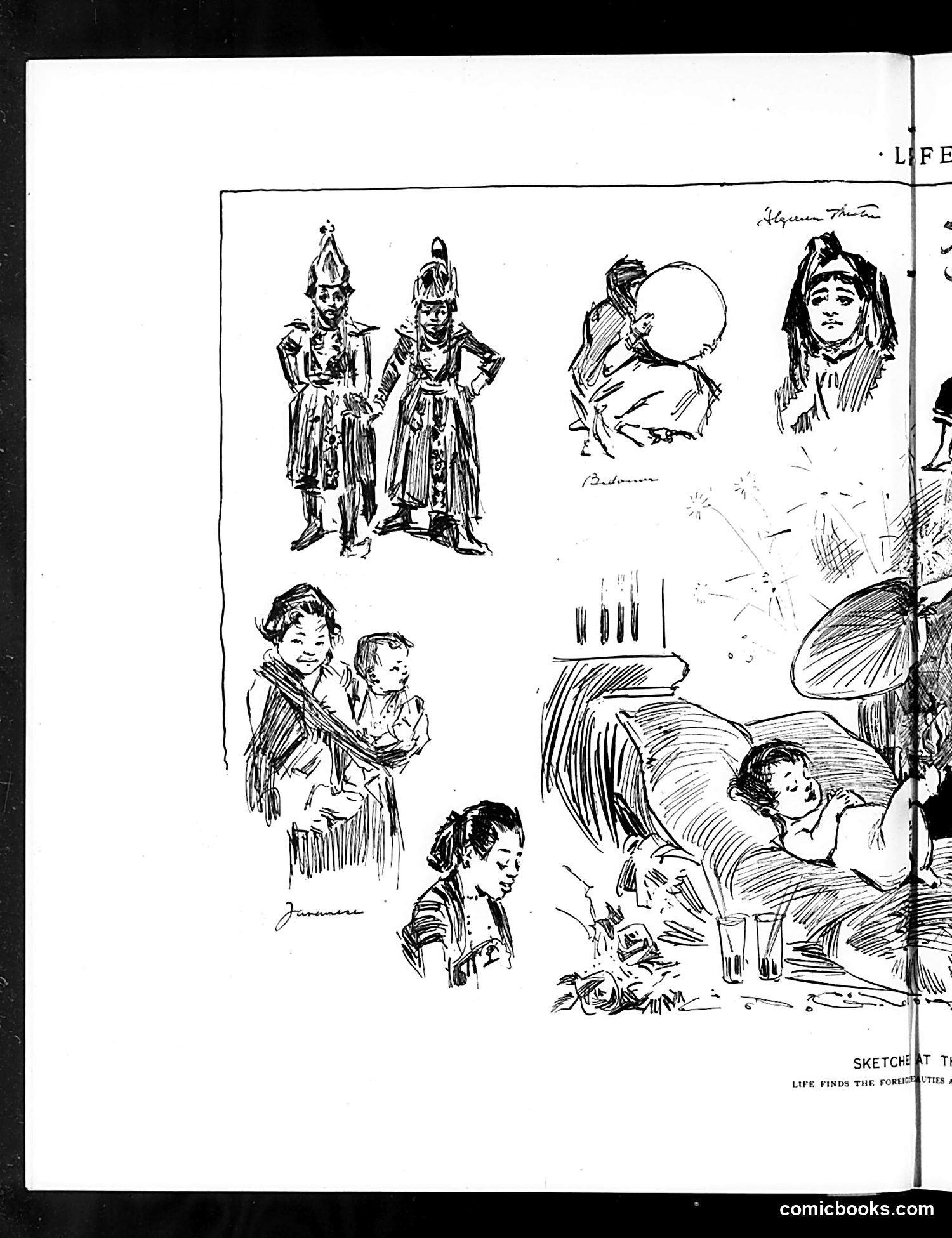
This page contains costume design sketches, likely for theatrical production. The upper portion shows two elaborately dressed figures in ornate period costumes with tall headdresses, suggesting operatic or historical drama. Below are character sketches including a woman holding a child, a single figure study, and a domestic interior scene with figures on a bed and various objects scattered about. The caption at bottom reads "SKETCHES AT THE... LIFE FINDS THE FOREGROUND" (text partially obscured). Without clearer context or complete captions, this appears to be theatrical costume/set design documentation rather than political satire. The sketches showcase character types and staging arrangements typical of early 20th-century magazine illustration, but the specific production, artist intent, and satirical meaning—if any exists—remain unclear from the visible information.
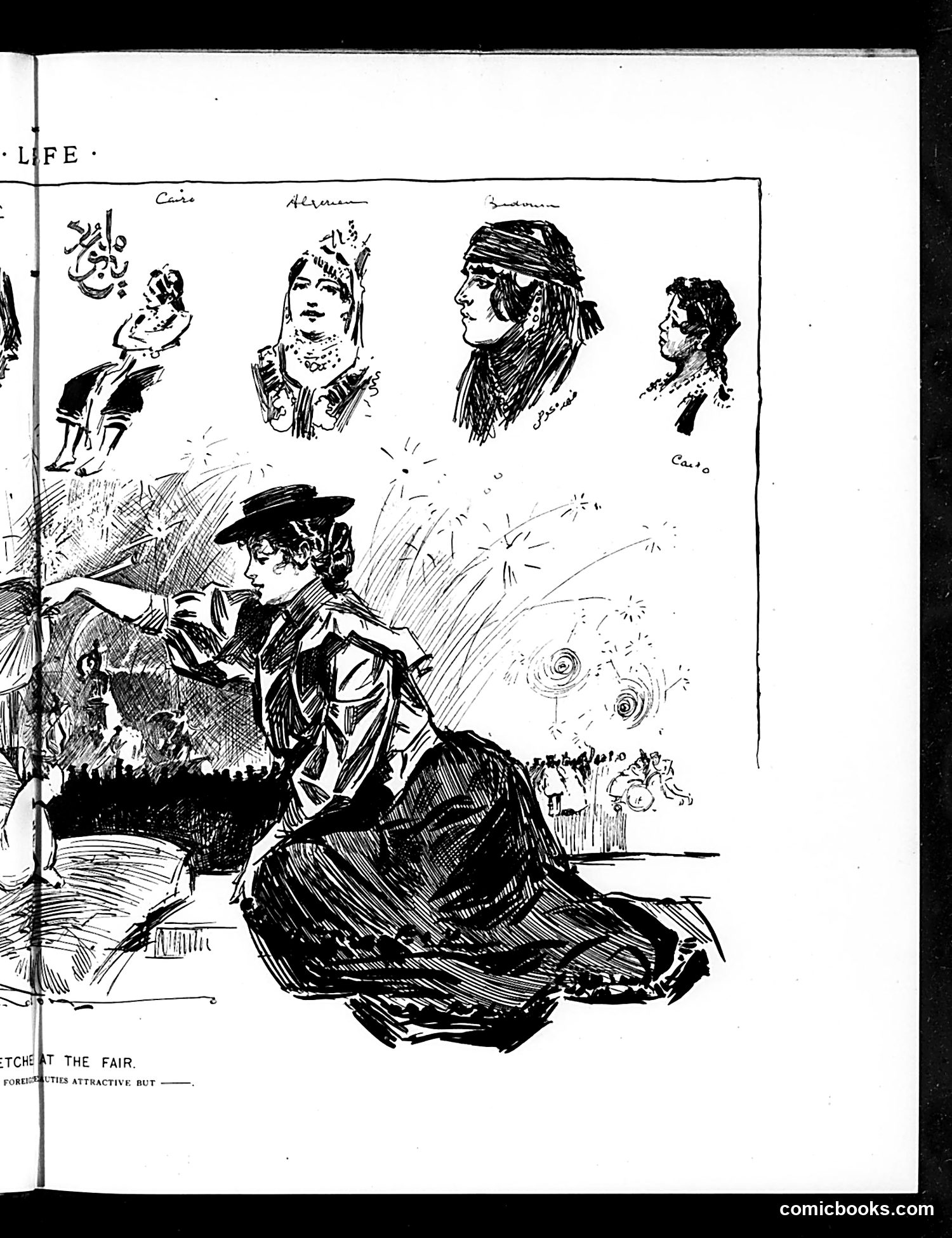
This page from *Life* magazine presents character sketches titled "Sketches at the Fair," depicting various types of women attending what appears to be a World's Fair or similar public exhibition. The main illustration shows a fashionably dressed woman in period attire (appearing to be early 1900s based on the clothing style) seated and observing the fair's attractions in the background. The four smaller head studies above appear to represent different "types" of fair attendees—likely satirizing various social classes or personality types of women visitors. The satire seems to mock the pretensions and social posturing of fair-goers, particularly women of different social standings and their distinctive appearances and mannerisms. The caption notes these are "curiosities attractive but—" (text cut off), suggesting ironic commentary on what constitutes "curiosities" at such events.
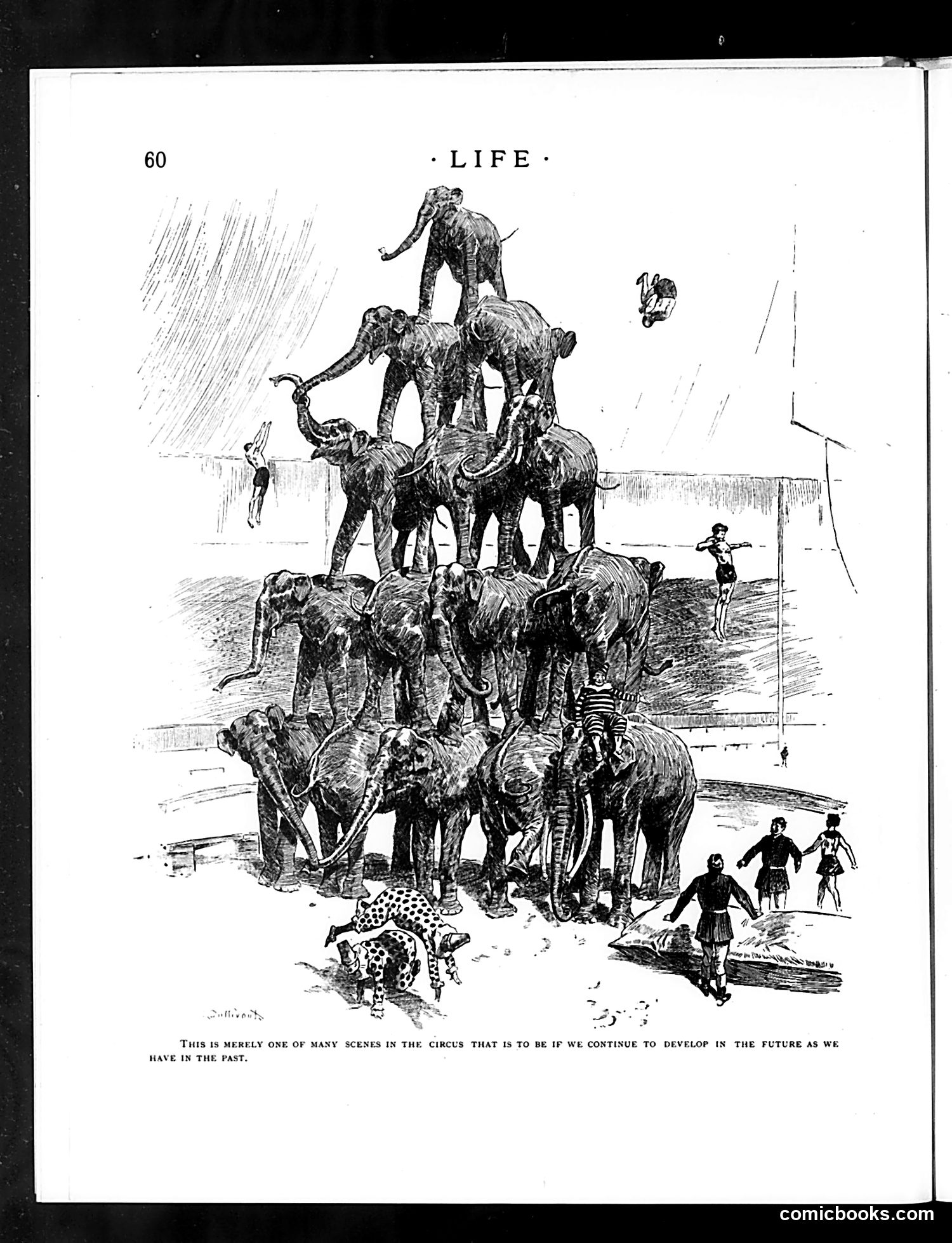
This satirical illustration depicts a precarious pyramid of elephants stacked atop one another, with human figures (appearing to be circus performers and audience members) around the base. The caption warns this represents potential future development if current trends continue. The satire critiques unchecked industrial or social "development"—suggesting that pursuing progress without restraint leads to an unstable, absurd, and dangerous circus-like society. The elephant pyramid is inherently unstable, metaphorically representing how reckless expansion collapses under its own weight. The human figures appear casual or oblivious to this precarious arrangement, suggesting society isn't adequately concerned about structural instability. This appears to be early 20th-century commentary on rapid industrialization, urbanization, or economic growth and their potential consequences.
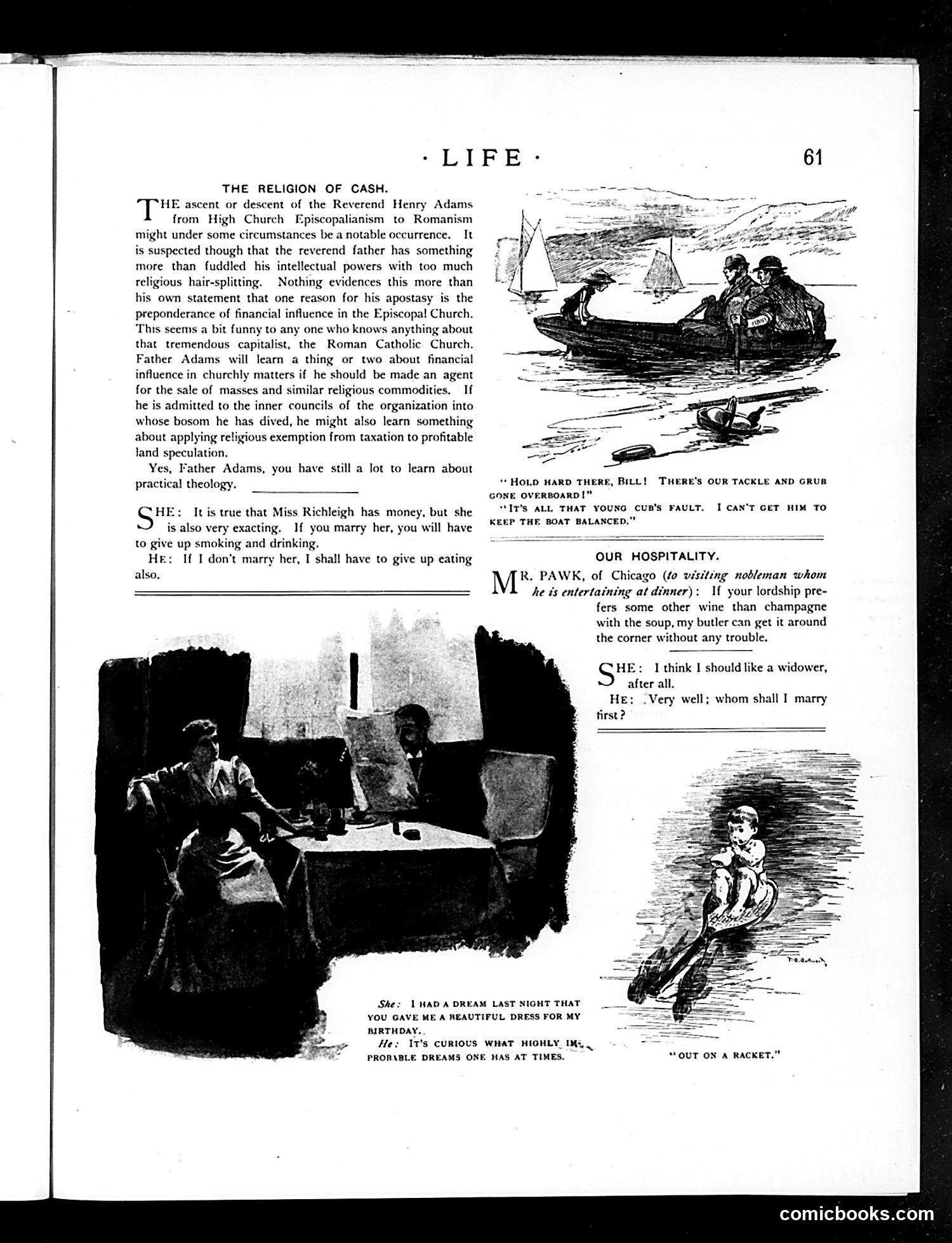
This page contains several satirical vignettes typical of Life's humor: **"The Religion of Cash"** (top): A commentary mocking Reverend Henry Adams for converting from Episcopalianism to Catholicism, citing the Episcopal Church's financial influence as his reason. The satire's point: this is hypocritical, since the Catholic Church is even more dominated by money and financial exploitation—including selling masses and exploiting tax exemptions for land speculation. **Three short comedic dialogues** featuring domestic and social humor: 1. A woman warns a suitor that marrying her means giving up smoking and drinking; he replies he'd have to give up eating if he *doesn't* marry her—joking that her exacting nature or his poverty makes both options miserable. 2. Mr. Pawk of Chicago boasts to a visiting nobleman that his butler can obtain superior wine "around the corner"—a veiled reference to Prohibition-era bootlegging. 3. A woman claims to have dreamed of receiving a dress; the man's response implies her dreams of gifts are unrealistic fantasies. **Illustrations** include sailing/boating scenes and a figure "out on a racket."
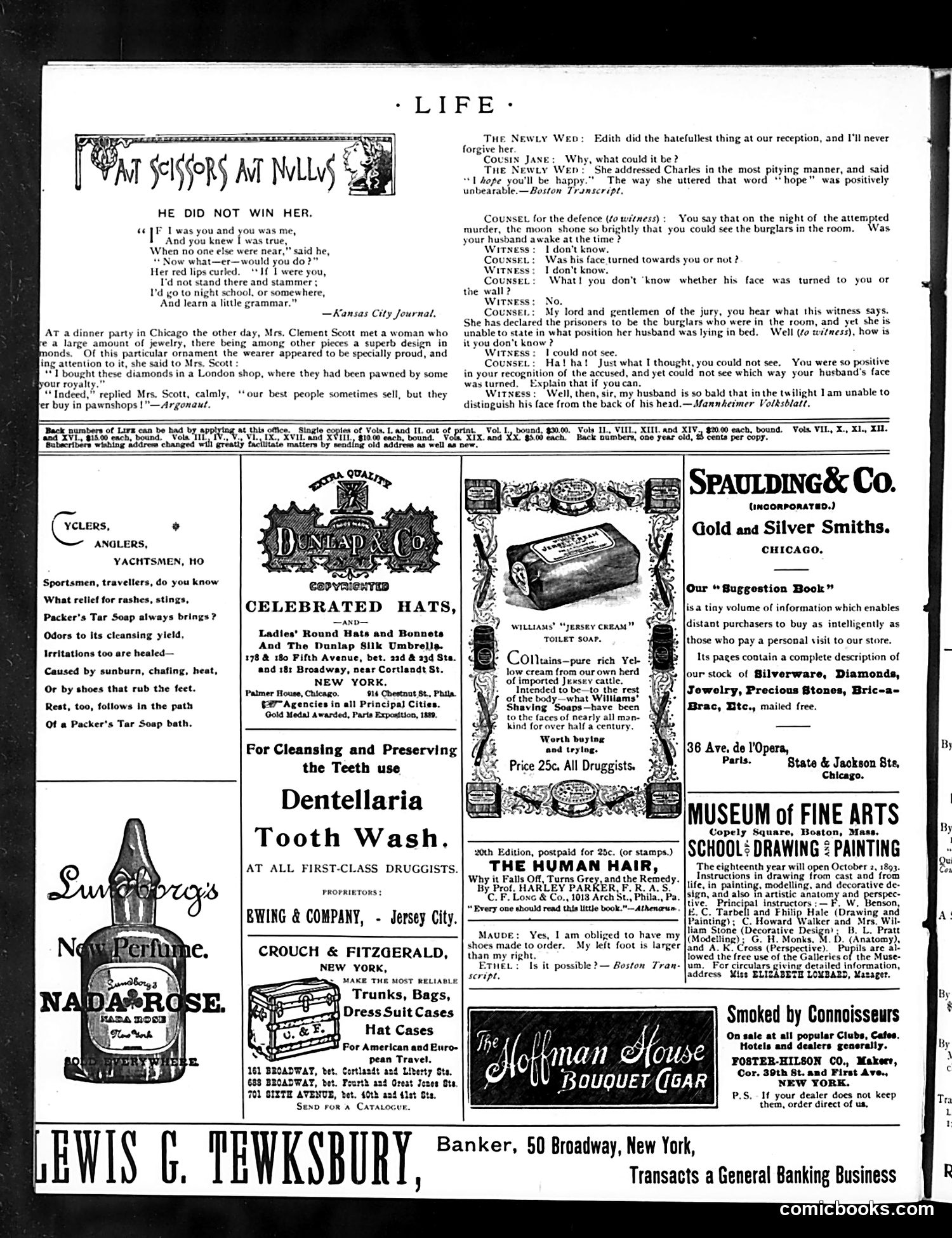
This page contains three separate satirical anecdotes typical of *Life* magazine's humor: 1. **"He Did Not Win Her"**: A man attempts a romantic proposal but stammers awkwardly. The woman rejects him, sarcastically suggesting he attend night school to improve his grammar first. The joke mocks his poor speech and ineffectual courtship. 2. **The Pawnshop Diamond Story**: At a Chicago dinner party, a woman boasts about expensive diamonds. Mrs. Scott replies that "our best people sometimes sell" jewelry at pawnshops—a cutting remark implying the woman's claimed social status is dubious, possibly that she bought secondhand goods. 3. **The Cross-Examination**: A legal satire where a witness testifies she recognized burglars by moonlight but contradicts herself when questioned. The punchline reveals her husband is so bald she cannot distinguish his face from the back of his head in dim light—absurdist humor exposing the witness's unreliability. All three mock poor communication, social pretension, and logical inconsistency. The page also contains period advertisements for grooming products and luggage.
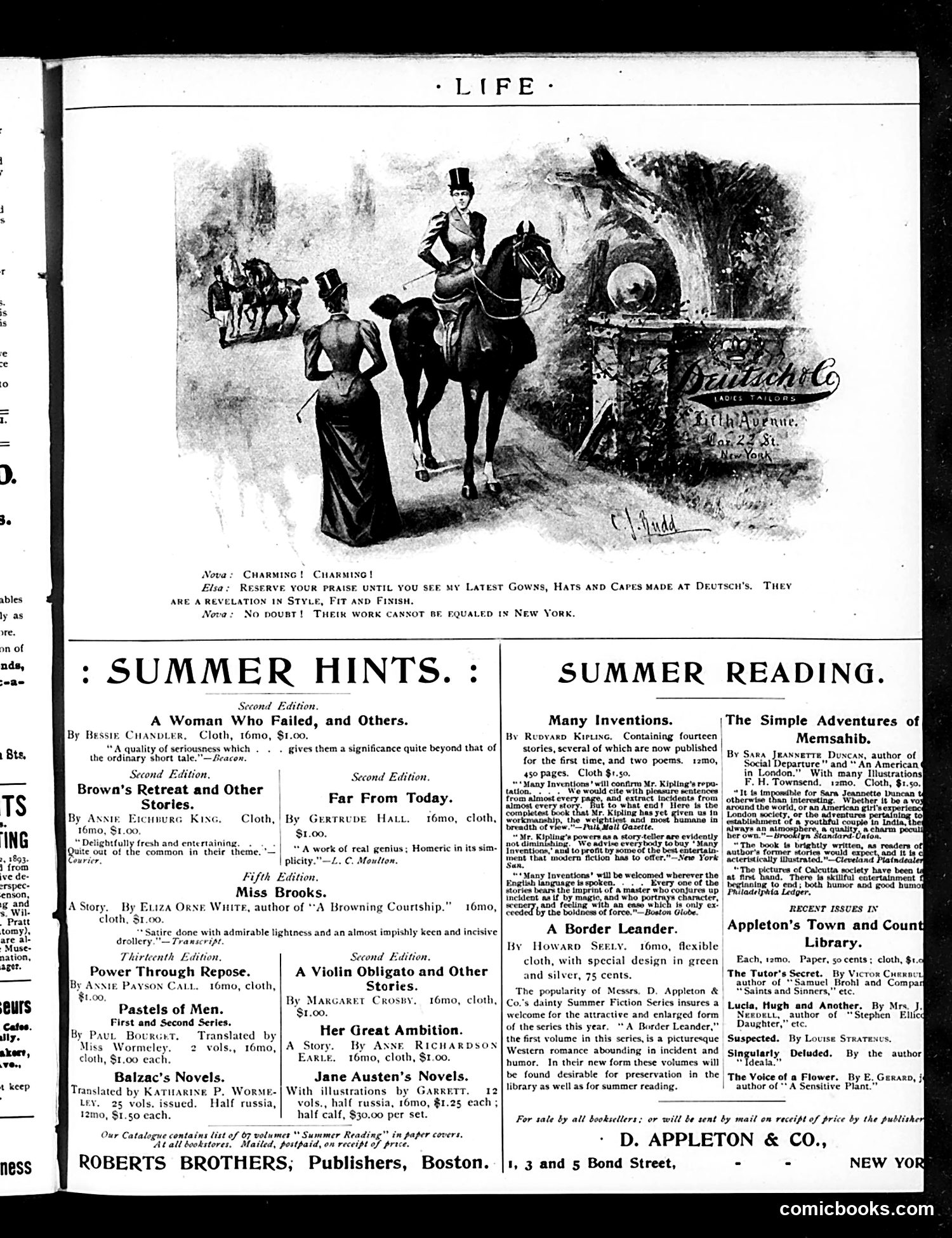
This is primarily an **advertising and book catalog page** rather than a political cartoon. The top illustration is a **fashion advertisement** for Deutsch's Ladies Tailors (New York), showing a woman admiring a fashionably dressed lady on horseback. The dialogue mocks the woman's enthusiasm—she says the clothes are "charming" and "reveal style, fit and finish," while the rider haughtily commands her to "reserve your praise" until seeing Deutsch's latest designs, asserting they cannot be "equaled in New York." The satire targets **vanity and class pretension**: the advertisement exaggerates both the snobbish superiority of the fashionable woman and the gullible admiration of those below her social station. It's a gentle mockery of how fashion advertising exploits consumers' aspirations. The remainder of the page consists of **summer reading recommendations**—books by authors like Rudyard Kipling and Jane Austen, published by Roberts Brothers and D. Appleton & Co. This reflects late 19th-century American literary culture and publishing practices.
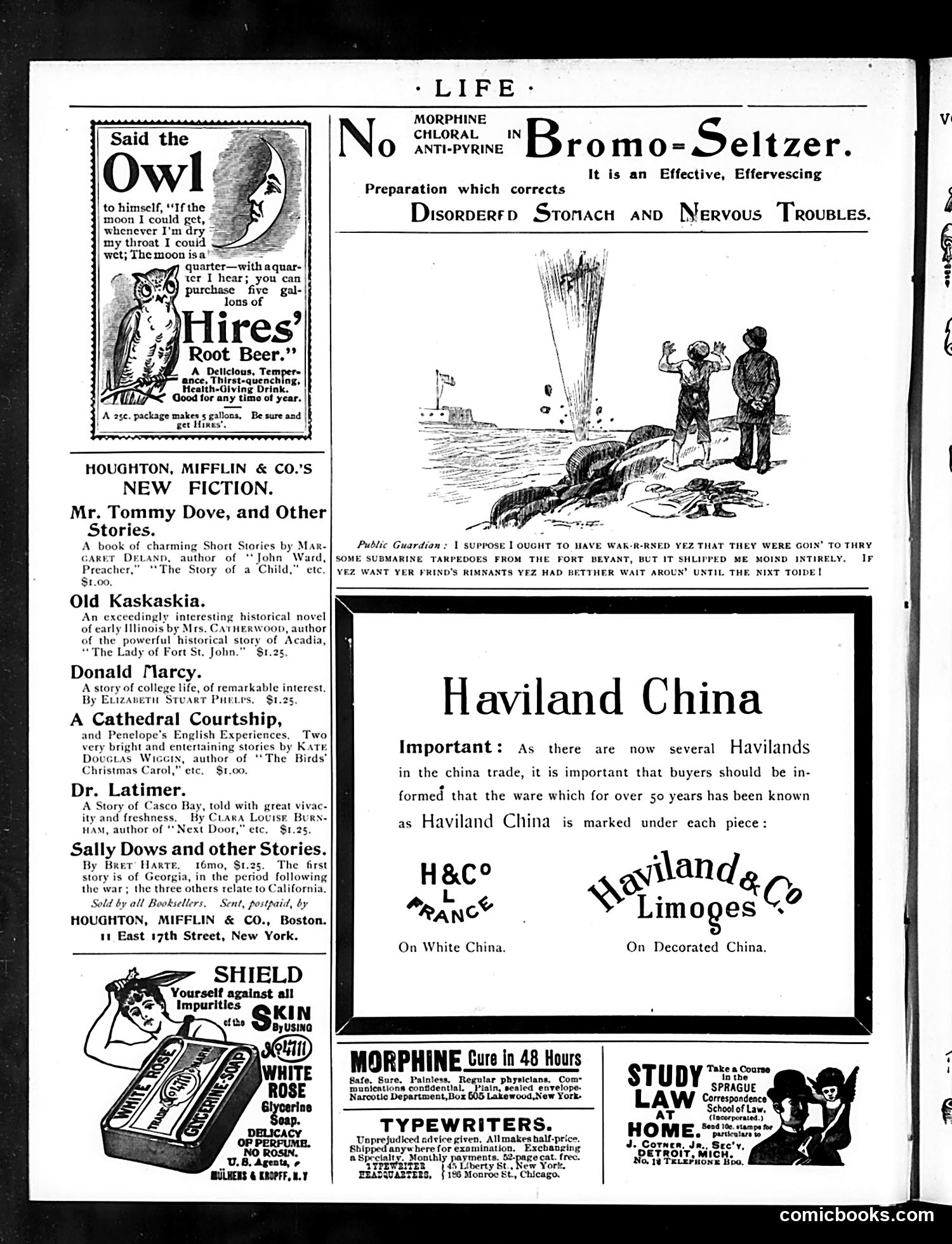
This page is primarily **advertising and book announcements** rather than editorial cartoon content. The main satirical element is a small illustration labeled "Public Guardian," which appears to be an Irish-accented character (indicated by dialect spelling: "WAR-R-R-D YEZ," "SHLIPPED," "RIMNANTS") apologizing for forgetting to warn about submarine torpedoes from "the fort beyant" (beyond). This likely references **early WWI submarine warfare concerns** affecting Irish-American readers, using comic dialect for satirical effect. The bulk of the page consists of: - **Book advertisements** from Houghton Mifflin publishers - **Product ads** (Hires Root Beer, Bromo-Seltzer, morphine treatments, typewriters, law school courses) - **Haviland China notices** distinguishing authentic French china from competitors The owl mascot promotes root beer as a temperance alternative to alcohol—reflecting Progressive-era anti-drinking sentiment common in the period.