
Life, 1893-07-27 · page 8 of 16
Life — July 27, 1893 — page 8: what you’re looking at
What you’re looking at
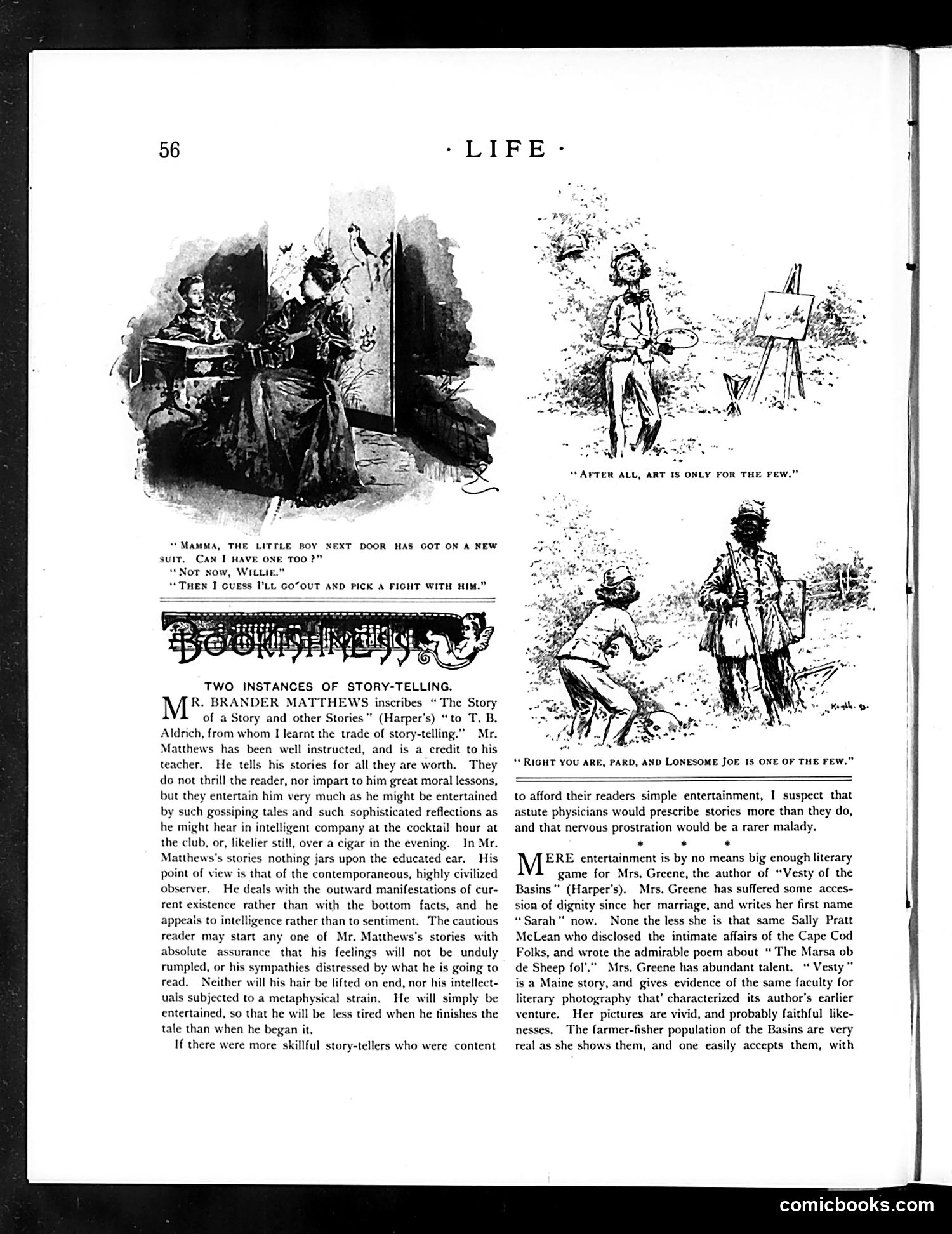
This page from *Life* magazine contains two distinct sections: **Left side:** A sketch-based comic about a child requesting a new suit by referencing a neighbor boy's outfit, with the caption suggesting the child would "pick a fight" to obtain one. This is gentle domestic humor about childhood materialism and sibling rivalry. **Right side:** Three sketches illustrating different characters with the captions "After all, art is only for the few" and "Right you are, Pard, and lonesome Joe is one of the few." These appear to satirize artistic pretension—mocking the idea that art appreciation is elite while suggesting certain "common" types (represented by the roughly-drawn figures) lack artistic sensibility. The main text discusses story-telling as entertainment, praising Brander Matthews' approach to accessible narrative over overly intellectualized fiction.
📄 Transcribed text from this page (OCR, searchable)
Machine-transcribed from the original scan — historical spelling and the odd misread are preserved.
“MAMMA, THE LITTLE BOY NEXT DOOR HAS GOT ON A NEW suit, Can I HAVE ONE TOO ?” “Not sow, WILLIE. TWO INSTANCES OF STORY-TELLING. M®* BRANDER MATTHEWS inscribes “The Story of a Story and other Stories” (Harper's) “to T. B. Aldrich, from whom I learnt the trade of story-telling.” Mr. Matthews has been well instructed, and is a credit to his teacher. He tells his stories for all they are worth. They do not thrill the reader, nor impart to him great moral lessons, but they entertain him very much as he might be entertained by such gossiping tales and such sophisticated reflections as he might hear in intelligent company at the cocktail hour at the club, or, likelier still, over a cigar in the evening. In Mr. Matthews's stories nothing jars upon the educated ear. His point of view is that of the contemporancous, highly civilized observer. He deals with the outward manifestations of cur- rent existence rather than with the bottom facts, and he appeais to intelligence rather than to sentiment. The cautious reader may start any one of Mr. Matthews's stories with absolute assurance that his feelings will not be unduly rumpled, or his sympathies distressed by what he is going to read. Neither will his hair be lifted on end, nor his intellect- uals subjected to a metaphysical strain. He will simply be entertained, so that he will be less tired when he finishes the tale than when he began it. If there were more skillful story-tellers who were content “RIGHT YOU ARE, PARD, AND LONESOME JOE 18 ONE OF THE FEW.” to afford their readers simple entertainment, I suspect that astute physicians would prescribe stories more than they do, and that nervous prostration would be a rarer malady. . . . ERE entertainment is by no means big enough literary game for Mrs. Greene, the author of “Vesty of the Basins” (Harper's). Mrs. Greene has suffered some acces- sion of dignity since her marriage, and writes her first name “Sarah” now. None the less she is that same Sally Pratt McLean who disclosed the intimate affairs of the Cape Cod Folks, and wrote the admirable poem about “ The Marsa ob de Sheep fol’... Mrs. Greene has abundant talent. “ Vesty” is a Maine story, and gives evidence of the same faculty for literary photography that’ characterized its author's earlier venture. Her pictures are vivid, and probably faithful like- nesses, The farmer-fisher population of the Basins are very real as she shows them, and one easily accepts them, with comicbooks.com