
Life, 1893-07-27 · page 9 of 16
Life — July 27, 1893 — page 9: what you’re looking at
What you’re looking at
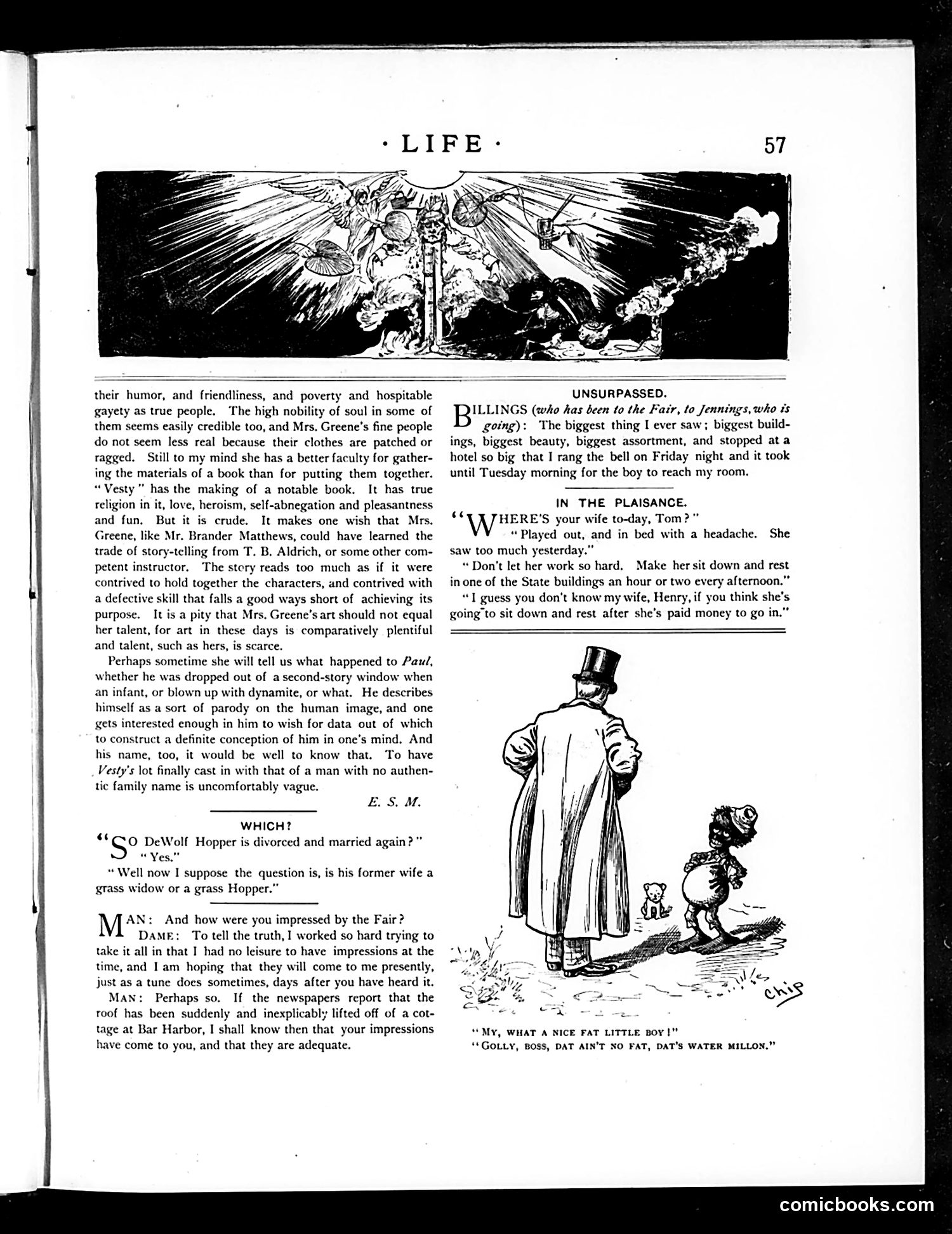
This page contains literary criticism and social commentary rather than political cartoons. The main content discusses Mrs. Greene's book about poor people, critiquing her portrayal of working-class life as somewhat superficial despite good intentions. A small illustration shows a well-dressed man in a top hat walking with a child, captioned "My, what a nice fat little boy!" with the child's reply about water melons. This appears to be gentle social satire about class differences and how the wealthy perceive poor children. The page also includes dialogue exchanges labeled "UNSURPASSED," "IN THE PLAISANCE," and "WHICH?"—typical of Life's humor format—offering witty observations about domestic life and social pretensions. The overall tone is satirical commentary on late 19th or early 20th-century American society and literature.
📄 Transcribed text from this page (OCR, searchable)
Machine-transcribed from the original scan — historical spelling and the odd misread are preserved.
their humor, and friendliness, and poverty and hospitable gayety as true people. The high nobility of soul in some of them seems easily credible too, and Mrs. Greene’s fine people do not seem less real because their clothes are patched or ragged. Still to my mind she has a better faculty for gather- ing the materials of a book than for putting them together. “Vesty " has the making of a notable book. It has true religion in it, love, heroism, self-abnegation and pleasantness. and fun, But it is crude. It makes one wish that Mrs. Greene, like Mr. Brander Matthews, could have learned the trade of story-telling from T. B. Aldrich, or some other com- petent instructor. The stery reads too much as if it were contrived to hold together the characters, and contrived with a defective skill that falls a good ways short of achieving its purpose. It is a pity that Mrs. Greene's art should not equal her talent, for art in these days is comparatively plentiful and talent, such as hers, is scarce. Perhaps sometime she will tell us what happened to Pax/, whether he was dropped out of a second-story window when an infant, or blown up with dynamite, or what. He describes himself as a sort of parody on the human image, and one gets interested enough in him to wish for data out of which to construct a definite conception of him in one’s mind, And his name, too, it would be well to know that. To have Vesty’s lot finally cast in with that of a man with no authen- tic family name is uncomfortably vague. ELS. M. WHICH? “©©O DeWolf Hopper is divorced and married again?” “Well now I suppose the question is, is his former wife a gtass widow or a grass Hopper.” AN: And how were you impressed by the Fair? DaME: To tell the truth,] worked so hard trying to take it all in that I had no leisure to have impressions at the time, and Iam hoping that they will come to me presently, just as a tune does sometimes, days after you have heard it. MAN: Perhaps so. If the newspapers report that the roof has been suddenly and inexplicably lifted off of a cot- tage at Bar Harbor, I shall know then that your impressions have come to you, and that they are adequate. UNSURPASSED. ILLINGS (who has been to the Fair, to Jennings, who is going): The biggest thing I ever saw; biggest build- ings, biggest beauty, biggest assortment, and stopped at a hotel so big that I rang the bell on Friday night and it took until Tuesday morning for the boy to reach my room. IN THE PLAISANCE. HERE'S your wife to-day, Tom?” “Played out, and in bed with a headache. She saw too much yesterday.” “Don’t let her work so hard. Make her sit down and rest in one of the State buildings an hour or two every afternoon.” “T guess you don’t know my wife, Henry, if you think she’s going to sit down and rest after she’s paid money to go in,” “MY, WHAT A NICE FAT LITTLE Boy !"" ‘*GOLLY, BOSS, DAT AIN'T NO FAT, DAT'S WATER MILLON.”” comicbooks.com