
A complete issue · 18 pages · 1893
Life — July 6, 1893
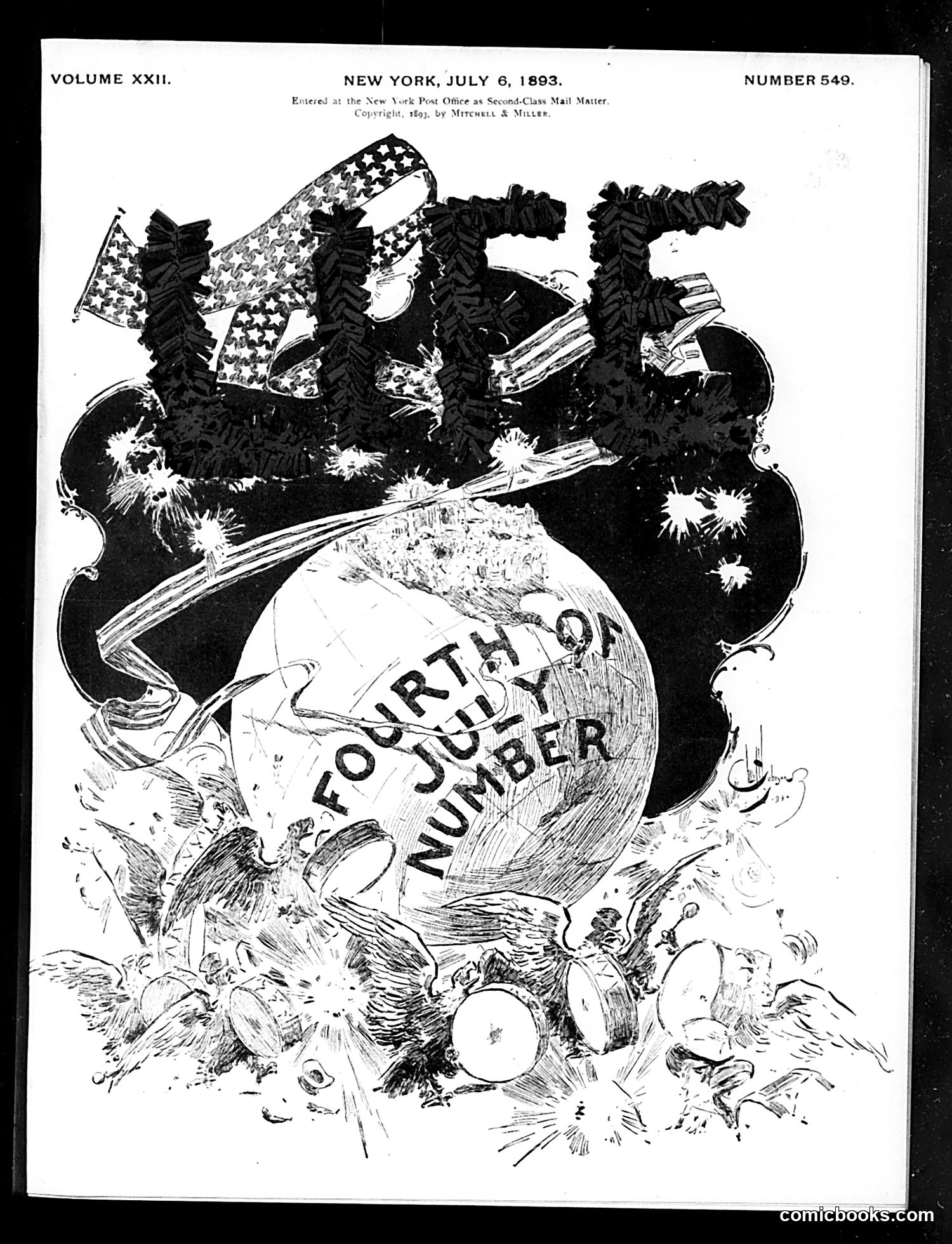
This satirical cover depicts a large egg labeled "FORTY-SECOND NUMBER" being attacked by two caricatured figures. The egg appears to be hatching or exploding with fireworks and celebratory imagery, including American flags. The "forty-second number" likely references the 42nd Congress or a significant legislative session. The two figures—rendered in a style suggesting political opponents—are shown as if struggling with or reacting to this development. The fireworks and explosive imagery suggest either celebration or chaos surrounding a political event. Without the article text, the specific legislative or political controversy isn't entirely clear, but the cover presents a contentious moment being treated with satirical mockery typical of Life magazine's approach to contemporary political events.
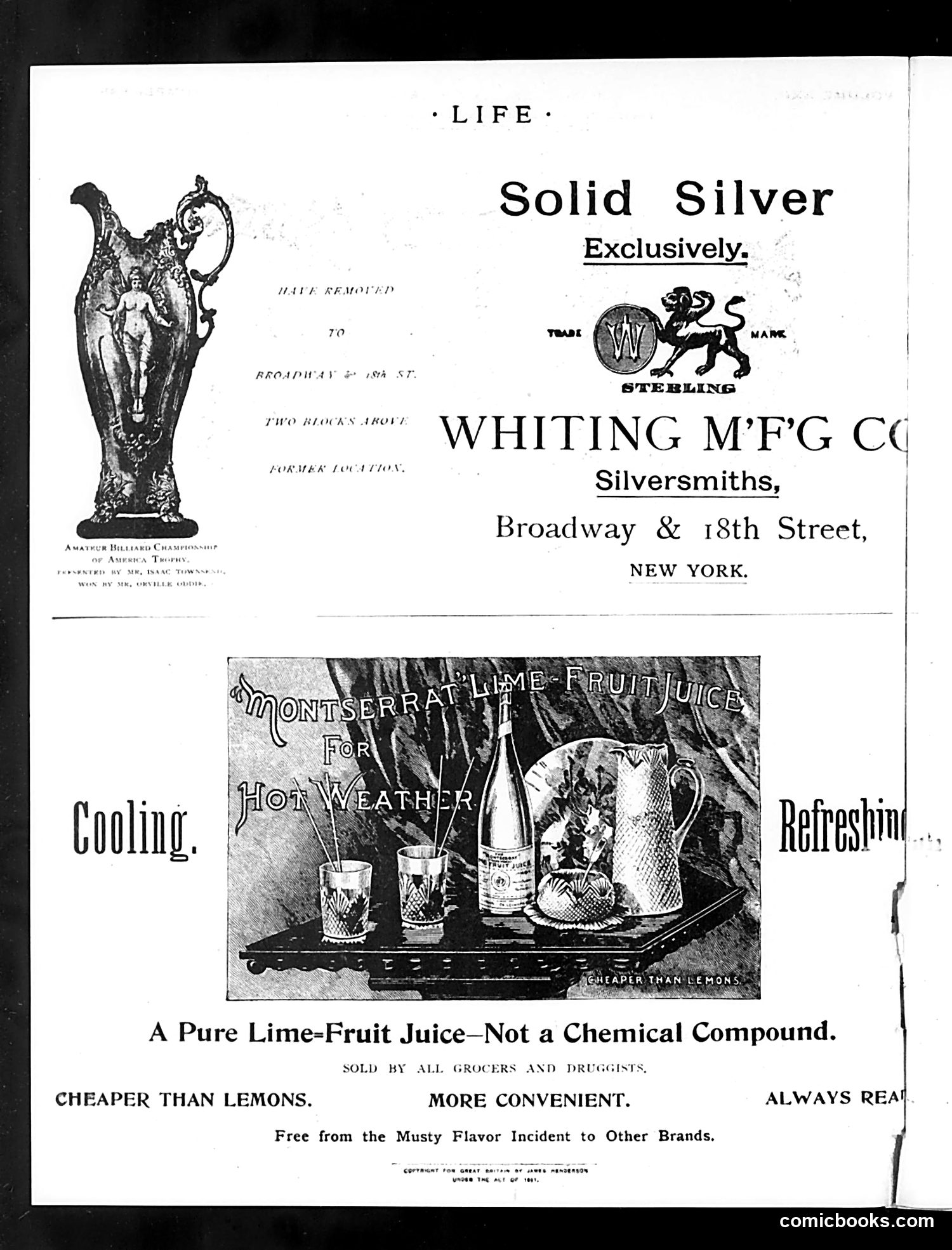
This page is primarily **advertising**, not satire or political commentary. The top half features two unrelated ads: a Whiting Manufacturing Company advertisement for solid silver products (silversmiths located at Broadway & 18th Street, New York), accompanied by an ornate silver pitcher trophy labeled "Amateur Billiards Championship." The bottom half advertises Montserrat Lime-Fruit Juice, a beverage marketed for hot weather consumption. The ad emphasizes it's "a pure lime-fruit juice—not a chemical compound," cheaper than lemons, and "free from the musty flavor incident to other brands." There is **no evident political cartoon or satire** on this page. It represents typical early 20th-century *Life* magazine advertising content promoting luxury goods and consumer products to its affluent readership.
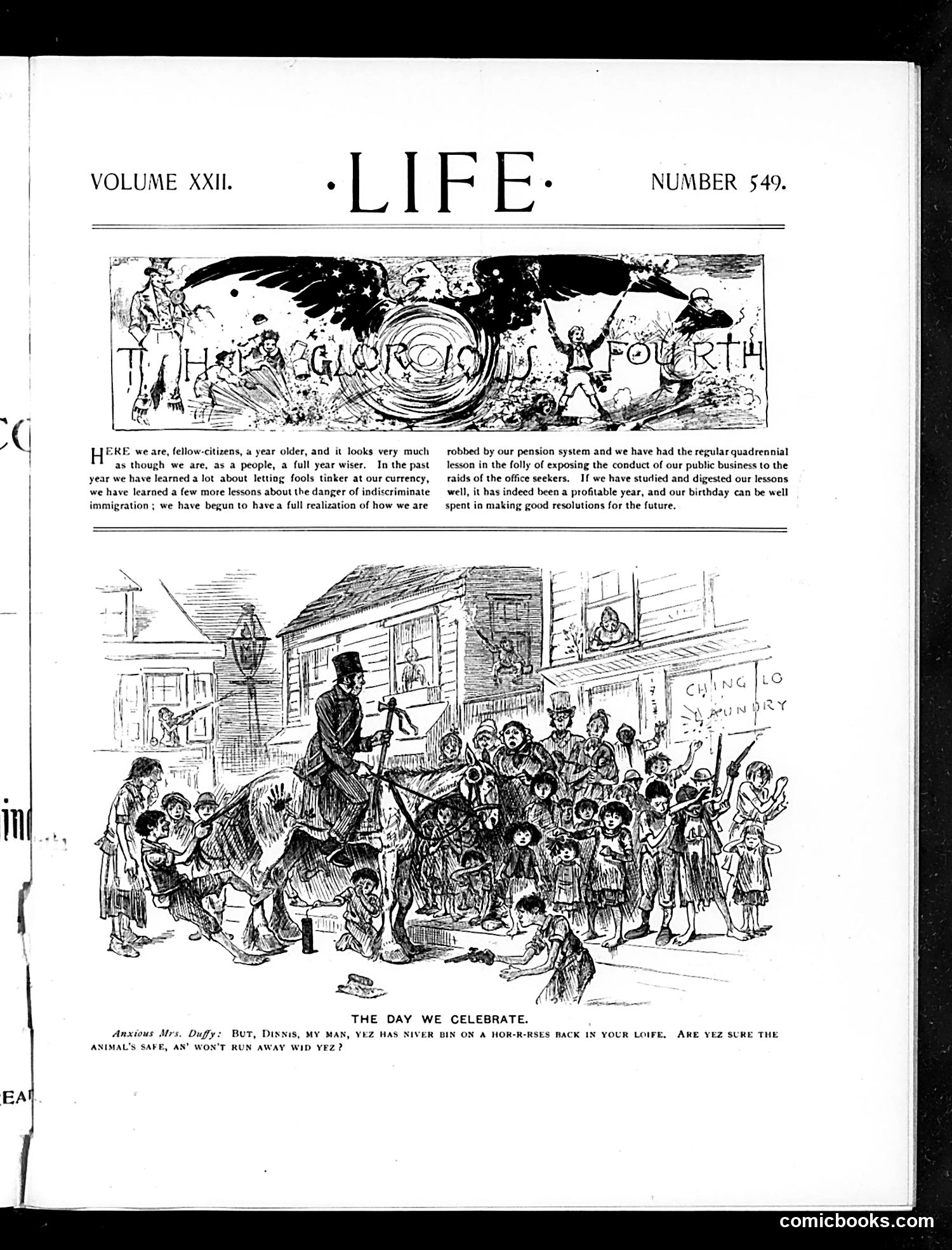
This page from *Life* magazine's "Fourth of July" issue features a satirical cartoon titled "The Day We Celebrate." The illustration shows a man on horseback addressing a large crowd of poor urban children in what appears to be a tenement neighborhood. The caption includes dialect speech ("Yez has niver bin on a hor-n-ses back in your loife") that appears to mock both the speaker and the audience, suggesting condescension toward impoverished immigrants. The satire critiques wealthy Americans making performative gestures toward the poor—the horseman's patriotic address to underprivileged children seems hollow and patronizing rather than substantive. The accompanying editorial text references lessons learned about "the danger of indiscriminate immigration" and "good resolutions for the future," indicating this reflects early-20th-century anxieties about immigration and class divisions.
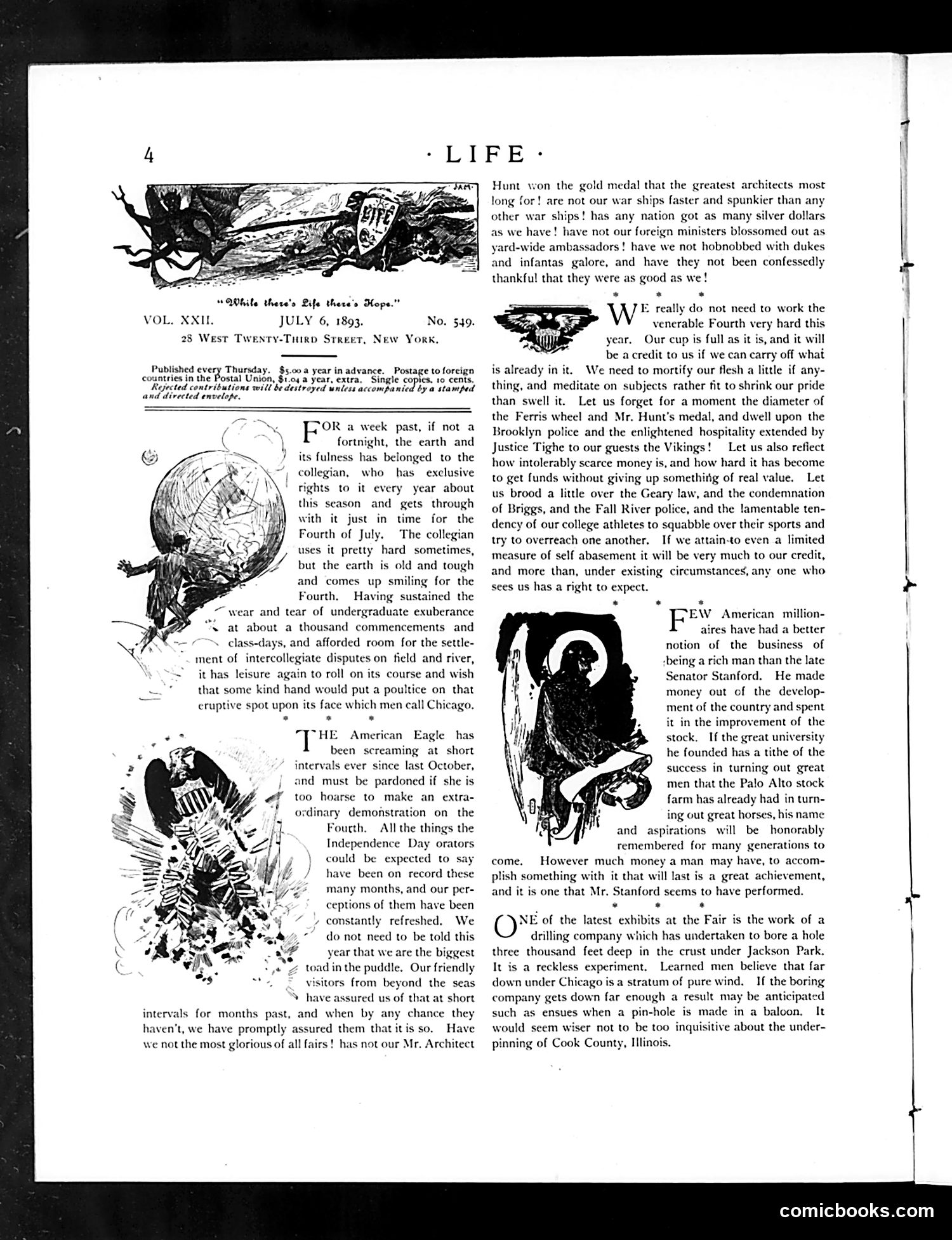
This page contains editorial commentary rather than political cartoons. The text addresses several 1893 issues: **The Eagle illustration** references the American Eagle as a national symbol, discussing Independence Day celebrations and noting the Eagle has been "screaming" (protesting) since October—likely referring to economic anxieties during the 1893 financial panic. **Senator Stanford reference** praises a wealthy businessman's philanthropic vision for developing superior stock and horses, contrasting private wealth with public good. **The Jackson Park boring experiment** describes a drilling company attempting to bore 3,000 feet deep under Chicago to study subsurface conditions—presented as reckless scientific curiosity that could cause disasters. The tone is satirical about American excess, ambition, and the tensions between private enterprise and public safety during the economically turbulent 1890s.
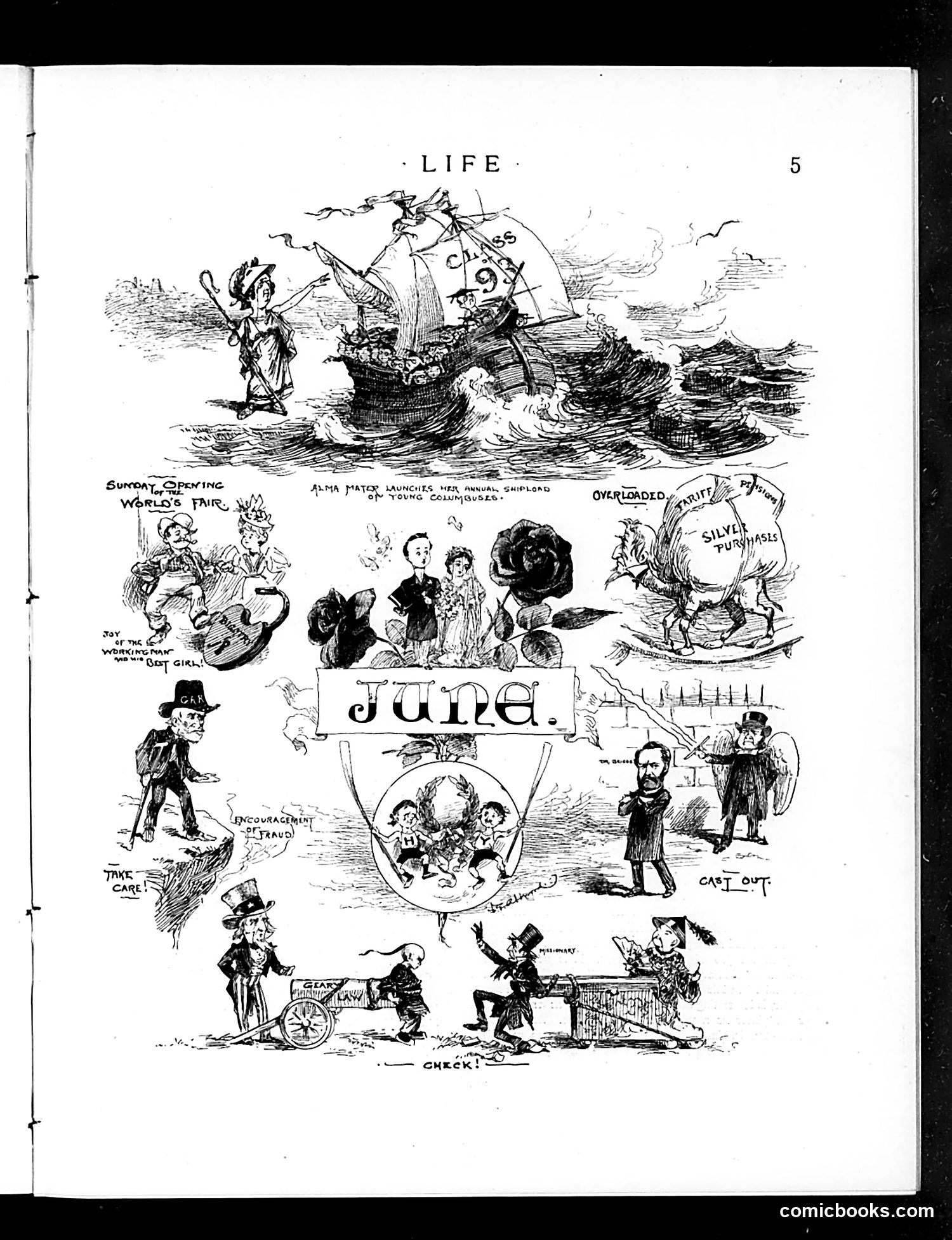
This page is a visual calendar for June featuring satirical vignettes of contemporary social issues and behaviors. The cartoons include: **"Sunday Opening World's Fair"** — depicts the controversy over opening the 1893 World's Columbian Exposition on Sundays, which religious groups opposed. **"Alma Mater Launches Her Annual Shipload of Young Columbiuses"** — satirizes university graduates entering the world unprepared. **"Overloaded Charity"** and **"Silver Turnstiles"** — likely comment on charitable organizations and financial matters. **"Joy of Witnessing Man and His Dust Girl,"** **"Discouragement at First," "Take Care,"** **"Cast Out,"** and **"Check!"** — appear to address various social anxieties: employment struggles, poverty, class conflict, and legal/financial troubles typical of the 1890s. The central June emblem ties these disparate social commentary sketches together as monthly themes.
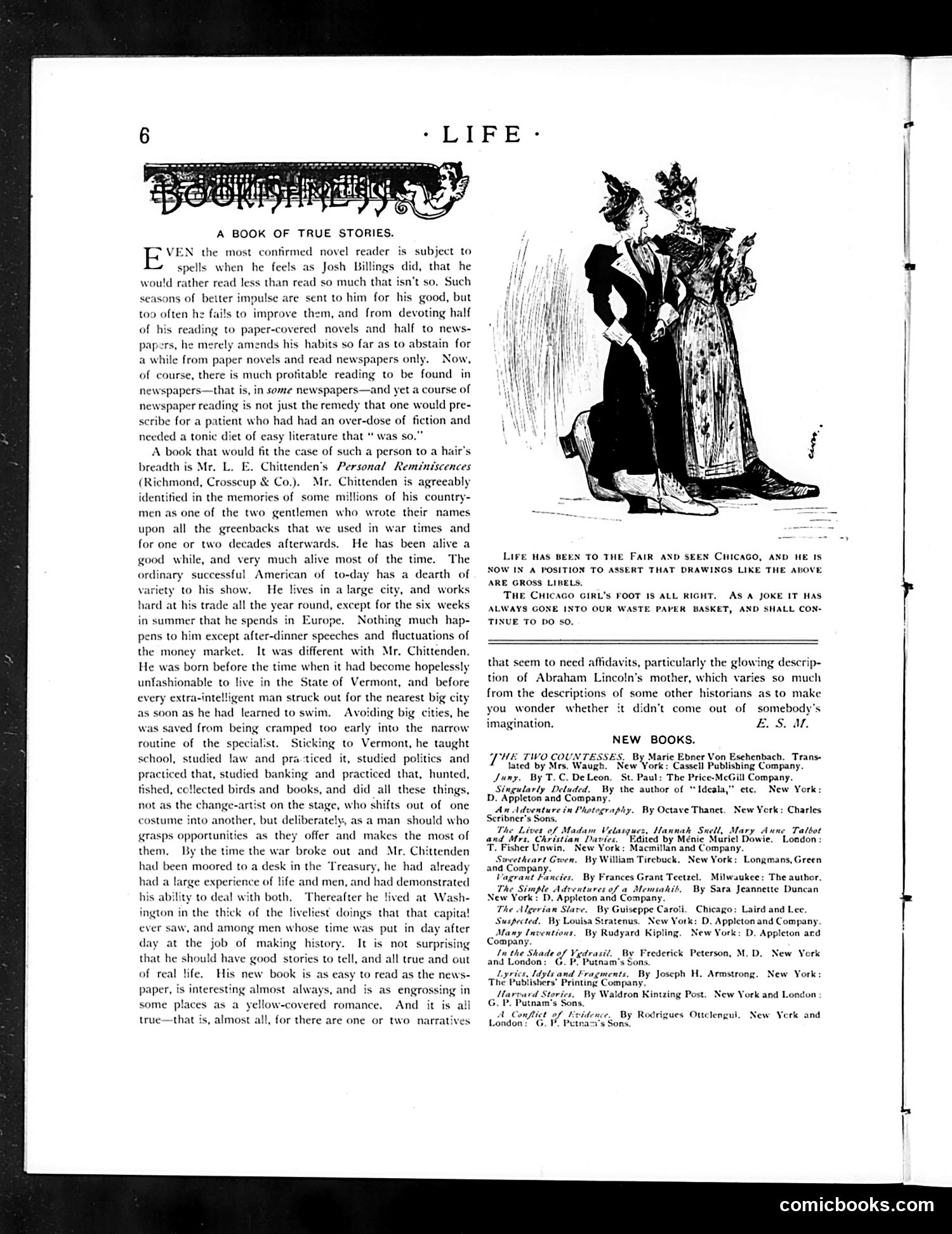
This page features a book review section titled "Bookishly" with accompanying satirical illustration. The cartoon depicts two fashionably dressed figures—a man in formal attire and a woman in an elaborate gown with feathered hat—appearing to represent Chicago's social elite or nouveau riche. The accompanying text (in all caps) notes: "Life has been to the Fair and seen Chicago, and he is now in a position to assert that drawings like the above are gross libels. The Chicago girl's foot is all right." This references the 1893 World's Columbian Exposition ("the Fair") in Chicago. The satire mocks exaggerated portrayals of Chicago society figures, while the specific jab at "the Chicago girl's foot" suggests contemporary stereotypes about Midwestern women's appearance or fashion—presenting them as provincial or unfashionable compared to Eastern society standards.
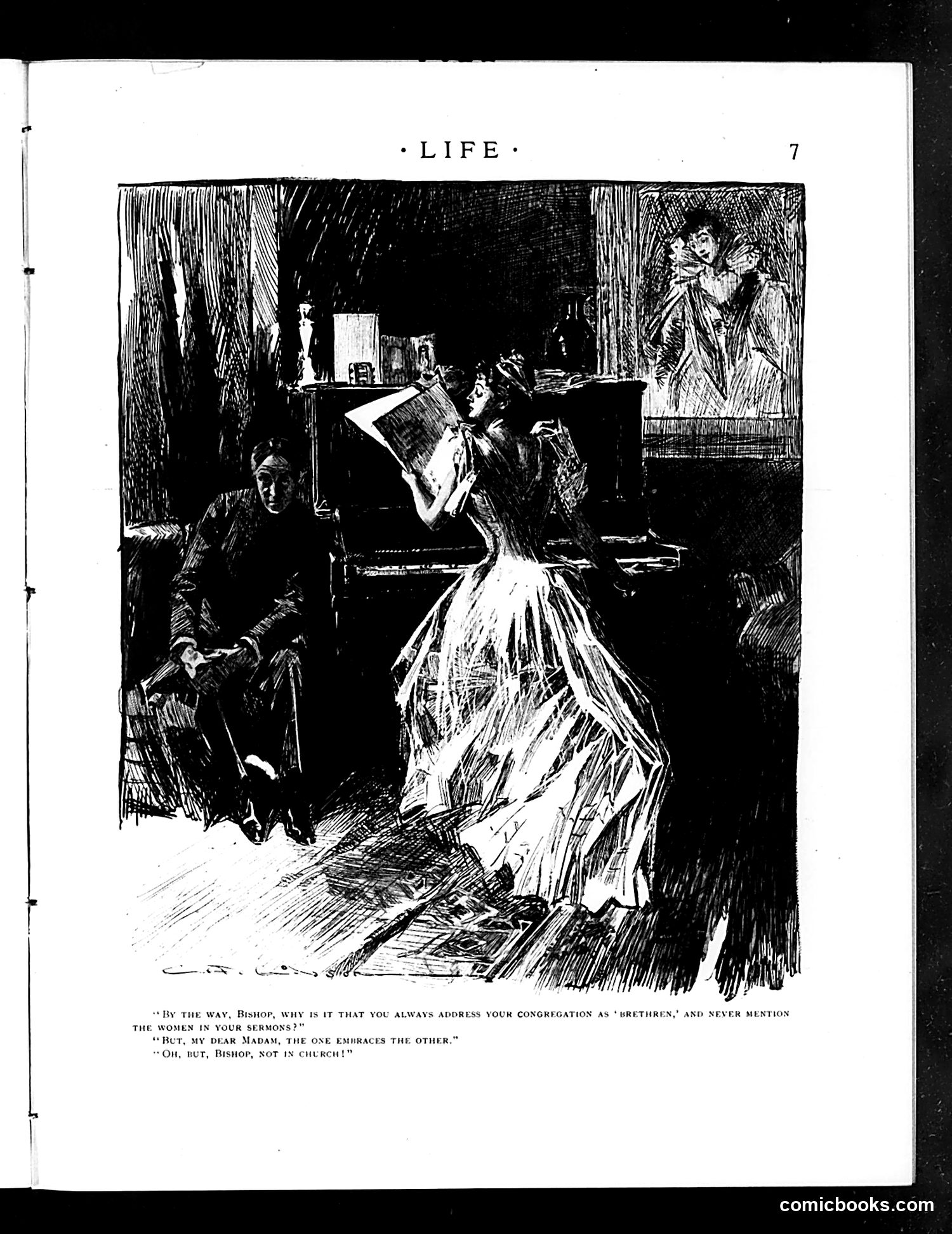
This is a satirical cartoon about gender and religious authority. A woman in an elegant white dress stands at a piano, addressing a Bishop (identifiable by his clerical attire on the left). The dialogue reveals the satire's target: The woman challenges the Bishop's inconsistent language—he addresses his congregation as "brethren" (exclusively masculine) yet never mentions the women present. The Bishop's response, "But, my dear Madam, the one embraces the other," attempts to claim that "brethren" somehow includes women. The cartoon mocks this linguistic evasion, suggesting the church's language deliberately erases women's presence and identity. It's a critique of early 20th-century institutional sexism and how male-dominated institutions used language to marginalize women while claiming inclusivity. The woman's bold confrontation represents emerging feminist critique of such hypocrisy.
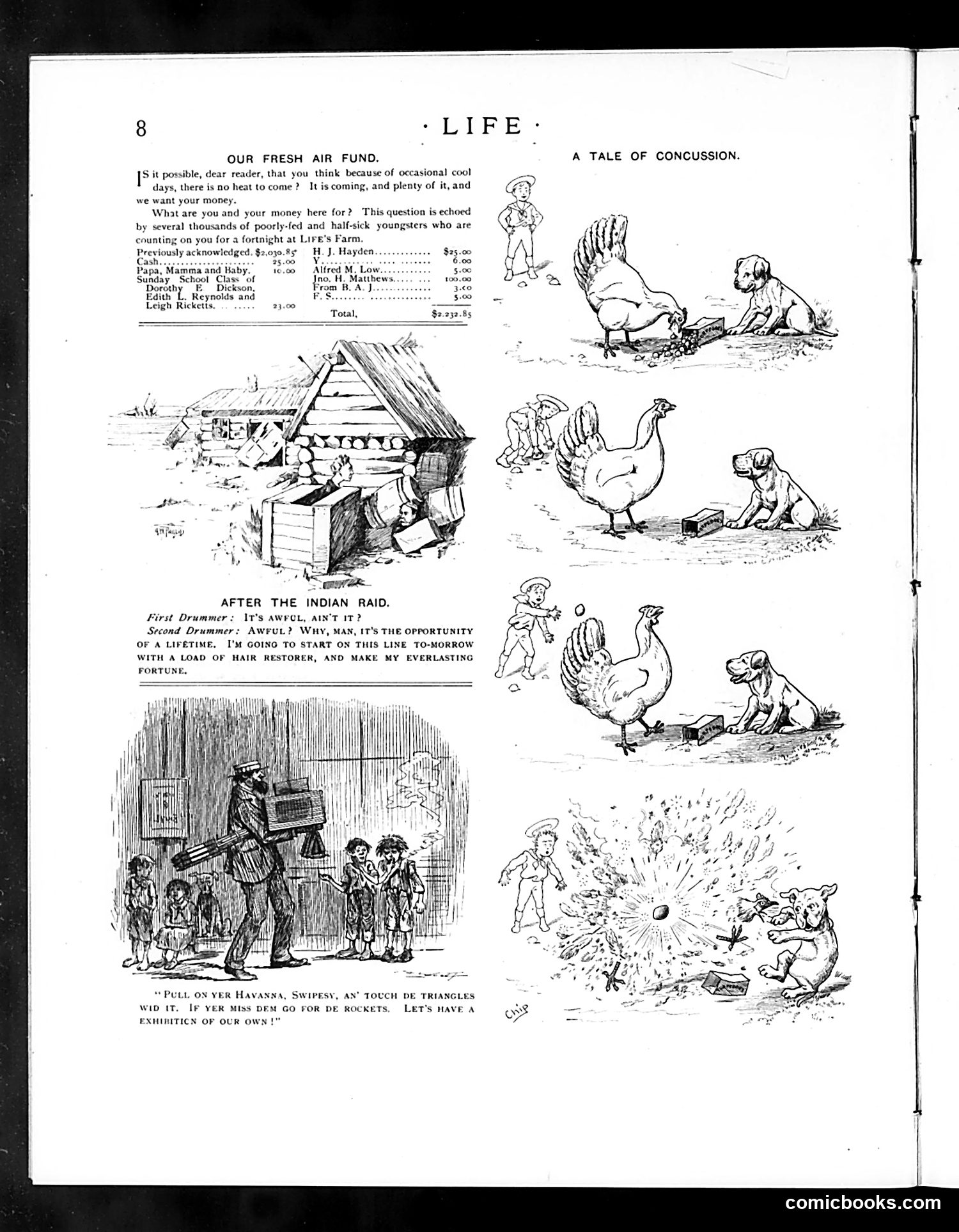
This page contains two distinct pieces: **"Our Fresh Air Fund"** (top left): A fundraising appeal listing donors' names and amounts for a charitable cause—likely sending poor children to a rural retreat called "Life's Farm." This reflects Progressive-era philanthropy. **"After the Indian Raid"** (center): A satirical cartoon mocking American expansionism and greed. Two characters discuss starting a hair-restoration business following conflict with Native Americans, treating tragedy as a commercial opportunity. The caption's reference to "Havana" and "rockets" suggests this comments on American imperialism in the Spanish-American War era (late 1890s). **"A Tale of Concussion"** (right): A humorous comic strip showing children playing with a chicken, culminating in slapstick violence—a joke about childhood mishaps. The satire targets both capitalist exploitation of tragedy and military aggression.
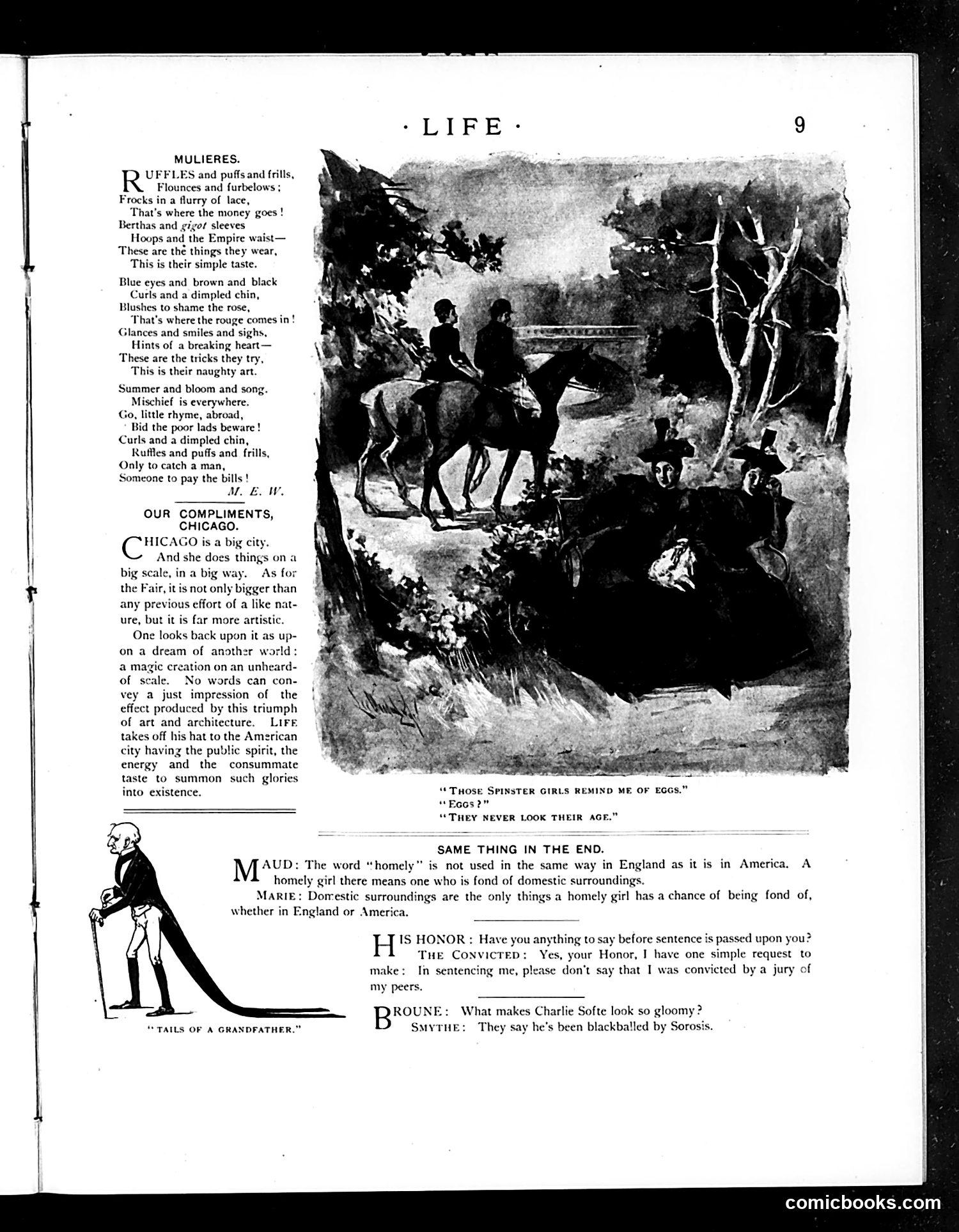
This page contains **two separate pieces of satire**: 1. **"Mulieres"** (left): A poem mocking fashionable women's appearance and behavior—their expensive frills, curls, dimpled chins, and flirtatiousness. The satire suggests these aesthetic tricks are used to manipulate men financially ("Someone to pay the bills!"). This reflects common Victorian/Edwardian-era mockery of women's fashion as frivolous performance. 2. **"Our Compliments, Chicago"** (center-right): Praises the 1893 Chicago World's Fair as a magnificent artistic achievement, calling it a "magic creation" that surpasses previous efforts. 3. **"Same Thing in the End"** (bottom): A dialogue contrasting English and American definitions of "homely girl," satirizing cultural differences between nations. The page's illustration shows people on horseback near water—likely accompanying one of these pieces, though the specific connection is unclear.
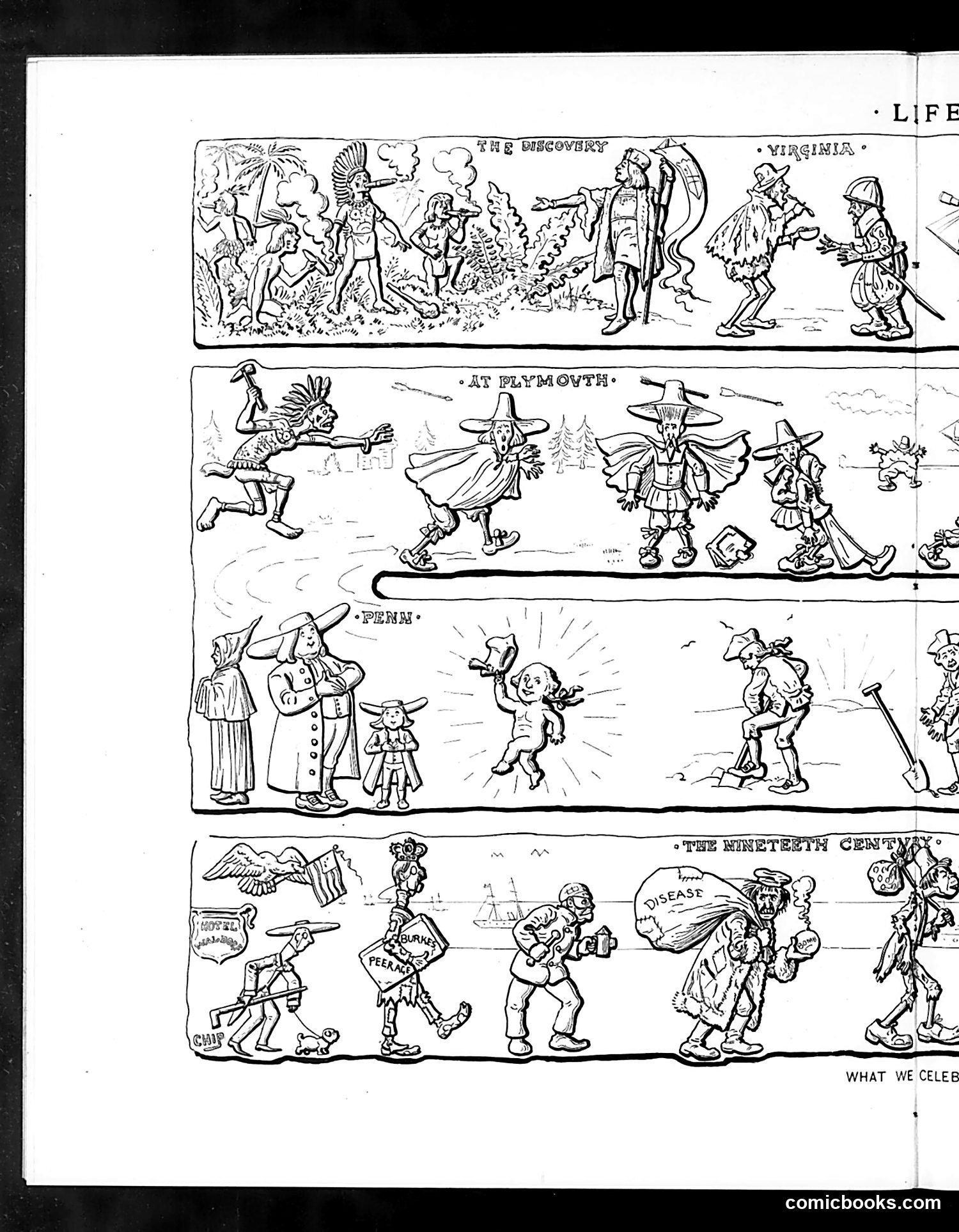
This page shows four horizontal comic strips depicting early American colonial history: 1. **"The Discovery"** (Virginia): Shows Native Americans encountering European explorers/colonists 2. **"At Plymouth"**: Depicts Pilgrims in characteristic clothing and hats 3. **"Penn"**: Features William Penn (identifiable by label) with colonists 4. **"The Nineteenth Century"**: Shows a progression from colonial figures through figures labeled "Disease," "Peevishness," and "Greed," ending with modern figures The satire contrasts America's idealized founding narratives—Native Americans greeting explorers, Pilgrims establishing settlements—with a cynical view of 19th-century American development. The final strip suggests the nation's founders' virtues deteriorated into social vices and moral failings by the 1900s, mocking American progress mythology and contemporary society's character decline.
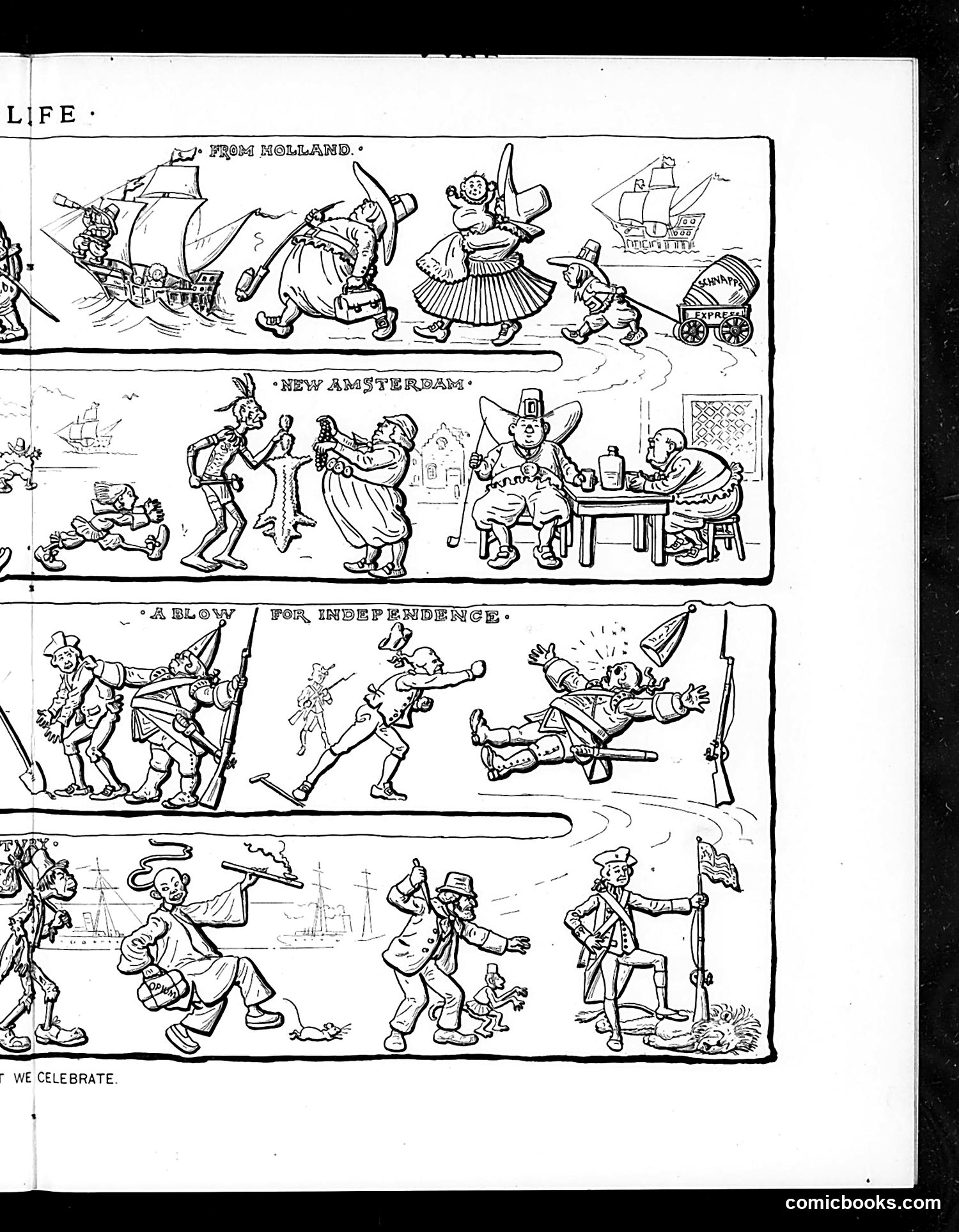
This page contains three comic strips satirizing Dutch and American culture: **"From Holland"** depicts stereotypical Dutch figures with ships, traditional dress, and wooden shoes—mocking Dutch stereotypes. **"New Amsterdam"** shows early Dutch settlers in colonial New York (the original name for Manhattan) in domestic and social situations, apparently contrasting "civilized" European behavior with frontier life. **"A Blow for Independence"** portrays American Revolutionary War themes with figures wielding weapons and flags, celebrating American independence from colonial rule. The overall satire appears to mock both Dutch cultural stereotypes and perhaps comment on America's transition from European colonial heritage to independent nationhood. The exaggerated caricatures and physical comedy are typical of early 20th-century *Life* magazine's satirical style.
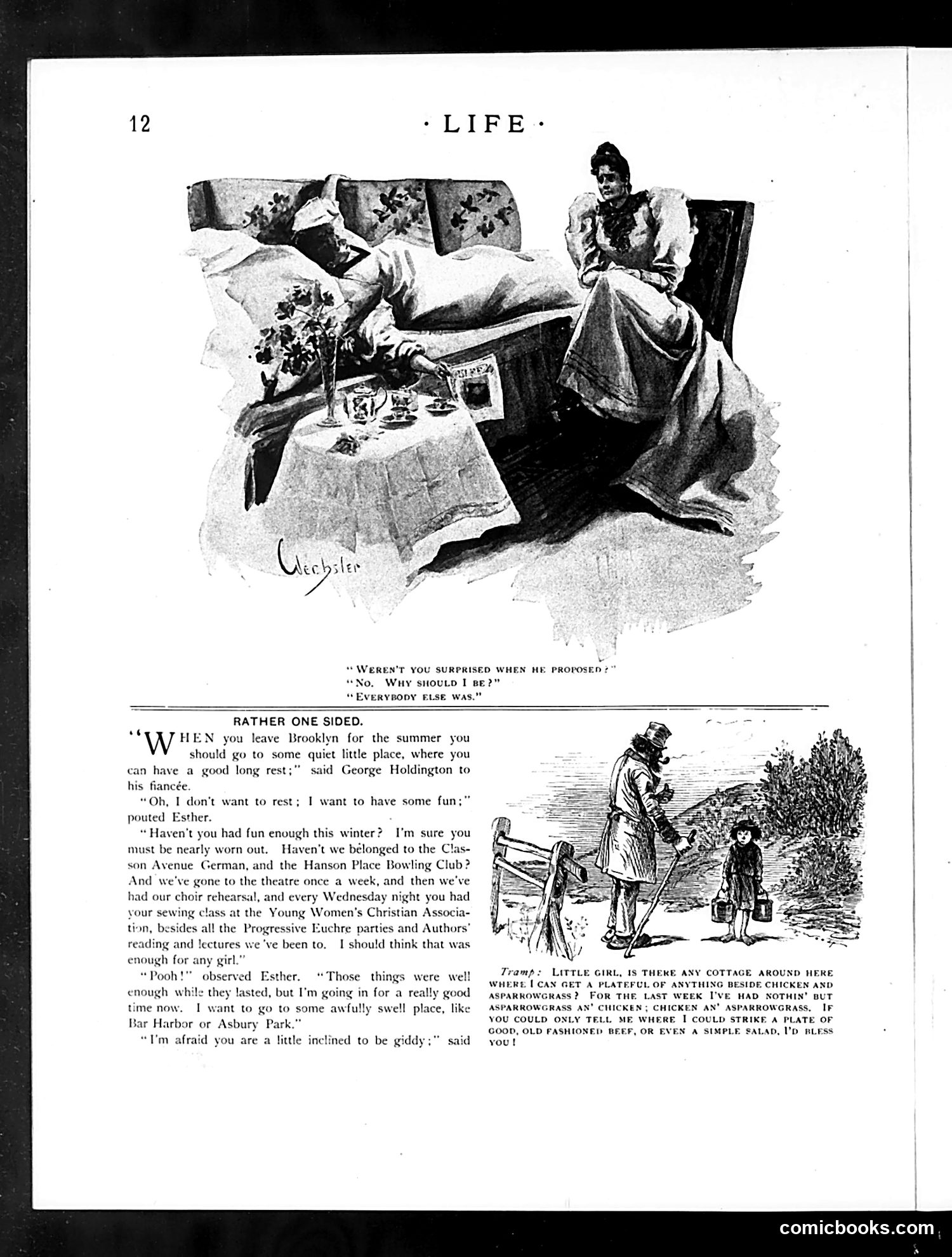
This page contains two separate satirical pieces mocking upper-middle-class social pretensions of the era. **Top cartoon ("Rather One Sided"):** A woman questions why her fiancé George was surprised when he proposed, claiming "everybody else was." The joke satirizes shallow courtship—she's apparently so socially prominent and sought-after that his proposal should have been expected, yet his surprise suggests he knows something about her character that makes the engagement itself surprising to others. **Bottom story and cartoon:** A tramp complains to a little girl about being served only chicken and asparagus at wealthy summer homes where he's begged. He yearns for simple food like beef or salad. This mocks the pretentiousness of affluent vacation destinations (Bar Harbor, Asbury Park—mentioned above) where even charity food follows fashionable menus rather than providing genuine nourishment. The satire targets both the giddiness of wealthy women seeking "awfully swell places" and the artificial refinement that characterizes their leisure pursuits, contrasted with real human need.
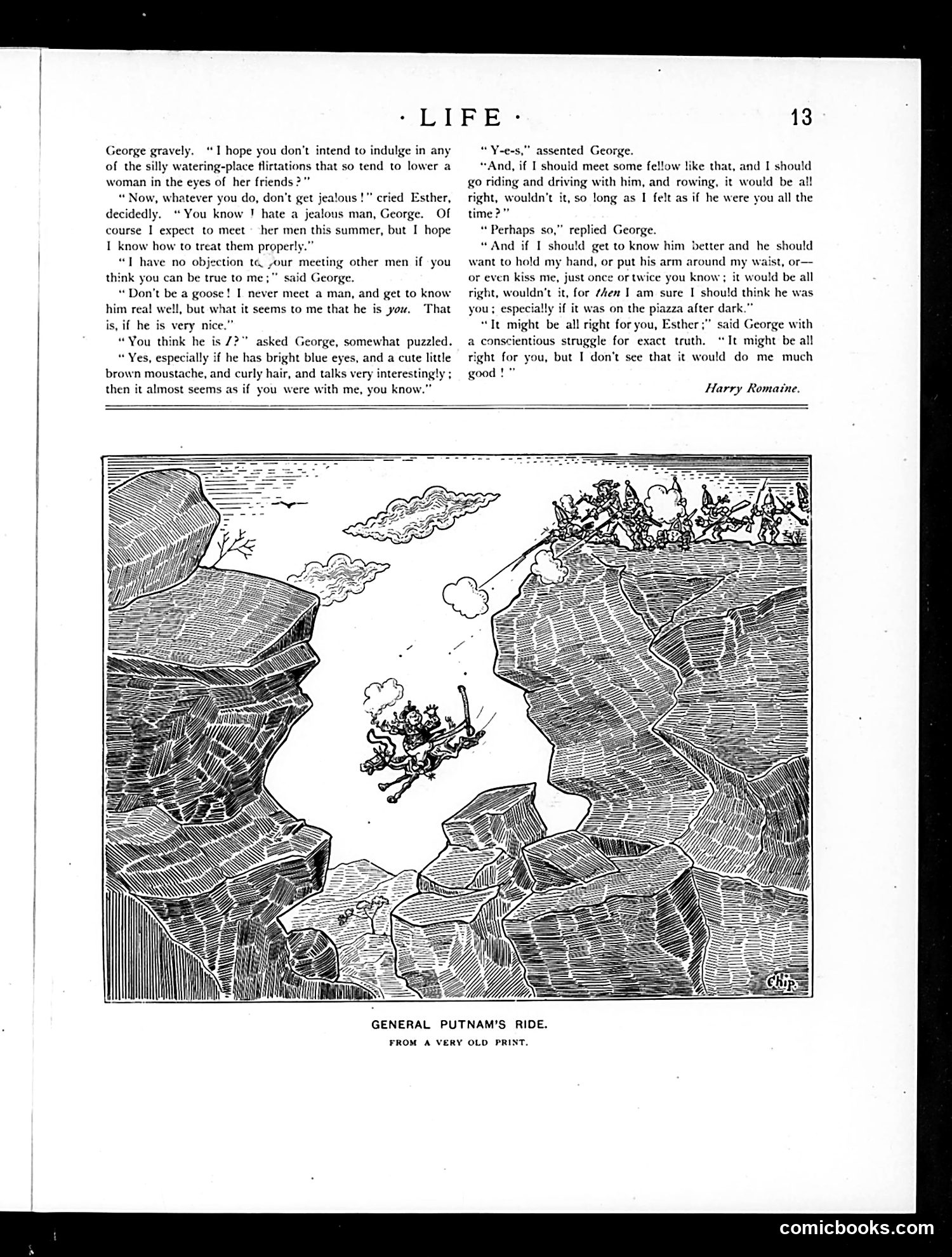
This *Life* magazine page contains two distinct elements: **The Main Text (by Harry Romaine):** A satirical dialogue between George and Esther about marital fidelity. Esther argues that flirting, hand-holding, and even kissing another man is acceptable—as long as she *imagines* he's George. The humor targets Victorian-era gender double standards and the absurdity of women's restricted social freedoms. George's final deadpan response ("it would do me much good") exposes the logical flaw in her reasoning, delivering the satirical punch. **The Illustration:** "General Putnam's Ride" depicts a famous Revolutionary War legend where General Israel Putnam allegedly escaped British forces by riding his horse down a steep cliff. The engraving is labeled "from a very old print," suggesting it's a historical reproduction meant to contrast dignified historical action with the petty domestic squabbles in the text above—a common *Life* technique using juxtaposition for satirical effect. Together, the page mocks both restrictive marriage conventions and women's limited social agency in early 20th-century America.
This page contains three satirical anecdotes rather than political cartoons: 1. **The Pennsylvania Avenue Merchant**: A con artist pitches a scheme requiring only a modest subscription to operate a Krupp gun (expensive German artillery) in Chicago. The satire mocks both get-rich-quick schemes and perhaps German industrial might as an investment opportunity. 2. **The Irish Duel**: An Irishman accepts a duel against a crippled opponent but loses his nerve when facing actual danger. Asking to lean against a milestone like his opponent, he becomes a coward—the humor targets Irish stereotypes and physical comedy. 3. **The Produce Haggler**: A street vendor and customer engage in witty barter—she questions short measure; he notes her half-dollar also passes for full value. This satirizes everyday market dishonesty as socially acceptable. The remaining content is advertisements for patent medicines, household goods, and financial services typical of the era. The page functions primarily as satirical humor about fraud, cowardice, and petty deception in American life.
This page is **primarily advertising**, not editorial content or political cartoons. It's from Life magazine, circa 1893 (based on the World's Columbian Exposition references and bicycle model dates). The only satirical content appears to be three brief, unmarked **joke items** scattered among ads: 1. A exchange between "John" and "Mary" about love and death—a sentimental melodrama joke 2. Clara and Dora gossiping about a flatterer named Mr. Softie 3. A one-liner about a cook who attends church four times weekly but "can't cook" These are mild domestic humor typical of the era, poking fun at romantic clichés and household servants. The rest consists of product advertisements: beef extract, pens, refrigerators, bicycles, soap, whiskey, fishing reels, and china. Notably, Raymond & Whitcomb advertises guided tours to the Chicago World's Columbian Exposition, a major cultural event of 1893. **No political figures or serious satire appear on this page.**
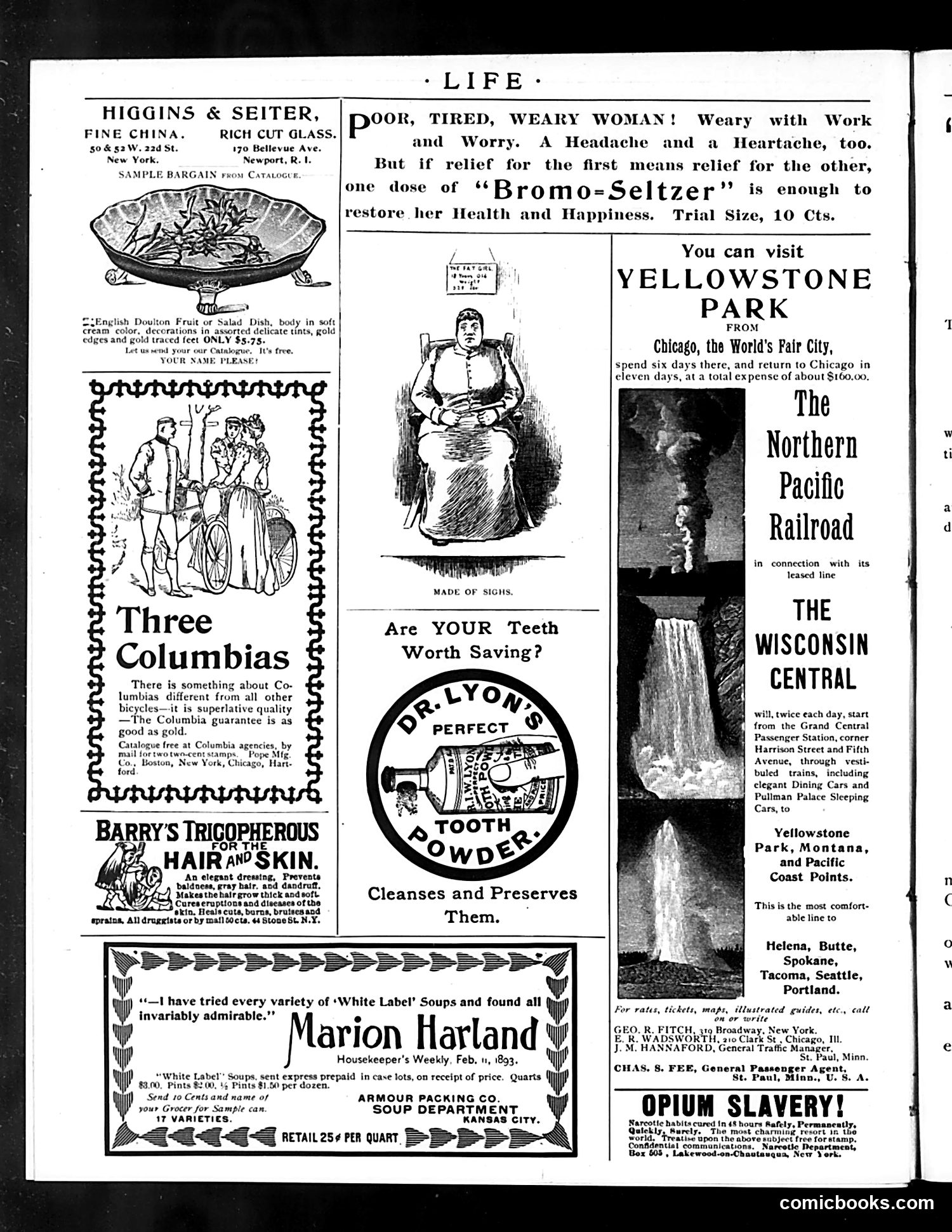
This page is primarily **advertising**, not satirical cartoons. However, one illustration merits attention: The central image labeled "Made of Sighs" depicts an exhausted, heavyset woman slumped in a chair—a visual commentary on female fatigue from domestic labor and worry. The caption acknowledges her "headache and heartache," positioning Bromo-Seltzer as a cure-all remedy. This reflects period attitudes treating women's physical and emotional exhaustion as a medical problem solvable by patent medicine, rather than addressing the actual causes: overwork and limited social opportunities. The "sighs" pun underscores the resignation expected of women. The surrounding ads (bicycles, hair tonic, tooth powder, railroad excursions) represent typical turn-of-the-century consumer culture marketed to relatively affluent readers. The page's final ad for "Opium Slavery" treatment reveals that addiction was openly discussed—and apparently treatable—in this era.
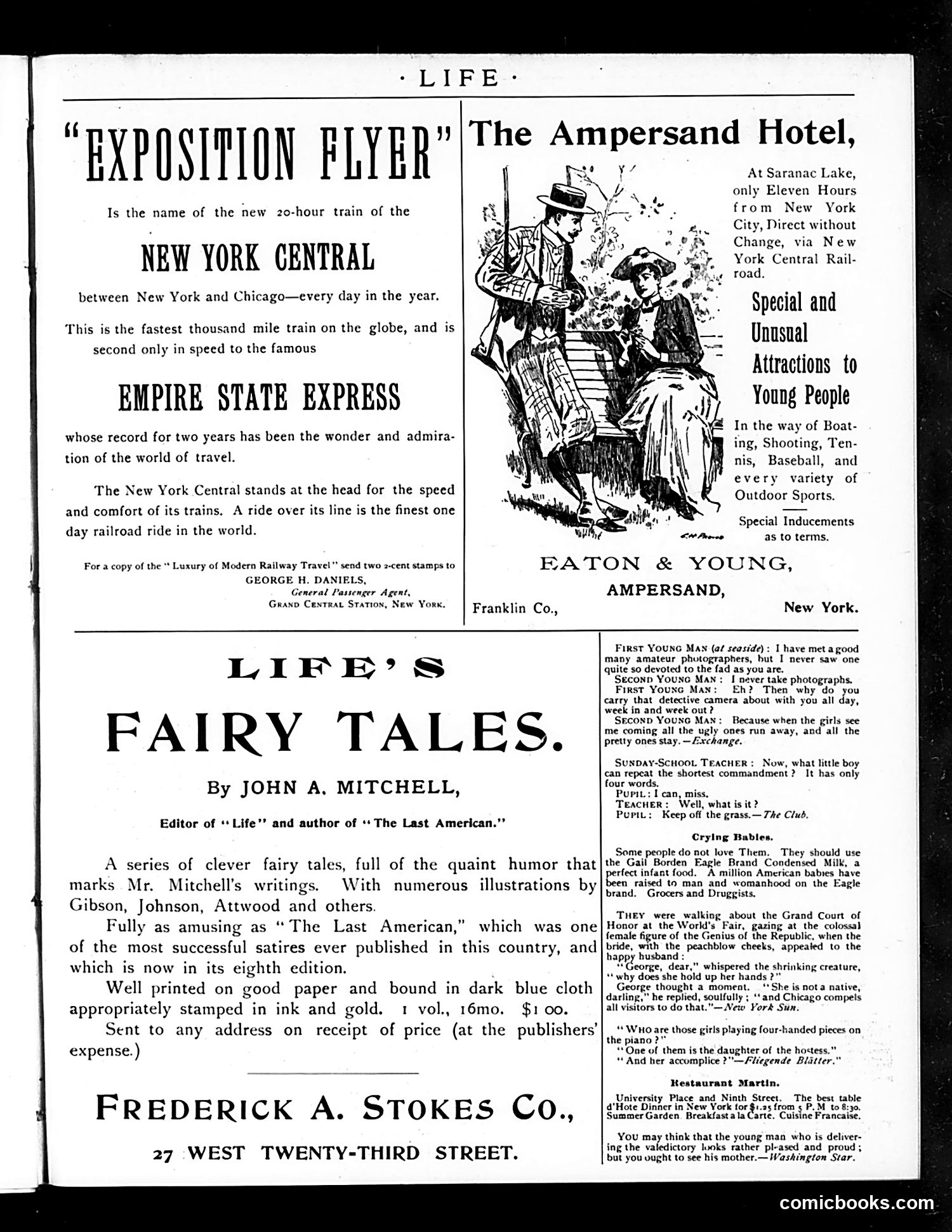
This page is primarily **advertising and humor**, not political satire. It contains: **Advertisements:** The top half promotes the New York Central Railroad's "Exposition Flyer" train and the Ampersand Hotel at Saranac Lake, emphasizing modern leisure travel for young people. **"Life's Fairy Tales"** book advertisement by John A. Mitchell, editor of *Life* magazine, promoting a humorous collection. **Humor Section:** The bottom half contains brief jokes typical of the era's comedy magazines: - Amateur photographers and attractive women - A Sunday school child answering "Keep off the grass" as the shortest commandment - A newlywed bride confused by a statue's pose - Girls playing four-handed piano pieces (one is the host's daughter) - A mother proudly watching her son deliver his valedictory speech These jokes reflect period-appropriate humor about photography fads, childhood innocence, newlyweds, courtship, and parental pride. There is **no political content or social satire** on this page—it's standard commercial and entertainment advertising from an early 20th-century magazine.
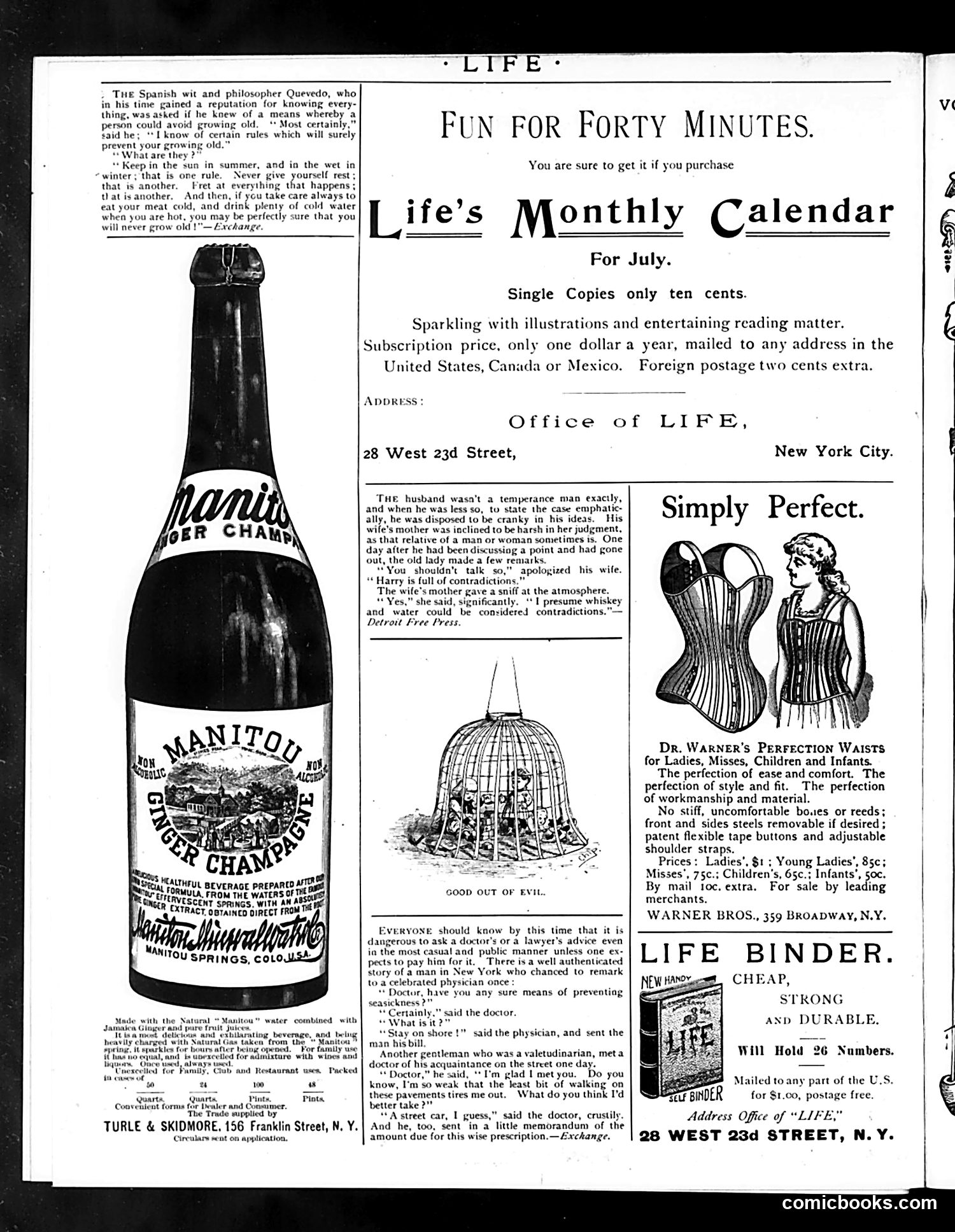
This is primarily an **advertising page** from Life magazine, with two brief humorous anecdotes interspersed among ads. The **two satirical pieces** both target professional pretension: 1. **"Good Out of Evil"** mocks doctors' tendency to charge for casual medical advice. A man asks a physician about seasickness prevention, receiving the curt response "A street car, I guess"—then gets billed. The joke satirizes how doctors exploit even flip remarks for fees. 2. The untitled domestic anecdote depicts a husband who drinks too much, with his critical mother-in-law making a cutting remark about "whiskey and water" being "contradictions." The humor targets marital tension and in-law friction, with implicit criticism of the husband's drinking. Both pieces reflect *Life*'s satirical focus on social hypocrisy and professional greed—themes typical of turn-of-century American humor magazines. The page otherwise advertises the magazine itself, Dr. Warner's corsets, a "Manitou" beverage (featuring mineral water), and a Life binder.