
Life, 1893-07-06 · page 6 of 18
Life — July 6, 1893 — page 6: what you’re looking at
What you’re looking at
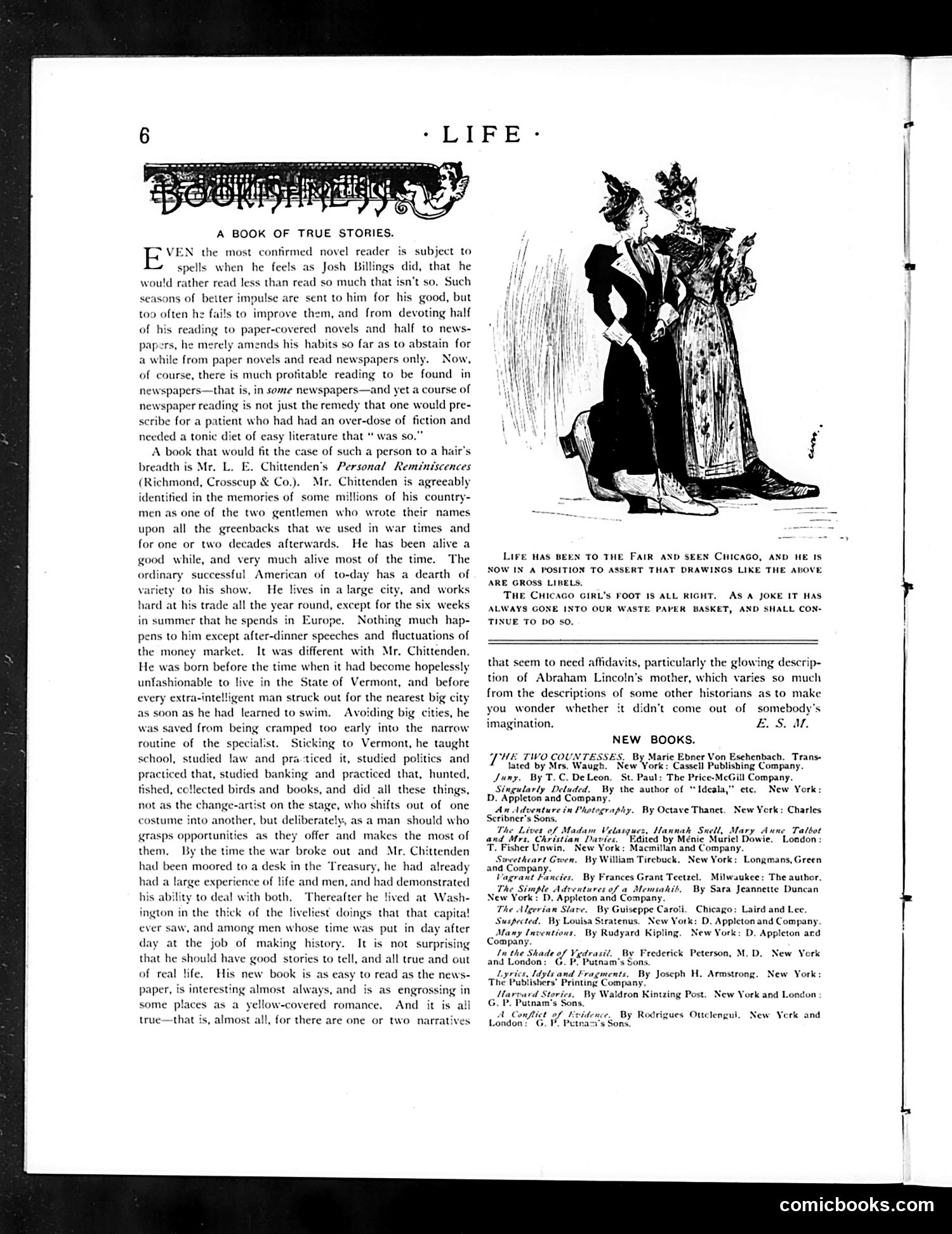
This page features a book review section titled "Bookishly" with accompanying satirical illustration. The cartoon depicts two fashionably dressed figures—a man in formal attire and a woman in an elaborate gown with feathered hat—appearing to represent Chicago's social elite or nouveau riche. The accompanying text (in all caps) notes: "Life has been to the Fair and seen Chicago, and he is now in a position to assert that drawings like the above are gross libels. The Chicago girl's foot is all right." This references the 1893 World's Columbian Exposition ("the Fair") in Chicago. The satire mocks exaggerated portrayals of Chicago society figures, while the specific jab at "the Chicago girl's foot" suggests contemporary stereotypes about Midwestern women's appearance or fashion—presenting them as provincial or unfashionable compared to Eastern society standards.
📄 Transcribed text from this page (OCR, searchable)
Machine-transcribed from the original scan — historical spelling and the odd misread are preserved.
A BOOK OF TRUE STORIES. > VEN the most confirmed novel reader is subject to spells when he feels as Josh Billings did, that he would rather read less than read so much that isn’t so. Such npulse are sent to him for his good, but seasons of better too often he fails to improve them, and from devoting half of his reading to paper-covered novels and half to news- papers, he merely amends his habits so far as to abstain for a while from paper novels and read newspapers only. Now, of course, there is much protitable reading to be found in newspapers—that is, in some newspapers—and yet a course of not just the remedy that one would pre- newspaper reading is ibe for a patient who had had an over-dose of fiction and needed a tonic diet of easy literature that A book that would fit the case of such a werden to a hair's breadth is Mr. L. E. Chittenden’s Personal Reminiscences (Richmond, Crosscup & Co.). Mr. Chittenden is agreeably identitied in the memories of some millions of his country- men as one of the two gentlemen who wrote their names greenbacks that we used in war times and for one or two decades afterwards. He has been alive a and very much alive most of the time. The ordinary successful American of to-day has a dearth of variety to his show. He lives in a large city, and works hard at his trade all the year round, except for the six weeks in summer that he spends Nothing much hap- pens to him except after-dinner speeches and fluctuations of the money market. It was different with Mr, Chittenden, He was born before the time when it had become hopelessly unfashionable to live in the State of Vermont, and before every extra-intelligent man struck out for the nearest big city as soon as he had learned to swim. Avoiding big ‘as saved from being cramped too early into the narrow routine of the specialist. ing to Vermont, he taught studied law and practiced it, studied pol! practiced that, studied banking and practiced that, hunted, fished, collected birds and books, and did all these things. not as the change-artist on the stage, who shifts out of one another, but deliberately, as a man should who offer and makes the most of Mr. Chittenden ad already upon all the good while, in Europe. ies, he y ics and school, costume int grasps opportunities as they them, By the time the war broke out and had been moored to a desk in the ‘Treasury, he had a large experience of life and men, and had demonstrated his ability to deal with both, Thereafter he lived at Wash- ington in the thick of the liveliest doings that that capi ever saw, and among men whose time was put in day after day at the job of making history. It is not surprising that he should have good stories to tell, and all true and out of real life. His new book is as easy to read as the news paper, is interesting almost always, and is as engrossing in some place And it is all true—that is, almost all, for there are one or two narratives How-covered romance. as a ye LIFE HAS BEEN TO THE FAIR AND SEEN CHICAGO, AND HE Is NOW IN A POSITION TO ASSERT THAT DRAWINGS LIKE THE ABOVE ARE GROSS LIBELS. THE CHICAGO GIRL’S FOOT 1S ALL RIGHT, AS A JOKE IT Has ALWAYS GONE INTO OUR WASTE PAVER BASKET, AND SHALL CON- TINUE TO DO SO. that seem to need affidavits, particularly the glov tion of Abraham Lincoln's mother, which vari from the descriptions of some other historians you wonder whether didn’t come out of imagination. ing descrip- Ss so much sto make somebody's E. S. M. NEW BOOKS. THE TWO COUNTESSES. lated by Mrs. Waugh. Juny, By T.C. De Leon. Singularly Deluded. By the author of * Ideala,” D. Appleton and Company. An Adventure in Photography. By Octave Thanet. New York: Charles Scribner’: The Lives of Madam Velasquez, Hannah Snell, Mary Anne Talbot and Mrs, Christian Davies, Edited by Ménic Muriel Dowie. London : T. Fisher Unwin. New York: Macmillan and Company. cethcart Gwen. By William Tirebuck. New York: Longmans,Green and Company. Vagrant Fancies, By Frances Grant Teetzel, Milwaukee: The author. The Simple Adventures of a Memsahib. By Sara Jeannette Duncan New York: D. Appleton and Company. The Algerian Slave, By Guiseppe Caroli. Chicago: Laird and Lee. Suspected. By Louisa Stratenus. New York: D. Appleton and Company Many Inventions. By Rudyard Kipling. New York: D. Appleton ard Company. 1x the Shade of Vedrasit. By Frederick Peterson, M. D. and London: G. P, Putnam's Sons. Lyrics, Idyls and Fragments, By Joseph H. Armstrong, The Publishers’ Printing Company. Harvard Stories, By Waldron Kintzing Post G.P. Putnam's Son: A Conflict of London: G.P, Petra By Marie Ebner Von Esehenbach. Trans- w York: Cassell Publishing Company. St. Paul: The Price-McGill Company. etc. New York: New York New York: New York and London nce. By Rodrigues Ouclengui. New Verk and 1's Sons. comicbooks.com