
A complete issue · 16 pages · 1893
Life — June 8, 1893
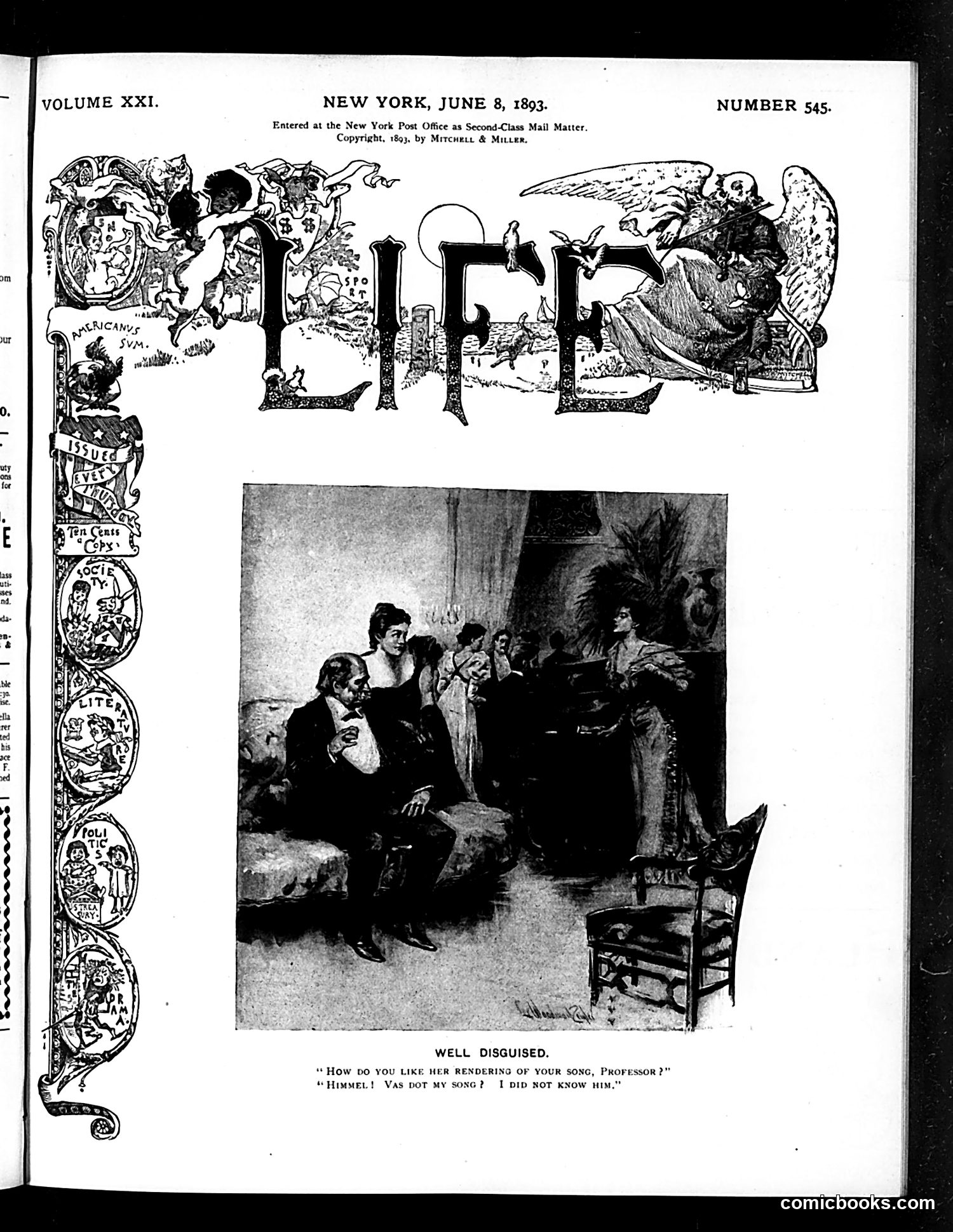
This cartoon satirizes a musical performance or composition critique. The caption reads: "How do you like her rendering of your song, Professor?" / "Himmel! Vas dot my song? I did not know him." The joke appears to center on a composer (likely German, given the "Himmel" and "Vas" dialectical speech) not recognizing his own work when performed by a female vocalist. The satire targets either poor musical interpretation or the composer's obtuseness—he fails to recognize his composition when rendered differently, perhaps suggesting the performance was so altered or poorly executed that it became unrecognizable. The "well disguised" title reinforces this: the song was disguised through performance into something entirely different from the original.
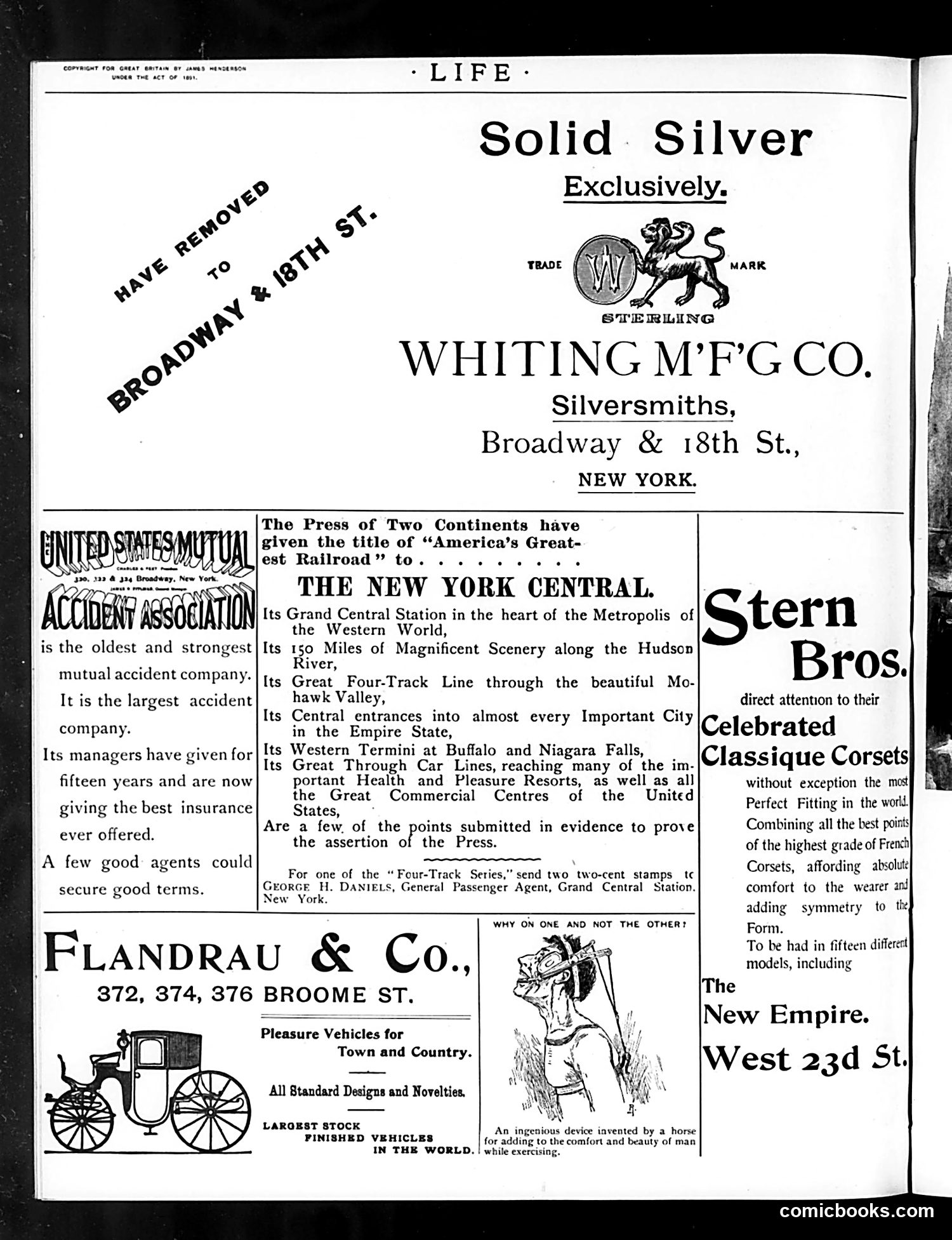
This page is primarily **advertising**, not political satire. It contains several commercial notices: 1. **Whiting M'F'G Co.** – A silversmith advertising solid sterling silver goods at Broadway & 18th St., New York 2. **United States Mutual Accident Association** – Insurance company claiming to be the oldest and strongest mutual accident insurer 3. **Flandrau & Co.** – Vehicle manufacturer advertising pleasure carriages for town and country use, claiming to have "the largest stock finished vehicles in the world" 4. **Stern Bros.** – Department store promoting their "Celebrated Classique Corsets" 5. **New York Central Railroad** – Promoting their rail line as "America's Greatest Railroad" The only cartoon element is a small humorous illustration about horseback riding comfort, but the page is fundamentally a collection of period advertisements rather than satirical content.
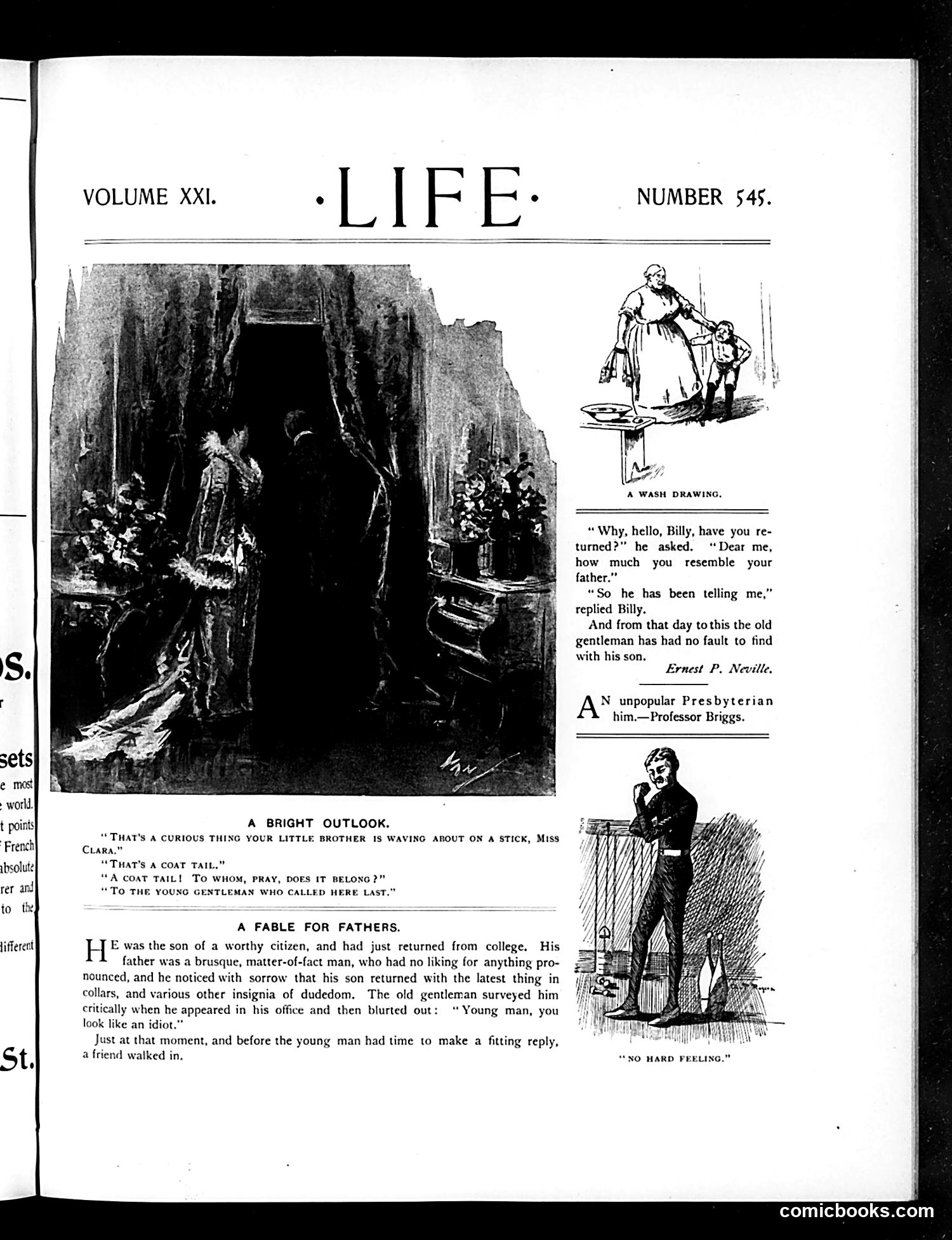
This page contains three distinct pieces of humor content: 1. **"A Bright Outlook"** (top): A dark illustration showing what appears to be a funeral scene, with accompanying dialogue about a "little brother waving about on a stick." The humor involves morbid wordplay about a child's toy or object. 2. **"A Wash Drawing"** (right): A brief anecdote where a woman remarks that a boy resembles his father because the father has been "telling me" things—suggesting infidelity or improper conduct. The joke relies on period innuendo about paternity and family relations. 3. **"A Fable for Fathers"** (bottom): A story about a college-returned son displaying modern fashions and mannerisms that his traditional father finds ridiculous, ending with the father's dismissive judgment. This satirizes generational conflict over changing social customs and dress codes. The page reflects early 20th-century anxieties about youth culture and social propriety.
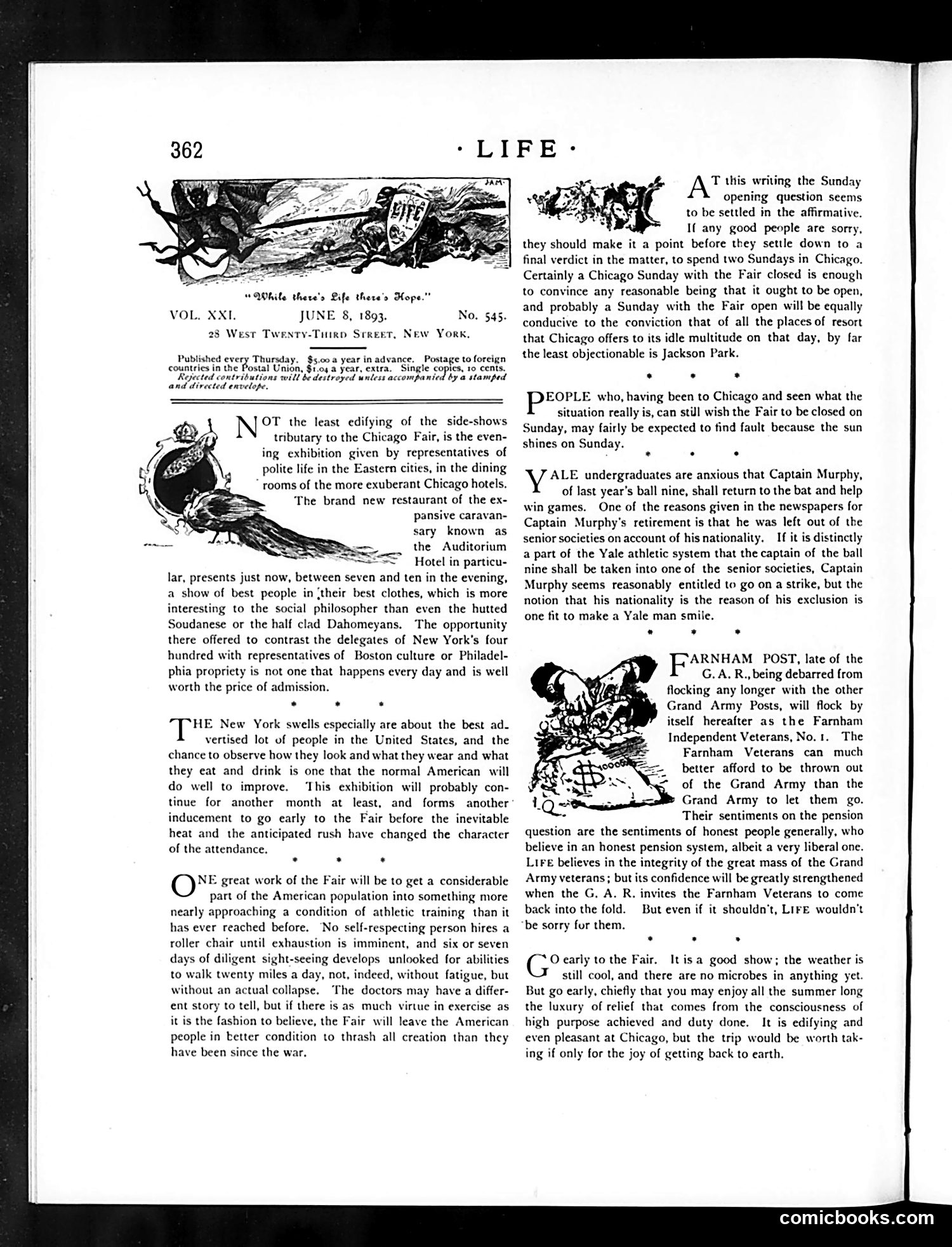
The page contains editorial commentary on the World's Columbian Exposition (Chicago's Fair). The masthead cartoon shows a figure labeled "Life" alongside text "While there's Life there's Hope." The articles discuss whether the Fair should open on Sundays, debating whether Chicago's "idle multitude" deserve this recreation. Other pieces cover Yale athletics (Captain Murphy's ball nine) and the Farnham Post's exclusion from Grand Army of the Republic gatherings due to nationalist sentiment. The decorative illustrations are ornamental rather than satirical—serving as section breaks. The satire is gentle and social rather than pointed political commentary. The overall tone is that of an educated, East Coast publication commenting on Midwestern institutions and propriety questions of the day.
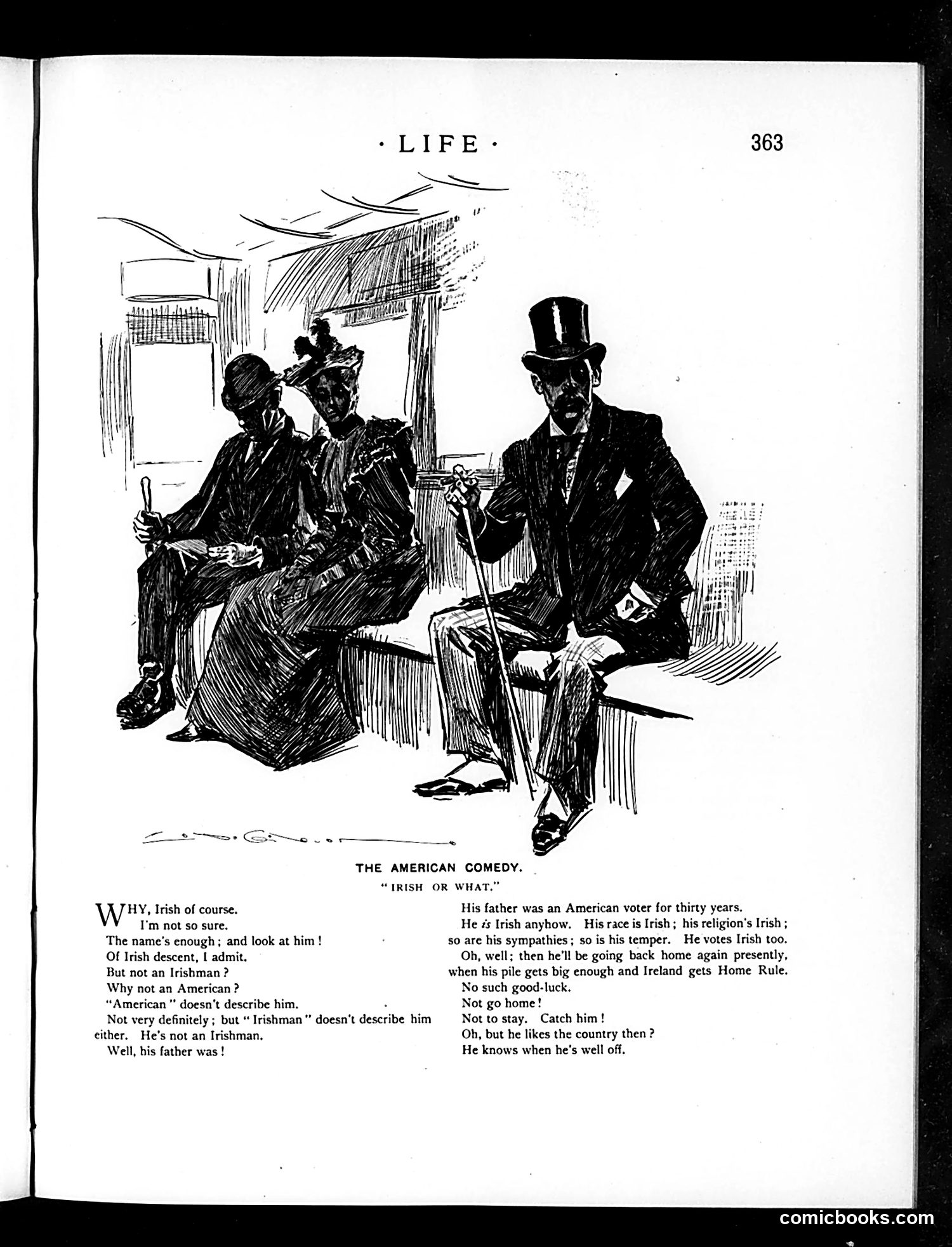
This satirical piece examines identity and assimilation of Irish immigrants. The dialogue presents a debate about whether someone of Irish descent can truly be "American." The central tension: a man's father was an American voter for thirty years, yet the speaker questions whether the son is "Irish or what"—suggesting ambiguous identity. The satire critiques nativist anxieties about Irish-Americans' loyalty and belonging, mocking the gatekeeping attitude that questions whether someone of Irish descent, despite American citizenship, can be authentically American. The right-side commentary emphasizes the contradiction: the man's nationality, religion, sympathies, and temperament are all Irish, so "he knows when he's well off"—implying Irish-Americans belong elsewhere. The cartoon ridicules such exclusionary attitudes toward immigrant communities.
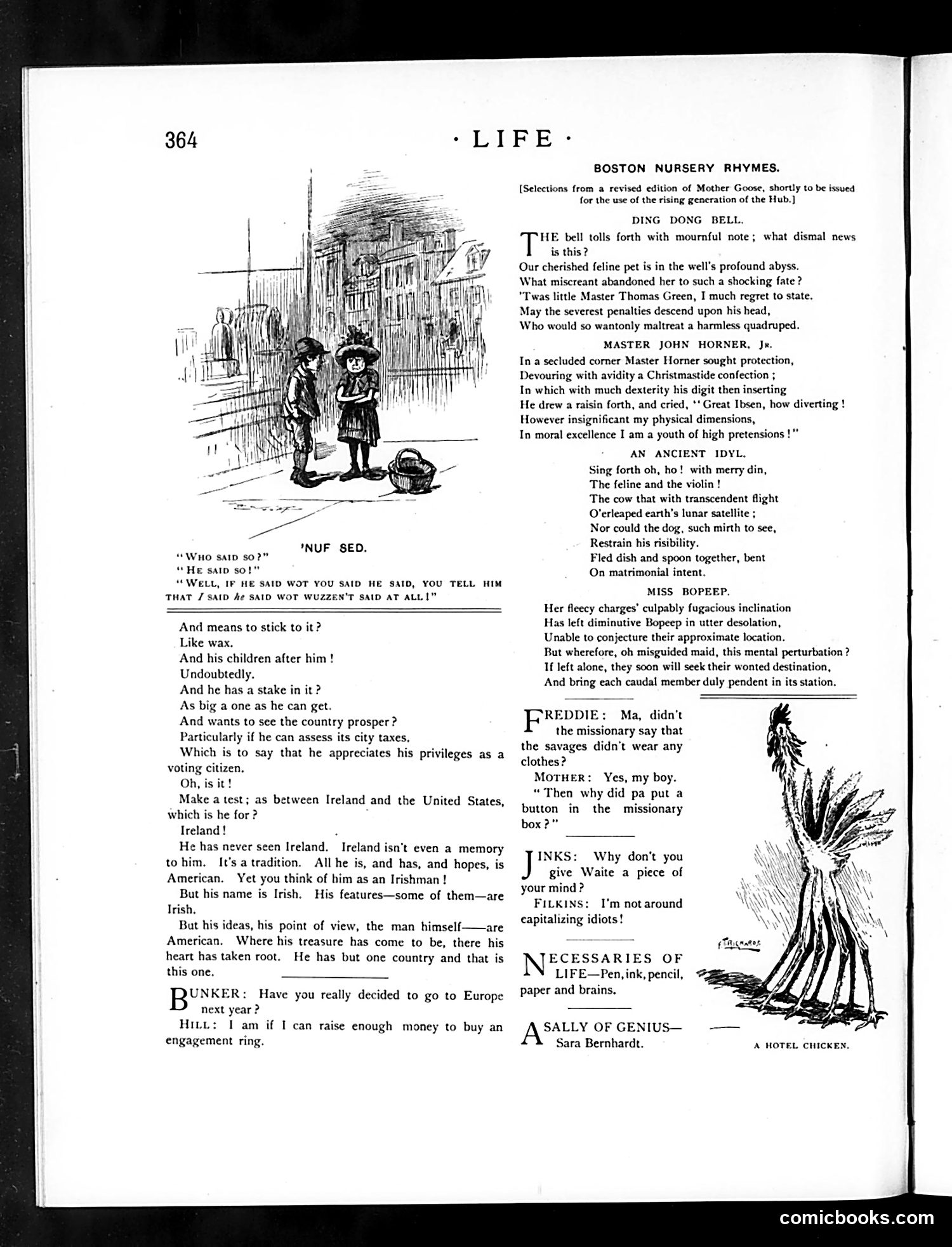
This page presents satirical versions of classic nursery rhymes adapted for contemporary readers of *Life* magazine. The content includes: **"Ding Dong Bell"** and **"'Nuf Sed"** — a dialogue-based joke about an Irish-American man who has never visited Ireland but is perceived as Irish by nationality and character. The satire comments on American identity politics and immigrant heritage, suggesting tension between assumed ethnic identity and actual experience. The remaining rhymes (**"Master John Horner," "An Ancient Idyl," "Miss Bopeep," and others**) offer witty social commentary on contemporary American life, class, ambition, and moral character — typical of *Life's* satirical approach during the early 20th century. The accompanying illustrations are decorative rather than specifically political.
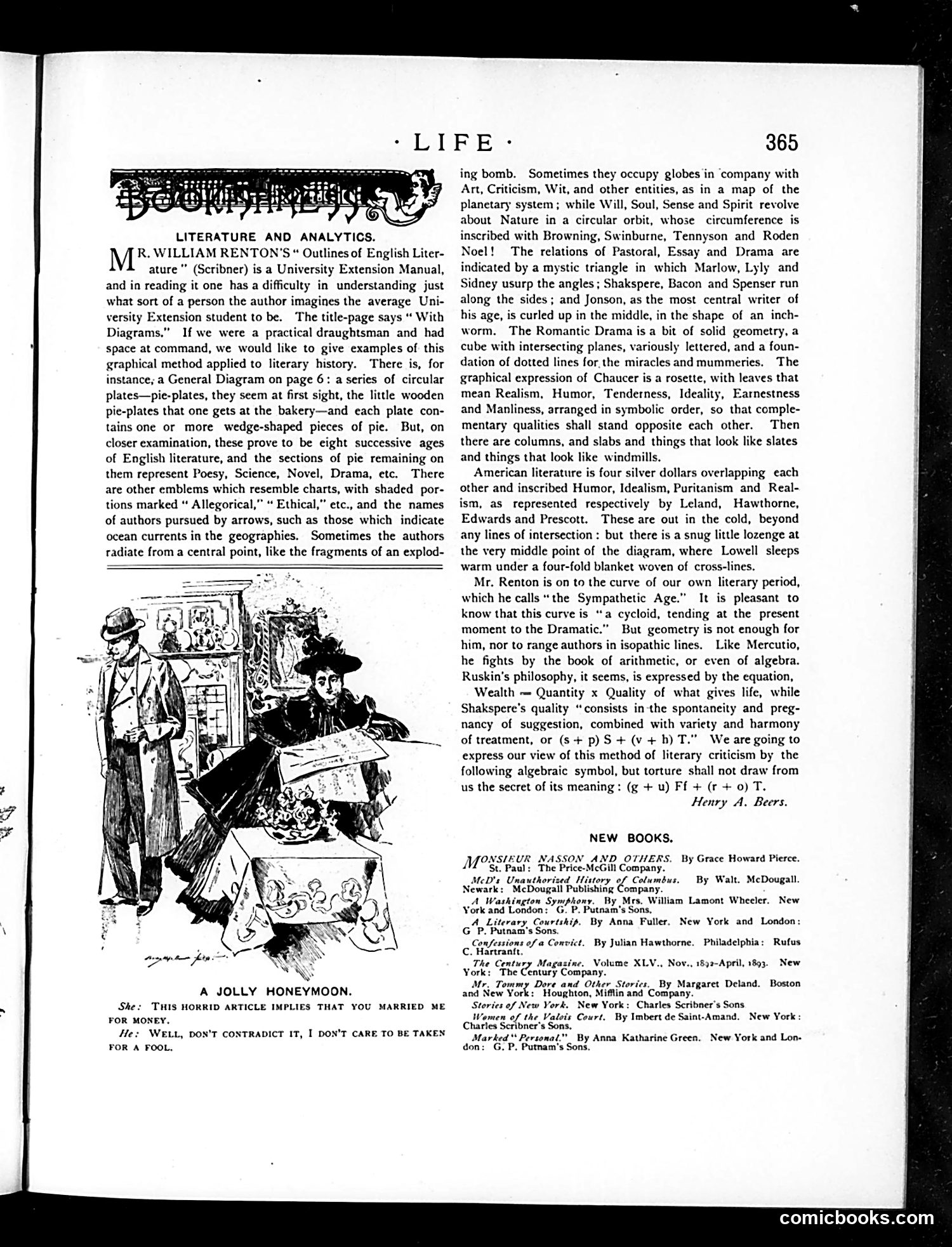
This cartoon depicts a domestic argument between newlyweds. The husband says: "This horrid article implies that you married me for money." The wife responds: "Well, don't contradict it, I don't care to be taken for a fool." The satire mocks contemporary attitudes about marriage and finances. The joke relies on the period assumption that women married for economic security rather than love—presenting this bluntly as the wife's honest position. By having her refuse to correct the "horrid" implication, she admits mercenary motives while simultaneously insulting her husband's desirability as a partner. The humor derives from her frank cynicism about marriage, which contradicts romanticized contemporary ideals of matrimonial devotion.
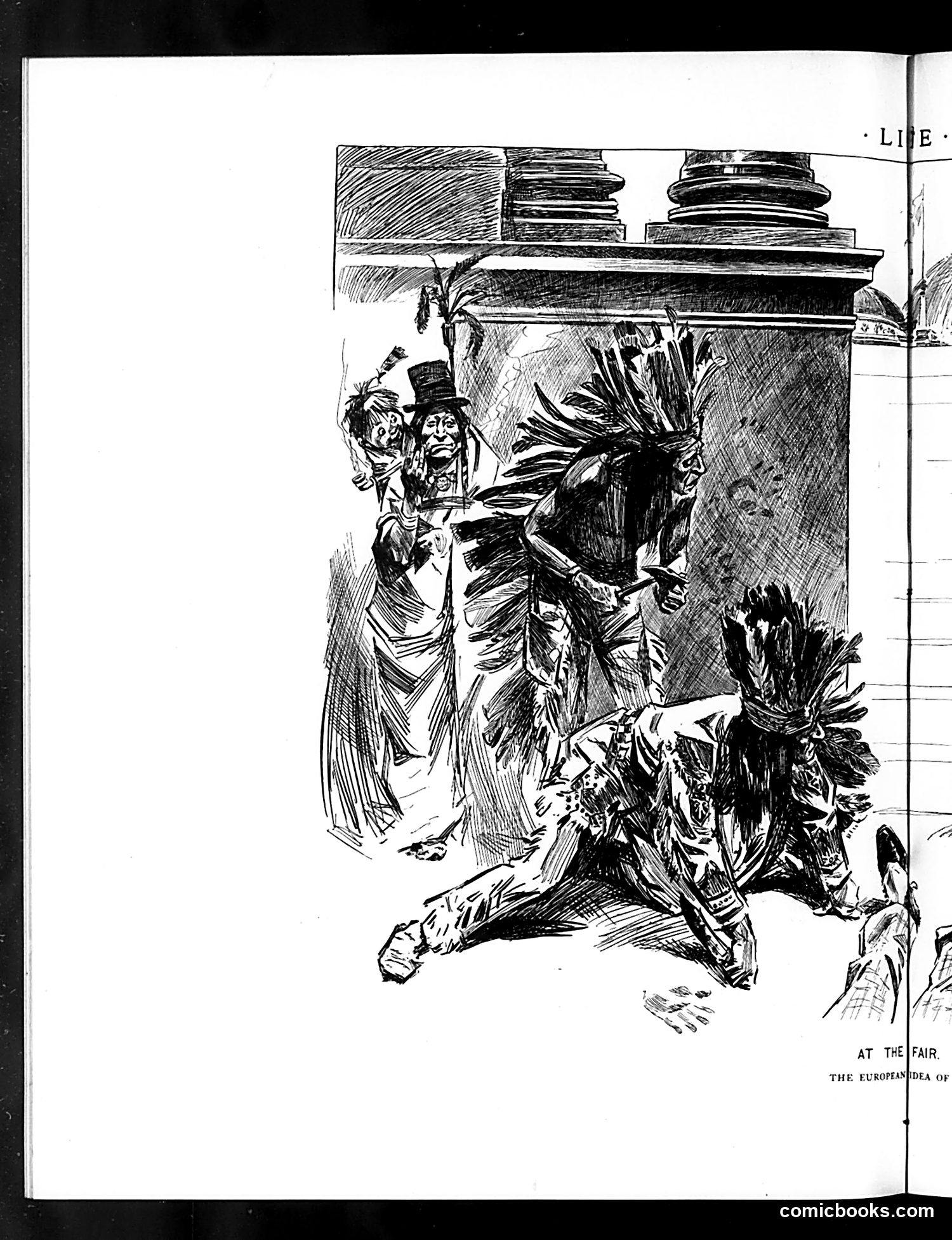
This appears to be a satirical cartoon titled "At the Fair: The European Idea of—" (title incomplete). The sketch depicts what seems to be a European perspective on American culture or society, shown through caricatured figures at what the caption indicates is a fair or exhibition. The drawing style uses heavy cross-hatching typical of early 20th-century editorial illustration. The figures appear exaggerated and grotesque, suggesting mockery of European stereotypes or misconceptions about America. Without the complete caption text, the specific satirical target—whether mocking European ignorance about America, American pretensions, or fair exhibitions themselves—cannot be definitively determined. The "Life" magazine attribution confirms this is American political satire from that era.
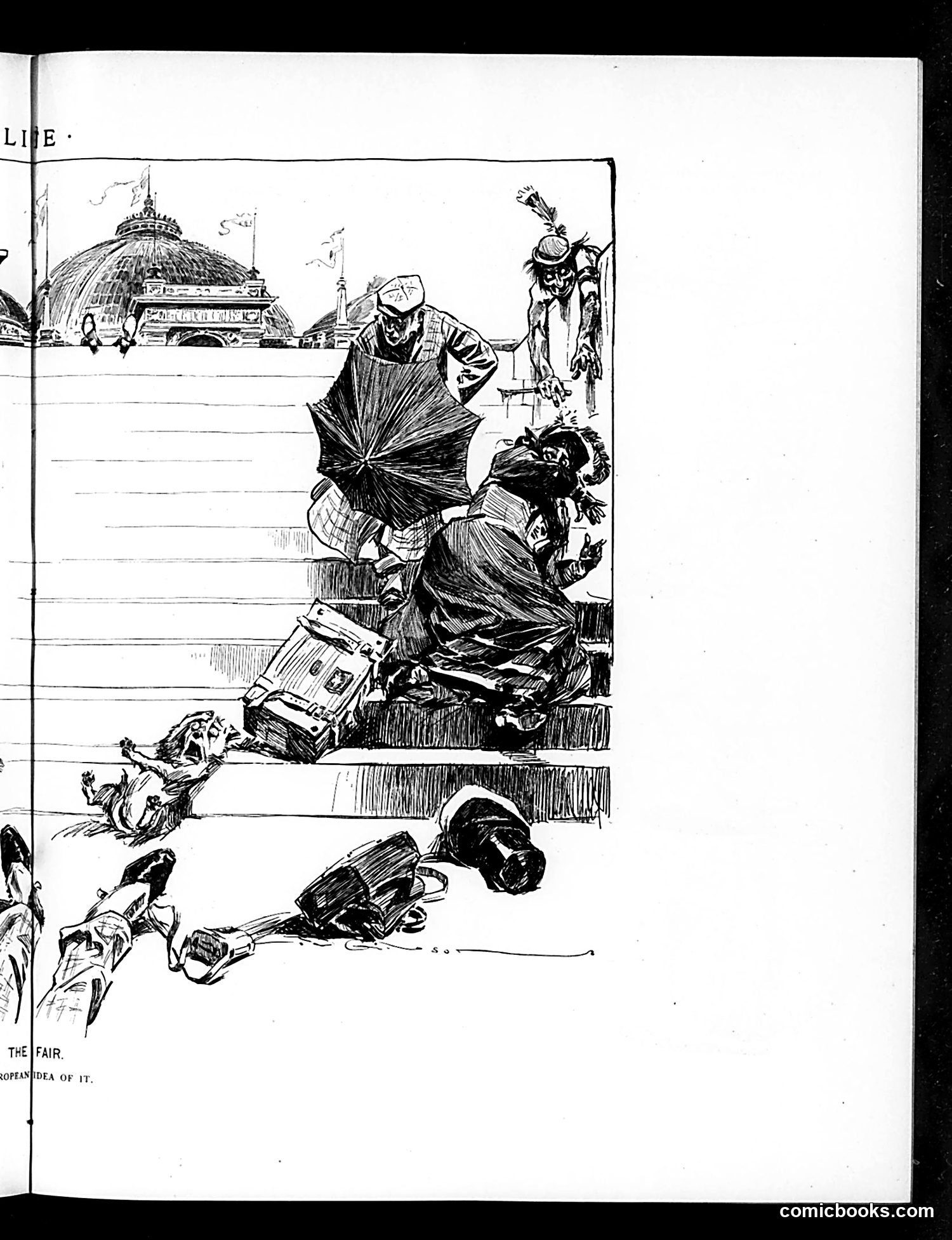
This appears to be a satirical illustration from *Life* magazine depicting a scene at what looks like a World's Fair (suggested by the domed building in the background). The central figures include a man with an umbrella confronting what appears to be a woman and child on steps, with various items scattered below. The partial text references "THE FAIR" and mentions a "EUROPEAN IDEA OF IT," suggesting this cartoon satirizes European perceptions or attitudes toward an American World's Fair—likely the 1893 Chicago World's Columbian Exposition or similar event. The scattered belongings and confrontational posture suggest commentary on social class, poverty, or the contrast between the fair's grandeur and urban hardship. However, without complete text or date information, the specific satirical target remains unclear.
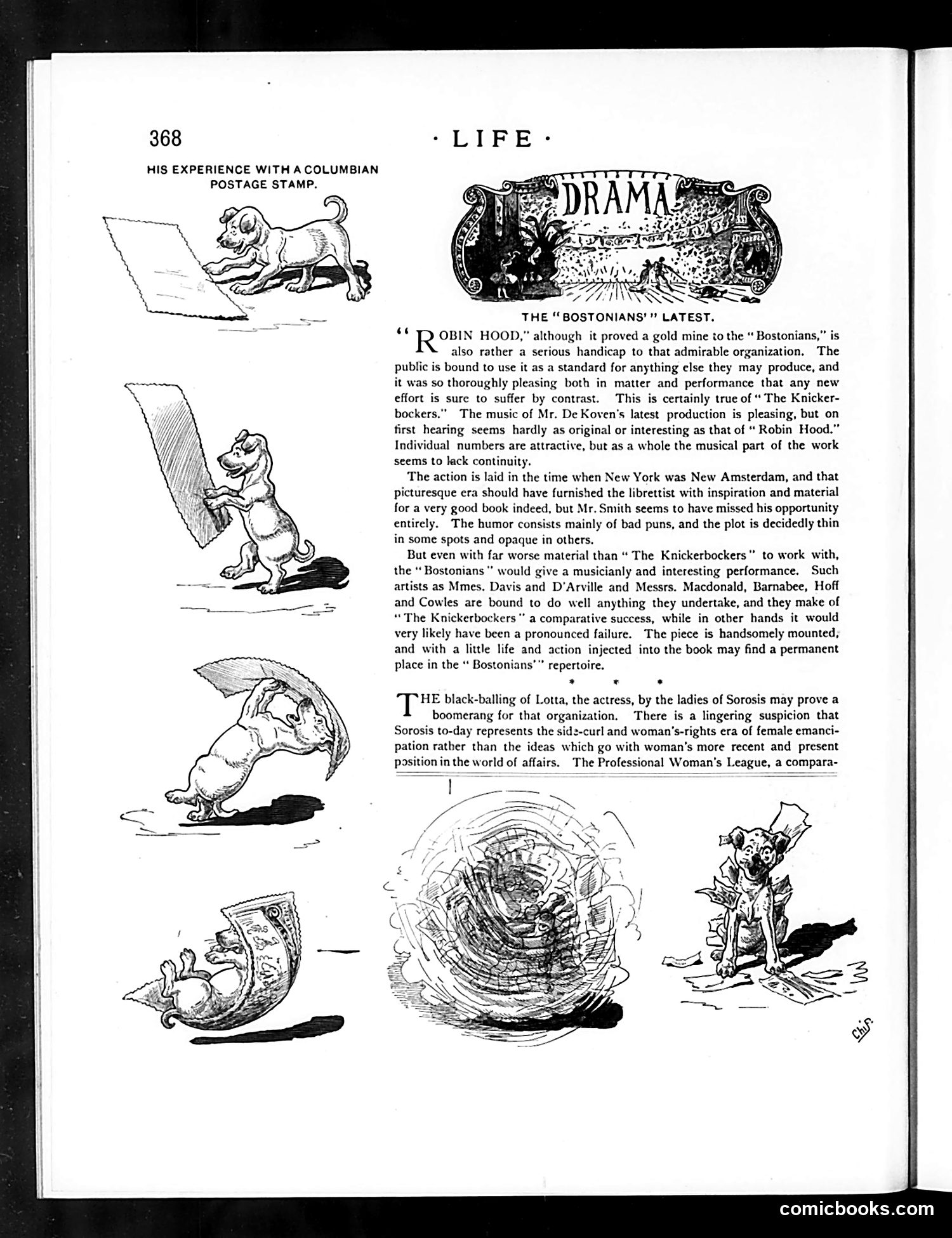
This page reviews theatrical productions for Boston audiences. The left column contains sketches illustrating "His Experience with a Colombian Postage Stamp"—cartoon vignettes of a figure struggling comically with an adhesive stamp, showing escalating physical contortions. The main text critiques "Robin Hood," a production by the Bostonians theatrical company. The review is mixed: while the piece has merit and talented performers (Mmes. Davis and D'Arville, Messrs. Macdonald and Barnabee), the music lacks originality compared to their previous success "The Knickerbockers." The critic notes the humor relies too heavily on bad puns. A separate paragraph discusses actress Lotta's "blackballing" by the Sorosis ladies' organization, suggesting this reflects broader tensions about women's roles and professional women's leagues in this era.
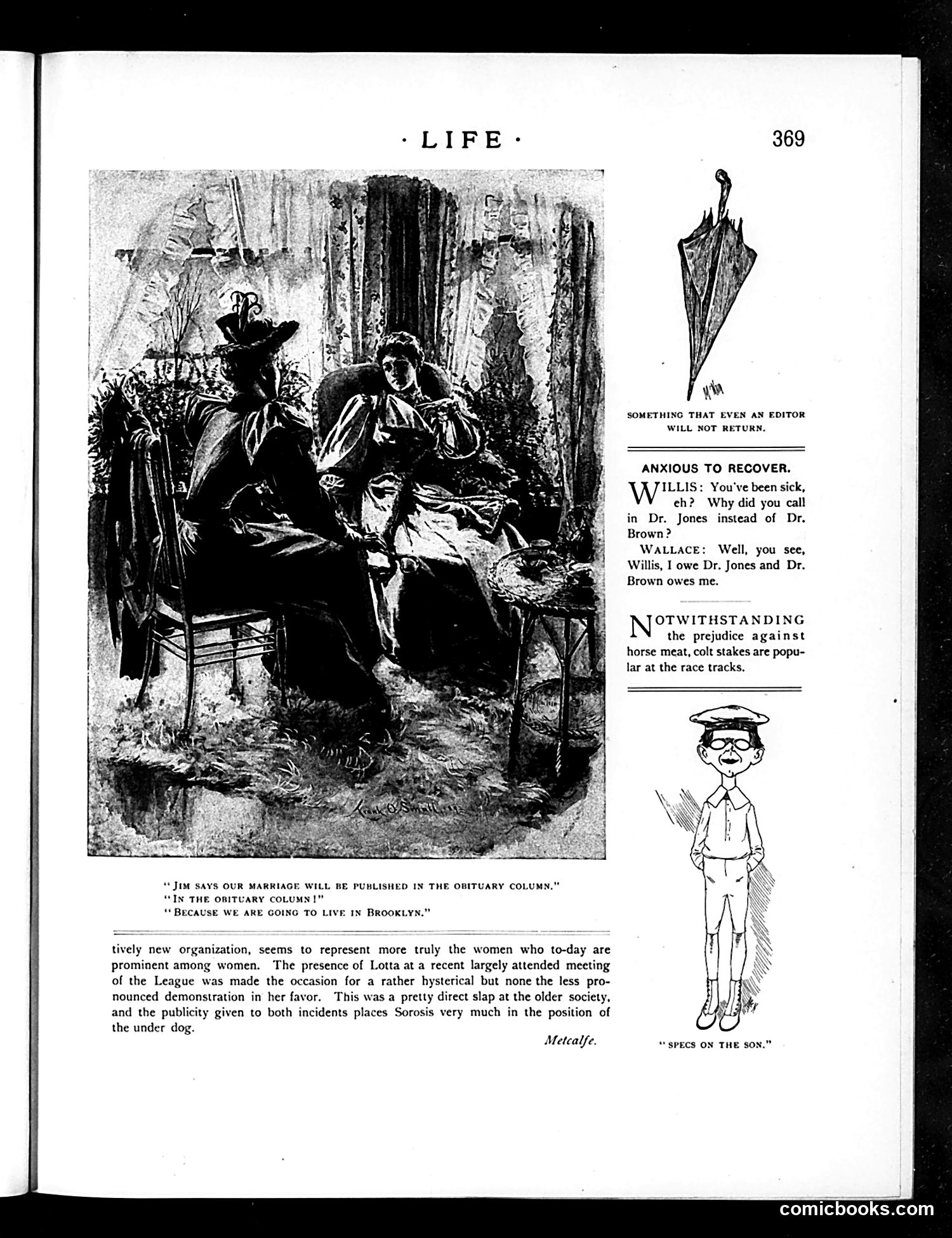
The main illustration depicts a Victorian-era domestic scene where a man (Willis) lies ill in bed while visitors attend him. The accompanying dialogue reveals Willis is recovering from sickness and owes money to two doctors—Dr. Jones and Dr. Brown—creating comic tension about medical debt. Below, a separate satirical note comments on horse meat and colt stakes being popular at race tracks "notwithstanding the prejudice against" such meat, suggesting contemporary debate about what constitutes acceptable food sources. The small cartoon labeled "Specs on the Son" shows a bespectacled boy, likely poking fun at youth or family dynamics. The overall tone is typical of Life's Victorian-era humor: domestic comedy mixed with social commentary on class, debt, and eating habits.
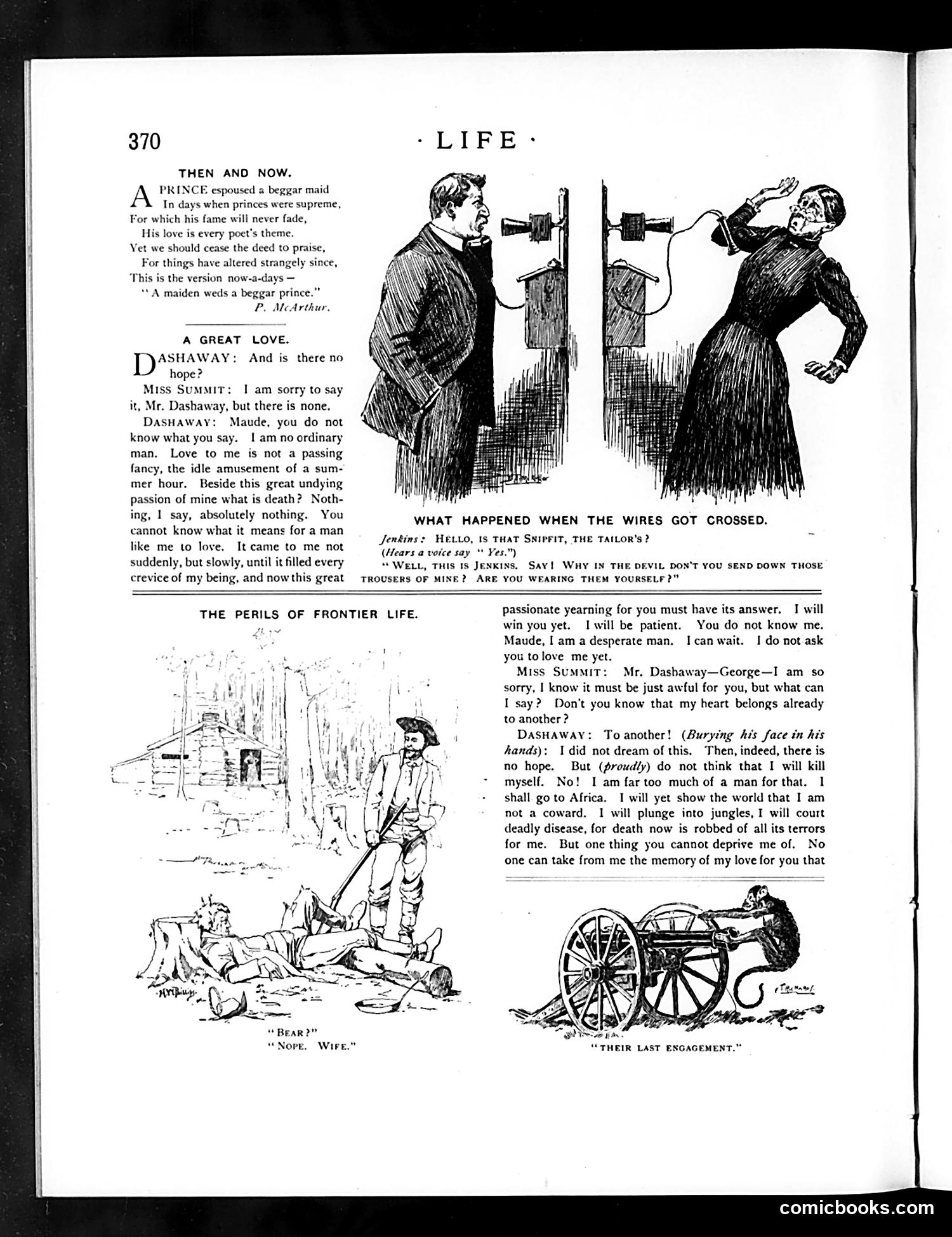
This page contains three satirical pieces mocking romantic conventions of the era: **"Then and Now"** (top): A poem by P. McArthur inverts the classic fairy tale where a prince marries a peasant girl. The satire notes that in modern times, the reverse occurs—"a maiden weds a beggar prince"—suggesting that wealthy, titled men of the contemporary period are financially or morally worthless, reduced to "beggars" despite their status. **"A Great Love"** (center): A melodramatic dialogue where Mr. Dashaway makes an absurdly overwrought romantic declaration to Miss Summit, threatening to flee to Africa and court deadly disease if rejected. The satire mocks the verbose, self-pitying emotionalism of romantic suitors. **"What Happened When the Wires Got Crossed"** (top right): A telephone mix-up comedy where a tailor receives an angry call meant for someone else, humorously deflating romantic tension. **"The Perils of Frontier Life"** and **"Their Last Engagement"** (bottom): Crude frontier and mechanical humor with minimal context visible. The page satirizes exaggerated romantic sentiment and class pretension common to the period.
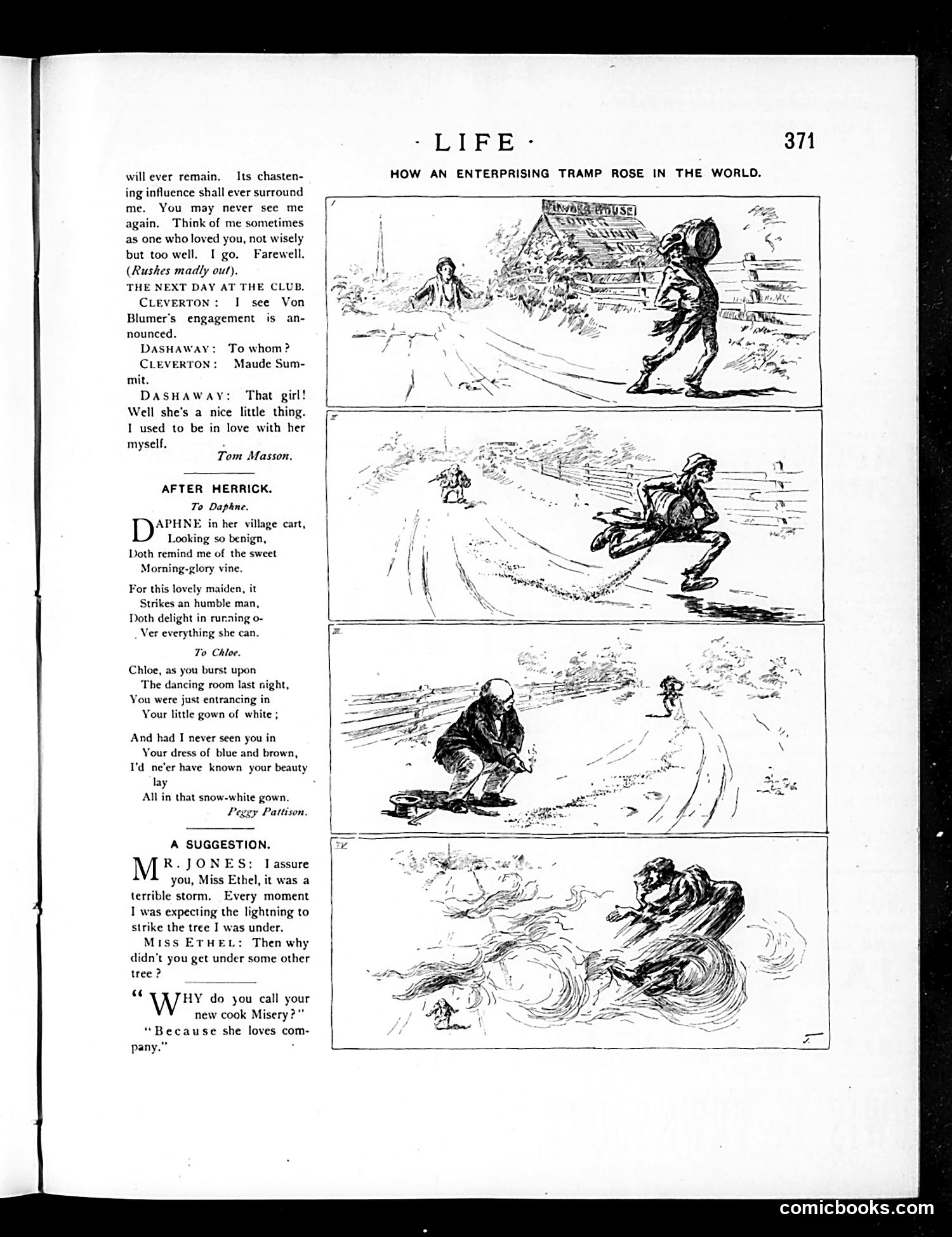
This page contains several distinct pieces of satirical humor typical of Life magazine's early 20th-century format: **Main Feature**: "How an Enterprising Tramp Rose in the World" — a four-panel comic strip showing a vagrant constructing an elaborate trap (appears to be a net or snare) to catch something, progressing through increasingly chaotic scenes. The satire suggests resourcefulness or cunning schemes. **Text Sections**: Dramatic monologues and short comedic sketches, including: - A melodramatic farewell scene involving characters Blumer and Maude Summit - Poetry tributes ("After Herrick") mocking romantic verse - Brief joke exchanges about logic (the tree/lightning joke) and wordplay (calling a cook "Misery") **The Satire**: The humor targets Victorian sentimentality, pretentious poetry, domestic situations, and everyday absurdities. The juxtaposition of dramatic dialogue with visual comedy was characteristic of Life's format, blending literary and visual humor for educated readers. The page represents typical early Life content: sophisticated, somewhat cynical commentary on manners, romance, and human behavior.
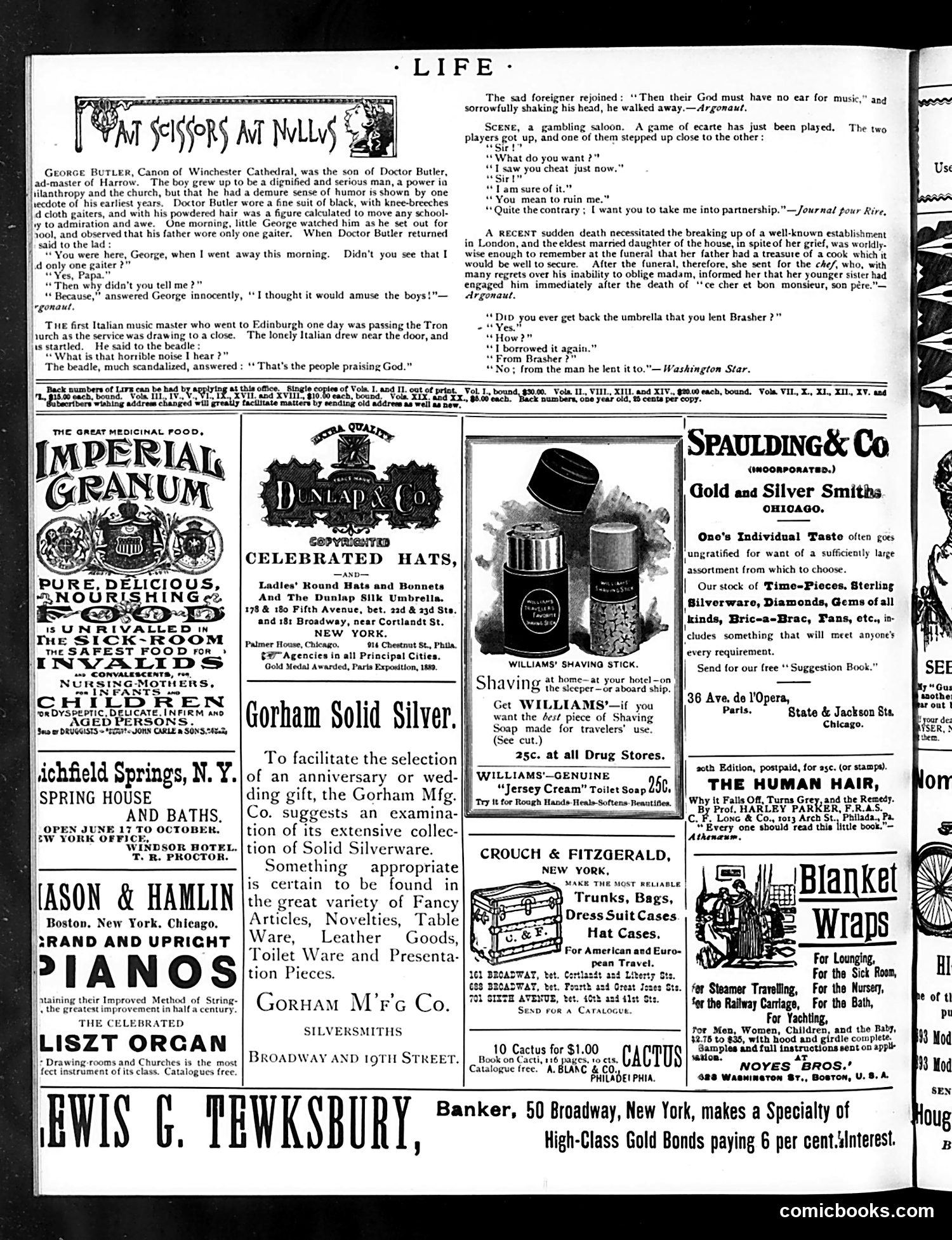
This page contains no political cartoons but rather four humorous anecdotes presented as text, a common feature of *Life* magazine's satirical humor: 1. **Young George Butler's wit**: A boy observes his father missing a gaiters (leg coverings) but says nothing, claiming it would "amuse the boys"—mocking his father's dignified appearance while feigning innocence. 2. **The Italian musician's critique**: A foreign music master hears church congregational singing and dismissively declares the parishioners' God "must have no ear for music"—satire on continental attitudes toward English religious practice. 3. **The clever cheater**: A gambler caught cheating proposes partnership rather than facing exposure—commenting cynically on dishonesty in society. 4. **The inherited cook**: After a man's death, his daughter secures his prized cook, only to learn his younger sister hired him first—gentle satire on familial greed. All four mock human vanity, pretension, and self-interest through supposedly witty anecdotes. The page is primarily advertising.
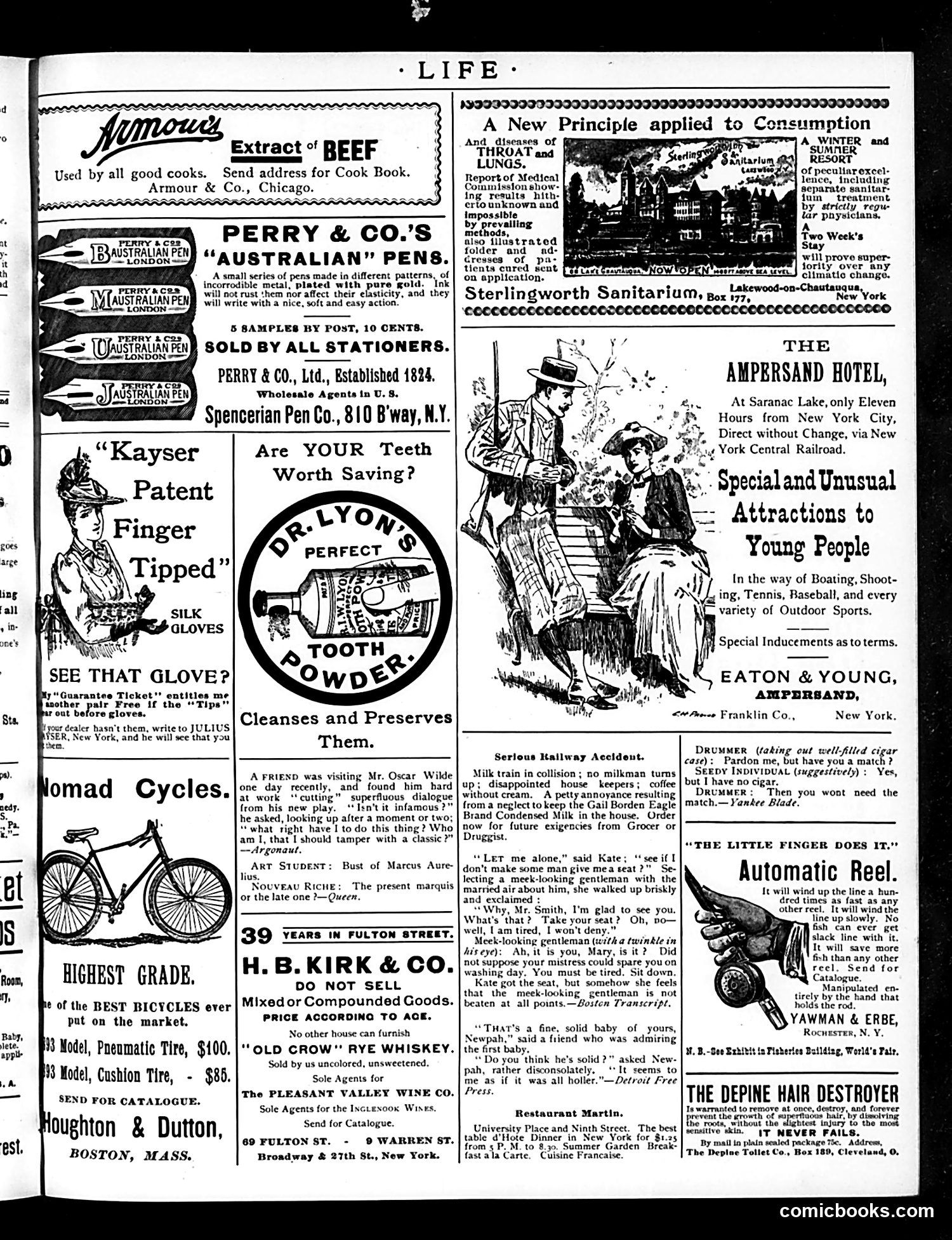
This is primarily a **advertisements page** from Life magazine, with a few brief humorous anecdotes mixed in. The cartoons/jokes are minor: 1. **Oscar Wilde anecdote**: References the famous playwright editing his own work, satirizing artistic pretension—he worries about "tampering with a classic" while revising his own new play. 2. **Art Student joke**: A wealthy "nouveau riche" person cannot distinguish between two versions of the same classical bust, mocking the newly rich's lack of genuine cultural knowledge. 3. **Railway accident story**: A mild domestic humor piece about a woman manipulating a tired gentleman for a train seat, only to realize he outwitted her socially. 4. **Baby anecdote**: Simple wordplay about a baby being "solid" (healthy) versus "hollow." These are lightweight social observations typical of Life's satirical humor—poking fun at pretension, social climbing, and domestic situations—rather than political commentary. The page is dominated by patent medicines, bicycles, pens, and other period products.
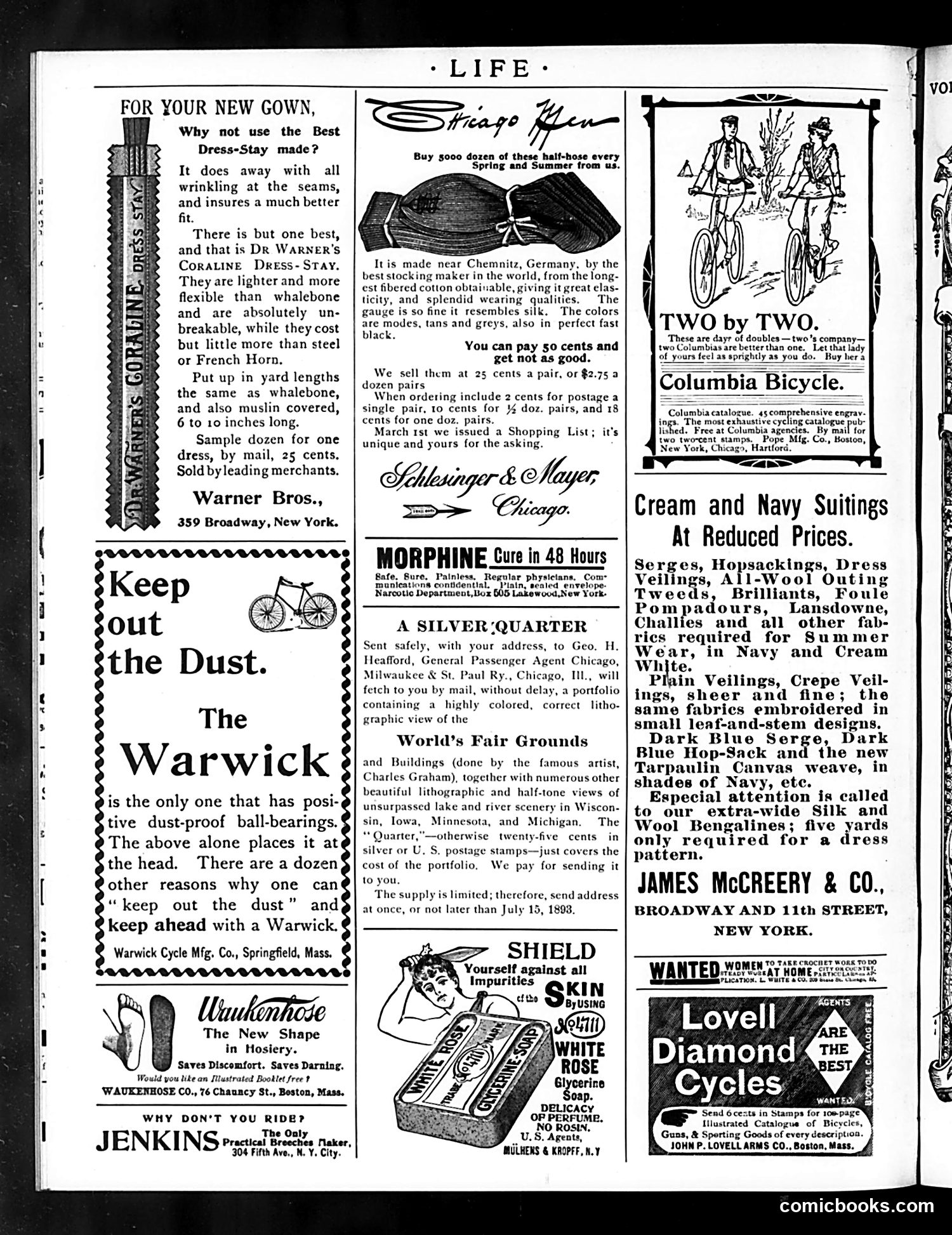
This is primarily an **advertising page** from Life magazine (circa 1893, based on World's Fair references). Rather than political cartoons, it contains commercial advertisements typical of the era. The ads reflect **late 19th-century consumer concerns**: dress-stays (corset supports), bicycle dust-proof bearings, hosiery, and clothing. Notable is the **morphine advertisement** promising a "cure in 48 hours"—legal and uncontroversial at the time, before narcotics regulation. The **Columbia Bicycle ad** features a simple illustration of two cyclists (appearing to be a couple) with the slogan "Two by Two," marketing bicycles as recreational vehicles for women—a progressive social note, as cycling was becoming acceptable leisure for women. The **World's Fair portfolio offer** references the 1893 Chicago World's Columbian Exposition, a major contemporary event. These ads collectively showcase how turn-of-the-century Americans viewed modernity: mechanical innovation, fashion, and public spectacle as markers of progress.