
Life, 1893-06-08 · page 7 of 16
Life — June 8, 1893 — page 7: what you’re looking at
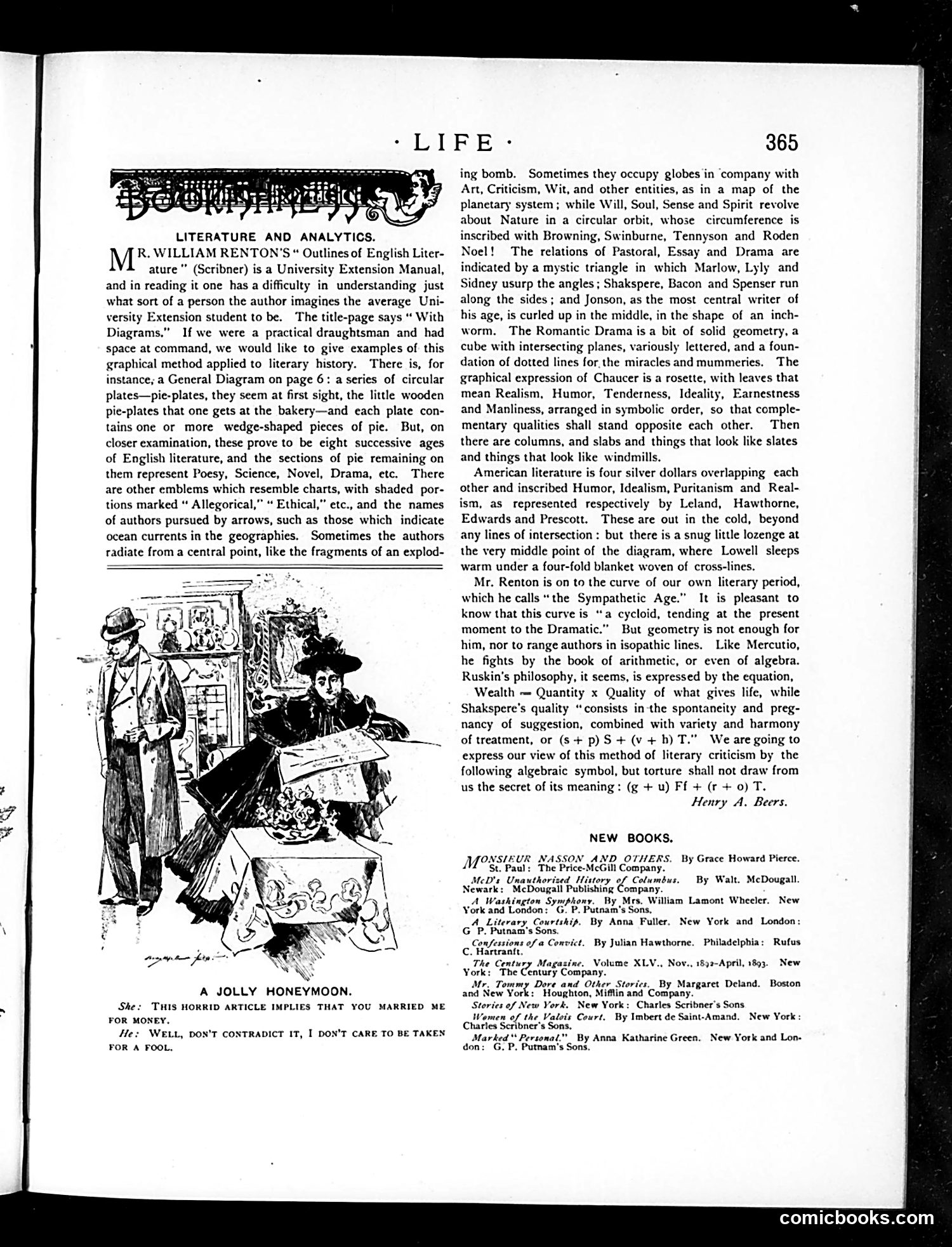
What you’re looking at
This cartoon depicts a domestic argument between newlyweds. The husband says: "This horrid article implies that you married me for money." The wife responds: "Well, don't contradict it, I don't care to be taken for a fool." The satire mocks contemporary attitudes about marriage and finances. The joke relies on the period assumption that women married for economic security rather than love—presenting this bluntly as the wife's honest position. By having her refuse to correct the "horrid" implication, she admits mercenary motives while simultaneously insulting her husband's desirability as a partner. The humor derives from her frank cynicism about marriage, which contradicts romanticized contemporary ideals of matrimonial devotion.
📄 Transcribed text from this page (OCR, searchable)
Machine-transcribed from the original scan — historical spelling and the odd misread are preserved.
- LIFE: LITERATURE AND ANALYTICS. R. WILLIAM RENTON'S “ Outlines of English Liter- ature " (Scribner) is a University Extension Manual, and in reading it one has a difficulty in understanding just what sort of a person the author imagines the average Uni- versity Extension student to be. The title-page says “ With Diagrams.” If we were a practical draughtsman and had space at command, we would like to give examples of this graphical method applied to literary history. There is, for instance, a General Diagram on page 6: a series of circular plates—pie-plates, they seem at first sight, the little wooden pie-plates that one gets at the bakery—and each plate con- tains one or more wedge-shaped pieces of pie. But, on closer examination, these prove to be eight successive ages of English literature, and the sections of pie remaining on them represent Poesy, Science, Novel, Drama, etc. There are other emblems which resemble charts, with shaded por- tions marked “ Allegorical,” “ Ethical,” etc., and the names of authors pursued by arrows, such as those which indicate ocean currents in the geographies. Sometimes the authors radiate from a central point, like the fragments of an explod- A JOLLY HONEYMOON. She: THIS HORRID ARTICLE IMPLIES THAT YOU MARRIED ME FOR MONEY. He: WELL, DON'T CONTRADICT IT, I DON'T CARE TO BE TAKEN FOR A FOOL. 365 ing bomb. Sometimes they occupy globes in company with Art, Criticism, Wit, and other entities, as in a map of the planetary system; while Will, Soul, Sense and Spirit revolve about Nature in a circular orbit, whose circumference is inscribed with Browning, Swinburne, Tennyson and Roden Noel! The relations of Pastoral, Essay and Drama are indicated by a mystic triangle in which Marlow, Lyly and Sidney usurp the angles ; Shakspere, Bacon and Spenser run along the sides ; and Jonson, as the most central writer of his age, is curled up in the middle, in the shape of an inch- worm. The Romantic Drama is a bit of solid geometry, a cube with intersecting planes, variously lettered, and a foun- dation of dotted lines forthe miracles and mummeries. The graphical expression of Chaucer is a rosette, with leaves that mean Realism, Humor, Tenderness, Ideality, Earnestness and Manliness, arranged in symbolic order, so that comple- mentary qualities shall stand opposite each other. Then there are columns, and slabs and things that look like slates and things that look like windmills. American literature is four silver dollars overlapping each other and inscribed Humor, Idealism, Puritanism and Real- ism, as represented respectively by Leland, Hawthorne, Edwards and Prescott. These are out in the cold, beyond any lines of intersection : but there is a snug little lozenge at the very middle point of the diagram, where Lowell sleeps warm under a four-fold blanket woven of cross-lines. Mr. Renton is on to the curve of our own literary period, which he calls “the Sympathetic Age.” It is pleasant to know that this curve is “a cycloid, tending at the present moment to the Dramatic.” But geometry is not enough for him, nor to range authors in isopathic lines. Like Mercutio, he fights by the book of arithmetic, or even of algebra. Ruskin’s philosophy, it seems, is expressed by the equation, Wealth — Quantity x Quality of what gives life, while Shakspere’s quality “consists in-the spontaneity and preg- nancy of suggestion, combined with variety and harmony of treatment, or (s+ p)S + (v + h) T.” We are going to express our view of this method of literary criticism by the following algebraic symbol, but torture shall not draw from us the secret of its meaning: (g + u) Ff + (r + 0) T. Henry A. Beers. NEW BOOKS, MONSIEUR NASSON AND OTHERS. JA''St. Paul: The Price-McGill Company. McD's Unauthorised History of Columbus. Newark: McDougall Publishing Company. A Washington Symphony. By Mrs. William Lamont Wheeler. New York and London: G. P. Putnam's Sons, A. Literary Courtship. By Anna Fuller. New York and London: G’P. Putnam's Sons. Confessions of a Convict. Hanan 7 The Century Magazine. Volume XLV., Nov., 1892-April, 1893, York: ‘The Century Company. Mr. Tommy Dore and Other Stories. By Margaret Deland. and New York: Houghton, Mifflin and Company. Stories of New York. New York: Charles Scribner's Sons Women of the Valois Court. By Imbert de Saint-Amand. New York: Charles Scribner's Sons, Marked" Personal.” By Anna Katharine Green. don: G, P, Putnam's Sons. By Grace Howard Pierce. By Walt. McDougall. By Julian Hawthorne. Philadelphia: Rufus New Boston New York and Lon- comicbooks.com