
A complete issue · 16 pages · 1893
Life — June 1, 1893
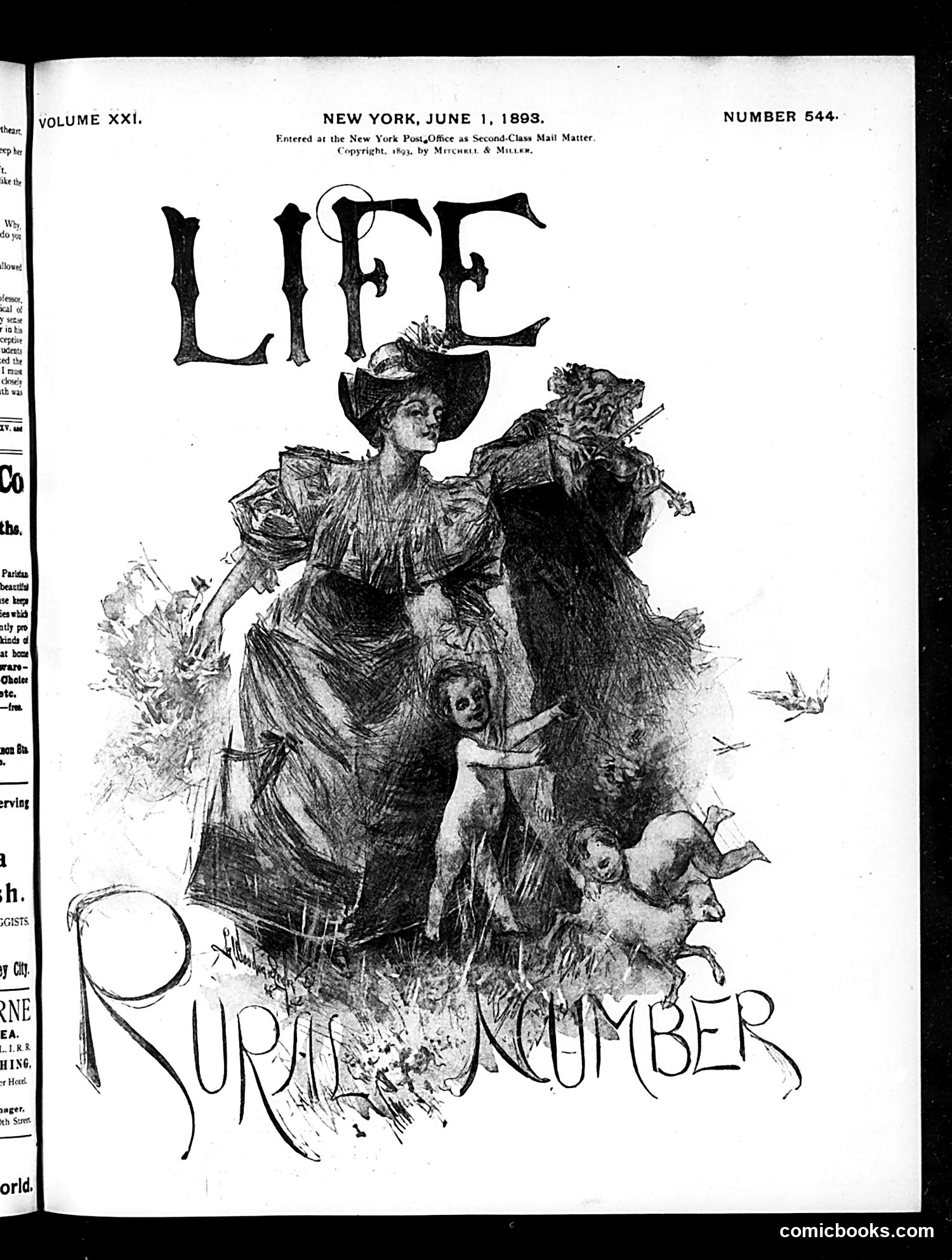
This is a cover illustration for "Life" magazine's September 1893 issue (Volume XXI, Number 544). The artwork depicts an allegorical female figure—likely representing "Life" itself or American womanhood—dressed in 1890s fashion with a large hat, surrounded by cherubs or putti (baby figures). She appears nurturing and maternal. The title "Life: September" frames the image. The illustration's style is typical of fin-de-siècle decorative art, emphasizing elegance and idealized femininity popular in the 1890s. Without additional context from the magazine's contents, the specific satirical message remains unclear, though the image likely reflects contemporary themes about gender, society, or seasonal celebration common to Life's editorial approach during this period.
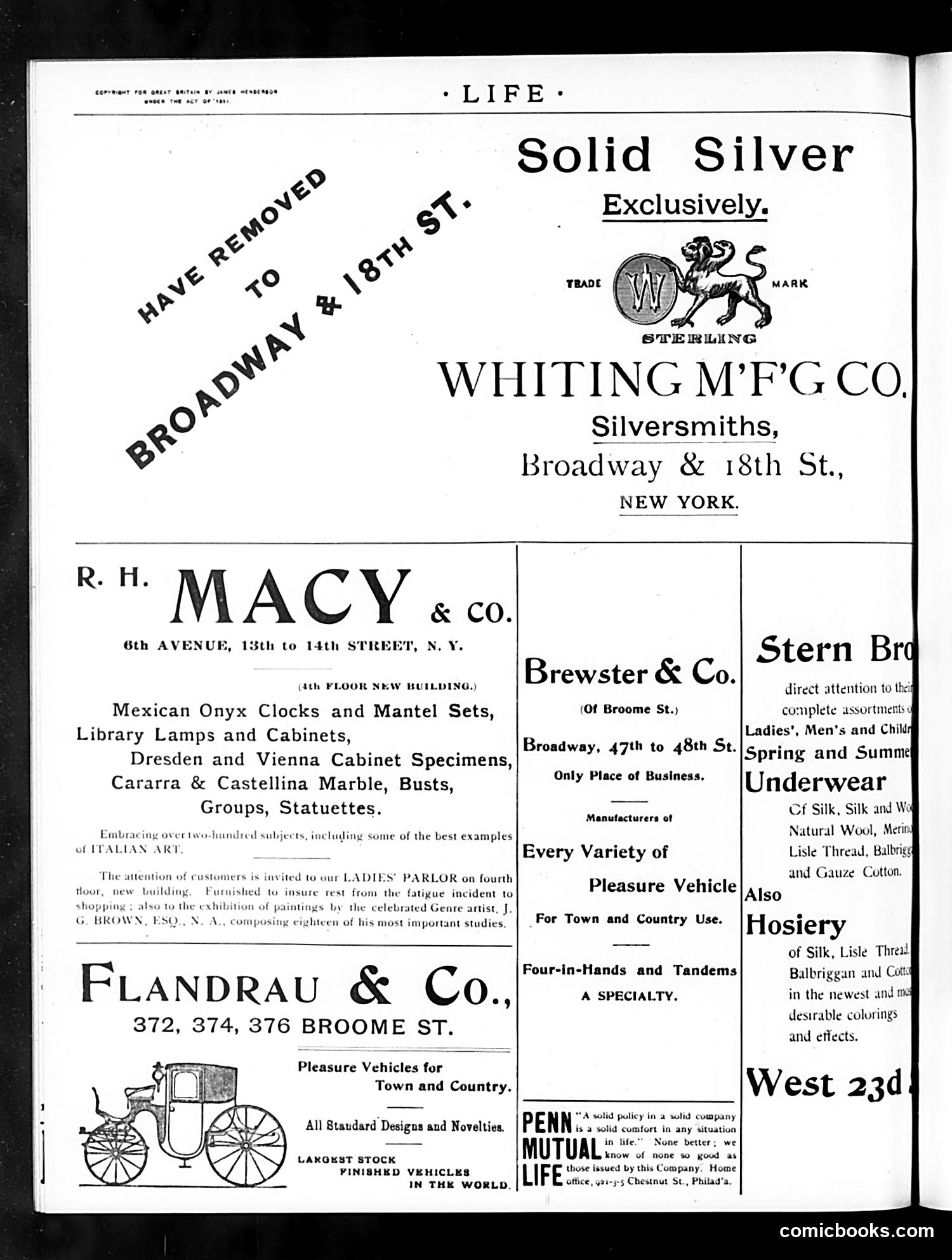
This page is primarily **advertising**, not editorial content or satire. It contains commercial notices for luxury goods and services from late 19th or early 20th-century New York City: - **Whiting M'fg Co.** advertises sterling silver goods - **R.H. Macy & Co.** promotes high-end furniture and decorative items - **Flandrau & Co.** specializes in pleasure carriages/vehicles - **Brewster & Co.** manufactures carriages and tandem vehicles - **Stern Bro** advertises ladies' and children's undergarments The only notable textual element is a Penn Mutual Life Insurance company tagline emphasizing reliability ("solid policy"). There is no political cartoon or satire visible—this is straightforward commercial promotion typical of *Life* magazine's revenue model during this era.
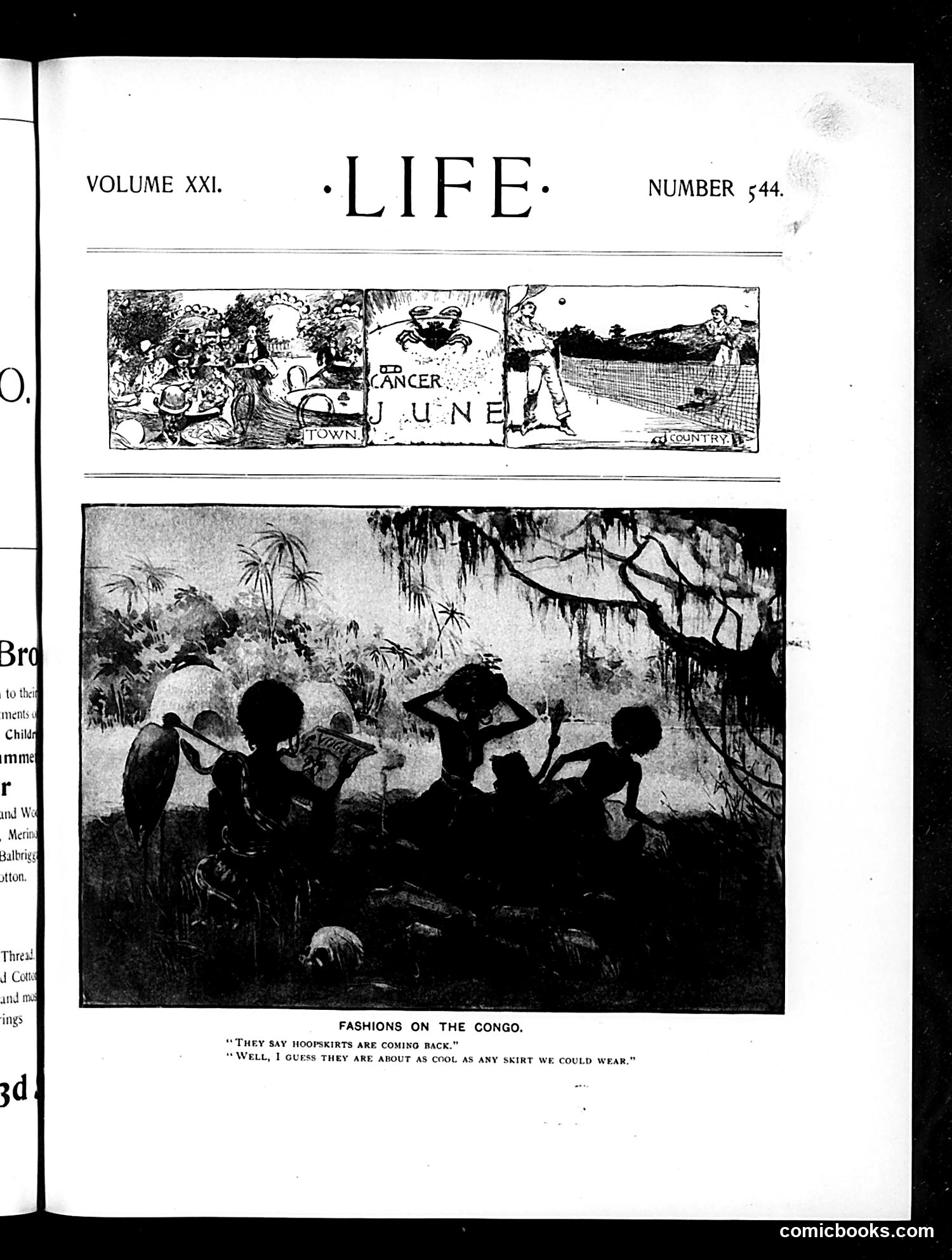
This satirical cartoon mocks Victorian-era fashion trends and European attitudes toward colonialism. The image depicts silhouetted figures in a tropical Congo setting, with the caption referencing hoopskirts—a fashionable garment returning to popularity. The satire operates on two levels: it ridicules the notion that hoopskirts are "cool" enough for tropical climates (an obvious practical absurdity), and implicitly critiques European colonizers who imposed their impractical fashion standards in African colonies despite unsuitable environments. The silhouetted figures appear to represent both European colonists and African inhabitants, highlighting the disconnect between European aesthetic preferences and colonial realities. The joke assumes readers share skepticism about both hoopskirts' practicality and colonial enterprise itself.
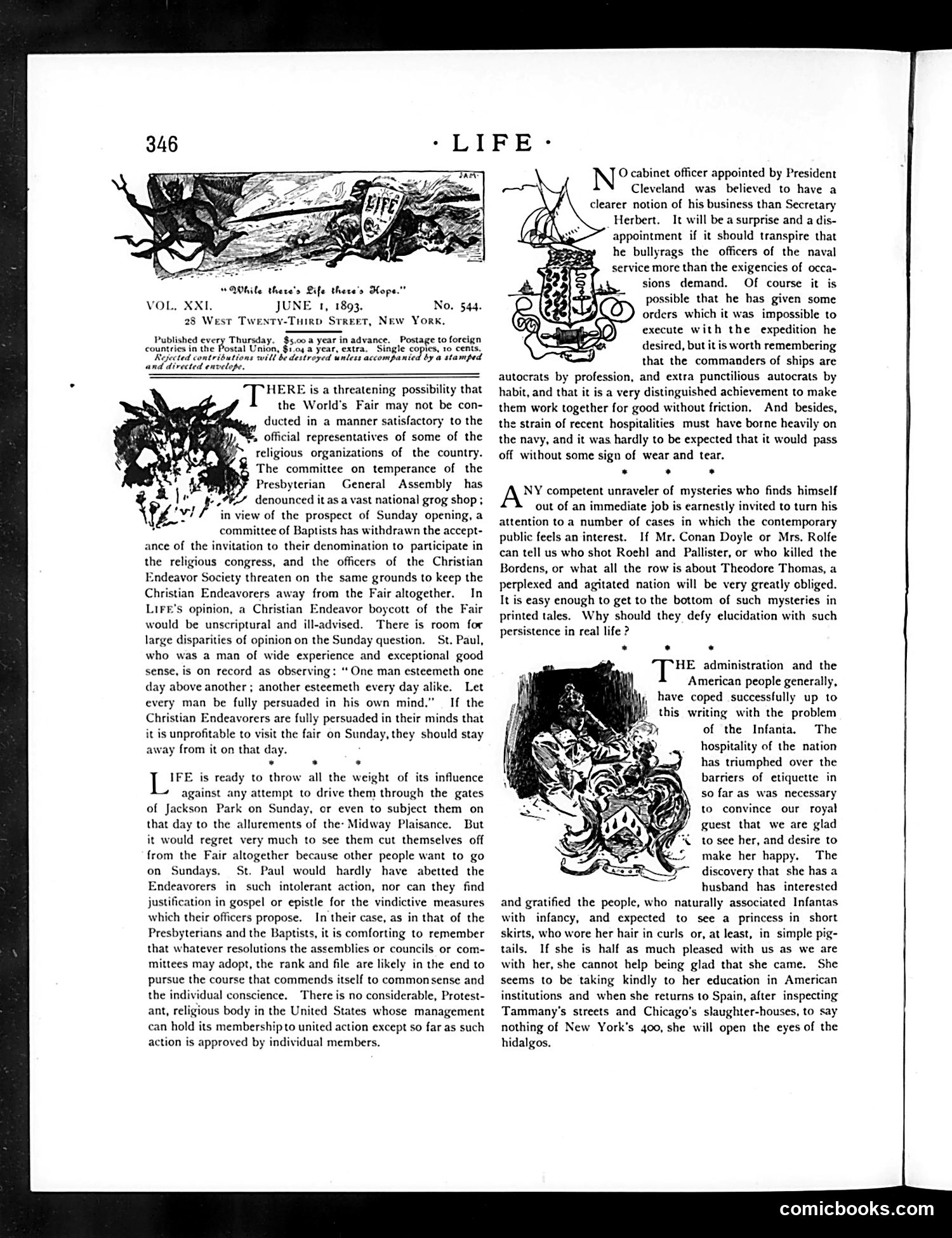
This page contains editorial commentary rather than cartoon satire. The main text discusses concerns about the World's Columbian Exposition (the 1893 Chicago World's Fair) opening on Sundays, which conflicted with religious groups' Sabbath observance beliefs. The article argues against religious organizations attempting to prevent fair attendance on Sundays, defending individual conscience over institutional pressure. The author invokes St. Paul as supporting religious tolerance. A secondary piece discusses the Infanta (Spanish royal child) visiting America, praising the nation's hospitality toward the young princess. The text suggests she'll return to Spain impressed by American institutions. The decorative illustrations are ornamental rather than specifically satirical—they frame the editorial discussion without depicting particular political figures or events.
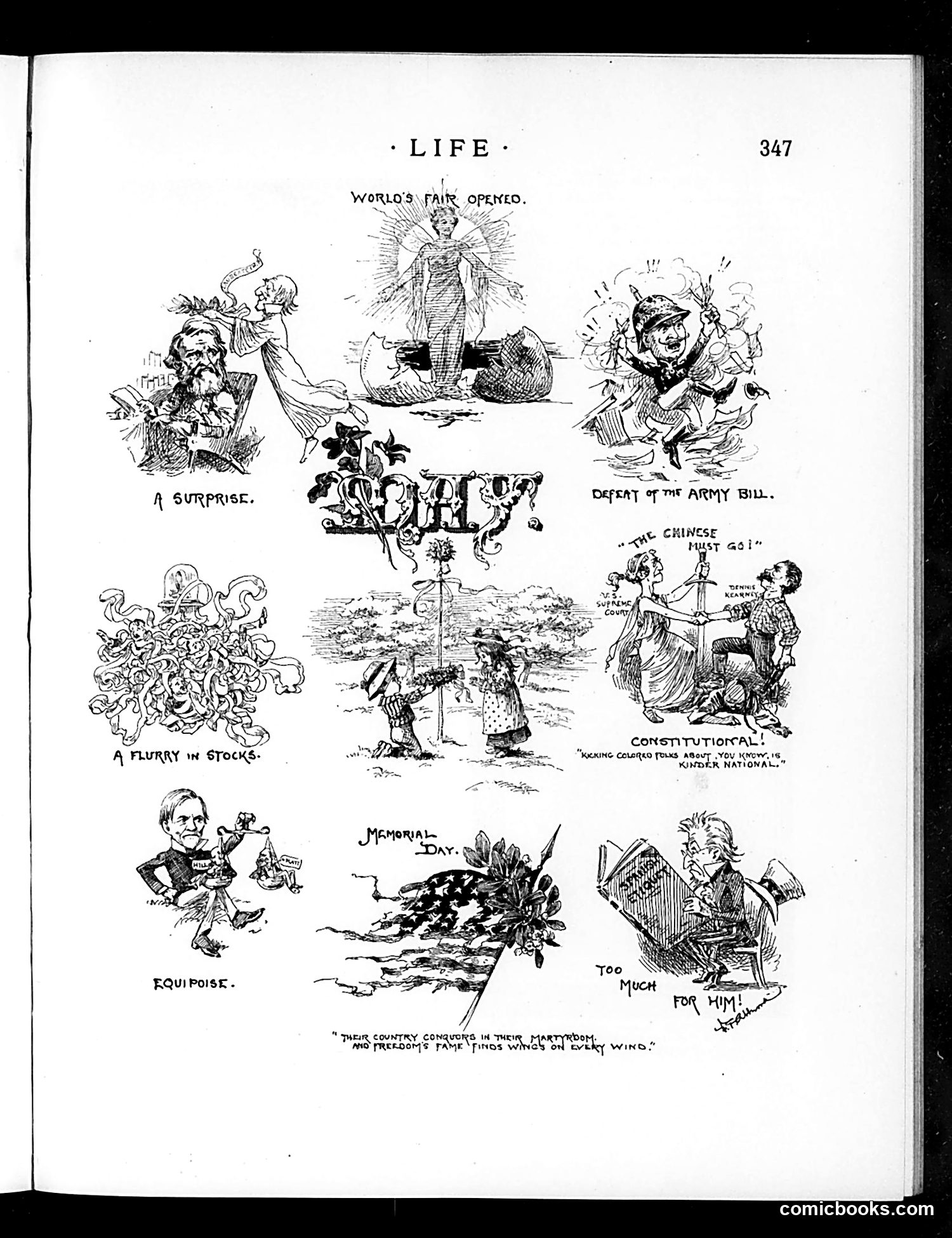
This page collects brief satirical commentaries on 1904 events: **"World's Fair Opened"** depicts the St. Louis World's Fair opening with an allegorical female figure. **"A Surprise"** and **"Defeat of the Army Bill"** mock political figures—likely related to military legislation debates of that era. **"A Flurry in Stocks"** shows financial market chaos. **"The Chinese Must Go"** references anti-Chinese sentiment and immigration policy, depicting xenophobic rhetoric. **"Constitutional!"** appears to satirize a Supreme Court decision or constitutional controversy, possibly involving race relations ("colored" reference suggests civil rights issues). **"Memorial Day,"** "Equipoise," and **"Too Much for Him!"** offer lighter social commentary on national holidays and political figures' struggles. The bottom caption references national freedom and strength—likely commentary on American expansionism or military policy.
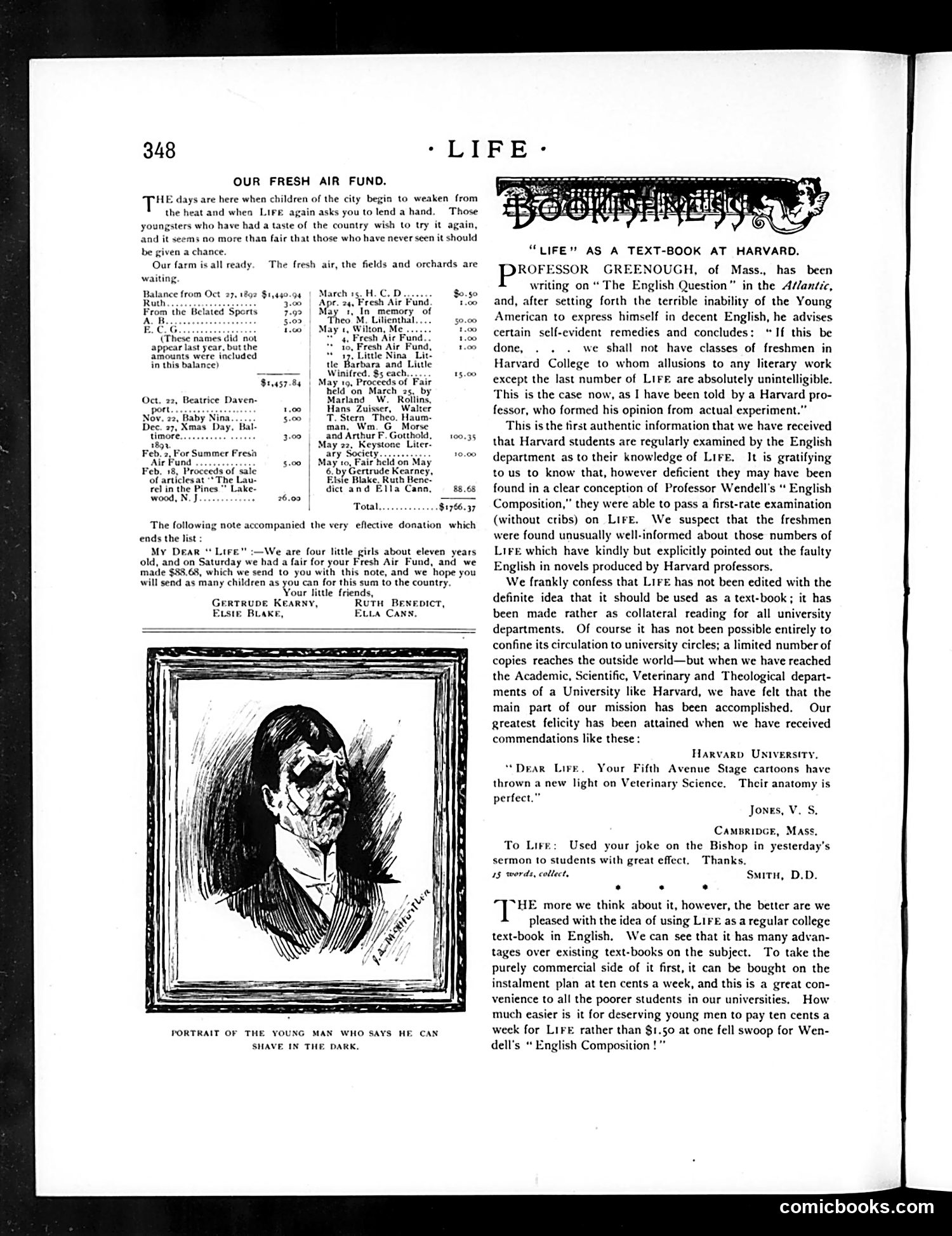
The page features two distinct sections: **Left side:** A sketch portrait labeled "Portrait of the Young Man Who Says He Can Shave in the Dark." The cartoon mocks a man claiming an impossible feat—shaving safely without light—a humorous exaggeration of overconfidence or male bravado common in early 20th-century satire. **Right side:** An article discussing *Life* magazine's use as a Harvard textbook for English composition. The text humorously notes that Harvard professors have assigned *Life* to students, claiming it provides superior instruction in English writing compared to traditional composition textbooks. The piece celebrates this validation while poking fun at academic pretension and the magazine's broader cultural influence. The page combines visual satire with self-promotional commentary typical of *Life*'s irreverent style.
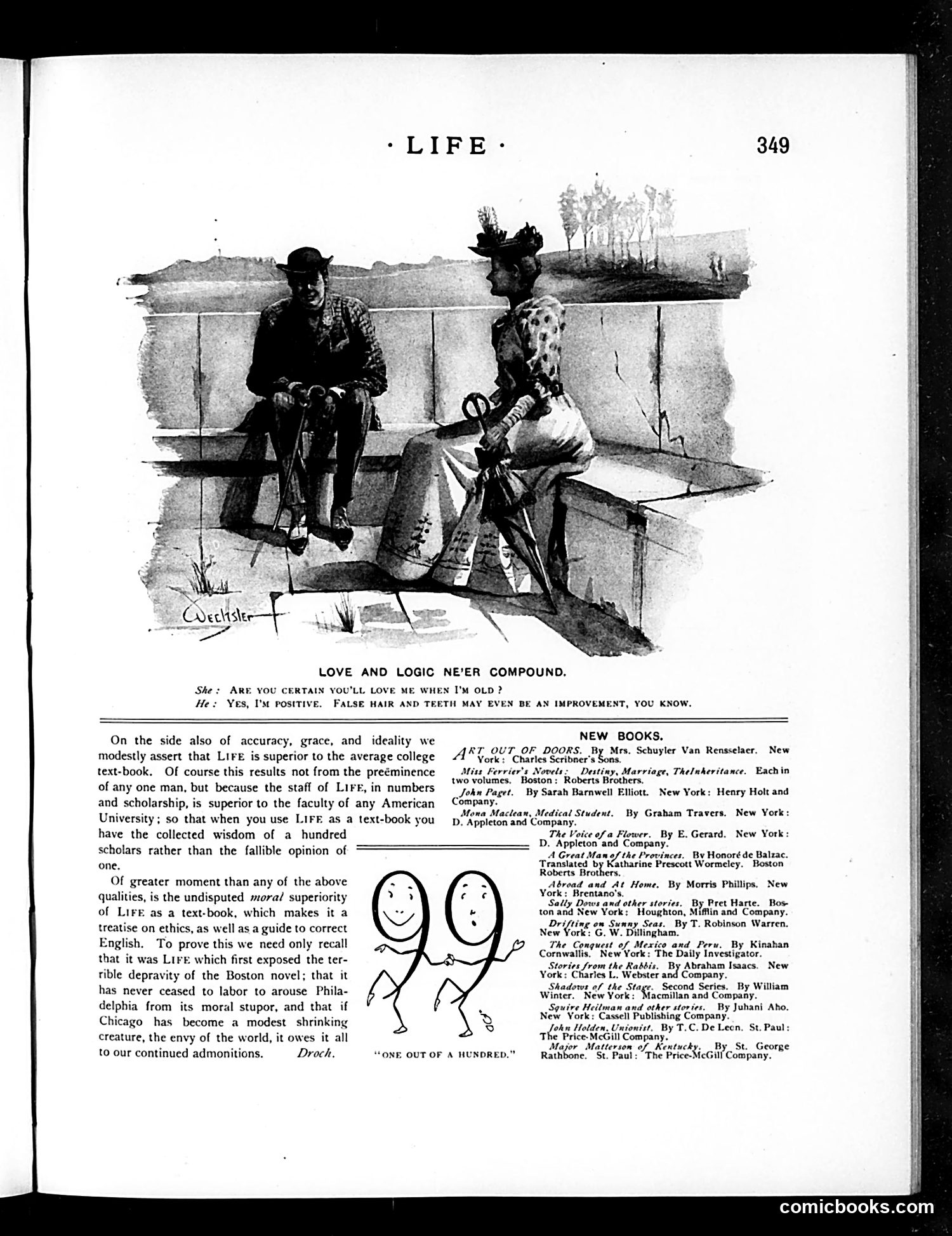
The main cartoon depicts two figures on a bench overlooking a landscape—a man in military uniform on the left and a woman in a polka-dot dress on the right. The caption reads: "LOVE AND LOGIC NEVER COMPOUND." **The Dialogue:** - She asks if he'll love her when she's old - He responds affirmatively, noting "false hair and teeth may even be an improvement" **The Satire:** This appears to be a commentary on romantic courtship and practicality. The male figure's clinical assessment of aging—treating physical deterioration as potentially correctable through artificial means—mocks the tension between romantic idealism and harsh reality. The title "One Out of a Hundred" (visible in the sketch) suggests this represents an uncommon attitude or relationship dynamic. The joke relies on the absurdity of reducing love to logical cost-benefit analysis regarding artificial enhancements.
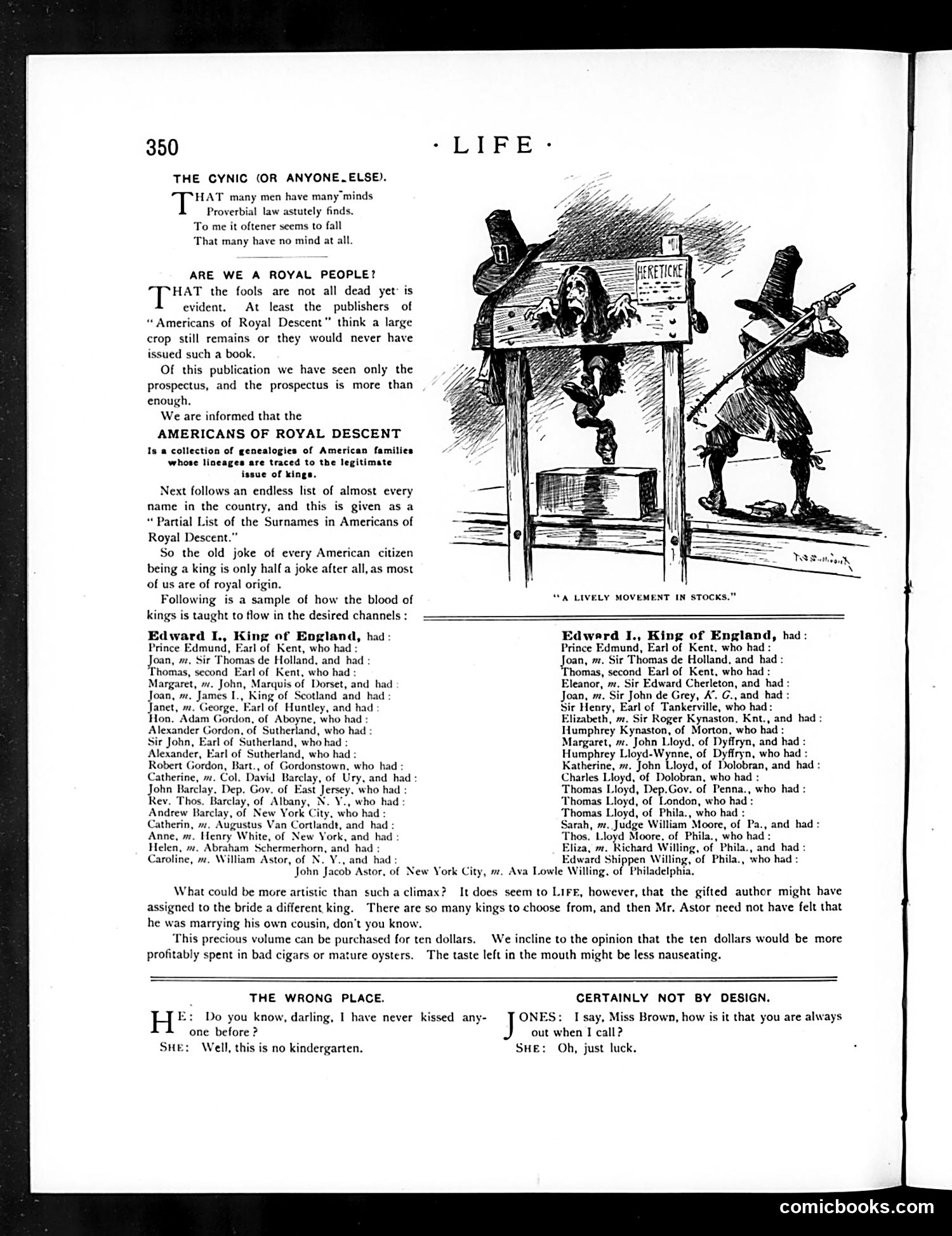
This page satirizes the "Americans of Royal Descent" publication—a genealogical guide claiming many American citizens descended from European nobility. The article mocks this as absurd vanity, noting the book lists "almost every name in the country" as having royal blood. The cartoon depicts a stock ticker labeled "GENETICK" with figures examining lineages, satirizing how widespread and commercialized these royal-descent claims had become. The article jokes that if most Americans truly descended from kings, the old saying about "the blood of kings" flowing through us becomes meaningless. The humor targets American social pretension: wealthy people (like William Astor, mentioned) purchasing genealogies to claim aristocratic status. The piece suggests this ten-dollar book was frivolous spending compared to cigars or oysters.
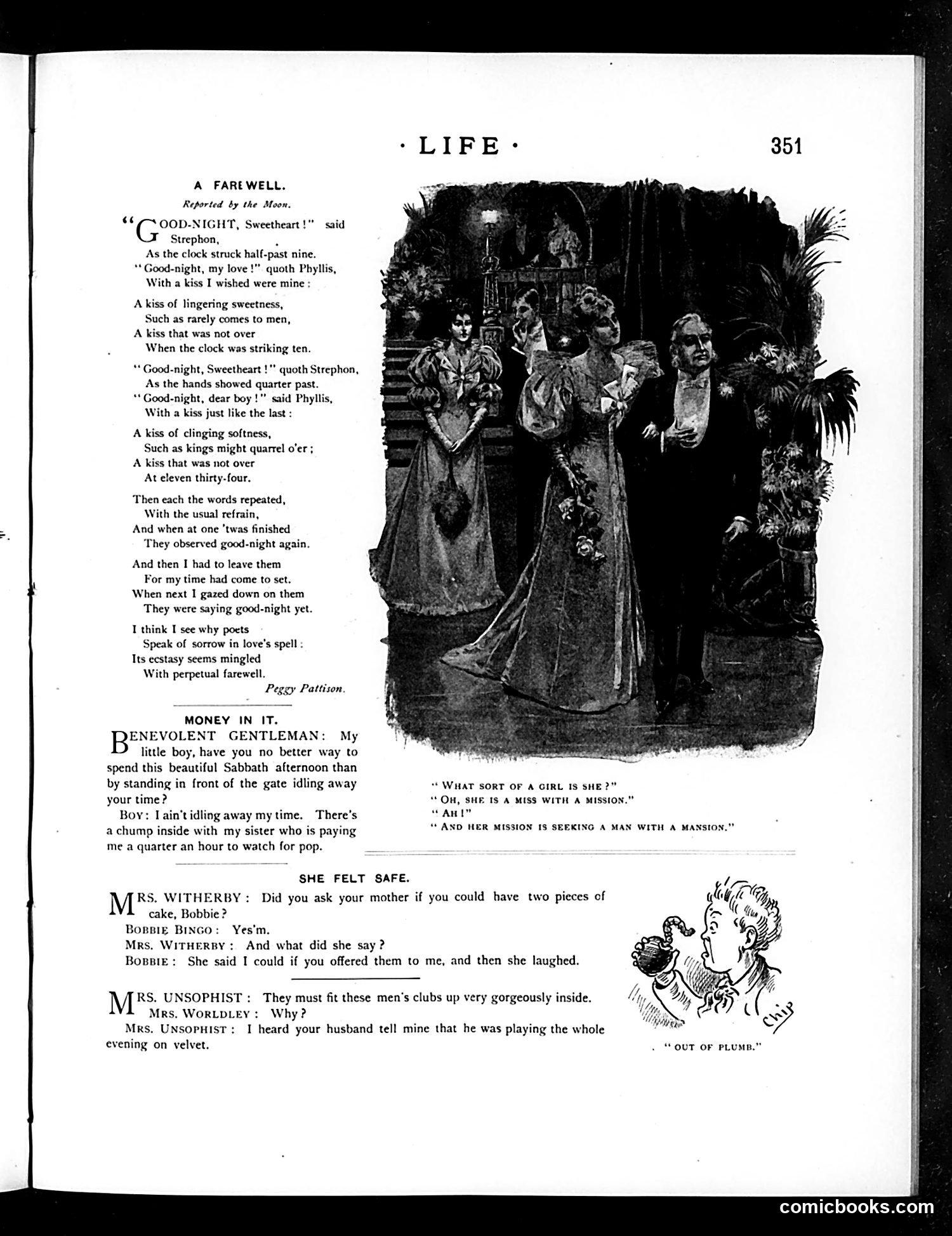
This page contains three distinct humorous pieces: **"A Farewell"** is a sentimental poem about saying goodnight to sweethearts, noting the bittersweet nature of parting kisses. It's credited to "Peggy Petition." **"Money in It"** presents a brief comic dialogue between a "benevolent gentleman" and a boy idling at a gate. The gentleman suggests the boy could be doing something productive on a Saturday afternoon, but the boy reveals he's actually earning a quarter watching his sister's suitor—implying the suitor is paying him to leave them alone. **"She Felt Safe"** features short comic exchanges between various characters about cakes and men's clubs, with a small illustration of a surprised woman labeled "Out of Plumb." The humor is genteel and domestic, typical of early Life magazine's lighthearted approach to romance, courtship, and social observation.
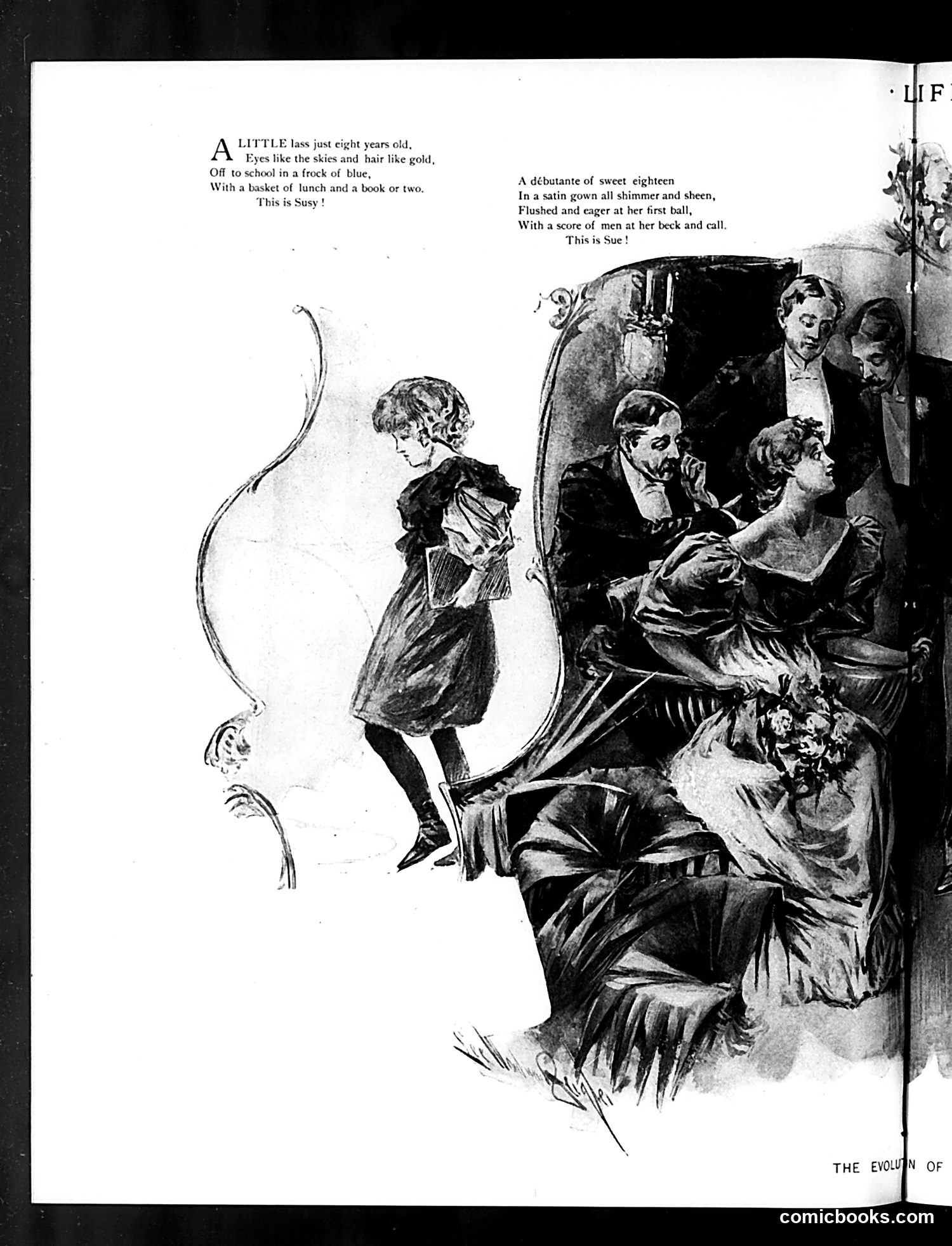
This page presents two contrasting character sketches from *Life* magazine's satirical commentary on American girlhood. The left poem describes "Susy," an eight-year-old schoolgirl—innocent, energetic, and simply dressed ("frock of blue"). The right poem and illustration depict "Sue," an eighteen-year-old debutante—glamorous, fashionable ("satin gown all shimmer and sheen"), and socially ambitious with "a score of men at her beck and call." The illustration shows her at what appears to be a formal social event, surrounded by admiring gentlemen. The satire contrasts childhood simplicity with adult vanity and social competition. The humor lies in tracking how quickly girls transform from innocent pupils into fashion-conscious socialites seeking male attention—a critique of upper-class courtship rituals and the emphasis placed on female appearance and marriageability in early 20th-century American society.
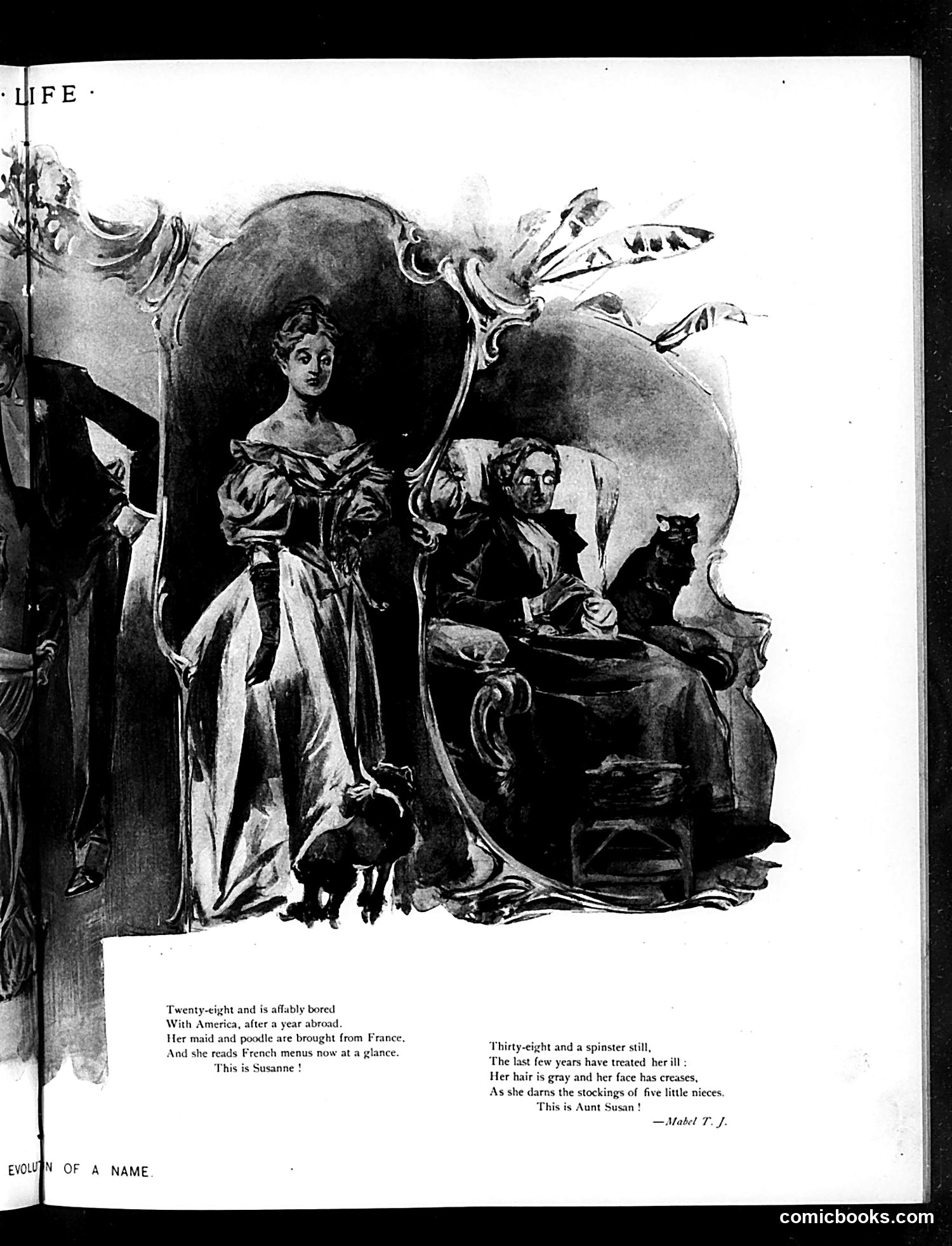
This Life magazine page satirizes the social transformation of women through marriage and aging. Two contrasting vignettes, attributed to Mabel T. J., present "Susanne" at different life stages: **Left panel:** A 28-year-old woman, recently returned from abroad with French fashions and Continental sophistication—she owns a French maid and poodle, reads French menus. **Right panel:** The same woman at 38, now "Aunt Susan"—her vitality drained by domestic duties (mending stockings for nieces), her appearance aged (gray hair, creases), reduced to spinster status. The satire mocks how marriage and motherhood supposedly transform fashionable, cosmopolitan young women into worn-out, unglamorous matrons, stripped of their former identity and appeal. It critiques both the toll of domesticity and society's treatment of aging women.
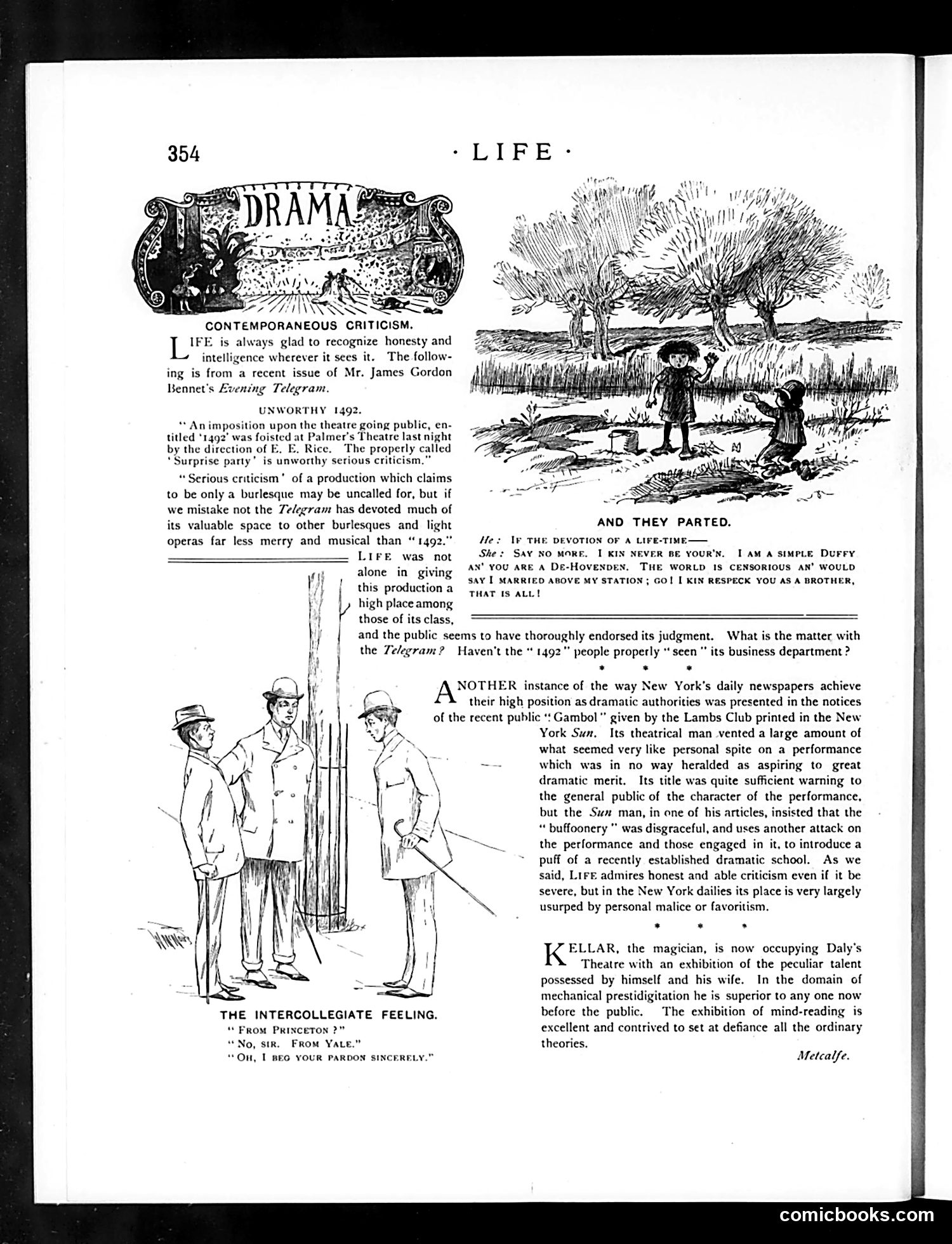
This page satirizes New York newspapers' dramatic criticism as biased and self-serving rather than honest. **"Unworthy 1492"**: Life defends the burlesque play *1492* against harsh criticism from James Gordon Bennett's *Evening Telegram*, arguing the paper devoted serious critical space to a deliberately frivolous production while praising lighter works elsewhere—exposing inconsistent standards. **"Gambol" critique**: Similarly, Life criticizes the *New York Sun's* theater reviewer for attacking a Lambs Club performance with apparent personal malice, then using the attack to promote a newly established dramatic school—suggesting corrupt motives behind ostensibly serious criticism. **The cartoons**: "The Intercollegiate Feeling" mocks Princeton-Yale rivalry through an awkward social encounter; "And They Parted" depicts class-conscious melodrama with dialect humor. **Overall point**: Life argues New York dailies abuse their authority as dramatic arbiters through favoritism, personal spite, and hidden agendas rather than objective assessment.
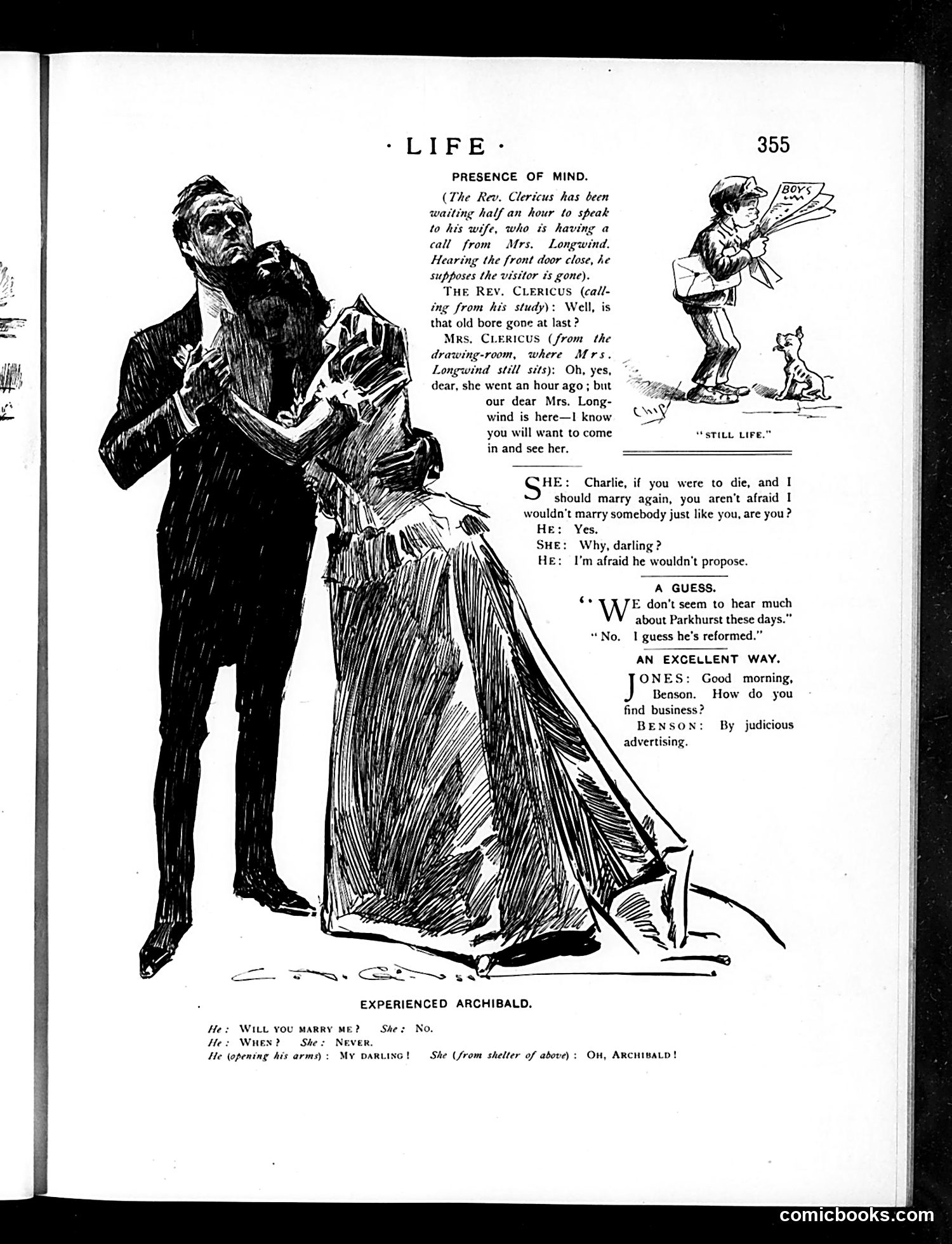
This page contains several brief comic sketches typical of Life's satirical style: **"Presence of Mind"**: A reverend complains about a boring visitor ("Mrs. Longwind"), unaware she's still present. His wife's quick lie saves him social embarrassment—the joke being her diplomatic presence of mind. **"Still Life"**: A romantic joke about male insecurity. A man fears his widow would remarry someone identical to him, not because she'd be unfaithful, but because the replacement "wouldn't propose"—implying he doubts his own marriageability. **"A Guess"**: Brief quip about reformed criminal Parkhurst, suggesting reformed criminals disappear from public notice. **"An Excellent Way"**: A businessman attributes success to "judicious advertising"—satire on turn-of-century commercial culture. **"Experienced Archibald"**: A rejected suitor's persistence; even when refused marriage "never," he continues pursuing with romantic gestures. These sketches target Victorian social conventions, male vanity, and commercial values.
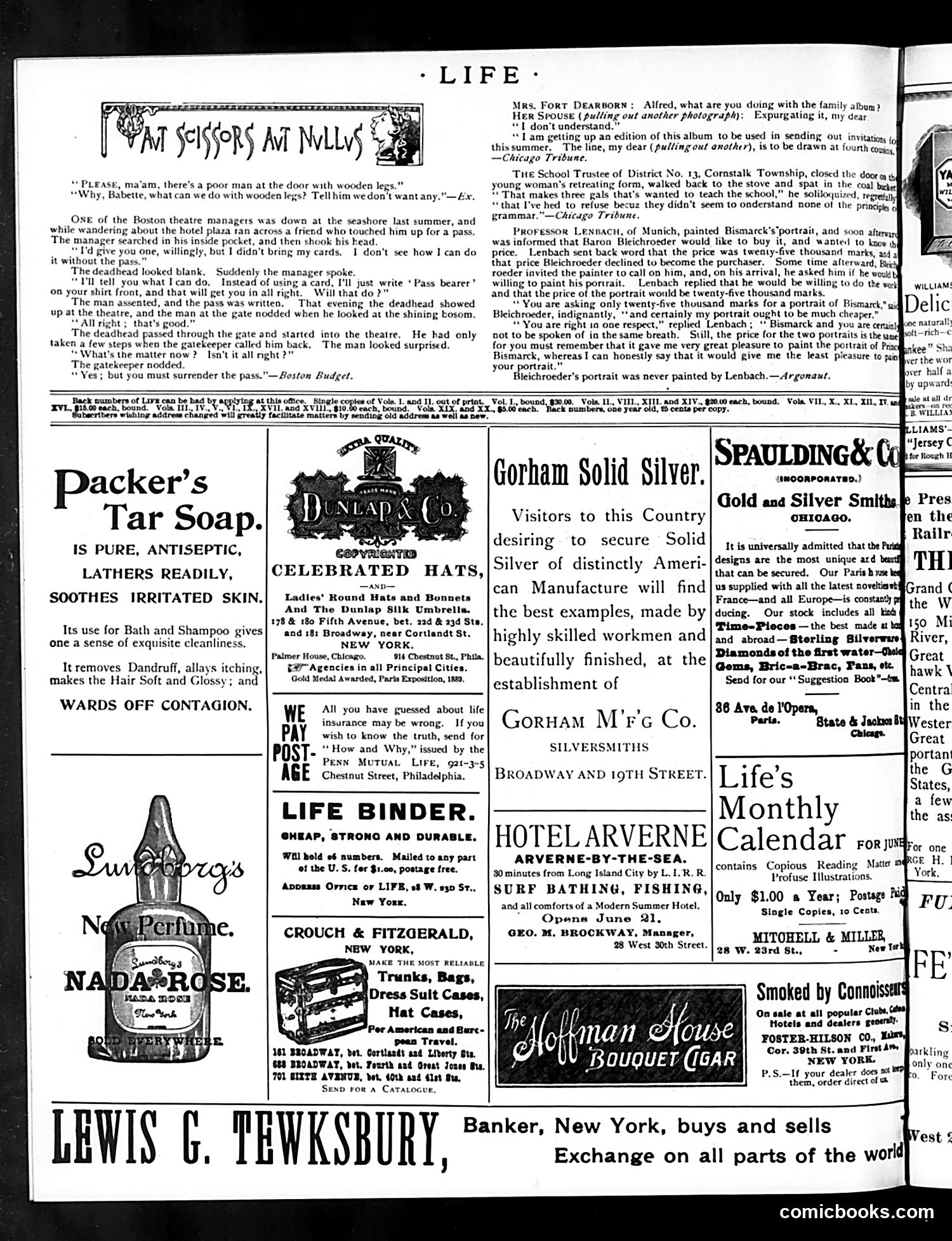
This page contains three short satirical anecdotes typical of *Life* magazine's humor: 1. **"Wooden Legs"**: A servant announces a beggar with wooden legs; the mistress dismissively refuses, not understanding the absurd premise that wooden legs are merchandise to be sold. 2. **"The Pass"**: A Boston theater manager writes "Pass bearer" on a deadbeat's shirt instead of providing a card. The joke's punchline: the gatekeeper demands he surrender the pass—treating the written words as a physical object requiring return, missing the entire point. 3. **"Bismarck's Portrait"**: Professor Lenbach refuses to paint Baron Bleichroeder's portrait after Bleichroeder balked at paying 25,000 marks (Bismarck's portrait price). Lenbach sarcastically replies that painting Bismarck brought him pleasure, but painting Bleichroeder would bring "the least pleasure"—a cutting insult wrapped in courteous language. The page is primarily advertisements otherwise. These jokes rely on literal-mindedness, class humor, and witty comeuppances—typical of the era's satirical magazine style.
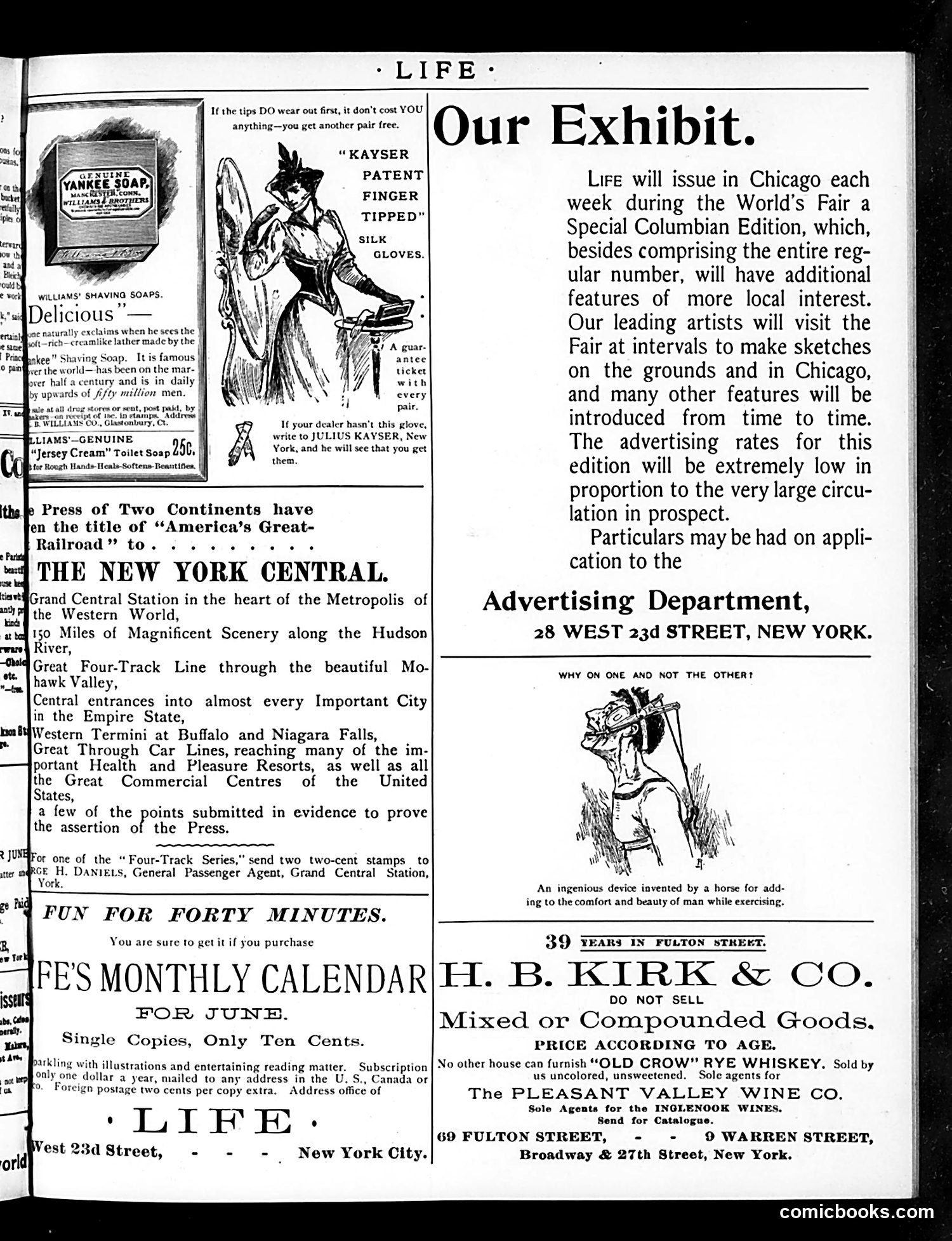
This page is primarily **advertising with one small satirical cartoon**. The main content announces Life's special coverage of the 1893 World's Columbian Exposition in Chicago, soliciting advertisers. The cartoon—captioned "WHY ON ONE AND NOT THE OTHER?"—depicts a horse wearing what appears to be a mechanical device or saddle. The caption describes it as "an ingenious device invented by a horse for adding to the comfort and beauty of man while exercising," which is **gentle satire mocking unnecessary or absurd inventions**. The joke suggests horses invented comfort aids for their riders, inverting the typical relationship. The remaining content consists of product advertisements (gloves, soaps, whiskey, wine) and promotional notices for Life's monthly calendar and the New York Central Railroad. There's no political commentary—this is straightforward commercial messaging typical of period magazine content.
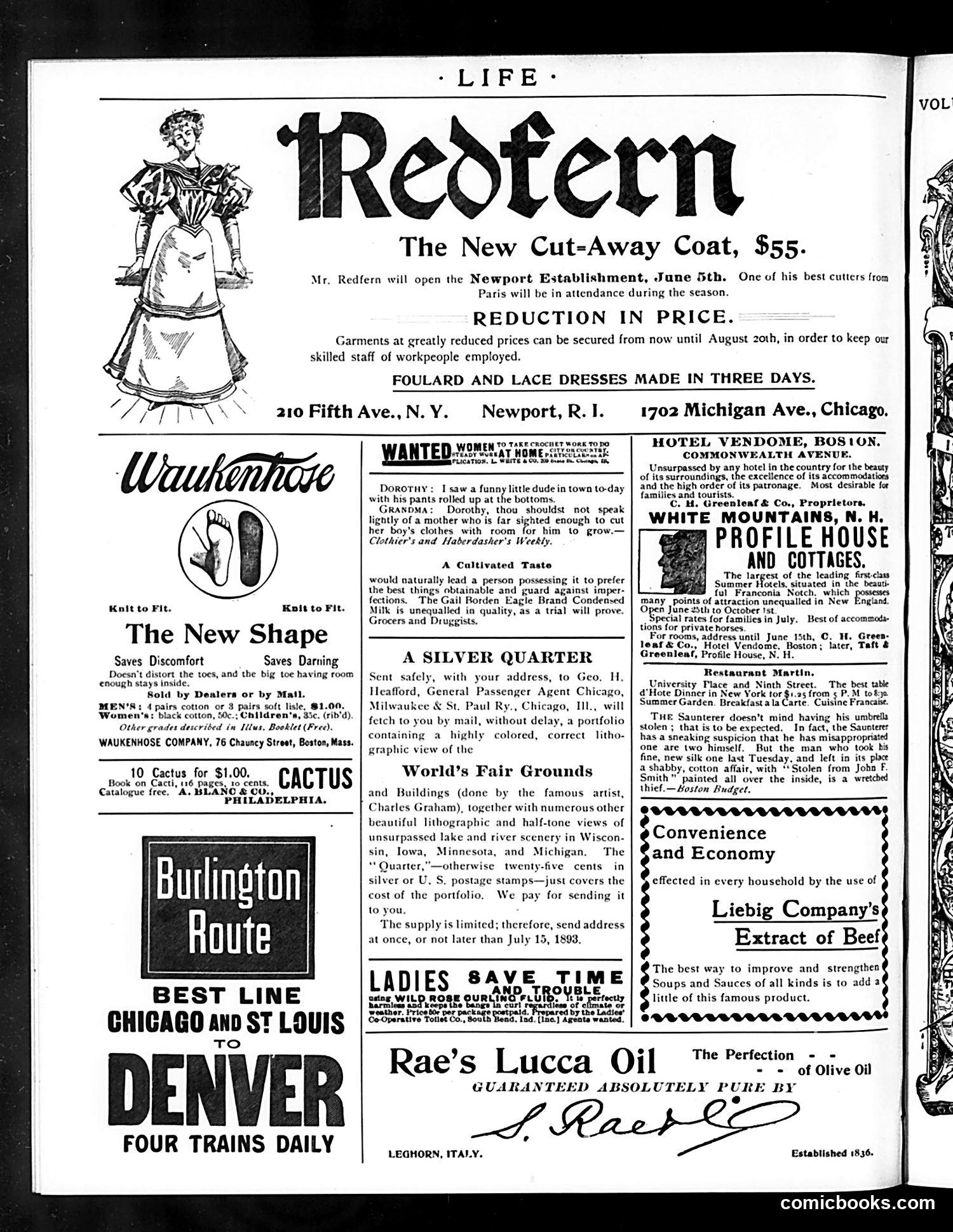
This page is primarily **advertisements** rather than satirical cartoons. However, it contains one humorous dialogue: The "Cultivated Taste" section features a brief comic exchange between **Dorothy and Grandma** about a boy seen with rolled-up pants. Grandma defends the mother, explaining she deliberately cut the boy's clothes oversized to allow room for growth—a practical, forward-thinking approach. The joke mocks Dorothy's superficial observation of fashion while praising sensible parenting. The page otherwise showcases **period luxury and convenience goods**: Redfern's high-end clothing ($55 cut-away coats), the Waukenhose Company's anatomically designed socks, rail travel via Burlington Route, and hotel accommodations. A notable advertisement promotes the **1893 World's Fair grounds** (likely the Chicago World's Columbian Exposition), offering lithographic views for a quarter coin. The content reflects late-19th-century consumer culture and advertising practices in a satirical magazine aimed at educated, affluent readers.