
Life, 1893-06-01 · page 4 of 16
Life — June 1, 1893 — page 4: what you’re looking at
What you’re looking at
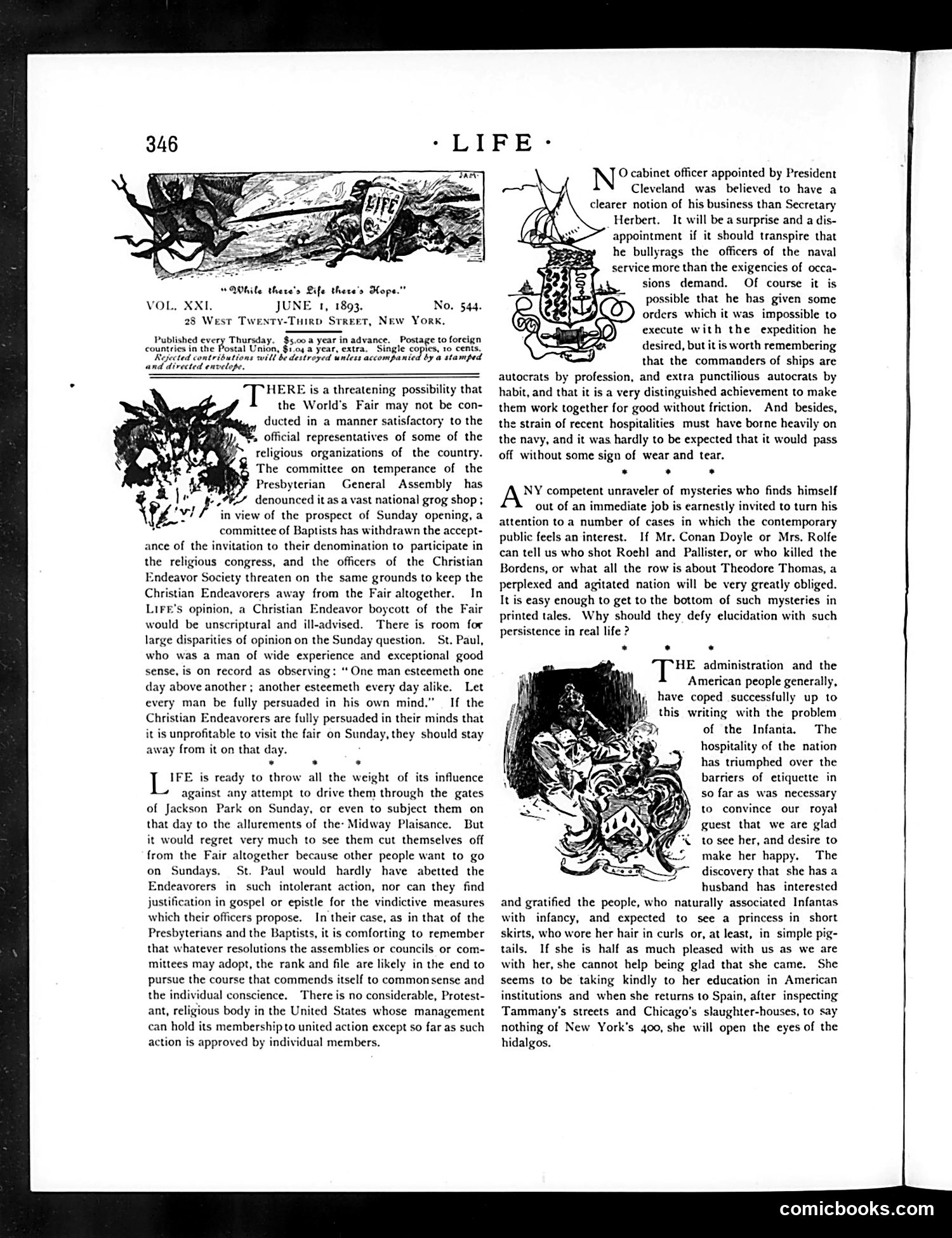
This page contains editorial commentary rather than cartoon satire. The main text discusses concerns about the World's Columbian Exposition (the 1893 Chicago World's Fair) opening on Sundays, which conflicted with religious groups' Sabbath observance beliefs. The article argues against religious organizations attempting to prevent fair attendance on Sundays, defending individual conscience over institutional pressure. The author invokes St. Paul as supporting religious tolerance. A secondary piece discusses the Infanta (Spanish royal child) visiting America, praising the nation's hospitality toward the young princess. The text suggests she'll return to Spain impressed by American institutions. The decorative illustrations are ornamental rather than specifically satirical—they frame the editorial discussion without depicting particular political figures or events.
📄 Transcribed text from this page (OCR, searchable)
Machine-transcribed from the original scan — historical spelling and the odd misread are preserved.
“While there's Life the JUNE. 1, 1893. No. 544- y-Tuirp Street, New York, VOL, XXI. 28 West Twen Published every Thursday. $5.00 a year in advance. Postage to foreign countries in the Postal Union, $1.04 a year, extra, Single copies, 10 cents, Rejected contributions will be destroyed wntess accompanied by a stamped and directed envelope. HE is a threatening possibility that the World’s Fair may not be con- ducted in a manner satisfactory to the E, official representatives of some of the religious organizations of the country. The committee on temperance of the Presbyterian General Assembly has sf ae in view of the prospect of Sunday opening, a * committee of Baptists has withdrawn the accept- ance of the invitation to their denomination to participate in the religious congress, and the officers of the Christian Endeavor Society threaten on the same grounds to keep the tian Endeavorers away from the Fair altogether. In LiFE’s opinion, a Christian Endeavor boycott of the Fair would be unscriptural and ill-advised. There is room for large disparities of opinion on the Sunday question. St. Paul, who was a man of wide experience and exceptional good sense, is on record as observing: “ One man esteemeth one day above another ; another esteemeth every day alike. Let every man be fully persuaded in his own mind.” If the Christian Endeavorers are fully persuaded in their minds that it is unprofitable to visit the fair on Sunday, they should stay away from it on that day. . . . IFE is ready to throw all the weight of its influence against any attempt to drive them through the gates of Jackson Park on Sunday, or even to subject them on that day to the allurements of the: Midway Plaisance. But it would regret very much to see them cut themselves off from the Fair altogether because other people want to go on Sundays. St. Paul would hardly have abetted the Endeavorers in such intolerant action, nor can they find justification in gospel or epistle for the vindictive measures which their officers propose. In their case, as in that of the Presbyterians and the Baptists, it is comforting to remember that whatever resolutions the assemblies or councils or com- mittees may adopt, the rank and file are likely in the end to pursue the course that commends itself to common sense and the individual conscience. There is no considerable, Protest- ant, religious body in the United States whose management can hold its membership to united action except so far as such action is approved by individual members. O cabinet officer appointed by President Cleveland was believed to have a clearer notion of his business than Secretary Herbert. It will be a surprise and a dis- appointment if it should transpire that he bullyrags the officers of the naval service more than the exigencies of occa- sions demand. Of course it is possible that he has given some orders which it was impossible to execute with the expedition he desired, but it is worth remembering that the commanders of ships are autocrats by profession, and extra punctilious autocrats by habit, and that it is a very distinguished achievement to make them work together for good without friction, And besides, the strain of recent hospitalities must have borne heavily on the navy, and it was hardly to be expected that it would pass off without some sign of wear and tear. . . . NY competent unraveler of mysteries who finds himself out of an immediate job is earnestly invited to turn his attention toa number of cases in which the contemporary public feels an interest. If Mr. Conan Doyle or Mrs. Rolfe can tell us who shot Roehl and Pallister, or who killed the Bordens, or what all the row is about Theodore Thomas, a perplexed and agitated nation will be very greatly obliged. It is easy enough to get to the bottom of such mysteries in printed tales. Why should they defy elucidation with such persistence in real life ? * . . HE administration and the American people generally, have coped successfully up to this writing with the problem of the Infanta. The hospitality of the nation has triumphed over the barriers of etiquette in so far as was necessary to convince our royal guest that we are glad to see her, and desire to make her happy. The discovery that she has a husband has interested and gratified the people, who naturally associated Infantas with infancy, and expected to see a princess in short skirts, who wore her hair in curls or, at least, in simple pig- tails. If she is half as much pleased with us as we are with her, she cannot help being glad that she came. She seems to be taking kindly to her education in American institutions and when she returns to Spain, after inspecting Tammany’s streets and Chicago's slaughter-houses, to say nothing of New York's 400, she will open the eyes of the hidalgos. comicbooks.com