
A complete issue · 16 pages · 1893
Life — May 4, 1893
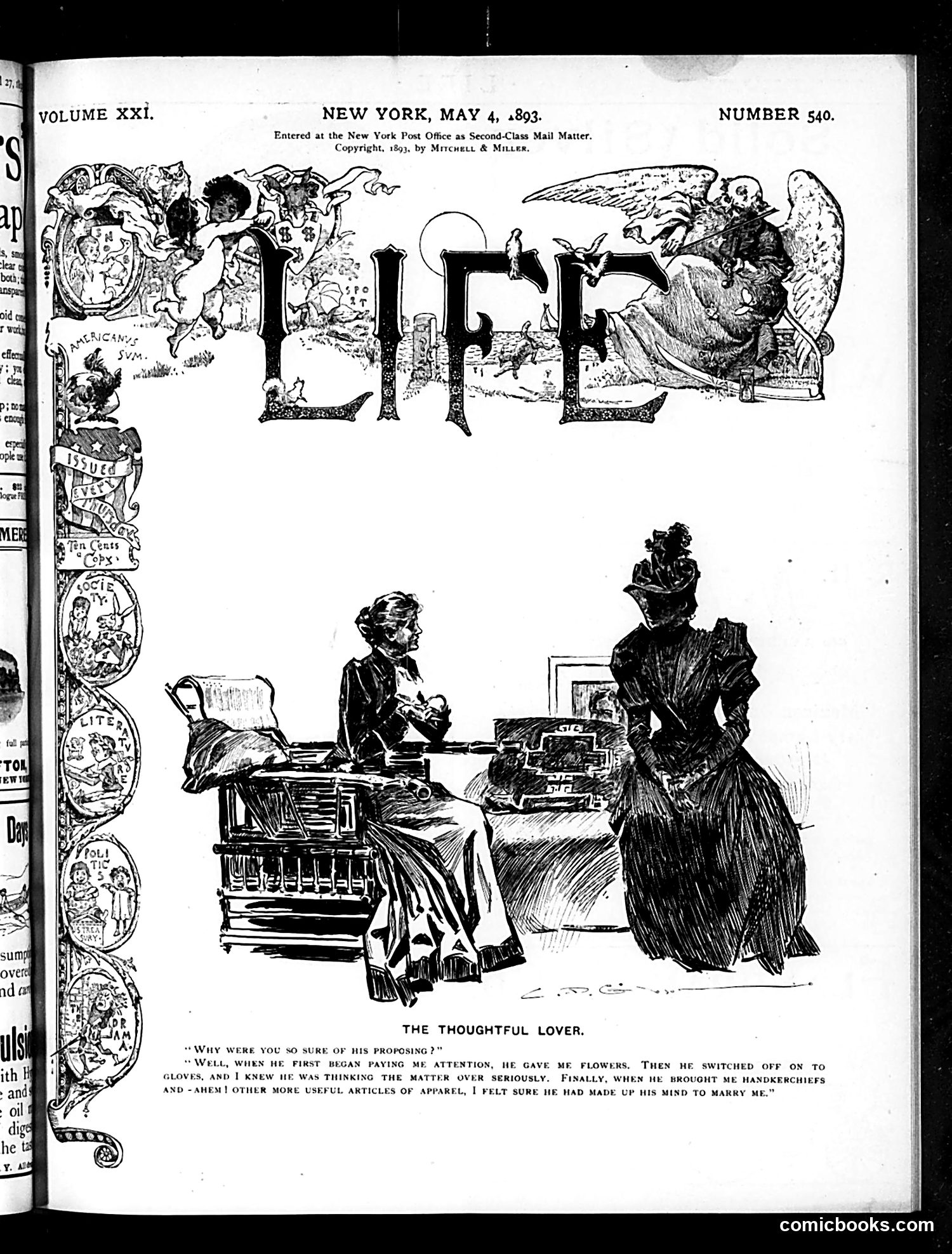
This satirical cartoon depicts a domestic scene labeled "The Thoughtful Lover." The caption presents a woman's explanation for why she was confident her suitor would propose: he systematically gave her flowers, then switched to gloves, then studied "the matter over seriously." Finally, when he brought handkerchiefs, she concluded he'd "made up his mind to marry me." The humor lies in the absurdist logic—the woman interprets his gift progression as evidence of marital intent, reading significance into mundane presents (flowers, gloves, handkerchiefs). The cartoon satirizes Victorian courtship rituals and women's tendency to over-interpret male behavior as romantic commitment. It's a gentle mockery of both romantic delusion and the elaborate social codes governing 1890s courtship.
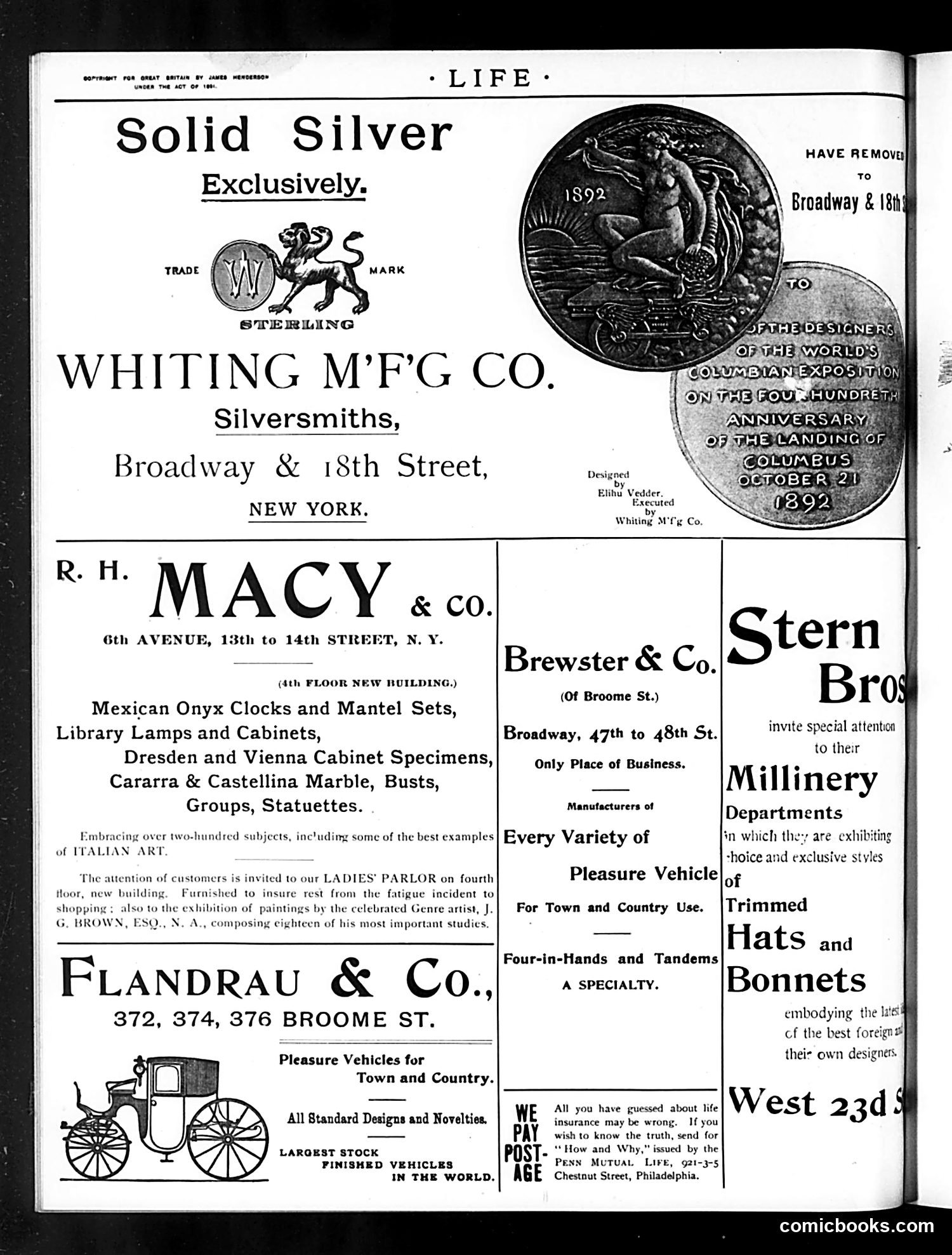
This page is primarily **advertising**, not satire or political commentary. It contains commercial advertisements for late 19th-century businesses: - **Whiting M'fg Co.**: A silversmith advertising solid silver goods, featuring a commemorative medallion from the 1892 Columbian Exposition (Chicago's World's Fair) - **R.H. Macy & Co.**: Department store listing decorative home goods - **Brewster & Co.**: Carriage manufacturer - **Flandrau & Co.**: Also a carriage/pleasure vehicle company with illustrations of their vehicles - **Stern Bros**: Millinery shop - **Penn Mutual Life**: Insurance company with a philosophical advertisement about life insurance The only visual content is product illustrations (coins, carriages) and company logos. There are no political cartoons or satirical commentary visible on this page. It represents typical *Life* magazine advertising from the 1890s.
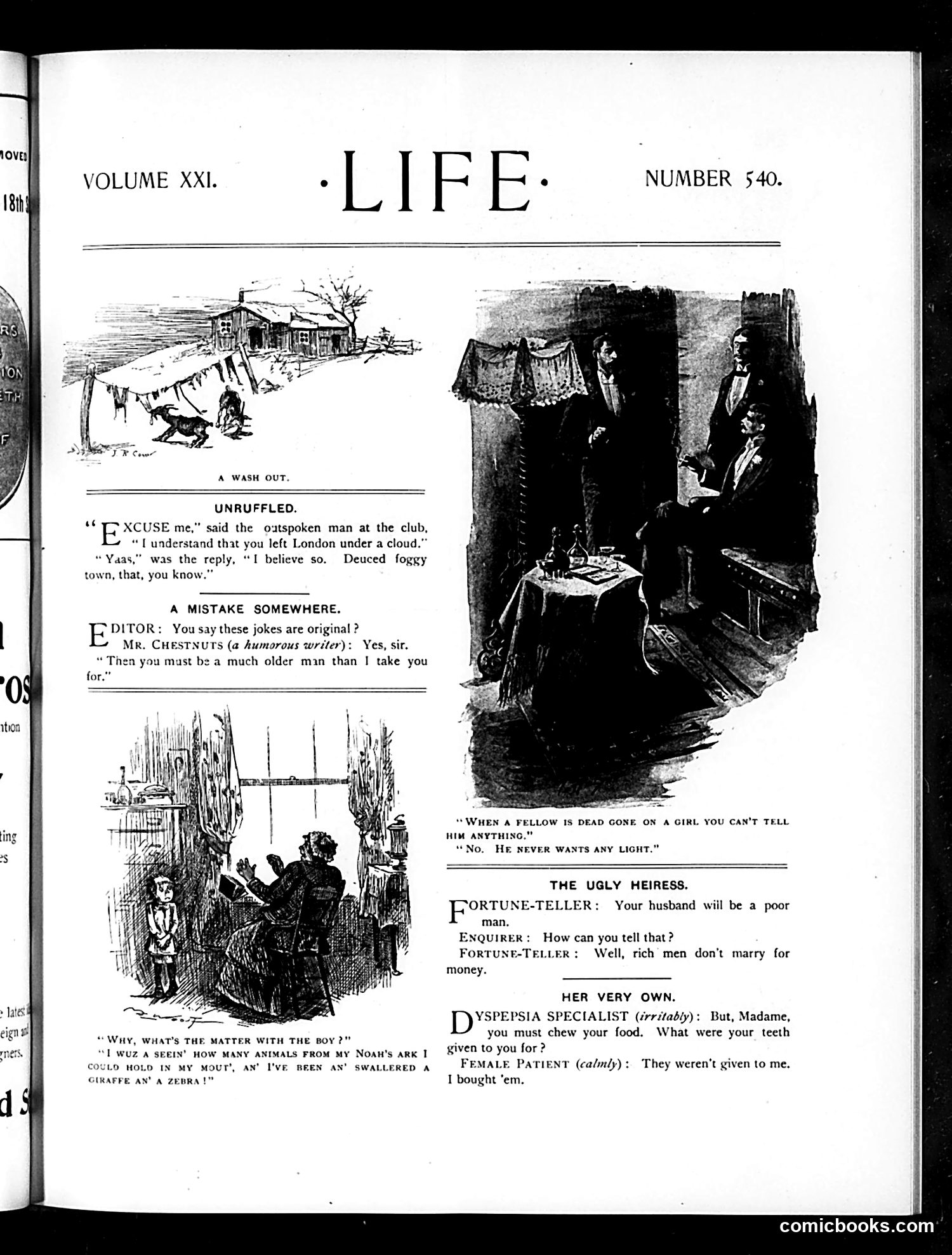
This page contains several brief humorous anecdotes rather than political cartoons: **"Unruffled"**: A joke about a man who left London under suspicious circumstances, with a casual dismissal suggesting small-town indifference. **"A Mistake Somewhere"**: An editor challenges a humorous writer about joke originality; the writer claims the editor must be much older, implying the jokes are ancient. **"The Ugly Heiress"**: A fortune-teller's quip that rich men don't marry for money—suggesting wealthy women are unattractive. **"Her Very Own"**: A dyspepsia specialist and female patient exchange about her dentures, implying she purchased false teeth rather than possessing natural ones. The illustrations are generic Victorian-era sketches. These are mild satirical observations about social pretension, aging, wealth, and vanity—typical of Life's light comedy content from this period.
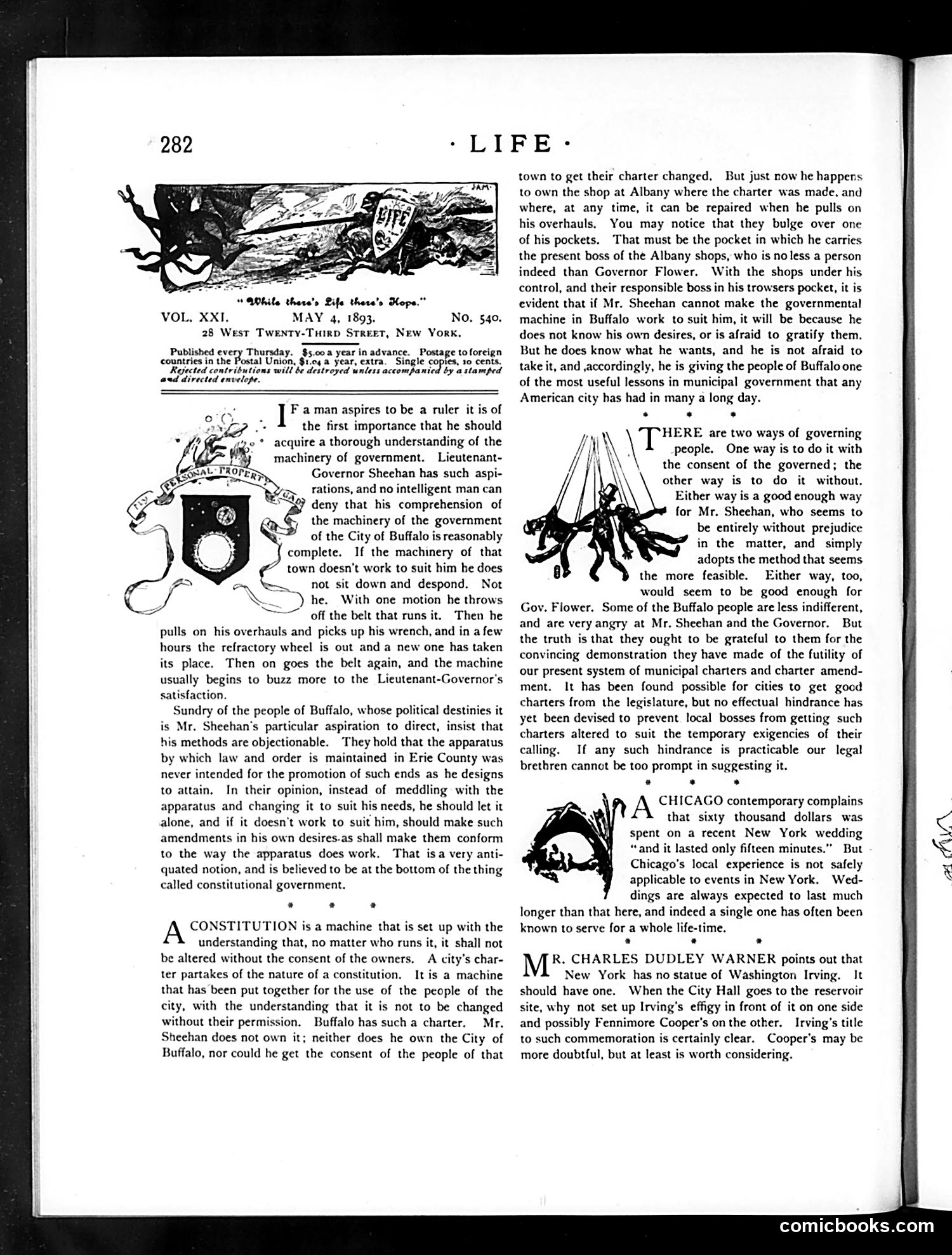
The page contains satirical commentary on Buffalo, New York's municipal government, specifically critiquing Lieutenant-Governor Sheehan's management of the city's machinery and charter. The **main illustration** (top left) shows a mechanical apparatus labeled "While there's Life there's Hope"—a visual metaphor for Buffalo's government as a machine that requires constant adjustment and repair. The text satirizes Sheehan's approach: rather than properly understanding how city government works, he simply tinkers with it mechanically, making ad-hoc fixes. The satire suggests he governs without genuine principle or comprehension—merely "throwing off the belt" and making temporary adjustments rather than addressing fundamental problems. The piece advocates for respecting constitutional municipal charters and questions whether Sheehan has legitimate authority to alter governmental structures unilaterally.
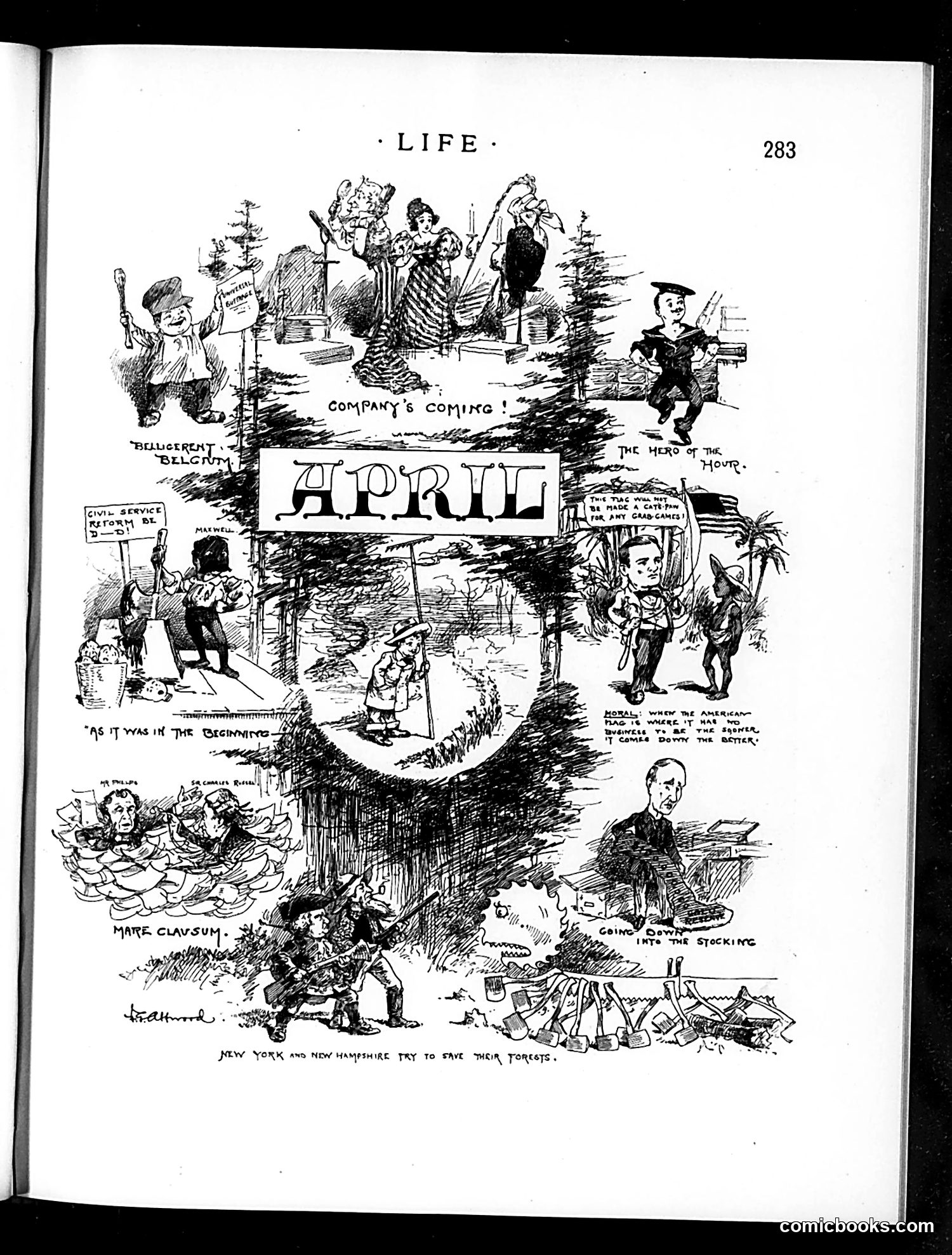
This Life magazine page satirizes April events through multiple vignettes. "Company's Coming" announces the month's arrival with various characters. Visible references include: - "Civil Service Reform" – depicting political patronage/bureaucracy concerns - "The Hero of the Hour" – unclear which specific figure is targeted - "As It Was in the Beginning" – likely a biblical or historical reference - References to American flags and what appears to be military or government figures - "Mare Claysum" and other labeled characters suggesting specific contemporary personalities - Bottom caption mentioning "New York and New Hampshire try to save their forests" The cartoon employs visual puns and caricature typical of early 20th-century political satire, though without additional historical context, some specific targets remain unclear.
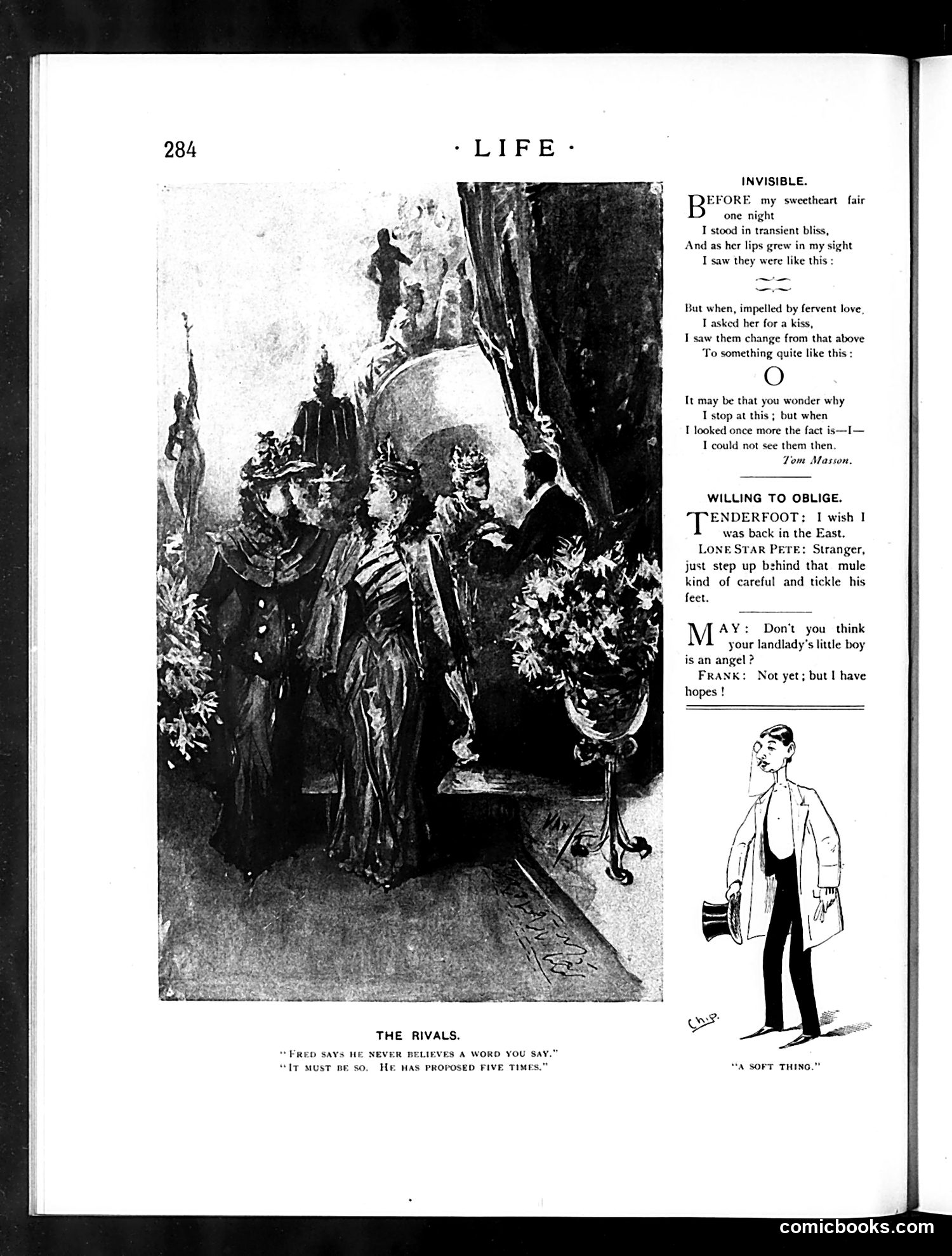
This page contains three separate satirical pieces: **"Invisible"** (poem by Tom Masson): A romantic verse about a sweetheart whose lips appeared as dashes ("=") initially, then as the letter "O" when the narrator asked for a kiss, then became invisible entirely—suggesting the speaker imagined the encounter. **"Willing to Oblige"** (dialogue): A brief comic exchange between rural characters (Tenderfoot, Lone Star Pete, May, and Frank) making crude jokes about a landlady's son being angelic, with Frank hoping otherwise—typical frontier humor. **"The Rivals"** (illustration): The large central image depicts an ornate interior scene with elaborately dressed figures, captioned with dialogue about Fred never believing words and having proposed five times—likely satirizing persistent, unsuccessful suitors. The humor targets romantic pretension and rural naïveté common to early 20th-century American satire.
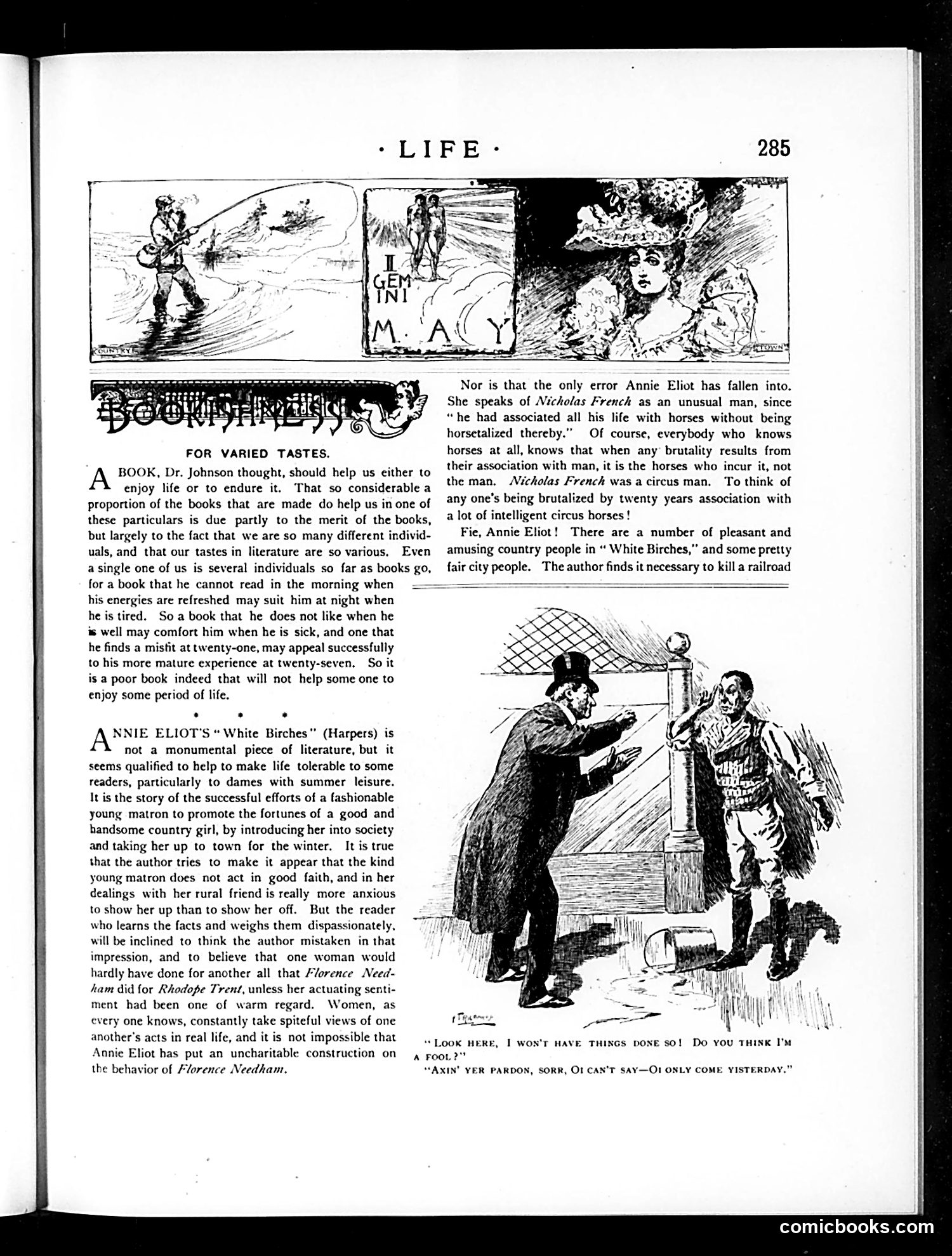
This page reviews Annie Eliot's novel "White Birches" (Harper's), framed as advice for varied literary tastes. The main text critiques the book's portrayal of a fashionable young woman promoting a country gentleman for social advancement in town. The reviewer argues Eliot unfairly depicts the protagonist as acting in bad faith, contrasting her unfavorably with "Florence Needham" from "Rhodope Trent." The accompanying illustration shows a domestic scene with two figures in period dress, with dialogue suggesting comedic misunderstanding about someone's foolish behavior or poor judgment. The page demonstrates Life's role as a satirical literary and social commentary magazine, using book reviews to critique both authors' moral characterizations and contemporary upper-class social dynamics.
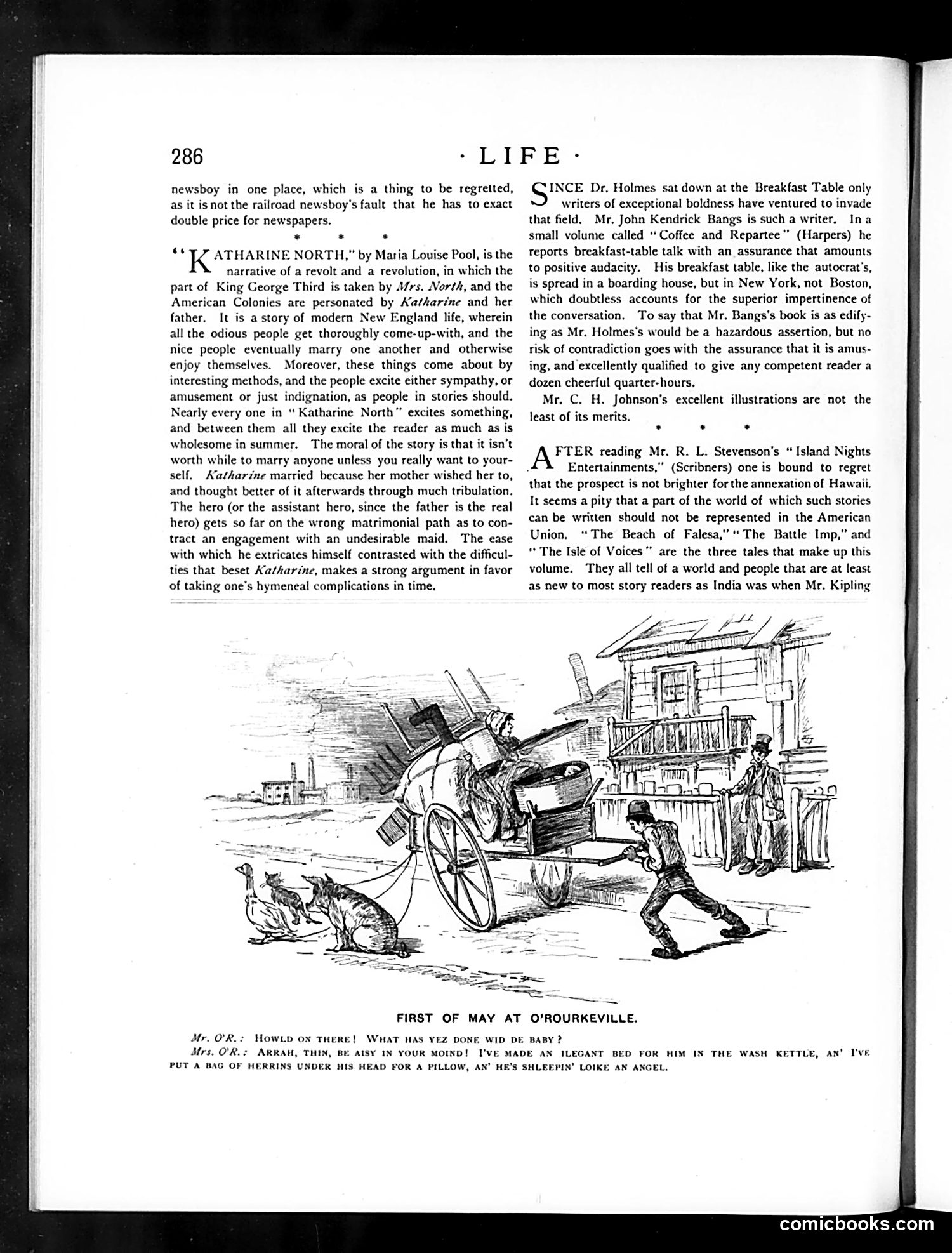
This cartoon illustrates an Irish-American working-class scene, likely from the late 19th or early 20th century. The sketch depicts what appears to be a chaotic May Day celebration in an Irish neighborhood ("O'Rourkeville"), with a man on a rickety cart being pulled by another man while children play nearby and onlookers watch from a porch. The caption's dialogue—referencing a baby's bed made from a wash kettle and herrings as a pillow—represents stereotypical Irish-American immigrant poverty and chaotic domestic life. The satire targets the living conditions and cultural practices of Irish working-class communities, portraying them as disorderly and impoverished in a way typical of period American satirical humor toward ethnic minorities.
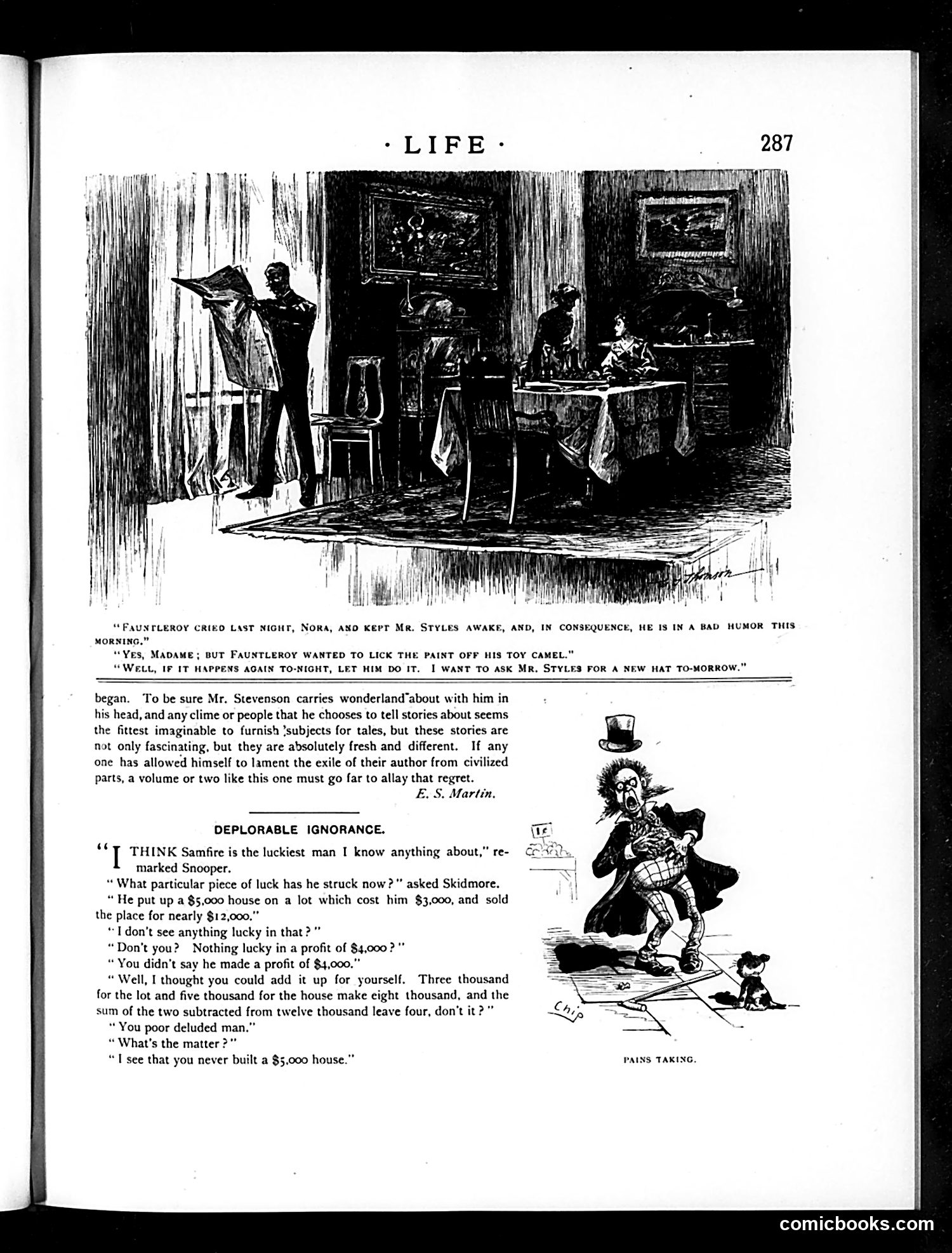
**Top Illustration:** A domestic scene showing a man displaying what appears to be a painting or artwork to others in a furnished room. The caption references "Fauntleroy" (likely the sentimental literary character) crying and keeping "Mr. Styles" awake, with dialogue about licking paint off a toy camel and requesting a new hat. This appears to be satirizing overly sentimental or fussy domestic complaints. **"Deplorable Ignorance" Section:** A humorous dialogue between Snooper and Skidmore about a man named Samfire's real-estate "luck." Samfire bought a $1,000 lot, built a $5,000 house, sold it for $11,000—netting a $5,000 profit. Skidmore fails at basic arithmetic, repeatedly miscalculating the sum, satirizing widespread mathematical ignorance among ordinary people. **Right Illustration:** A caricatured figure labeled "Pains Taking," likely mocking affected or pretentious artistic sensibilities.
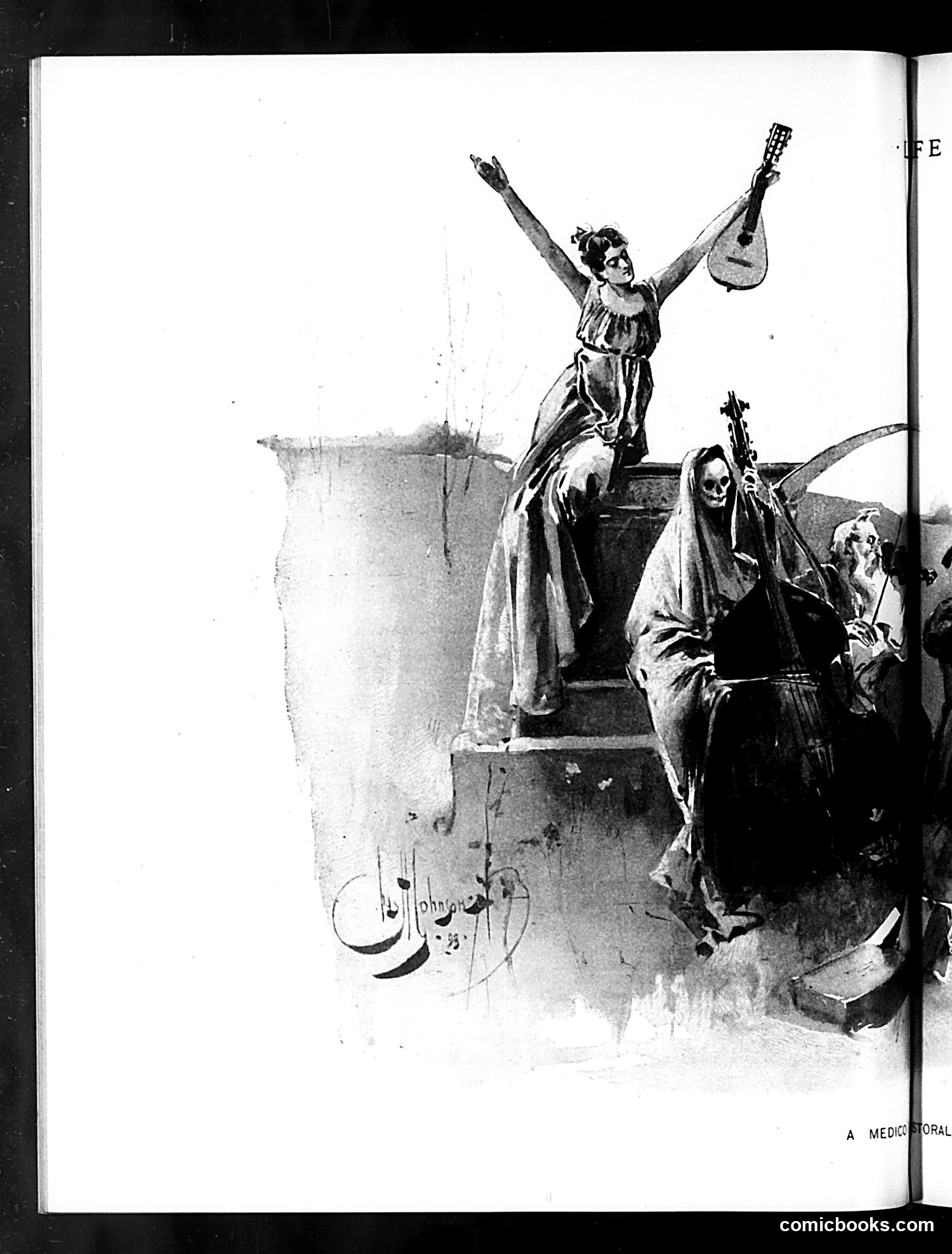
This appears to be a medieval-themed allegorical illustration satirizing medical practice or medical reform. A triumphant figure stands elevated on what appears to be a medical vessel or apparatus, arms raised in victory while holding what looks like a lute or musical instrument. Below stand robed figures—possibly representing Death or disease in skeletal form, and other medical practitioners or ailments. The "medical foray" title suggests this depicts medicine's conquest of illness or perhaps satirizes contemporary medical treatments as theatrical or ineffective. The medieval aesthetic may mock outdated medical practices. However, without the complete OCR text or visible publication date, the specific historical medical controversy being referenced remains unclear.
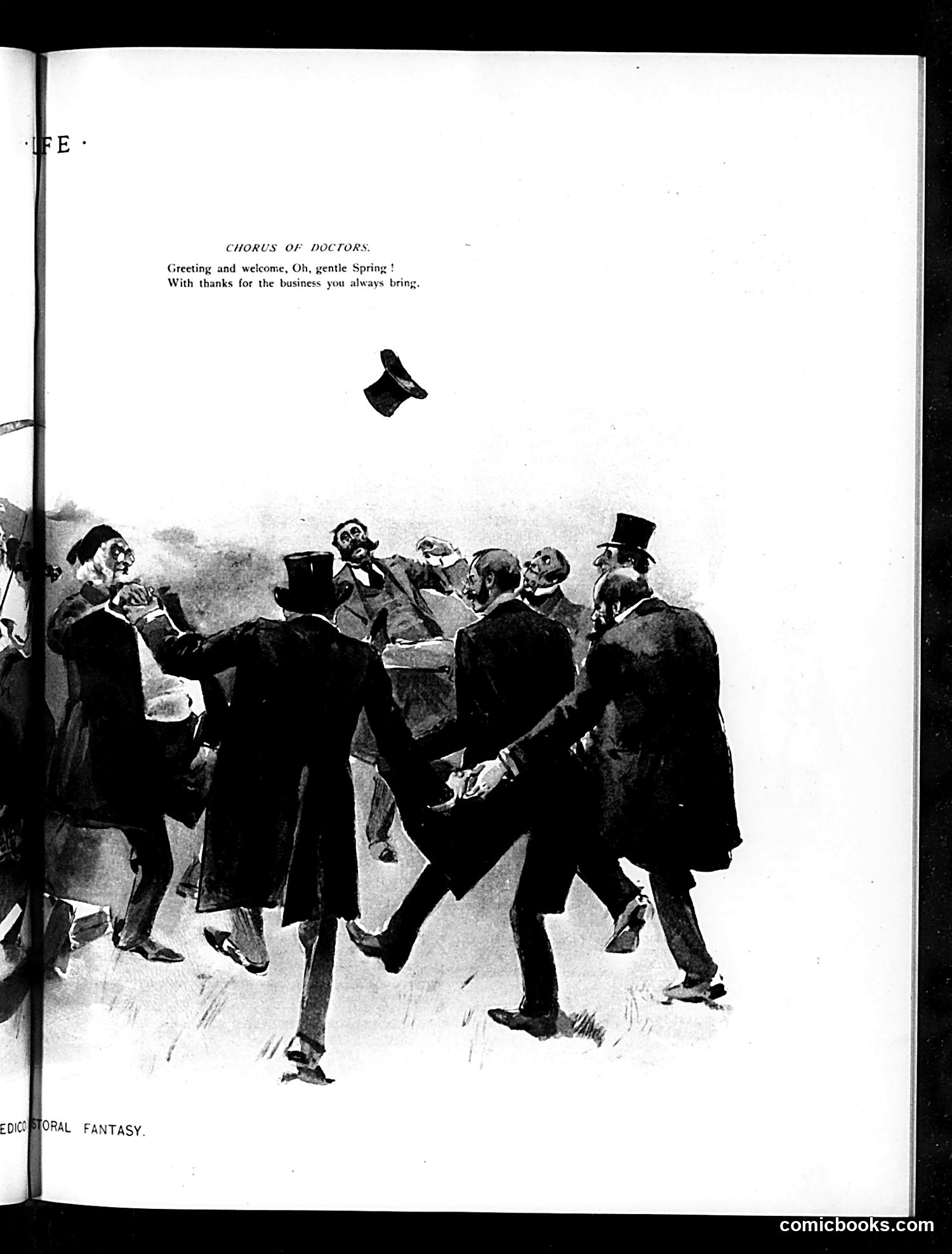
This satirical illustration depicts a group of formally-dressed gentlemen (identifiable as doctors by period context) gathered in a circle, greeting Spring with exaggerated enthusiasm. The text reads: "Greeting and welcome, Oh gentle Spring! / With thanks for the business you always bring." The satire targets physicians' financial self-interest: Spring traditionally brought increased illness (seasonal ailments, allergic conditions), which meant more patients and thus more lucrative business for doctors. The cartoon cynically suggests that doctors welcome Spring not for its natural beauty or renewal, but purely for the medical cases it generates—implying that practitioners cared more about profit than patient welfare. This reflects broader Progressive-era skepticism toward medical professionalism and commercialism.
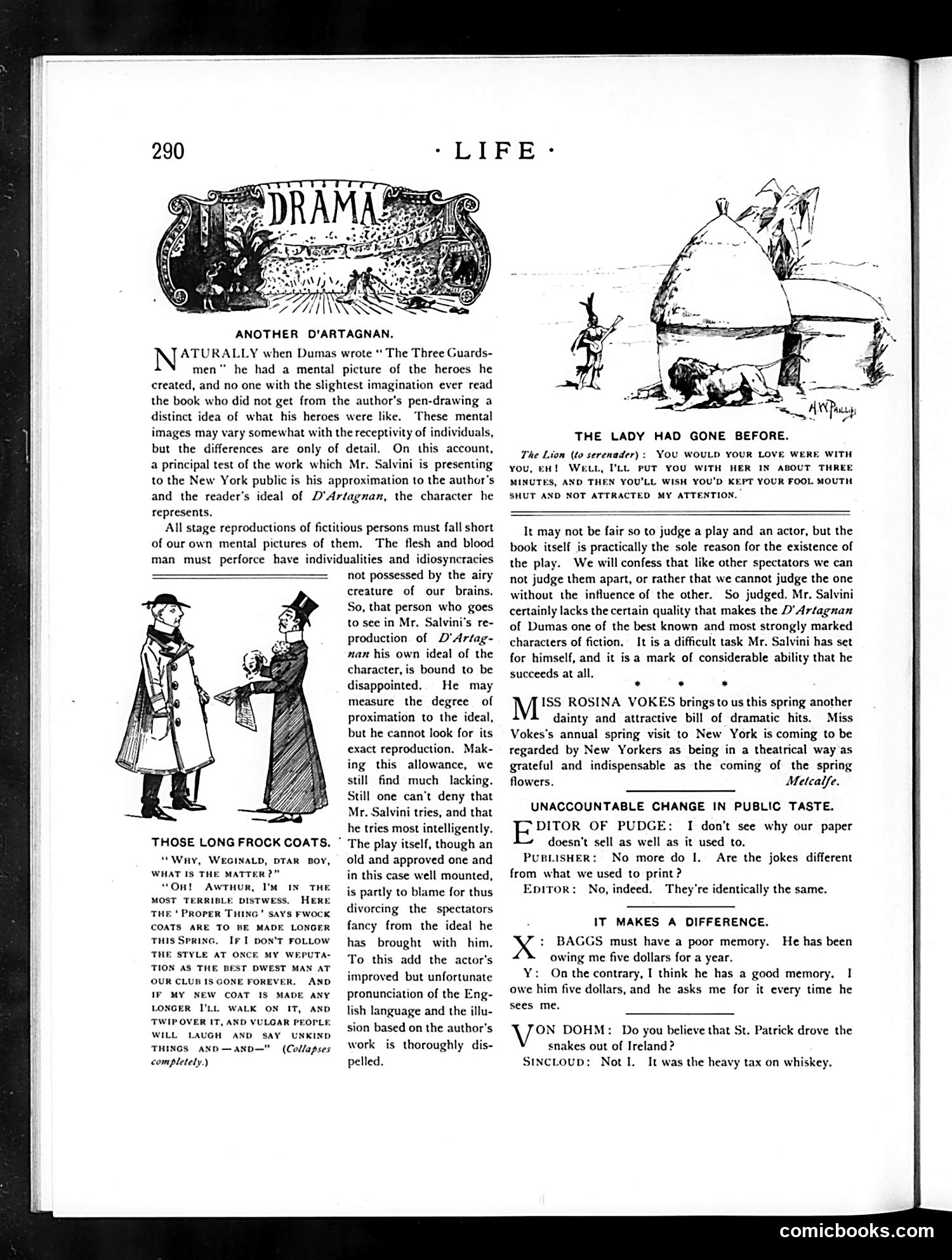
This page contains three satirical pieces typical of Life's humor: 1. **D'Artagnan Theater Review**: Critiques actor Salvini's stage portrayal of Dumas's famous character, arguing that readers' mental images of fictional heroes inevitably differ from actors' physical interpretations. The review acknowledges Salvini's effort but finds him lacking the essential quality needed to embody the iconic swordsman. 2. **"Those Long Frock Coats"**: Mocks fashion-obsessed aristocratic men. A character named "Reginald" panics over new coat-length trends, fearing his reputation as "best dressed man at our club" depends on immediately adopting longer coats—even though wearing them would force him to walk on the fabric, inviting ridicule. 3. **Minor gag pieces**: Brief jokes about memory, perception, and publishing trends, representing Life's typical short-form satirical humor. The illustrations are simple line drawings supporting the text's social commentary on theater, fashion anxiety, and petty vanity.
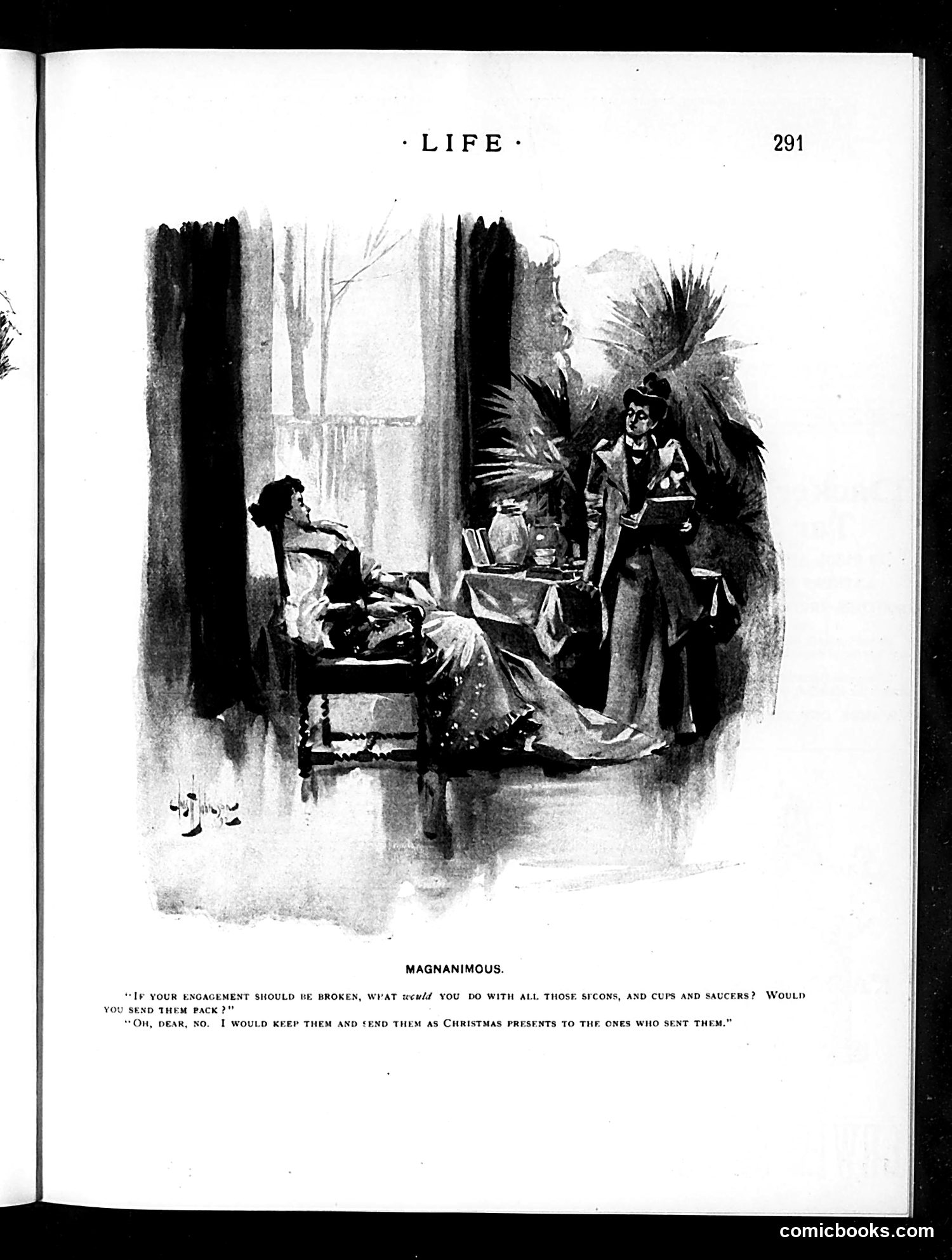
This cartoon satirizes wealthy society's gift-giving customs. A woman reclines while conversing with a visitor—likely a friend or social acquaintance. When asked what she'd do with engagement gifts (spoons, cups, saucers) if her engagement broke, she responds she'd keep them and regift them as Christmas presents to the original donors. The joke targets the superficiality and recycling of expensive gifts among the upper classes, while also mocking the woman's shameless attitude about reusing items meant as engagement congratulations. Her matter-of-fact response to this socially awkward scenario is presented as absurdly "magnanimous"—the title suggests she considers this generous rather than insulting.
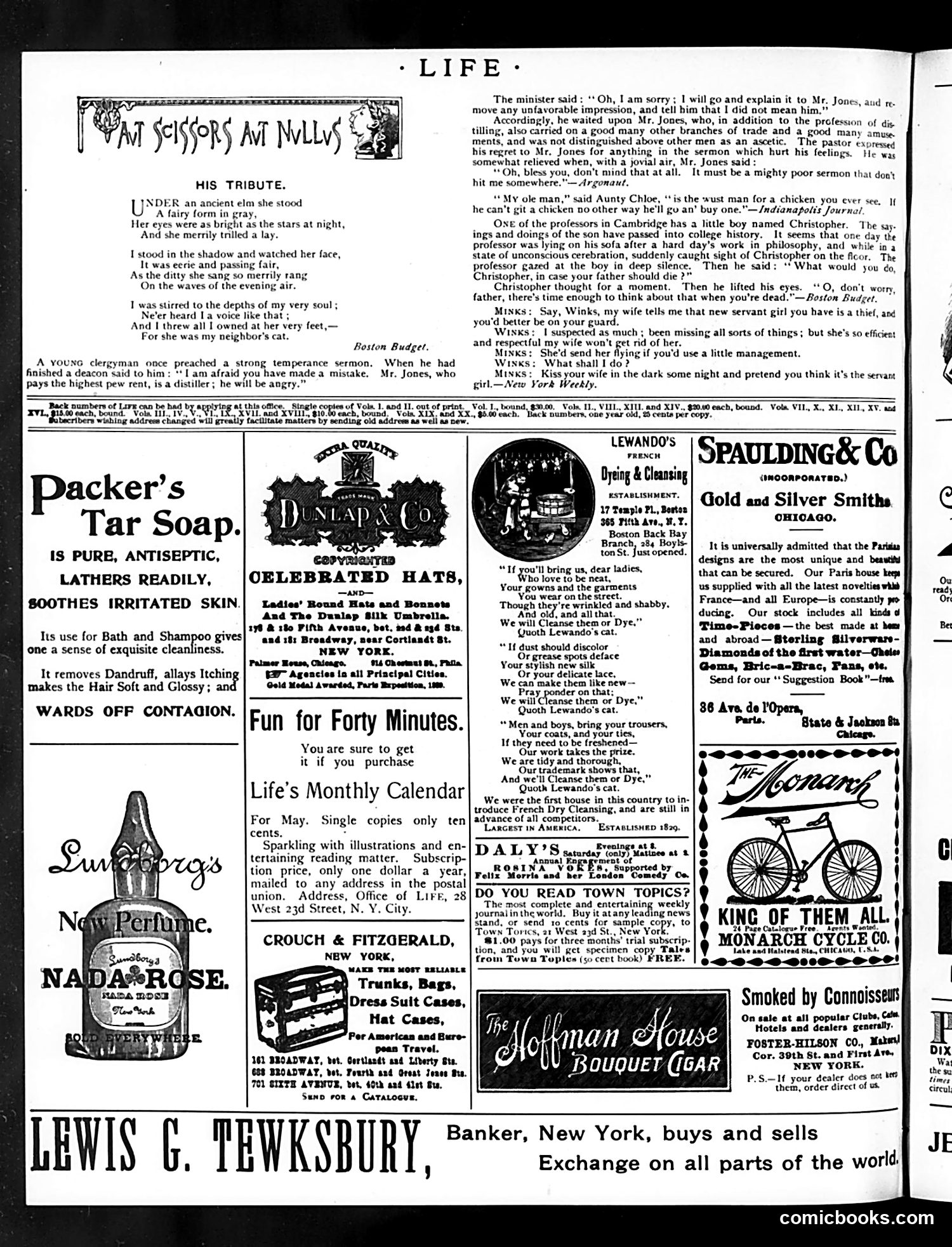
This page is primarily **advertisements and humorous anecdotes** rather than political cartoons. The content consists of: **Comic stories** about: - A man enchanted by his neighbor's cat (mistaking it for a fairy) - A clergyman who apologizes to a distiller for a temperance sermon, but the distiller isn't offended - A Cambridge professor's son giving practical advice about death - A married man suspected of theft involving a servant girl **The humor** relies on wordplay, unexpected punchlines, and gentle social satire typical of late-19th-century American magazines. None target specific political figures or events visible here. **The advertisements** promote period products: Packer's Tar Soap, Dunlap hats, Life's Monthly Calendar, perfume, bicycles, and financial services—reflecting Gilded Age consumer culture. The page demonstrates Life magazine's original format: literary humor and advertising rather than the visual political cartooning the title suggests.
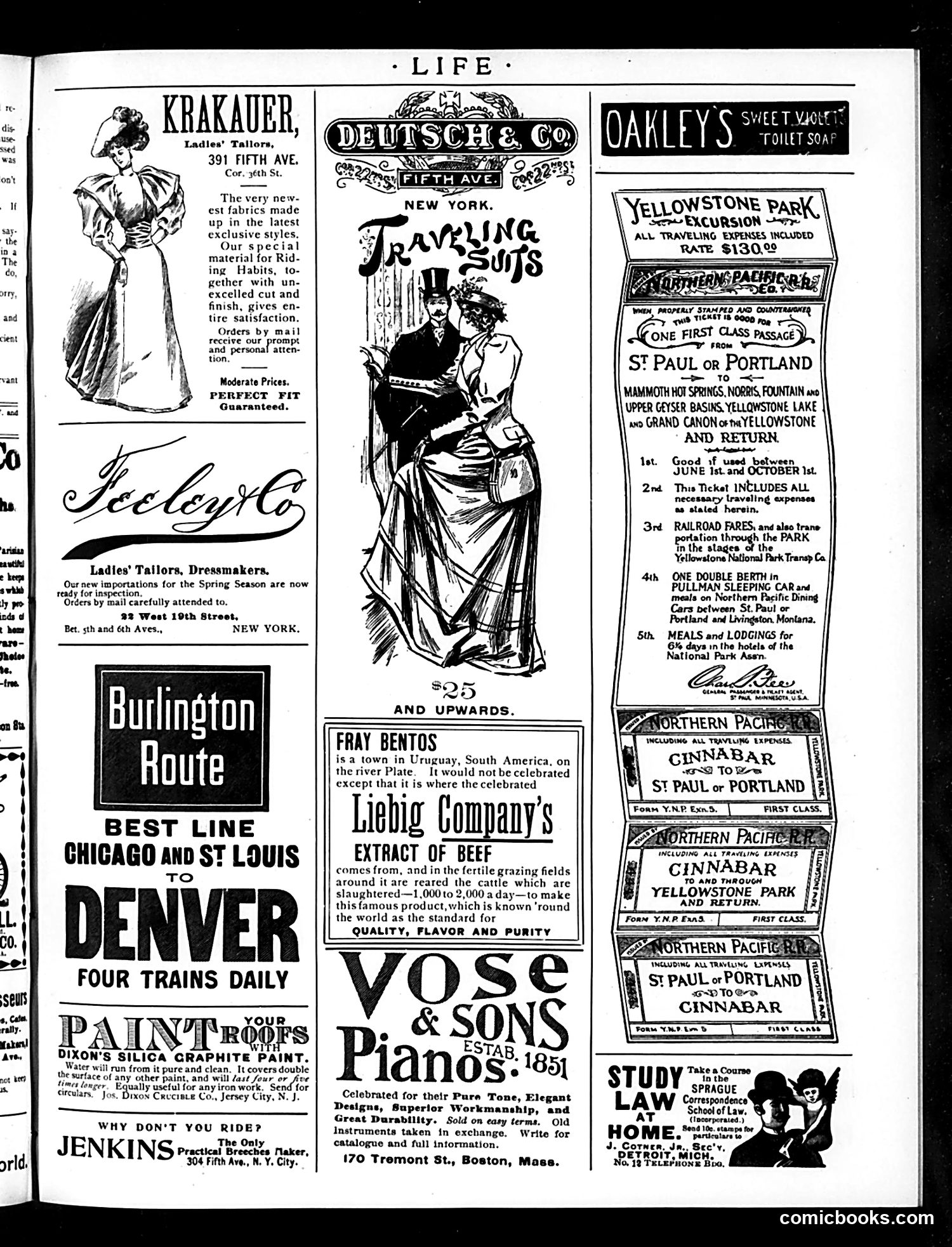
This is primarily an **advertising page** from Life magazine, not a satirical cartoon. The page contains commercial advertisements typical of the 1890s-early 1900s era. **Notable ads include:** - **Krakauer Ladies' Tailors** and **Seeley's** (dressmakers) — promoting fashionable riding habits and spring imports for affluent women - **Burlington Route and Denver trains** — advertising railroad travel to the American West - **Liebig Company's Extract of Beef** — a popular European beef concentrate product, emphasizing its Uruguayan origin and global reputation - **Vose & Sons Pianos** — Boston-based luxury instruments - **Yellowstone Park and Northern Pacific excursions** — all-inclusive tourist packages to the recently established national park ($130 total) - **Oakley's Toilet Soap** and **Jenkins' Practical Breeches** The page reflects turn-of-century consumer culture: upscale fashion, westward expansion tourism, imported luxury goods, and new commercial travel opportunities for the wealthy.
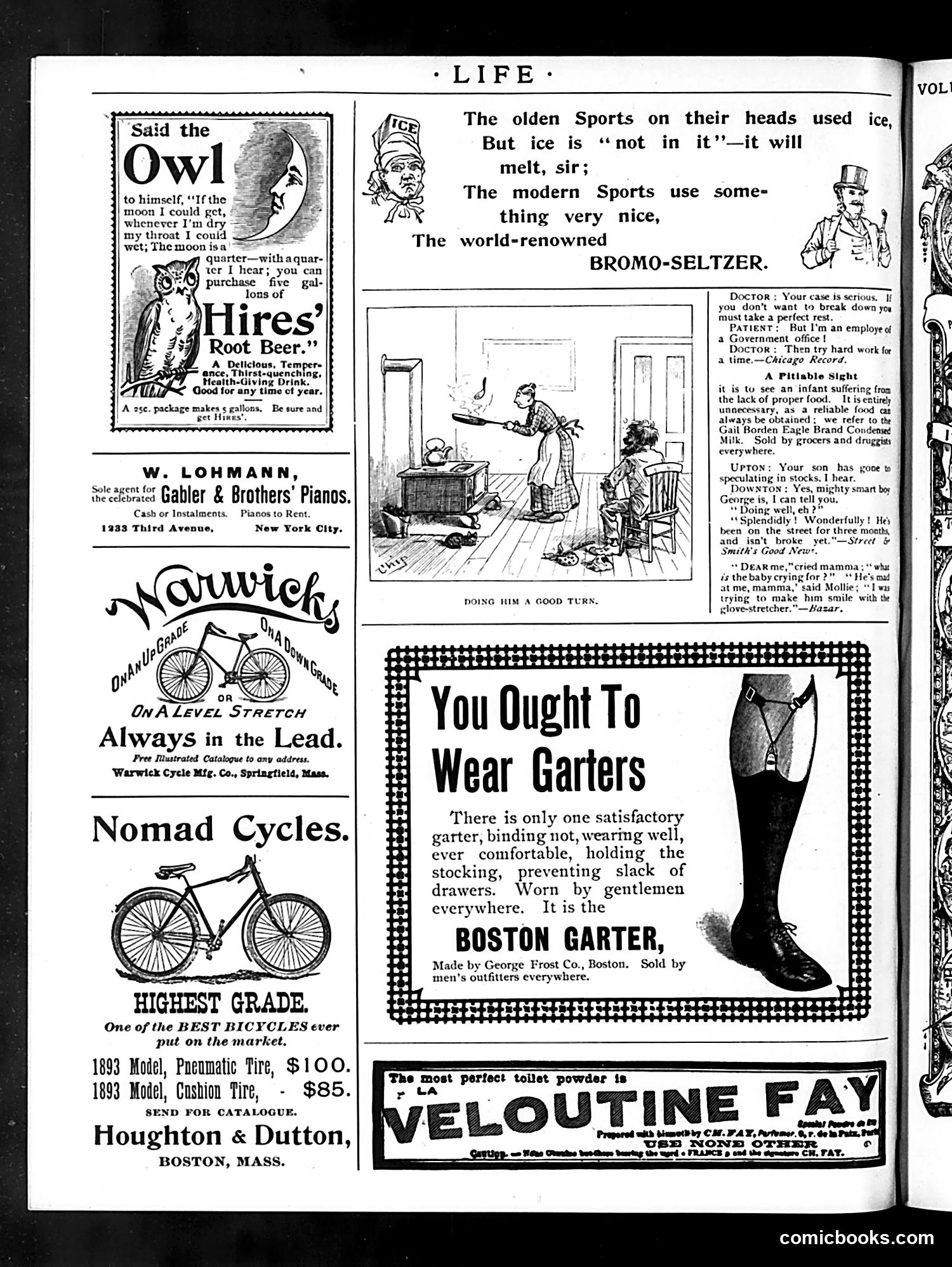
This page is primarily **advertisements** interspersed with brief humorous snippets and one cartoon titled "Doing Him a Good Turn." **The Main Cartoon** depicts a domestic scene where a woman appears to be trying to cheer up an ill or bedridden man by stretching a glove to make a face—a simple visual gag about attempting to entertain someone through silly gestures. **The Advertising Content** dominates, featuring: - Root beer, pianos, and bicycles (typical 1890s consumer goods) - An owl mascot endorsing Hires' Root Beer - A Bromo-Seltzer advertisement using a sports/athletics angle (the joke being modern athletes use this remedy rather than ice) - Boston Garters for men **The Humor Snippets** include mild jokes about government office work being lazier than hard labor, a child's speculation in stocks, and a baby's cry being mimicked with a glove-stretcher—all gentle, family-friendly humor typical of *Life's* satirical but inoffensive style. The page reflects **1890s consumer culture and domestic life** rather than serious political satire.