
Life, 1893-05-04 · page 7 of 16
Life — May 4, 1893 — page 7: what you’re looking at
What you’re looking at
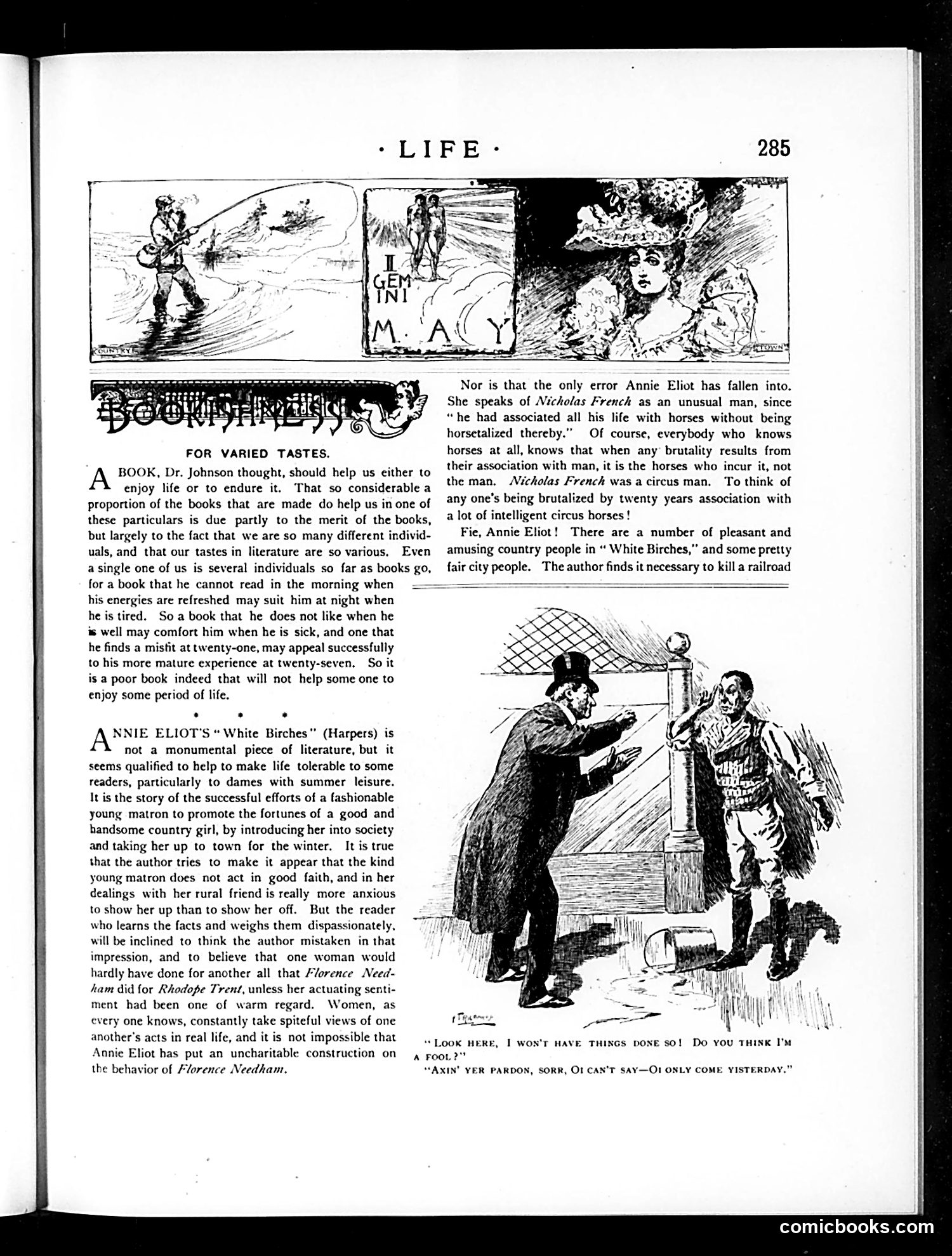
This page reviews Annie Eliot's novel "White Birches" (Harper's), framed as advice for varied literary tastes. The main text critiques the book's portrayal of a fashionable young woman promoting a country gentleman for social advancement in town. The reviewer argues Eliot unfairly depicts the protagonist as acting in bad faith, contrasting her unfavorably with "Florence Needham" from "Rhodope Trent." The accompanying illustration shows a domestic scene with two figures in period dress, with dialogue suggesting comedic misunderstanding about someone's foolish behavior or poor judgment. The page demonstrates Life's role as a satirical literary and social commentary magazine, using book reviews to critique both authors' moral characterizations and contemporary upper-class social dynamics.
📄 Transcribed text from this page (OCR, searchable)
Machine-transcribed from the original scan — historical spelling and the odd misread are preserved.
FOR VARIED TASTES. A BOOK, Dr. Johnson thought, should help us either to enjoy life or to endure it. That so considerable a proportion of the books that are made do help us in one of these particulars is due partly to the merit of the books, but largely to the fact that we are so many different individ- uals, and that our tastes in literature are so various. Even a single one of us is several individuals so far as books go, for a book that he cannot read in the morning when = =— his energies are refreshed may suit him at night when he is tired. Soa book that he does not like when he is well may comfort him when he is sick, and one that he finds a mistit at twenty-one, may appeal successfully to his more mature experience at twenty-seven, So it is a poor book indeed that will not help some one to enjoy some period of life. . . . NNIE ELIOT'S “ White Birches" (Harpers) is not a monumental piece of literature, but it seems qualified to help to make life tolerable to some readers, particularly to dames with summer leisure. It is the story of the successful efforts of a fashionable young matron to promote the fortunes of a good and handsome country girl, by introducing her into society and taking her up to town for the winter. It is true that the author tries to make it appear that the kind young matron does not act in good faith, and in her dealings with her rural friend is really more anxious to show her up than to show her off. But the reader who learns the facts and weighs them dispassionately, will be inclined to think the author mistaken in that impression, and to believe that one woman would hardly have done for another all that //orence Need- ham did for Rhodope Trent, unless her actuating senti- ment had been one of warm regard. Women, as every one knows, constantly take spiteful views of one another's acts in real life, and it is not impossible that ** Look HERE, Nor is that the only error Annie Eliot has fallen into. She speaks of Nicholas French as an unusual man, since “he had associated all his life with horses without being horsetalized thereby.” Of course, everybody who knows horses at all, knows that when any’ brutality results from their association with man, it is the horses who incur it, not the man. Nicholas French was a circus man. To think of any one’s being brutalized by twenty years association with a lot of intelligent circus horses ! Fie, Annie Eliot! There are a number of pleasant and amusing country people in “ White Birches,” and some pretty fair city people. The author finds it necessary to kill a railroad I Won't HAVE THINGS DONE SO! Do you THINK I'm Annie Eliot has put an uncharitable construction on the behavior of Florence Needham, A FOOL?” “AXIN’ YER PARDON, SORR, Ot CAN'T SAY—O1 ONLY COME YISTERDAY,” comicbooks.com