
Life, 1893-05-04 · page 4 of 16
Life — May 4, 1893 — page 4: what you’re looking at
What you’re looking at
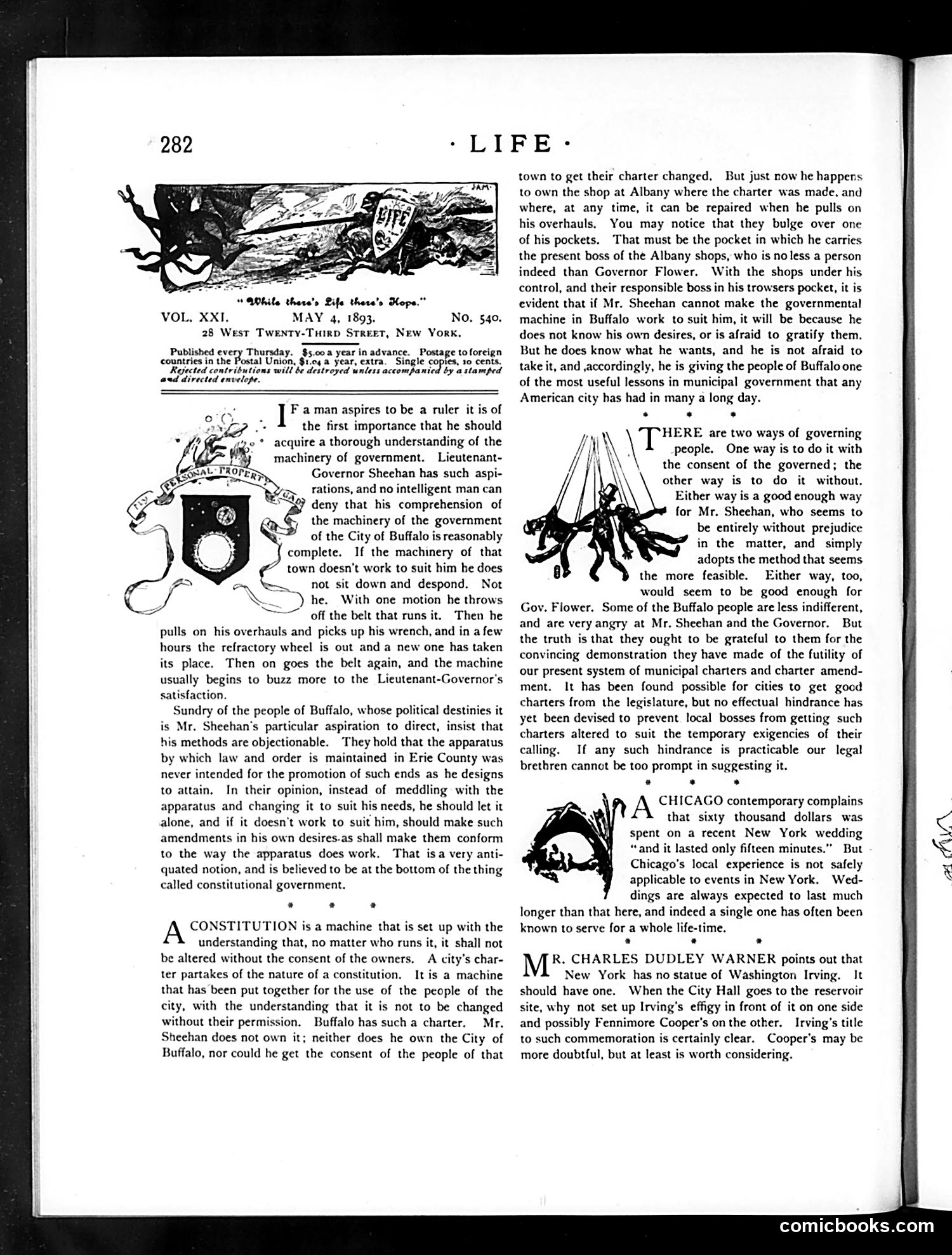
The page contains satirical commentary on Buffalo, New York's municipal government, specifically critiquing Lieutenant-Governor Sheehan's management of the city's machinery and charter. The **main illustration** (top left) shows a mechanical apparatus labeled "While there's Life there's Hope"—a visual metaphor for Buffalo's government as a machine that requires constant adjustment and repair. The text satirizes Sheehan's approach: rather than properly understanding how city government works, he simply tinkers with it mechanically, making ad-hoc fixes. The satire suggests he governs without genuine principle or comprehension—merely "throwing off the belt" and making temporary adjustments rather than addressing fundamental problems. The piece advocates for respecting constitutional municipal charters and questions whether Sheehan has legitimate authority to alter governmental structures unilaterally.
📄 Transcribed text from this page (OCR, searchable)
Machine-transcribed from the original scan — historical spelling and the odd misread are preserved.
LIFE “While there's Life there's Hope.” OL, XXI. MAY 4, 1893. No. 540. 28 West Twenty-Tuirp Street, New York, Published every Thursday. $5.00 year in advance, Postage toforeign countries in the Postal Union, $1.04 a year, extra. Single copies, 10 cents. Rejected contributions will be destroyed unless accompanied by a stamped and directed envelope. F a man aspires to be a ruler it is of the first importance that he should * acquire a thorough understanding of the machinery of government. Lieutenant- Governor Sheehan has such aspi- a, rations, and no intelligent man can deny that his comprehension of é the machinery of the government of the City of Buffalo is reasonably complete. If the machinery of that town doesn’t work to suit him he does a not sit down and despond. Not ~) he. With one motion he throws "off the belt that runs it, Then he pulls on his overhauls and picks up his wrench, and in afew hours the refractory wheel is out and a new one has taken its place. Then on goes the belt again, and the machine usually begins to buzz more to the Lieutenant-Governor's, satisfaction. Sundry of the people of Buffalo, whose political destinies it is Mr. Sheehan's particular aspiration to direct, insist that his methods are objectionable. They hold that the apparatus by which law and order is maintained in Erie County was never intended for the promotion of such ends as he designs to attain. In their opinion, instead of meddling with the apparatus and changing it to suit his needs, he should let it alone, and if it doesn’t work to suit him, should make such amendments in his own desires.as shall make them conform to the way the apparatus does work. That isa very anti- quated notion, and is believed to be at the bottom of the thing called constitutional government. * * . A CONSTITUTION is a machine that is set up with the understanding that, no matter who runs it, it shall not be altered without the consent of the owners. A city's char- ter partakes of the nature of a constitution. It is a machine that has been put together for the use of the people of the city, with the understanding that it is not to be changed without their permission. Buffalo has such a charter. Mr. Sheehan does not own it; neither does he own the City of Buffalo, nor could he get the consent of the people of that town to get their charter changed. But just now he happens to own the shop at Albany where the charter was made, and where, at any time, it can be repaired when he pulls on his overhauls. You may notice that they bulge over one of his pockets. That must be the pocket in which he carries the present boss of the Albany shops, who is no less a person indeed than Governor Flower. With the shops under his control, and their responsible boss in his trowsers pocket, it is evident that if Mr. Sheehan cannot make the governmental machine in Buffalo work to suit him, it will be because he does not know his own desires, or is afraid to gratify them. But he does know what he wants, and he is not afraid to take it, and accordingly, he is giving the people of Buffalo one of the most useful lessons in municipal government that any American city has had in many a Jeng day. \ Te RE are two ways of governing /} 1 \ people. One way is to do it with the consent of the governed; the other way is to do it without. Either way is a good enough way for Mr. Sheehan, who seems to be entirely without prejudice in the matter, and simply adopts the method that seems the more feasible. Either way, too, would seem to be good enough for Gov. Flower. Some of the Buffalo people are less indifferent, and are very angry at Mr. Sheehan and the Governor. But the truth is that they ought to be grateful to them for the convincing demonstration they have made of the futility of our present system of municipal charters and charter amend- ment. It has been found possible for cities to get good charters from the legislature, but no effectual hindrance has yet been devised to prevent local bosses from getting such charters altered to suit the temporary exigencies of their calling. If any such hindrance is practicable our legal brethren cannot be too prompt in suggesting it. . . . CHICAGO contemporary complains that sixty thousand dollars was spent on a recent New York wedding “and it lasted only fifteen minutes.” But Chicago's local experience is not safely applicable to events in New York. Wed- dings are always expected to last much longer than that here, and indeed a single one has often been known to serve for a whole life-time. . * . R, CHARLES DUDLEY WARNER points out that New York has no statue of Washington Irving. It should have one. When the City Hall goes to the reservoir site, why not set up Irving’s effigy in front of it on one side and possibly Fennimore Cooper's on the other. Irving's title to such commemoration is certainly clear. Cooper's may be more doubtful, but at least is worth considering. comicbooks.com