
A complete issue · 16 pages · 1893
Life — April 6, 1893
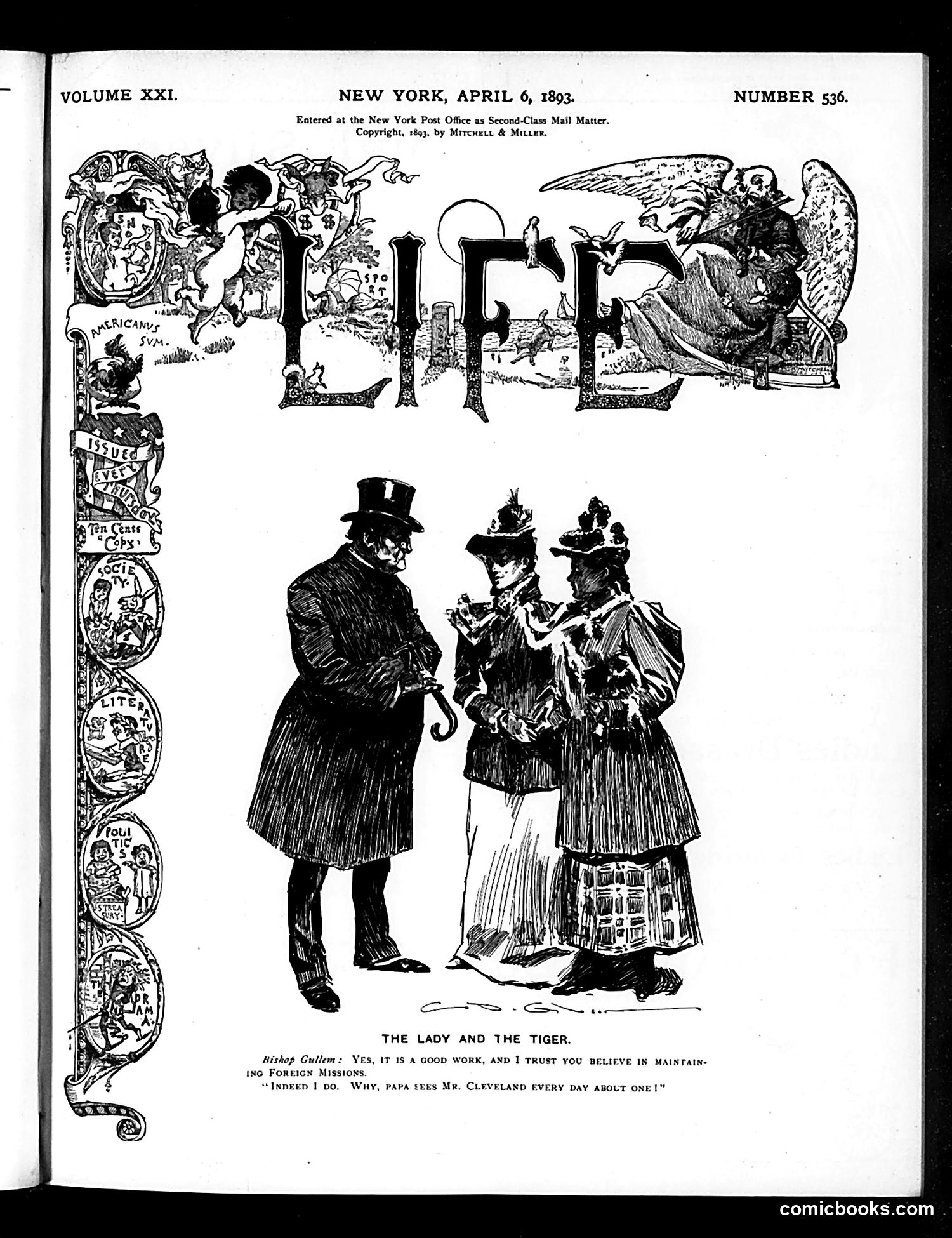
This cartoon satirizes the debate over foreign missionary work. Bishop Guillen endorses maintaining financial support for missions, claiming it's "good work." However, the caption's punchline—that Cleveland (President Grover Cleveland) "fears Mr. Cleveland every day about one!"—suggests marital tension. The "Lady" and "Tiger" title references a popular 1882 Frank Stockton short story about choosing between two doors with uncertain outcomes. Here, the cartoon uses this metaphor to mock the unpredictability and potential domestic strife caused by missionary advocacy. The bishop appears oblivious to the conflict his position creates at home, particularly with women who pressure the President about the issue.
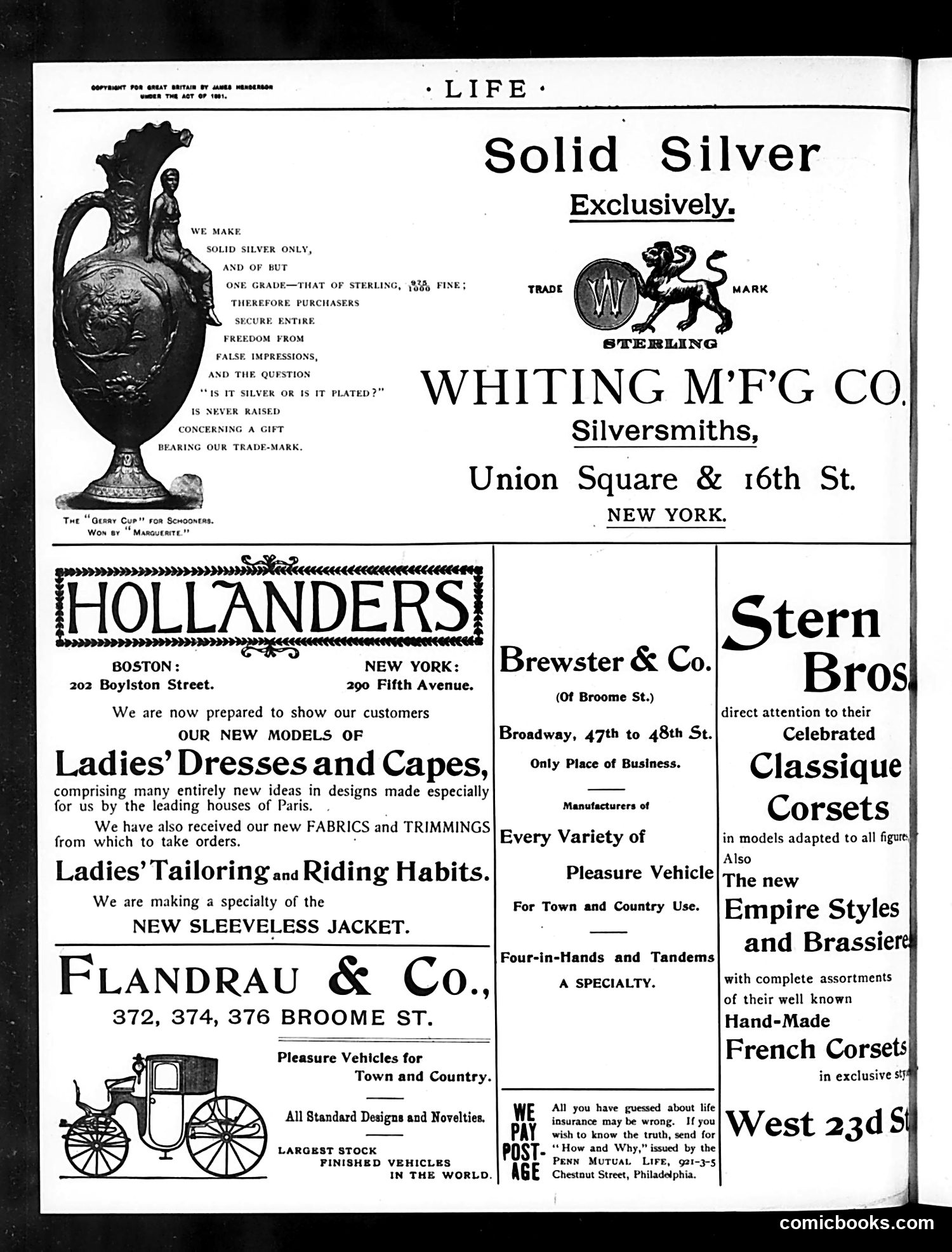
This page is **primarily advertising**, not political satire. It contains four commercial advertisements from circa 1901 (based on the copyright notice): 1. **Whiting Mfg. Co.** (top) - A silversmith advertising "solid silver exclusively" using a decorative ewer as their showcase piece 2. **Hollanders** (left) - Boston and New York clothiers advertising ladies' dresses, capes, tailoring, and a "new sleeveless jacket" 3. **Brewster & Co.** (center) - Manufacturers of pleasure vehicles (carriages) for town and country use 4. **Stern Bros** (right) - New York corset sellers advertising "Classique Corsets" and "Empire Styles" There is one small editorial item: **"We Pay Postage"** (bottom right) - promoting life insurance information from Penn Mutual Life. The page contains **no political cartoons or satirical content**—it's a standard advertising section from a magazine of this era.
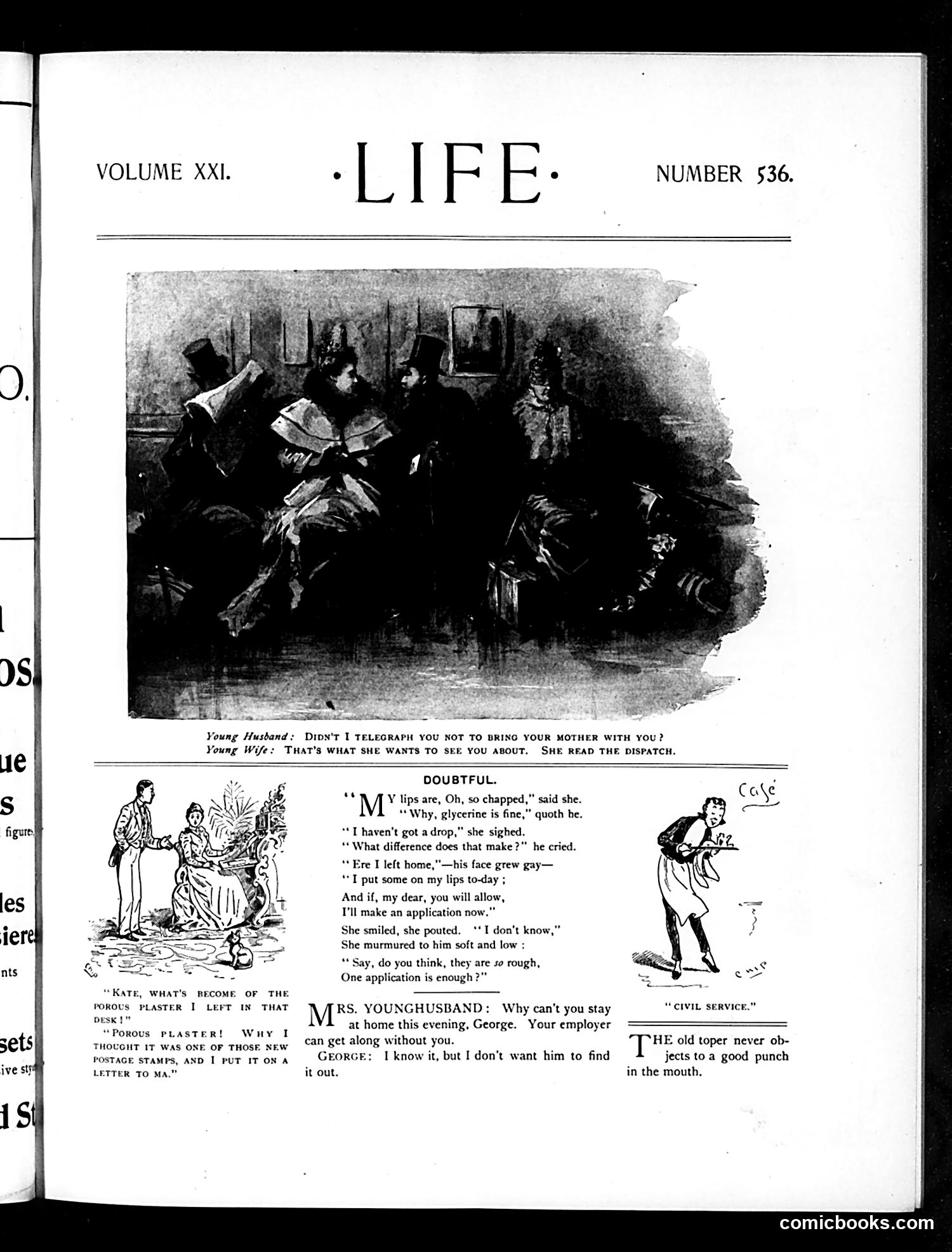
This page contains three separate humorous pieces typical of Life's satirical format: 1. **Top illustration**: Shows a crowded scene with the caption about a young husband not telegraphing his mother-in-law. The satire targets domestic tensions and the burdensome presence of in-laws during outings. 2. **"Doubtful"**: A dialogue poem mocking marital discord. A wife complains about chapped lips; her husband suggests glycerin won't help. The joke satirizes male indifference to women's beauty concerns and domestic arguments over trivial matters. 3. **"Civil Service"** and **"Mrs. Younghusband"**: Brief comic sketches about workplace employment and spousal dynamics—poking fun at bureaucratic annoyances and wives' complaints about husbands' work obligations. The page reflects early 20th-century middle-class anxieties about marriage, employment, and social etiquette through gentle domestic humor.
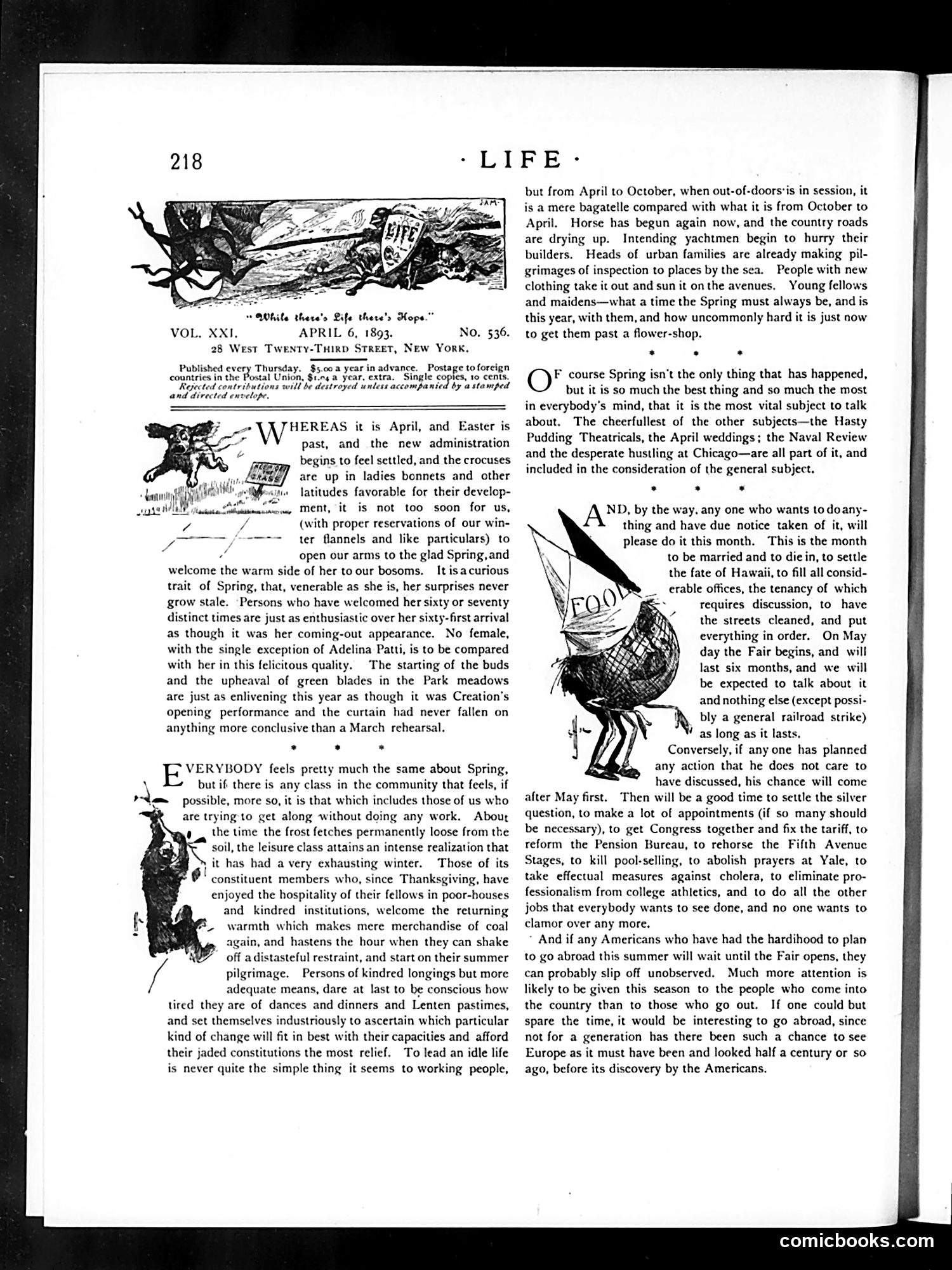
This page contains editorial commentary on spring and upcoming events, illustrated with decorative vignettes rather than pointed political cartoons. The main illustration shows a stylized "Fool" figure, likely representing foolishness or frivolity. The text references several 1893 concerns: the World's Columbian Exposition ("Fair") opening in Chicago, labor unrest including potential railroad strikes, and broader social issues like cholera prevention and pension reform. The editorial tone is satirical about spring's arrival making people idly optimistic while serious problems persist—unemployment, infrastructure needs, and social reform. The fool figure appears to mock those who believe spring brings solutions to deeper structural problems rather than addressing them directly.
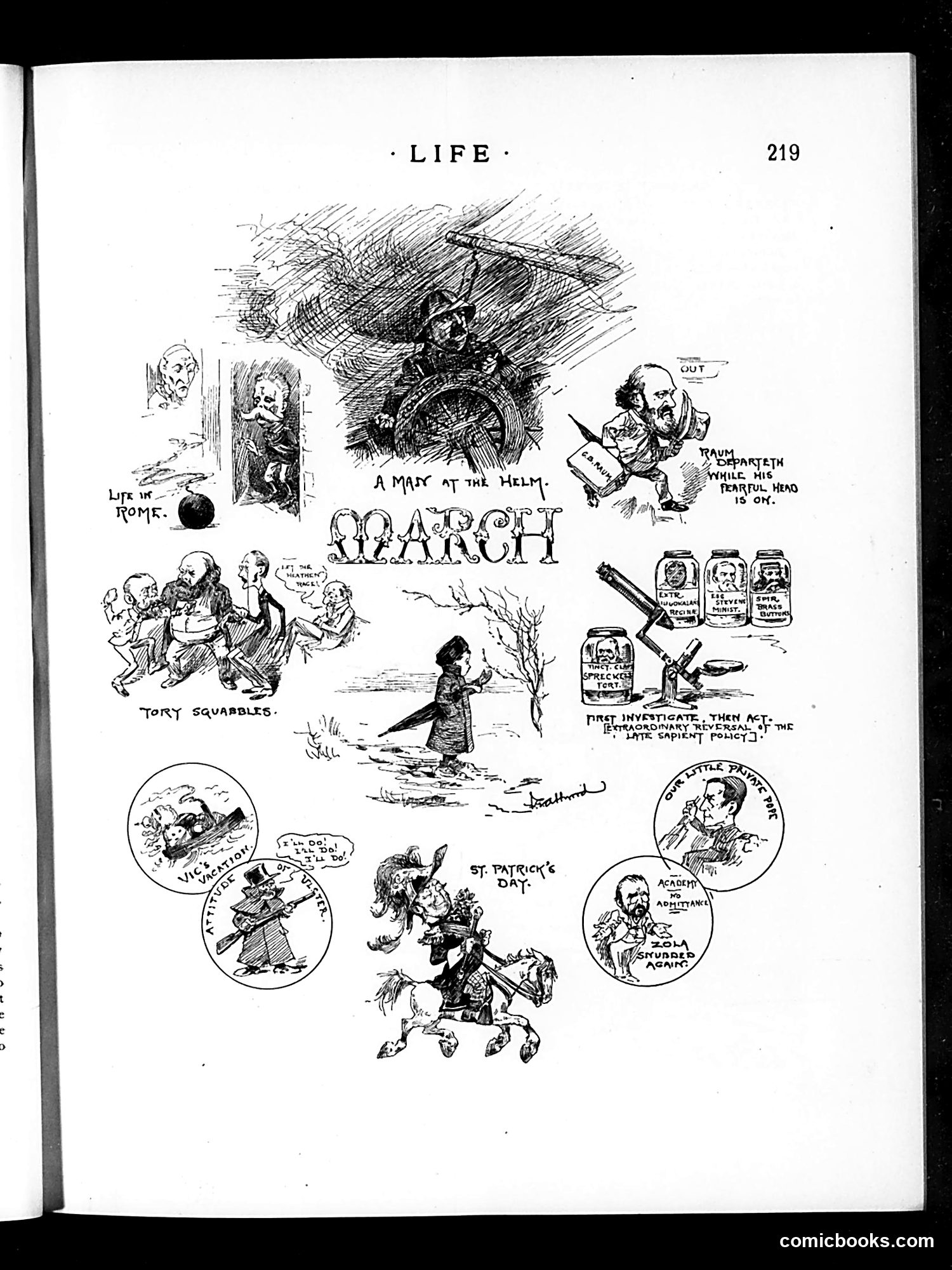
This page presents satirical sketches about Irish-British politics, likely from the early 20th century. "Life in Rome" depicts papal politics. "A Man at the Helm" shows a figure steering through turbulent waters—likely referencing Irish Home Rule leadership. "Tory Squabbles" mocks Conservative Party infighting. The beer bottles labeled "First Investigate, Then Act" satirize excessive drinking among politicians or the Irish working class. Multiple circular vignettes reference St. Patrick's Day, Irish stereotypes, and what appears to be British political figures (possibly including references to "Sinn Féin" and "Academy of Admittance"). The recurring theme is Irish-British political tension and related social commentary, rendered through caricature and crude stereotypes typical of early 20th-century American satirical humor.
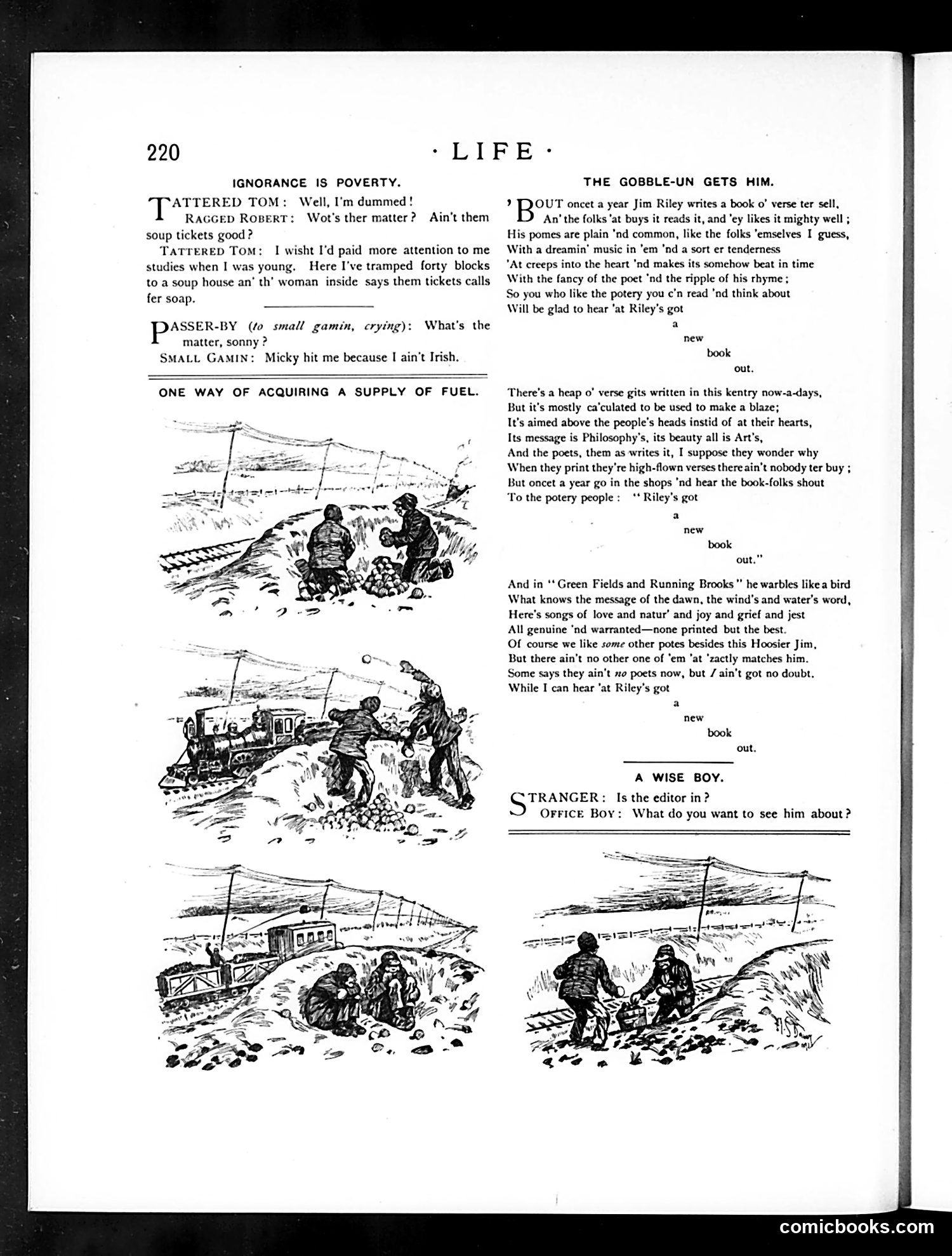
This page contains three separate satirical pieces from Life magazine: 1. **"Ignorance is Poverty"** - A brief dialogue mocking working-class characters (Tattered Tom, Ragged Robert, Small Gamin) who lack education and awareness of their own exploitation. 2. **"One Way of Acquiring a Supply of Fuel"** - Three sequential sketches showing poor people collecting driftwood or coal from a boat, illustrating economic desperation during what appears to be an industrial era. 3. **"The Gobble-Un Gets Him"** and **"A Wise Boy"** - Commentary on poet James Whitcomb Riley's popular verse, suggesting his sentimental poetry sells well to common people despite its modest literary merit. The overall theme critiques both working-class ignorance and commercialized popular culture, using class-based humor typical of late 19th-century American satire.
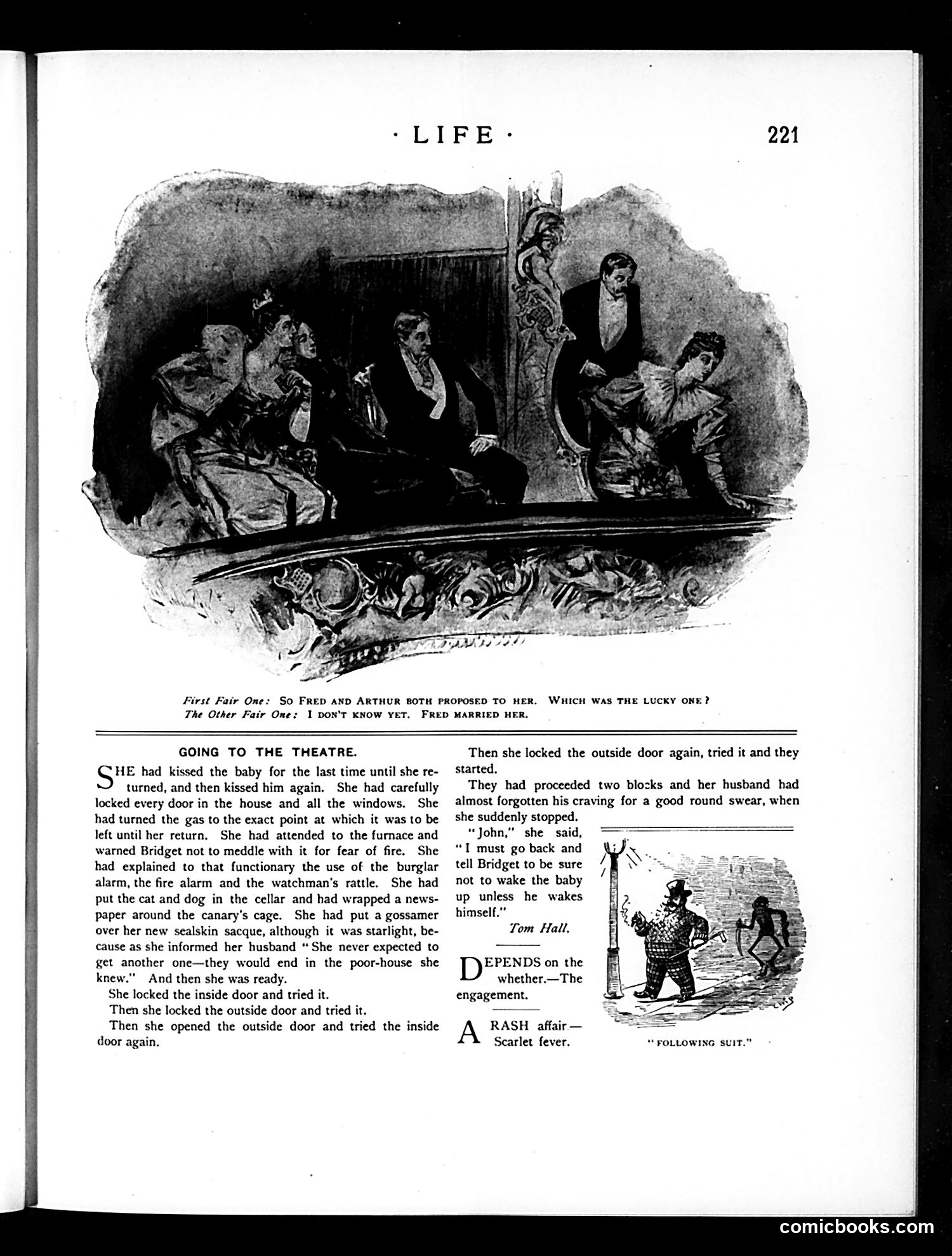
This page contains a serialized story titled "Going to the Theatre," depicting a domestic scene where a woman prepares to go out, carefully securing her home—locking doors, adjusting the gas, and even leaving instructions with her husband about the baby. The main cartoon at top shows a theater box with well-dressed patrons, likely satirizing upper-class theater attendance and social pretense. Below are small illustrations and text snippets labeled "Tom Hall," "Following Suit," and references to "rash affair" and "scarlet fever"—these appear to be separate jokes or story captions. Without clearer context about specific 1910s-era events or personalities referenced, the primary satire seems to target domestic anxiety and the elaborate precautions required for respectable women to leave home, poking fun at both marital relations and social conventions of the era.
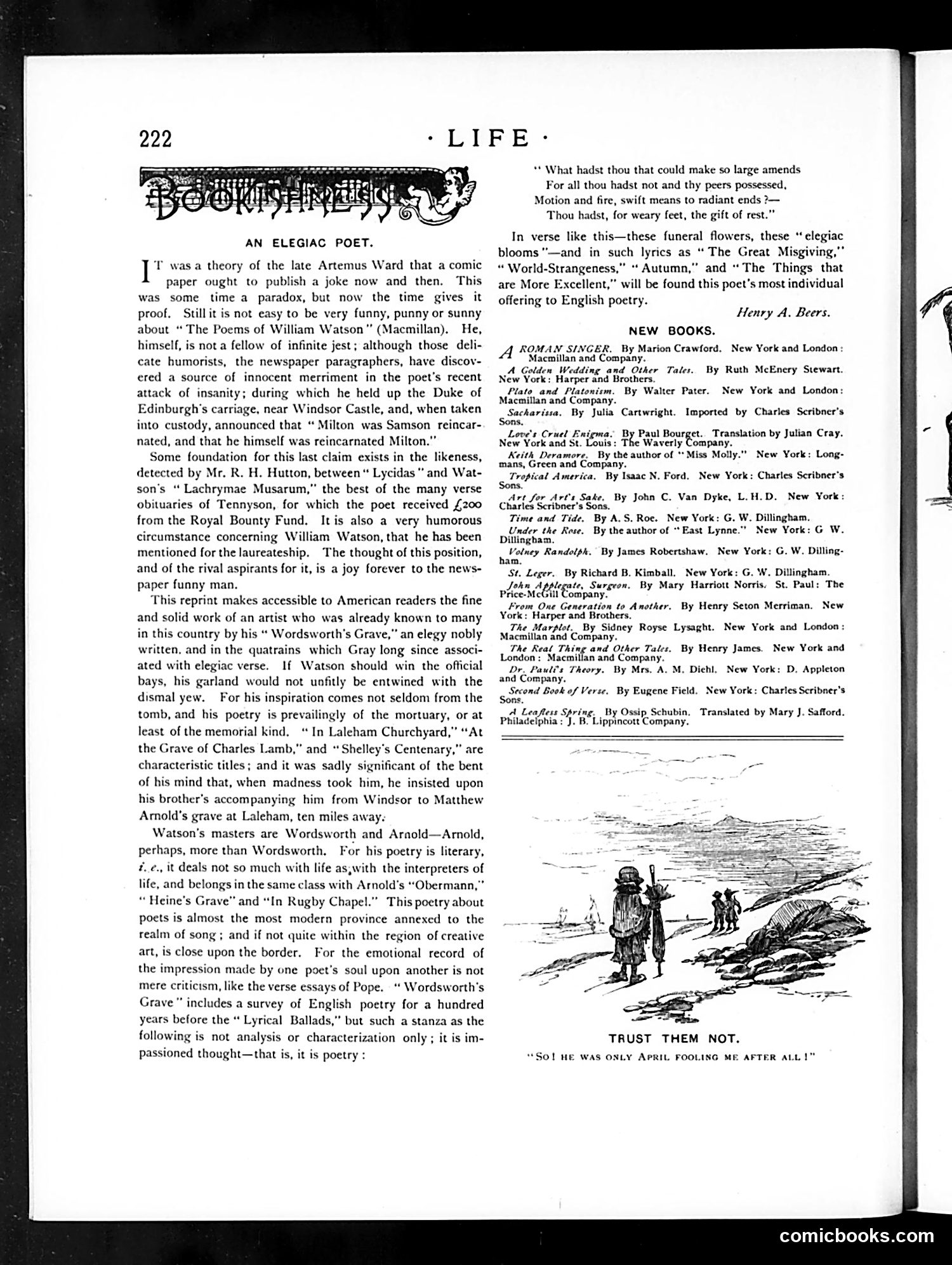
This page contains a literary essay titled "An Elegiac Poet" discussing Artemus Ward's comic writing style, followed by a "New Books" section listing recent publications. The only illustration is a small sketch captioned **"Trust Them Not"** showing figures on a hillside, with the quote "So I he was only April fooling me after all!" This appears to be a simple April Fools' Day joke cartoon—a figure has apparently been pranked or deceived by someone, delivering the punchline that the deception was just holiday tomfoolery. The cartoon illustrates a straightforward, lighthearted prank scenario typical of Life magazine's humor, with no apparent political or social commentary beyond the familiar cultural tradition of April Fools' Day pranks.
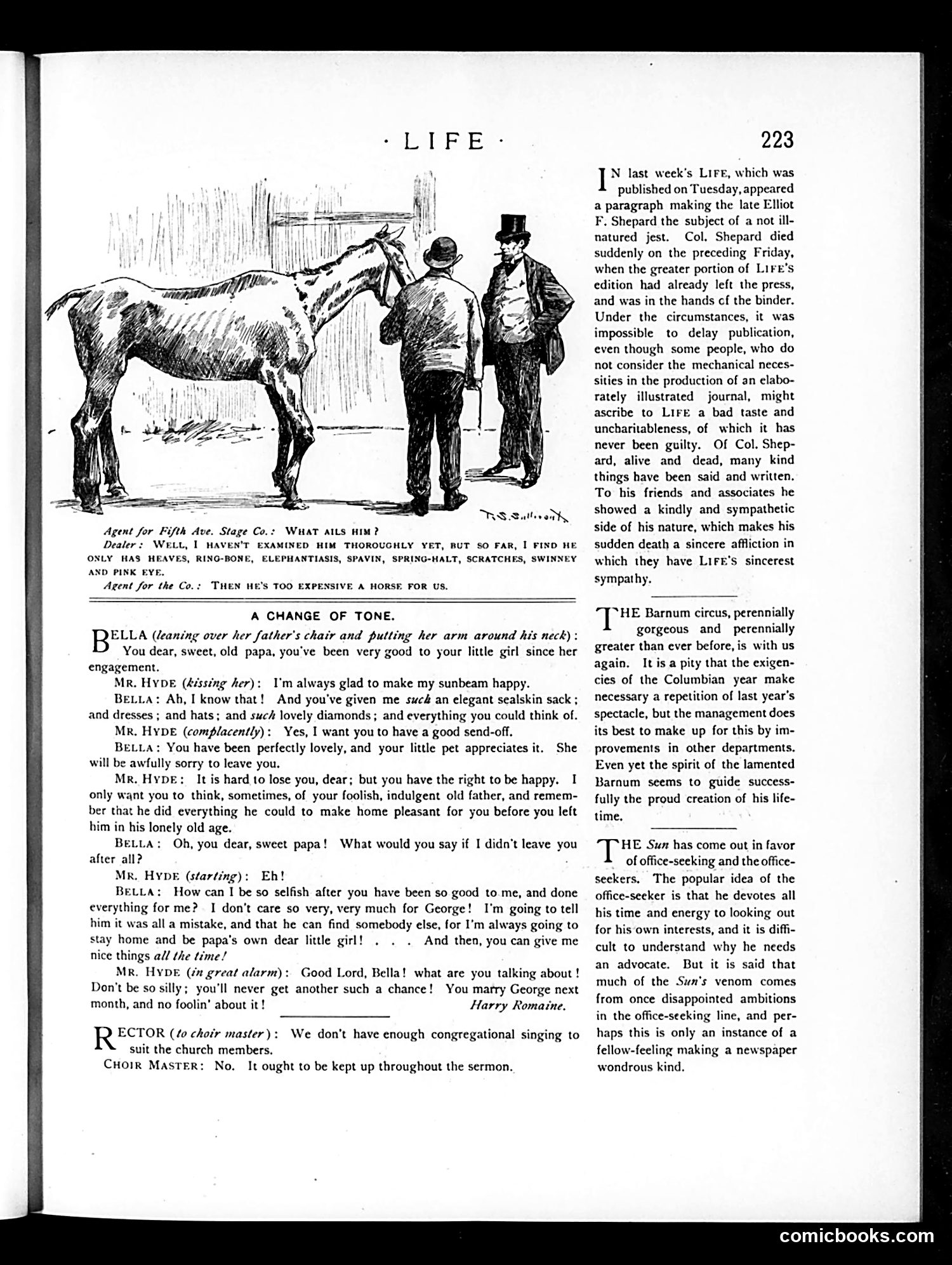
**The Main Cartoon** shows a veterinary scene with two men examining a horse. The caption identifies this as commentary on a horse's ailments—"heavy, ring-bone, elephantiasis, spavin, spring-halt, scratches, swingey and pink eye." One man remarks the horse is "too expensive" for their company. **The Satire:** This appears to be a jest about the Fifth Avenue Stage Company's horse being in poor health—worthless for their purposes. It's visual mockery of a real business situation. **The Dramatic Scene Below** labeled "A Change of Tone" depicts characters (Mr. Hyde, Bella, Rector, Choir Master) in what appears to be a theatrical or domestic dialogue about singing, marriage, and family obligations—likely a humorous playlet satirizing Victorian sentimentality and social conventions around courtship and duty.
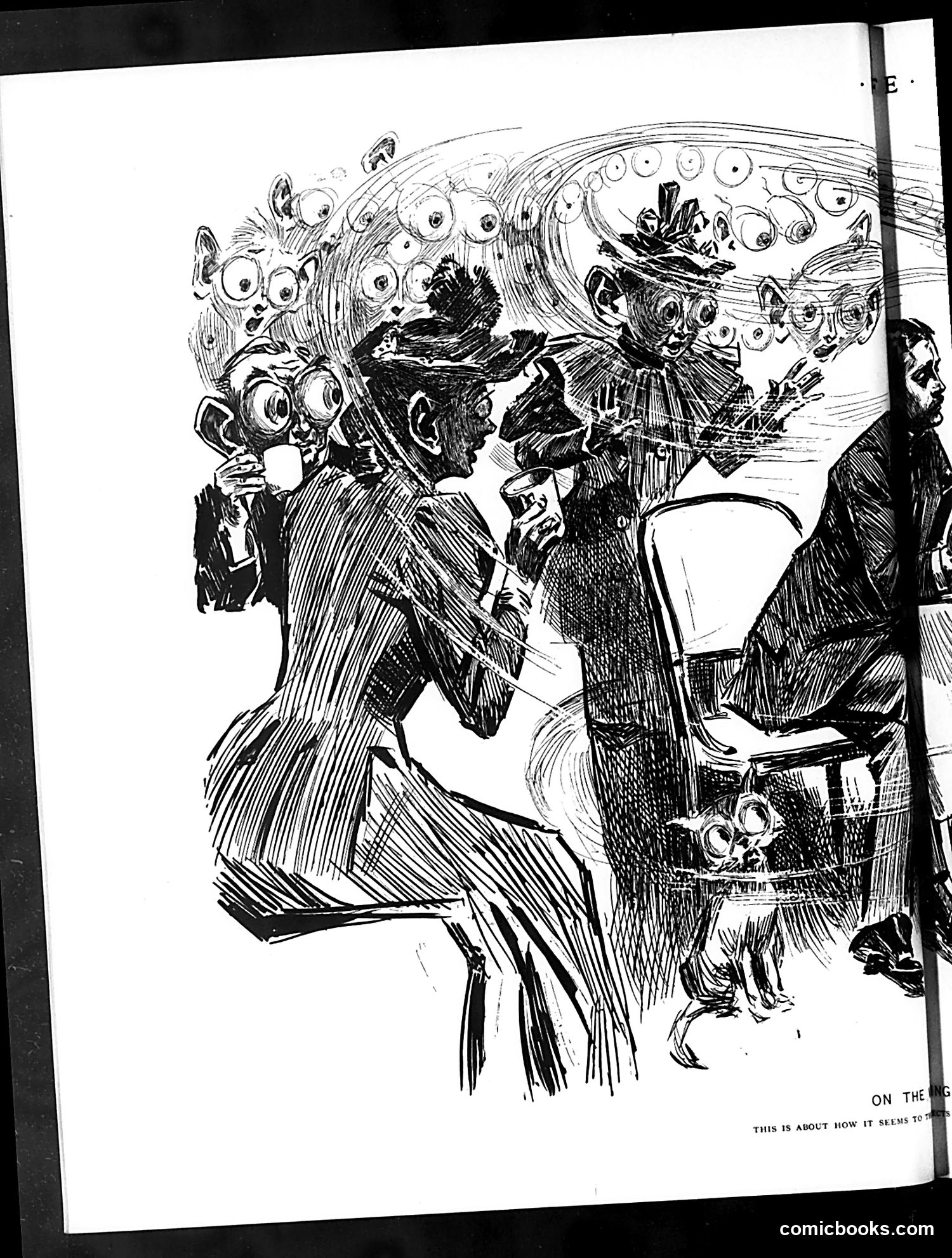
This appears to be a satirical cartoon from Life magazine depicting a social or political scene. The central figures are well-dressed men and women in formal attire, with exaggerated facial features characteristic of early 20th-century caricature style. Most striking are the grotesquely enlarged eyes floating above the figures' heads—a visual metaphor likely representing voyeurism, public scrutiny, or "watching eyes" of society. The caption at bottom reads: "THIS IS ABOUT HOW IT SEEMS TO..." (text cuts off), suggesting commentary on public perception or social observation. Without the complete caption or publication date visible, the specific political target remains unclear, though the satire appears to mock either high society pretension or the invasive nature of public attention and gossip among the elite.
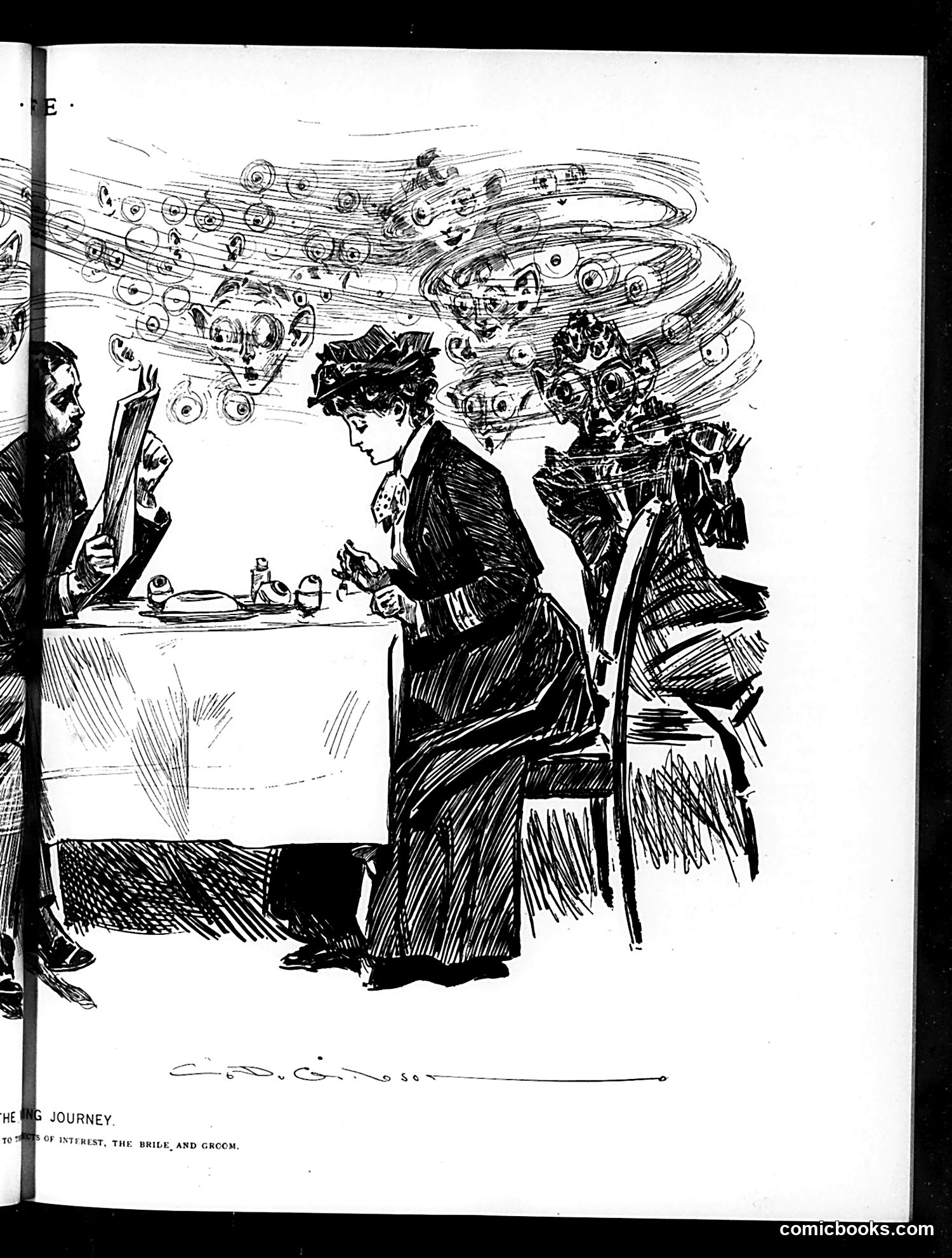
This ink sketch depicts a wedding scene with three figures at a table. The caption references "the bride and groom," though the identities of these specific individuals are unclear from the image alone. The satire appears to mock the elaborate social expectations surrounding weddings. The swirling, chaotic lines above the figures—resembling wheels, gears, and decorative elements—suggest the overwhelming machinery of wedding preparations and social obligations. The formal attire and seated arrangement indicate a formal wedding reception or gathering. The humor likely derives from contrasting the calm, seated wedding participants with the frenzied, complex visual chaos overhead, satirizing how weddings transform into overwhelming spectacles of social performance rather than intimate occasions.
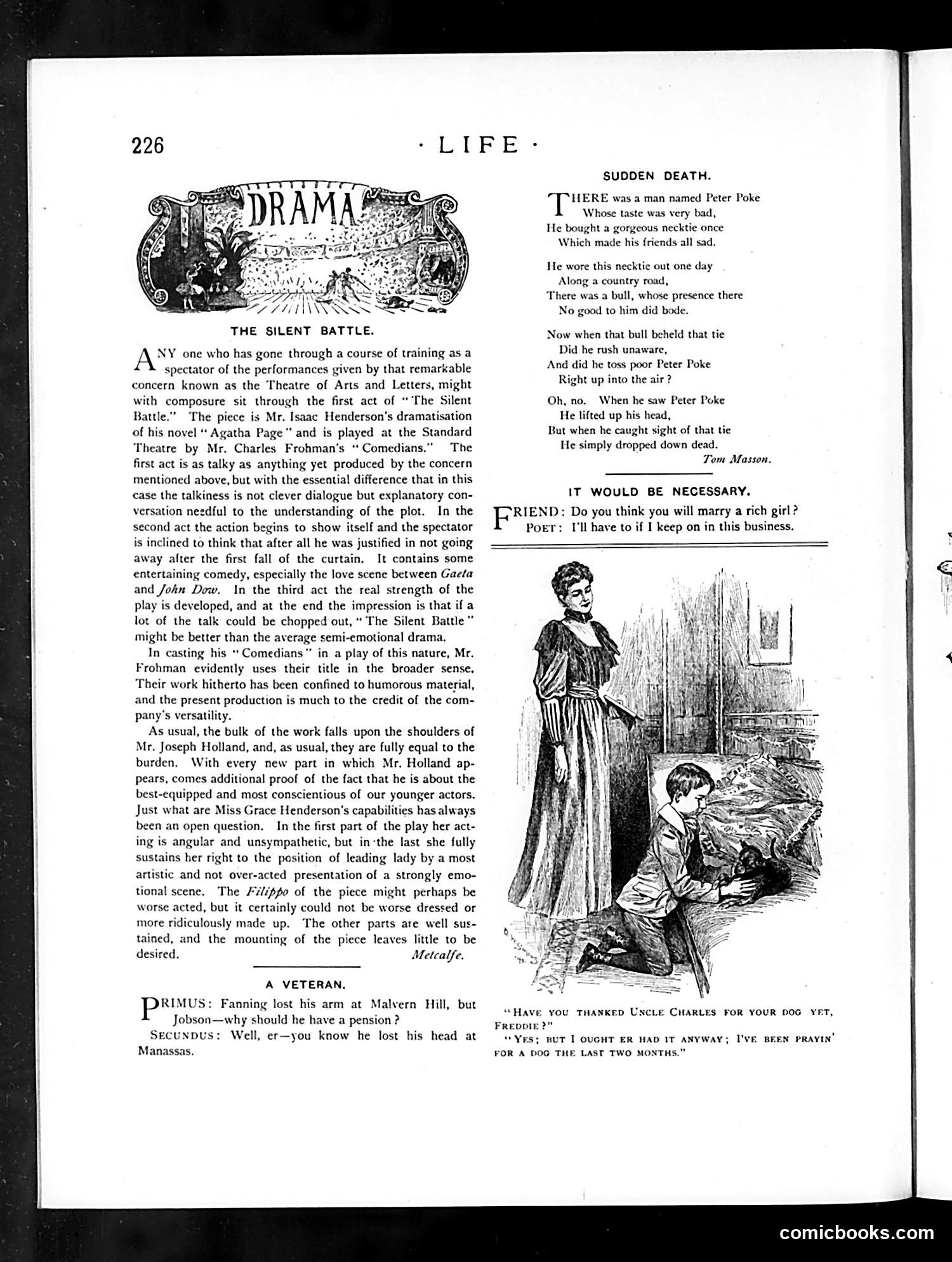
This page contains drama criticism, light verse, and brief comic exchanges typical of Life's satirical format. **"The Silent Battle"** reviews a stage play adapted from a novel, praising actors Joseph Holland and Grace Henderson while criticizing excessive dialogue in the first act. The critique suggests the production improves as it progresses. **"A Veteran"** is a two-line joke playing on Civil War references. It contrasts a soldier who lost his arm at Malvern Hill with one who "lost his head at Manassas"—the joke being that losing one's head (judgment/sanity) during battle was apparently worse than physical injury in terms of deserving a pension. **"Sudden Death"** is humorous verse about a man named Peter Poke whose ugly necktie is so offensive that a bull literally dies from shock upon seeing it—satirizing poor fashion taste. **"It Would Be Necessary"** is a brief dialogue joke about marriage and financial necessity. The illustration shows a child asking an adult about thanking "Uncle Charles" for a dog, with the child noting he'd been praying for one anyway—gentle domestic humor.
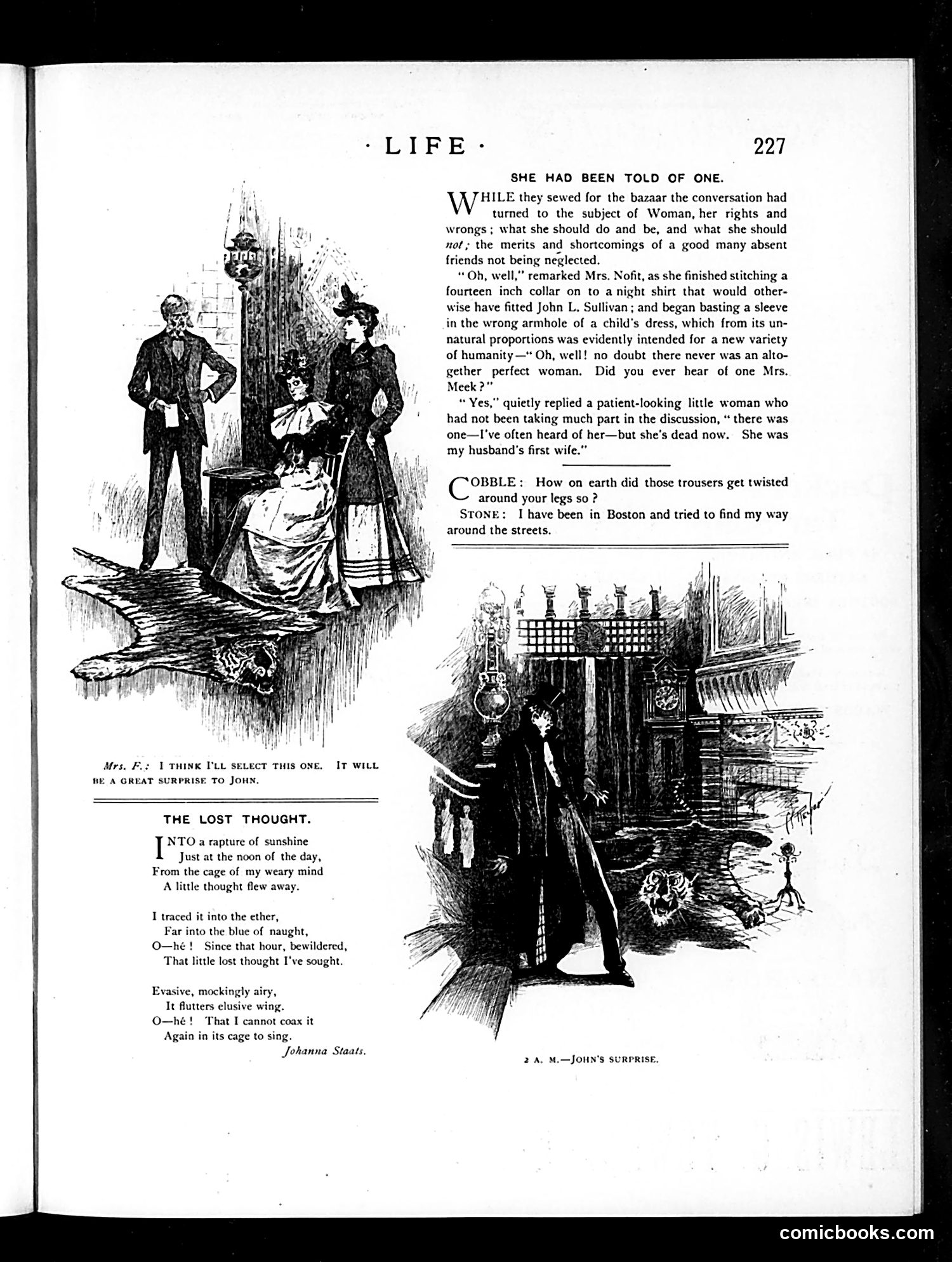
This page contains three distinct pieces of satirical humor typical of early 20th-century American magazines: **Main cartoon (top left):** depicts women sewing for a bazaar while discussing "the Woman question"—contemporary debates about women's rights and roles. Mrs. Nofit ironically claims no perfect woman exists, prompting a meek woman to reveal she's heard of one: her husband's *first* wife (now deceased). The satire mocks both the pretentious discussion and the joke's implication that wives become difficult through marriage. **Street humor (middle):** A brief joke about Boston's confusing street layout, playing on the city's famously irregular, non-grid streets. **Bottom cartoon:** Shows a woman selecting an oversized, poorly-fitted garment as a "surprise" for her husband John, satirizing either women's sewing incompetence or deliberate mischief—the caption "John's Surprise" suggests he won't be pleased. The page also includes "The Lost Thought," a sentimental poem unrelated to the satire.
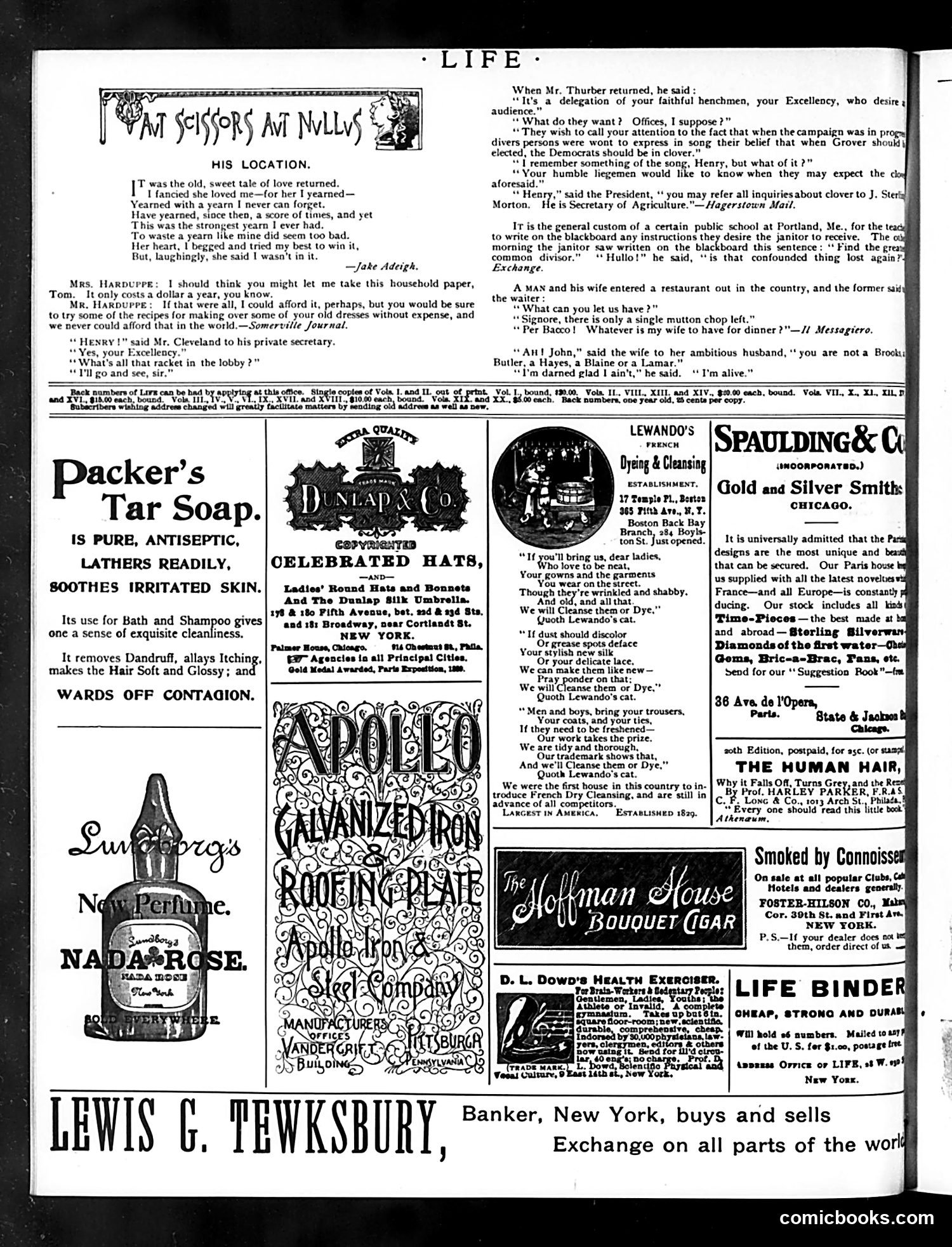
This page primarily contains **short humorous anecdotes and advertisements** rather than political cartoons. The most substantive political content is a joke about **President Grover Cleveland** and his secretary "Henry" (likely referencing an actual aide). The humor involves Democratic campaign promises: during the campaign, supporters sang that when "Grover" was elected, "the Democrats should be in clover" (prosperity). Now in office, disappointed office-seekers want to know when they can expect this promised clover. Cleveland deflects to his Secretary of Agriculture, J. Sterling Morton—satirizing the gap between campaign rhetoric and governing reality. Other jokes include a sarcastic anecdote about a Portland schoolteacher's blackboard instruction to "find the greatest common divisor," which the janitor mistakes for a lost object, and a domestic humor piece mocking ambitious politicians. The page is otherwise filled with period advertising for soap, perfume, hats, and clothing services—typical of Life's mixed content model.
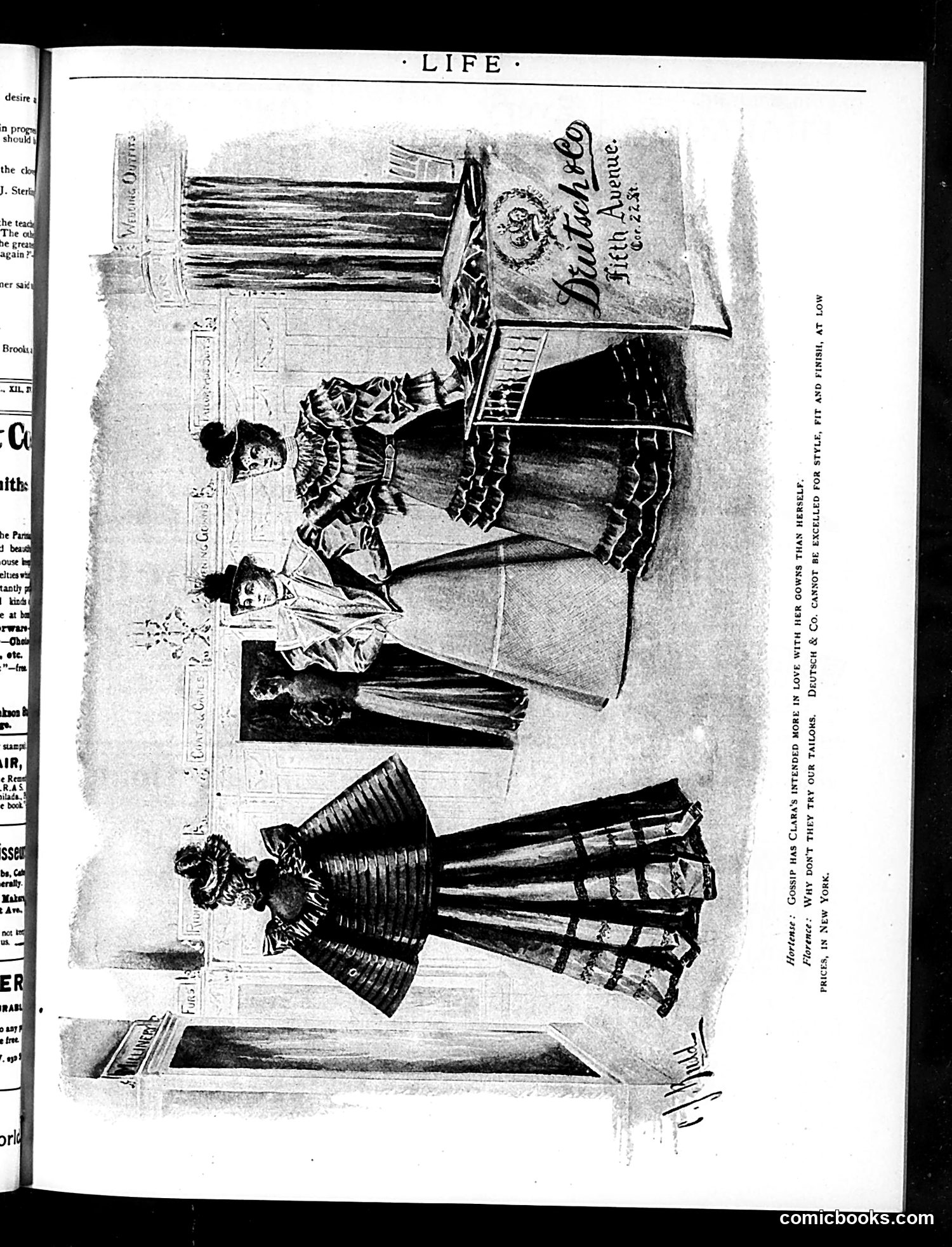
This page from *Life* magazine features a fashion illustration rather than political satire. The image shows three women's figures displaying clothing styles, likely from the early 20th century based on the silhouettes and design aesthetics. The central figure wears an elaborate dress with dramatic pleating and ruffles. Above is displayed what appears to be a "Dutch Lass" branded fabric or garment. The bottom figure shows another dress design with distinctive vertical pleating. The caption credits "Hortense" and "Florence" as the designers, and the text indicates this is an advertisement for "Deutsch & Co.," emphasizing their clothing cannot be "excelled for style, fit and finish at low" [price—text cuts off]. This is primarily **commercial advertising** rather than satirical commentary—a common feature in *Life* magazine during this era, mixed among humor and editorial content. The artistic quality and detailed rendering suggest this was a prominent advertisement in the publication.
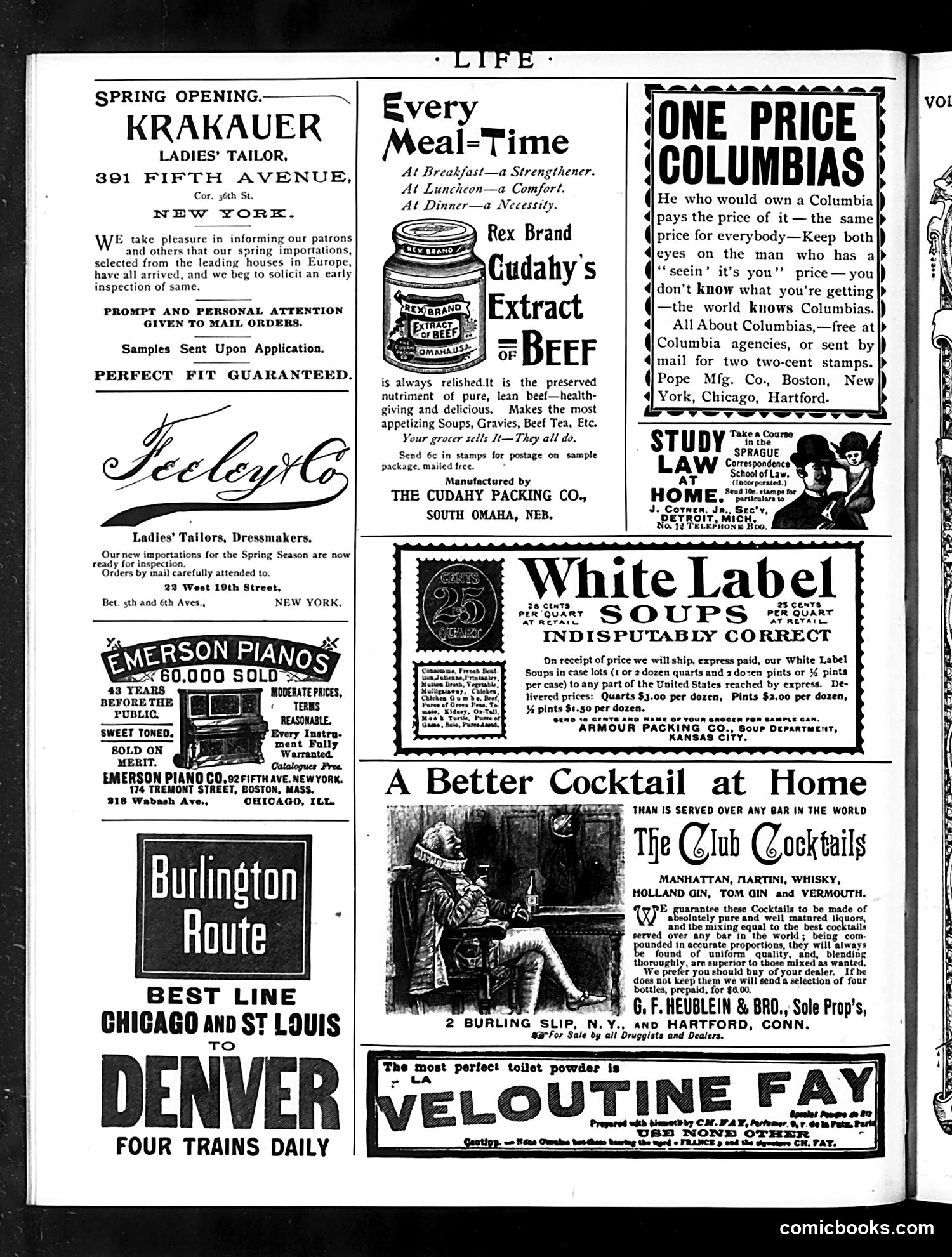
This page is **primarily advertising**, typical of early 20th-century magazines. There are no political cartoons or satirical content visible. The ads promote: - **Krakauer Ladies' Tailor** (Fifth Avenue fashion) - **Cudahy's Extract of Beef** (food product) - **Columbia bicycles** ("one price for everybody") - **Emerson Pianos** - **Burlington Route railroad** (Chicago-Denver service) - **White Label Soups** (Armour Packing Co.) - **Club Cocktails** (home bar premixes) - **Veloutine Fay** (toilet powder) The only content with mild social commentary is the Columbia bicycle ad's emphasis on uniform pricing—appealing to middle-class consumers by suggesting democratized access ("Keep both eyes on the man who has a 'seein' it's you' price"). Otherwise, this is a straightforward commercial page reflecting Gilded Age consumer culture: luxury tailoring, packaged foods, transportation, and emerging home convenience products.