
Life, 1893-04-06 · page 8 of 16
Life — April 6, 1893 — page 8: what you’re looking at
What you’re looking at
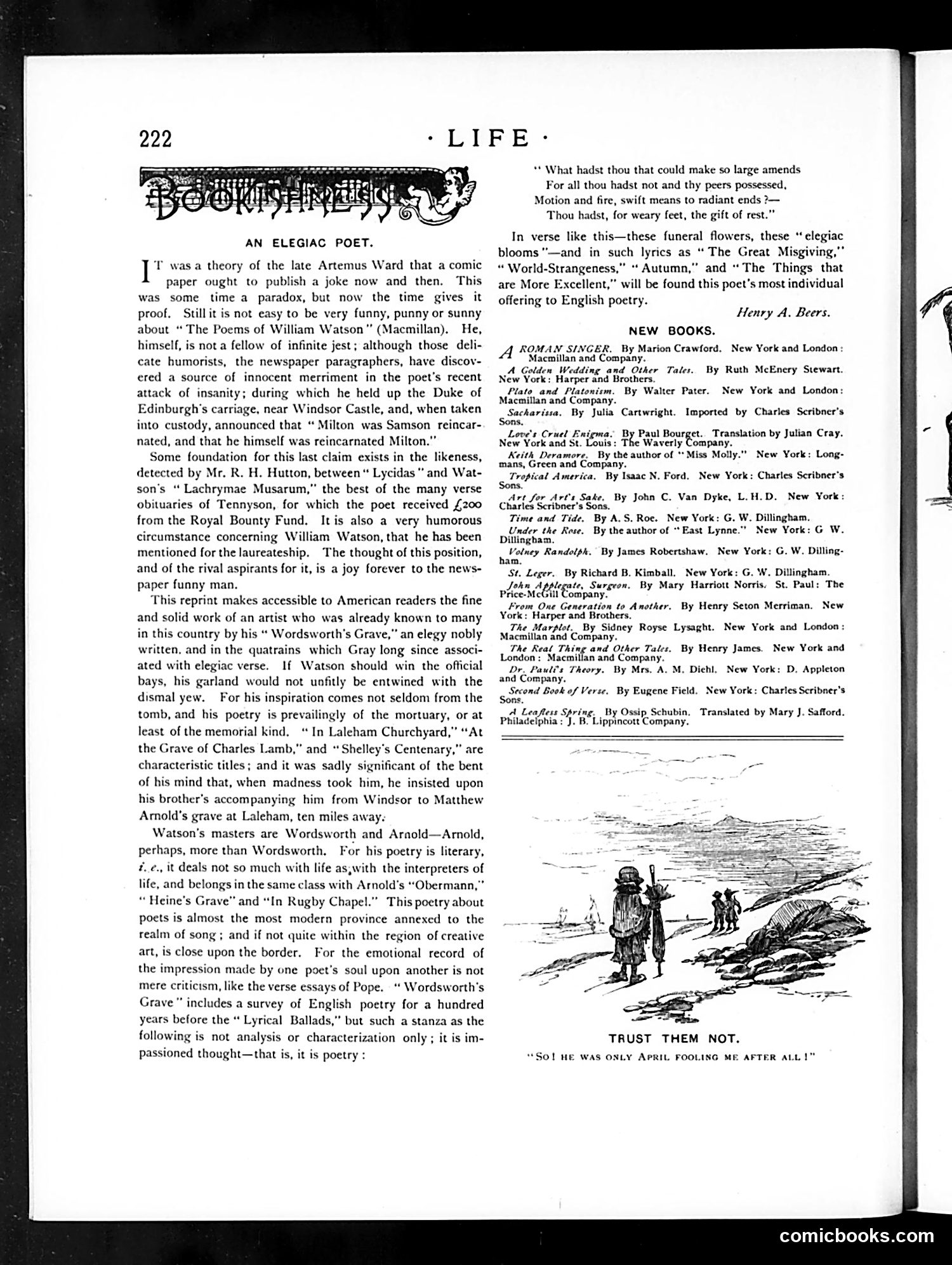
This page contains a literary essay titled "An Elegiac Poet" discussing Artemus Ward's comic writing style, followed by a "New Books" section listing recent publications. The only illustration is a small sketch captioned **"Trust Them Not"** showing figures on a hillside, with the quote "So I he was only April fooling me after all!" This appears to be a simple April Fools' Day joke cartoon—a figure has apparently been pranked or deceived by someone, delivering the punchline that the deception was just holiday tomfoolery. The cartoon illustrates a straightforward, lighthearted prank scenario typical of Life magazine's humor, with no apparent political or social commentary beyond the familiar cultural tradition of April Fools' Day pranks.
📄 Transcribed text from this page (OCR, searchable)
Machine-transcribed from the original scan — historical spelling and the odd misread are preserved.
A EVEE : AN ELEGIAC POET. I’ was a theory of the late Artemus Ward that a comic paper ought to publish a joke now and then. This was some time a paradox, but now the time gives it proof. Stillit is not easy to be very funny, punny or sunny about “ The Poems of William Watson” (Macmillan), He, himself, is not a fellow of infinite jest; although those deli- cate humorists, the newspaper paragraphers, have discov- ered a source of innocent merriment in the poet's recent attack of insanity; during which he held up the Duke of Edinburgh’s carriage, near Windsor Castle, and, when taken into custody, announced that “ Milton was Samson reincar- nated, and that he himself was reincarnated Milton. Some foundation for this last claim exists in the likeness, detected by Mr. R. H. Hutton, between “ Lycidas ” and Wat- son's “ Lachrymae Musarum,” the best of the many verse obituaries of Tennyson, for which the poet received £200 from the Royal Bounty Fund. Itis also a very humorous circumstance concerning William Watson, that he has been mentioned for the laureateship. The thought of this position, and of the rival aspirants for it, is a joy forever to the news- paper funny man. This reprint makes accessible to American readers the fine and solid work of an artist who was already known to many in this country by his “* Wordsworth’s Grave,” an elegy nobly written, and in the quatrains which Gray long since associ- ated with elegiac verse. If Watson should win the official bays, his garland would not unfitly be entwined with the dismal yew. For his inspiration comes not seldom from the tomb, and his poetry is prevailingly of the mortuary, or at least of the memorial kind. “In Laleham Churchyard,” “At the Grave of Charles Lamb,” and “Shelley's Centenary,” are characteristic titles; and it was sadly significant of the bent of his mind that, when madness took him, he insisted upon his brother's accompanying him from Windsor to Matthew Amold’s grave at Laleham, ten miles away: Watson’s masters are Wordsworth and Araold—Arnold, perhaps, more than Wordsworth. For his poetry is literary, #.¢,, it deals not so much with life as,with the interpreters of life, and belongs in the same class with Arnold's “Obermann,” “ Heine's Grave” and “In Rugby Chapel.” This poetry about poets is almost the most modern province annexed to the realm of song ; and if not quite within the region of creative art, is close upon the border. For the emotional record of the impression made by one poet's soul upon another is not mere criticism, like the verse essays of Pope.“ Wordsworth’s Grave” includes a survey of English poetry for a hundred years before the “ Lyrical Ballads,” but such a stanza as the following is not analysis or characterization only ; it is im- passioned thought—that is, it is poetry : “* What hadst thou that could make so large amends For all thou hadst not and thy peers possessed, Motion and fire, swift means to radiant ends ?— Thou hadst, for weary feet, the gift of rest. In verse like this—these funeral flowers, these ‘“elegiac blooms "—and in such lyrics as “ The Great Misgiving,"’ “ World-Strangeness,” “Autumn,” and “The Things that are More Excellent,” will be found this poet's most individual offering to English poetry. Henry A. Beers. NEW BOOKS. ROMAN SINGER. By Marion Crawford. New York and London : Macmillan and Company. A Golden Wedding and Other Tales. New York: Harper and Brothers. Plato and Platonism. By Walter Pater. Macmillan and Company. Sacharissa, By Julia Cartwright. Imported by Charles Scribner's s. By Ruth McEnery Stewart. New York and London: Love's Cruet Enigma. By Paul Bourget. Translation by Julian Cray. New York and St. Louis: The Waverly Company. Keith Deramore. By the author of ** Miss Molly.” mans, Green and Company. Tropical America, By Isaac N. Ford. few York: Long- New York: Charles Scribner's: Art for Art's Sake, By John C, Van Dyke, L.H.D. New York: Charles Scribner's Sons. Time and Tide, By A.S. Roe. Under the Rose. By the author of “East Lynne.” Dillingham. eed Randolph. By James Robertshaw. New York: G. W. Dilling- m, New York: G, W. Dillingham, New York: G W. St. Leger. By Richard B. Kimball. John Applegate, Surgeon, By Mary Harriott Norris. Price-MeGill Company. From One Generation to Another. By Henry Seton Merriman. New York: Harper and Brothers. The Marplot. By Sidney Royse Lysaght. tiactiins toa ‘Company. laa The Real Thing and Other Tales. London: Macmillan and Company. Dr, Pauli's Theory. By Mrs. A. M. Diehl. and Company. cSerond Beek of Verse, By Eugene Field. New York: Charles Scribner's ns. New York: G. W. Dillingham. St. Paul: The New York and London: By Henry James. New York and New York: D. Appleton Spring. By Ossip Schubin, Translated by Mary J. Safford. . B Lippincott Company. A Lea, pritadclgn —_ TRUST THEM NOT. OL HE WAS ONLY APRIL FOOLING ME AFTER ALL! comicbooks.com