
A complete issue · 14 pages · 1893
Life — March 2, 1893
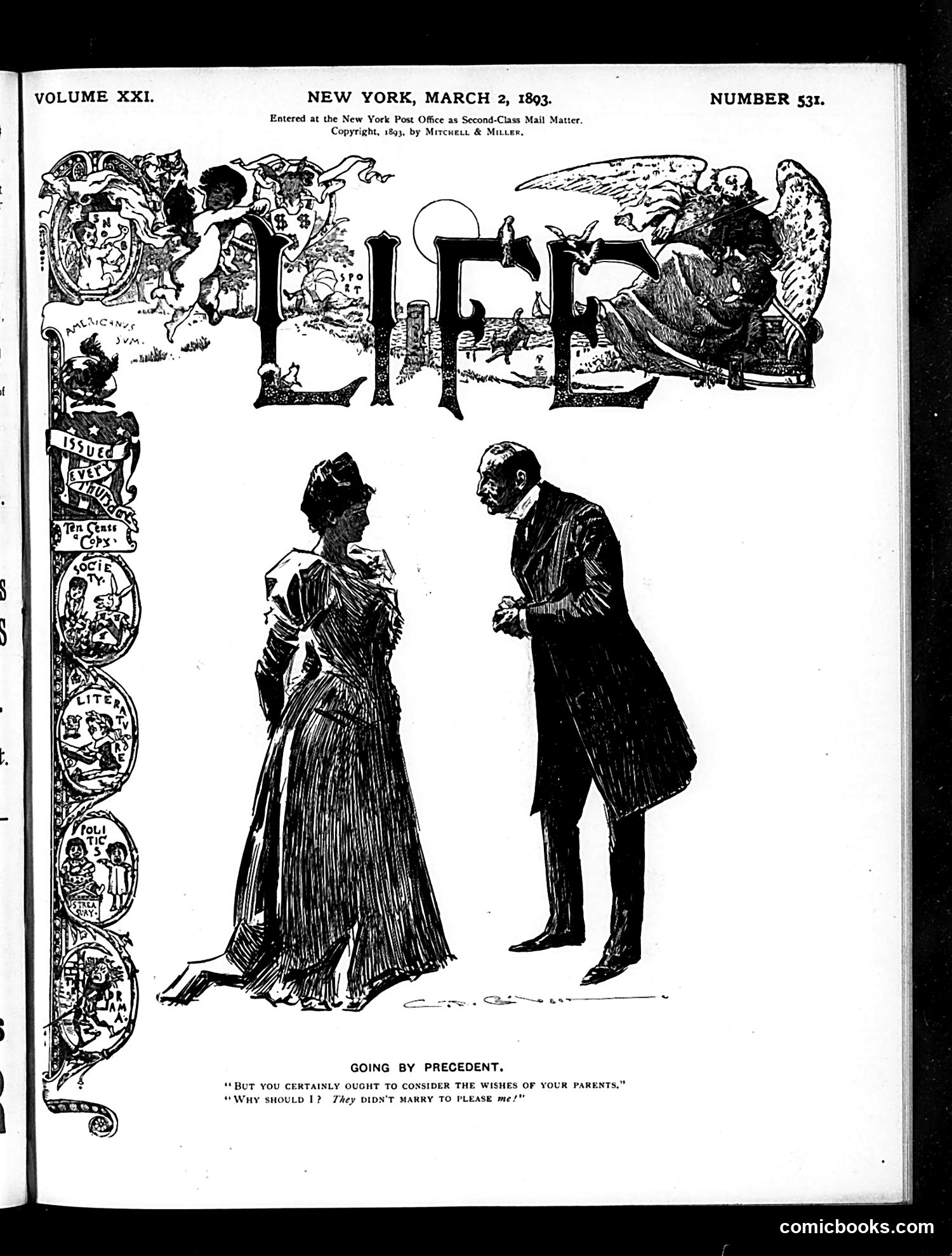
This cartoon depicts a romantic disagreement between a young couple. The man objects to the woman's plan to marry, insisting her parents didn't marry to please *him*—implying he won't marry to please *them*. The title "Going By Precedent" suggests the woman is citing parental wishes as justification, while the man counters with the logical precedent that her parents made their own choice freely. The cartoon satirizes stubbornness in romantic disputes and the clash between dutiful obedience to parental authority versus individual autonomy in matters of marriage—a recurring tension in 1890s social comedy. The elaborate Art Nouveau borders and typography are typical of Life's design aesthetic from this period.
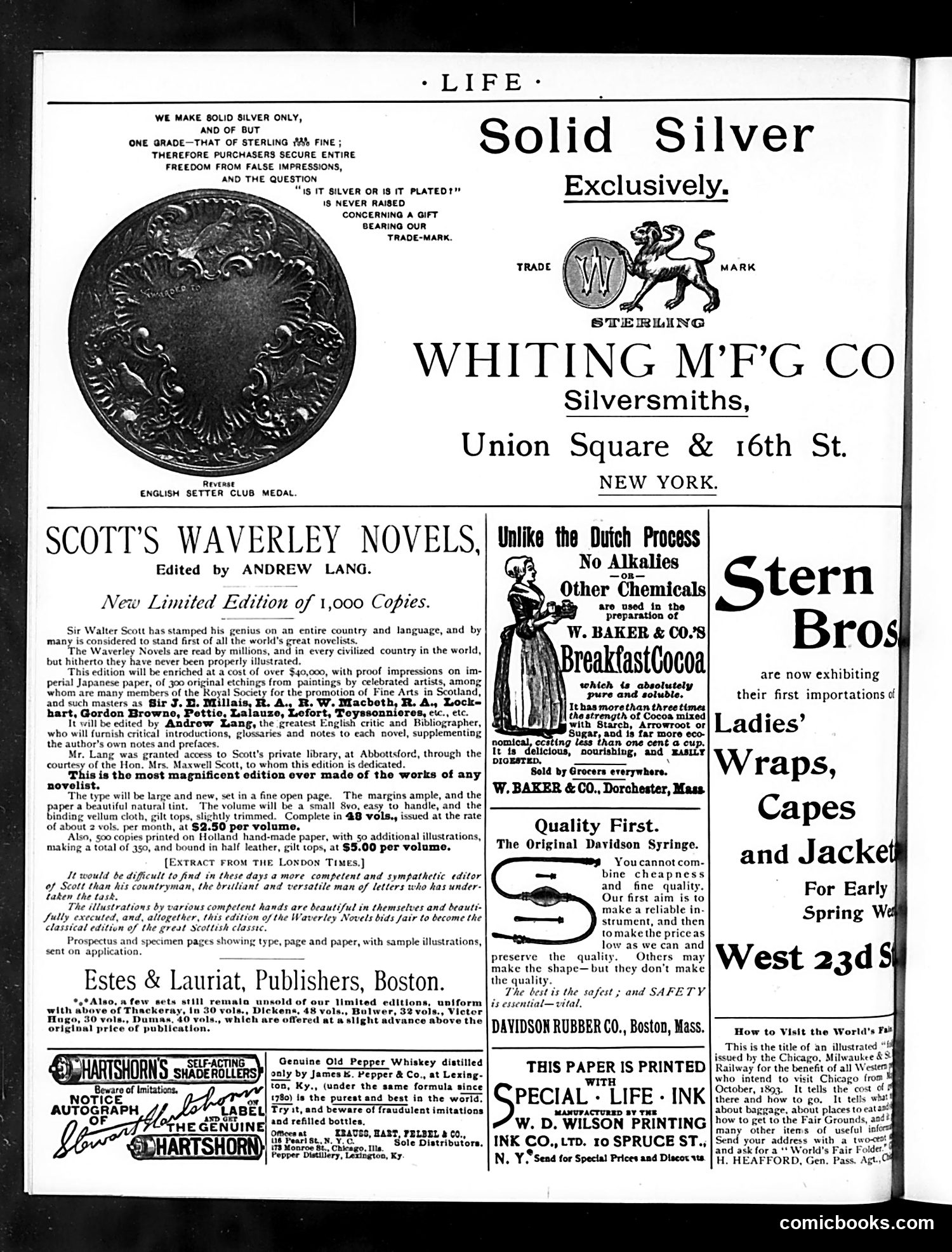
This page is predominantly **advertising**, not satirical content. The main advertisements include: - **Whiting MFG Co.**: Silversmiths promoting solid sterling silver goods, featuring an ornate medal image - **Scott's Waverley Novels**: A limited edition book series with editorial introduction - **W. Baker & Co.**: Breakfast Cocoa advertisement emphasizing quality - **Stern Bros**: Ladies' wraps, capes, and jackets for spring - **Davidson Rubber Co.**: Syringe products - **Hartshorn's**: Shade rollers (with what appears to be a signature) There is a small notice about **"Special Life Ink"** by W.D. Wilson Printing Co. The page contains no discernible political cartoons or satirical commentary—it's a standard turn-of-the-century magazine advertisement layout typical of *Life* magazine's commercial pages.
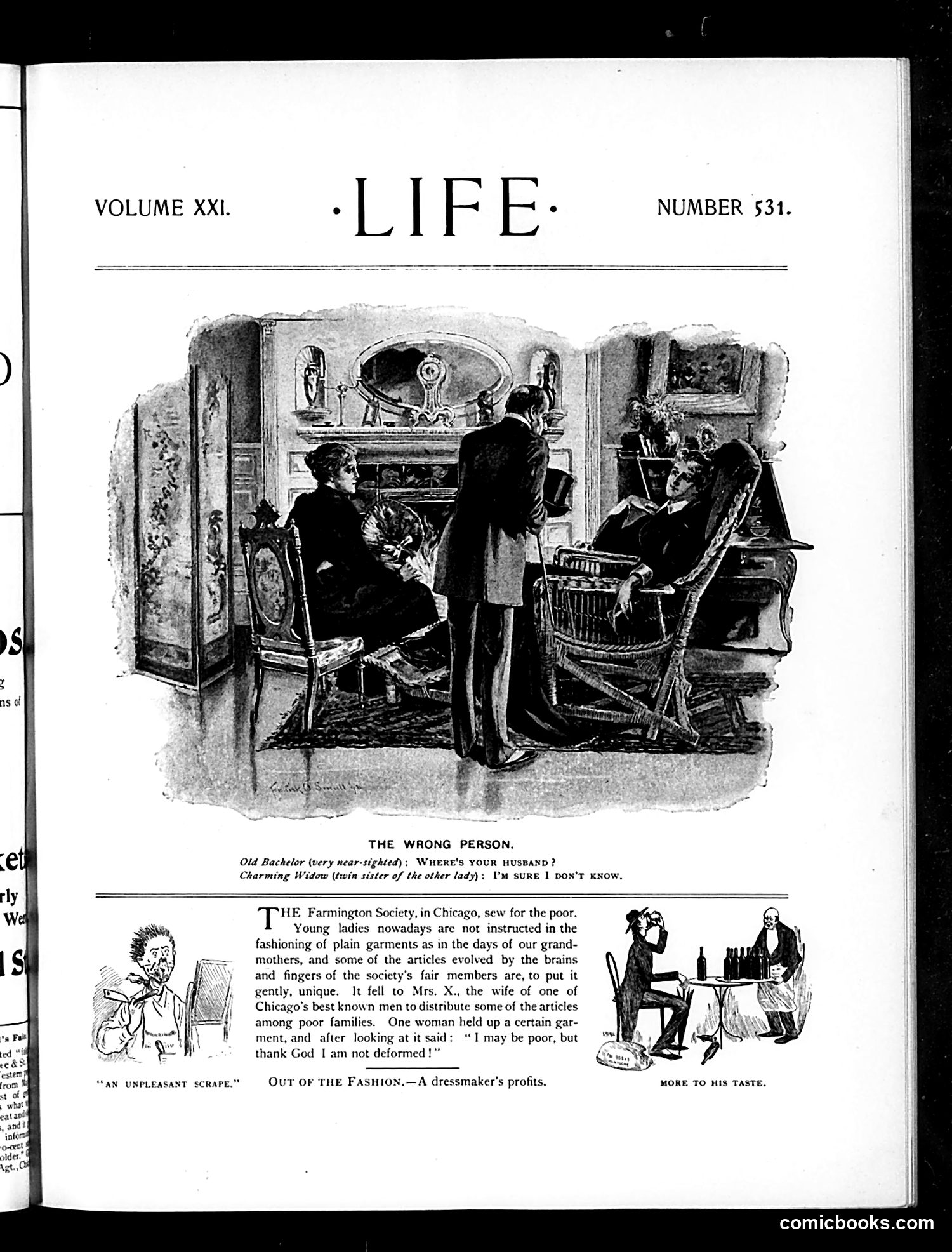
The main cartoon depicts a social comedy of mistaken identity. A well-dressed man stands between two groups in an elegant interior, apparently caught in an awkward situation. The caption indicates he's a bachelor who has been mistaken for a "husband" by a "charming widow," while another woman (his sister) watches. The humor relies on Victorian-era sensibilities about propriety—the embarrassment of being wrongly identified as attached or of romantic interest. Below, a brief article describes the Farmington Society in Chicago, which sewed clothing for poor families. The anecdote mocks a wealthy woman's indignation at being called "deformed" when she complained about the quality of donated garments. The satire targets class pretension and hypocrisy among the privileged.
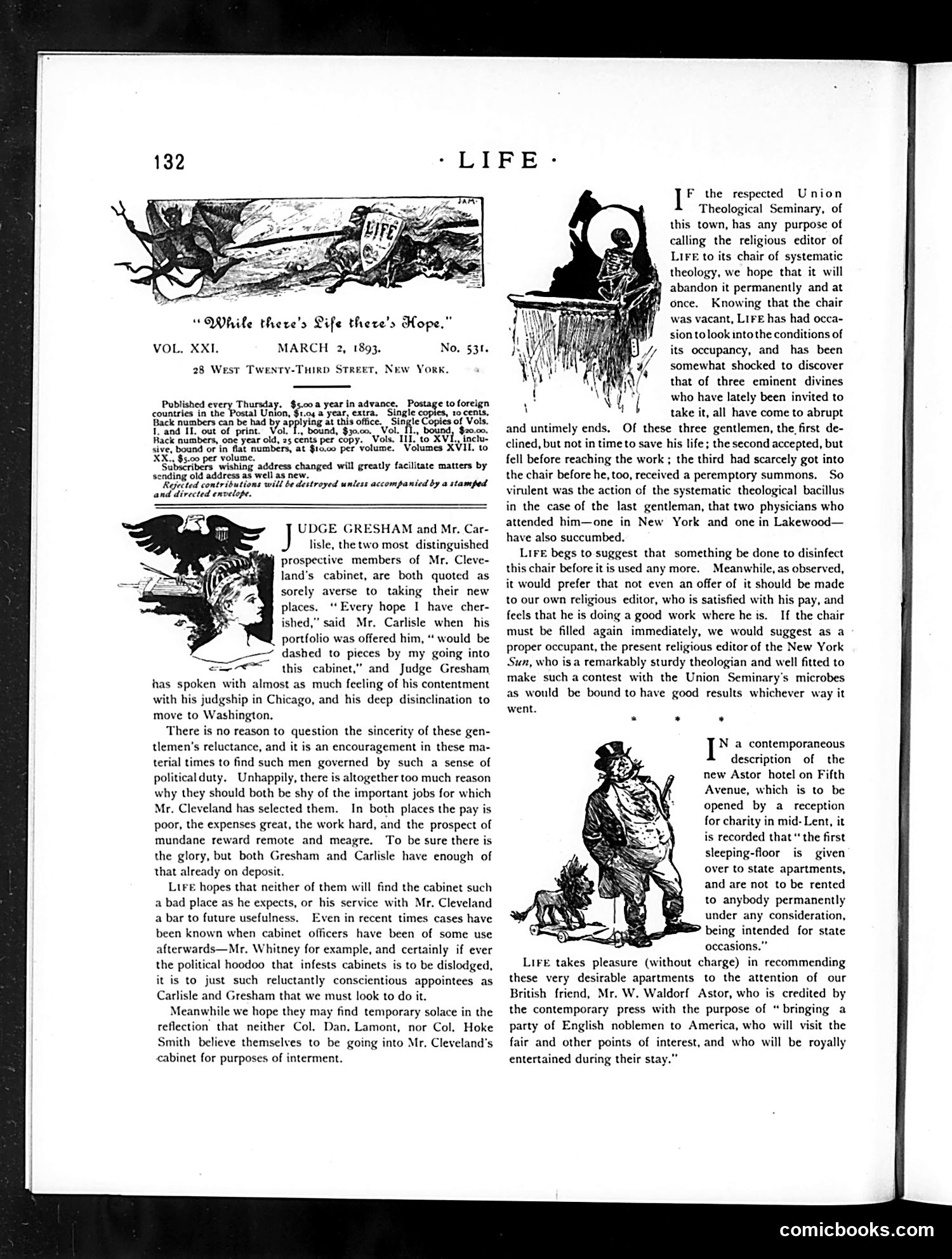
This page satirizes the **Union Theological Seminary's vacant chair of systematic theology**. Three prominent divines recently invited to fill the position all declined or failed—one died before accepting, another before starting, and a third received a "peremptory summons" (suggesting sudden death or scandal). The satire focuses on the **chair itself being cursed or dangerous**, joking that the position is so undesirable that prominent clergy refuse it. The text darkly notes that physicians attending the last candidate have also died, extending the curse metaphor. The cartoon likely depicts Death or a skeletal figure presiding over the empty chair, visualizing the magazine's humorous claim that accepting the position brings misfortune. This mocks both the seminary's difficulties and the reluctance of major theological figures to take the job.
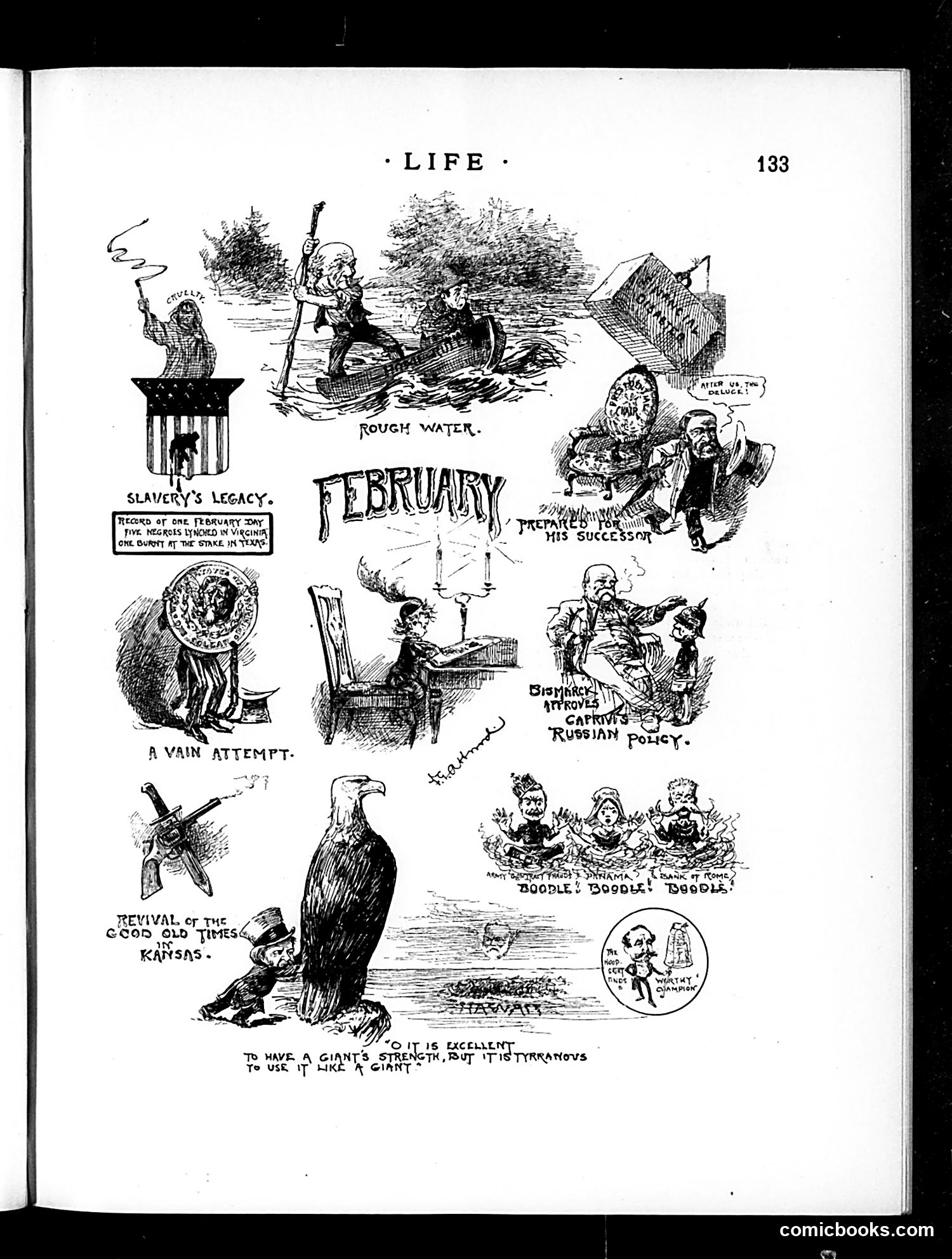
This page collects satirical sketches addressing American political issues from the early 20th century: **"Slavery's Legacy"** critiques ongoing racial violence and injustice following the Civil War. **"Rough Water"** appears to reference political turbulence, possibly related to diplomatic or domestic crises. **"A Vain Attempt"** shows someone struggling futilely—likely satirizing a failed political initiative or policy. **"Revival of the Good Old Times in Kansas"** references frontier violence, possibly relating to political conflict in that state. **"Bismarck Approves Caprivi's Russian Policy"** references European diplomatic maneuvering. **"Doodle: Doodle, Doodle"** and the Hawaii sketch appear to comment on American imperial expansion. The bottom quote about giants using their strength tyrannously suggests critique of powerful nations or leaders abusing their power. Without specific dates, precise historical context remains unclear.
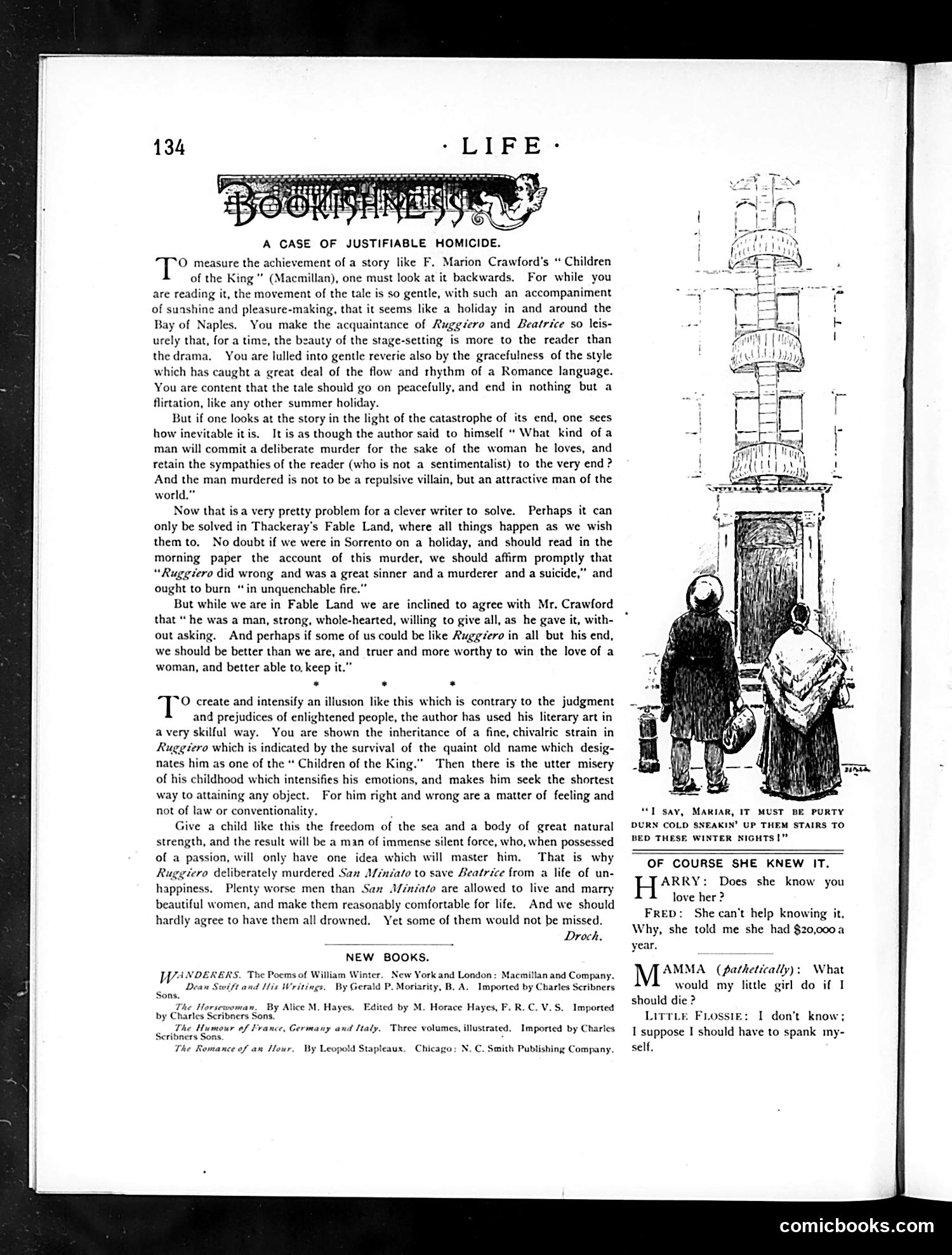
The page is primarily a **book review** of F. Marion Crawford's "Children of the King," not a political cartoon. The review discusses the novel's plot—a man committing murder for love—and debates whether the protagonist is justifiably sympathetic or morally problematic. The **illustration on the right** appears to be a scene from the novel showing figures on what looks like a staircase or tower, with accompanying caption about winter nights and cold. Below is a **comic dialogue** titled "Of Course She Knew It" involving characters named Harry, Fred, Mamma, and Little Flossie, depicting a humorous domestic scene about a woman knowing about an expensive gift ($30,000). This is **not political satire** but rather literary criticism and light social humor typical of Life magazine's mixed content format.
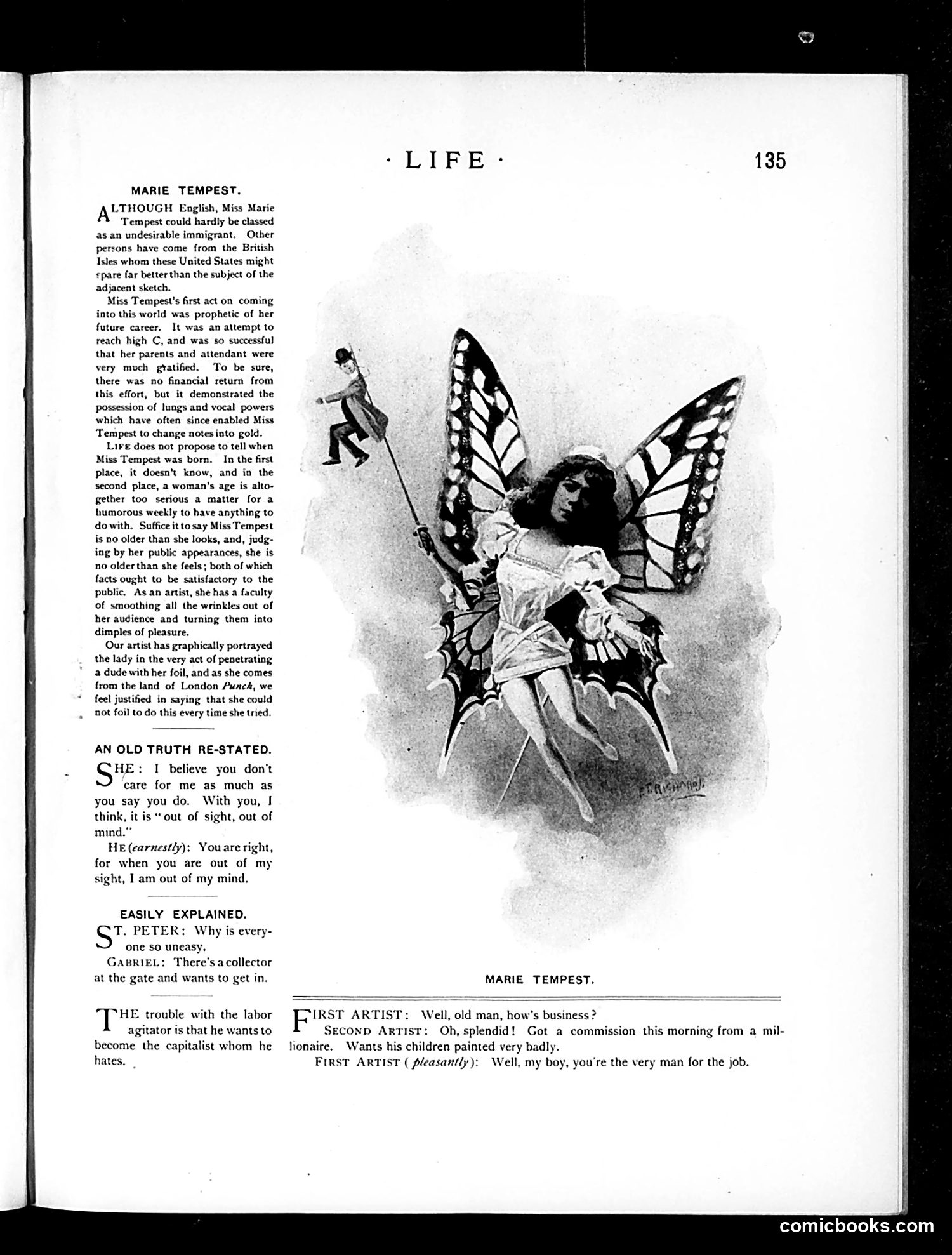
This page satirizes **Marie Tempest**, a British-born actress working in America. The text presents her as someone English society might reject as an undesirable immigrant, yet she's successfully performing in the U.S. theater. The large illustration shows a woman (Tempest) as a **butterfly** being foiled by a man with a butterfly net—a visual metaphor for her elusiveness and artistry. The artist praises her skill at "penetrating a dude with her foil," suggesting her talent lies in comedic stage combat. Below are several comic dialogues mocking common human behaviors: lovers' misunderstandings, bureaucratic obstacles, and artist-patron relationships. The satire reflects turn-of-century American attitudes toward British entertainers and immigrant performers in theater.
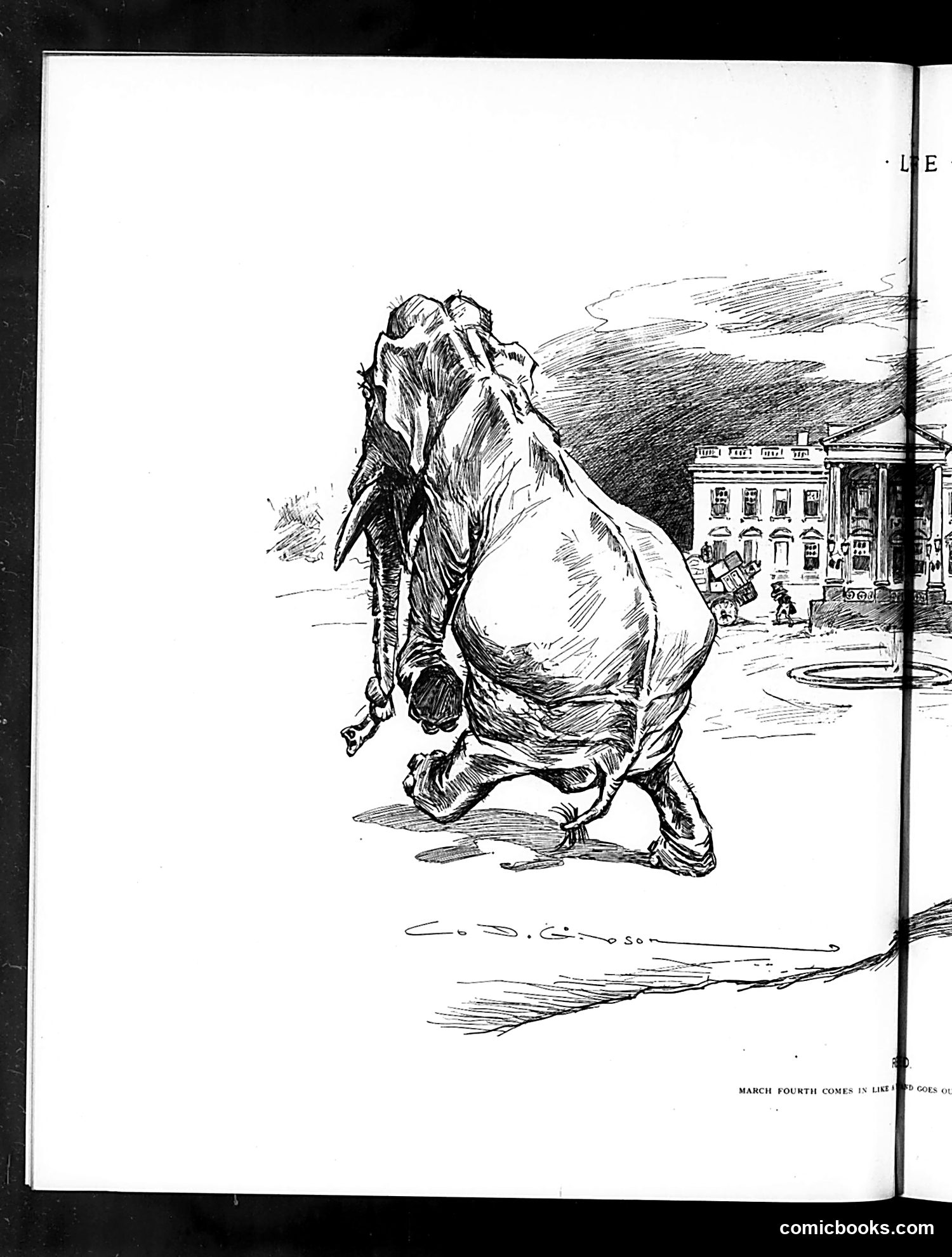
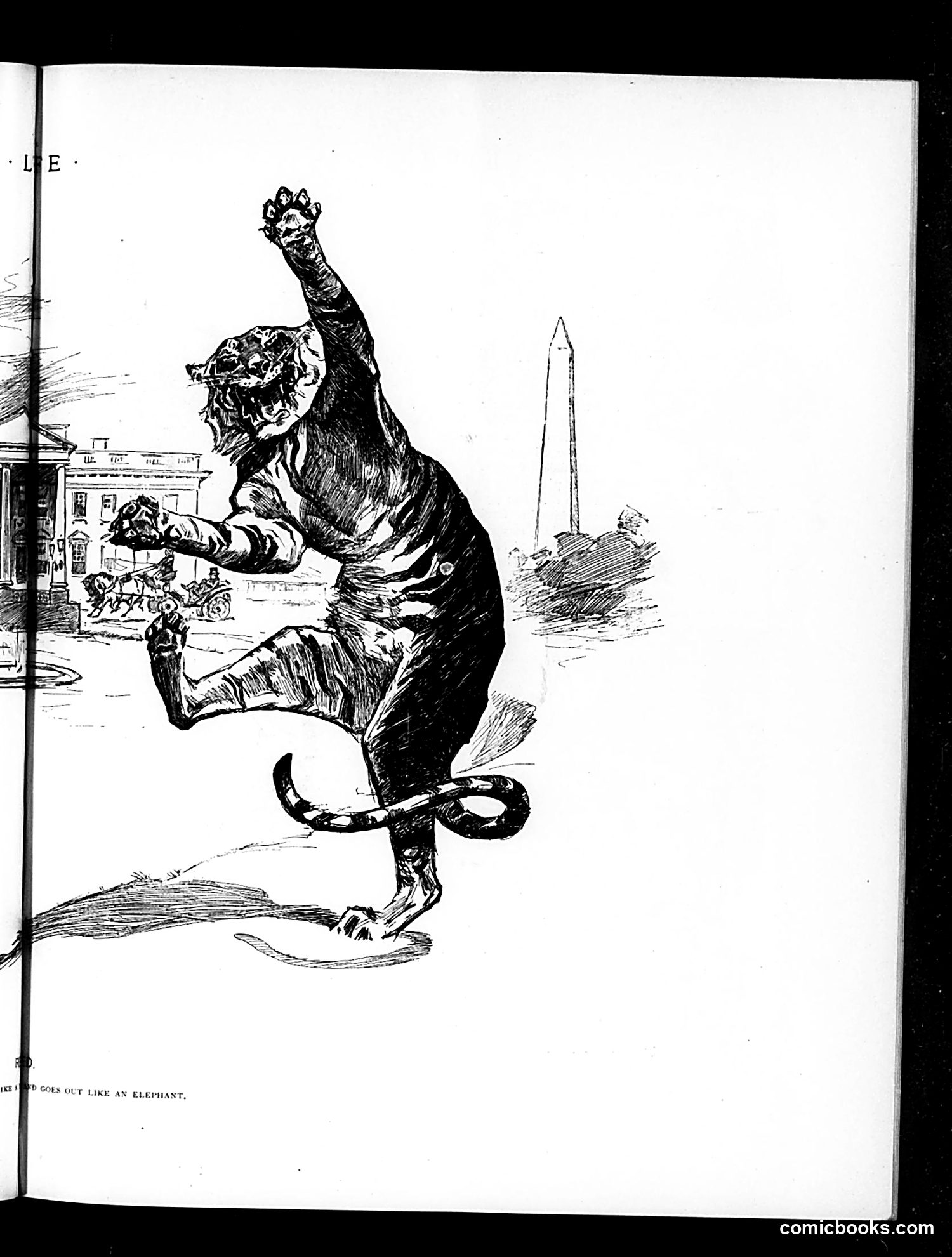
This is a single ink sketch showing a large, rotund figure viewed from behind, wearing period clothing (appears to be early 20th century). The figure is depicted in an exaggerated caricature style typical of Life magazine satire. The caption reads "MARCH FOURTH COMES IN LIKE A LION GOES OUT" (text appears cut off). This likely references the saying "March comes in like a lion, goes out like a lamb" — a common weather proverb. The cartoon appears to satirize a political figure or public personality associated with March 4th, possibly an inauguration or significant political event. However, without the complete caption or additional context, I cannot definitively identify which specific historical figure or event is being mocked. The exaggerated physique suggests ridicule of appearance or character.
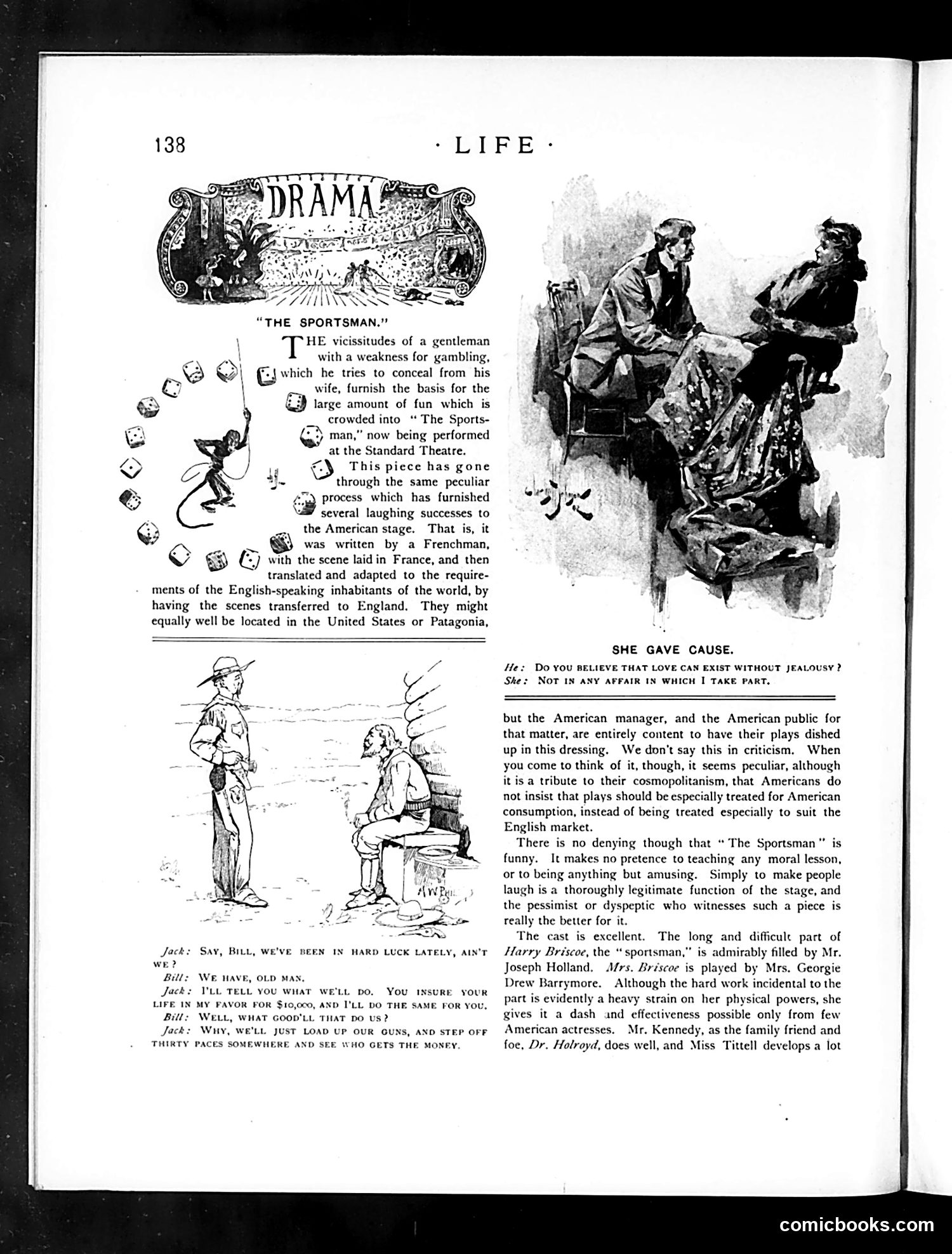
This page reviews a play called "The Sportsman" at the Standard Theatre. The drama concerns a gentleman hiding a gambling habit from his wife—a light comedic piece originally written by a Frenchman with scenes set in France, then adapted for English-speaking audiences. The two cartoon illustrations show scenes from the play: one depicts two male characters in conversation (likely the "sportsman" and another man), while the lower cartoon shows a fishing scene with dialogue about insuring one's life and obtaining money—suggesting the plot involves financial schemes or deceptions related to gambling. The text notes the play aims simply to amuse rather than teach morality, and praises the cast, particularly Joseph Holland as the "sportsman."
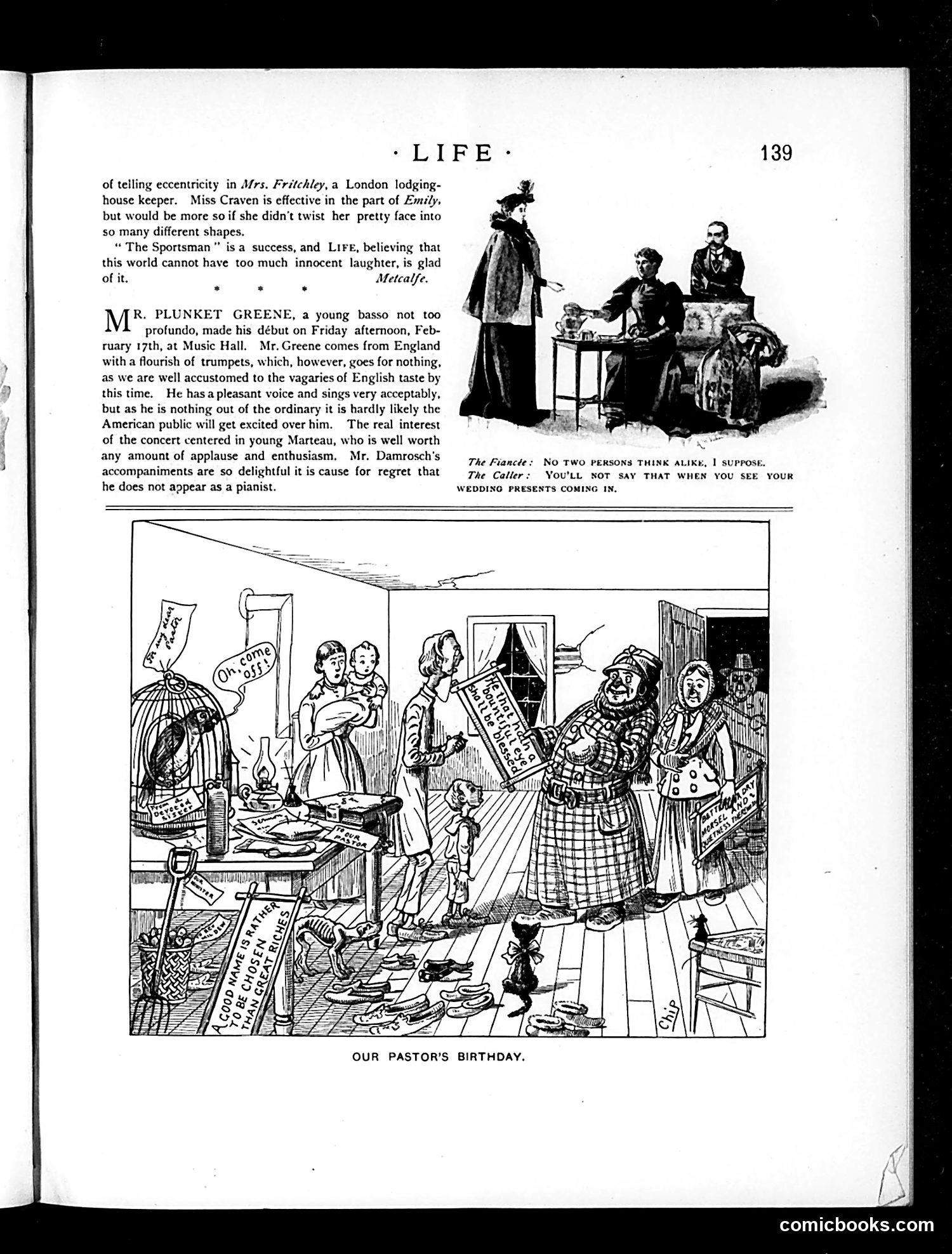
This page contains two distinct elements: **Upper section:** A brief theater review of Mr. Plunket Greene's vocal debut at Music Hall, praising his pleasant voice and "very acceptable" singing. The critic notes regret that accompanist Mr. Damrosch doesn't perform as a pianist. **Lower cartoon ("Our Pastor's Birthday"):** A chaotic domestic scene depicting a crowded, messy room filled with various people and scattered items. The satire appears to mock the disorder and commotion of a birthday celebration, possibly suggesting the disorganization or unruly nature of parish events. The abundance of people crammed into the space and scattered belongings conveys comedic chaos rather than orderly celebration. The page combines theater criticism with domestic humor typical of Life's satirical approach.
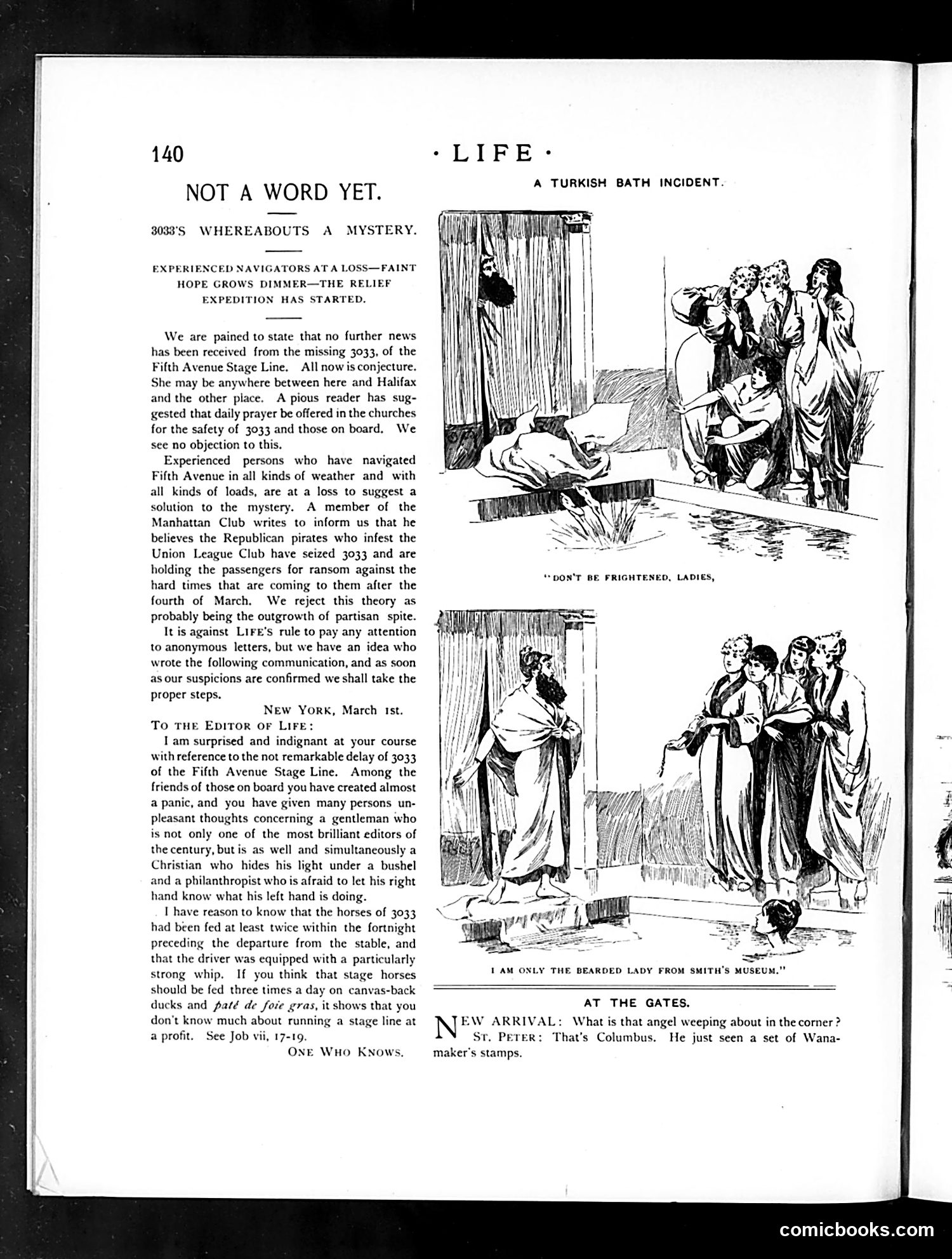
This page satirizes two unrelated topics. "A Turkish Bath Incident" (illustrated cartoons) depicts women in a Turkish bath reacting with alarm—likely mocking Victorian propriety and anxieties about exotic foreign customs. The main text concerns a missing Fifth Avenue stagecoach (#3033). *Life* playfully treats its disappearance as a mystery, with experienced navigators baffled. A reader's letter defends an unnamed "brilliant editor" (likely a figure at a rival publication like the Union League Club) against accusations of negligence, sarcastically arguing the horses were adequately fed and the whip sufficient—mocking concerns about animal welfare in urban transportation. The bottom joke about Columbus and "Wanamaker's stamps" appears to reference John Wanamaker, the Philadelphia merchant and postmaster general, suggesting some commercial or postal humor now obscure. The satire targets journalistic sensationalism, class tensions, and contemporary urban concerns about transportation and commerce.
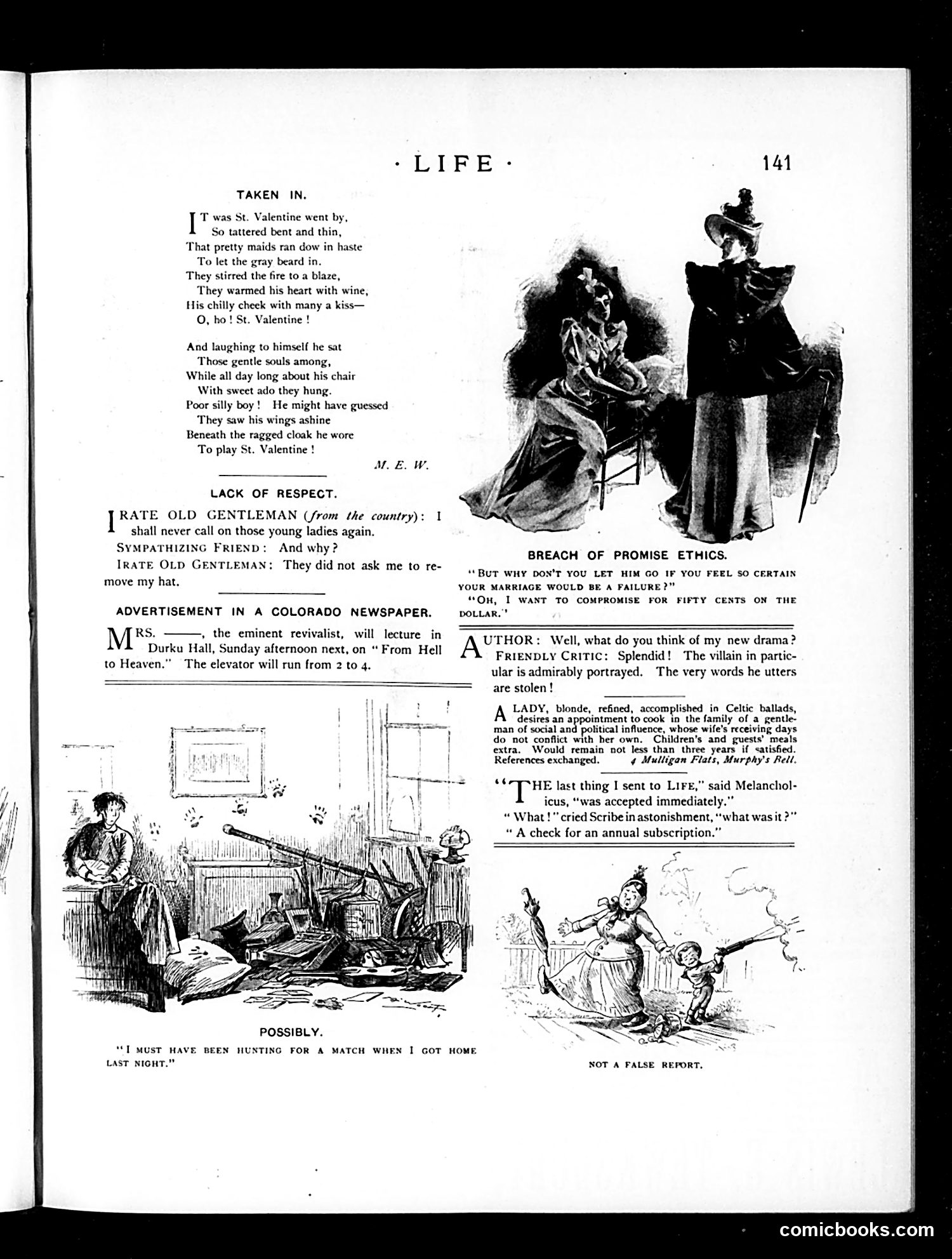
This page contains multiple brief satirical pieces mocking Victorian social conventions and human folly: **"Taken In"**: A poem about St. Valentine (personified as an old beggar) fooling young women into hospitality by hiding his divine "wings" beneath rags—satirizing women's gullibility and romantic sentimentality. **"Lack of Respect"**: A country gentleman complains that young ladies failed to ask him to remove his hat during a visit—mocking rustic expectations of propriety and changing urban manners. **"Breach of Promise Ethics"**: A woman refuses to release her fiancé despite believing marriage would fail, demanding "fifty cents on the dollar"—satirizing mercenary attitudes in broken engagements and litigious marriage culture. **Other pieces** mock: a revivalist's advertisement with awkward elevator logistics, a playwright's stolen dialogue, and job-seekers' absurd personal ads. The humor targets Victorian pretension, commercial opportunism, and the disconnect between social ideals and actual behavior—typical of *Life* magazine's satirical purpose during this era.
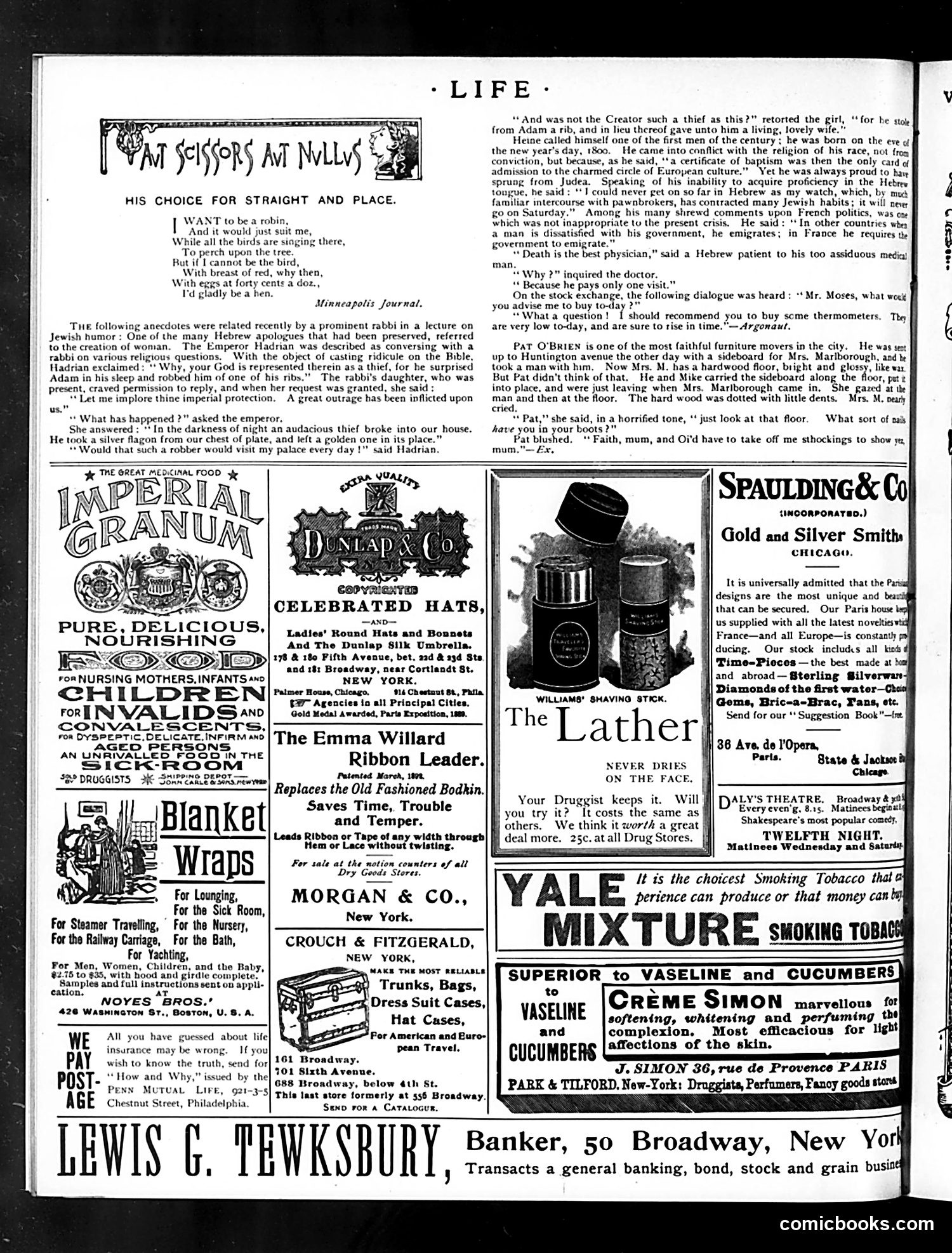
This page contains primarily **humorous anecdotes and advertisements** rather than political cartoons. The main content includes three jokes: 1. **A poem about wanting to be a bird or hen** — lighthearted, no satirical intent. 2. **Jewish humor anecdotes** attributed to a rabbi's lecture, including: - An exchange between Emperor Hadrian and a rabbi's daughter about God "stealing" Adam's rib, with the daughter cleverly reframing it as a favorable trade - A joke about Heine (the 19th-century German-Jewish poet) and his assimilation into European culture - Stock exchange and medical humor 3. **A story about Pat O'Brien**, an Irish furniture mover who damages a customer's floor — a simple ethnic humor piece playing on Irish stereotypes (the implied nail-studded boots). The satire is **gentle and domestic** — poking fun at everyday situations, ethnic groups, and social absurdities rather than critiquing major political events. The Jewish anecdotes particularly showcase wit and intellectual comeback rather than mockery. The remainder is **advertisements** for period products (Imperial Granum, Blanket Wraps, Yale Mixture tobacco, etc.).