
Life, 1893-03-02 · page 6 of 14
Life — March 2, 1893 — page 6: what you’re looking at
What you’re looking at
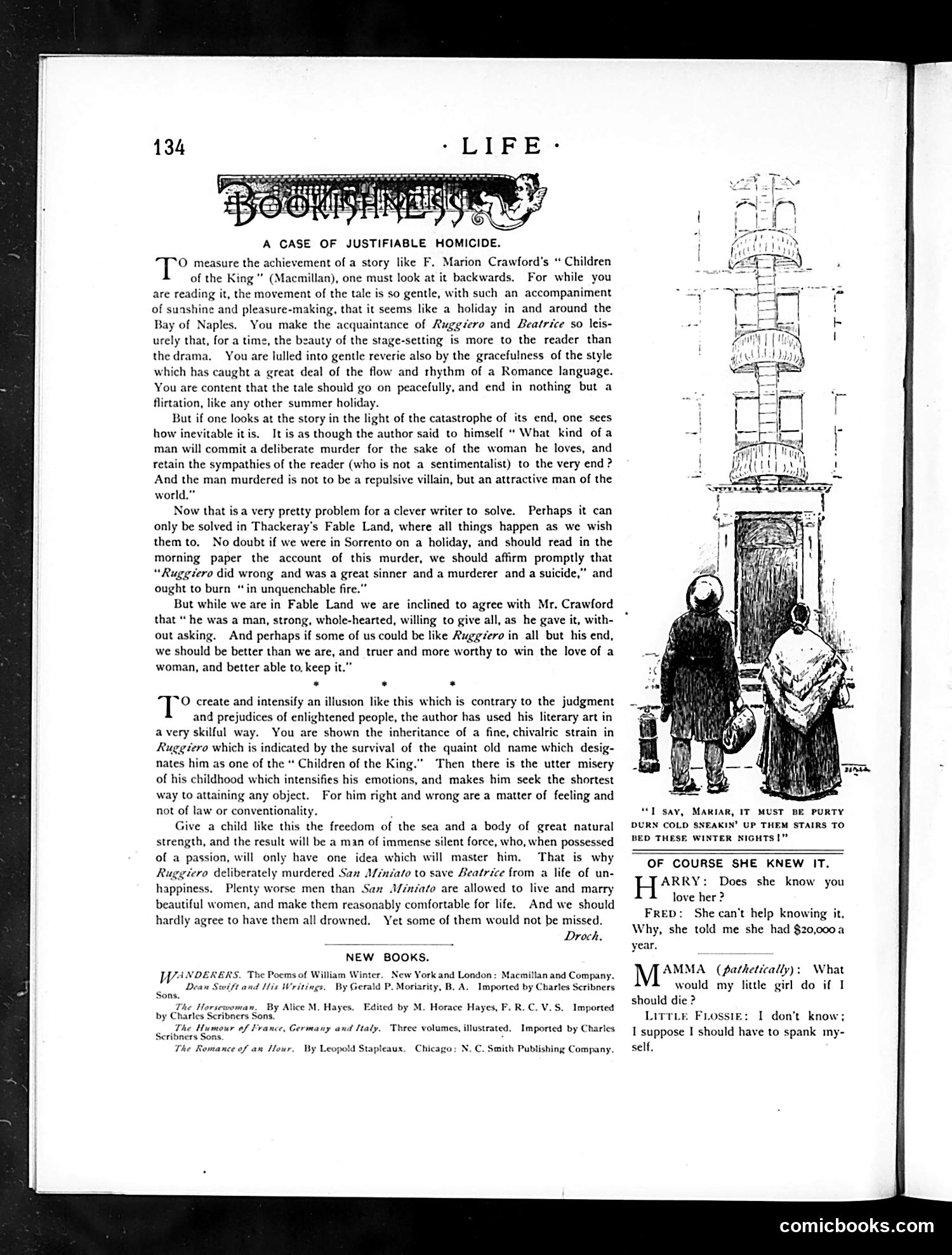
The page is primarily a **book review** of F. Marion Crawford's "Children of the King," not a political cartoon. The review discusses the novel's plot—a man committing murder for love—and debates whether the protagonist is justifiably sympathetic or morally problematic. The **illustration on the right** appears to be a scene from the novel showing figures on what looks like a staircase or tower, with accompanying caption about winter nights and cold. Below is a **comic dialogue** titled "Of Course She Knew It" involving characters named Harry, Fred, Mamma, and Little Flossie, depicting a humorous domestic scene about a woman knowing about an expensive gift ($30,000). This is **not political satire** but rather literary criticism and light social humor typical of Life magazine's mixed content format.
📄 Transcribed text from this page (OCR, searchable)
Machine-transcribed from the original scan — historical spelling and the odd misread are preserved.
A CASE OF JUSTIFIABLE HOMICIDE. T° measure the achievement of a story like F, Marion Crawford's “ Children of the King” (Macmillan), one must look at it backwards. For while you are reading it, the movement of the tale is so gentle, with such an accompaniment of sunshine and pleasure-making, that it seems like a holiday in and around the Bay of Naples. You make the acquaintance of Ruggéero and Beatrice so \eis- urely that, for a time, the beauty of the stage-setting is more to the reader than the drama. You are lulled into gentle reverie also by the gracefulness of the style which has caught a great deal of the flow and rhythm of a Romance language. You are content that the tale should go on peacefully, and end in nothing but a flirtation, like any other summer holiday. But if one looks at the story in the light of the catastrophe of its end, one sees how inevitable itis. It is as though the author said to himself “ What kind of a man will commit a deliberate murder for the sake of the woman he loves, and retain the sympathies of the reader (who is not a sentimentalist) to the very end ? And the man murdered is not to be a repulsive villain, but an attractive man of the world.” Now that isa very pretty problem for a clever writer to solve. Perhaps it can only be solved in Thackeray's Fable Land, where all things happen as we wish them to, No doubt if we were in Sorrento on a holiday, and should read in the morning paper the account of this murder, we should affirm promptly that “Ruggiero did wrong and was a great sinner and a murderer and a suicide,” and ought to burn “in unquenchable fire.” But while we are in Fable Land we are inclined to agree with Mr. Crawford that “ he was a man, strong, whole-hearted, willing to give all, as he gave it, with- out asking. And perhaps if some of us could be like Ruggzero in all but his end, we should be better than we are, and truer and more worthy to win the love of a woman, and better able to, keep it.” T° create and intensify an illusion like this which is contrary to the judgment and prejudices of enlightened people, the author has used his literary art in a very skilful way. You are shown the inheritance of a fine, chivalric strain in Ruggtero which is indicated by the survival of the quaint old name which desig- nates him as one of the “ Children of the King.” Then there is the utter misery of his childhood which intensifies his emotions, and makes him seek the shortest way to attaining any object. For him right and wrong are a matter of feeling and not of law or conventionality. Give a child like this the freedom of the sea and a body of great natural strength, and the result will be a man of immense silent force, who, when possessed of a passion, will only have one idea which will master him, That is why Ruggiero deliberately murdered San Miniato to save Beatrice from a life of un- happiness. Plenty worse men than San .Winéato are allowed to live and marry beautiful women, and make them reasonably comfortable for life. And we should hardly agree to have them all drowned. Yet some of them would not be missed. Droch. NEW BOOKS. [ZANDERERS., The Pooms of William W Dean Swift and His Writings. By Sons, The Horsewoman. By Mice M. Hayes. by Charles Scribners Sons. The Humour of France, Germany and Italy. Scribners Sons. The Romance of an Hour. ter. New York and London: Macmillan and Company. rald P. Moriarity, B.A. Imported by Charles Scribners Edited by M. Horace Hayes, FR. C. V.S. Imported ‘Three volumes, illustrated, Imported by Charles By Leopold Stapleaux. Chicago: N. C. Smith Publishing Company “Tsay, MARIAR, IT MUST BE PURTY DURN COLD SNEAKIN’ UP THEM STAIRS TO BED THESE WINTER NIGHTS 1” OF COURSE SHE KNEW IT. ARRY: Does she know love her ? Freb: She can't help knowing it. Why, she told me she had $20,000a year. Masa (pathetically): What would my little girl do if I should die ? LitrLe Fhossie: I don’t know; I suppose I should have to spank my- self. you comicbooks.com