
A complete issue · 16 pages · 1893
Life — January 19, 1893
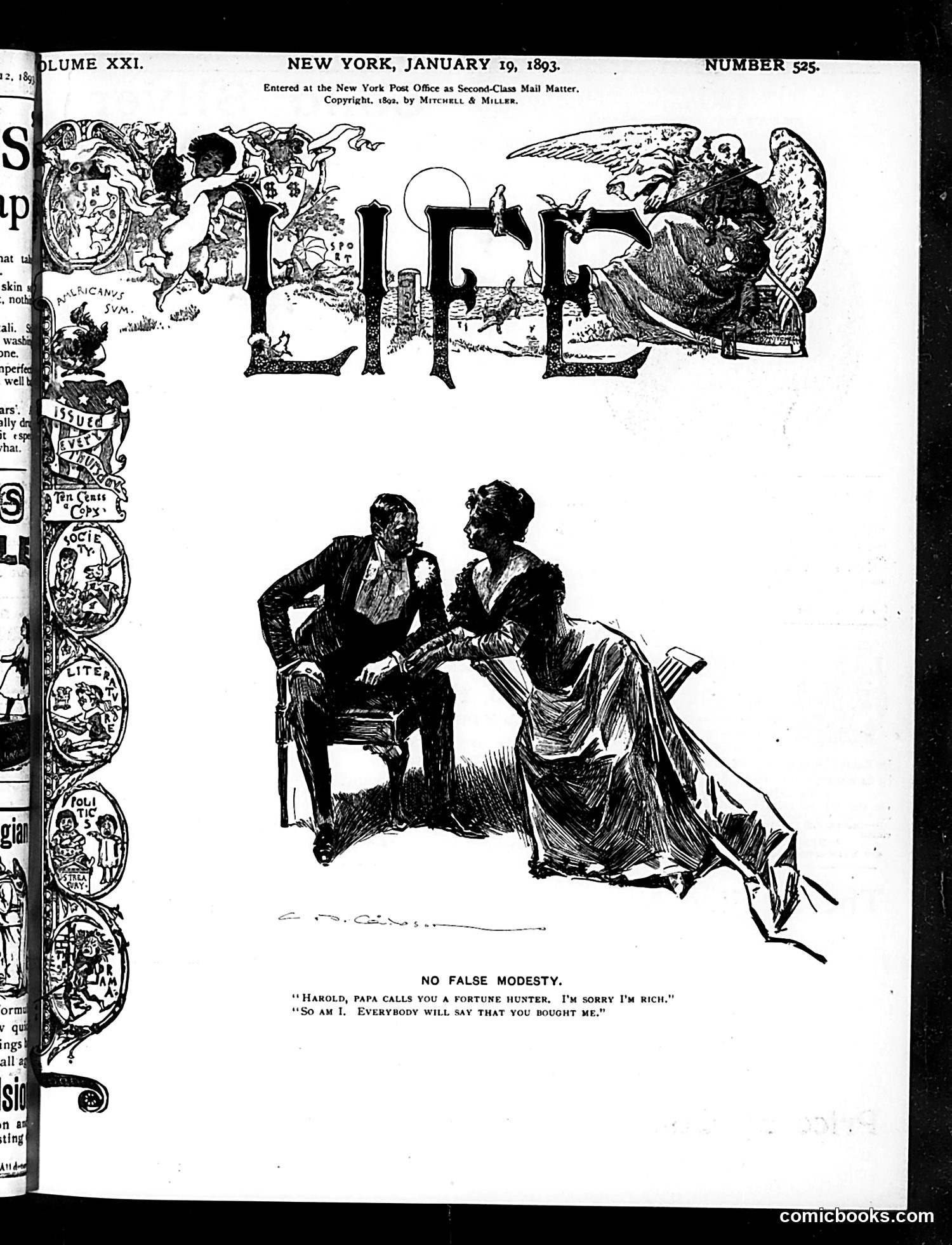
This cartoon satirizes a wealthy man's contradictory claims about his riches. The dialogue reveals the joke: "Harold, Papa calls you a fortune hunter. I'm sorry I'm rich" / "So am I. Everybody will say that you bought me." The satire targets the social hypocrisy of the wealthy regarding marriage and money. Harold protests he's not a fortune hunter while simultaneously admitting he benefits from the woman's wealth—and worse, that society will assume he married *for* that money anyway. The cartoon mocks the false modesty and transparent self-interest of gilded-age courtship, where financial motives were acknowledged yet denied. It's commentary on how wealth corrupted romantic pretense among the elite during the 1890s.
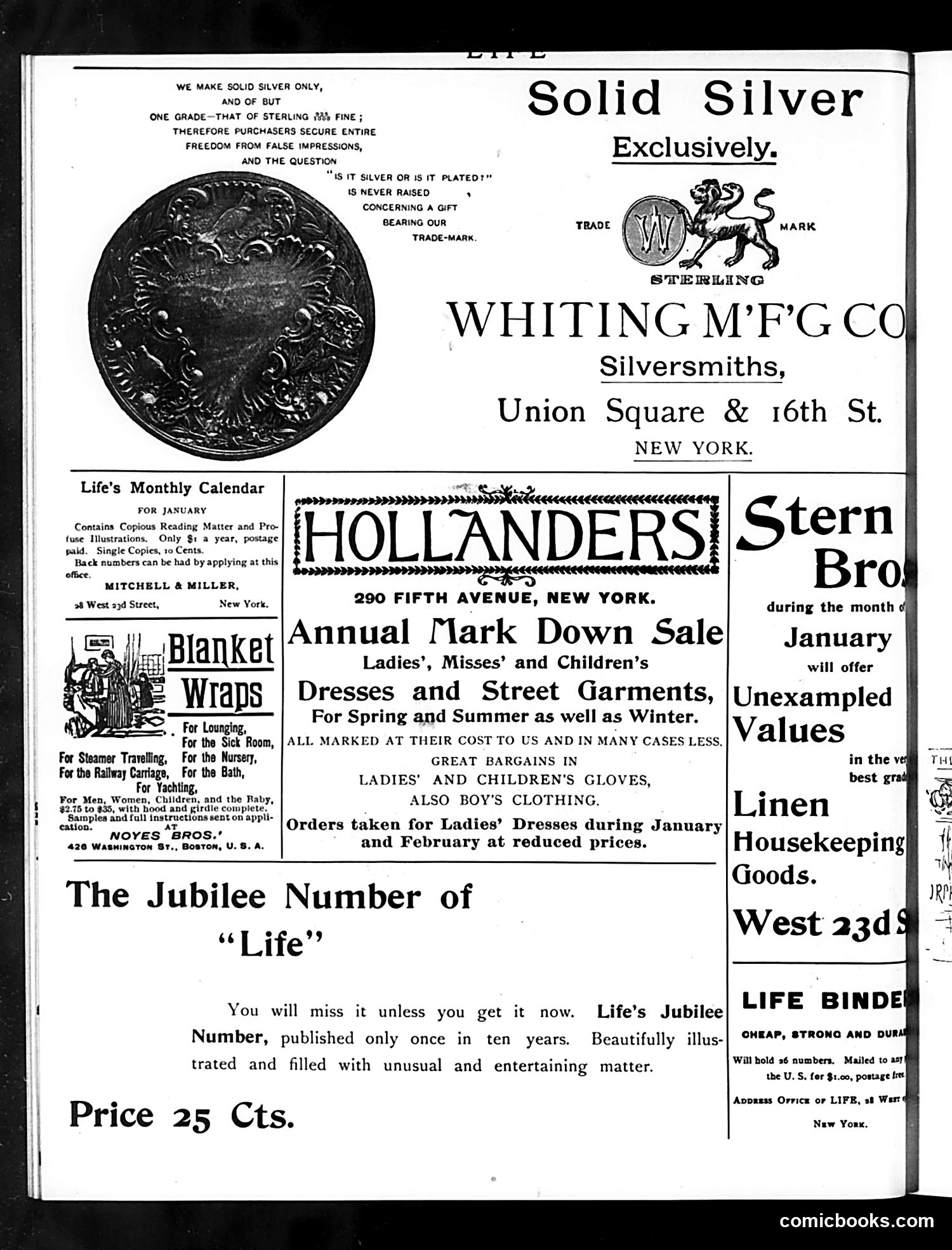
This page is **predominantly advertising** with no political cartoons or satirical content visible. The ads promote: - **Whiting M'fg Co**: Sterling silver goods, emphasizing solid silver (not plated) to avoid "false impressions" - **Hollanders**: A Fifth Avenue department store's annual markdown sale on women's and children's clothing - **Blanket Wraps**: Practical garments for various uses (travel, nursing, etc.) - **Stern Bro**: Linen housekeeping goods - **Life's Jubilee Number**: A special anniversary issue priced at 25 cents, published "once in ten years" The only potentially humorous element is the **Blanket Wraps ad**, which uses comedic illustrations of people in various domestic situations, but this is product marketing rather than political satire. This appears to be a standard magazine back page from Life's advertising section, circa early 1900s.
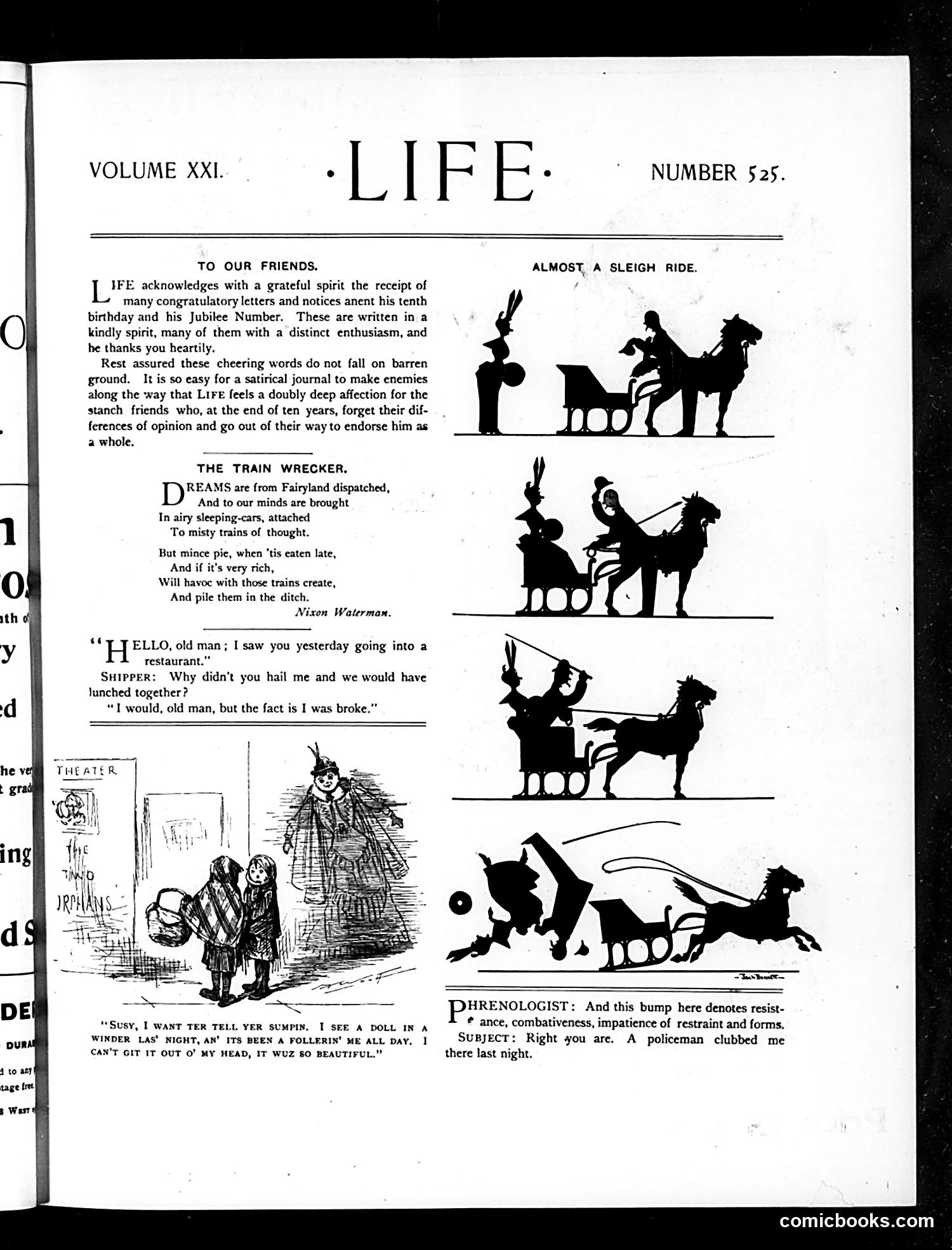
This page contains several humorous items typical of Life's satirical format: **"Almost a Sleigh Ride"** (right): A sequential comic strip showing a rabbit and person in a sleigh being progressively thrown off a galloping horse, culminating in a crash. The humor derives from the contrast between the genteel activity (sleigh riding) and the chaotic reality. **"The Train Wrecker"** (left): A poem by Nixon Waterman about destructive dreams, likely critiquing impractical idealism or dangerous fantasies. **Brief dialogues** include social humor (a man claiming poverty to avoid lunch, and a theater scene with working-class characters). **"Phrenologist" exchange** (bottom right): Mocks pseudoscientific phrenology while making a joke about police brutality—a policeman "clubbed" someone, demonstrating the "bump" for "resistance." The overall tone is light satire mixed with social observation.
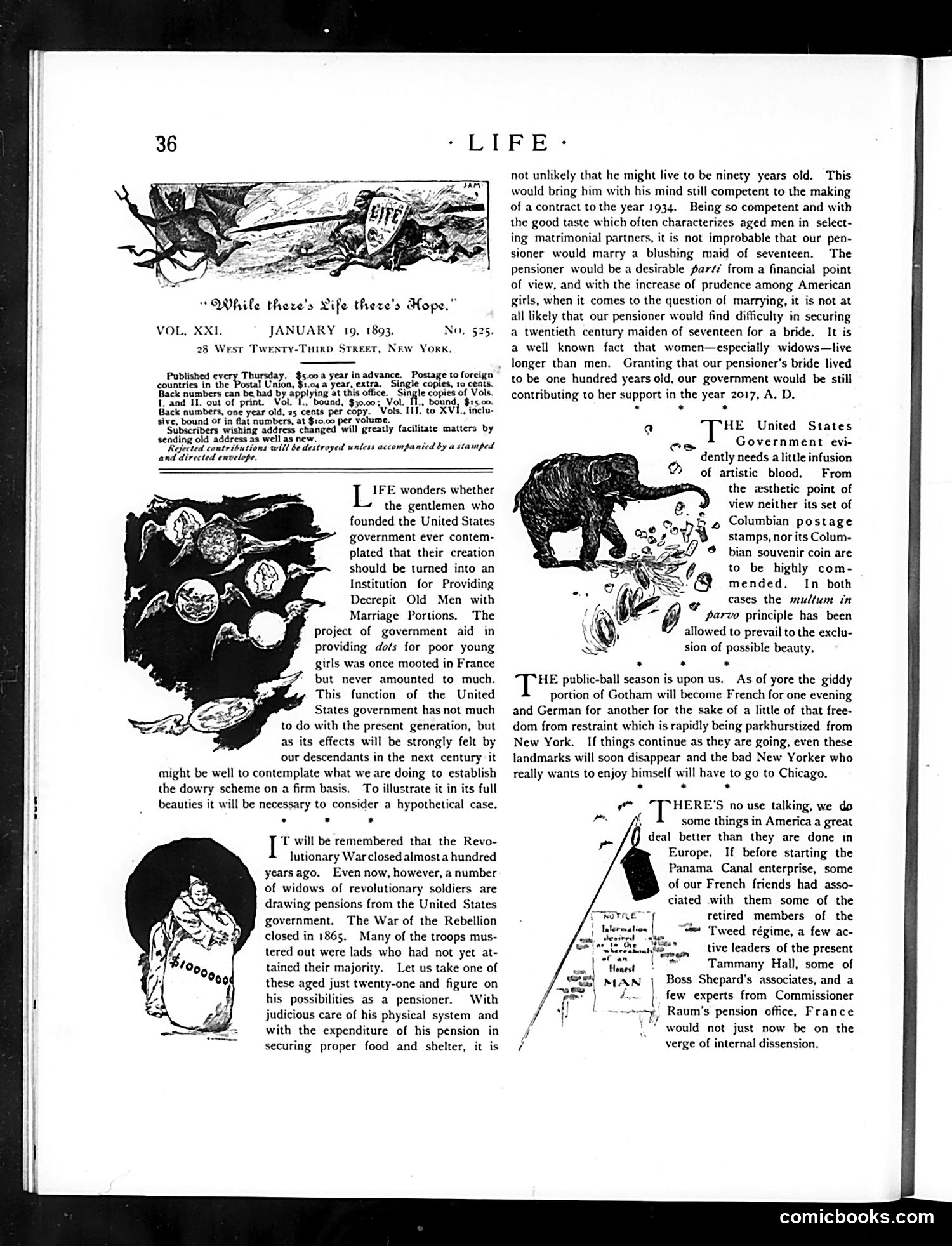
This satirical page critiques government inefficiency through multiple cartoons. The main article discusses establishing a "Decrepit Old Men with Marriage Portions"—a darkly humorous proposal for government pensions for aging Revolutionary War widows. The accompanying illustrations mock this idea: one shows an elderly man surrounded by coins, suggesting the absurdity of pensioning ancient soldiers; another depicts a rotund figure labeled with governmental associations. The text sarcastically questions whether America's founders intended the government to become a "distribution for Providing Decrepit Old Men with Marriage Portions," attacking what the editors view as wasteful pension spending to aging Civil War veterans still drawing from the Treasury decades after the war's 1865 conclusion.
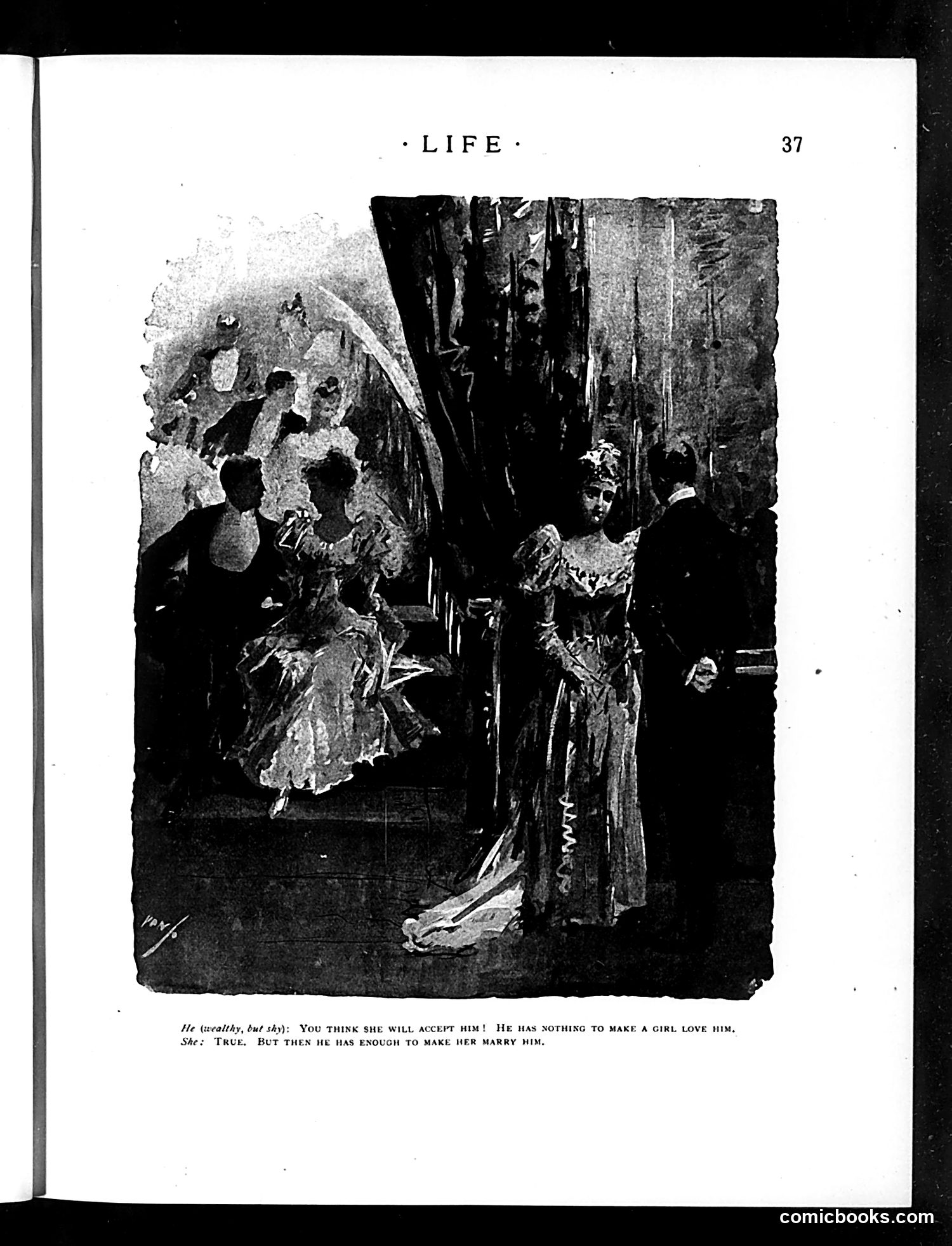
This page from *Life* magazine (page 37) depicts an elegant social scene at what appears to be a formal ball or high-society event. The illustration shows aristocratic figures in formal dress and elaborate gowns, with a woman in an ornate gown prominently featured. The caption presents a conversation between "He" and "She" about marriage and financial security. He argues the woman will accept a suitor because "he has nothing to make a girl love him," but she counters that "he has enough to make her marry him." The satire critiques marriage practices among the wealthy elite, suggesting that women of high society marry for money rather than love—a common theme in early 20th-century social commentary. The joke targets mercenary attitudes toward matrimony and the transactional nature of upper-class unions.
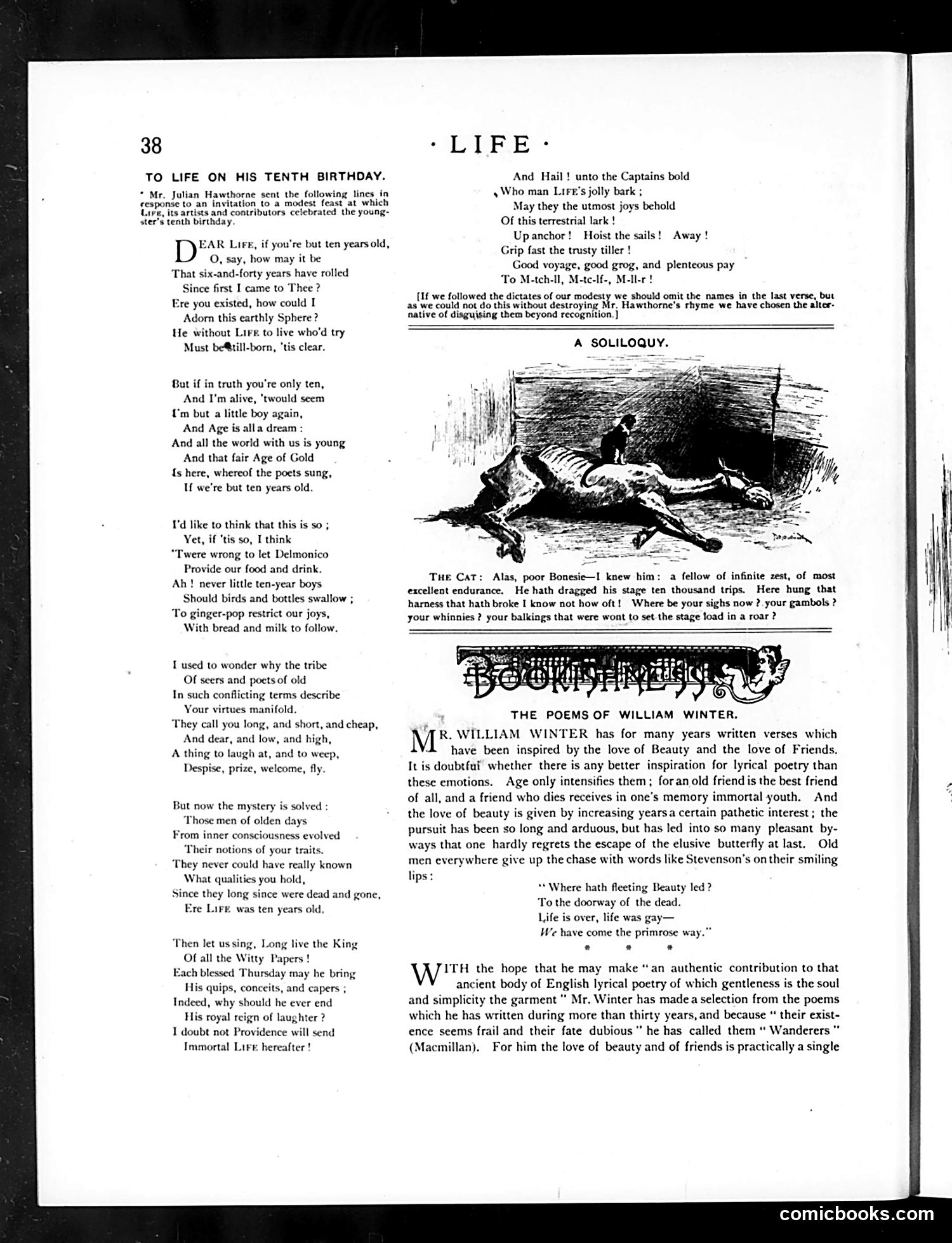
This page contains two distinct sections: **Left side:** A poem titled "To Life on His Tenth Birthday" — a humorous verse celebrating a young person's tenth birthday, reflecting on childhood's brevity and the passage of time. **Right side:** "A Soliloquy" — an illustration showing a cat lying down, accompanied by satirical text personifying the cat as "Bonesie," a worn-out stage horse. The joke appears to be a mock-tragic monologue where the exhausted cat compares itself to an overworked theatrical performer, complaining about its demanding career ("ten thousand trips") and asking where its promised retirement has gone. It's a clever anthropomorphic satire on animal labor and unfulfilled promises. The page also includes an introduction to William Winter's poems about beauty and friendship.
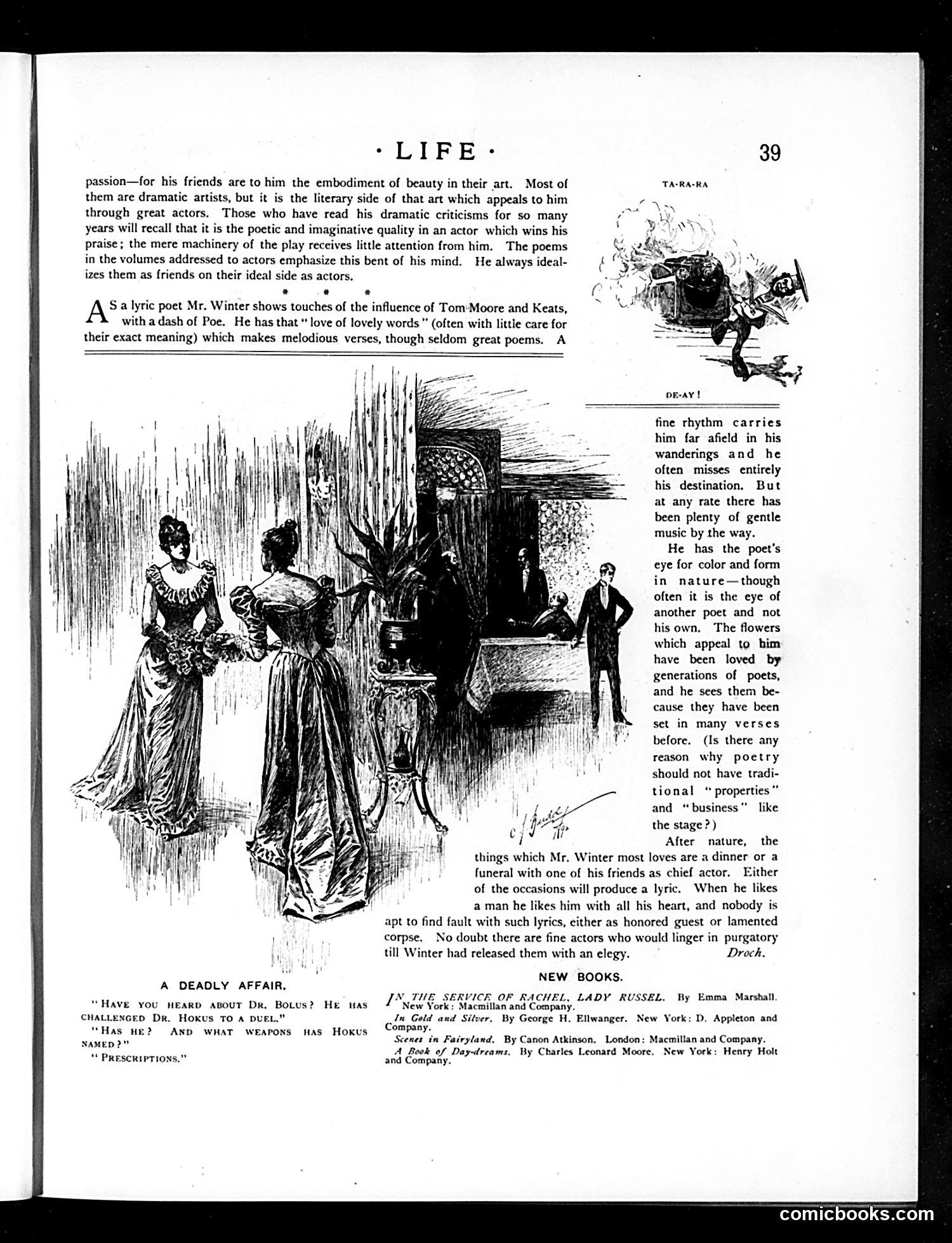
This page discusses William Winter, a dramatic critic and lyric poet. The text praises his literary contributions to theater, noting his influence from Tom Moore and Keats, and his gift for melodious verses. The main illustration titled "A Deadly Affair" depicts an apparently dramatic scene with two women in Victorian dress and a man in formal attire. The caption references Winter's challenge to Dr. Hokus to a duel, asking "Has he? And what weapons has Hokus named? 'Proscriptions.'" The satire appears to mock Winter's critical authority—suggesting his weapon of choice is literary criticism ("proscriptions" meaning prohibitions or criticisms) rather than physical weapons. This jokes about the power of a critic's pen as his actual "duel" weapon. The page concludes with new book reviews, a standard magazine feature.
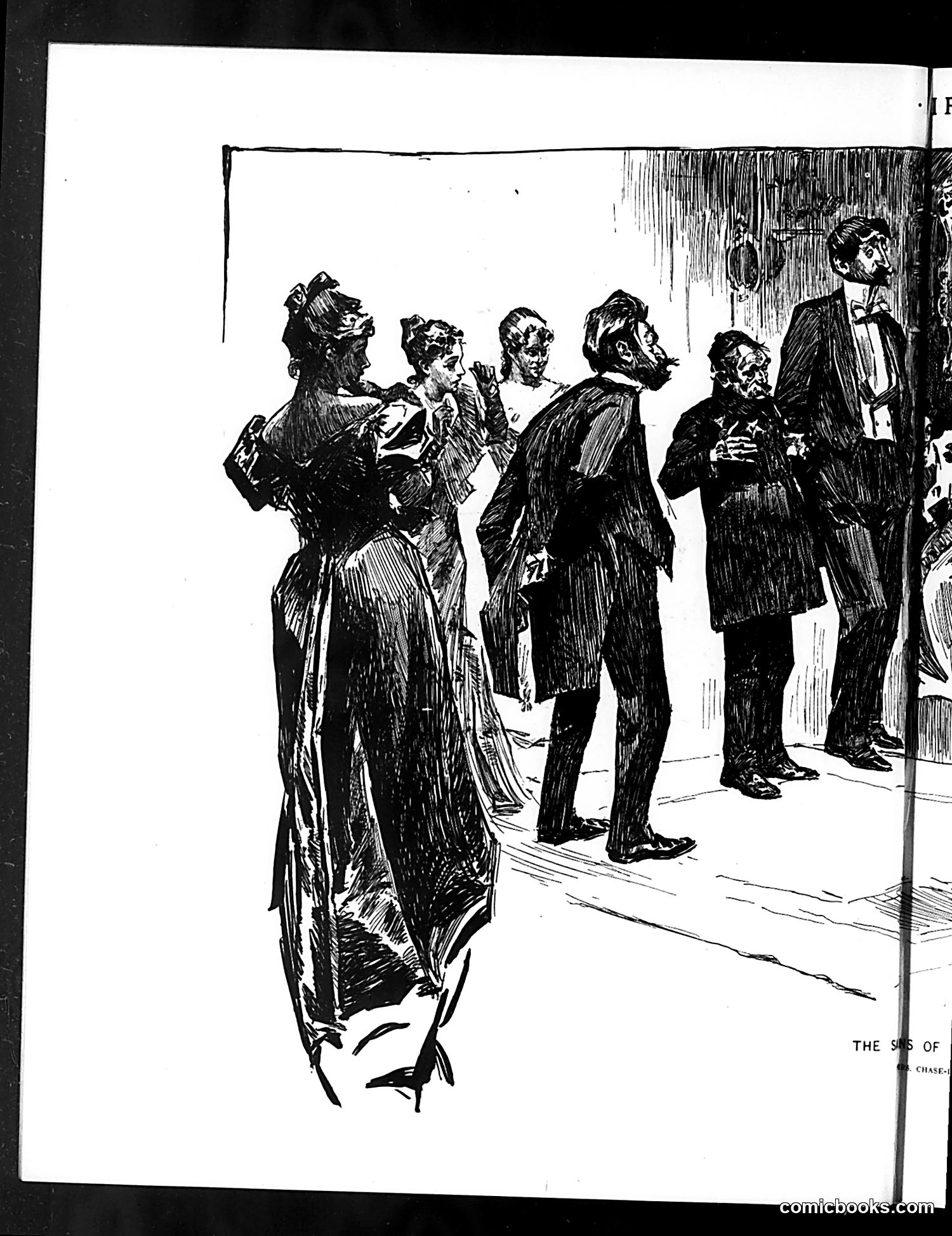
This sketch depicts a formal social gathering, likely at a diplomatic or high-society event. The drawing shows elegantly dressed men in formal attire (tuxedos) and a woman in an elaborate gown, rendered in pen-and-ink style typical of early 20th-century satirical illustration. The partial text visible ("THE SUS OF" and "CHASE") is incomplete, making the specific satirical target unclear. Without the full caption or title, I cannot identify which political figures or social situation is being lampooned. The scene suggests commentary on upper-class social pretense or formal diplomatic interactions, but the exact point of satire—who these figures represent and what behavior is being criticized—remains uncertain without additional context from the complete article text.
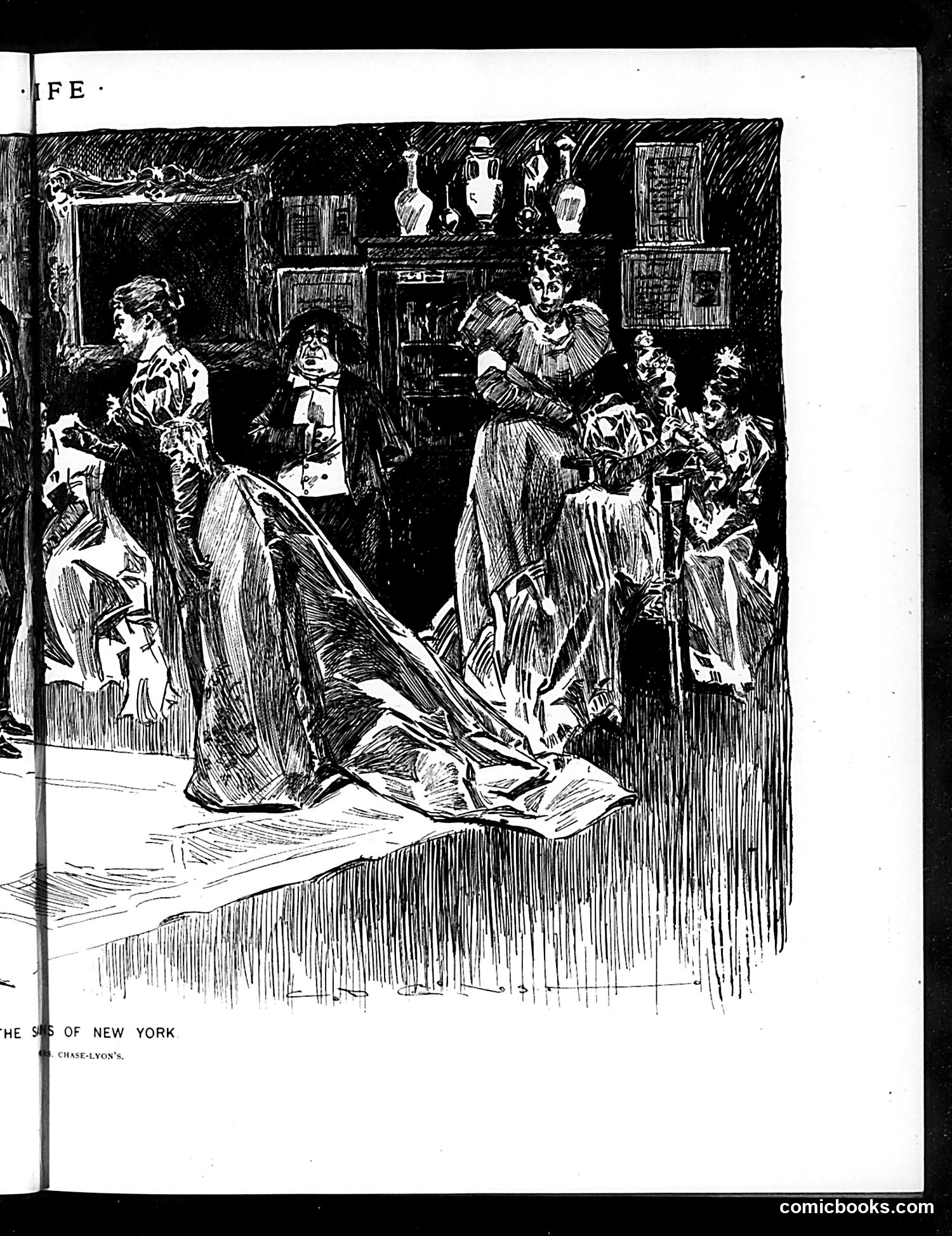
This page from *Life* magazine features an illustration titled "The Sis of New York" credited to Chase-Lyon's. The sketch depicts an interior domestic scene with elegantly dressed women in Edwardian-era clothing gathered in what appears to be an affluent drawing room. The central figure, seated prominently, wears an elaborate gown with a large collar. The piece appears to be social satire focused on upper-class New York society women—their fashions, mannerisms, and social interactions. The detailed interior with decorative objects on shelves suggests wealth. However, without additional context or caption text visible on the page, the specific satirical point regarding "the sis" (sisterhood? a particular social type?) remains unclear. The sketch likely mocked contemporary society figures or social pretensions of the era.
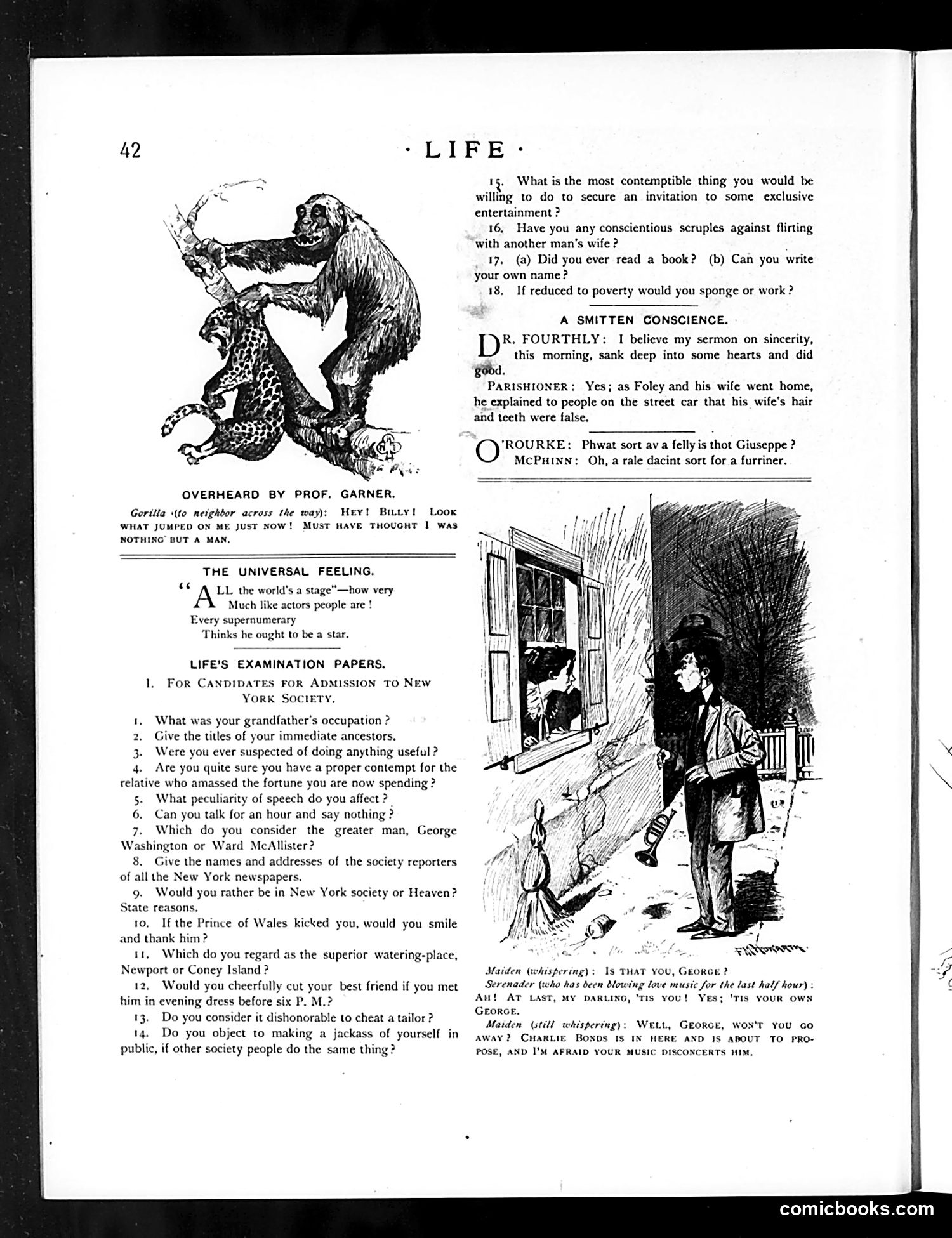
The page contains two satirical sections: 1. **"Overheard by Prof. Garner"**: A cartoon showing a gorilla and bulldog fighting, captioned with the gorilla saying it "must have thought I was nothing but a man." This appears to satirize contemporary debates about animal behavior and human nature—possibly referencing popular discussions about animal intelligence or evolutionary theory. 2. **"Life's Examination Papers"**: A mock questionnaire for New York high society admission, featuring absurdist questions (e.g., "Would you rather be in New York society or Heaven?"). The humor targets wealthy elites' pretensions and social climbing. 3. **"A Smitten Conscience"**: A dialogue scene with an illustration showing the interaction between characters named Maiden, Serenader, and George, apparently satirizing romantic entanglements and social embarrassment. The overall tone mocks upper-class affectations and social conventions.
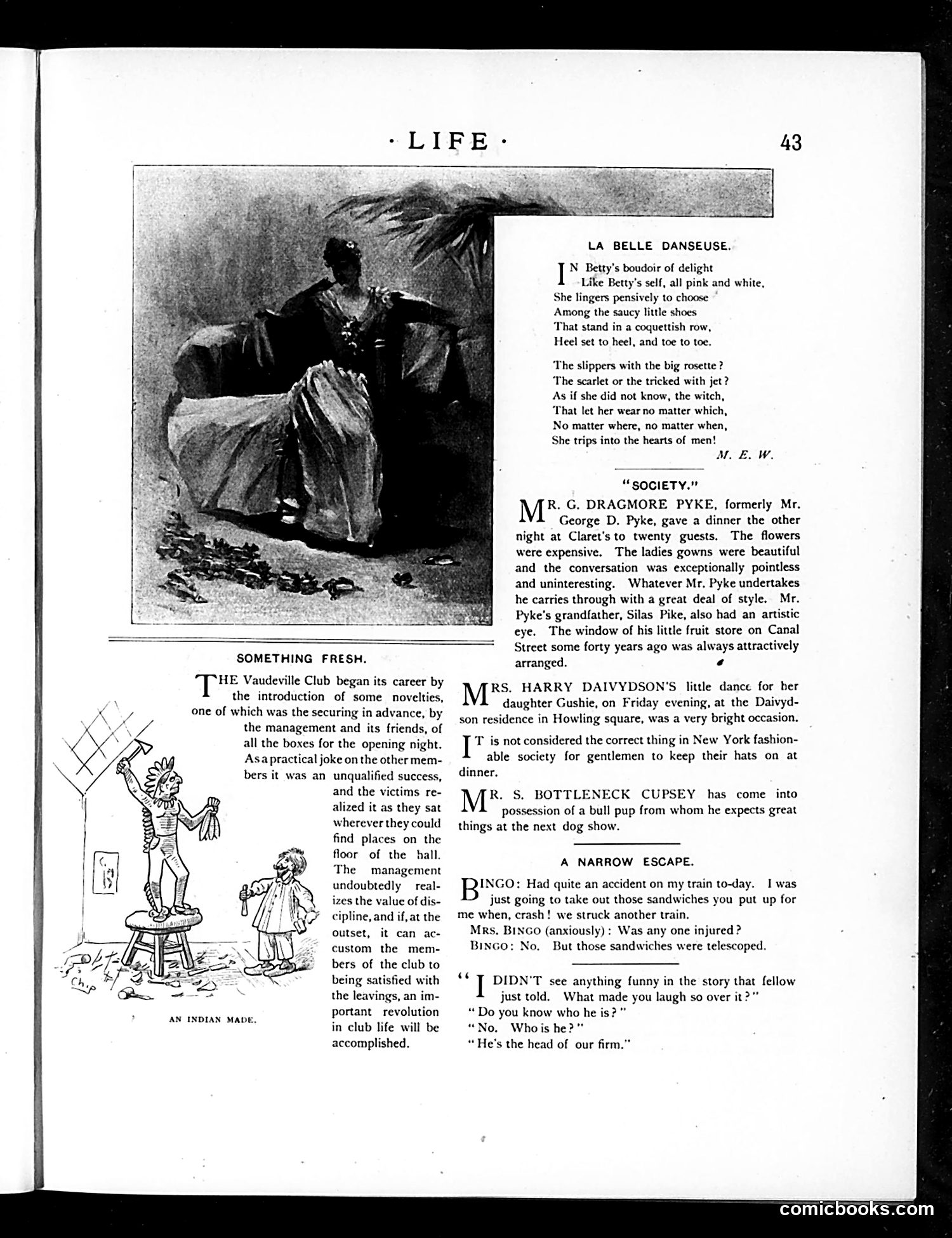
This untitled cartoon depicts a club or social venue where management has decided to entertain members with novelties. The joke centers on an "uncivilized" or "primitive" performance—the cartoon shows what appears to be a caricatured figure on a platform, with club members watching below. The satire mocks both the novelty-seeking behavior of wealthy club members and the era's casual racism and cultural appropriation. By billing this entertainment as "An Indian Made," the publication satirizes how elite social clubs presented "exotic" performances as curiosities for amusement, treating non-Western cultures as spectacle. The humor targets the club members' pretension and boredom rather than celebrating the entertainment itself—a critique of shallow fashionable society.
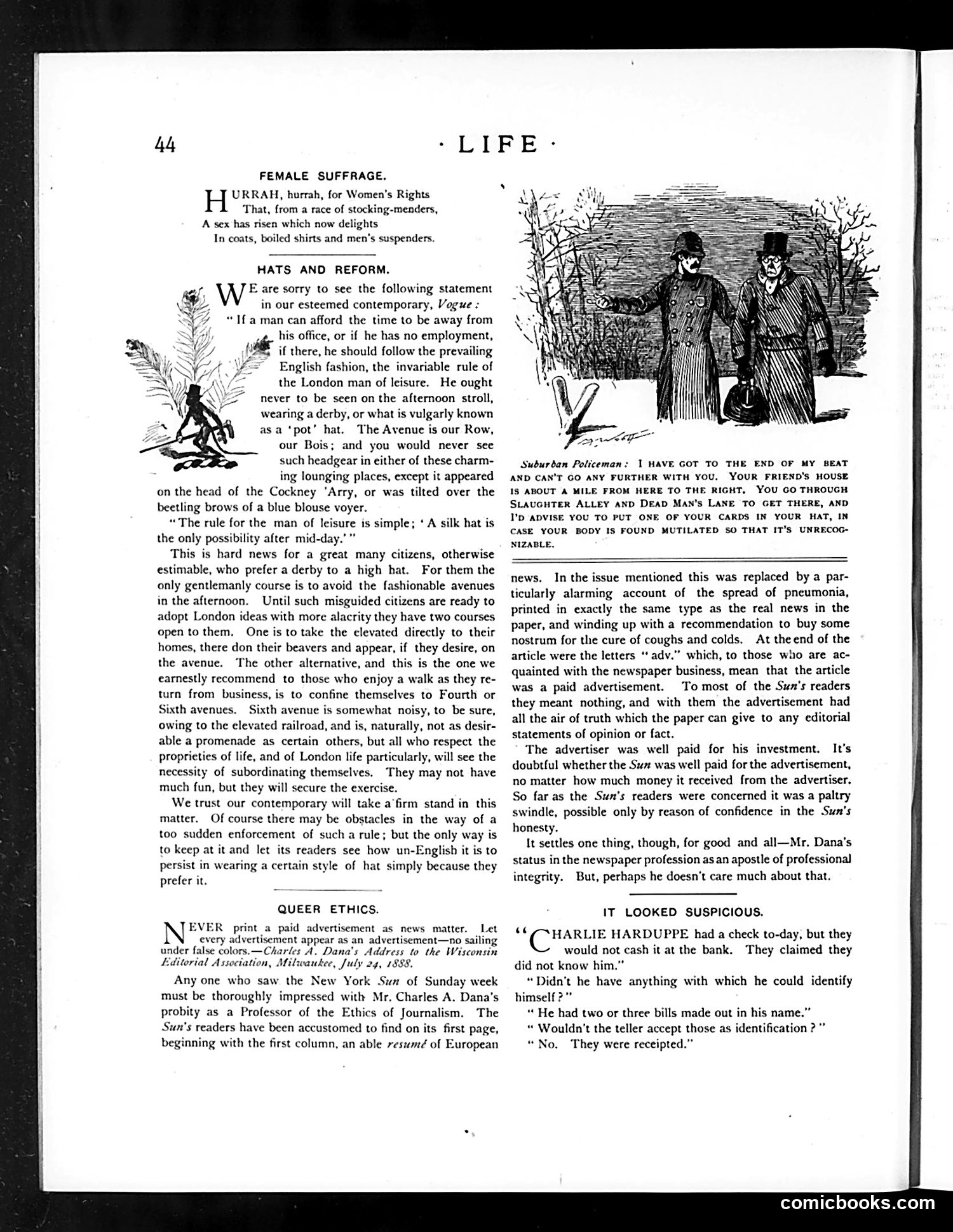
This page contains three distinct satirical pieces mocking contemporary issues: **"Female Suffrage"**: A brief poem ridiculing women's rights advocates, suggesting that women claiming equality has led them absurdly to adopt masculine clothing (coats, shirts, suspenders) rather than traditional "stocking-mending." **"Hats and Reform"**: Satirizes rigid class conformity by mocking *Vogue* magazine's pretentious insistence that gentlemen of leisure wear only silk hats after midday, never derbies. Life lampoons this arbitrary fashion rule as absurdly restrictive, sarcastically suggesting respectable citizens must avoid fashionable avenues unless properly hatted. **"Queer Ethics"**: Criticizes newspaper publisher Charles A. Dana's hypocrisy. Dana publicly preached that paid advertisements must be clearly labeled, yet his newspaper *The Sun* printed a pneumonia-cure advertisement in identical news-type format with only tiny "adv." letters—invisible to most readers—effectively disguising commercial content as genuine news. The page also includes an unrelated cartoon of a policeman directing someone through dangerous neighborhoods.
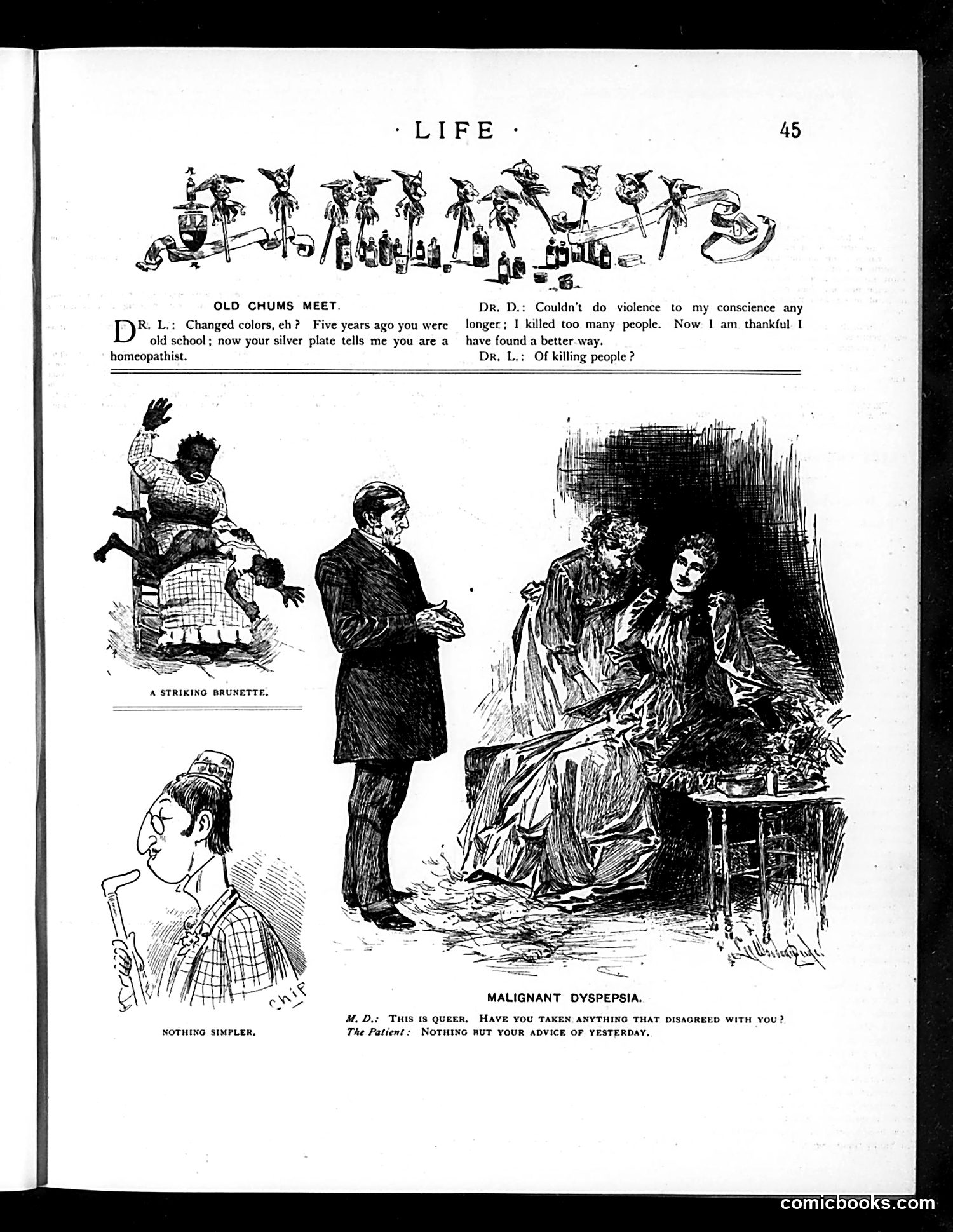
This page contains three satirical cartoons mocking the medical profession circa early 1900s. **"Old Chums Meet"** depicts two doctors reuniting. One has switched from traditional medicine to homeopathy (a pseudo-scientific practice using extreme dilutions). The joke: the first doctor sarcastically notes his colleague's conversion, suggesting homeopathy is so ineffective it's almost non-violent compared to conventional medicine's harmful treatments. **"A Striking Brunette"** (upper left) uses visual pun—a fashionable woman literally "strikes" poses. **"Malignant Dyspepsia"** shows a doctor visiting a patient with digestive problems. The patient blames the doctor's own previous medical advice as the cause—a joke about doctors giving harmful prescriptions that create new ailments. The overall theme satirizes late 19th/early 20th-century medicine's questionable practices and the irony that doctors often caused more harm than good, whether through aggressive conventional treatment or worthless alternative medicine.
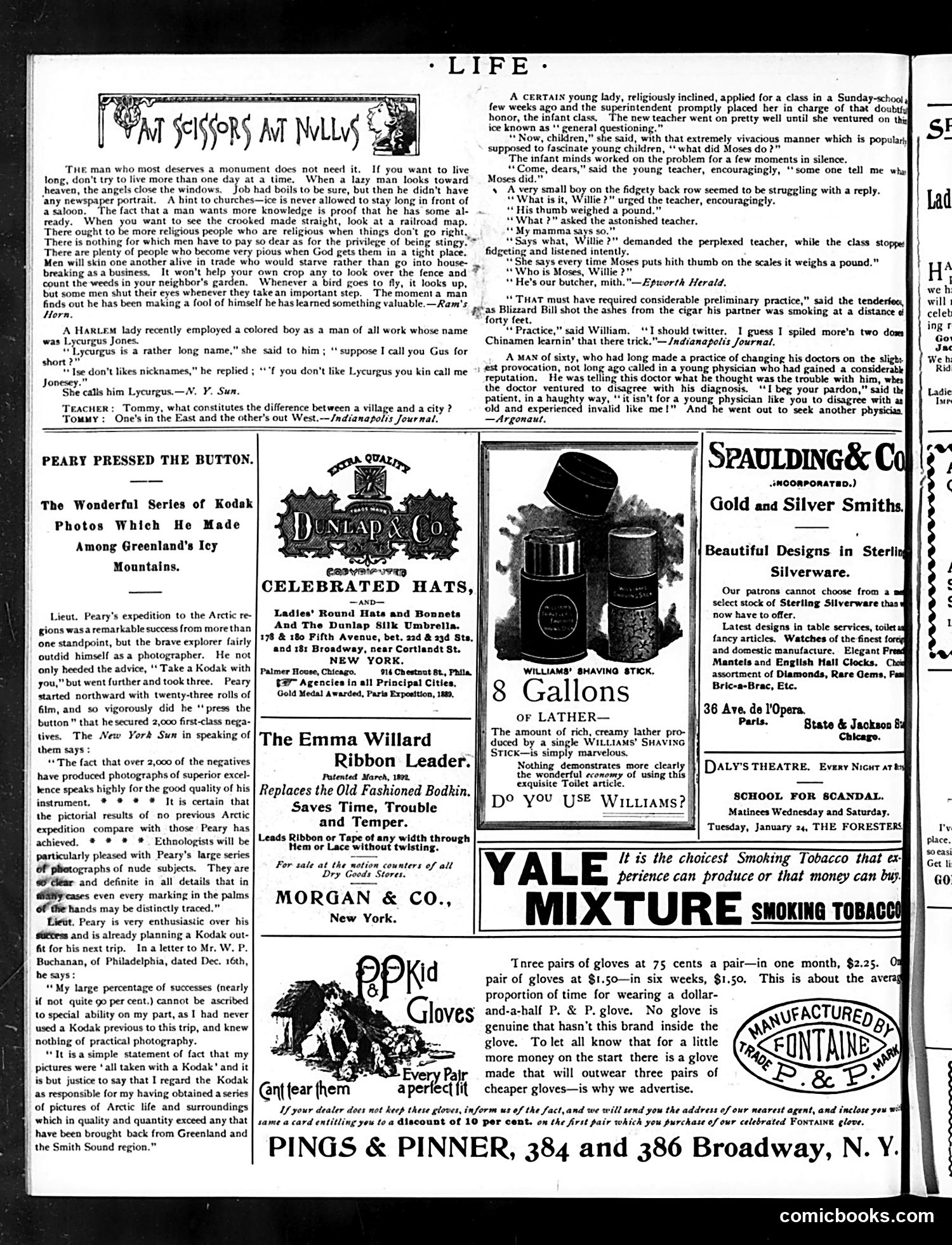
This page is primarily **advertising and humor miscellany** rather than political cartooning. The content consists of: **Main Features:** - A title section called "Scissors at Nullus" featuring brief aphorisms and anecdotes - Several short humorous stories, including: a joke about a colored boy named Lycurgus Jones; a Sunday school teacher asking children about Moses (a child misunderstands, thinking of a butcher); and an anecdote about a patient disagreeing with his young doctor **The Satire:** The humor targets common social hypocrisies and human foibles—religious people who abandon faith when times are difficult, pretentious naming practices, educational misunderstandings, and the arrogance of elderly patients. There's gentle racial humor typical of the era regarding the servant "Lycurgus Jones." **Advertisements:** The page is dominated by period product ads (Kodak cameras, hats, silverware, gloves, tobacco) with ornamental typography. **Political Content:** None visible. This is light, domestic social satire reflecting turn-of-century American attitudes.
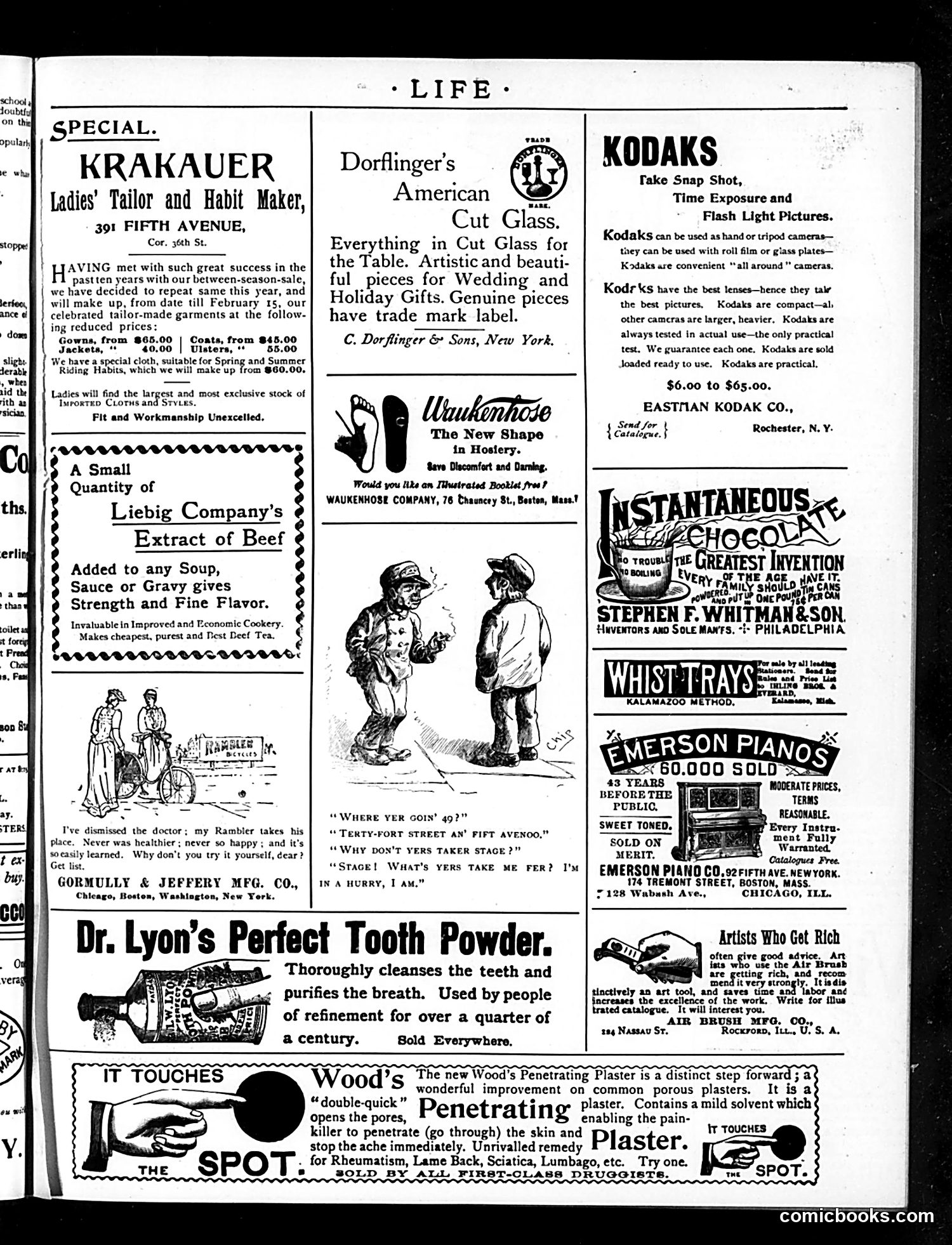
This is primarily an **advertising page** with one embedded cartoon. The single notable illustration depicts two working-class men in dialogue—one appears to be a taxi or carriage driver responding to a passenger's question about directions. The exchange uses heavy dialect humor: the passenger asks "WHERE YER GOIN'?" and the driver responds he's heading to "TERTY-FORT STREET AN' FIFT AVENOO" (42nd Street and Fifth Avenue), then dismisses the suggestion to take a stage coach, saying "STAGE! WHAT'S YERS TAKE ME FER? I'M IN A HURRY, I AM!" The joke plays on **class contrasts and transportation modernization**—the working-class character prefers his vehicle (likely a bicycle or early motorized transport) to the outdated stage coach, emphasizing efficiency and progress over traditional methods. This reflects early-1900s attitudes toward new transportation technology replacing horse-drawn services. The surrounding advertisements (dental powder, pianos, Kodaks, cut glass) are typical period marketing with no satirical content.
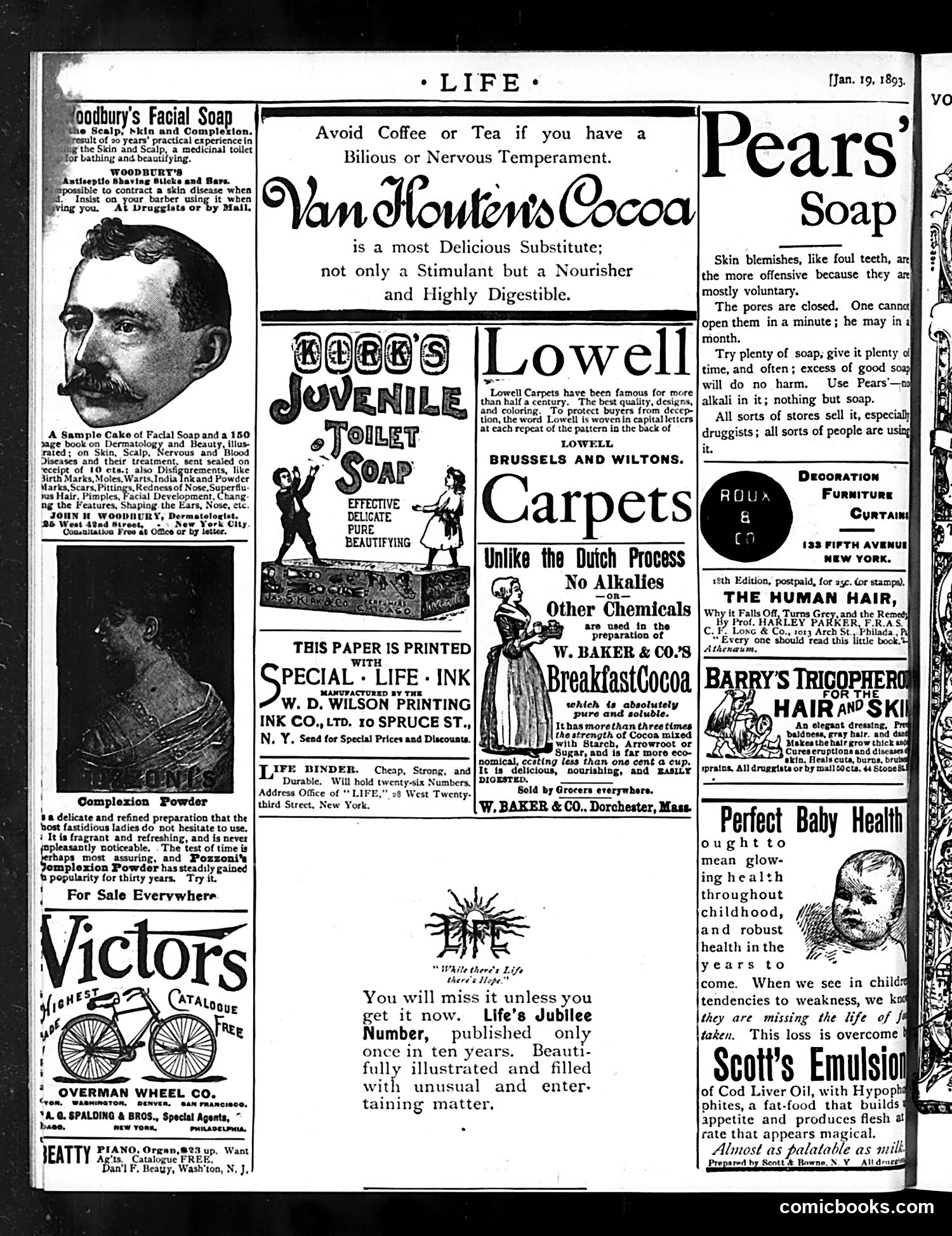
This page is primarily **advertising**, not satirical editorial content. It features Victorian-era patent medicines and consumer products typical of the 1890s. Notable ads include: - **Woodbury's Facial Soap** and **Pozzoni's Complexion Powder**: beauty products marketed to women, reflecting era anxieties about skin blemishes and appearance - **Van Houten's Cocoa**: positioned as a healthy alternative to coffee/tea for those with "bilious or nervous temperament"—revealing period beliefs linking digestion to mental health - **W. Baker & Co.'s Breakfast Cocoa**: emphasizes purity and lack of "alkalies or chemicals" - **Scott's Emulsion**: cod liver oil supplement for child health The ads reveal late-Victorian consumer culture and medical attitudes: patent remedies promised cures for vague ailments; appearance anxieties were heavily marketed to; and pseudo-scientific language ("alkalies," "digestible") legitimized products. The page includes two portrait photographs, likely of product endorsers, though their identities aren't specified.