
Life, 1893-01-19 · page 12 of 16
Life — January 19, 1893 — page 12: what you’re looking at
What you’re looking at
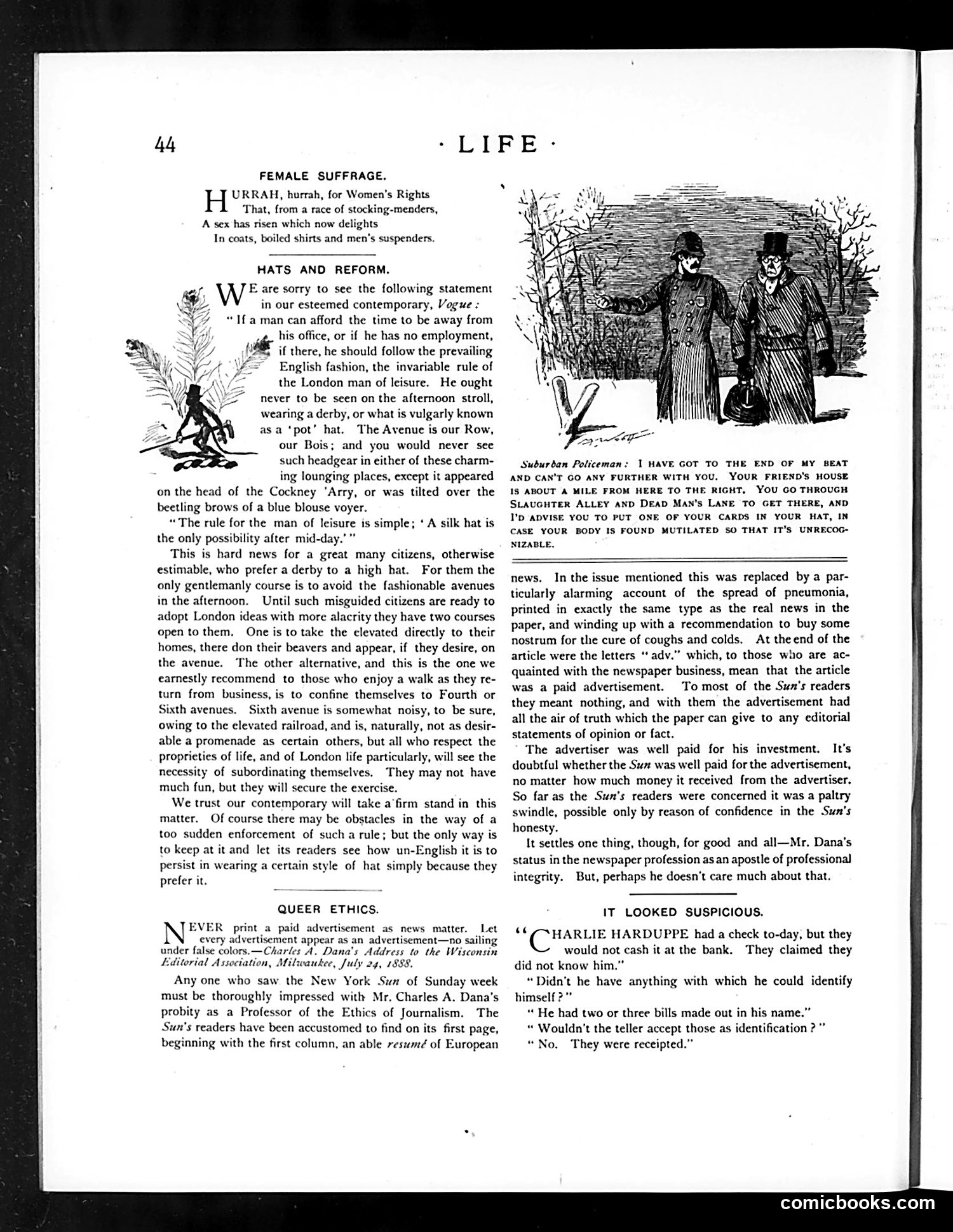
This page contains three distinct satirical pieces mocking contemporary issues: **"Female Suffrage"**: A brief poem ridiculing women's rights advocates, suggesting that women claiming equality has led them absurdly to adopt masculine clothing (coats, shirts, suspenders) rather than traditional "stocking-mending." **"Hats and Reform"**: Satirizes rigid class conformity by mocking *Vogue* magazine's pretentious insistence that gentlemen of leisure wear only silk hats after midday, never derbies. Life lampoons this arbitrary fashion rule as absurdly restrictive, sarcastically suggesting respectable citizens must avoid fashionable avenues unless properly hatted. **"Queer Ethics"**: Criticizes newspaper publisher Charles A. Dana's hypocrisy. Dana publicly preached that paid advertisements must be clearly labeled, yet his newspaper *The Sun* printed a pneumonia-cure advertisement in identical news-type format with only tiny "adv." letters—invisible to most readers—effectively disguising commercial content as genuine news. The page also includes an unrelated cartoon of a policeman directing someone through dangerous neighborhoods.
📄 Transcribed text from this page (OCR, searchable)
Machine-transcribed from the original scan — historical spelling and the odd misread are preserved.
FEMALE SUFFRAGE. I | URRAH, hurrah, for Women's Rights That, from a race of stocking-menders, A sex has risen which now delights In coats, boiled shirts and men’s suspenders. HATS AND REFORM. E are sorry to see the following statement in our esteemed contemporary, Vogue : “Ifa man can afford the time to be away from his office, or if he has no employment, ie if there, he should follow the prevailing English fashion, the invariable rule of the London man of leisure. He ought never to be seen on the afternoon stroll, wearing a derby, or what is vulgarly known asa ‘pot’ hat. The Avenue is our Row, our Bois; and you would never see such headgear in either of these charm- ing lounging places, except it appeared on the head of the Cockney ‘Arry, or was tilted over the beetling brows of a blue blouse voyer. “The rule for the man of leisure is simple; ‘A silk hat is the only possibility after mid-day.’ ” This is hard news for a great many citizens, otherwise estimable, who prefer a derby to a high hat. For them the only gentlemanly course is to avoid the fashionable avenues in the afternoon. Until such misguided citizens are ready to adopt London ideas with more alacrity they have two courses open to them, One is to take the clevated directly to their homes, there don their beavers and appear, if they desire, on the avenue. The other alternative, and this is the one we earnestly recommend to those who enjoy a walk as they re- turn from business, is to confine themselves to Fourth or Sixth avenues. Sixth avenue is somewhat noisy, to be sure, owing to the elevated railroad, and is, naturally, not as desir- able a promenade as certain others, but all who respect the proprieties of life, and of London life particularly, will see the necessity of subordinating themselves. They may not have much fun, but they will secure the exercise. We trust our contemporary will take a‘firm stand in this matter. Of course there may be obstacles in the way of a too sudden enforcement of such a rule; but the only way is to keep at it and let its readers see how un-English it is to persist in wearing a certain style of hat simply because they prefer it. QUEER ETHICS. EVER print a paid advertisement as news matter. Let every advertisement appear as an advertisement—no sailing under false colors. —Charles A. Dana's Address to the Wisconsin Editorial Association, Milwaukee, July 24, 1888. Any one who saw the New York Sun of Sunday week must be thoroughly impressed with Mr, Charles A. Dana's probity as a Professor of the Ethics of Journalism. The Sun's readers have been accustomed to find on its first page, beginning with the first column, an able reszemé of European Suburban Policeman: 1 HAVE GOT TO THE END OF MY BEAT AND CAN'T GO ANY FURTHER WITH YOU, YOUR FRIEND'S HOUSE 18 ABOUT A MILE FROM HERE TO THE RIGHT. YOU GO THROUGH SLAUGHTER ALLEY AND DEAD Man's LANE TO GET THERE, AND I'D ADVISE YOU TO PUT ONE OF YOUR CARDS IN YOUR HAT, IN CASE YOUR BODY IS FOUND MUTILATED SO THAT IT’S UNRECOG- NIZABLE, news. In the issue mentioned this was replaced by a par- ticularly alarming account of the spread of pneumonia, printed in exactly the same type as the real news in the paper, and winding up with a recommendation to buy some nostrum for the cure of coughs and colds. At theend of the article were the letters “adv.” which, to those who are ac- quainted with the newspaper business, mean that the article was a paid advertisement. To most of the Sun's readers they meant nothing, and with them the advertisement had all the air of truth which the paper can give to any editorial statements of opinion or fact. The advertiser was well paid for his investment. It’s doubtful whether the Su was well paid for the advertisement, no matter how much money it received from the advertiser. So far as the Sun's readers were concerned it was a paltry swindle, possible only by reason of confidence in the Sun's honesty. It settles one thing, though, for good and all—Mr. Dana's status in the newspaper profession asan apostle of professional integrity. But, perhaps he doesn’t care much about that. IT LOOKED SUSPICIOUS. *“ 7S HARLIE HARDUPPE had a check to-day, but they would not cash it at the bank. They claimed they did not know him.” “Didn't he have anything with which he could identify himself?" “ He had two or three bills made out in his name.” “ Wouldn't the teller accept those as identification ? ” “No. They were receipted.” comicbooks.com