
Life, 1893-01-19 · page 7 of 16
Life — January 19, 1893 — page 7: what you’re looking at
What you’re looking at
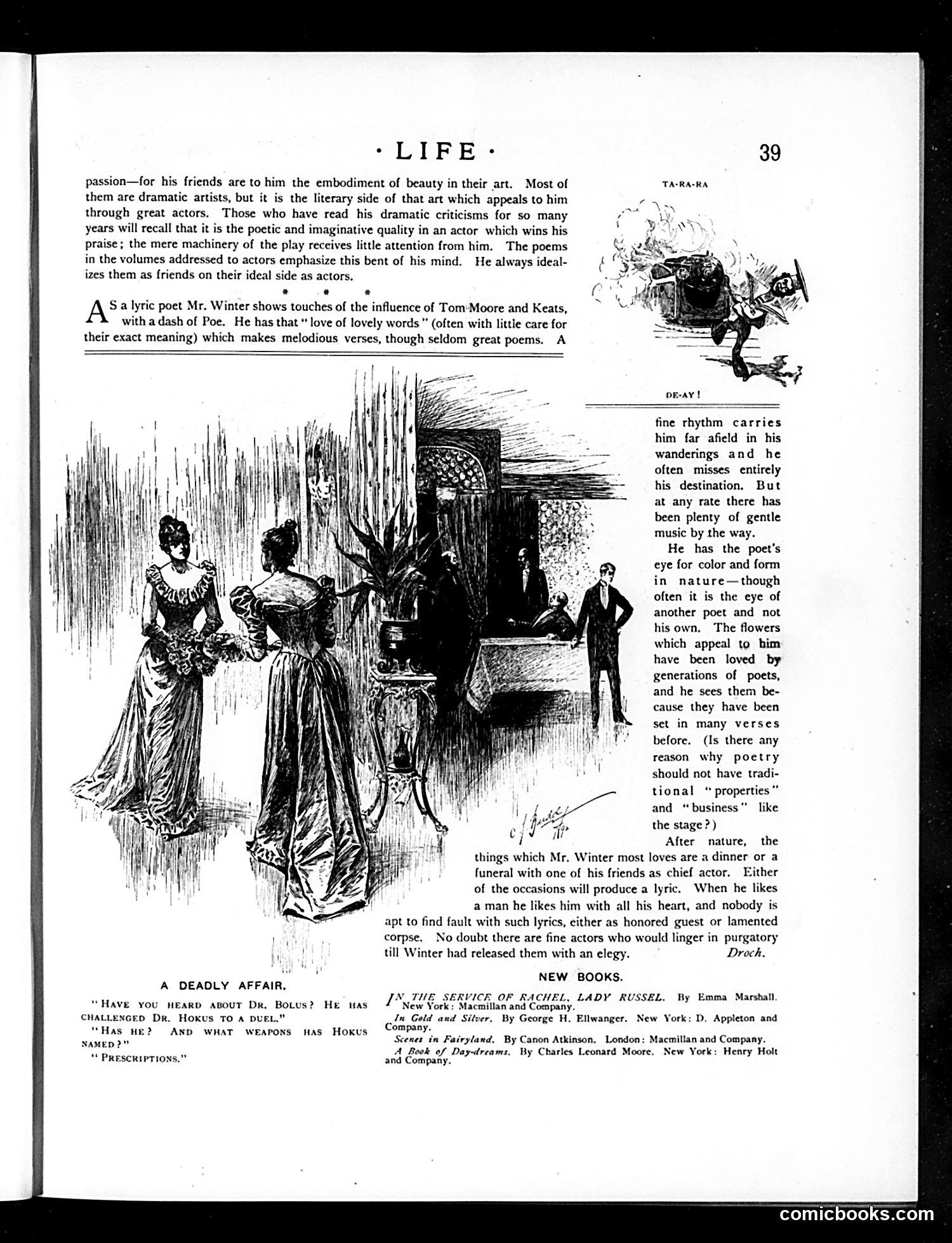
This page discusses William Winter, a dramatic critic and lyric poet. The text praises his literary contributions to theater, noting his influence from Tom Moore and Keats, and his gift for melodious verses. The main illustration titled "A Deadly Affair" depicts an apparently dramatic scene with two women in Victorian dress and a man in formal attire. The caption references Winter's challenge to Dr. Hokus to a duel, asking "Has he? And what weapons has Hokus named? 'Proscriptions.'" The satire appears to mock Winter's critical authority—suggesting his weapon of choice is literary criticism ("proscriptions" meaning prohibitions or criticisms) rather than physical weapons. This jokes about the power of a critic's pen as his actual "duel" weapon. The page concludes with new book reviews, a standard magazine feature.
📄 Transcribed text from this page (OCR, searchable)
Machine-transcribed from the original scan — historical spelling and the odd misread are preserved.
> LIFE: passion—for his friends are to him the embodiment of beauty in their art. Most of TA-RA-RA them are dramatic artists, but it is the literary side of that art which appeals to him through great actors. Those who have read his dramatic criticisms for so many years will recall that it is the poetic and imaginative quality in an actor which wins his praise; the mere machinery of the play receives little attention from him. The poems in the volumes addressed to actors emphasize this bent of his mind. He always ideal- izes them as friends on their ideal side as actors. * * * Sa lyric poet Mr. Winter shows touches of the influence of Tom:Moore and Keats, with a dash of Poe. He has that “ love of lovely words” (often with little care for their exact meaning) which makes melodious verses, though seldom great poems. A DR-AY! fine rhythm carries him far afield in his wanderings and he often misses entirely his destination, But at any rate there has been plenty of gentle music by the way. He has the poet's eye for color and form in nature—though often it is the eye of another poet and not his own, The flowers which appeal to him have been loved by generations of poets, and he sees them be- cause they have been set in many verses before. (Is there any reason why poetry should not have tradi- tional “ propertie: i aa and “business” like LW, the stage?) “] vil After nature, the things which Mr, Winter most loves are a dinner or a funeral with one of his friends as chief actor. Either of the occasions will produce a lyric. When he likes a man he likes him with all his heart, and nobody is apt to find fault with such lyrics, either as honored guest or lamented corpse, No doubt there are fine actors who would linger in purgatory till Winter had released them with an elegy. Droch. NEW BOOKS. [N THE SERVICE OF RACHEL, LADY RUSSEL. By Emma Marshall “HAVE you HEARD ABouT Dk, BoLus? He was New York: Macmillan and Company. CHALLENGED Dr. Hokus To A DUEL.” In Geld and Sitver, By George H. Ellwanger. New York: D. Appleton and “Has HE? AND WHAT WEAPONS Hokus Company. NAMED?” POWHAT WEAPONS HAS Scenes in Fairyland, By Canon Atkinson, London: Macmillan and Company. Bee A Book of Day-dreams, By Charles Leonard Moore, New York: Henry Holt PRESCRIPTIONS,” and Company. A DEADLY AFFAIR,