
A complete issue · 16 pages · 1892
Life — November 3, 1892
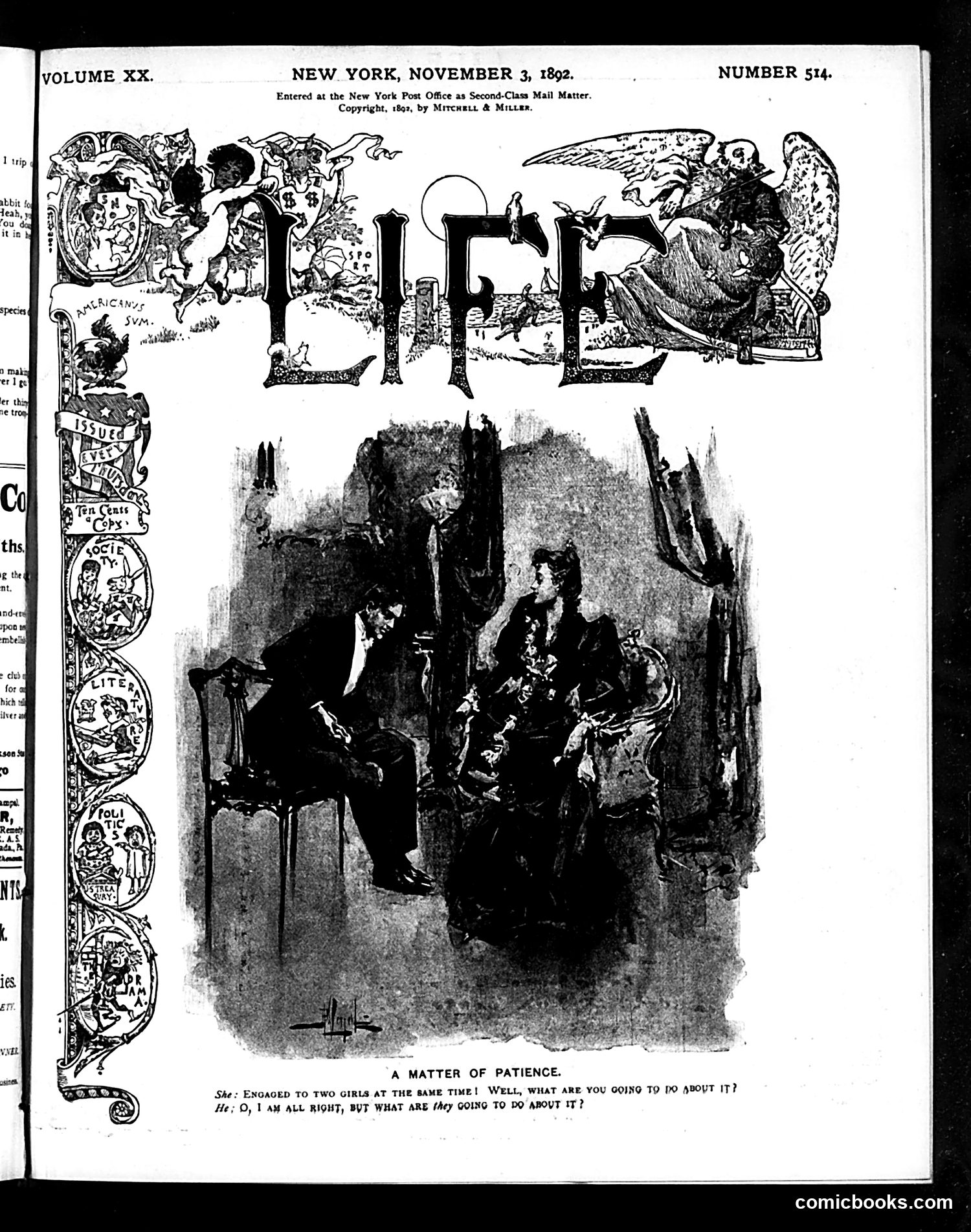
This cartoon depicts a domestic dispute over romantic attention. The caption reads: "She: Engaged to two girls at the same time! Well, what are you going to do about it? / He: O, I am all right, but what are they going to do about it!" The joke relies on Victorian-era anxieties about masculine deception and courtship. The man's casual confidence suggests he believes he can manage the situation through charm or evasion—a common satirical target in period comics mocking unreliable suitors. The woman's exasperation ("what are you going to do about it?") contrasts with his deflection ("what are *they* going to do?"), portraying him as irresponsible and dismissive of the consequences his duplicity will create for the jilted women involved.
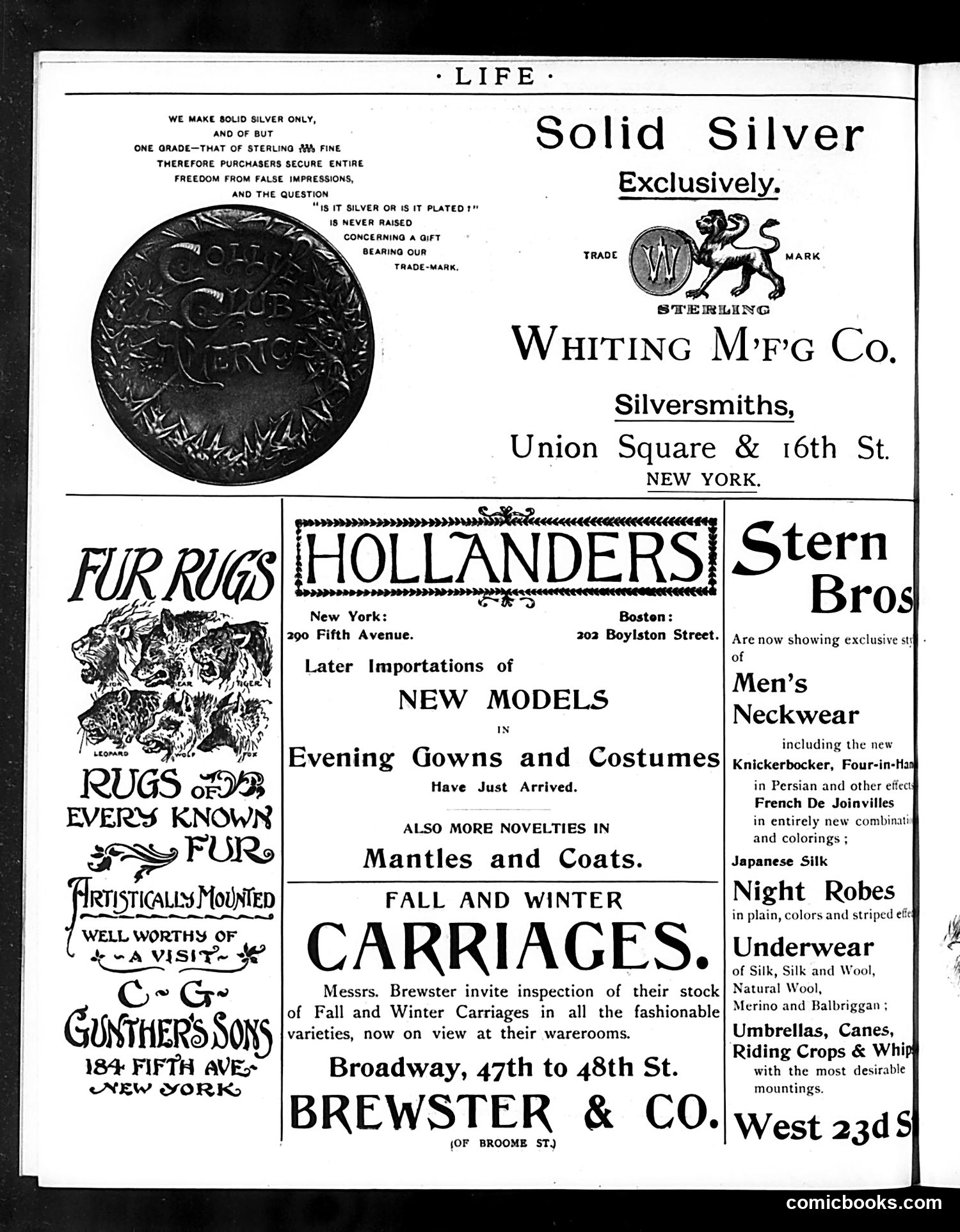
This page is primarily **advertising rather than satirical content**. It contains multiple commercial announcements typical of early 20th-century Life magazine: - **Whiting M'FG Co.** advertises sterling silver goods, emphasizing "solid silver exclusively" rather than plated items - **Hollanders** announces new imported evening gowns, costumes, mantles, and coats - **Brewster & Co.** promotes fall and winter carriages for fashionable clientele - **Stern Bros** showcases men's neckwear and accessories - **Gunther's Sons** advertises fur rugs The left side features decorative advertising copy for fur rugs with ornamental typography. There are **no political cartoons or satirical commentary** on this page—it represents straightforward commercial promotion aimed at wealthy New York consumers of the era.
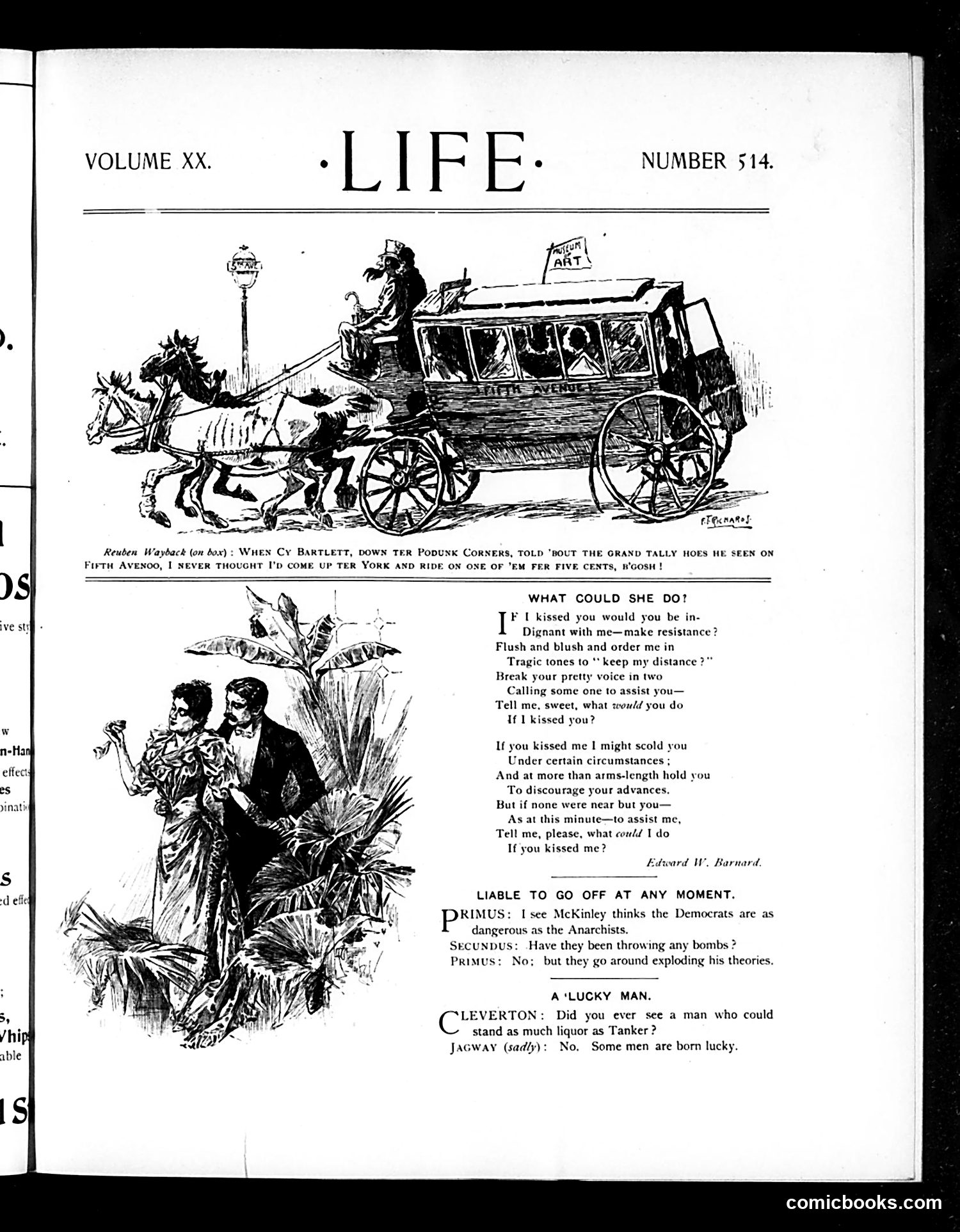
**Top Cartoon:** Depicts a horse-drawn wagon labeled "FINE ART" traveling through New York streets. The caption references Cy Bartlett encountering a "grand tally ho" on Fifth Avenue—apparently an unusual sight. This appears to satirize either the incongruity of rural/sporting imagery in urban Manhattan or possibly mocks pretentious displays of wealth and leisure activities among the wealthy. **Middle Section:** "What Could She Do?" is a humorous poem by Edward W. Barnard about a woman's dilemma if kissed—exploring social propriety and acceptable responses to romantic advances, reflecting early 20th-century concerns about proper female behavior and decorum. **Bottom Section:** Brief comic dialogue about McKinley Democrats, Anarchists, and a man's drinking capacity—likely contemporary political commentary, though specific references remain unclear.
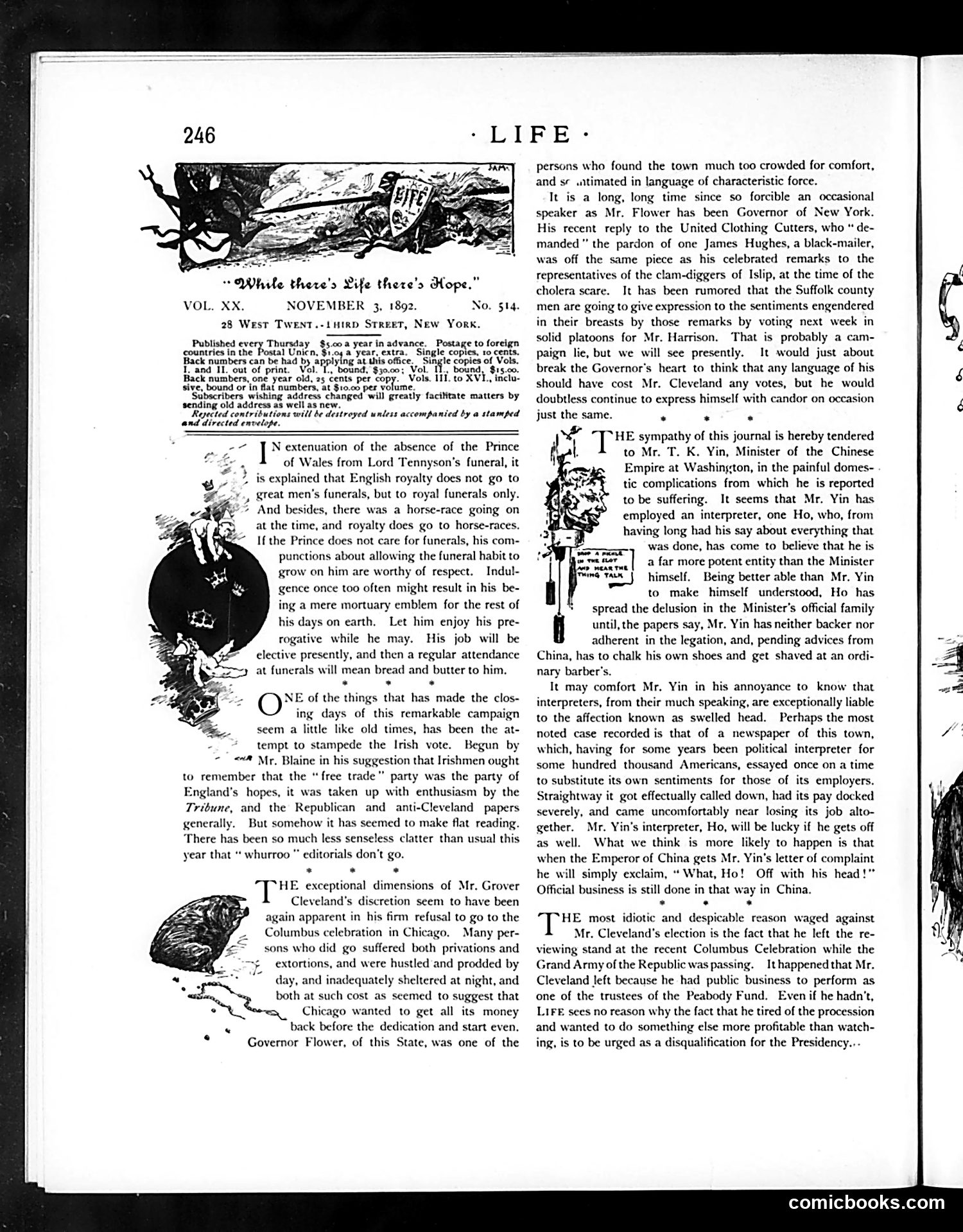
**Main Cartoon:** The top illustration captioned "While there's Life there's Hope" appears to be a political commentary, though the specific figures are unclear from the image alone. **Identified Content:** The page discusses several contemporary issues: 1. **Prince of Wales funeral etiquette** - Commentary on English royal protocols 2. **Mr. Grover Cleveland's discretion** - References Cleveland's refusal to attend Chicago's Columbus Celebration dedication, suggesting he prioritized private business (Peabody Fund trustee duties) over public appearances. The text argues this should disqualify him from the Presidency. 3. **Mr. T.K. Yin (Chinese Minister)** - Satirizes his reliance on interpreters and their influence over diplomatic matters. The satirical tone criticizes political figures' judgment and priorities during the 1892 election period.
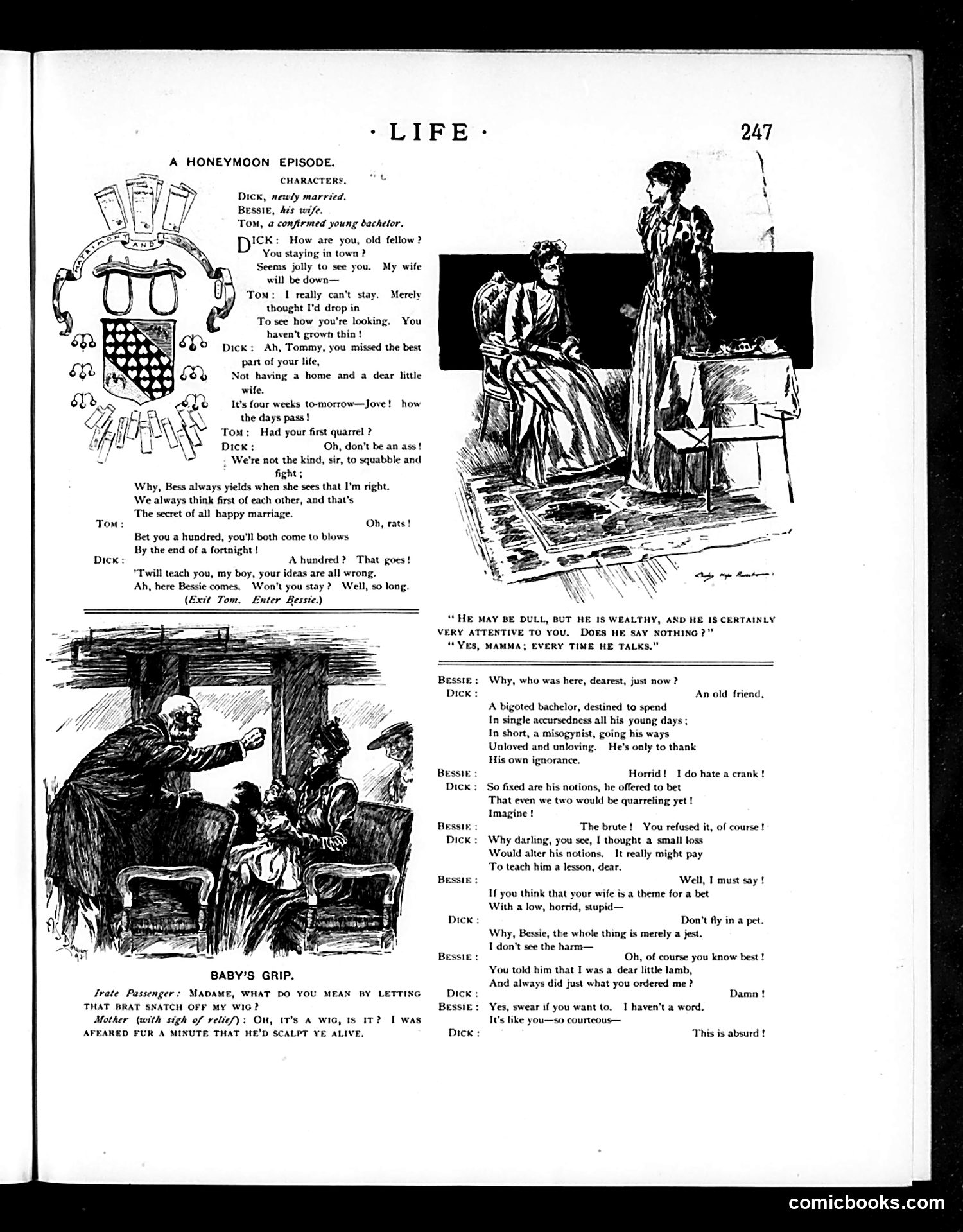
This page contains two theatrical sketches satirizing marriage and social behavior. **"A Honeymoon Episode"** depicts newlyweds Dick and Bessie with bachelor friend Tom. The humor centers on marital conflict: Dick warns Tom that marriage leads to quarrels, while Bessie defends her right to occasional disagreement. The satire mocks both the idealization of marriage and the reality of domestic discord—a recurring theme in early 20th-century humor. **"Baby's Grip"** shows an irate passenger confronting a woman about her child's behavior, using exaggerated dialect ("Madame, what do you mean by letting that young cub"). The joke targets both unruly children and permissive parenting—social anxieties about changing child-rearing practices. Both sketches use class signifiers and accent to enhance comedic effect, typical of period magazine humor.
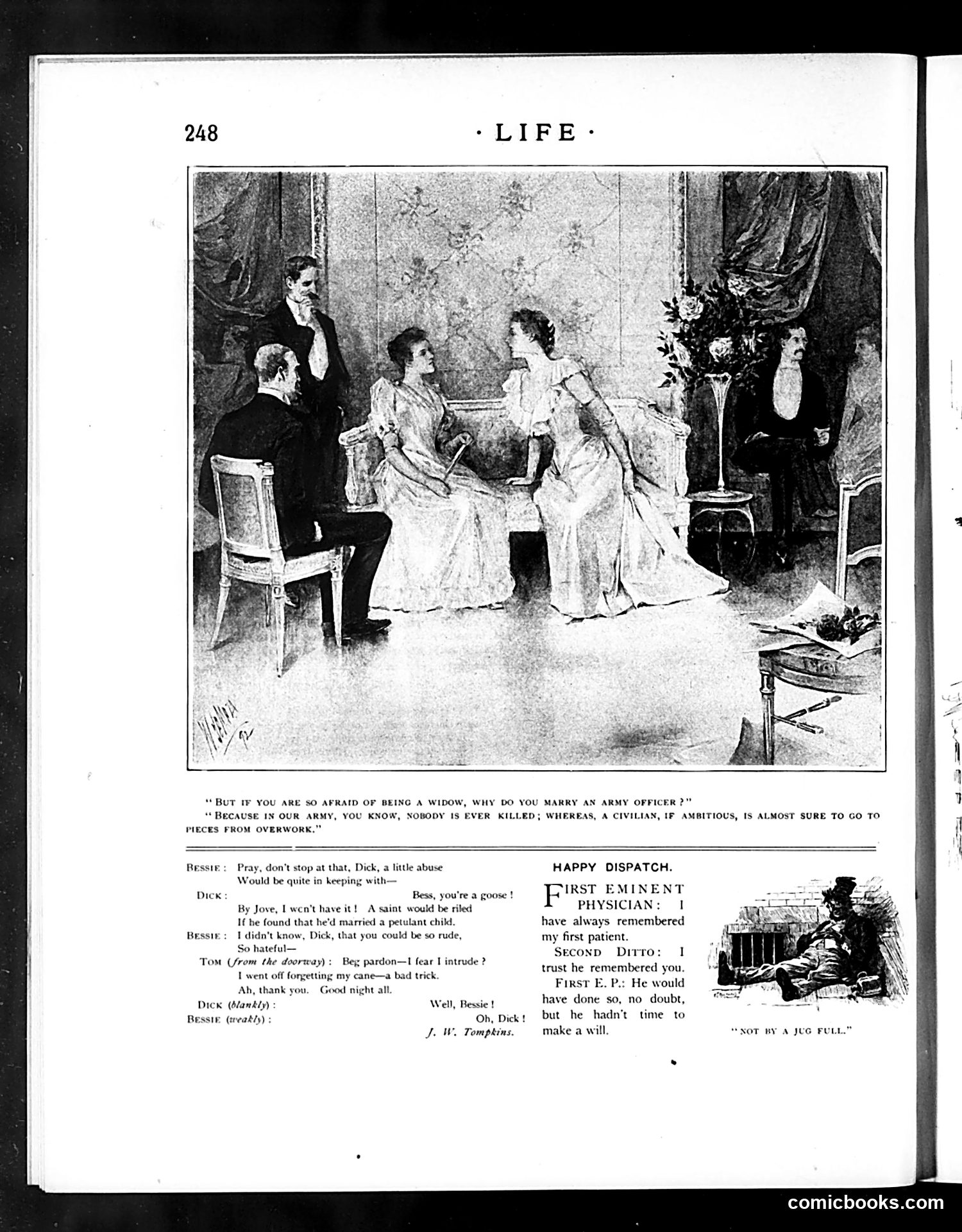
This page contains two separate satirical pieces: **Upper cartoon**: Depicts a social conversation where a woman expresses fear of becoming a widow, prompting discussion of marrying an army officer. The satire critiques military life—an officer's dialogue argues that soldiers face mortal danger ("nobody is ever killed"), while civilians pursuing ambition risk overwork and death. The joke inverts expectations: the "safe" civilian profession is actually more dangerous than military service. **Lower section ("Happy Dispatch")**: A brief comedic exchange between physicians. The humor centers on a doctor's first patient, with wordplay around medical memory and professional obligation—the first E.P. (unclear acronym) apparently didn't make a will, creating an ironic situation. Both pieces employ Victorian-era conversational humor typical of Life's satirical style.
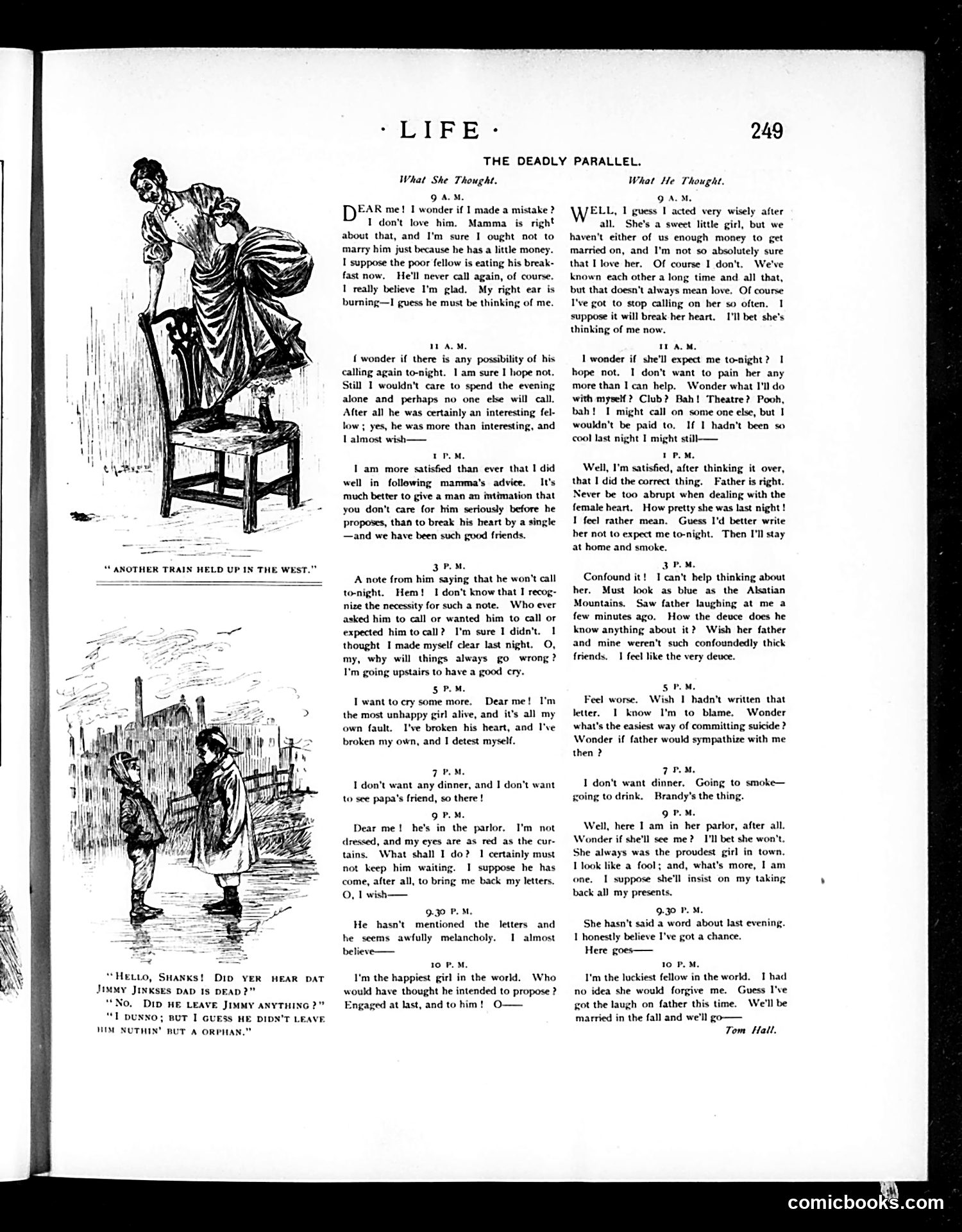
This page presents a satirical story contrasting a woman's and man's thoughts about a broken engagement. The two illustrations with dialogue show them experiencing the same situation from opposite emotional perspectives—she agonizes over hurting him and questions her decision, while he moves on relatively quickly, planning to marry in the fall. The satire targets gender stereotypes: women are portrayed as emotionally overwrought and self-blaming, while men are shown as pragmatic and resilient. The "deadly parallel" structure emphasizes the irony that despite identical circumstances, their internal lives diverge dramatically based on supposed gender nature. The lower illustrations appear unrelated anecdotal humor about other social situations. This reflects *Life* magazine's typical mix of satirical commentary on contemporary manners and relationships.
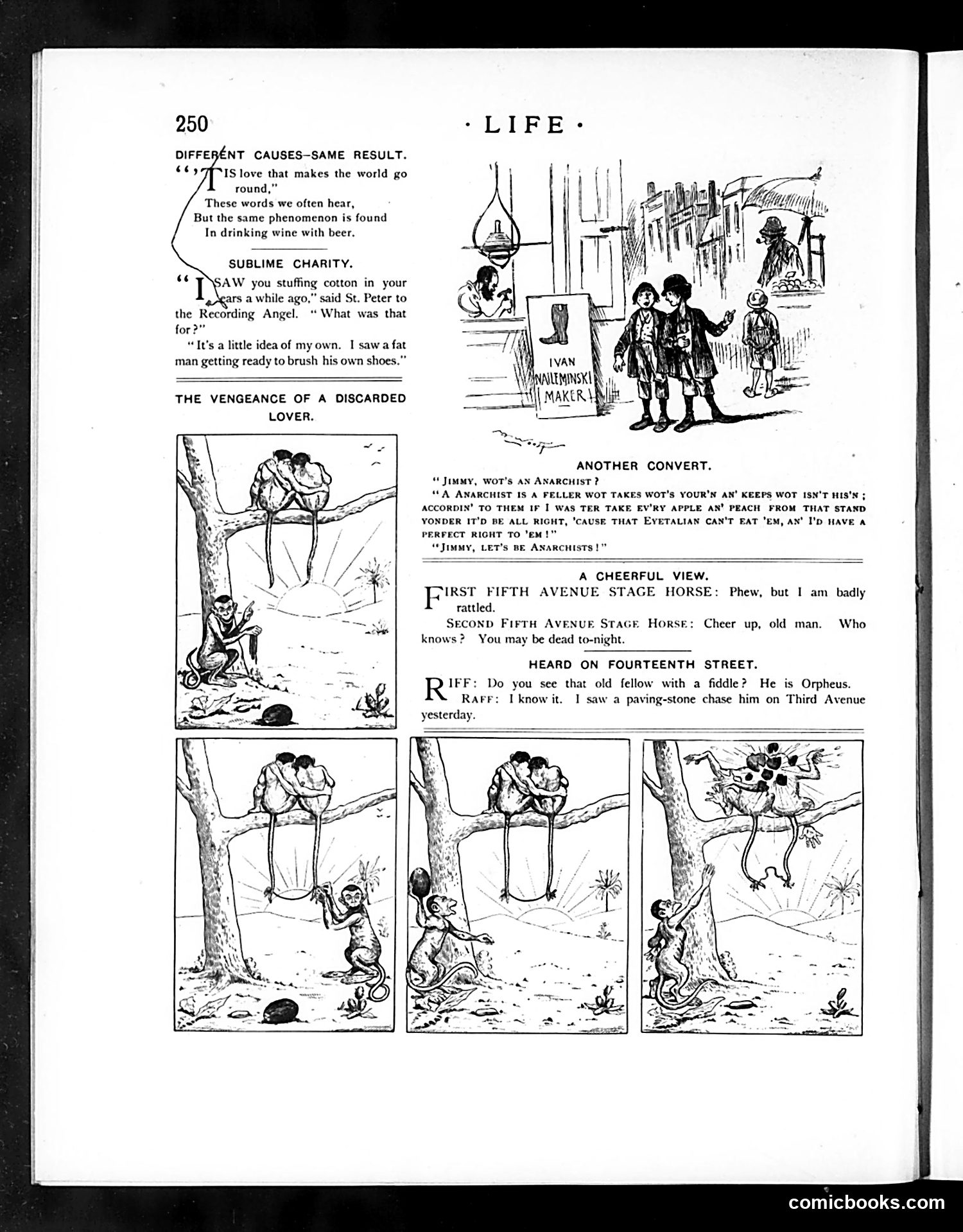
This page contains several unrelated humorous anecdotes and cartoons typical of Life's satirical format: **"Different Causes—Same Result"** mocks mixing wine and beer, attributed to a common saying. **"Sublime Charity"** jokes about a man observing someone brushing their shoes—presented as charitable observation to a "Recording Angel." **"The Vengeance of a Discarded Lover"** shows a comic strip about figures in a tree, likely depicting romantic betrayal through slapstick. **"Another Convert"** uses dialect humor about anarchism and property ownership—reflecting early 20th-century anxieties about radical ideology. **"A Cheerful View"** features stage horses' dark gallows humor about death. **"Heard on Fourteenth Street"** jokes about an impoverished fiddler ("Orpheus") being chased by police. The three-panel sequence shows children playing with hanging figures, appearing to depict innocent childhood games.
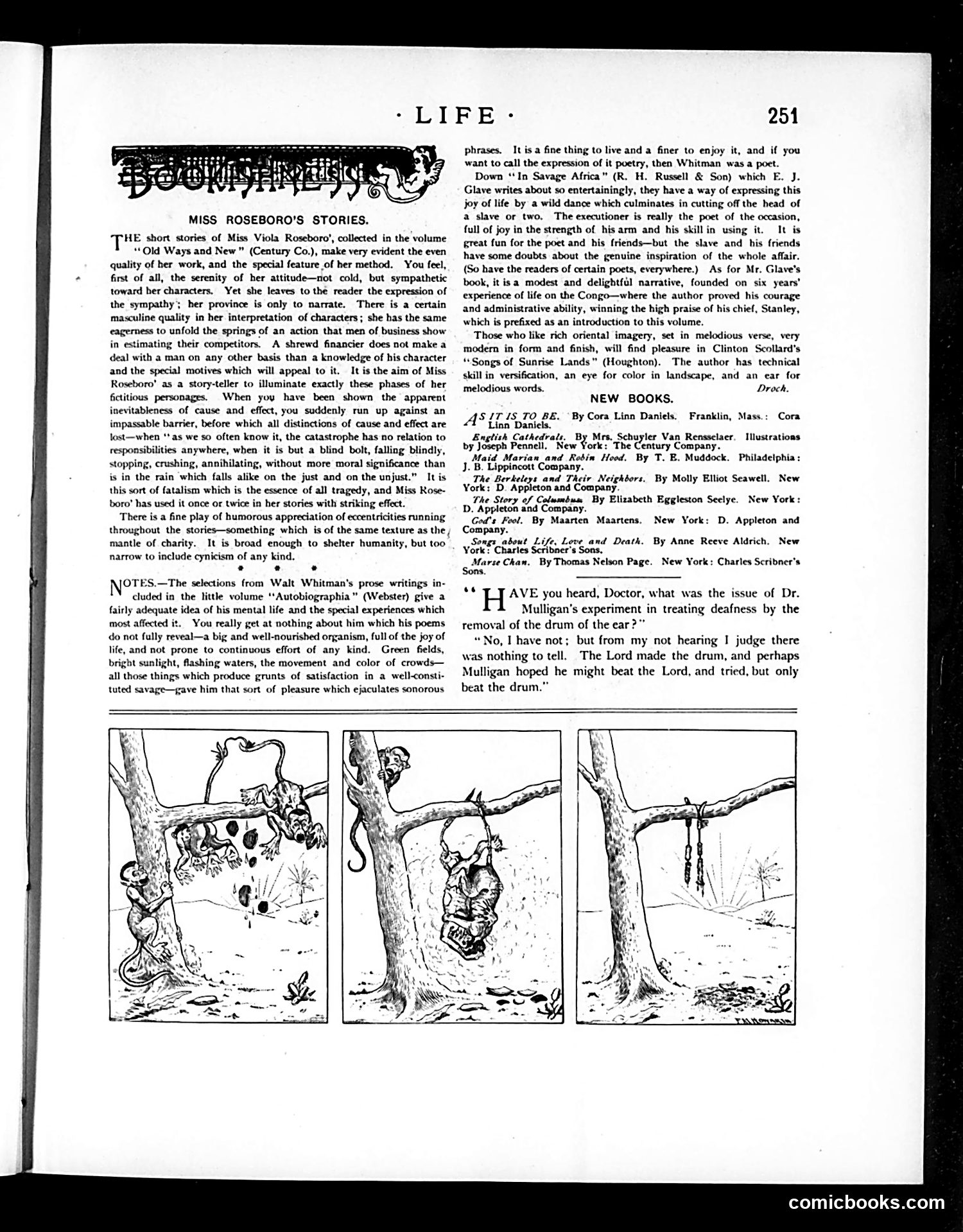
This page contains book reviews and a three-panel cartoon. The cartoon depicts a figure attempting increasingly desperate methods to remove a drum hanging from a tree branch—first juggling objects beneath it, then swinging on the branch, finally just standing before the bare tree. The accompanying text explains the joke: Dr. Mulligan conducted an experiment to cure drum-removal phobia by removing the drum itself, but only "beat the drum" instead. This is a pun-based joke playing on "beat" (to strike) versus the idiomatic "beat" (to overcome or solve). The cartoon illustrates the futility of the effort—showing escalating, absurd attempts that fail to solve the simple problem, likely satirizing overcomplicated or ineffective solutions to straightforward issues.
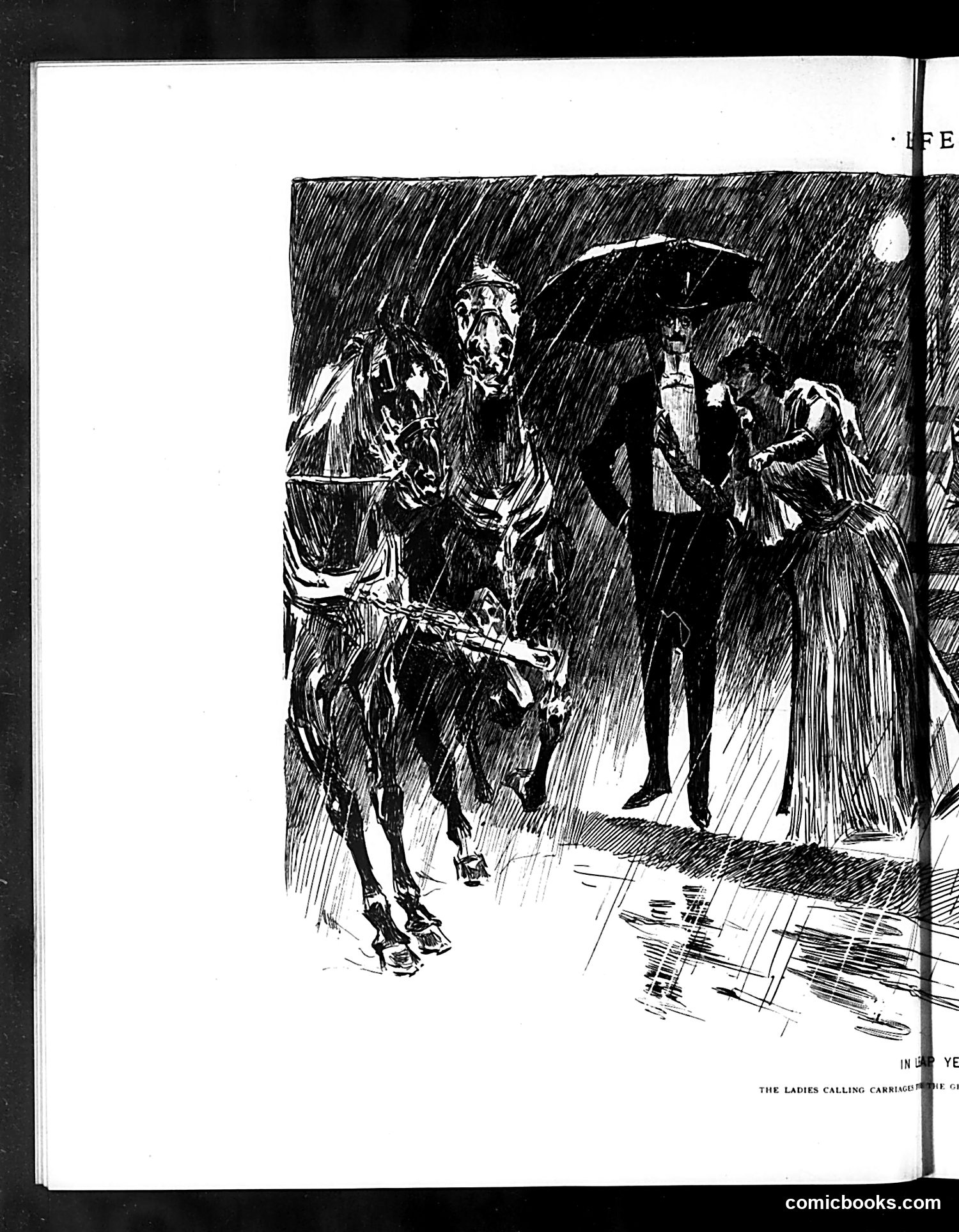
This appears to be an illustration titled "The Ladies Calling Carriage of [incomplete text]" from Life magazine's satirical section. The sketch depicts a rainy scene with well-dressed figures and a horse-drawn carriage. The style and formal Victorian attire suggest this satirizes upper-class social conventions, likely mocking the practice of "calling" — formal social visits that were important to genteel society. The joke appears to target the pretensions and inconveniences of these rigid social rituals: ladies bundled in umbrellas and finery, arriving by carriage for ceremonial visits regardless of weather. The exaggerated caricature of the horse and the emphasis on rain suggests the satire ridicules how devotion to social etiquette persists even under impractical circumstances. Without the complete caption, the specific target remains unclear.
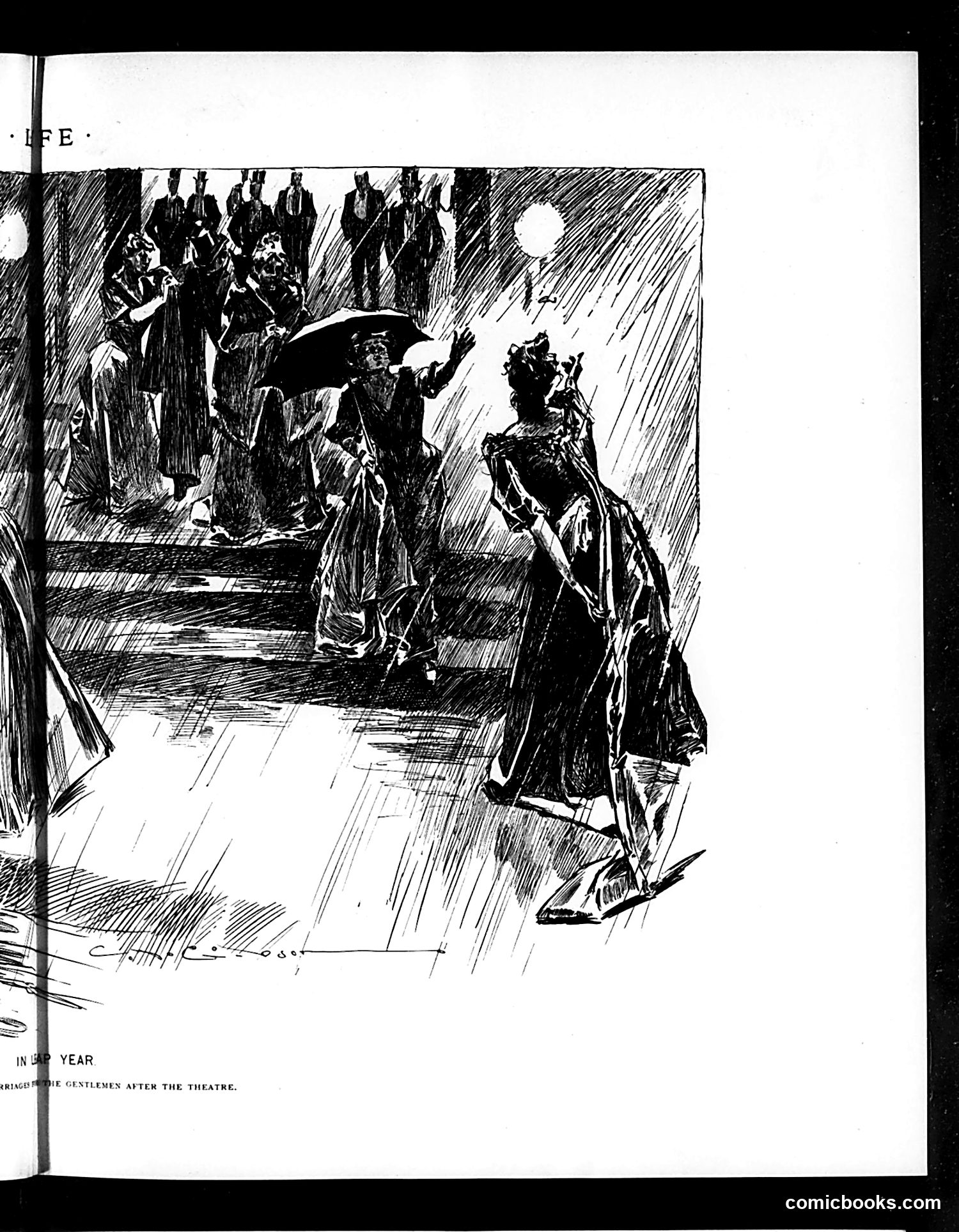
This is a satirical illustration titled "BRINGING THE GENTLEMEN AFTER THE THEATRE" from Life magazine's "IN MY YEAR" section. The sketch depicts a rainy street scene where a woman with an umbrella stands in the foreground, while formally dressed gentlemen gather in the background, appearing to follow or approach her. The satire likely mocks social conventions around courtship and gender dynamics of the era—specifically the expectation that respectable women would be pursued by "gentlemen" even in public spaces like theater districts. The woman's solitary stance with umbrella suggests independence or defensiveness, contrasting with the clustered male attention behind her. The title's ironic phrasing suggests commentary on how theater-going gentlemen behaved toward women afterward, poking fun at period social rituals and male behavior norms.
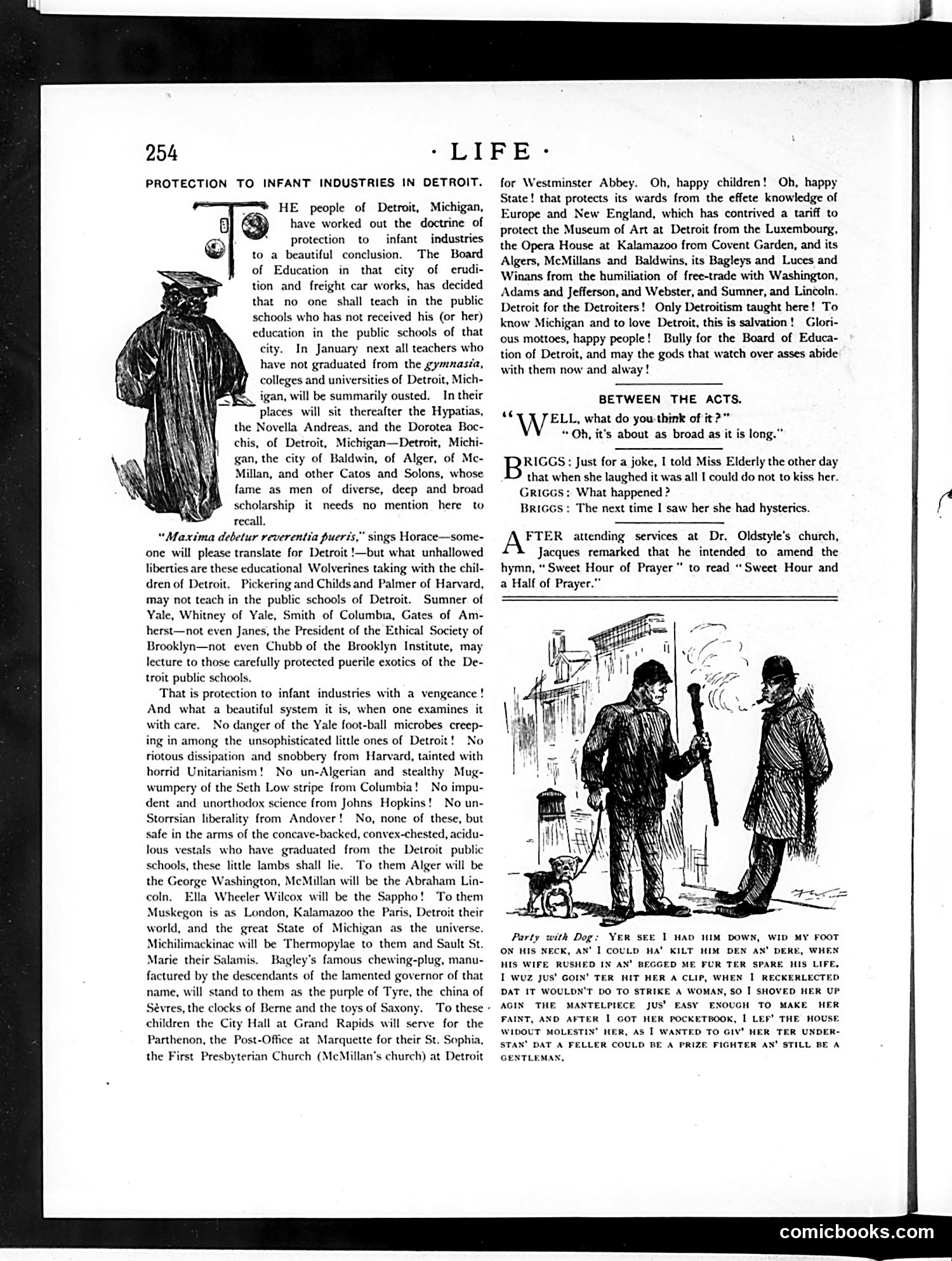
This satire mocks Detroit's school board policy requiring all public school teachers to have graduated from Detroit's own educational institutions, banning instructors from Harvard, Yale, Columbia, and other prestigious universities. The article uses heavy irony to criticize this "protectionism." It compares the policy to trade tariffs, sarcastically praising how it shields Detroit children from "effete" Eastern influence—whether Harvard's "dissipation and snobbery" or Johns Hopkins' "unorthodox science." The satire crescendos absurdly, suggesting Detroit will elevate local figures (businessmen Alger, McMillan, Baldwin) to the status of Washington and Lincoln, and transform Kalamazoo into "Paris" and local landmarks into classical temples. The underlying critique: Detroit's isolationism—keeping out superior educational talent—will produce provincialism and intellectual stagnation. By naming real prestigious educators barred from teaching, *Life* emphasizes what Detroit loses through this parochial policy.
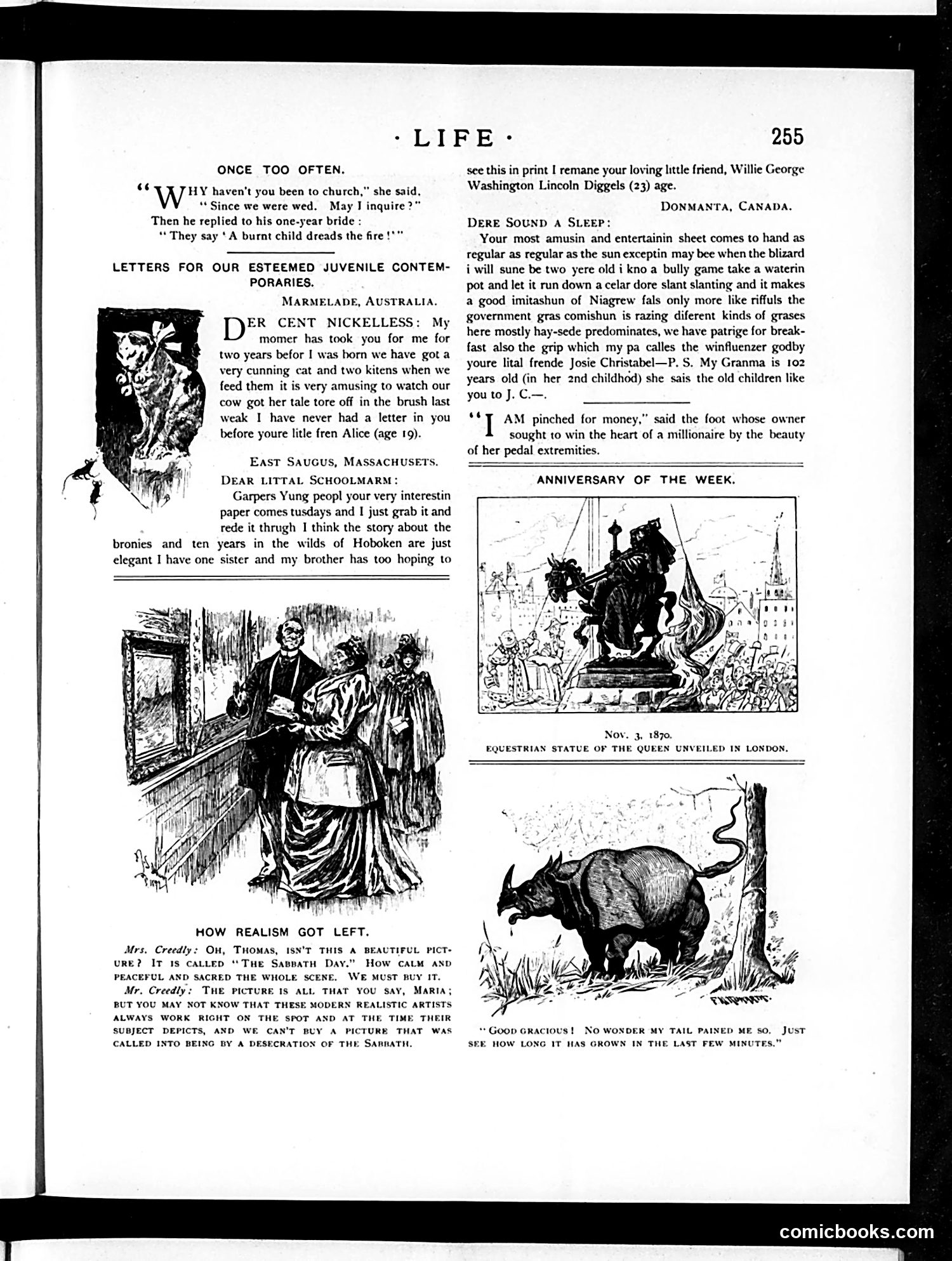
**"Once Too Often"** (top): A husband jokes to his newlywed wife that he hasn't attended church since their wedding because "a burnt child dreads the fire"—implying his first marriage was so unpleasant it scared him away from church. The humor relies on the husband blaming his previous marriage rather than admitting religious indifference. **"How Realism Got Left"** (center): Mr. and Mrs. Creedly admire a painting called "The Sabbath Day." Mr. Creedly explains that modern realistic artists paint on-site during their subject's actual events. The satire: they can't buy this "sacred" picture because the artist would have had to desecrate the Sabbath (work on Sunday) to create it—exposing the contradiction between realistic art's methods and genteel Victorian propriety. The page also contains humorous letters from readers with comically misspelled names and text, typical of Life's satirical "children's letters" feature mocking rural and uneducated correspondents.
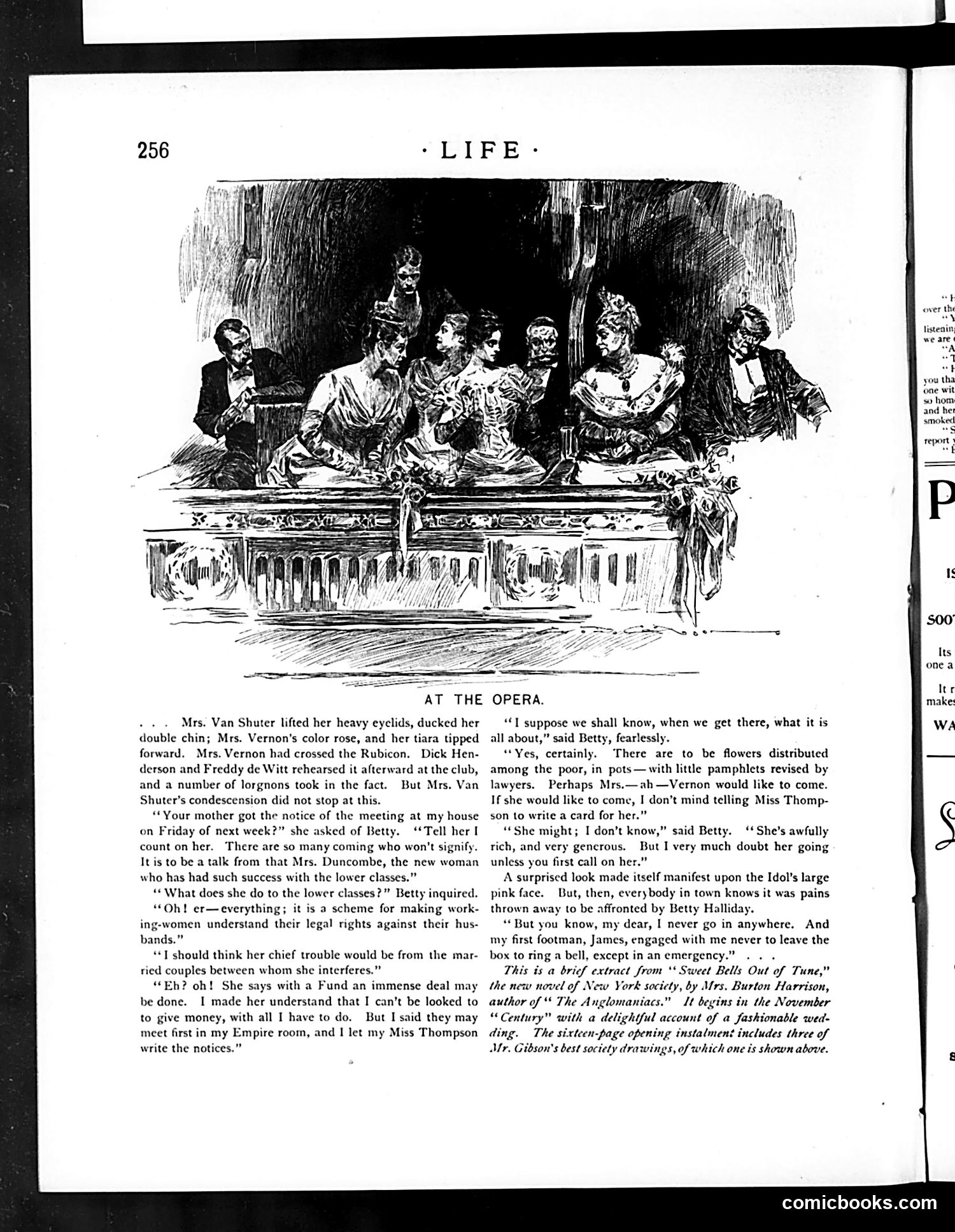
This illustration satirizes upper-class hypocrisy and social pretension in Gilded Age New York society. The scene depicts wealthy women at the opera—a marker of refinement—discussing Mrs. Duncombe, a reformer advocating for working women's legal rights against their husbands. The satire targets multiple targets: Mrs. Van Shuter's condescending "charity" (distributing potted flowers with lawyer-approved pamphlets to the poor), her refusal to actually donate money despite her wealth, and her shock that Mrs. Vernon might expect a social call before attending her meeting. The joke culminates in her absurd claim that her footman cannot leave the opera box to ring a bell except in emergencies—highlighting how trivial upper-class concerns are compared to the working-class legal struggles being discussed. The illustration accompanies a serialized novel about New York society, using humor to expose the gap between wealthy women's charitable pretensions and their actual indifference to substantive social reform.
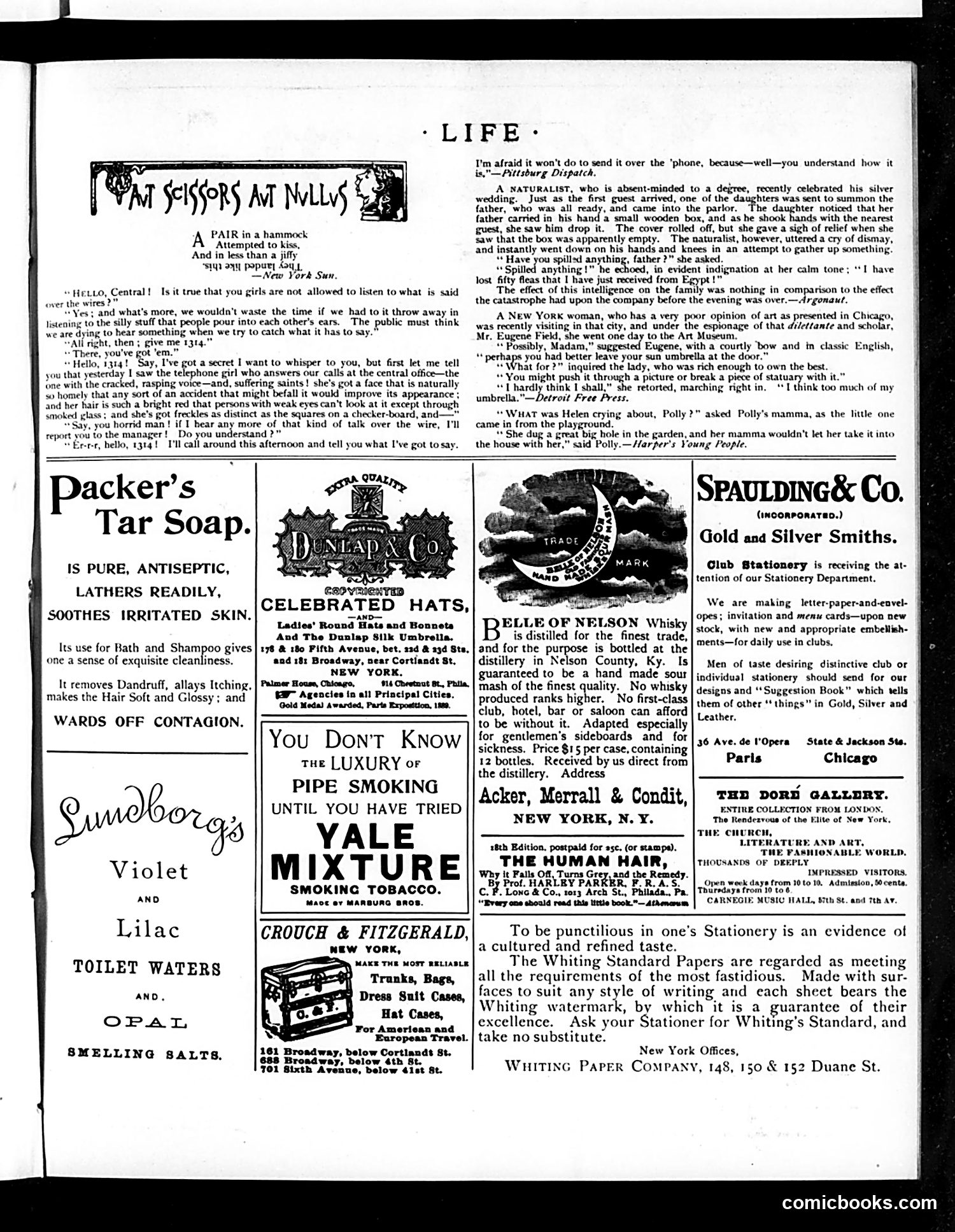
This page contains three separate humorous anecdotes satirizing early 1900s social conventions and human folly: 1. **The Telephone Operator Anecdote**: A man attempts to share gossip about a telephone operator's appearance over the phone—not realizing she can hear him. The satire targets male rudeness and obliviousness; the operator's indignant threat to report him to management provides comeuppance. 2. **The Absent-Minded Naturalist**: A scholar loses fifty Egyptian fleas at his silver wedding celebration. The humor derives from the contrast between an important family milestone and the protagonist's comical concern for insect specimens—mocking academic absentmindedness. 3. **The Art Museum Visitor**: A wealthy Chicago woman insists on bringing her umbrella into a museum despite warnings she might damage artwork. The satire mocks both her defensive materialism ("I think too much of my umbrella") and presumed lack of cultural refinement. The page is primarily advertisements for consumer goods (soaps, hats, tobacco, whisky). The tone reflects *Life*'s characteristic gentle mockery of middle-class American behavior and pretension.
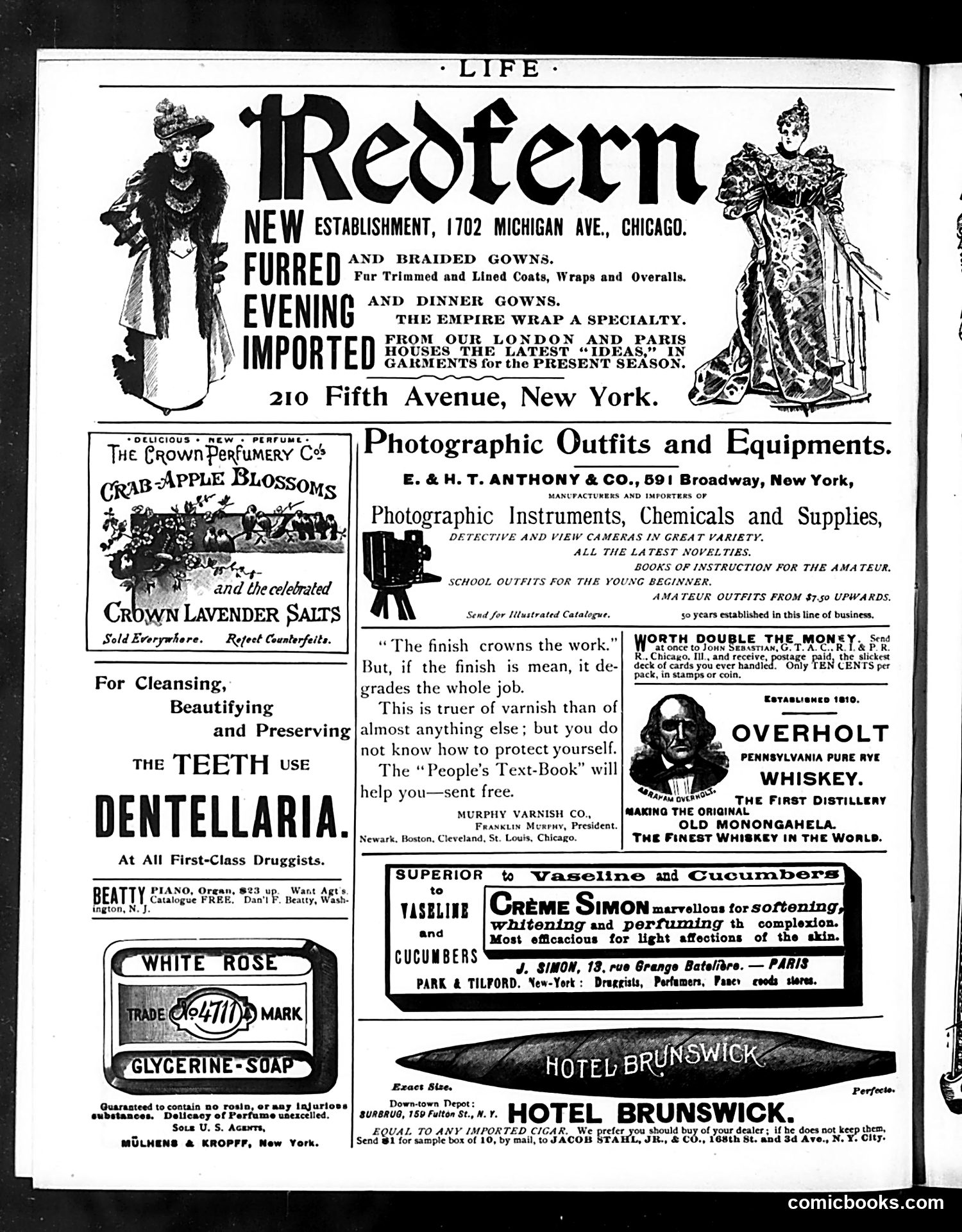
This page is **primarily advertising**, not editorial content or political cartoons. It showcases luxury goods and services from the early 1900s, reflecting the consumption patterns of wealthy Americans. The ads include fashion (Redfern garments from Chicago and New York), perfumes and cosmetics (Crown Perfumery, Crème Simon), photography equipment, dental care (Dentellaria), soap, whiskey (Overholt, Hotel Brunswick cigars), and other luxury items. The decorative illustrations of fashionably dressed women in elaborate gowns and hats represent the period's high-fashion aesthetic. The one substantive text element—a Murphy Varnish Co. quote about finishing work—is a product endorsement claiming quality matters in varnish application, not satire. The page documents consumer culture and advertising conventions of this era, targeting affluent readers through appeals to refinement, imported goods, and modern conveniences like photography equipment.