
Life, 1892-11-03 · page 9 of 16
Life — November 3, 1892 — page 9: what you’re looking at
What you’re looking at
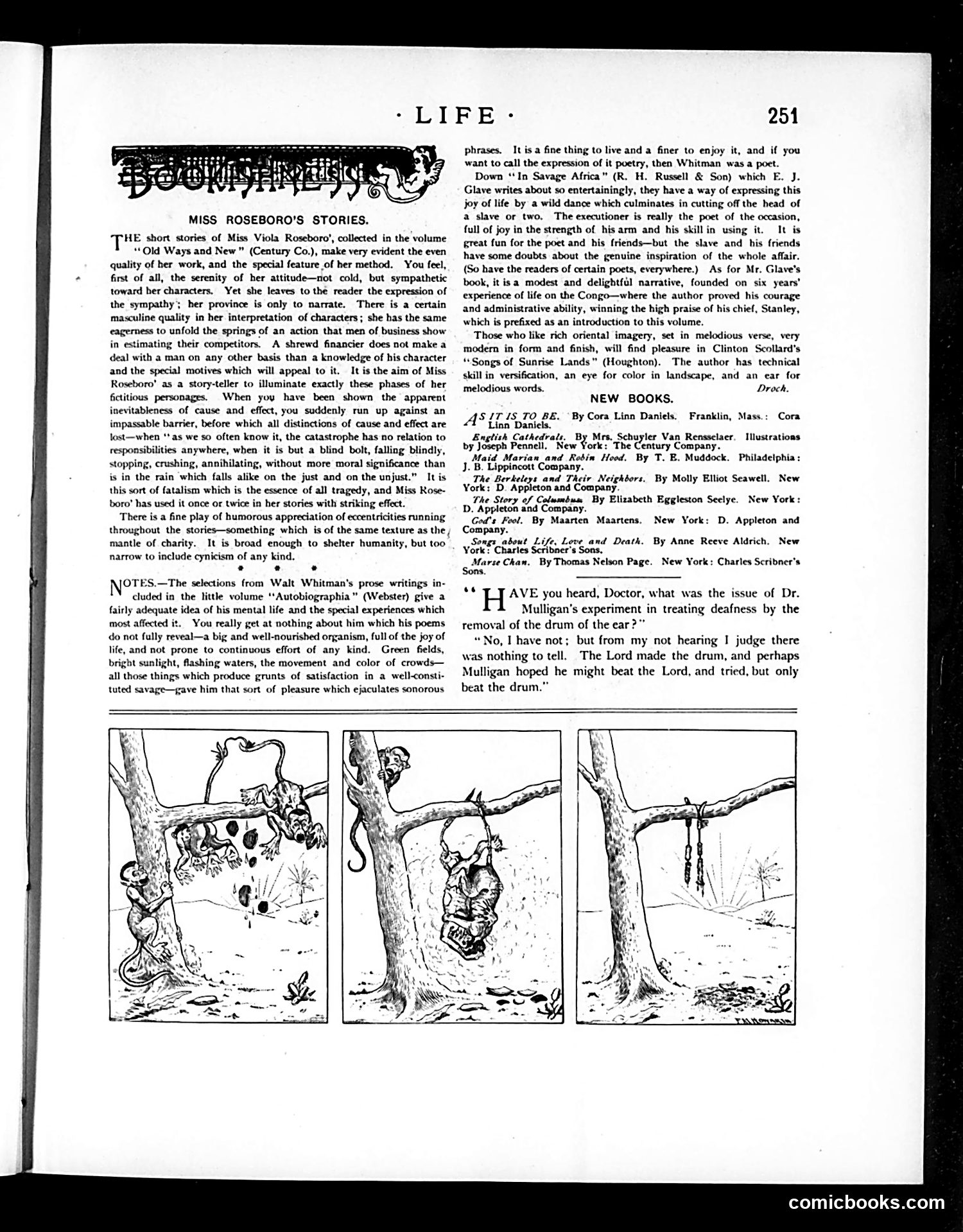
This page contains book reviews and a three-panel cartoon. The cartoon depicts a figure attempting increasingly desperate methods to remove a drum hanging from a tree branch—first juggling objects beneath it, then swinging on the branch, finally just standing before the bare tree. The accompanying text explains the joke: Dr. Mulligan conducted an experiment to cure drum-removal phobia by removing the drum itself, but only "beat the drum" instead. This is a pun-based joke playing on "beat" (to strike) versus the idiomatic "beat" (to overcome or solve). The cartoon illustrates the futility of the effort—showing escalating, absurd attempts that fail to solve the simple problem, likely satirizing overcomplicated or ineffective solutions to straightforward issues.
📄 Transcribed text from this page (OCR, searchable)
Machine-transcribed from the original scan — historical spelling and the odd misread are preserved.
MISS ROSEBORO’S STORIES. HE short stories of Miss Viola Roseboro’, collected in the volume “Old Ways and New” (Century Co.), make very evident the even quality of her work, and the special feature of her method. You feel, first of all, the serenity of her attitude—not cold, but sympathetic toward her characters, Yet she leaves to the reader the expression of the sympathy; her province is only to narrate. There is a certain masculine quality in her interpretation of characters; she has the same eagerness to unfold the springs of an action that men of business show in estimating their competitors, A shrewd financier does not make a deal with a man on any other basis than a knowledge of his character and the special motives which will appeal to it. It is the aim of Miss Roseboro’ as a story-teller to illuminate exactly these phases of her fictitious personages. When you have been shown the apparent inevitableness of cause and effect, you suddenly run up against an impassable barrier, before which all distinctions of cause and effect are lost—when ‘* as we so often know it, the catastrophe has no relation to responsibilities anywhere, when it is but a blind bolt, falling blindly, stopping, crushing, annihilating, without more moral significance than is in the rain which falls alike on the just and on the unjust.” It is this sort of fatalism which is the essence of all tragedy, and Miss Kose- boro’ has used it once or twice in her stories with striking effect. ‘There is a fine play of humorous appreciation of eccentricities running throughout the stories—something which is of the same texture as the / mantle of charity. It is broad enough to shelter humanity, but too narrow to include cynicism of any kind. * * . OTES.—The selections from Walt Whitman's prose writings in- cluded in the little volume ‘Autobiographia” (Webster) give a fairly adequate idea of his mental life and the special experiences which most affected it. You really get at nothing about him which his poems do not fully reveal—a big and well-nourished organism, full of the joy of life, and not prone to continuous effort of any kind. Green fields, bright sunlight, flashing waters, the movement and color of crowds— all those things which produce grunts of satisfaction in a well-consti- tuted savage—gave him that sort of pleasure which ejaculates sonorous 251 phrases. It isa fine thing to live and a finer to enjoy it, and if you want to call the expression of it poetry, then Whitman was a poet. Down ‘In Savage Africa” (R. H. Russell & Son) which E. J. Glave writes about so entertainingly, they have a way of expressing this joy of life by a wild dance which culminates in cutting off the head of a slave or two. The executioner is really the poet of the occasion, full of joy in the strength of his arm and his skill in using it. It is great fun for the poet and his friends—but the slave and his friends have some doubts about the genuine inspiration of the whole affair. (So have the readers of certain poets, everywhere.) As for Mr. Glave's book, it isa modest and delightfal narrative, founded on six years’ experience of life on the Congo—where the author proved his courage and administrative ability, winning the high praise of his chief, Stanley, which is prefixed as an introduction to this volume. Those who like rich oriental imagery, set in melodious verse, very modern in form and finish, will find pleasure in Clinton Scollard’s “Songs of Sunrise Lands” (Houghton). The author has technical skill in versification, an eye for color in landscape, and an car for melodious words. Droch. NEW BOOKS. ASAT IS TO BE. By Cora Linn Daniels. Linn Daniels. Bnslish Cathedrale, By Mrs. Schuyler Van Renssclaer by Joseph Pennell. New York: The Century Company. Maid Marian and Kebin Hood. By T. B. Muddock. Philadelphia: J.B. Lippincott Company. The Berkeleys and Their Neighbors. York: D. Appleton and Company. The Story of Columbum By Elizabeth Eggleston Seelye. D. Appleton and Company. God's Feel, By Maarten Maartens, New York: Company. Songs about Life, Love and Death. By Anne Reeve Aldrich. New York: Charles Scribner's Sons. farse Chan, By Thomas Nelson Page. New York: Charles Scribner's Franklin, Mass.: Cora Illustrations By Molly Elliot Seawell. New New York: D. Appleton and Sons. ——— ae H AVE you heard, Doctor, what was the issue of Dr. Mulligan’s experiment in treating deafness by the temoval of the drum of the ear?” “No, I have not; but from my not hearing I judge there was nothing to tell. The Lord made the drum, and perhaps Mulligan hoped he might beat the Lord, and tried, but only beat the drum.” comicbooks.com