
A complete issue · 14 pages · 1892
Life — October 27, 1892
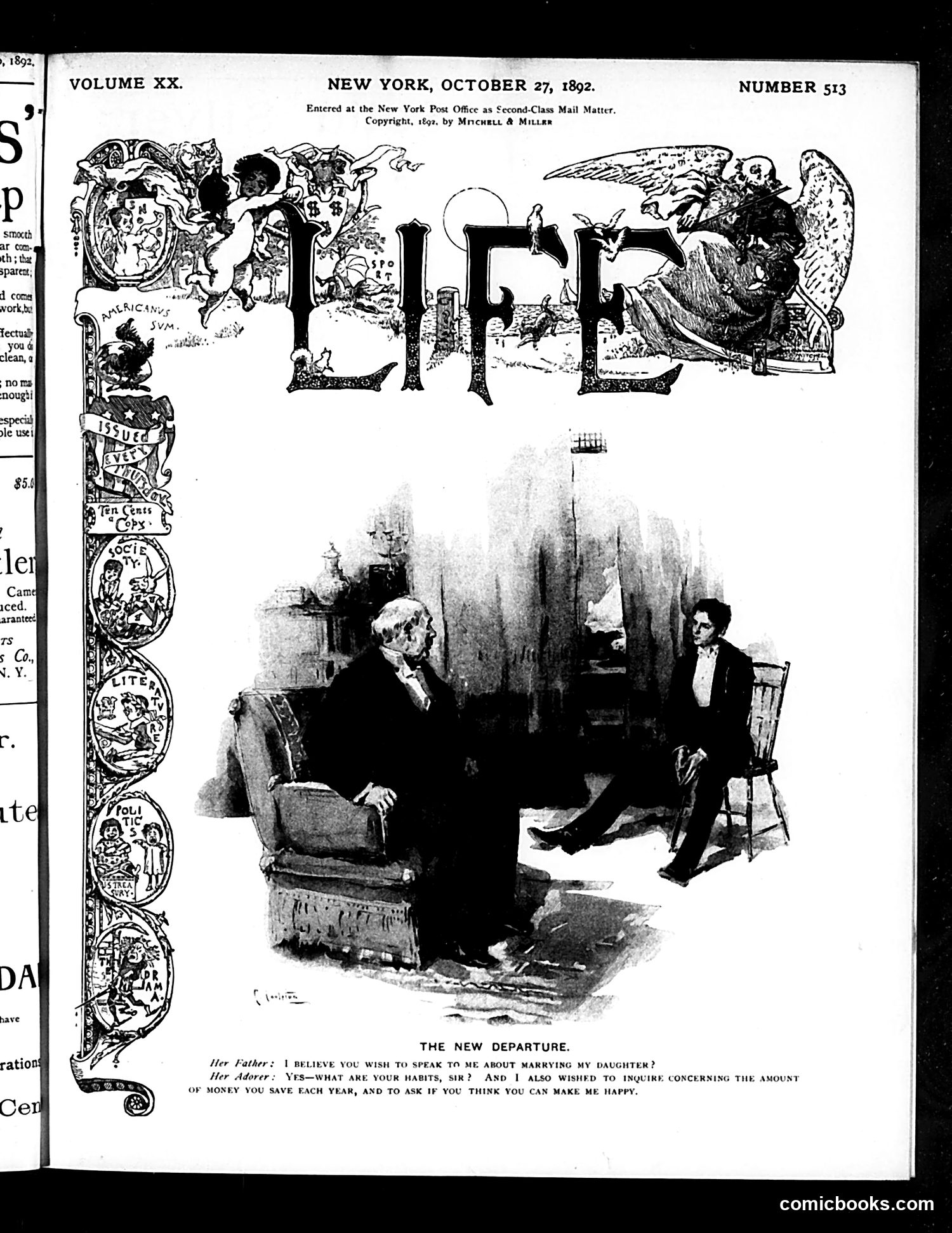
This cartoon satirizes a father-daughter conversation about marriage. The dialogue reads: **Her Father:** "I believe you wish to speak to me about marrying my daughter?" **Her Suitor:** "Yes—what are your habits, sir? And I also wished to inquire concerning the amount of money you have each year, and to ask if you think you can make her happy." The satire inverts traditional courtship protocol. Normally, a suitor would be questioned about *his* finances and character. Here, the young man audaciously interrogates the *father* about these matters—implying he's evaluating whether the bride's family can adequately support him financially. This "new departure" mocks emerging attitudes about mercenary marriages and shifting gender dynamics in the 1890s, where financial considerations increasingly dominated matrimonial arrangements.
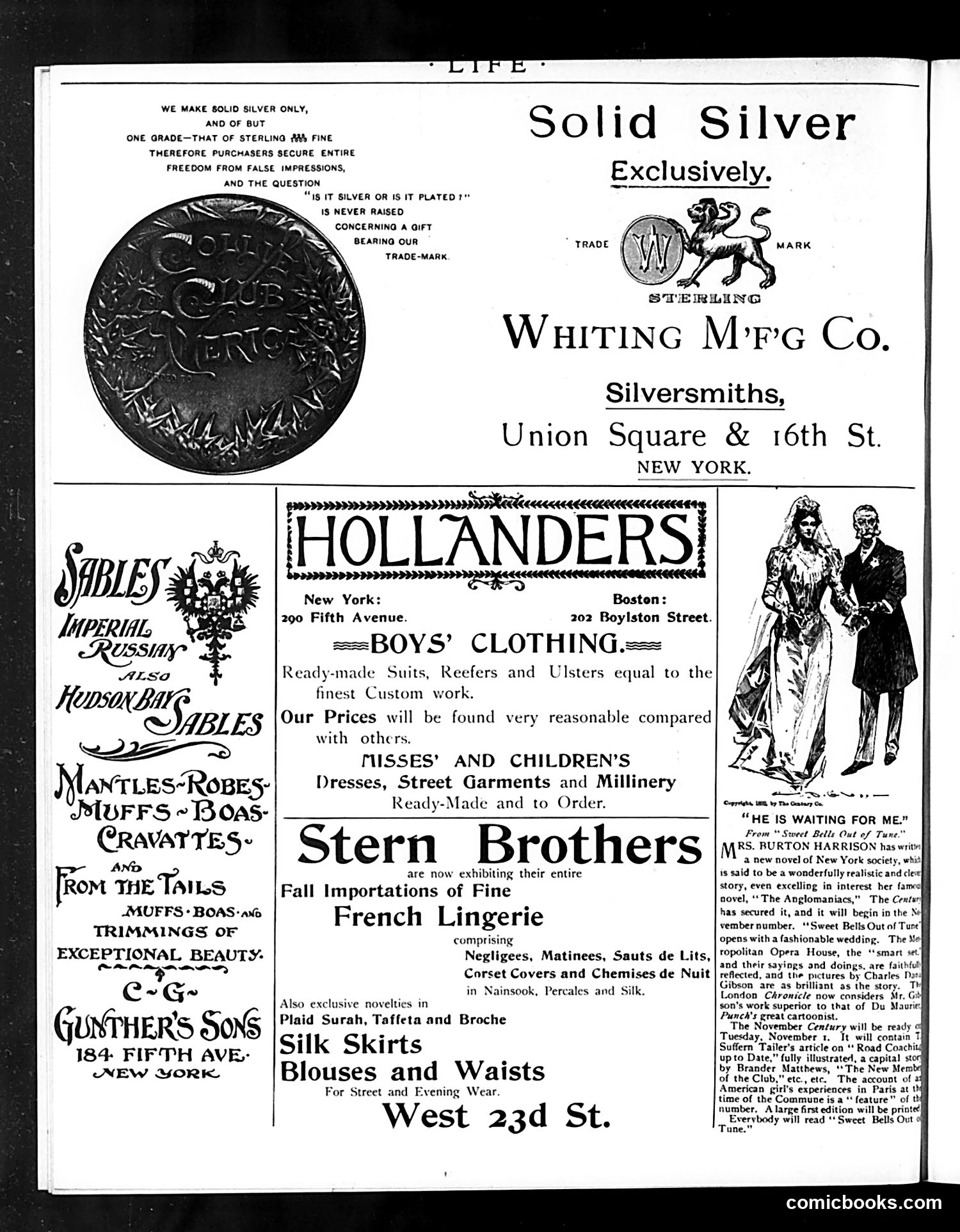
This page is **primarily advertising**, not political satire or comics. It contains multiple commercial advertisements from late 19th or early 20th-century New York businesses: - **Whiting M'fg Co.**: Silversmith advertising solid sterling silver goods - **Hollanders**: Boys' clothing retailer with locations in New York and Boston - **Stern Brothers**: Department store promoting French lingerie, silk skirts, and blouses - **Gunther's Sons**: Furrier selling sables, furs, and trimmings The only non-advertising content is a small illustration captioned "He Is Waiting For Me," accompanying text about a novel called "Sweet Bells Out of Tune" by Mrs. Burton Harrison. There is **no political commentary or satirical cartoon content** visible on this page—it's a straightforward commercial advertisement section from *Life* magazine.
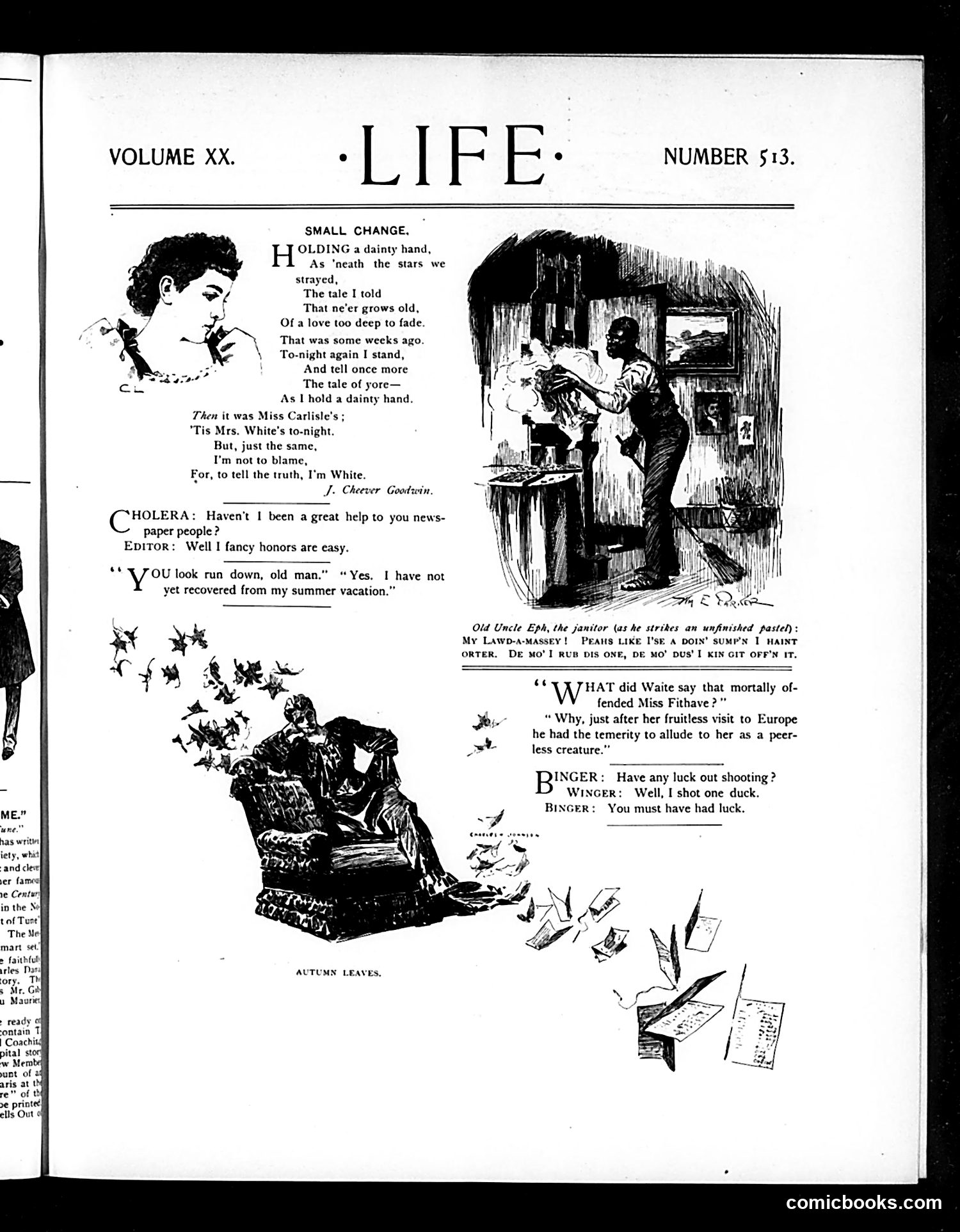
This page from *Life* magazine contains humor pieces rather than political cartoons. **"Small Change"** is a sentimental poem about holding a lover's hand under the stars, attributed to Chester Goodwin. The accompanying illustration shows a couple in an intimate moment. **"Autumn Leaves"** depicts a man surrounded by scattered papers/bills, suggesting financial troubles from autumn expenses—a visual pun on the season's "leaves." The dialogue exchanges ("Cholera," "You look run down") are brief comedic exchanges typical of *Life*'s humor column format, touching on everyday topics like newspaper work and hunting. The magazine's satirical edge here is gentle, focused on domestic and social observations rather than sharp political commentary. The illustrations are charming period sketches emphasizing the humor through visual detail.
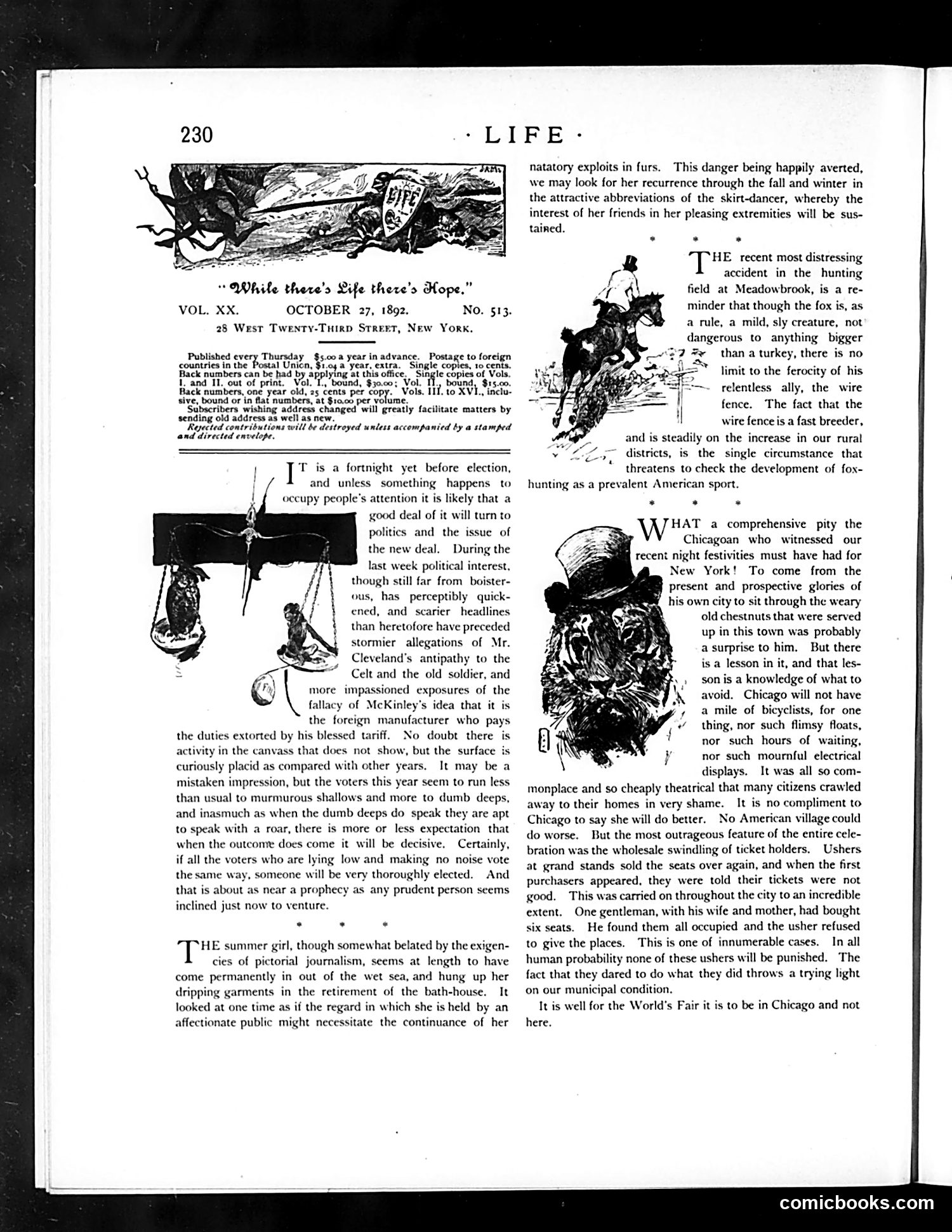
The page contains two editorial cartoons addressing contemporary issues: **Left cartoon**: Depicts a balance scale with figures on either side, illustrating debate over McKinley's tariff policy. The text criticizes McKinley's protectionist tariff as benefiting manufacturers while burdening ordinary voters, calling it a "fallacy" that needs exposure before the upcoming election. **Right cartoon**: A caricatured bearded figure (appears to be Santa Claus or similar character) satirizes Chicago's chaotic World's Fair ticketing scandal. The text describes corrupt ushers who sold occupied seats, refusing legitimate ticket holders entry. The author mocks Chicago's mismanagement, suggesting the fair would be better held elsewhere and criticizing the city's inability to prevent such corruption—a damning commentary on municipal competence.
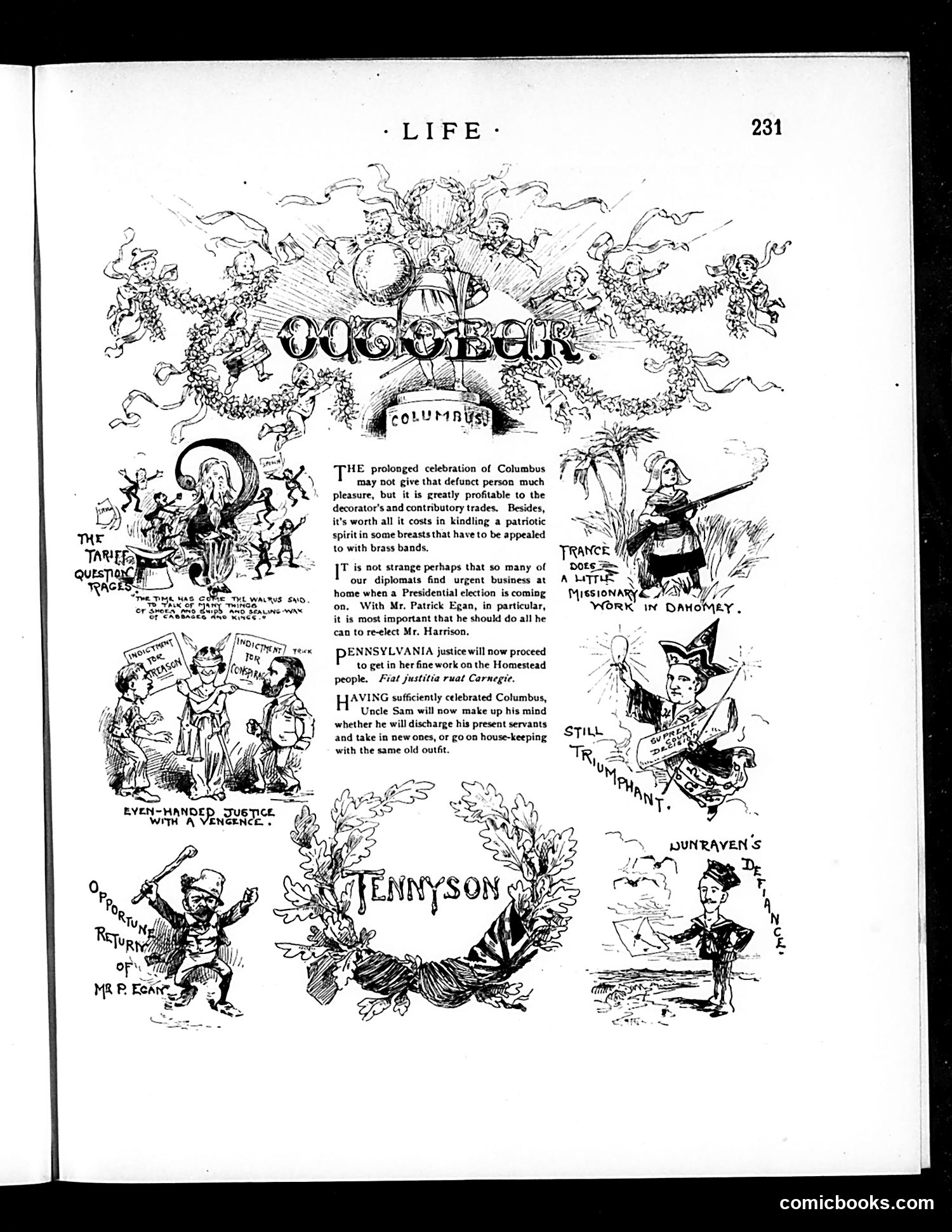
This page satirizes October 1892 political events during a U.S. Presidential election year. The central cartoon titled "October" features cherubs celebrating Columbus Day, which the text notes benefits decorators and brass bands more than actual commemoration. Other sections mock: - **"The Tariff Question"**: depicts confused justice, satirizing trade policy debates - **Pennsylvania's "First Justice"**: comments on state legal proceedings - **Uncle Sam and servants**: jokes about potential changes after the election - **Tennyson reference**: appears to be a literary allusion - **"Dunraven's Denial"**: likely references a contemporary scandal or controversy The cartoons use exaggerated caricatures and wordplay typical of 1890s political satire, targeting electoral politics, legal corruption, and current events unknown to modern readers without further historical context.
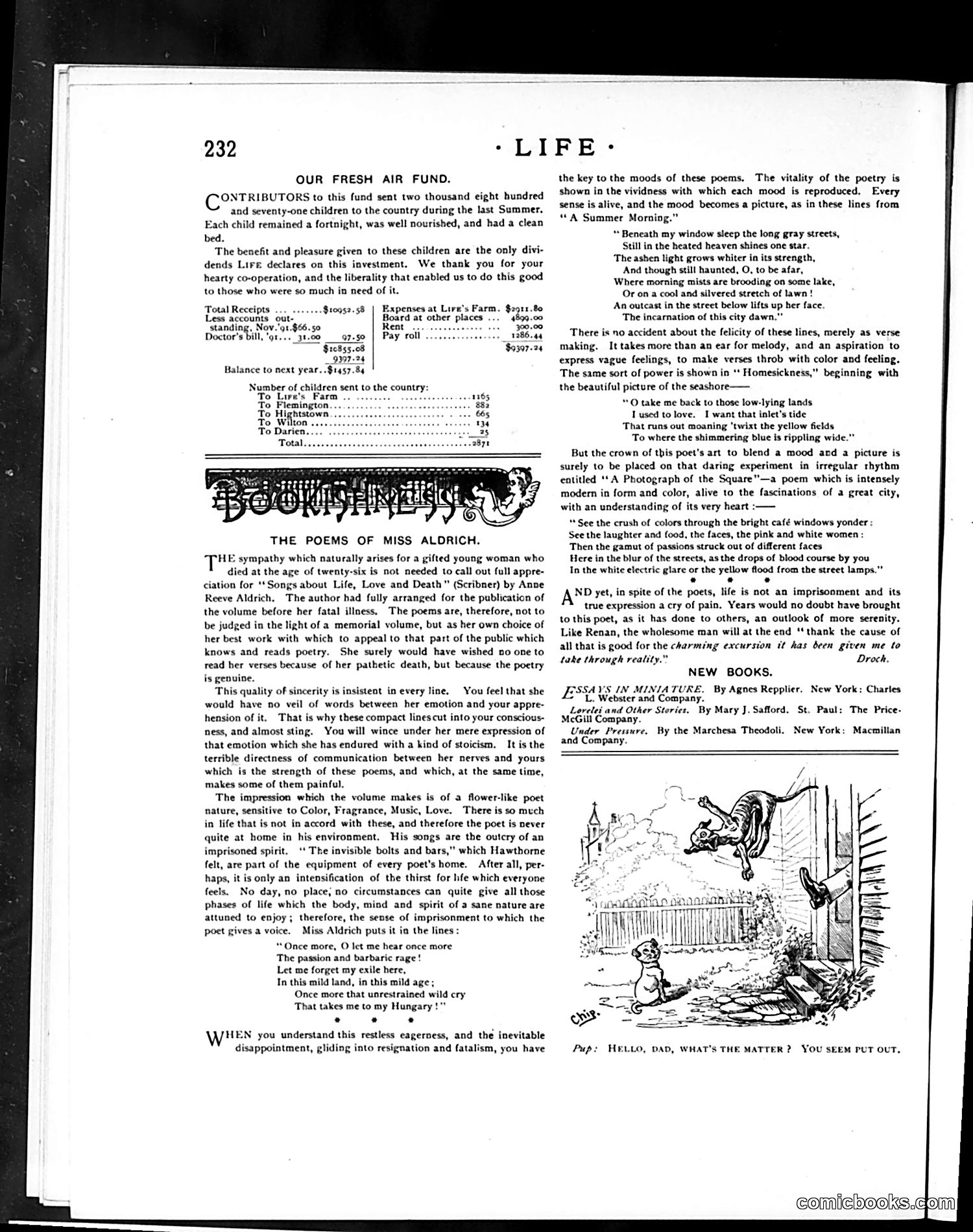
This page contains two main sections: **Left side:** "Our Fresh Air Fund" - a financial report documenting contributions for sending children to the countryside during summer. It lists donations and expenses, concluding with a balance to carry forward. **Right side:** A literary critique of poems by Miss Aldrich, praising her sincere emotional expression and poetic sensitivity. The text emphasizes how her work connects emotion to visual imagery. **Cartoon:** The illustration at bottom shows a child playing outdoors (appearing muddy or dirty) while an adult observes. The caption reads "Hello, dad, what's the matter? You seem put out." This appears to humorously contrast the child's enjoyment of outdoor play with parental concern about cleanliness—likely satirizing tension between children's freedom and adult propriety expectations during the Progressive Era.
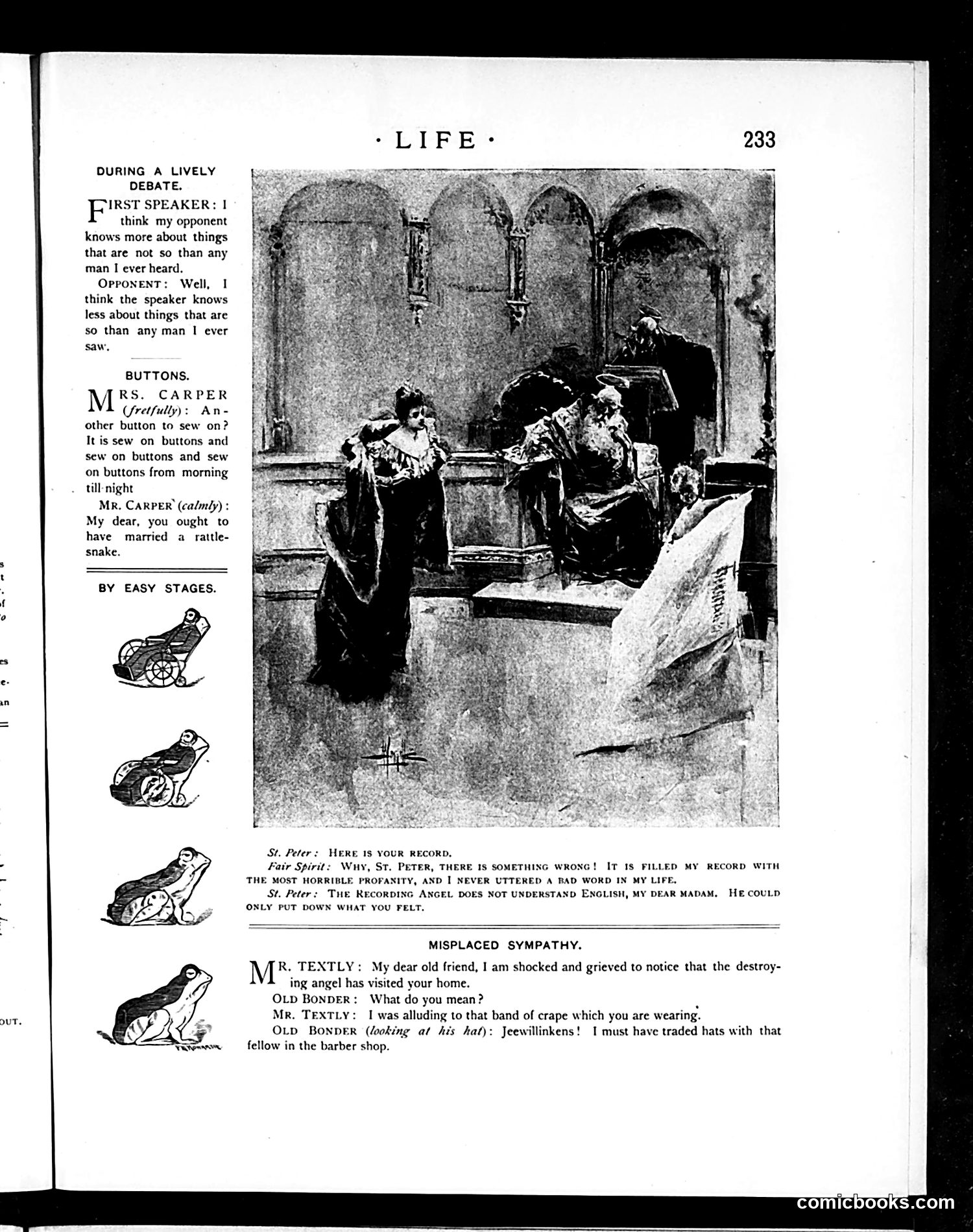
This page contains three separate humorous pieces typical of early 20th-century satirical magazines: 1. **"During a Lively Debate"**: A witty exchange where speakers claim superior knowledge, with the opponent's comeback suggesting the first speaker actually knows *less* about obscure matters. 2. **"Buttons" (Mrs. Carper)**: A domestic joke about a wife endlessly sewing buttons while complaining, with the husband's response comparing her to a rattlesnake—implying she's venomous/nagging. 3. **"Misplaced Sympathy"**: Mr. Textly insults his friend's hat, calling it "crape" (funeral cloth), suggesting he traded hats with a barber. The friend misinterprets this as sympathy for a death in the family. The illustrated frog progression labeled "By Easy Stages" appears decorative. All humor relies on wordplay, misunderstanding, and domestic/social commentary typical of the era.
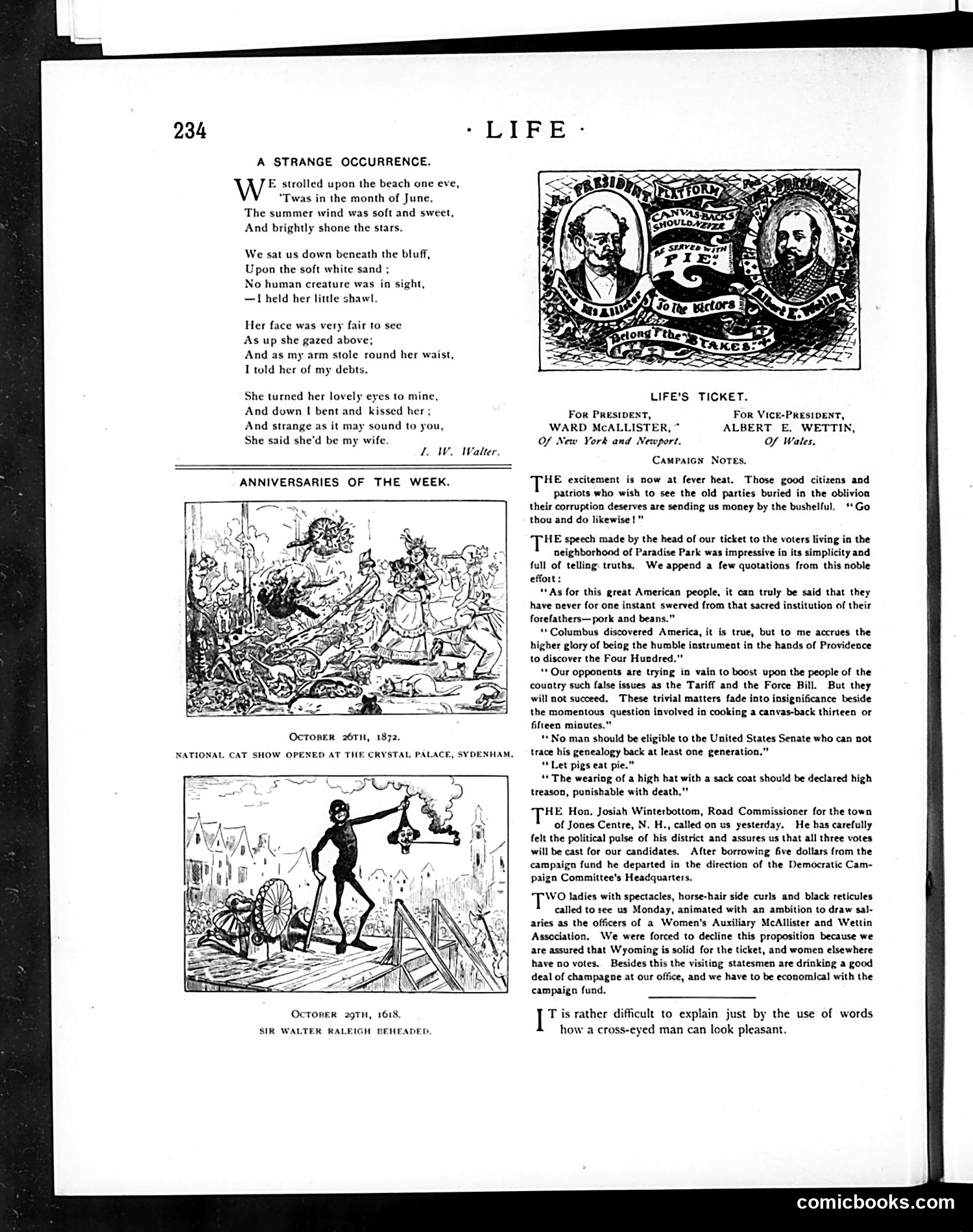
This page contains campaign material for the 1872 U.S. presidential election. The masthead shows Ward McAllister (for President) and Albert E. Wettin (for Vice-President) of New York and Wales respectively—clearly a satirical ticket. The "Campaign Notes" section ridicules both major parties through mock quotations, particularly attacking arguments about American exceptionalism ("pork and beans") and eligibility requirements for Senate (the "high treason" reference to wearing high hats appears to be absurdist humor). Two illustrations commemorate historical anniversaries: one from October 26, 1872 (a "National Cat Show") and another from October 29, 1618 (Sir Walter Raleigh's beheading)—the juxtaposition likely mocking the seriousness of contemporary politics by placing them alongside trivial or tragic historical events.
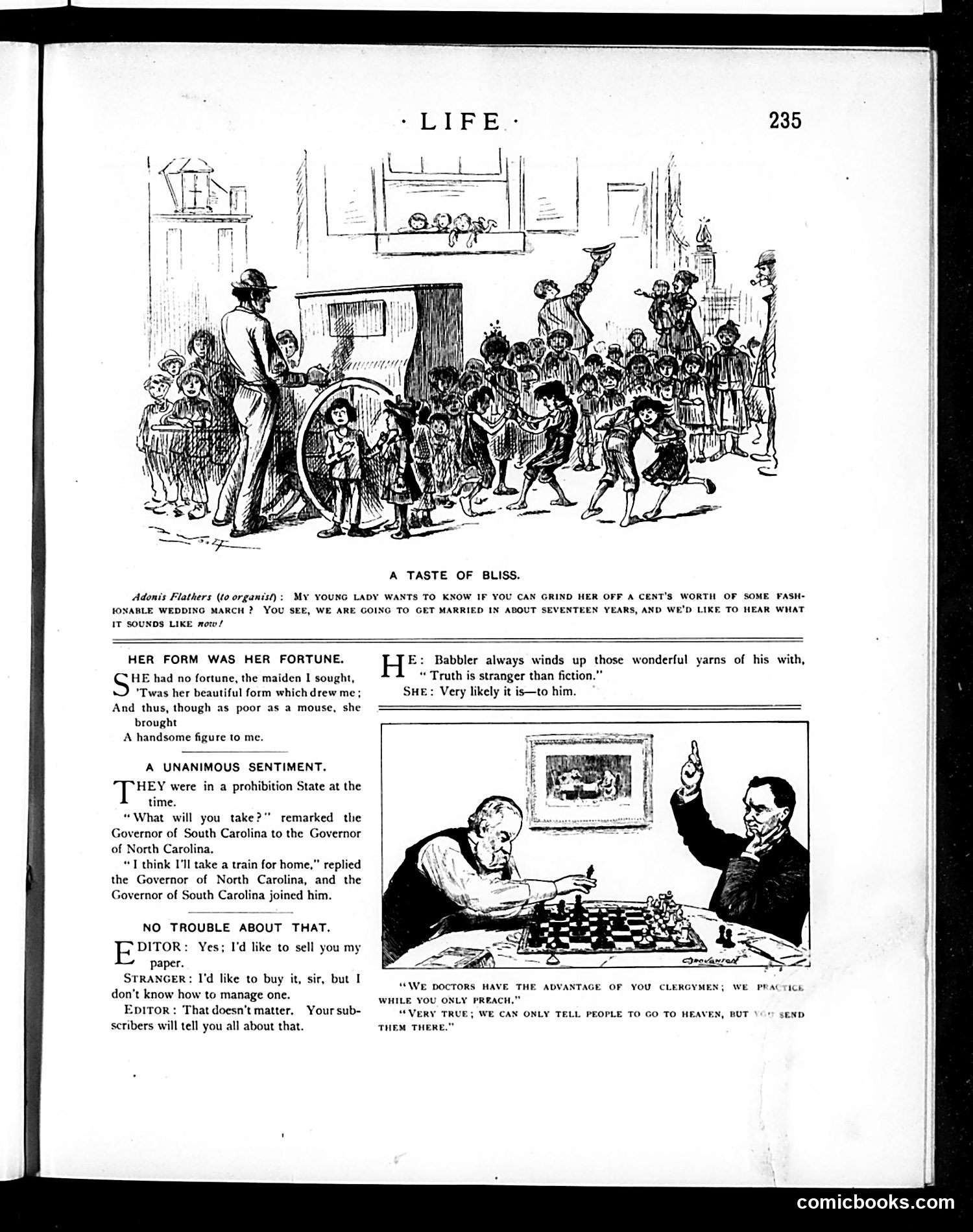
This page contains three separate satirical pieces mocking social pretension and hypocrisy. **Top cartoon**: Shows a street vendor's organ grinder surrounded by children. The organist boasts about marrying off a young lady within 17 years—crude humor about arranging a poor girl's marriage, presumably for economic survival. **Middle section**: Three brief anecdotes satirizing greed and materialism: a poor maiden valued only for her beauty; governors' unanimous support for taking a "train home" (likely referencing political corruption or state resources); and an editor's dismissive response to a stranger wanting to sell a newspaper—mocking journalistic gatekeeping. **Bottom cartoon**: Two men playing chess, with a doctor claiming professional advantage over clergymen because doctors "practice" while clergy only "preach." This satirizes competing claims to moral authority and expertise between professions.
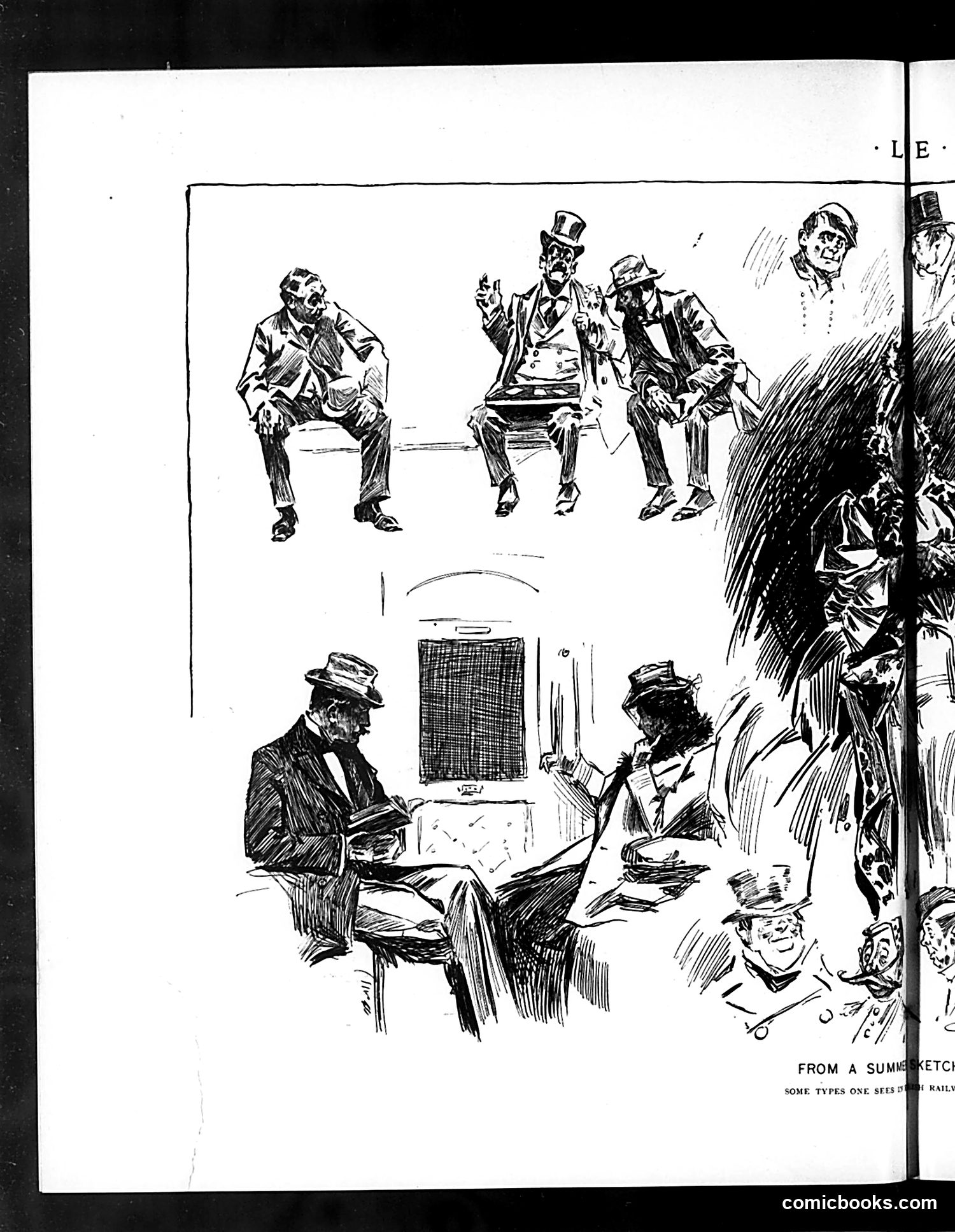
The caption reads "FROM A SUMMER SKETCH" with partial text mentioning "SOME TYPES ONE SEES." This appears to be a satirical sketch depicting social types or character studies rather than specific political figures. The cartoon shows two scenes: the upper panel features three men in formal attire sitting and conversing, while the lower panel depicts two men at what appears to be a desk or table with papers, surrounded by onlookers. Without clearer identifying text or context, the exact social commentary is unclear. The exaggerated caricature style and formal dress suggest satire of upper-class or professional society types—possibly bankers, lawyers, or politicians. The sketch appears to mock recognizable "types" encountered during summer social season, though which specific types remain uncertain from the visible image alone.
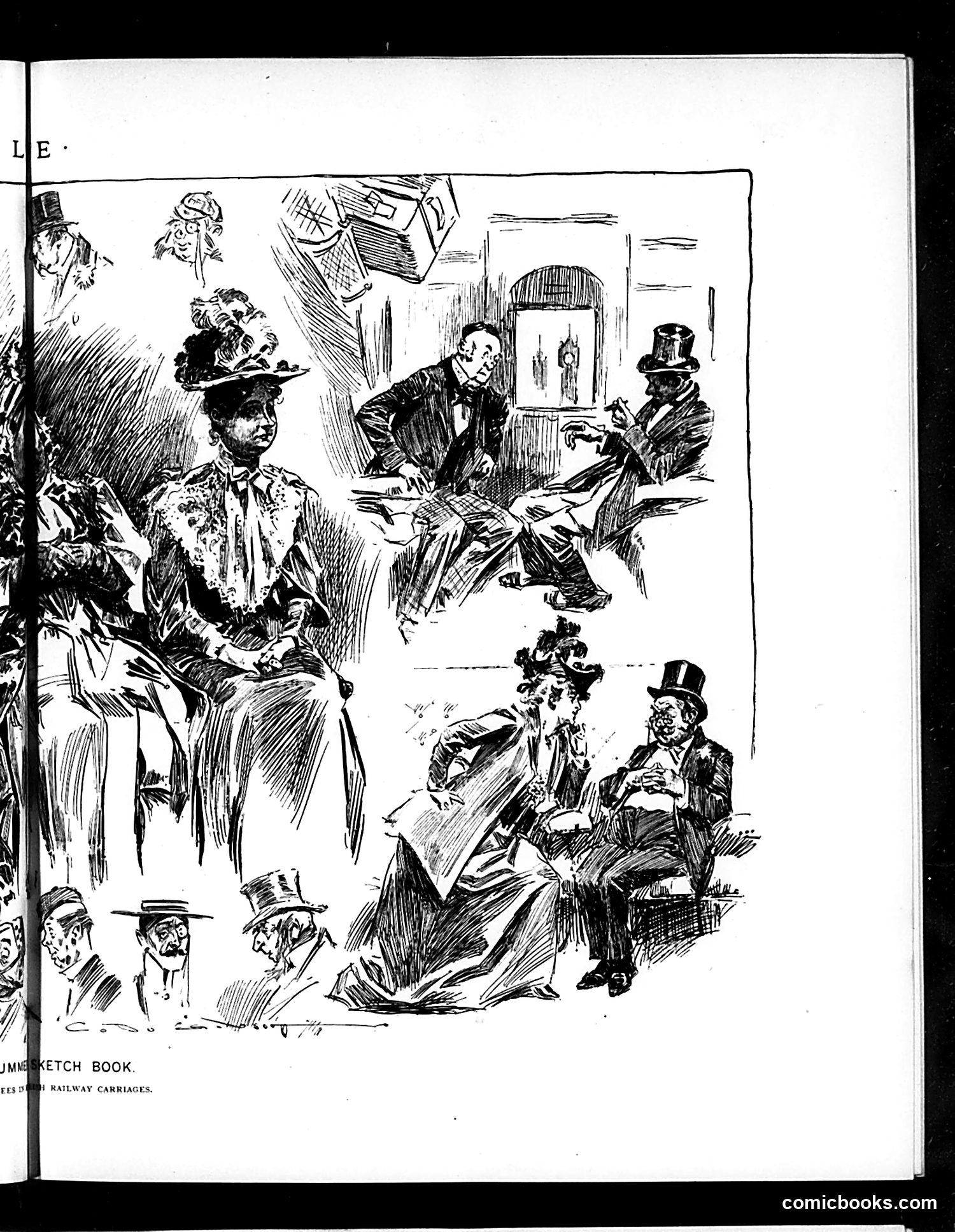
This page from *Life* magazine's "Sketch Book" depicts scenes of railway carriage travel, likely from the late 19th or early 20th century. The sketches show various passenger types—well-dressed gentlemen in top hats, fashionable women—interacting in what appears to be a train compartment or station setting. The satire appears to target social behavior and class distinctions observable during railway travel: the formality of dress, awkward encounters between strangers in confined spaces, and the performance of propriety in public transportation. The exaggerated expressions and postures suggest mild mockery of Victorian-era social conventions and the somewhat absurd rituals of polite society during the railway age. The specific social commentary remains unclear without additional context about contemporary railway culture.
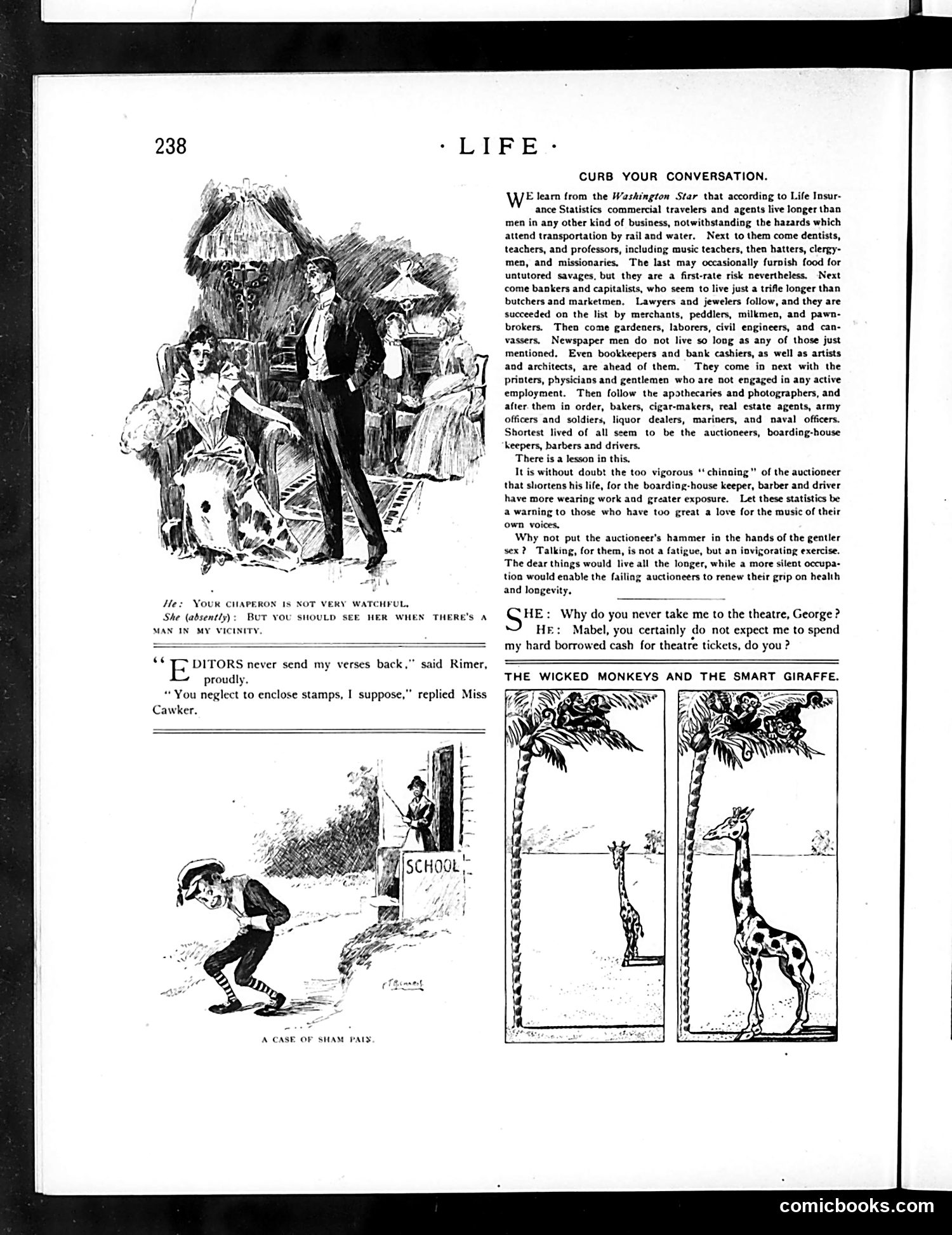
This page satirizes occupational longevity using life insurance statistics. The main article mocks auctioneers, boarding-house keepers, barbers, and drivers as the shortest-lived professions—attributing auctioneers' brief lifespans to excessive talking ("chinning") rather than actual labor. The satire suggests women should replace male auctioneers since talking supposedly *invigorates* women rather than exhausting them, thereby extending auctioneers' lives through retirement. The accompanying cartoons are brief comedic vignettes: one shows a boy feigning illness to avoid school ("A Case of Sham Paly" [palsy]), and another depicts "The Wicked Monkeys and the Smart Giraffe"—likely a fable-style strip. The dialogue jokes address dating/romance etiquette and publishing rejections, typical period humor emphasizing gender stereotypes and social pretension.
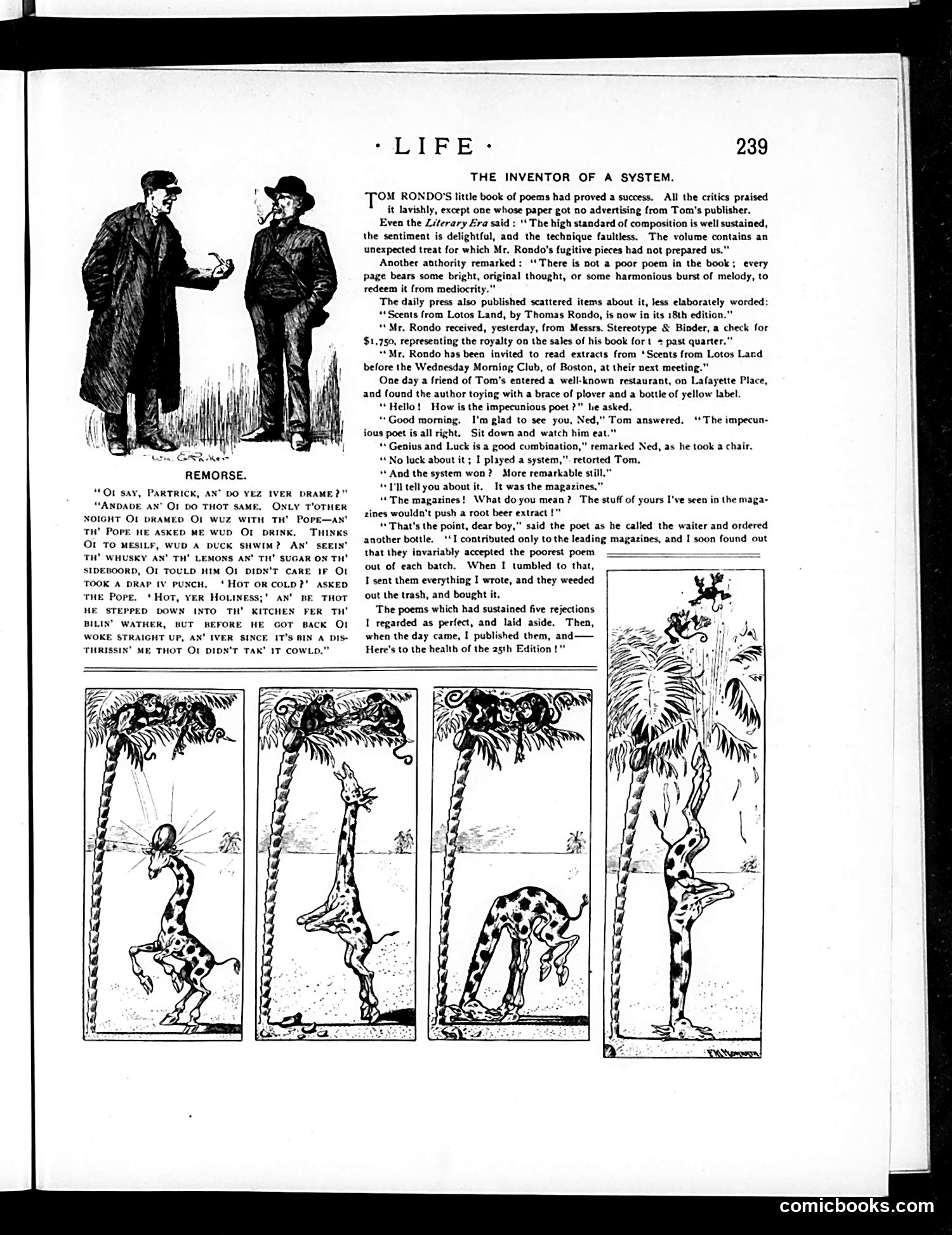
This page contains two distinct pieces: **"Remorse"** (top): An Irish-dialect joke featuring two working-class men discussing dreams. One recounts dreaming he was offered a hot whiskey punch by the Pope but woke before accepting—and has regretted this missed opportunity ever since. The humor relies on ethnic stereotyping (exaggerated Irish brogue) and the absurdist premise of the Pope offering alcohol. **"The Inventor of a System"** (main story): A satirical tale about poet Thomas Rondo who achieves commercial success through a deliberate strategy: he submits his *worst* poems to leading magazines, knowing editors will reject them, then publishes only the rejected work—assuming rejected poems are superior. This is satirizing both: (1) poets' delusions about their own work quality, and (2) magazine editors' predictable contrarian judgment. The joke is that his "system" is merely reverse psychology dressed as genius. The giraffe cartoon strips (bottom) appear unrelated to the text above.
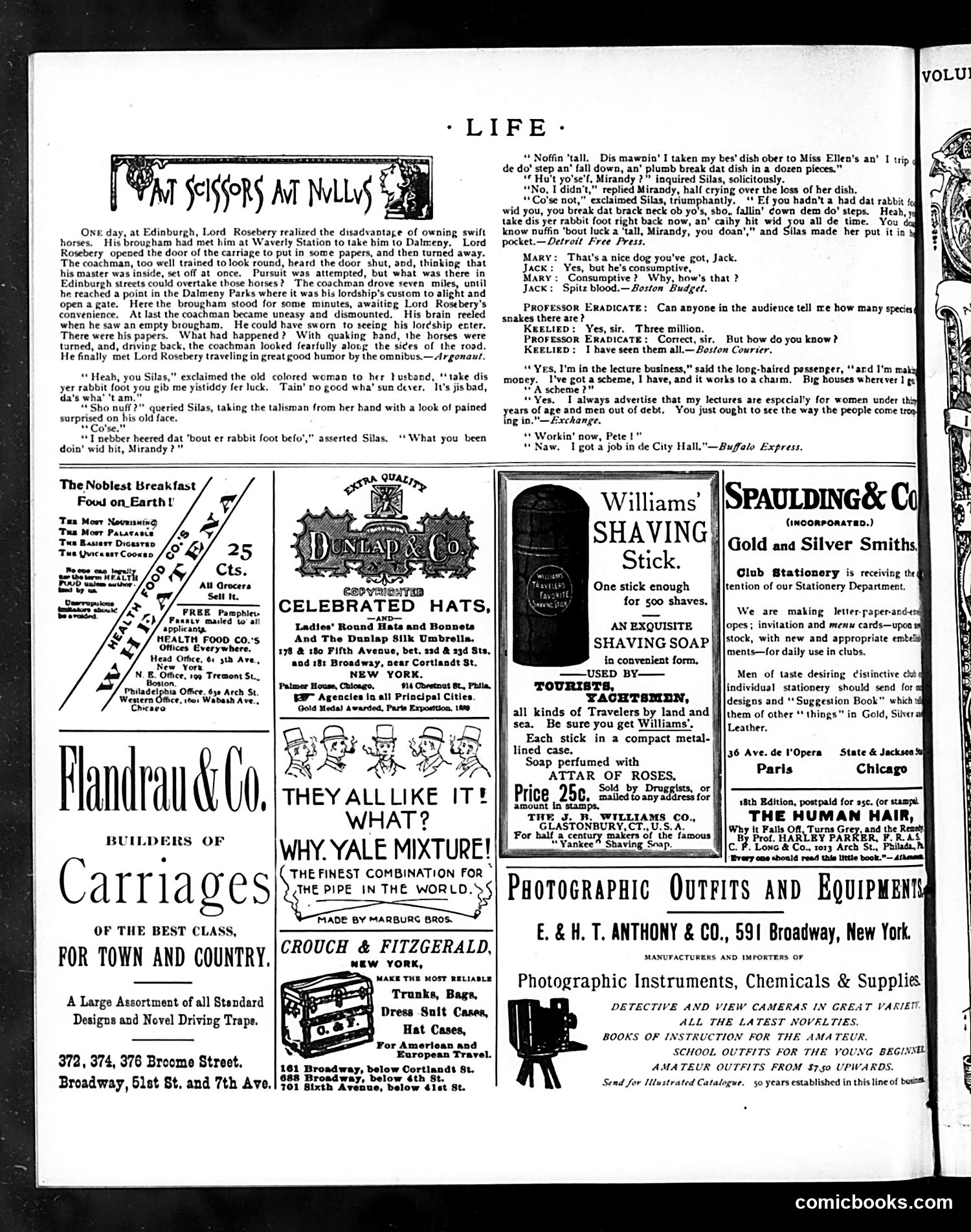
This page mixes **humorous anecdotes** with **advertisements** typical of Life magazine's format circa 1880s-1890s. The main cartoon story involves **Lord Rosebery**, a British politician, whose coachman drives an empty carriage seven miles after his employer steps out to retrieve papers. The joke: a well-trained servant doesn't look back when hearing a door close, so he assumes the lord is inside. The punchline is that Rosebery ends up taking an omnibus (public bus) home—a comic reversal of class expectations. Below this are brief comedic sketches featuring **racial dialect humor** (a dated period convention), including a story about Silas and Mirandy's rabbit's foot charm, and academic jokes about lecture attendance. The page is primarily **advertisements** for products like Dunlap hats, Yale tobacco mixture, Williams shaving soap, and photographic equipment—standard Period advertising. Most content reflects contemporary upper-class British and American humor and consumer culture.