
Life, 1892-10-27 · page 6 of 14
Life — October 27, 1892 — page 6: what you’re looking at
What you’re looking at
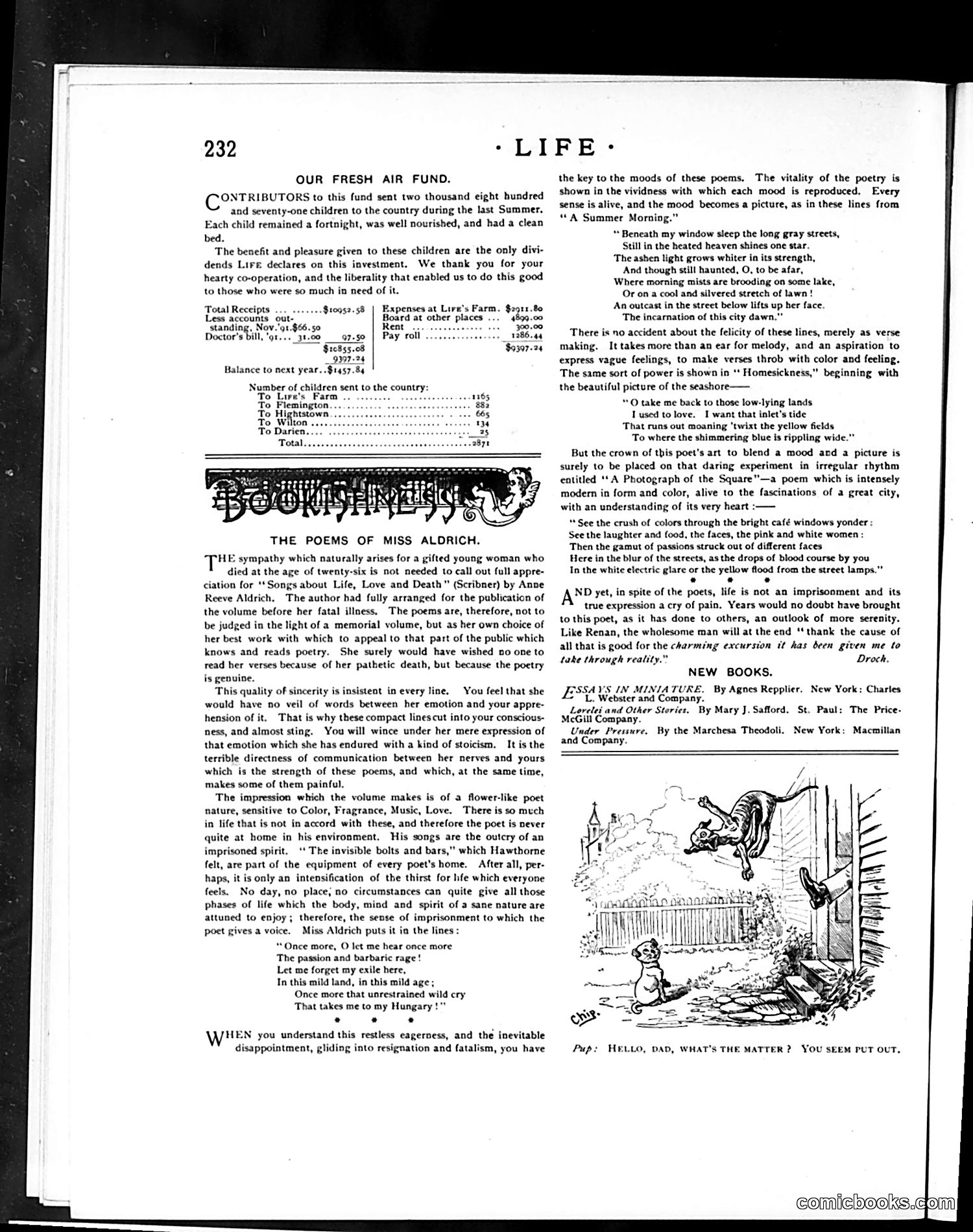
This page contains two main sections: **Left side:** "Our Fresh Air Fund" - a financial report documenting contributions for sending children to the countryside during summer. It lists donations and expenses, concluding with a balance to carry forward. **Right side:** A literary critique of poems by Miss Aldrich, praising her sincere emotional expression and poetic sensitivity. The text emphasizes how her work connects emotion to visual imagery. **Cartoon:** The illustration at bottom shows a child playing outdoors (appearing muddy or dirty) while an adult observes. The caption reads "Hello, dad, what's the matter? You seem put out." This appears to humorously contrast the child's enjoyment of outdoor play with parental concern about cleanliness—likely satirizing tension between children's freedom and adult propriety expectations during the Progressive Era.
📄 Transcribed text from this page (OCR, searchable)
Machine-transcribed from the original scan — historical spelling and the odd misread are preserved.
232 OUR FRESH AIR FUND. CONTRIBUTORS to this fund sent two thousand eight hundred and seventy-one children to the country during the last Summer, Each child remained a fortnight, was well nourished, and had a clean bed. ‘The benefit and pleasure given to these children are the only divi- dends Lire declares on this investment. We thank you for your hearty co-operation, and the liberality that enabled us to do this good to those who were so much in need of it. Total Receipts ... .. ++ $10952.38 Less accounts out- standing, Nov.'9t.$6.s0 Doctor's bill, ’9 Expenses at Live's Farm, $2911.80 Board at other places Rent .. Pay roll 1085, 9397-24 Balance to next year..$1457.84 Number of children sent to the country: To Live's Farm .. ..... To Flemington To Hightstown To Wilton To Darien... THE POEMS OF MISS ALDRICH. THE sympathy which naturally arises for a gifted young woman who died at the age of twenty-six is not needed to call out full appre- ciation for “Songs about Life, Love and Death” (Scribner) by Anne Reeve Aldrich, The author had fully arranged for the publication of the volume before her fatal illness, The poems are, therefore, not to be judged in the light of a memorial volume, but as her own choice of her best work with which to appeal to that part of the public which knows and reads poetry. She surely would have wished no one to read her verses because of her pathetic death, but because the poetry is genuine. This quality of sincerity is insistent in every line, You feel that she would have no veil of words between her emotion and your appre- hension of it. That is why these compact linescut into your conscious- ness, and almost sting. You will wince under her mere expression of that emotion which she has endured with a kind of stoicism, It is the terrible directness of communication between her nerves and yours which is the strength of these poems, and which, at the same time, makes some of them painful. ‘The impression which the volume makes is of a flower-like poet nature, sensitive to Color, Fragrance, Music, Love. There is so much in life that is not in accord with these, and therefore the poet is never quite at home in his environment. His songs are the outcry of an imprisoned spirit.‘ The invisible bolts and bars," which Hawthorne felt, are part of the equipment of every poet's home. After all, per- haps, it is only an intensification of the thirst for life which everyone feels. No day, no place, no circumstances can quite give all those phases of life which the body, mind and spirit of a sane nature are attuned to enjoy; therefore, the sense of imprisonment to which the poet gives a voice. Miss Aldrich puts it ia the lines : “Once more, O let me hear once more The passion and barbaric rage! Let me forget my exile here, In this mild land, in this mild age; Once more that unrestrained wild cry That takes me to my Hungary ! . . * HEN you understand this restless eagerness, and the inevitable disappointment, gliding into resignation and fatalism, you have - LIFE: the key to the moods of these poems. The vitality of the poetry is shown in the vividness with which each mood is reproduced. Every sense is alive, and the mood becomes a picture, as in these lines from “A Summer Morning.” “Beneath my window sleep the long gray streets, Still in the heated heaven shines one star. ‘The ashen light grows whiter in its strength, And though still haunted, O, to be afar, Where morning mists are brooding on some lake, Or on a cool and silvered stretch of lawn ! An outcast in the street below lifts up her face. ‘The incarnation of this city dawn." There is no accident about the felicity of these lines, merely as verse making. It takes more than an ear for melody, and an aspiration to express vague feelings, to make verses throb with color and feeling. ‘The same sort of power is shown in "* Homesickness,” beginning with the beautiful picture of the seashore— *O take me back to those low-lying lands Tused to love. I want that inlet’s tide ‘That runs out moaning ‘twixt the yellow fields To where the shimmering blue is rippling wide.” But the crown of this poet's art to blend a mood ard a picture is surely to be placed on that daring experiment in irregular rhythm entitled ‘A Photograph of the Square"—a poem which is intensely modem in form and color, alive to the fascinations of a great city, with an understanding of its very heart :— See the crush of colors through the bright café windows yonder See the laughter and (ood, the faces, the pink and white wome: Then the gamut of passions struck out of different faces Here in the blur of the streets, as the drops of blood course by you In the white electric glare or the yellow flood from the street lamps."" . ° ° AND vets in spite of the poets, life is not am imprisonment and its true expression a cry of pain. Years would no doubt have brought to this poet, as it has done to others, an outlook of more serenity. Like Renan, the wholesome man will at the end “thank the cause of all that is good for the charming excursion it has been given me to take through reality.” Droch. NEW BOOKS. SSAVS IN MINIATURE. By Agnes Repplier. New York: Charles L. Webster and Company. Lorelei and Other Stories, By Mary J. Safford. St. Paul: The Price- McGill Company. Under Pressure, and Company. By the Marchesa Theodoli. New York: Macmillan HELLO, DAD, WHAT'S THE MATTER ? YOU SEEM PUT OUT, comichooks.qom