
A complete issue · 14 pages · 1892
Life — September 8, 1892
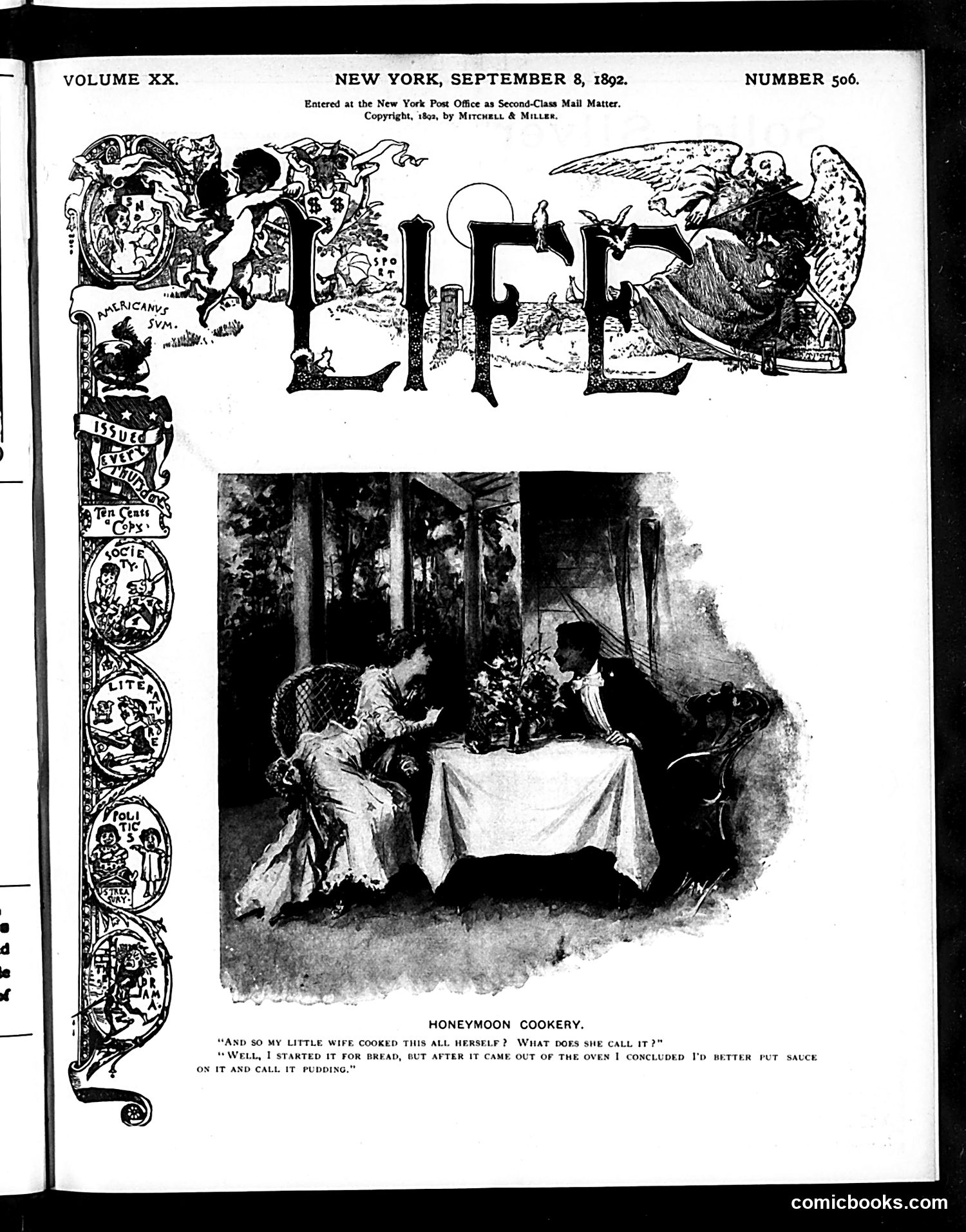
This is a humorous domestic sketch satirizing newlyweds and early marriage. The illustration shows a couple dining outdoors during their honeymoon, with the caption presenting a comedic dialogue: the husband compliments his wife's cooking attempt, but reveals it was so inedible he reinterpreted the failed dish—originally intended as bread—as "pudding" after applying sauce to salvage it. The satire targets newly married women's domestic inexperience and the common trope of the incompetent bride learning to cook. It's gentle humor typical of early 1900s Life magazine, poking fun at romantic ideals versus practical married life. The ornate Art Nouveau title design and decorative border are characteristic of the magazine's visual style from this era.
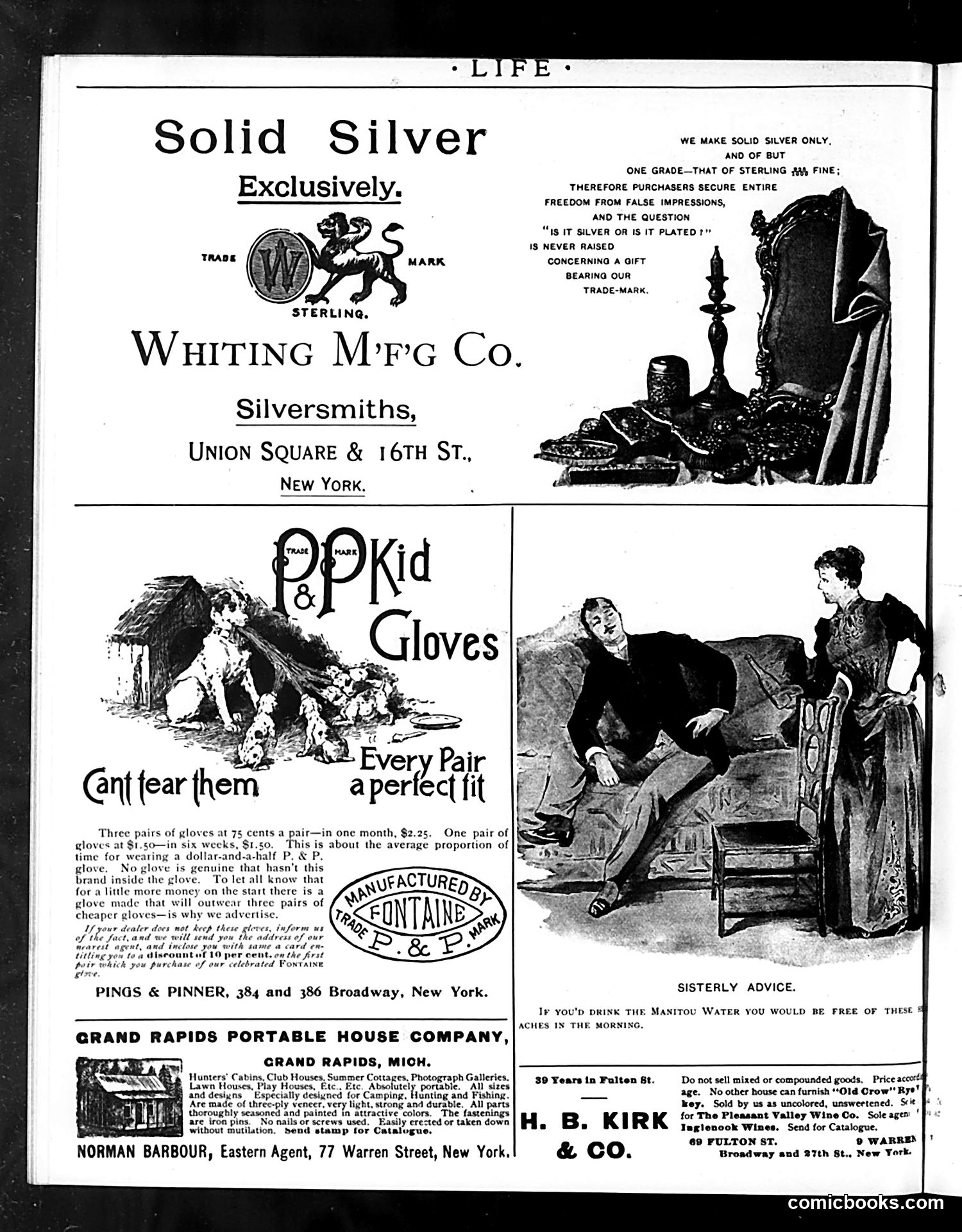
This page is primarily **advertising rather than political satire**. The main content consists of four distinct advertisements: 1. **Whiting M'fg Co.** (top): Silver flatware manufacturer emphasizing their sterling silver quality and trade-mark guarantee. 2. **P&P Kid Gloves** (left): Children's gloves marketed with the promise of durability and perfect fit, priced affordably. 3. **"Sisterly Advice"** (right): A social illustration showing two women, with text about Manitou Water and its health benefits—an advertisement disguised as editorial content about wellness. 4. **Lower advertisements**: Portable houses, H.B. Kirk & Co. wines, and other consumer goods. The page reflects early 20th-century consumer culture with no apparent political commentary or satirical content.
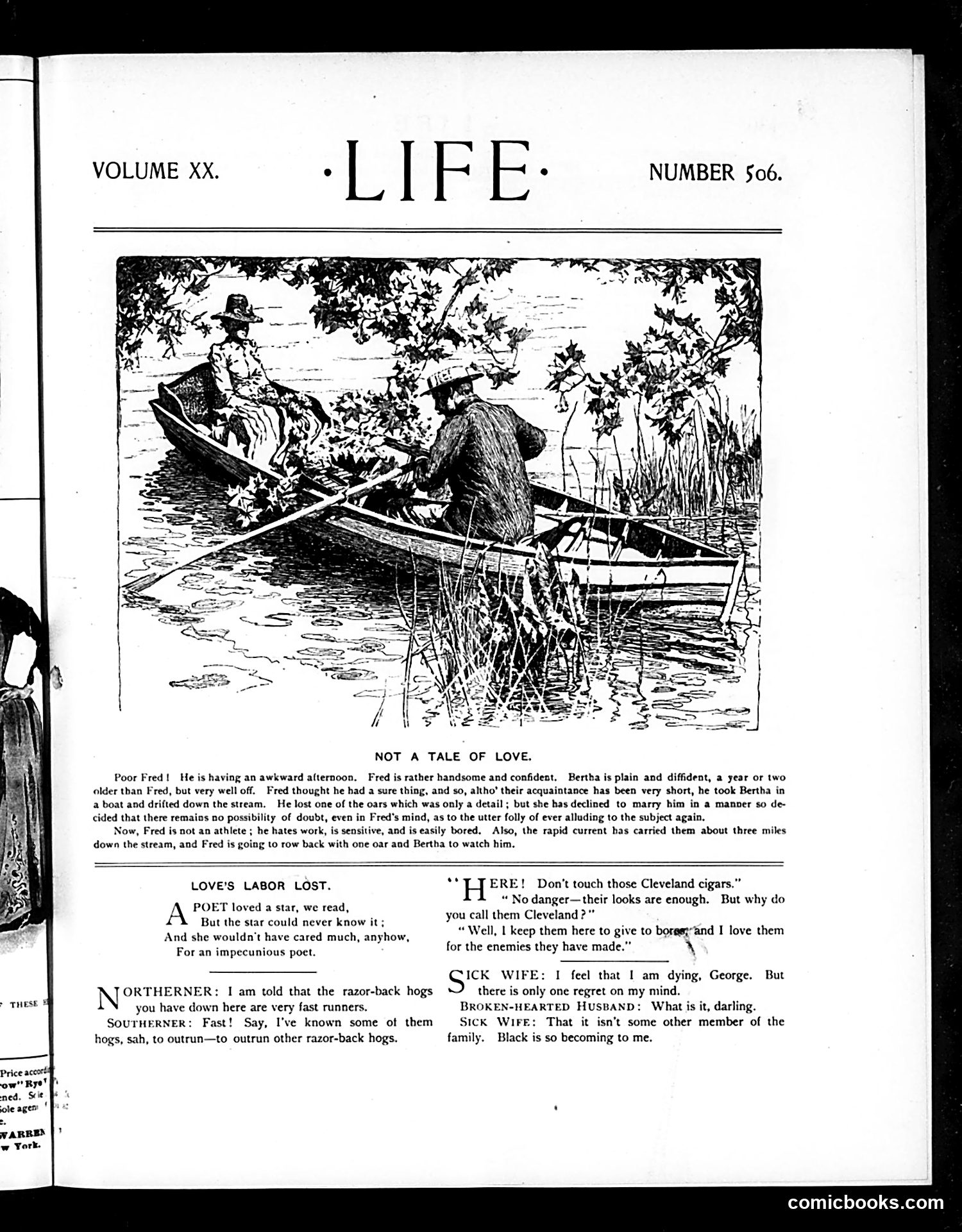
This page from *Life* magazine contains two distinct items: **Top illustration ("Not a Tale of Love")**: A sketch depicting two men in a rowboat with a woman watching from shore. The accompanying text describes Fred, a handsome but indecisive man, and Bertha, a plainspoken woman. The narrative humorously suggests Fred takes Bertha boating to avoid commitment—he's "not an athlete" and easily bored, so he uses the outing as an escape rather than romance. **Bottom section**: Two brief humorous dialogues. "Love's Labor Lost" mocks a poet's unrequited feelings for a star he'll never know. "Sick Wife" presents a domestic joke about a husband keeping Cleveland cigars, which the wife finds ugly enough to cause her "to die"—playing on the cigar's poor reputation. These are light social humor pieces targeting romantic indecision and consumer products of the era, typical of *Life*'s satirical approach to everyday life.
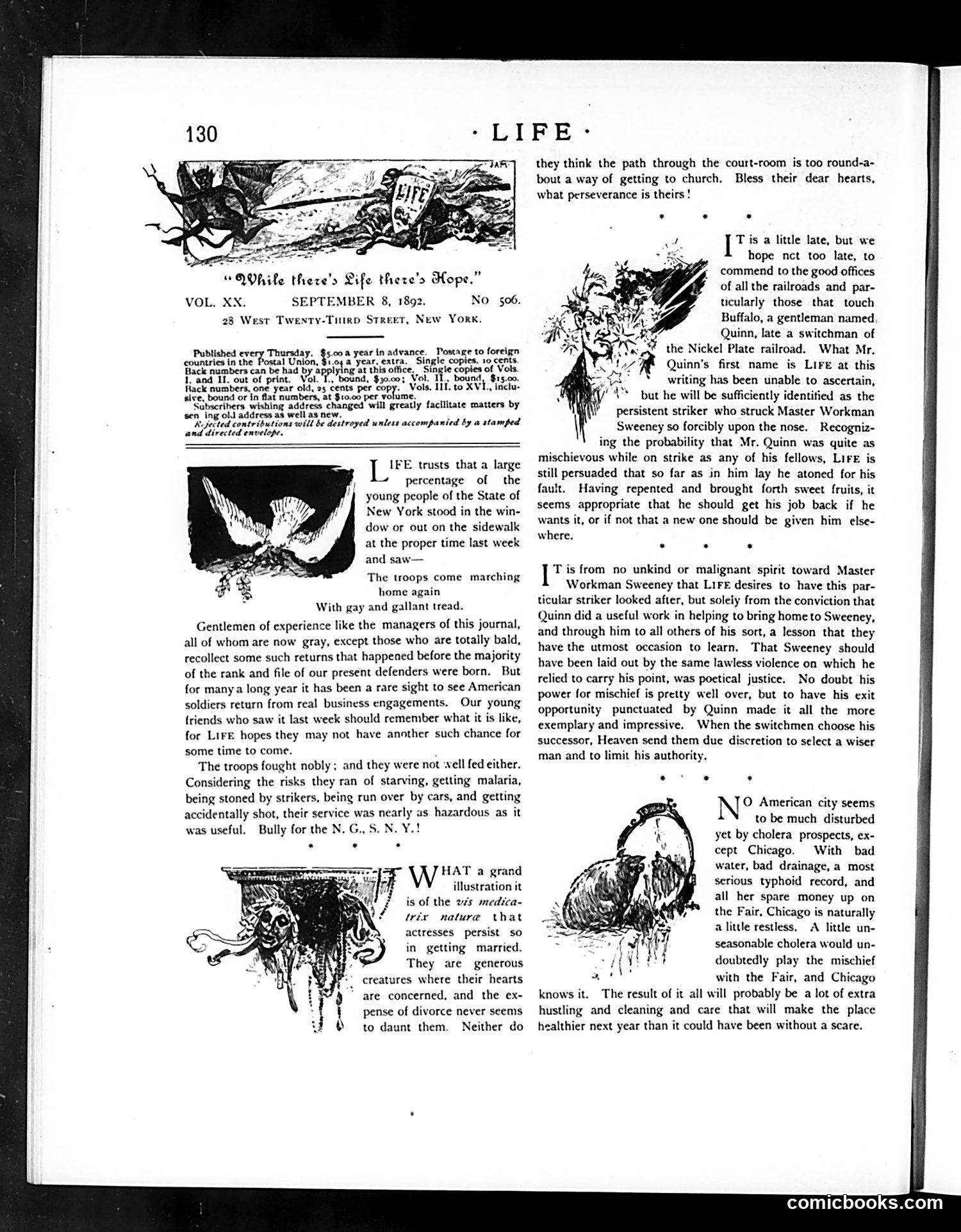
This page contains editorial commentary rather than political cartoons. The main content discusses: 1. **A railroad strike incident**: The text references Master Workman Sweeney of the Knights of Labor being struck on the nose by a switchman named Quinn of the Nickel Plate Railroad. Life presents Quinn's action sympathetically, suggesting Sweeney deserved it for his strike leadership. 2. **Pro-management stance**: The magazine praises Quinn for his "useful work" in confronting labor agitators, framing the assault as poetic justice against a "persistent striker." 3. **Chicago cholera concerns**: Brief commentary on Chicago's cholera fears and the upcoming World's Fair. The illustrations are decorative rather than satirical. Life's perspective clearly favors management over organized labor during this turbulent period of American industrial relations.
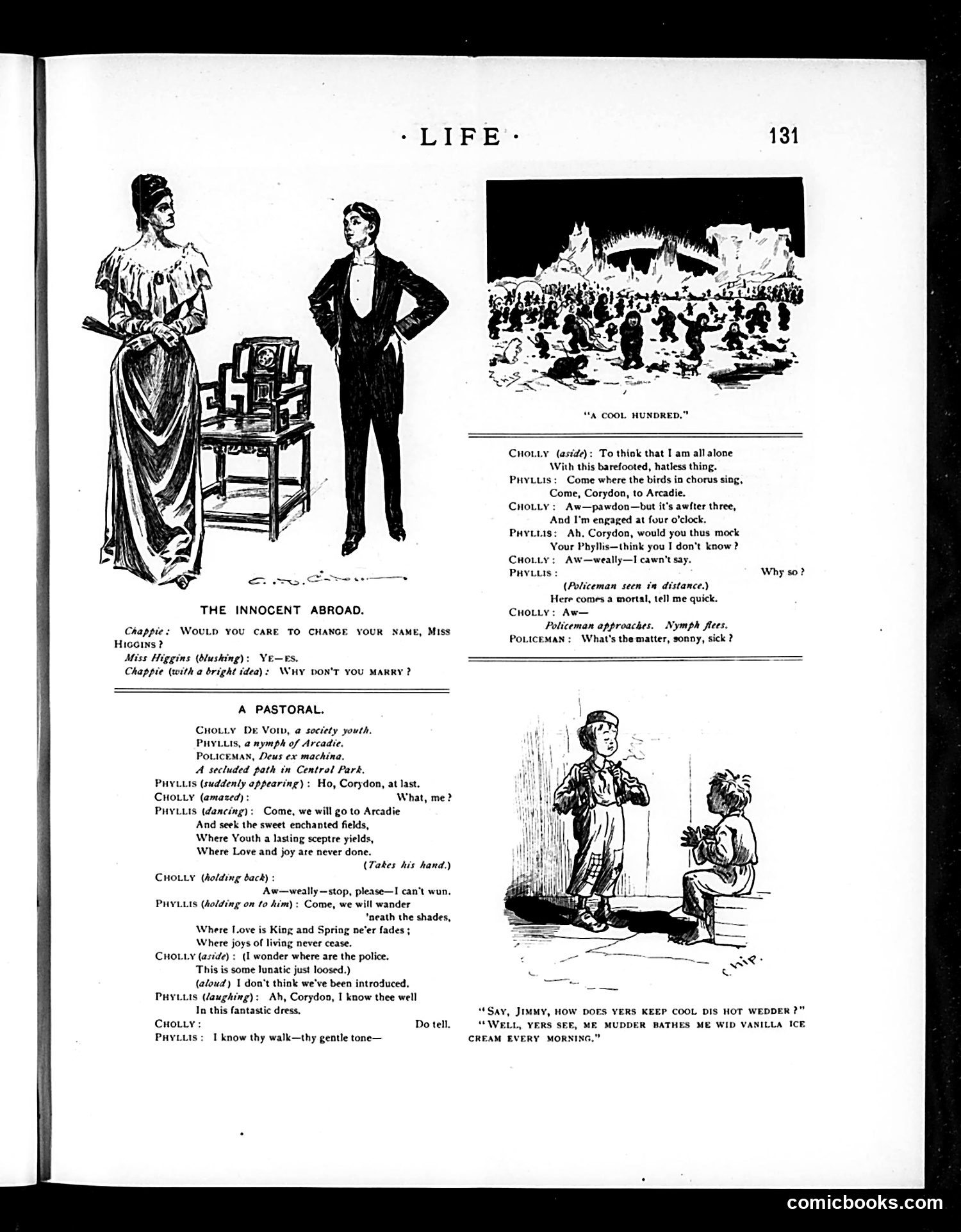
This page contains three separate comic sketches satirizing early 20th-century social conventions: 1. **"The Innocent Abroad"**: A woman considers changing her name to marry a man—satirizing the expectation that women surrender their identity upon marriage. 2. **"A Pastoral"**: Young people (Cholly, Phyllis, and a policeman) discuss romantic encounters in Central Park, poking fun at awkward courtship rituals and the intrusion of authorities into private moments. 3. **"A Cool Hundred"**: A beach scene showing crowds, with dialogue about keeping drinks cold—likely satirizing summer leisure activities and commercialization of recreation. The cartoons collectively mock middle-class social pretensions, romantic conventions, and leisure-time behaviors of the era.
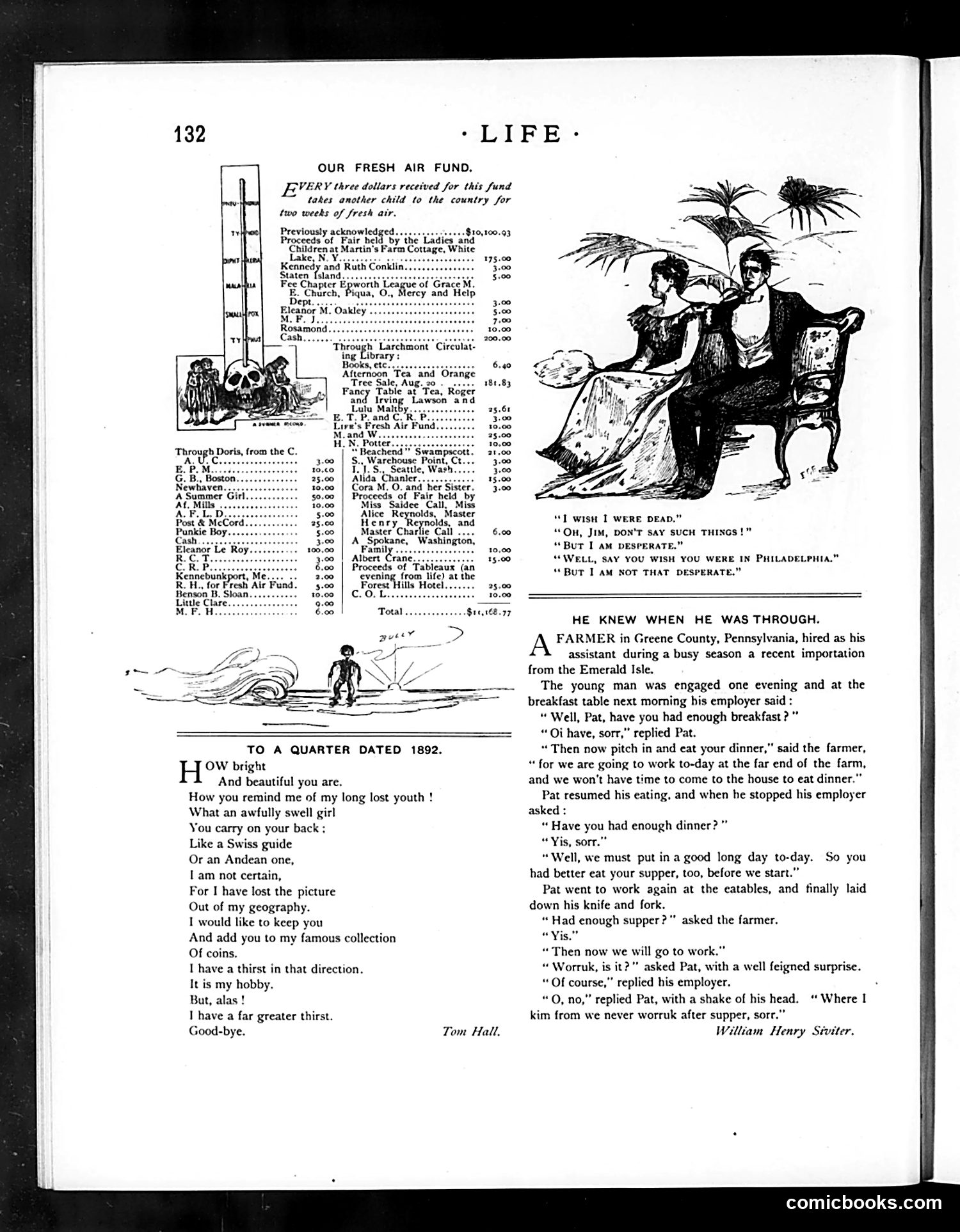
This page contains three distinct pieces: 1. **"Our Fresh Air Fund"** (top left): A fundraising list for sending poor children to the countryside for health benefits—a genuine Progressive-era charitable cause, not satire. 2. **"To a Quarter Dated 1892"** (bottom left): A sentimental poem by Tom Hall about lost youth and romance, addressed to a coin from that year. This appears to be nostalgic verse rather than satire. 3. **"He Knew When He Was Through"** (right): A humorous anecdote about an Irish farm worker named Pat who, after being asked repeatedly whether he's eaten enough, decides working on a full stomach causes indigestion and quits. The joke plays on Irish immigrant stereotypes and working-class attitudes toward labor. The page mixes charitable notices, sentimental poetry, and comedic fiction typical of Life's varied content.
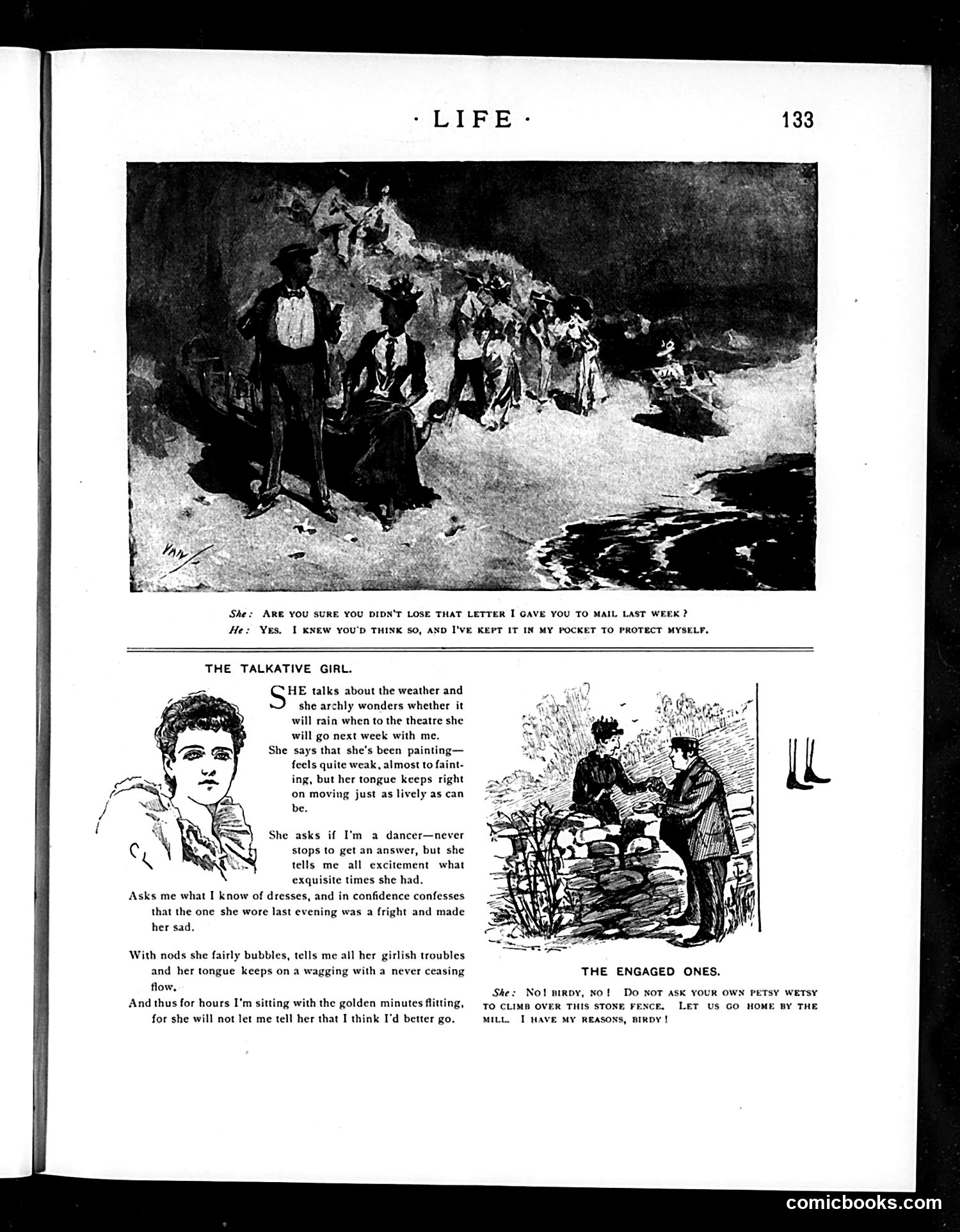
This page contains two separate humorous sketches about courtship and relationships, typical of Life magazine's satirical social commentary. **"The Talkative Girl"** depicts a woman who talks constantly—about weather, theater, dresses, and her troubles—while a man sits passively listening. The satire targets the stereotype of chatty women and patient (or long-suffering) male suitors. **"The Engaged Ones"** shows a couple where the woman wants to climb a stone fence, but the man refuses, citing vague "reasons" and suggesting they go home instead. The humor lies in his mysterious reluctance and her casual dismissal of his concerns—satirizing the dynamics of engaged couples and conflicting desires in relationships. Both sketches employ period stereotypes about gender roles and courtship behavior for comedic effect.
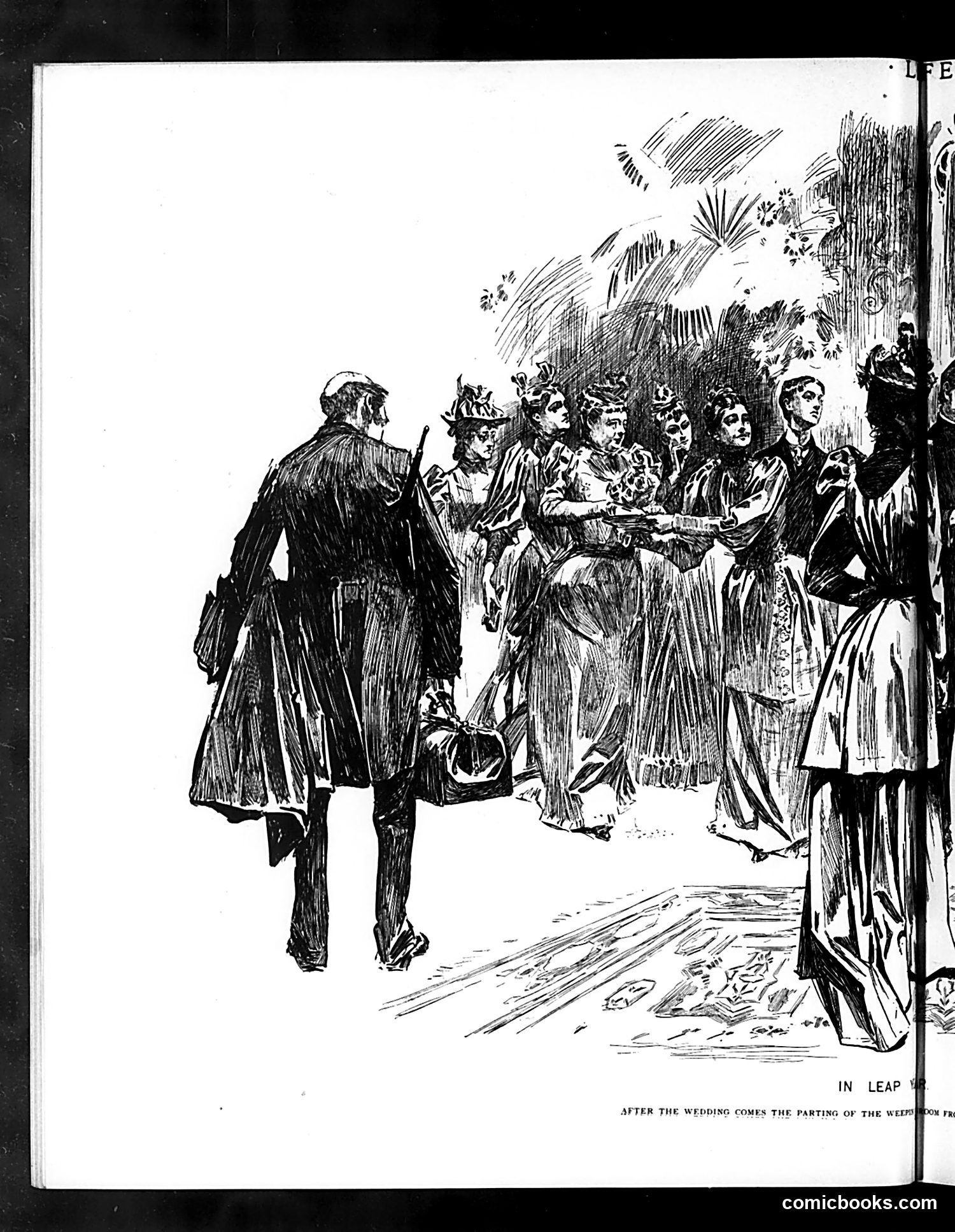
This illustration depicts a social scene from what appears to be a satirical piece titled "In Leap Year: After the Wedding Comes the Parting of the Weeds" (text partially obscured). The image shows a man in a dark coat approaching a group of elegantly dressed women at what seems to be a formal social gathering. The caption's reference to "leap year" and "parting of the weeds" suggests satire about courtship customs, likely mocking the tradition where women could propose to men during leap years. The cartoon appears to satirize gender role reversals and social expectations around marriage proposals. The man's hesitant posture contrasted with the women's apparent assertiveness suggests commentary on women taking the romantic initiative—a transgressive idea for the era in which this was published, making it humorous through its violation of Victorian social norms regarding female passivity in courtship.
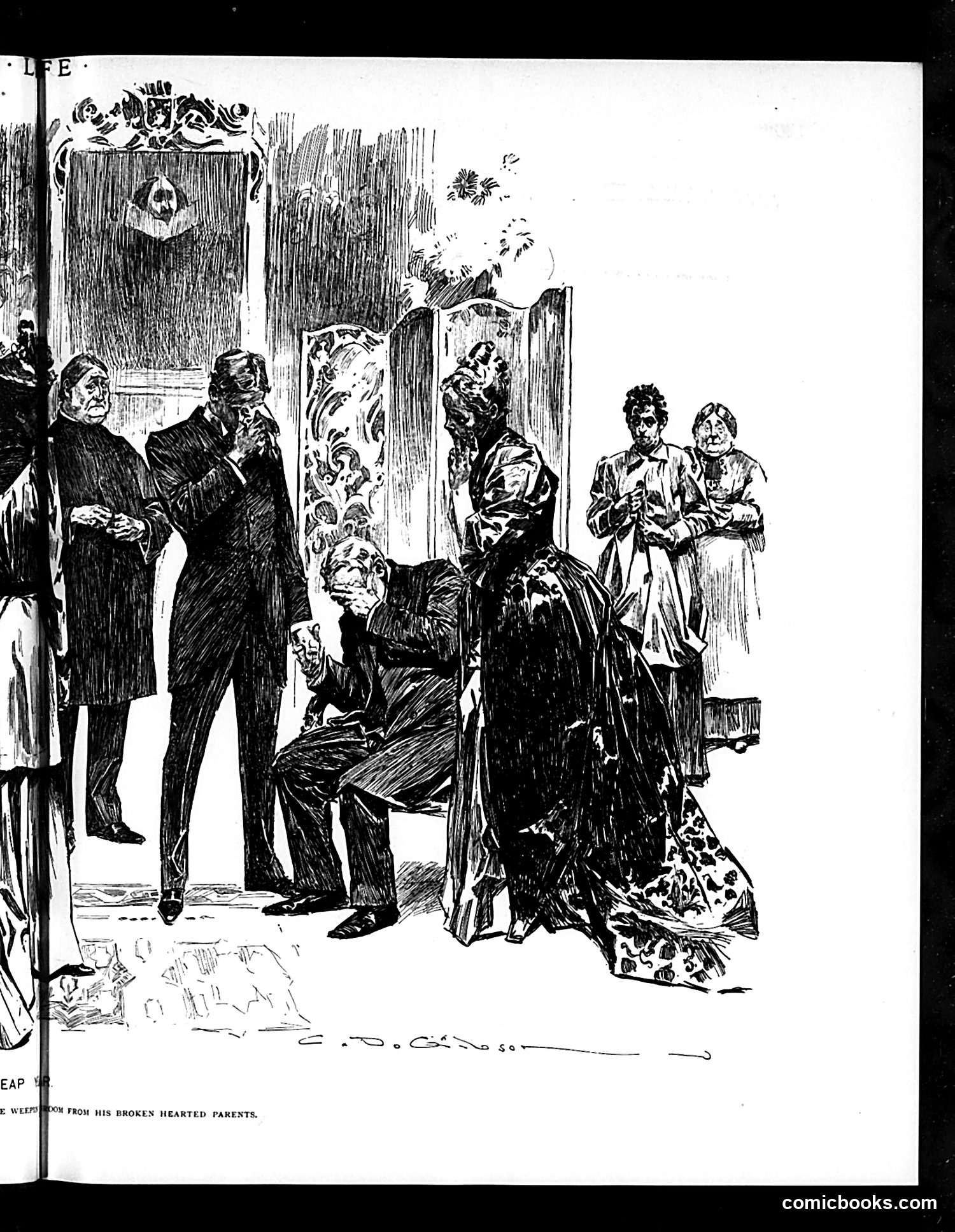
This appears to be a satirical illustration from *Life* magazine showing a domestic scene with social commentary. The caption reads "WEEP FROM HIS BROKEN HEARTED PARENTS" (though partially obscured). The image depicts what seems to be a formal or official setting—note the coat of arms above—where a seated woman appears distressed while men in formal dress stand around her. The elaborate dress and formal interior suggest this concerns upper-class or aristocratic figures. Without clearer text or visible date, I cannot identify the specific political or social scandal being referenced. The scene suggests commentary on family shame, possibly involving a son's misconduct affecting his parents' reputation—a common satirical theme in the era. The formal setting and the woman's apparent anguish are key to the joke's emotional point. Further context about publication date and authorship would be needed for precise identification.
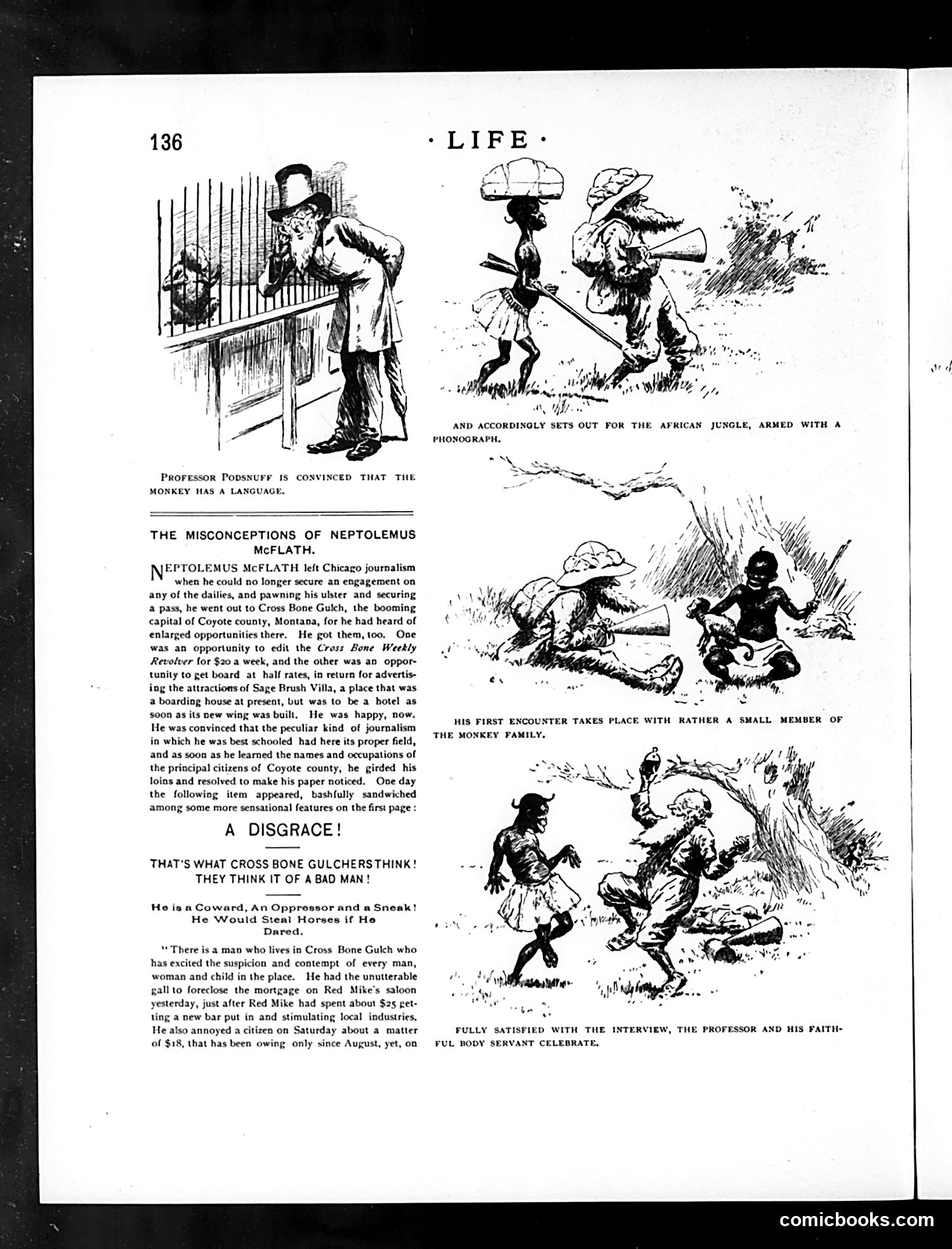
This satirical article mocks a Chicago journalist named Nepotolemus McFlath who left newspaper work to pursue failed business ventures in Montana, including editing the *Cross Bone Weekly Knocker* and attempting to convert a boarding house into a hotel. The accompanying illustrations show McFlath's mishaps in the African jungle, where he encounters monkeys while armed with a phonograph. The satire targets his pretensions and incompetence—he's portrayed as a coward and sneak who makes grandiose claims while bungling every enterprise. The piece exemplifies *Life* magazine's humor: deflating self-important figures through exaggerated narrative and caricature. The monkey encounters visualize his ridiculous aspirations, suggesting his schemes are absurdly misconceived.
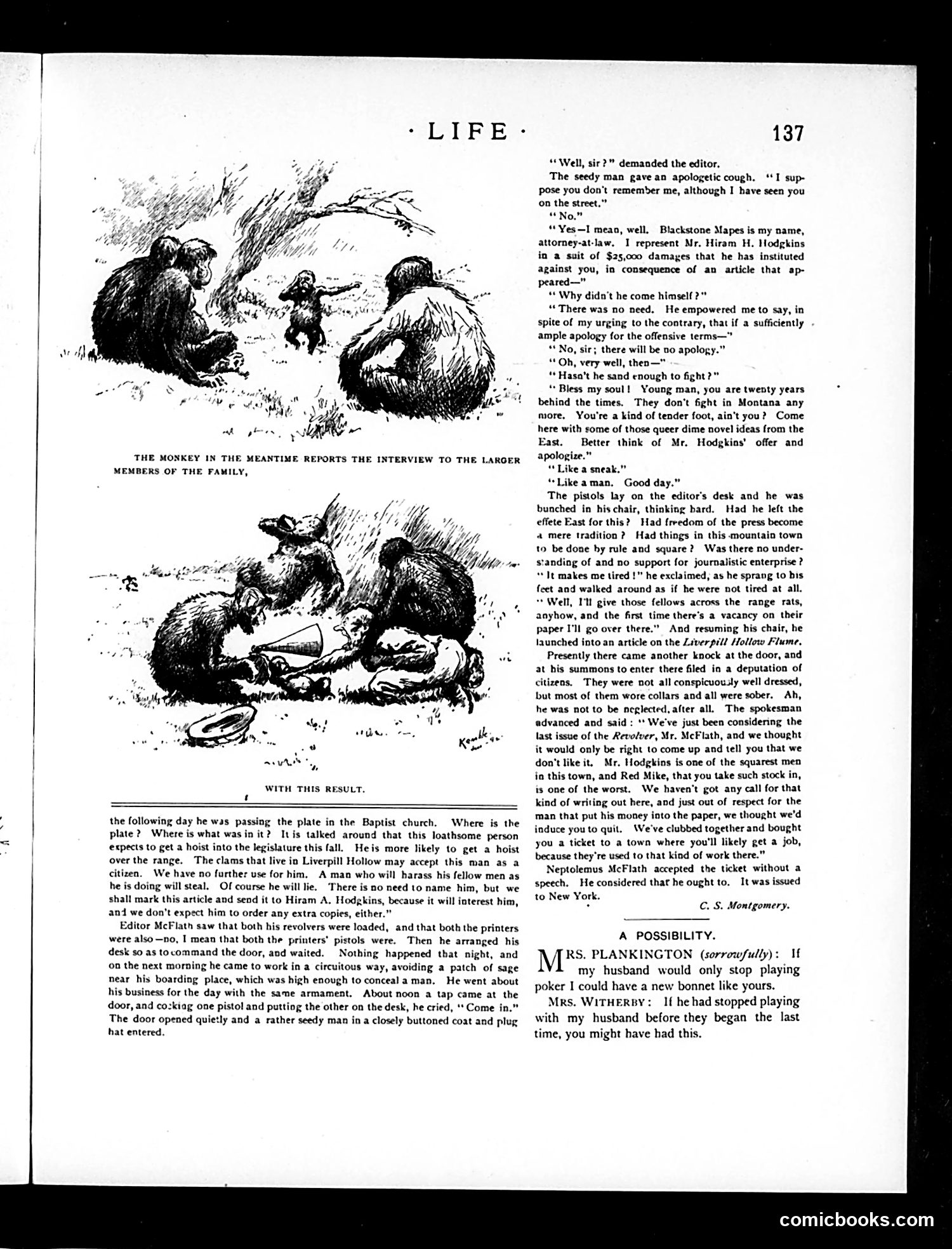
This page from *Life* magazine contains two satirical cartoons about a small-town newspaper conflict. The story (in text and illustrations) depicts an editor being threatened by local citizens angry over a published article. The cartoons show monkeys reporting an "interview" to larger family members, sarcastically comparing the townspeople's behavior to animals. The satire targets: - **Small-town intolerance** of press criticism - **Anti-intellectual sentiment** (comparing citizens to primates) - **Censorship attempts** against journalists who publish unflattering articles The final section presents a humorous advice column where Mrs. Plankington jokingly suggests her husband stop playing poker if he won't tolerate losing—satirizing self-deception and blame-shifting. The overall message critiques provincial attitudes toward journalism and personal responsibility.
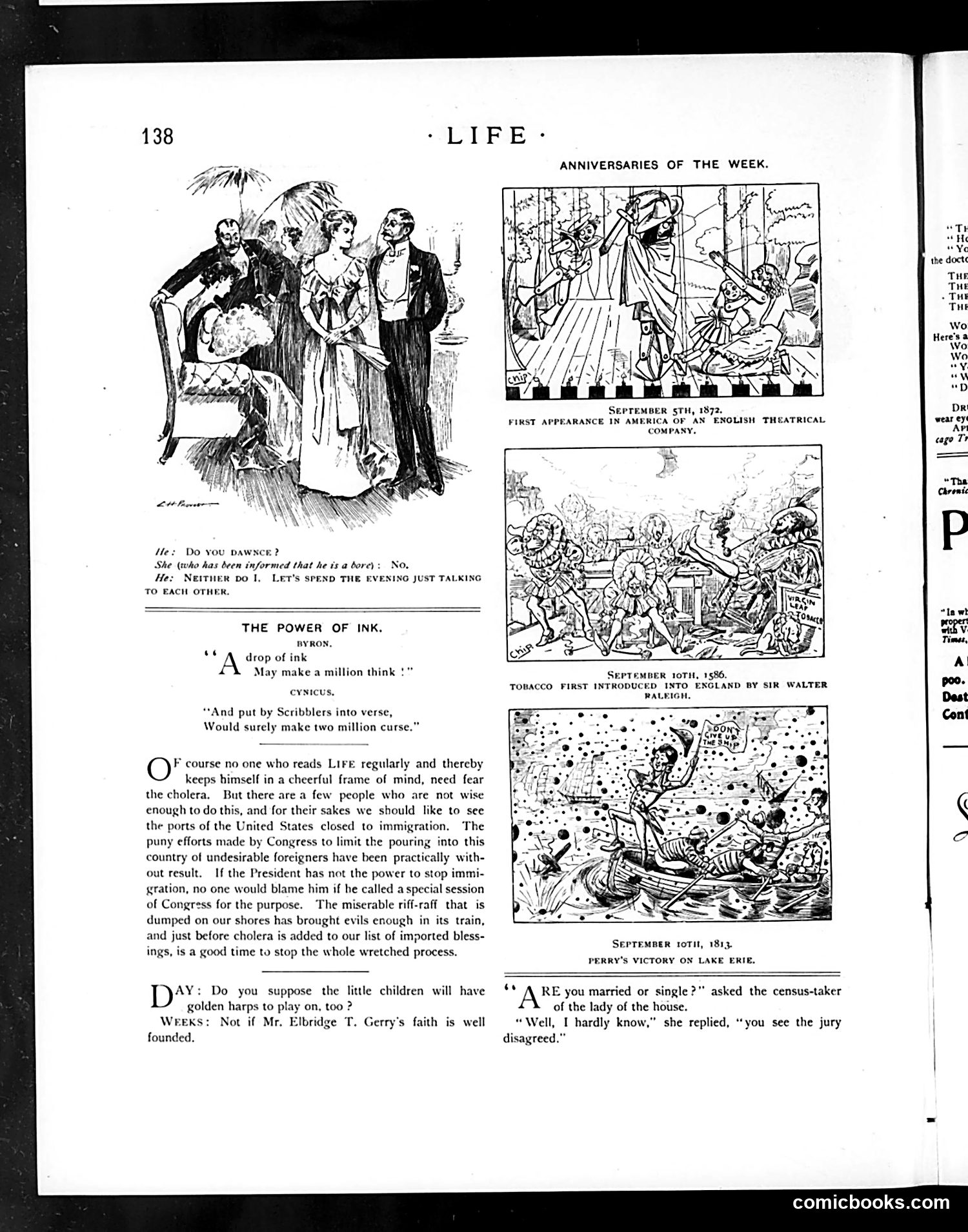
This page contains several distinct satirical pieces: **Top cartoon:** A social joke about a bore at a party, where the woman suggests they spend the evening "just talking to each other"—implying mutual tedium. **"The Power of Ink" section:** A brief editorial satirizing immigration policy. Life argues the U.S. should close ports to immigrants, blaming "undesirable foreigners" and "riff-raff" for bringing disease and social problems. The piece appears anxious about cholera arriving via immigration—a xenophobic response common during 19th-century disease panics. **Historical anniversaries:** Three illustrated vignettes marking dates: an English theatrical company's 1872 American debut, tobacco's introduction to England (1586), and Commodore Perry's 1813 Lake Erie naval victory. **Bottom joke:** A census-taker asks a woman her marital status; she replies the "jury disagreed"—a joke suggesting legal dispute over her marital status, likely referencing divorce or contested marriage. The page reflects period anxieties about immigration, disease, and social propriety typical of 1870s-80s American humor.
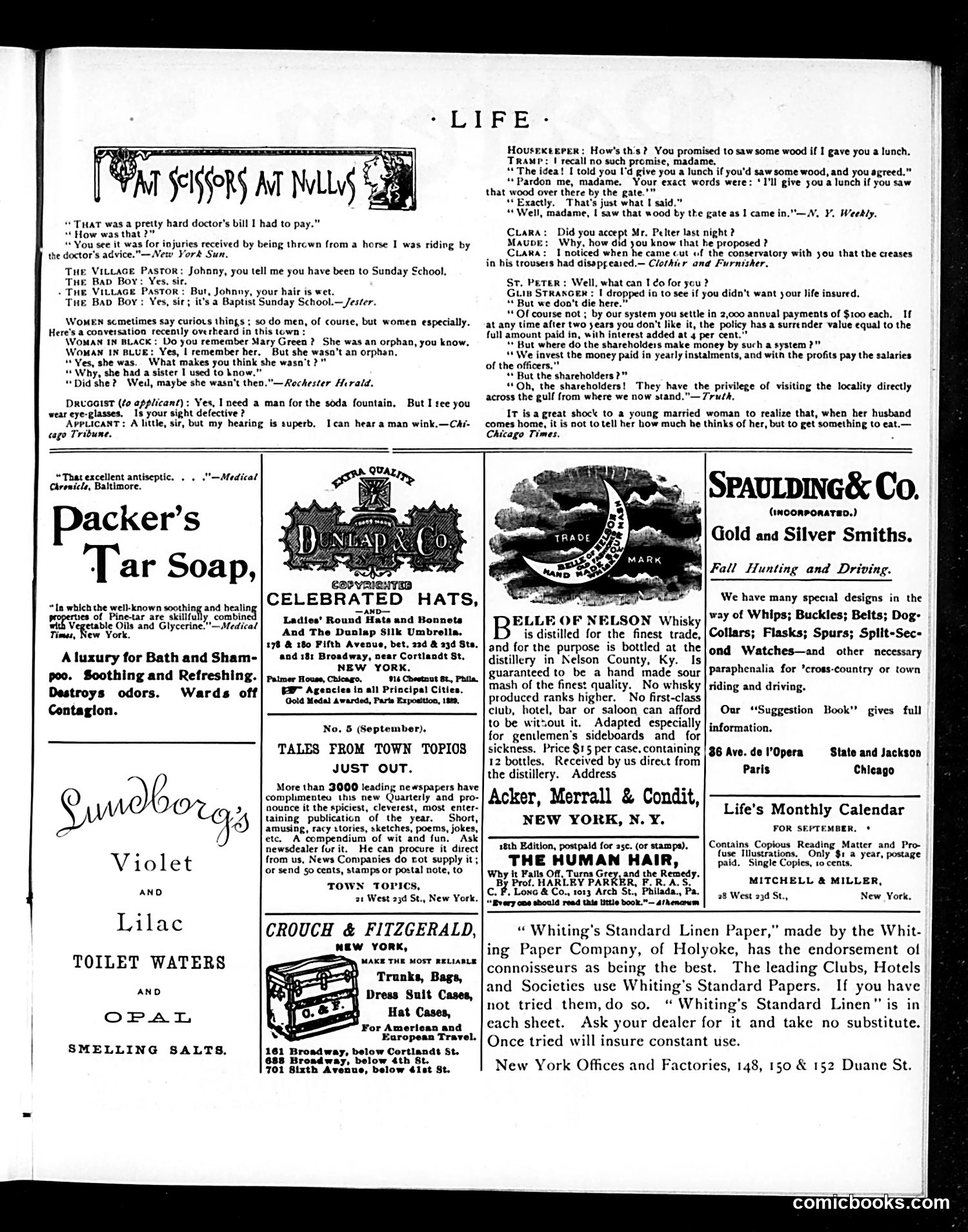
This page from *Life* magazine (appears to be late 19th century) contains several brief humorous anecdotes and jokes rather than a single political cartoon. The title "Scissors at Nullus" refers to the magazine's practice of reprinting short, witty observations clipped from newspapers. The jokes satirize everyday human behavior: a pastor's logical confusion about orphans, a soda fountain applicant's defective vision, a tramp's clever wordplay about a promise, and a woman realizing her husband cares more about dinner than romance. One joke mocks insurance salesmen's persistence, another pokes fun at the social awkwardness of marriage proposals. The humor is gentle, domestic satire targeting common social situations and human foibles rather than political issues. This reflects *Life*'s emphasis on lighthearted social commentary alongside its advertising content.
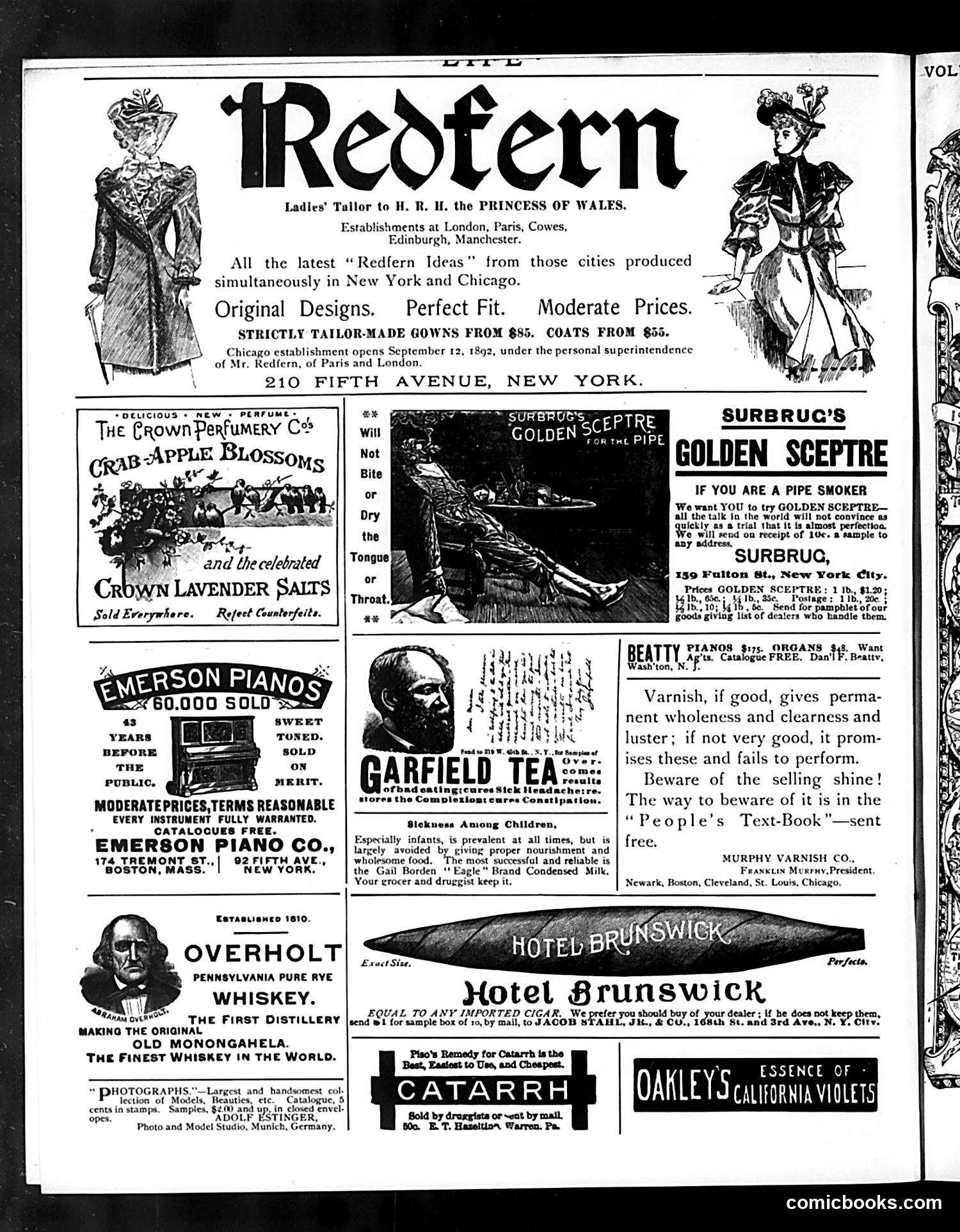
This page is primarily **advertising**, not satirical content. It's from Life magazine circa 1892, featuring luxury and consumer product ads typical of the era. The ads target affluent readers: Redfern offers high-end women's tailoring ($85+ gowns); Emerson Pianos emphasizes quality and "moderate prices"; Overholt whiskey claims superiority; Crown Perfumery and Oakley's Violets offer cosmetic luxuries. Notable is the **Garfield Tea ad**, featuring a portrait of what appears to be James Garfield (20th U.S. President, assassinated 1881). The ad claims the tea cures headaches and childhood sickness—typical patent medicine advertising of the period, making health claims now considered fraudulent. The Hotel Brunswick and Surbruc's Golden Sceptre pipe tobacco ads round out offerings for gentlemen's leisure. There is **no political satire** on this page—it's a commercial product showcase reflecting Gilded Age consumer culture and the advertising conventions of 1890s American magazines.