
A complete issue · 16 pages · 1892
Life — August 4, 1892
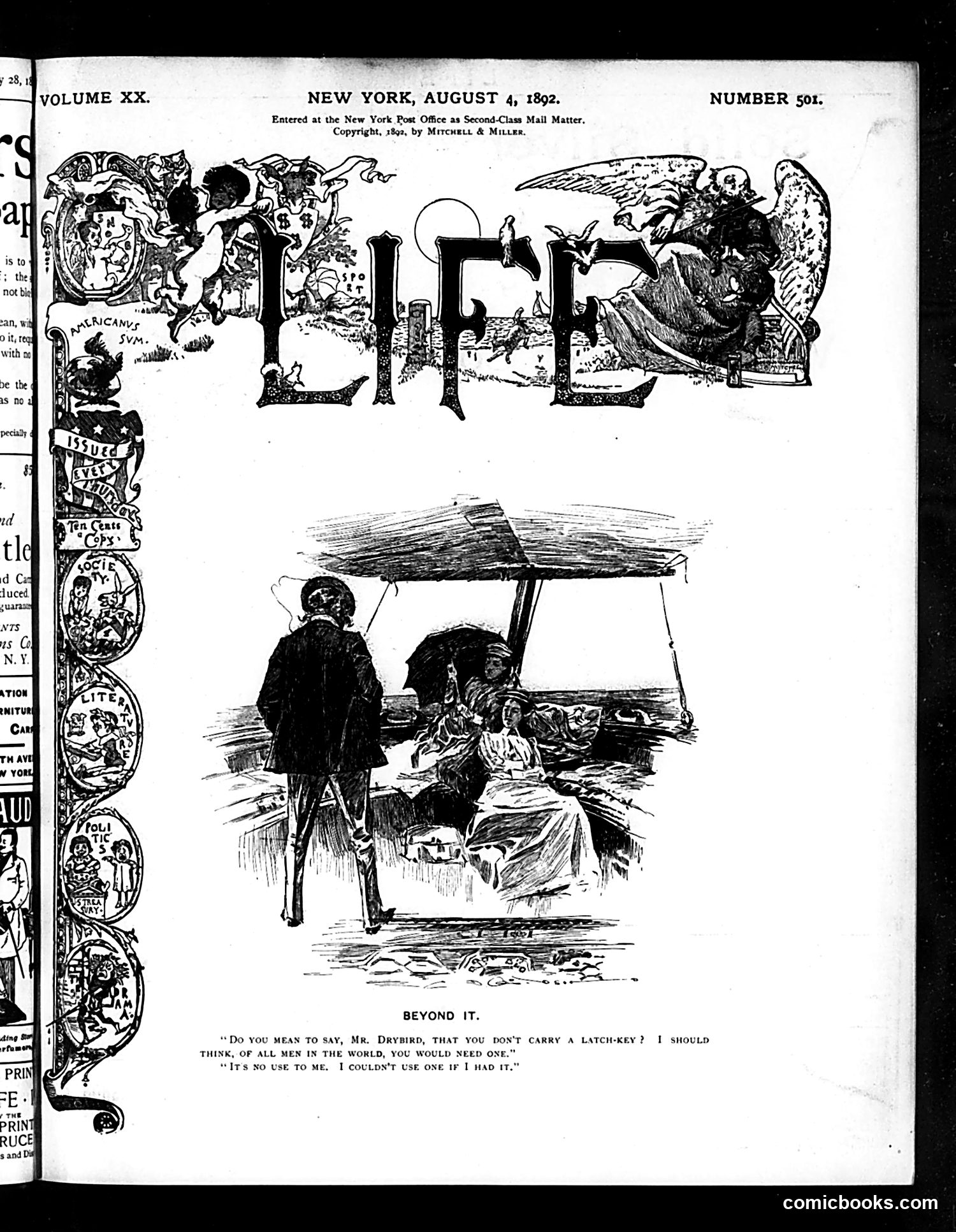
This cartoon satirizes a conversation between two men under a beach umbrella. One man (identified as "Mr. Drybird" in the dialogue) is being challenged about not carrying a latch-key. His interlocutor suggests that among all men in the world, he'd be the only one who couldn't use one if he had it—implying Drybird is either incompetent or sexually inexperienced/impotent. The humor relies on the double meaning of "latch-key"—both a literal key and a euphemism. The title "Beyond It" suggests Drybird has moved past such concerns, possibly through age or circumstance. The cartoon mocks masculine inadequacy through wordplay typical of 1890s satirical humor.
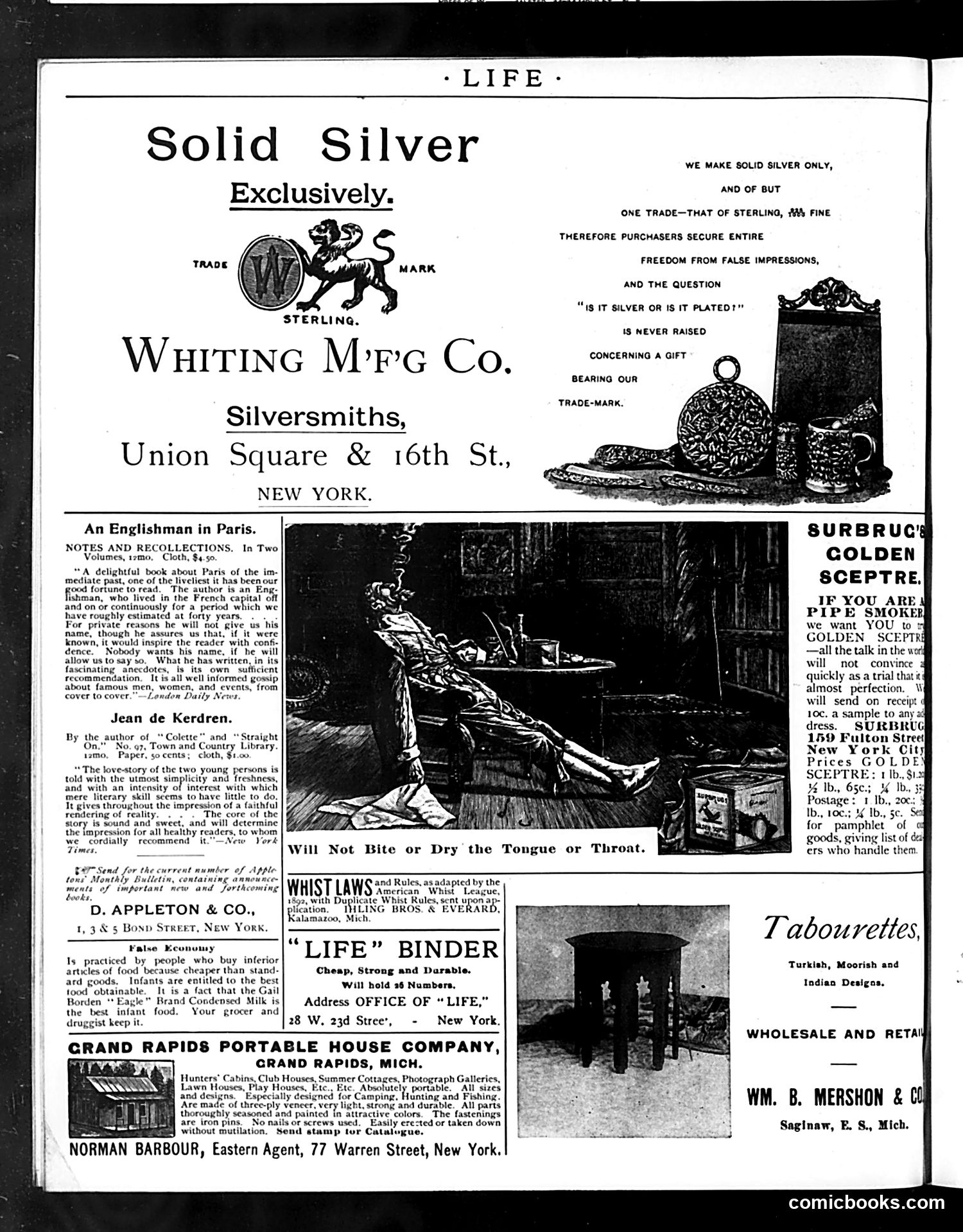
This page is primarily **advertising**, with no political cartoon present. The main content features ads for: - **Whiting Mfg Co.** (solid silver goods) - **Surbrack's Golden Sceptre** (apparently a cleaning product) - **Life Binder** (a bookbinding product) - **Grand Rapids Portable House Company** - **Tabourettes** (decorative furniture) There is one illustration labeled "Will Not Bite or Dry the Tongue or Throat" accompanying what appears to be a product advertisement, but it's unclear what specific product this references. The page also contains literary excerpts ("An Englishman in Paris" and "Jean de Kerdren"), but these are promotional content rather than satirical commentary. This is a standard commercial page with minimal editorial satire.
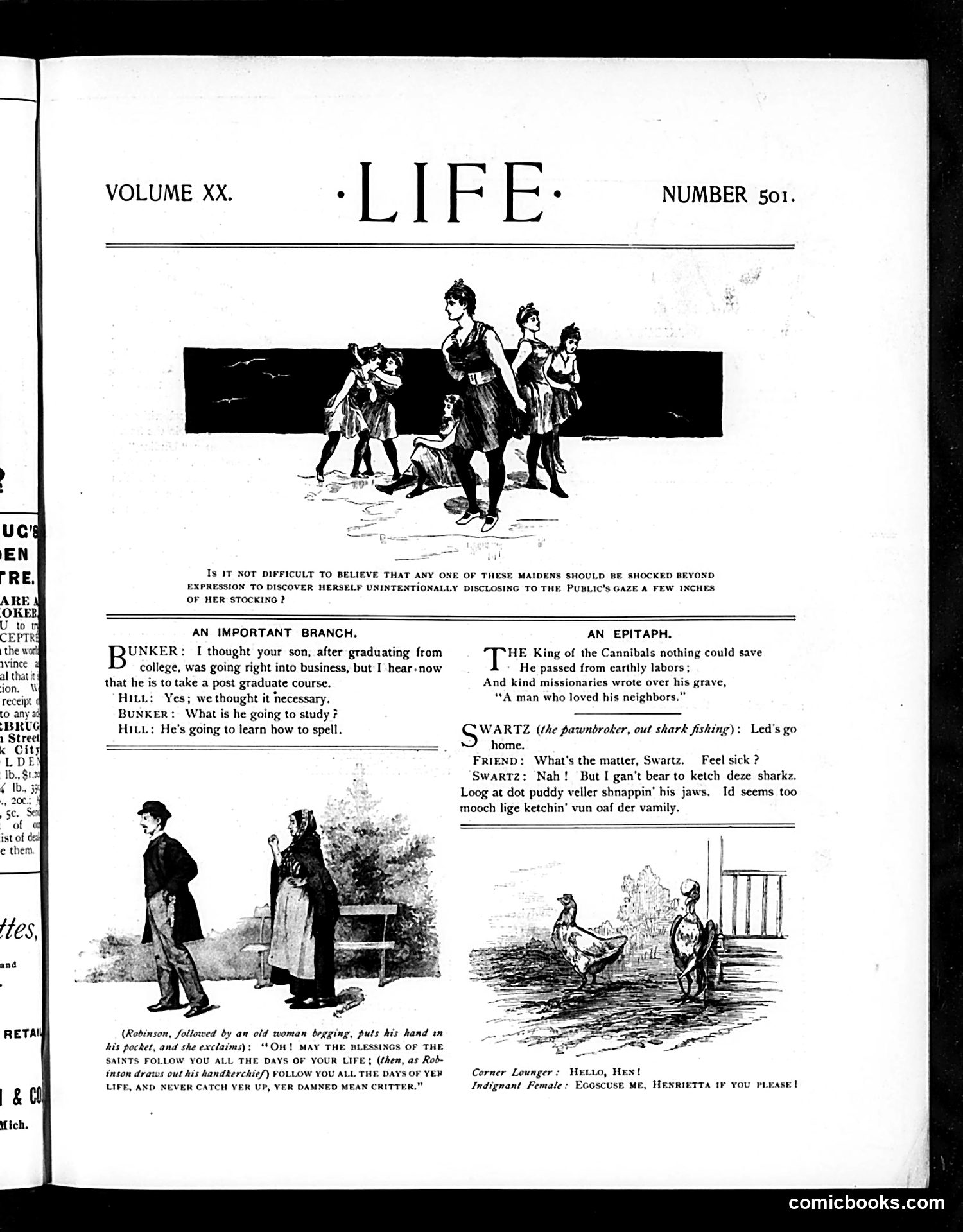
This page contains three separate humorous sketches rather than political cartoons: 1. **Top illustration**: Shows maidens with exposed stockings, captioned about their shock at public disclosure—likely satirizing Victorian prudishness about women's leg visibility. 2. **"An Important Branch"**: A dialogue joke about a college graduate pursuing "post graduate course" in spelling, playing on educational pretensions. 3. **"An Epitaph"**: A dark humor piece about a cannibal king, followed by a fishing anecdote featuring characters named Swartz and Friend discussing a shark. 4. **Bottom sketch**: Shows a man offering blessings to a woman, with caption referencing St. Swallow's day—appears to be sentimental domestic humor. The page is primarily light satirical humor and wordplay rather than political commentary, typical of Life's general entertainment content from this era.
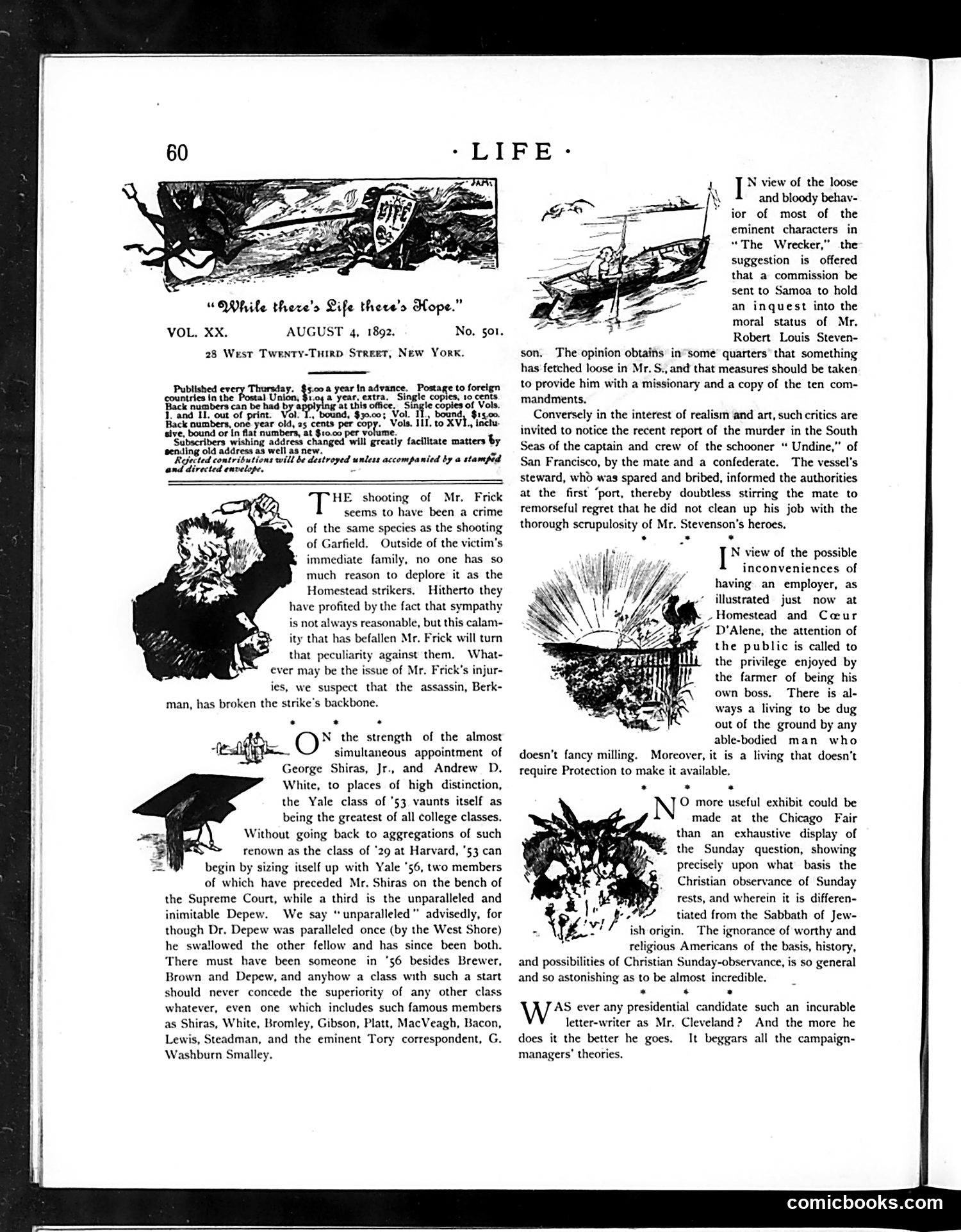
This page from Life magazine (Vol. XX, August 1, 1892) contains several satirical commentaries on contemporary issues: **The Frick Shooting**: The main article discusses Mr. Frick's shooting, noting it was "a crime of the same species as the shooting of Garfield." This appears to reference labor violence during the Homestead Strike, where sympathizers attacked management figures. The text defends strikers' broader cause while condemning the violence. **College Class Superiority**: Another section mocks Yale '56's claim to superiority among college classes, satirizing their boasting about prestigious members like Shirley and White. **Sunday Observance**: A final piece critiques American ignorance about Christian Sunday's origins versus the Jewish Sabbath. The illustrations are period political cartoons accompanying these satirical commentaries on labor violence, academic pretension, and religious practices.
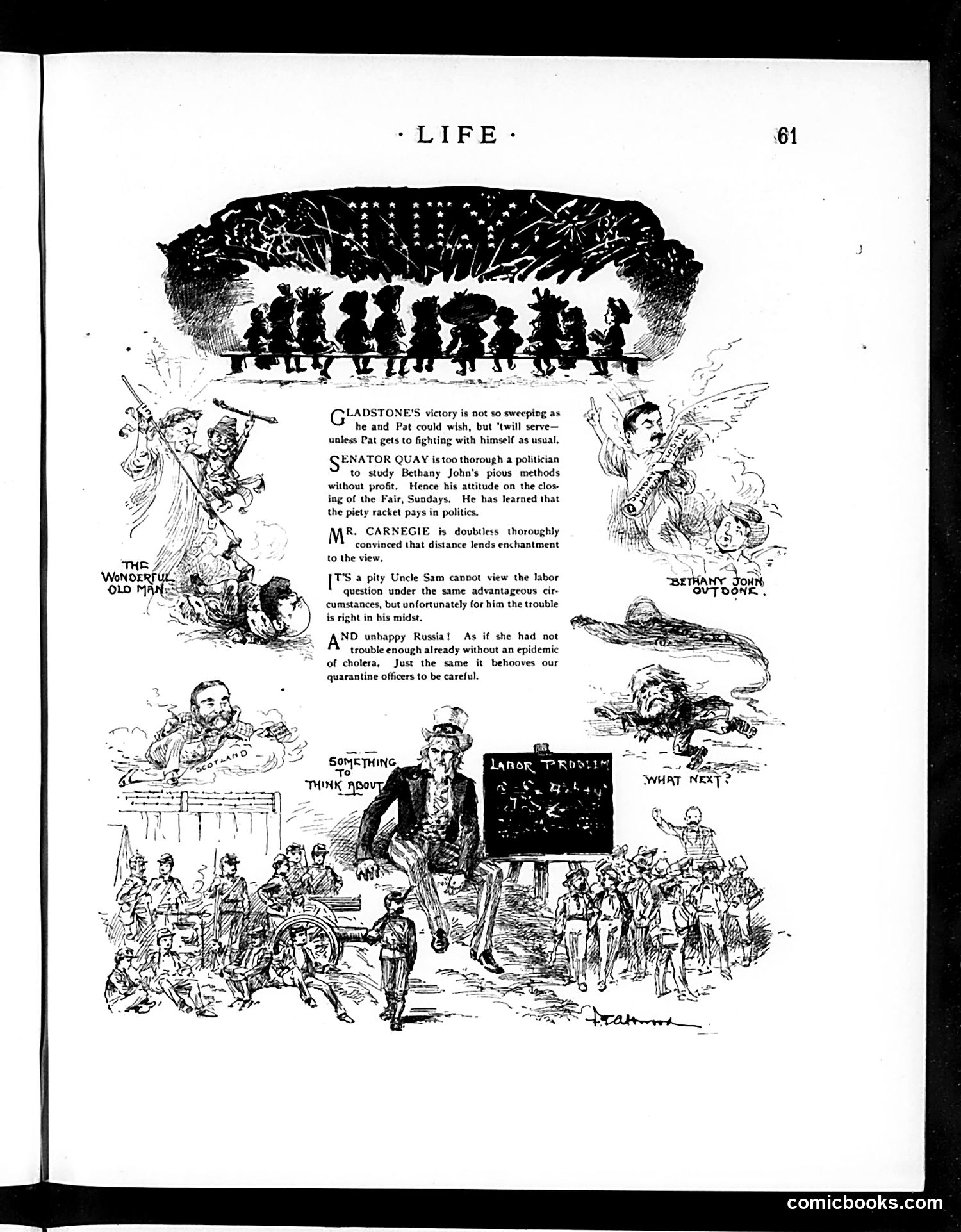
This page contains satirical commentary on contemporary political figures and issues. The text explicitly names **Gladstone, Senator Quay, and Mr. Carnegie**, critiquing their political positions and methods. The lower cartoon depicts a large figure (likely a political leader) presiding over crowds while holding a "Labor Problem" sign, with someone asking "What next?"—mocking political evasion of labor disputes. The top illustration shows silhouettes of people gathered in what appears to be a confined space, possibly referencing overcrowding or social conditions. "The Worshipful Old Man" and "Bethany John Out Gone" are labeled figures, though their specific identities are unclear from the image alone. The satire targets political hypocrisy, particularly around labor issues and the exploitation of piety for political gain during this period.
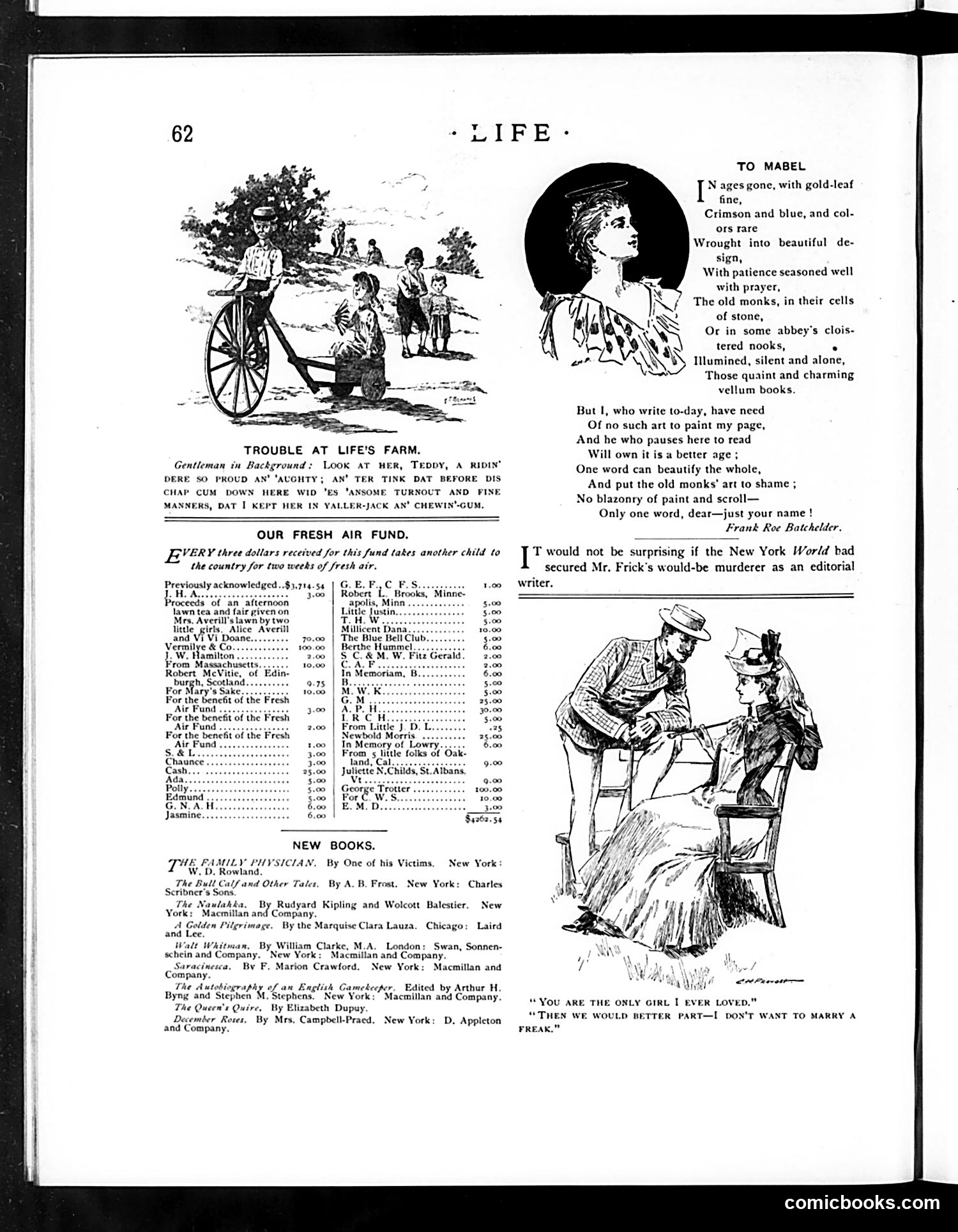
**"Trouble at Life's Farm"** depicts a gentleman scolding a child labeled "Teddy" (likely Theodore Roosevelt) for bad manners. The caption notes the speaker kept his temper despite Teddy's "turnout and fine manners." This appears to be political satire about Roosevelt's behavior or personality during his presidency, suggesting he lacked proper decorum despite his refined appearance. The page also contains "Our Fresh Air Fund"—a charitable listing of donations—and book advertisements typical of the era. The bottom illustration shows a dialogue between two figures about love and marriage, with no clear political reference. Without specific dating, the exact incident being mocked remains unclear, though the tone suggests criticism of Roosevelt's deportment or conduct.
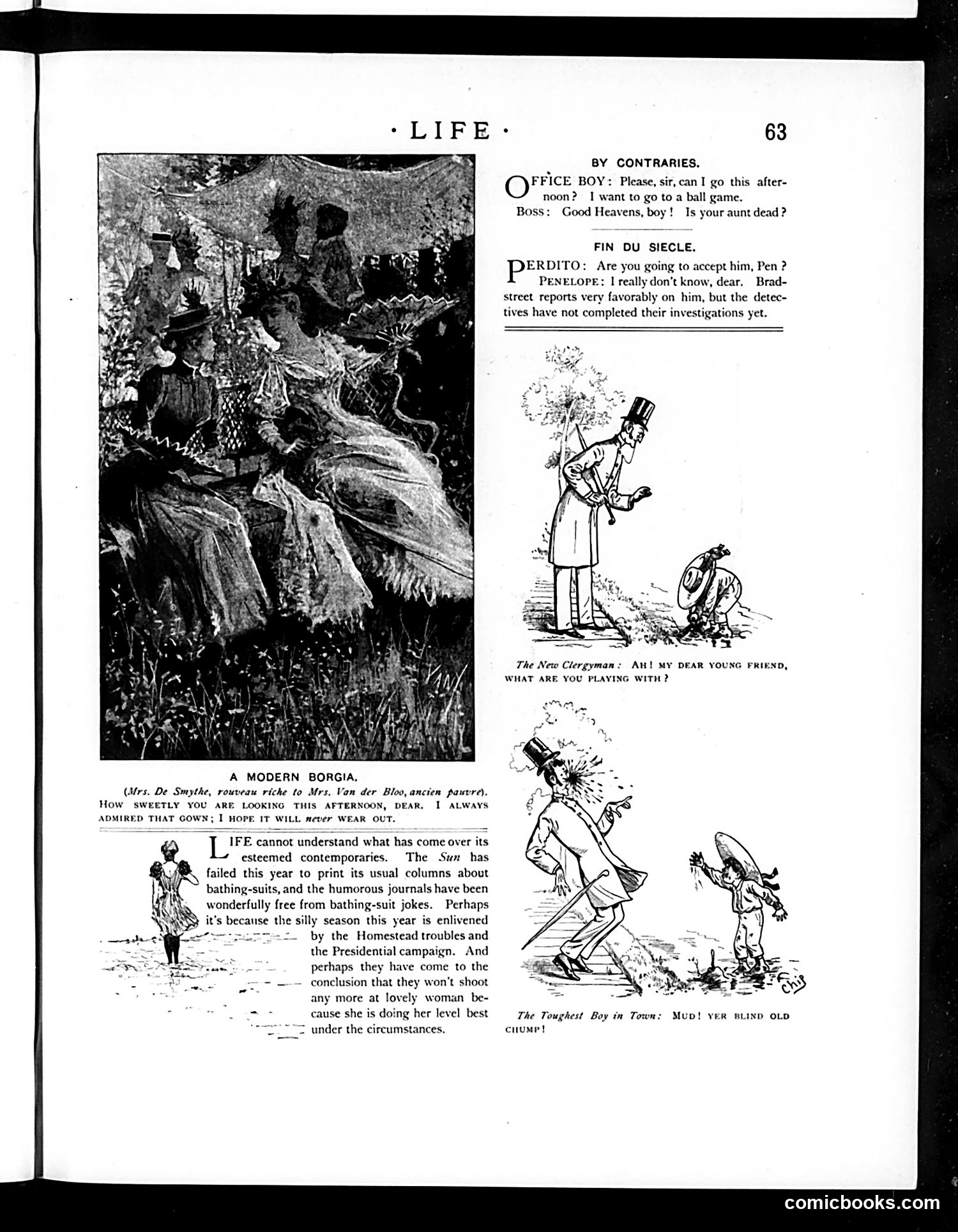
This page contains three distinct pieces of satire: **"A Modern Borgia"** (large photograph): Shows an elaborately dressed woman in a garden setting. The caption references Mrs. De Smythe and Mrs. Van der Blos, suggesting satire of wealthy socialites and their fashions. The accompanying text humorously admires the gown while subtly critiquing high society's vanity. **"By Contraries"** (dialogue): A humorous exchange between an office boy asking his boss for an afternoon off to attend a baseball game, with the boss asking if the boy's aunt is dead—playing on the traditional excuse. **"Fin Du Siecle"** and **"The Toughest Boy in Town"** (sketch cartoons): Street scenes satirizing contemporary youth behavior and social attitudes of the era. The overall page mocks upper-class pretension, workplace dynamics, and urban life.
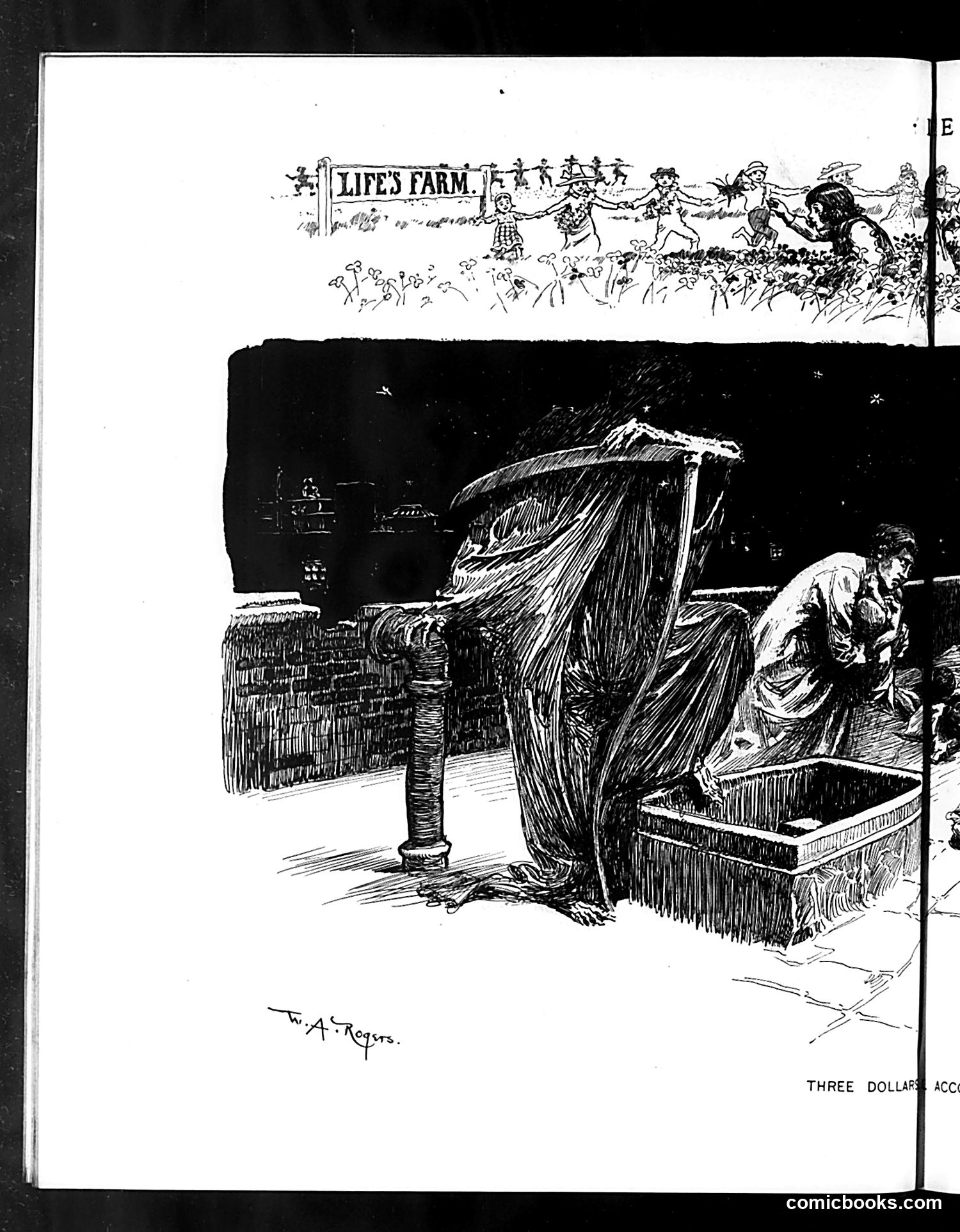
This page contains a satirical illustration signed by W.A. Rogers depicting a farm scene. The upper portion shows "Life's Farm" with figures in a pastoral setting. The lower illustration presents a darker, more detailed scene showing what appears to be a barn interior with a large horse and a figure working nearby. The title at bottom reads "THREE DOLLARS ACCO[UNT]" (text cut off), suggesting this relates to a financial or economic narrative. Without clearer context about the specific historical moment, the exact political figures being satirized remain unclear. However, the contrast between the idealized "Life's Farm" banner and the harsher, more realistic lower scene suggests social or economic commentary—possibly critiquing agrarian idealism versus harsh rural realities, or depicting accounts/debts affecting farmers. The Rogers signature indicates professional satirical cartooning typical of early 20th-century Life magazine.
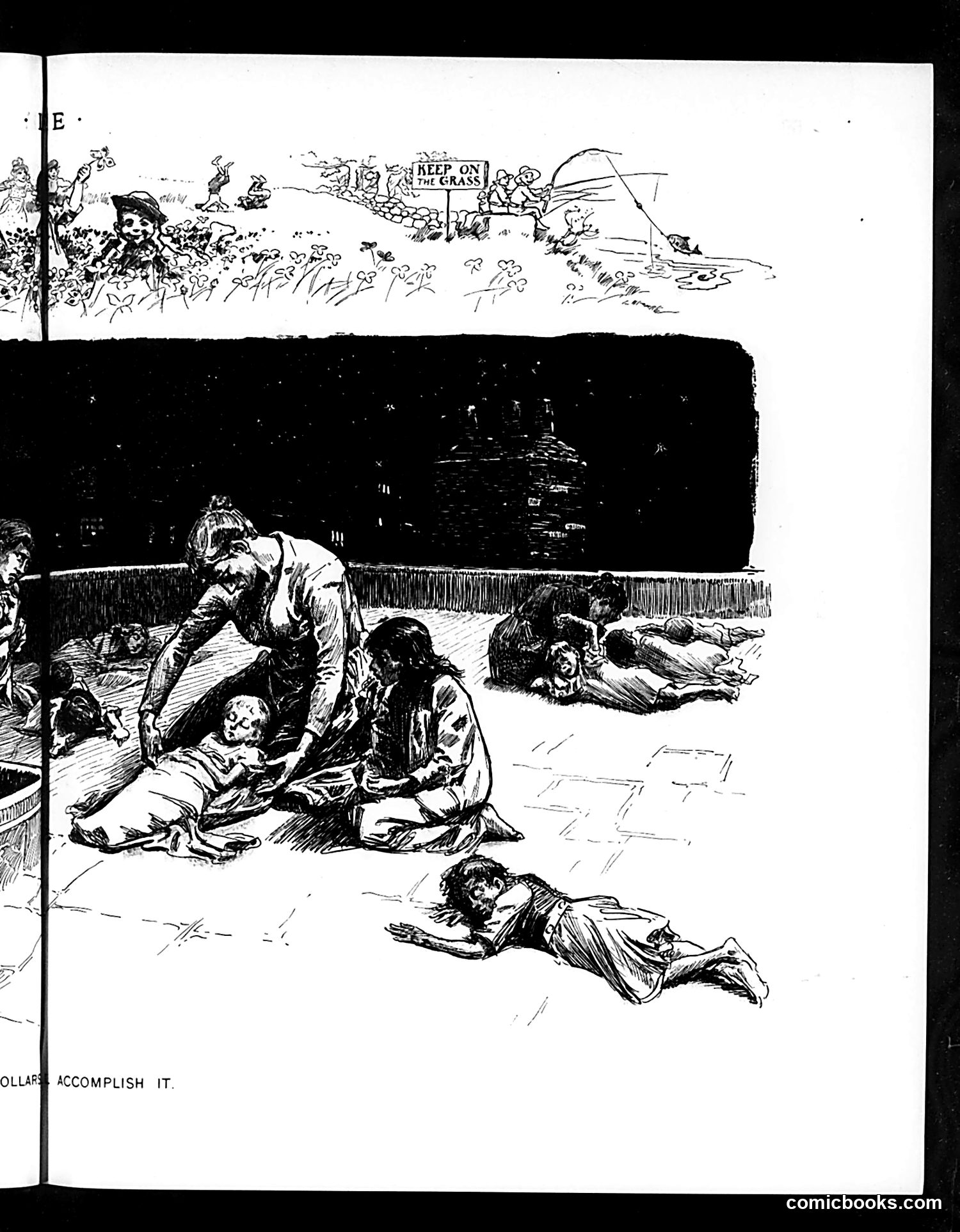
This page contains two satirical illustrations. The **top panel** shows a pastoral scene with a "Keep On the Grass" sign—ironic commentary on public behavior and rule-breaking, likely mocking people's tendency to ignore posted restrictions. The **bottom panel**, captioned "ACCOMPLISH IT," depicts what appears to be a darker social commentary. An adult figure tends to children lying on pavement in what looks like an urban setting, with buildings visible in the background. The scene suggests poverty, neglect, or child welfare conditions—possibly criticizing inadequate care or social conditions affecting children in cities. The juxtaposition implies satire about the gap between idealistic pastoral rules and harsh urban realities. Without a specific date visible, the exact historical context is unclear, but the imagery suggests early-to-mid 20th century concerns about child welfare or urban conditions.
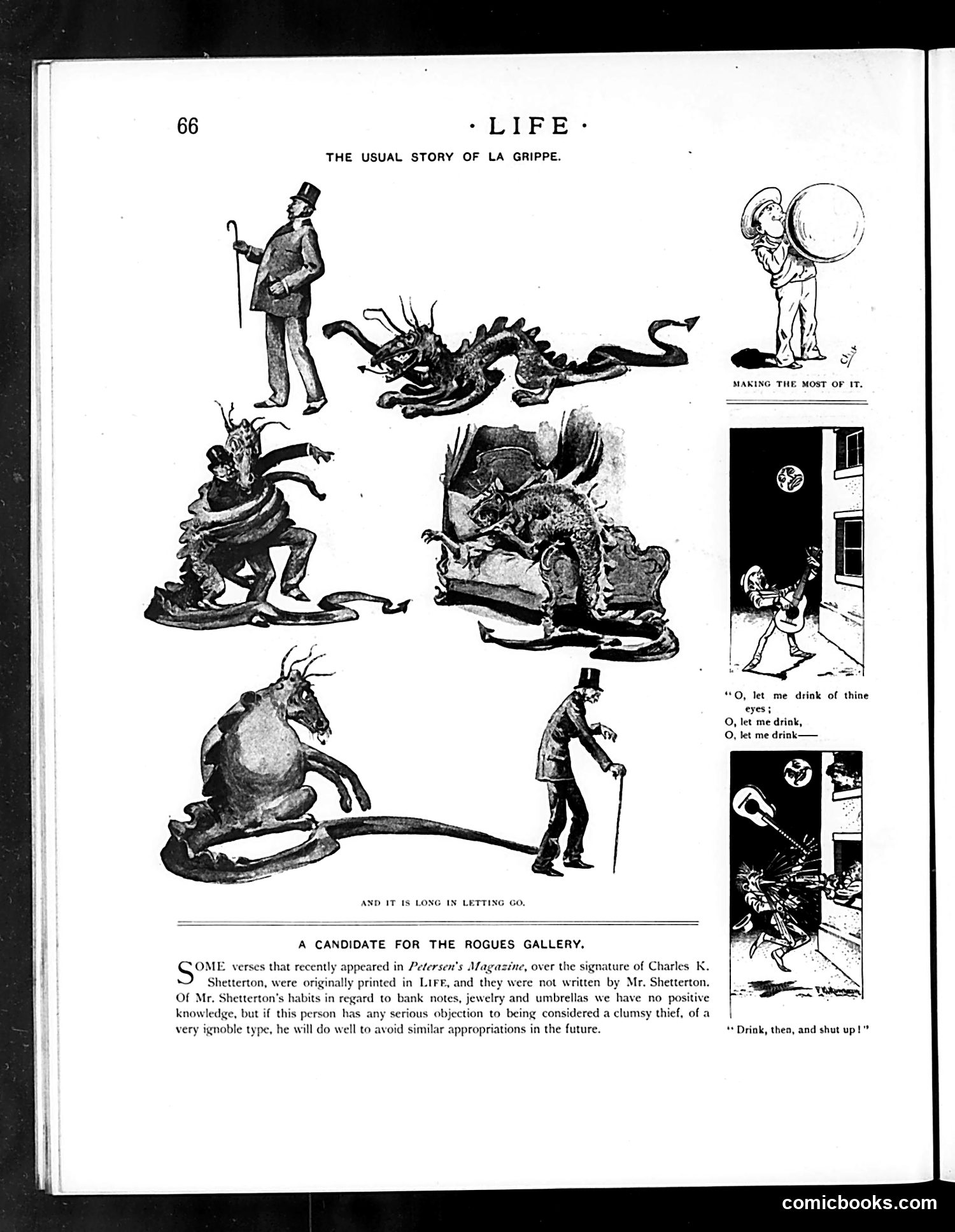
This page satirizes influenza ("la grippe," a period term for flu). The central illustrations show a well-dressed gentleman observing various disease personifications—grotesque demon-like creatures—representing how illness progresses and affects the body. The sequence depicts the illness's trajectory from initial encounter through full infection, with the final caption "AND IT IS LONG IN LETTING GO" emphasizing the flu's persistence. The right panel shows a sick person begging to "drink of thine eyes" while another illustration depicts someone being thrown out or collapsing, with the final quote "Drink, then, and shut up!" suggesting darkly comic resignation to illness's inevitability. The lower text addresses a plagiarism dispute involving Charles K. Shetterton and *Peterson's Magazine*, establishing this as satirical commentary on both disease and publishing ethics.
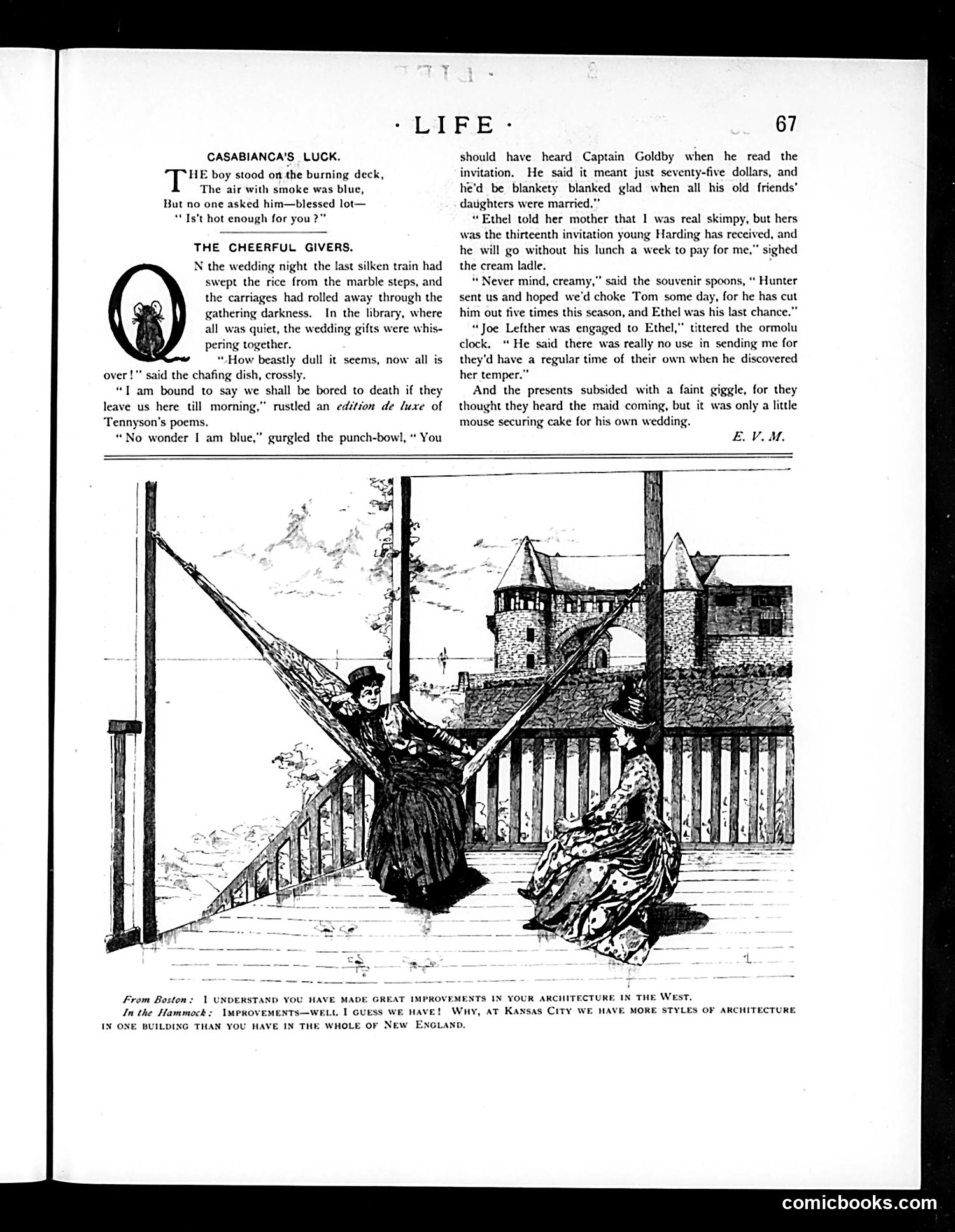
The page contains two satirical pieces about American social pretension: **"Casabianca's Luck"** mocks a boy attending a wedding on a "burning deck," satirizing dramatic self-sacrifice in literature. **"The Cheerful Givers"** ridicules upper-class wedding gift-giving customs. Characters discuss the expense and obligation of attending multiple society weddings, with complaints about required gifts and attendance costs. One guest notes they've attended five weddings this season for one man (Joe Lefther/Harding), and another mentions a groom demanding expensive gifts while remaining unemployed. **The cartoon below** depicts an East Coast woman bragging about Western architectural improvements to a visitor from Boston. The Bostonian responds sarcastically that Kansas City has more architectural styles in one building than all of New England—a jab at both Western pretension and Eastern snobbery about regional sophistication.
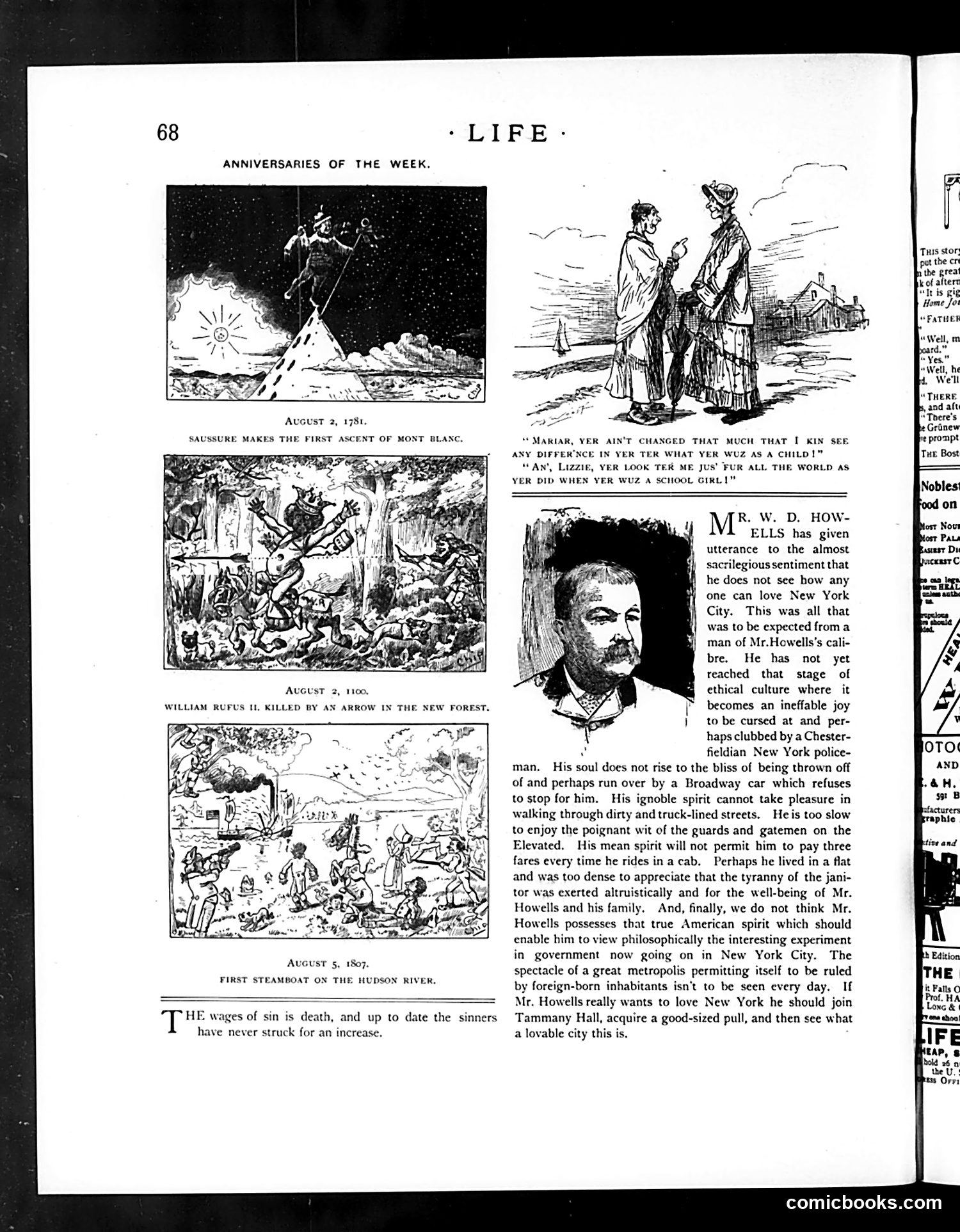
This page satirizes **W.D. Howells**, the prominent American writer and critic, for his public statement that he cannot love New York City. **The Main Satire:** Life's editors mock Howells mercilessly for failing to appreciate NYC's "charms"—which the magazine lists ironically: being cursed at by police, struck by Broadway streetcars, enduring rude Elevated guards, paying inflated cab fares, and tolerating tyrannical janitors. The satire suggests that accepting these urban indignities with good humor is the mark of true American spirit. **The Political Dig:** The piece concludes with a barbed jab at **Tammany Hall** (NYC's notorious Democratic political machine run by immigrant-dominated corruption). Life sarcastically suggests that if Howells wants to truly love New York, he should join Tammany and gain political "pull"—implying that Tammany's foreign-born control of city government is both absurd and inescapable. **The Joke:** Howells is portrayed as insufficiently patriotic for not embracing NYC's chaos, corruption, and rudeness as lovable character traits.
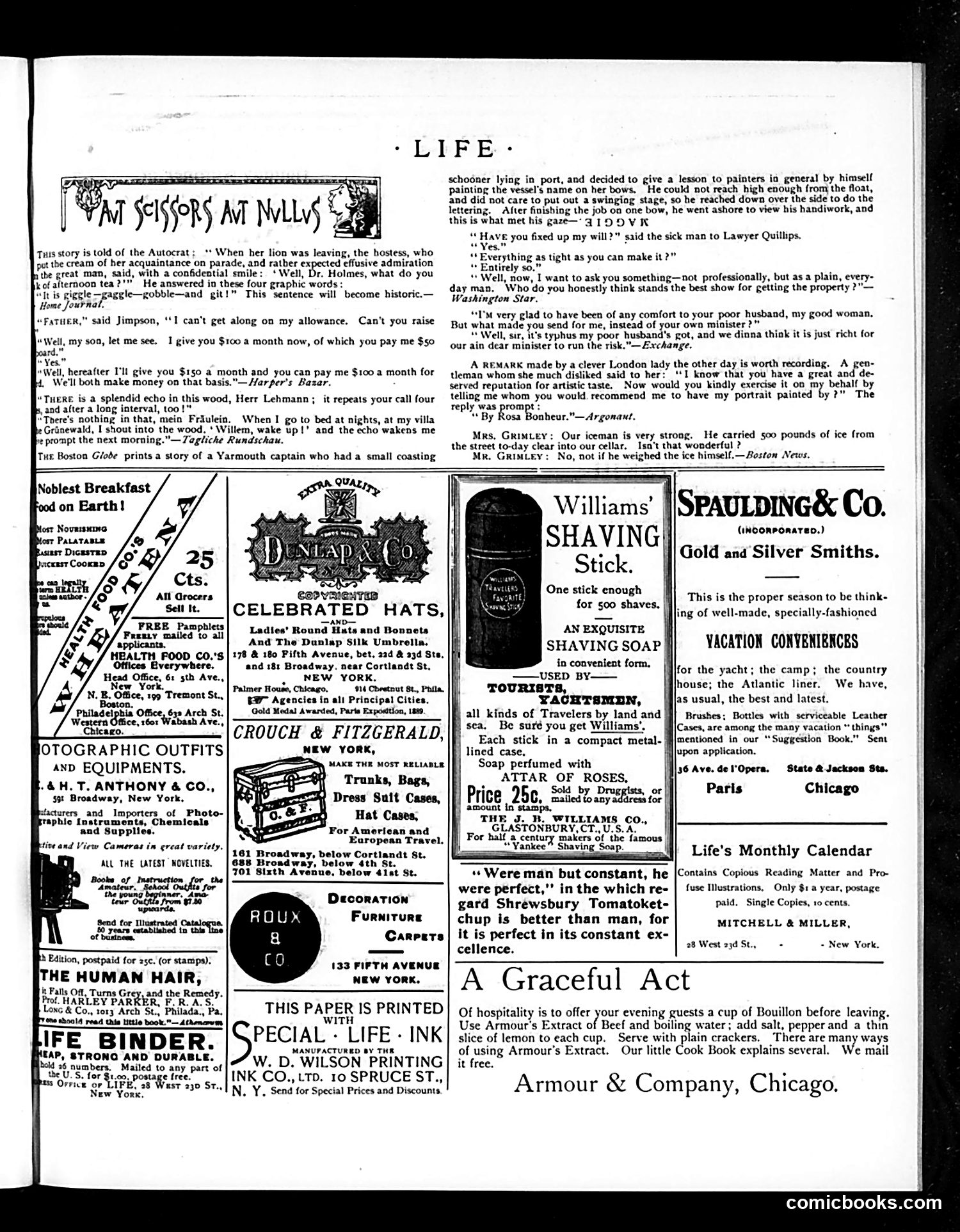
Looking at this *Life* magazine page, the humor relies on several comedic premises popular in the period: **The cartoon sections** present brief jokes, likely with accompanying illustrations. They include: - A story about an "Autocrat" and an allowance dispute (a wealthy father negotiating with his son) - Wordplay about a ship's name painted incorrectly ("9TDVK" instead of the intended name) - A dialogue about wills and legal advice, where a lawyer is asked to predict who'll inherit—poking fun at legal professionals' cynicism - A comment about a pastor avoiding typhus care, satirizing clerical squeamishness **The satire targets** include: - Family wealth dynamics and negotiations - Professionalism and reputation (the London lady cutting down a vain gentleman) - Physical strength (the iceman joke) The page is primarily **advertisements**—for breakfast food, cameras, typography, furniture—surrounding these brief, pithy comic anecdotes. The jokes are gentle social observation rather than pointed political satire, typical of *Life's* middle-class, urbane humor from this era.
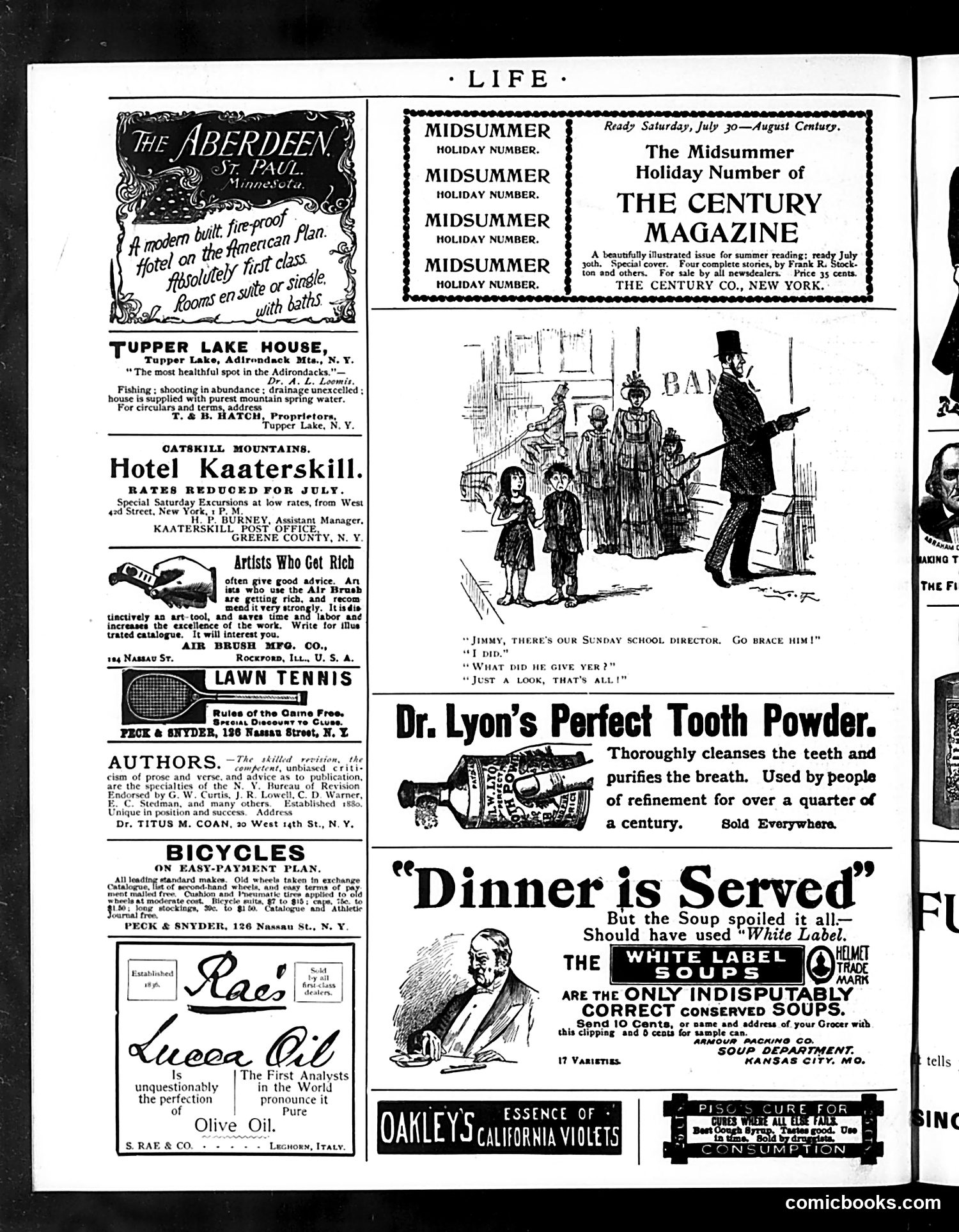
This is primarily a **magazine advertisement and content page** from Life's midsummer holiday issue (circa early 1900s). The main cartoon depicts a humorous social scene at what appears to be a bank or formal institution. The illustration shows a well-dressed man in a top hat confronting a group of people (likely a family with children) outside the building. The dialogue reveals the joke: Jimmy's Sunday school director is being accosted with requests for money. When asked what the director gave them, the response "Just a look, that's all!" suggests the man's stern disapproval—implying he refused their request, offering nothing but a disapproving glance. The satire targets **the hypocrisy of religious authority figures**: a Sunday school director (supposed moral exemplar) is portrayed as stingy and judgmental toward those seeking help, undermining his pious position. The remainder of the page consists of period advertisements for hotels, bicycles, olive oil, tooth powder, and soup—typical commercial content of the era.
This is primarily a **Life magazine advertising page**, not a political cartoon. It contains multiple commercial advertisements typical of early-20th-century magazines: **Key advertisements visible:** - Krakauer (ladies' tailor, Fifth Avenue) - Kodak cameras ("You press the button, we do the rest") - Hotel Brunswick - Overholt whiskey - No. 4711 Eau de Cologne - Boston Garters (for men wearing low shoes) - Brunswick cigars **Notable point:** The Boston Garter ad includes an illustration of a man fastening garters and explains that gentlemen *must* wear garters with low shoes—reflecting early-1900s menswear conventions where garters kept socks up. The page also promotes Life's Monthly Calendar subscription ($1/year) and single copies (10 cents). This reflects the magazine's business model: entertainment content subsidized by luxury goods advertising targeting affluent urban readers.
This page is primarily **advertising**, not political satire. It contains multiple product ads from the 1890s: **Main content:** A Franco-American Food Company advertisement featuring glowing testimonials about their canning factory—claiming it's "the most complete, systematic and appetizingly clean." This reflects era-specific anxieties about food safety and factory conditions. **The only cartoon** is a small sketch of two dog catchers discussing how to catch a dog by slipping something over its head—a minor sight gag with no apparent social commentary. **Supporting ads** promote Manitou Ginger Champagne (non-alcoholic), Mephisto cigars (emphasizing factory cleanliness and quality tobacco), and Barry's Tricopherous hair/skin treatment. The page exemplifies turn-of-century advertising conventions: products marketed through factory credentials and testimonials, reflecting consumer concerns about industrial-era manufacturing standards. The content is mundane commercial promotion rather than satirical commentary.