
Life, 1892-08-04 · page 4 of 16
Life — August 4, 1892 — page 4: what you’re looking at
What you’re looking at
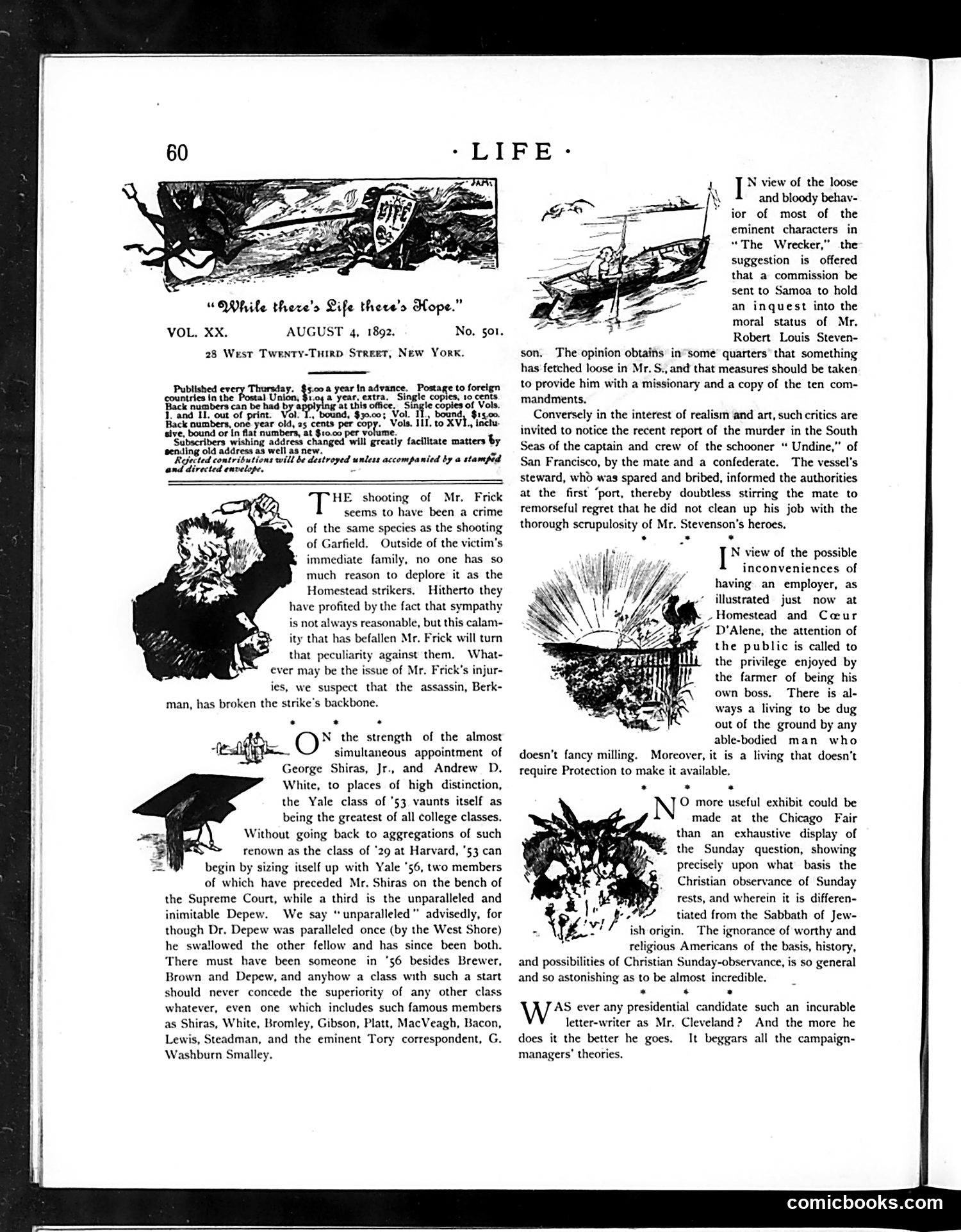
This page from Life magazine (Vol. XX, August 1, 1892) contains several satirical commentaries on contemporary issues: **The Frick Shooting**: The main article discusses Mr. Frick's shooting, noting it was "a crime of the same species as the shooting of Garfield." This appears to reference labor violence during the Homestead Strike, where sympathizers attacked management figures. The text defends strikers' broader cause while condemning the violence. **College Class Superiority**: Another section mocks Yale '56's claim to superiority among college classes, satirizing their boasting about prestigious members like Shirley and White. **Sunday Observance**: A final piece critiques American ignorance about Christian Sunday's origins versus the Jewish Sabbath. The illustrations are period political cartoons accompanying these satirical commentaries on labor violence, academic pretension, and religious practices.
📄 Transcribed text from this page (OCR, searchable)
Machine-transcribed from the original scan — historical spelling and the odd misread are preserved.
“WMhile there's Life there's Hope.” VOL. XX. AUGUST 4, 1892, 28 West Twenty-Tuirp Street, New York. No. 501. s.00 a year In advance. Posta, oq a year, extra, Single c Back num by aj ‘at this office. Single copie 1. and 11. out of print. Yan TP botind, $yn.c08 Vol. I1., bound, $15.00. Back numbers, one year old, 25 cents per copy. Vols. III. to XVI., inclu: sive, bound or in flat numbers, at $10.00 per volume. Subscribers wishing address changed will greatly facilitate matters by sending old address a3 well as new. oy Rejected contributions will be destroyed unless accompanied by a stamped and directed envelope. 3 to foreign jes, 10.cents, es of Vols. HE shooting of Mr. Frick seems to have been a crime of the same species as the shooting of Garfield. Outside of the victim's ; immediate family, no one has so much reason to deplore it as the Homestead strikers. Hitherto they have profited by the fact that sympathy is not always reasonable, but this calam- ity that has befallen Mr. Frick will turn that peculiarity against them, What- ever may be the issue of Mr. Frick's injur- ies, we suspect that the assassin, Berk- man, has broken the strike’s backbone. * . . N the strength of the almost simultaneous appointment of George Shiras, Jr.. and Andrew D. White, to places of high distinction, the Yale class of '53 vaunts itself as being the greatest of all college classes. Without going back to aggregations of such renown as the class of ‘29 at Harvard, '53 can begin by sizing itself up with Yale ‘56, two members of which have preceded Mr. Shiras on the bench of the Supreme Court, while a third is the unparalleled and inimitable Depew. We say “unparalleled” advisedly, for though Dr. Depew was paralleled once (by the West Shore) he swa!lowed the other fellow and has since been both. There must have been someone in '56 besides Brewer, Brown and Depew, and anyhow a class with such a start should never concede the superiority of any other class whatever, even one which includes such famous members as Shiras, White, Bromley, Gibson, Platt, MacVeagh, Bacon, Lewis, Steadman, and the eminent Tory correspondent, G. Washburn Smalley. N view of the loose and bloody behav- ior of most of the eminent characters in “The Wrecker,” the suggestion is offered that a commission be sent to Samoa to hold an inquest into the moral status of Mr. Robert Louis Steven- son. The opinion obtains in“some quarters’ that something has fetched loose in Mr. S., and that measures should be taken to provide him with a missionary and a copy of the ten com- mandments. Conversely in the interest of realism and art, such critics are invited to notice the recent report of the murder in the South Seas of the captain and crew of the schooner “ Undine,” of San Francisco, by the mate and a confederate. The vessel's steward, who was spared and bribed, informed the authorities at the first ‘port, thereby doubtless stirring the mate to remorseful regret that he did not clean up his job with the thorough scrupulosity of Mr. Stevenson's heroes. . . I N view of the possible inconveniences of having an employer, as illustrated just now at Homestead and Corur the public is called to the privilege enjoyed by the farmer of being his own boss. There is al- ways a living to be dug out of the ground by any able-bodied man who doesn’t fancy milling. Moreover, it is a living that doesn’t require Protection to make it available. . * . O more useful exhibit could be made at the Chicago Fair than an exhaustive display of the Sunday question, showing precisely upon what basis the Christian observance of Sunday rests, and wherein it is differen- tiated from the Sabbath of Jew- ish origin. The ignorance of worthy and religious Americans of the basis, history, and possibilities of Christian Sunday-observance, is so general and so astonishing as to be almost incredible. . . . W's ever any presidential candidate such an incurable letter-writer as Mr. Cleveland? And the more he does it the better he goes. It beggars all the campaign- managers’ theories, comicbooks.com