
A complete issue · 16 pages · 1892
Life — July 28, 1892
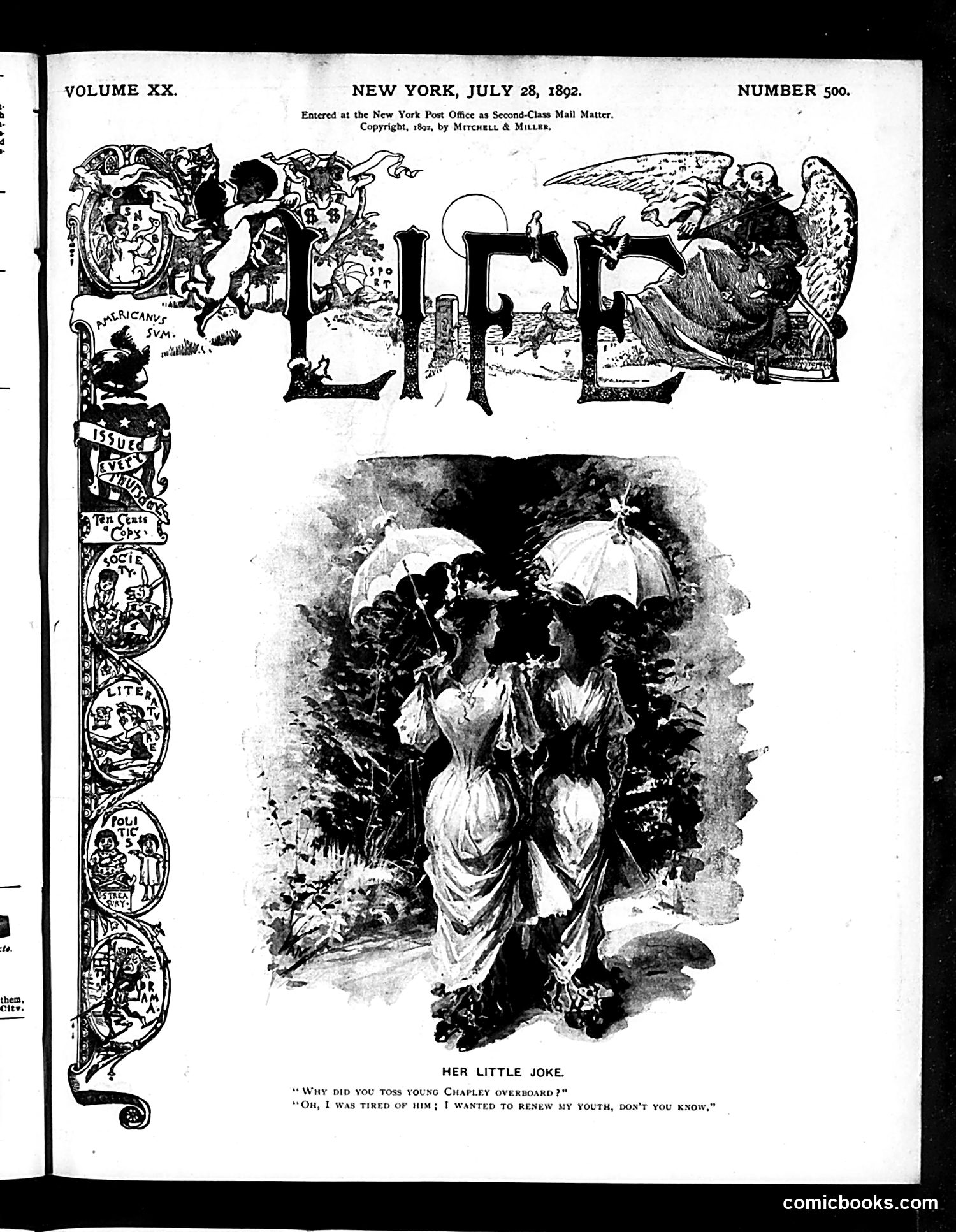
**The Main Cartoon: "Her Little Joke"** The illustration shows two women with umbrellas in what appears to be a romantic or social situation. The caption reads: "Why did you toss young Chapley overboard?" / "Oh, I was tired of him; I wanted to renew my youth, don't you know." This appears to be satirizing a contemporary scandal or social gossip involving someone named Chapley being literally thrown overboard. The "joke" mocks the flippant attitude of the woman—suggesting she murdered someone casually to feel young again. This likely references a real incident or prominent social figure that 1892 readers would immediately recognize, but without additional context, the specific event remains unclear to modern readers. The ornamental left border displays Life's masthead design elements.
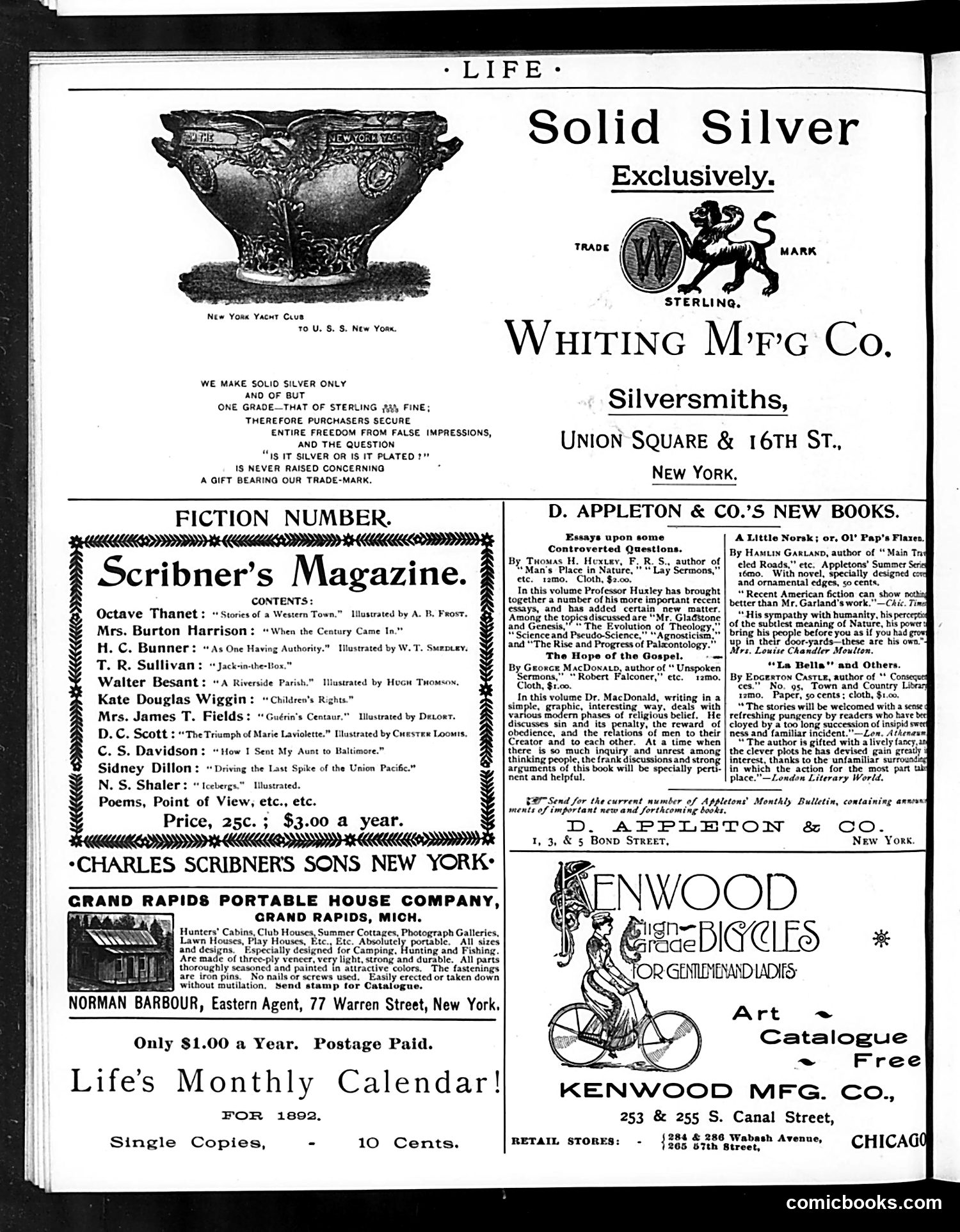
This page is **primarily advertising**, not political satire or cartoons. The dominant content includes: - A Whiting Manufacturing Company advertisement for sterling silver goods (top) - Scribner's Magazine promotion listing story titles and authors - D. Appleton & Co. book advertisements - Grand Rapids Portable House Company cabin advertisement - Kenwood Manufacturing Company bicycle advertisement for "high-grade bicycles for gentlemen and ladies" The only illustrated element with potential satirical content is the Kenwood bicycle ad, which features an Art Deco-style woman cyclist. However, this appears to be straightforward product marketing rather than political commentary. The page reflects **turn-of-the-century consumer culture and advertising**, not editorial satire typical of Life magazine's known output.
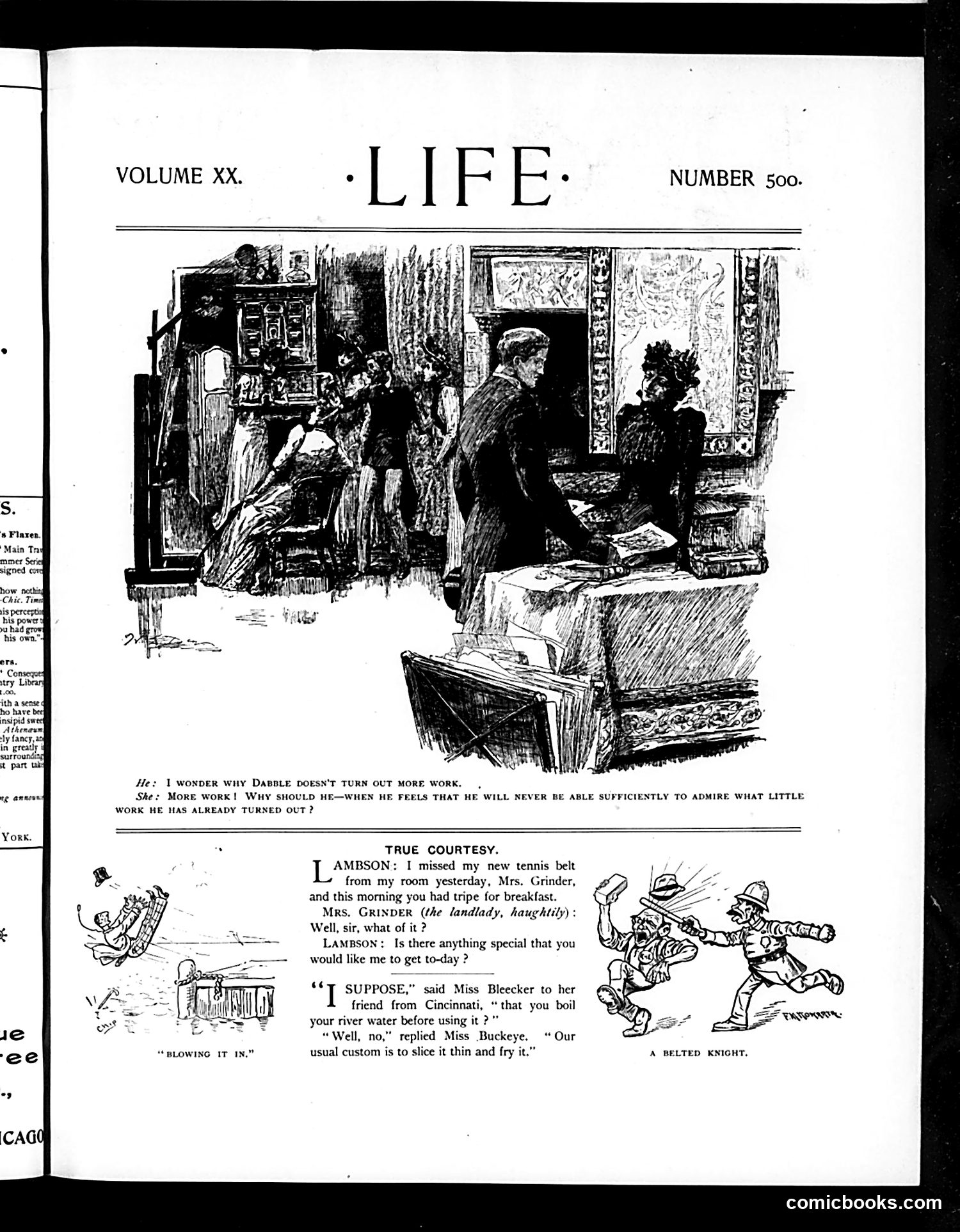
The top cartoon depicts a domestic scene where a man complains that his wife does excessive housework, suggesting she'll never have time to admire what little work he's already completed. This satirizes traditional gender roles and male laziness—a husband criticizing his wife for working too hard while he contributes minimally. Below, "True Courtesy" presents a humorous exchange between Lambson and Mrs. Grinder (his landlady). Lambson mentions missing his tennis belt and implies she caused his breakfast mishap through negligence. Mrs. Grinder's friend suggests boiling river water before use, and Miss Buckeye replies they slice it thin and fry it—absurdist humor mocking frontier/provincial practices around water safety and food preparation. The cartoons target domestic relationships and regional ignorance for comedic effect.
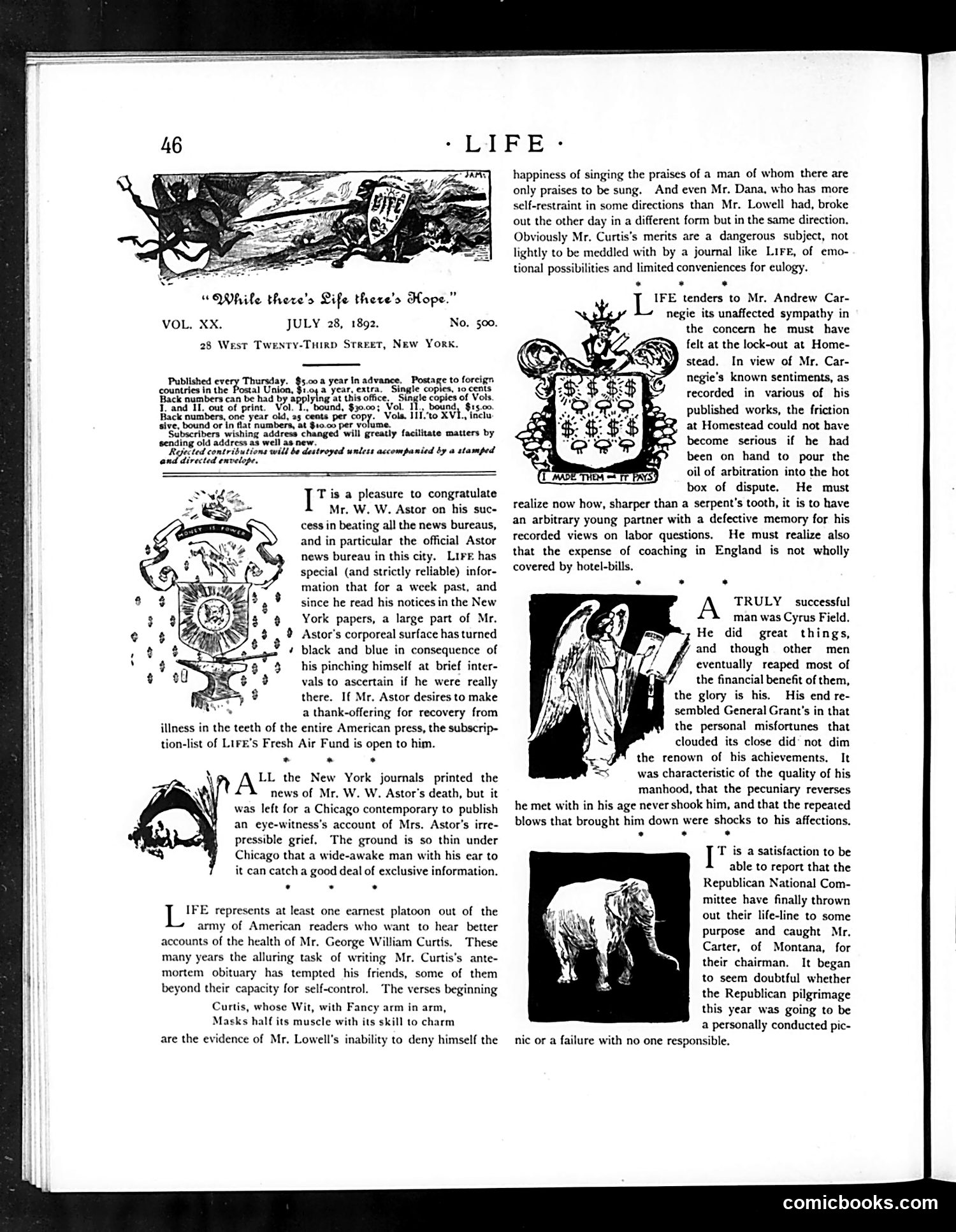
This page contains editorial commentary rather than traditional political cartoons. The main topics appear to be: 1. **W.W. Astor's death**: Life congratulates Astor on his newspaper success, then reports his death with some irony about Chicago papers getting the scoop on his "irreressible grief." 2. **Curtis's merit as a subject**: The editors critique George William Curtis's writing about labor issues, suggesting his views are too arbitrary and that hotel bills shouldn't cover coaching expenses in England—apparently a controversy within LIFE's editorial circles. 3. **Cyrus Field**: Described as a "truly successful man" whose achievements weren't dimmed by personal misfortunes, contrasting with General Grant's decline. 4. **Republican National Committee**: Brief mention of replacing their chairman, Mr. Carter of Montana, with uncertainty about the pilgrimages' success that year. The illustrations are decorative mastheads rather than satirical commentary.
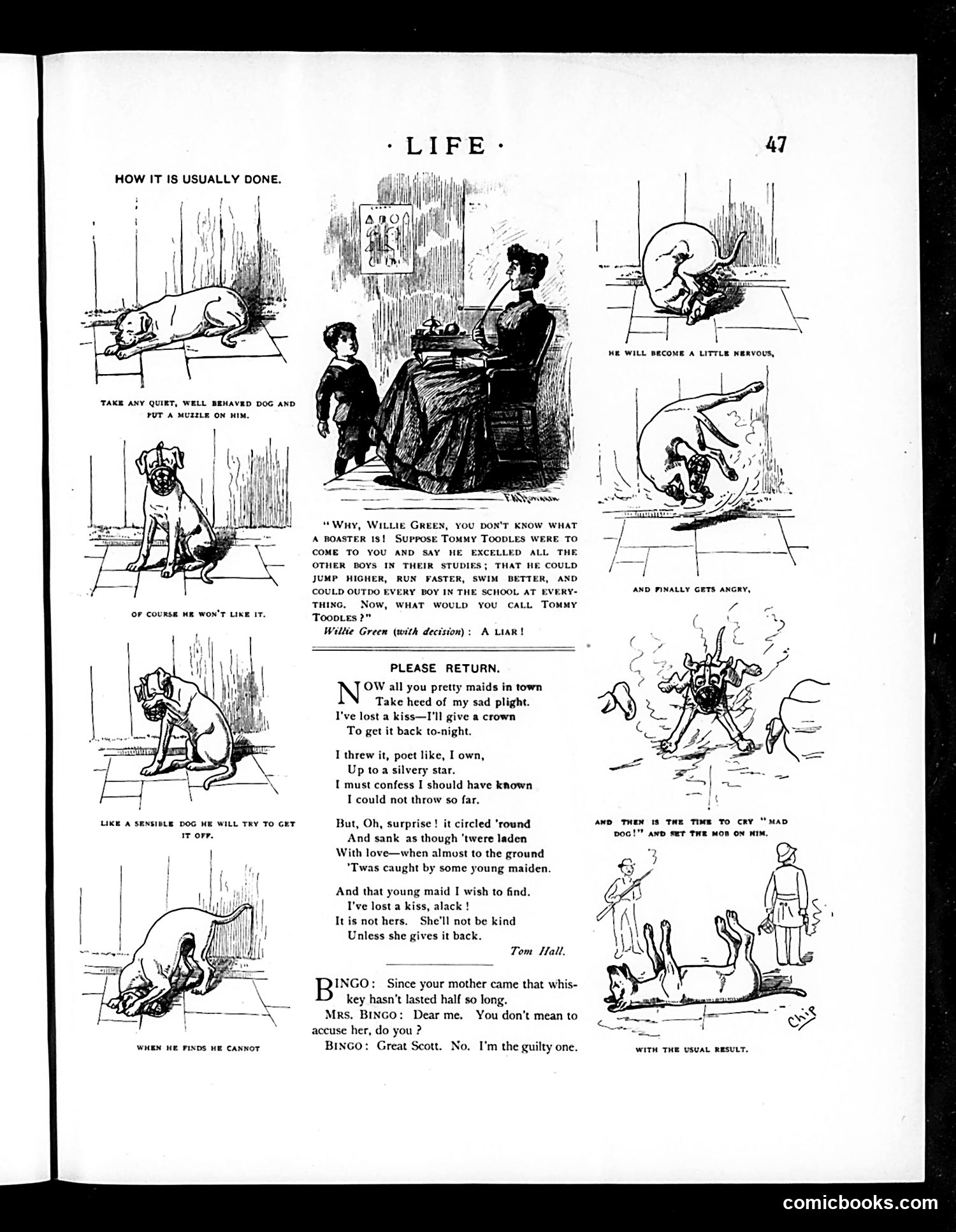
This page contains two unrelated humorous pieces: **"How It Is Usually Done"** (left): A visual gag about dog training. It shows a well-behaved dog being praised, contrasted with the same dog progressively misbehaving—refusing commands, becoming nervous, getting angry—and finally attacking. The caption suggests that "sensible dogs" will eventually rebel against training, implying satirical commentary on obedience and control. **"Please Return"** (center/right): A poem about a lost kiss and crown, with dialogue between characters named Bingo and Mrs. Bingo. It appears to be lighthearted romantic humor about a mislaid item and marital misunderstanding, concluding with Bingo accepting blame. Both pieces are domestic, non-political satire typical of early 20th-century Life magazine—focused on everyday social situations and human (or canine) behavior rather than current events.
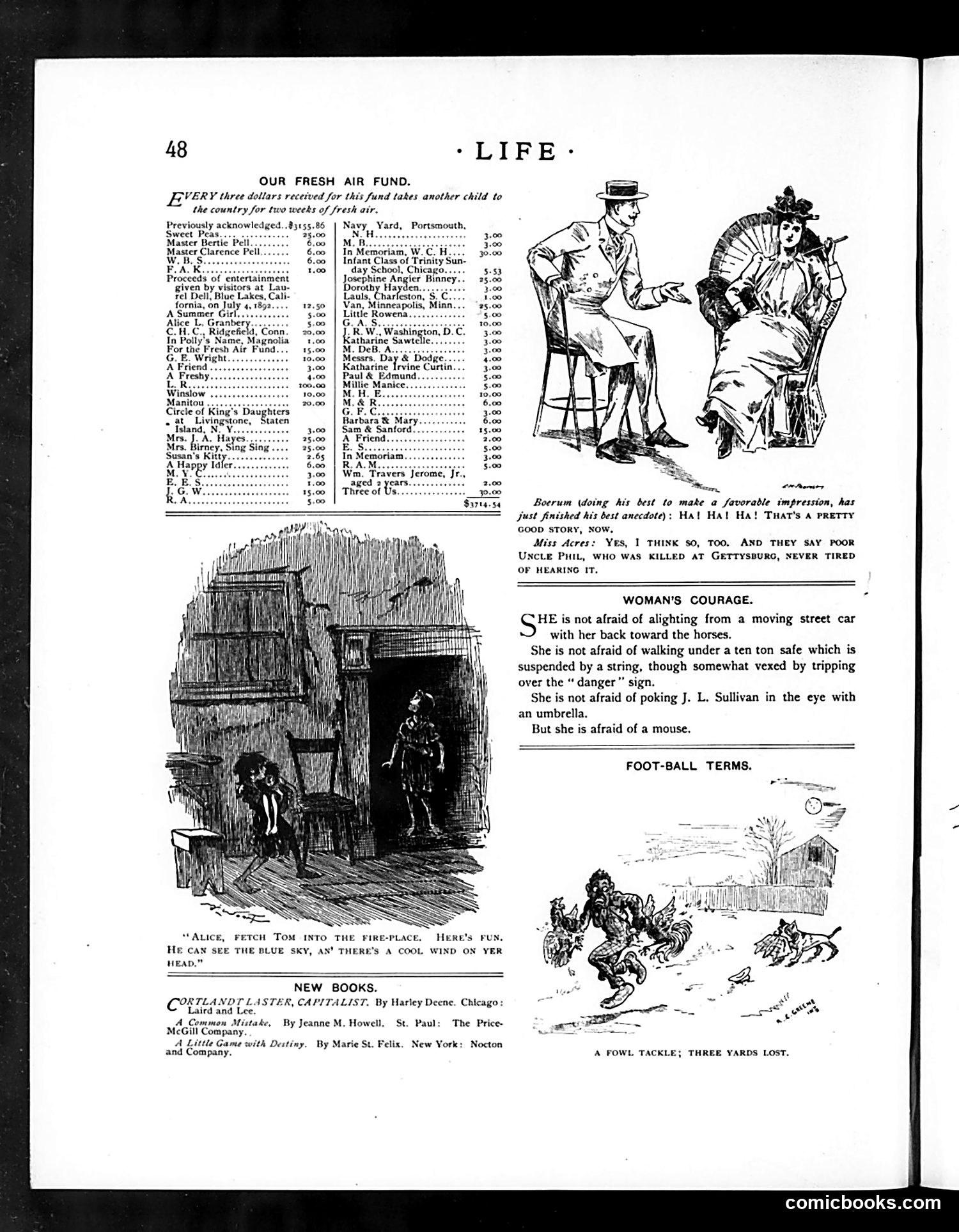
This page contains several distinct sections rather than a unified political cartoon: **"Our Fresh Air Fund"** lists charitable donations for a children's fresh air program—typical progressive-era philanthropy. **The main cartoon** shows a man and woman in conversation about making "a favorable impression" and doing one's "best ancestry." The humor appears to satirize social pretension and genealogical snobbery among the upper classes. **"Woman's Courage"** is a humorous list contrasting what women *aren't* afraid of (street cars, dangerous structures, umbrellas) with what they *are* afraid of (mice)—playing on contemporary gender stereotypes about feminine timidity. **"Foot-Ball Terms"** provides a sports joke illustration. The page is primarily humor and light social satire rather than hard political commentary.
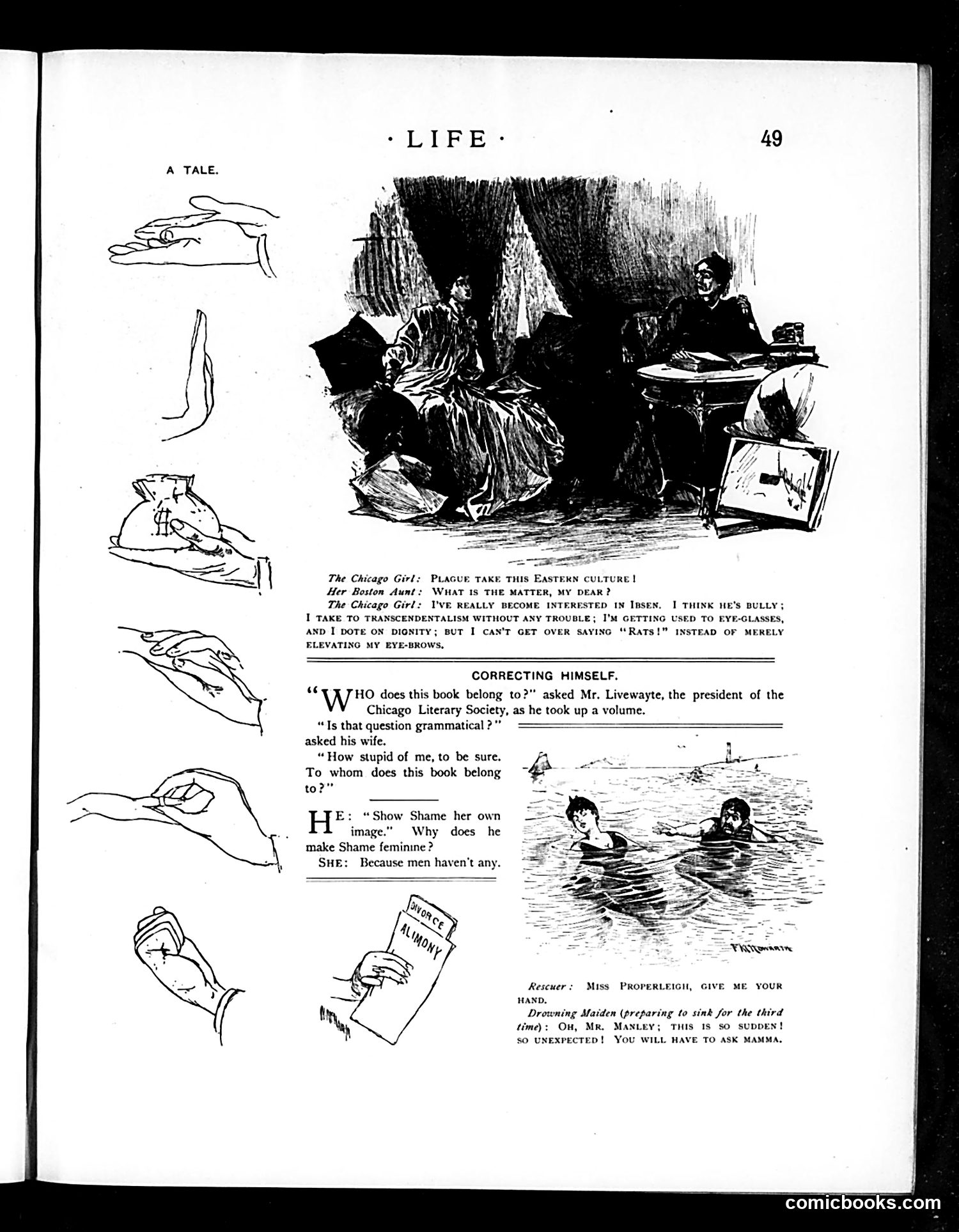
This page contains two distinct satirical pieces: **"A Tale"** (top left): A wordless comic strip showing hand gestures, likely depicting a narrative or joke through pantomime alone. **"The Chicago Girl"** (top right): Satirizes a young woman's pretentious adoption of Eastern/European cultural affectations. She claims interest in transcendentalism and Indian philosophy while maintaining shallow vanity (worrying about eyebrows). The humor targets urban sophistication among affluent young women. **"Correcting Himself"** (center): Mocks a Chicago Literary Society president's grammatical pedantry while his wife points out his own error—a gentle satire of intellectual pretension. **"Rescue"** (right): A swimming scene where a "Drowning Maiden" expects rescue but encounters an unexpected complication requiring parental notification—likely satirizing Victorian propriety or dramatic rescue scenarios. The page reflects early 20th-century American humor targeting social pretension and gender dynamics.
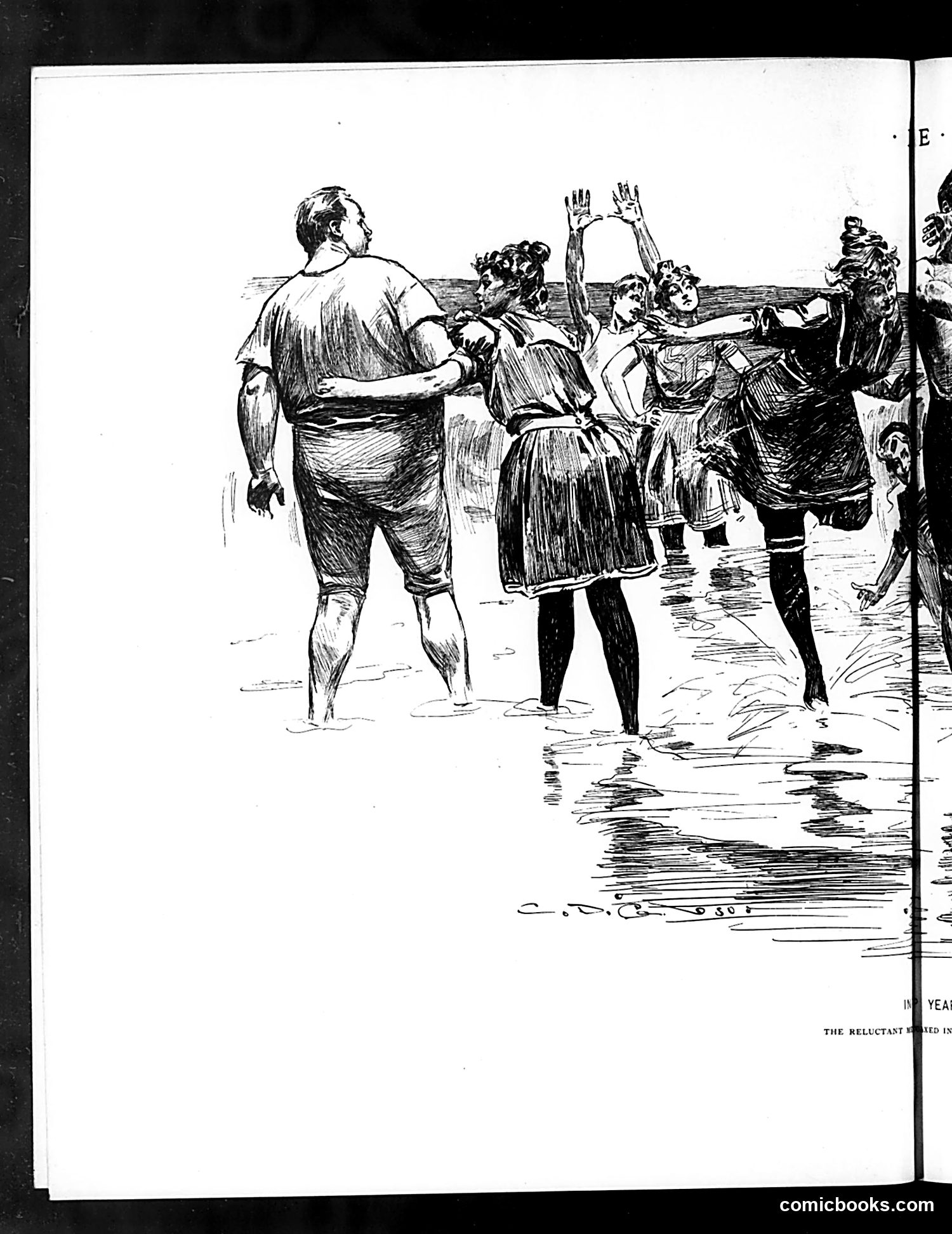
This appears to be a satirical beach scene from *Life* magazine. The image shows a man in swimming attire confronted by a woman and other beachgoers in shallow water. The caption text at the bottom reads "THE RELUCTANT..." (cut off). The satire likely concerns Victorian-era social conventions around public bathing and mixed-gender beach conduct. The man's apparent reluctance or discomfort, combined with the woman's assertive gesture and the onlookers' attention, suggests the cartoon is mocking either: 1. Rigid social propriety regarding swimwear and gender interaction at beaches, or 2. A specific man's hesitation about romantic or social engagement Without the complete caption, the precise reference remains unclear, though the scene clearly satirizes period attitudes toward beach etiquette and social interaction.
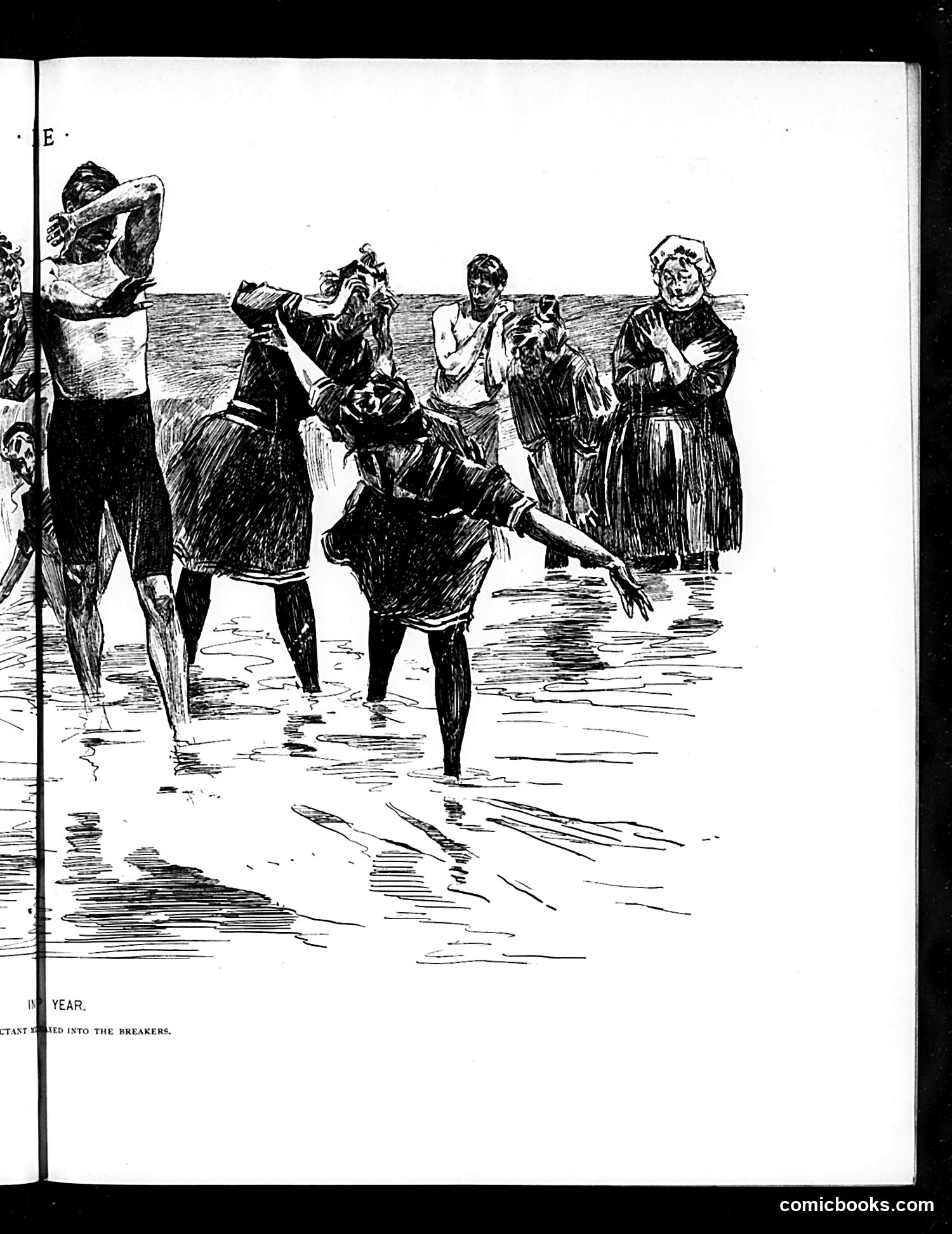
This page shows a beach scene with figures in late 19th-century dress. The visible text fragment reads "CAST INTO THE BREAKERS," suggesting a nautical or drowning metaphor. The illustration depicts what appears to be a social scene at the seaside, with women in period bathing costumes and dress watching a figure in the water. The dramatic posing and the caption suggest this is satirizing a social incident or scandal involving someone being figuratively or literally "cast out" by society. However, without the complete caption, title, or publication date visible on this page, I cannot identify the specific political figures or social controversy being referenced. The style and clothing suggest this is from the 1880s-1890s era of *Life* magazine, but the particular scandal or event being mocked remains unclear from the image alone.
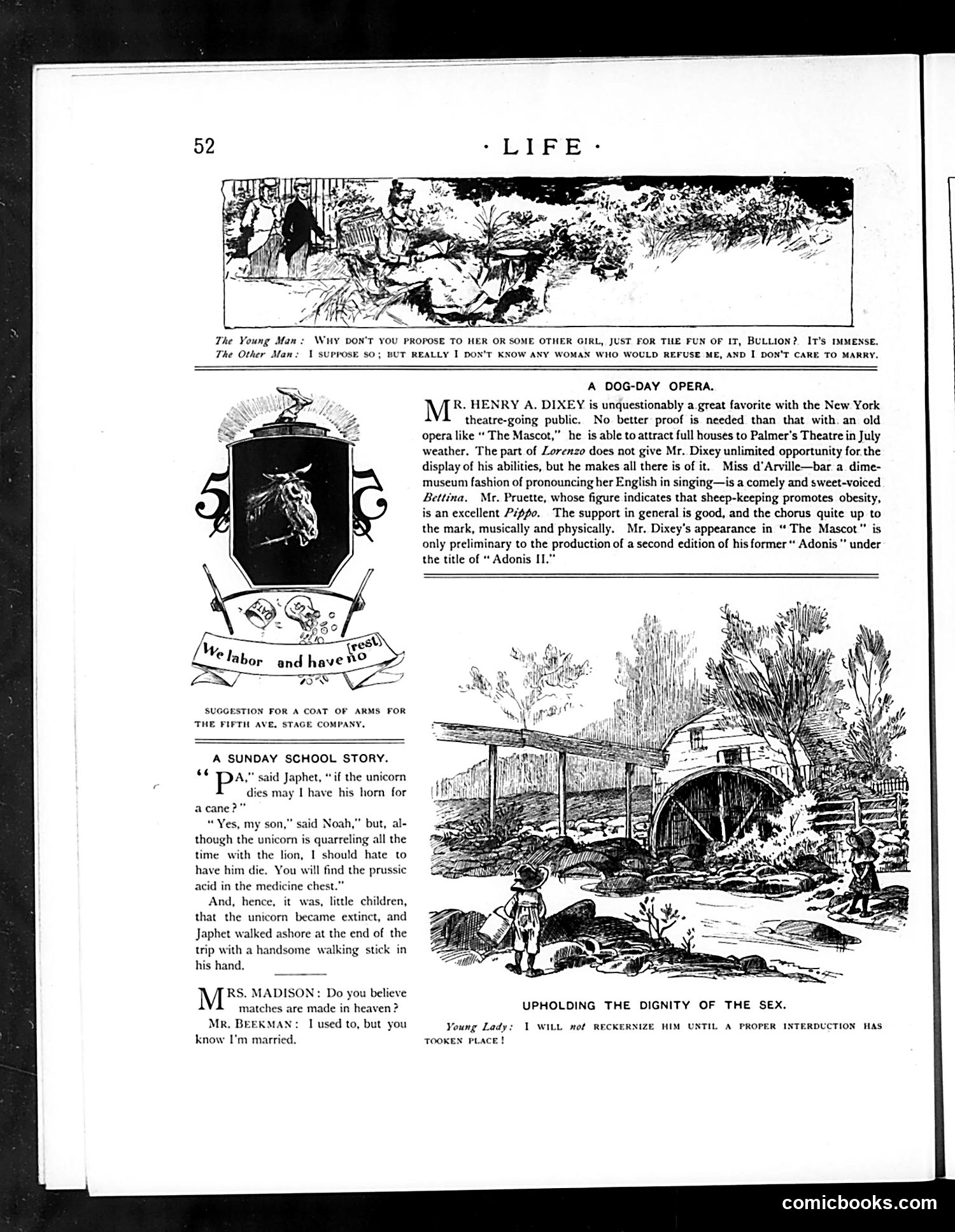
This page contains theatrical reviews and humorous dialogue rather than political cartoons. **"A Dog-Day Opera"** reviews Mr. Henry A. Dixey's performance in an operetta, praising his popularity and abilities, though noting his role as Lorenzo in this production doesn't fully showcase his talents. It mentions a character named Pippo and references his earlier successful work "Adonis." **"A Sunday School Story"** presents a dialogue where a child named Dap asks his father Noah about unicorns, leading to discussion of extinct animals and prussic acid in medicine chests—a darkly humorous ending typical of Life's satirical style. **"Upholding the Dignity of the Sex"** shows a young woman rejecting a suitor's advances until proper courtship procedures occur—satirizing Victorian-era dating conventions and gender proprieties.
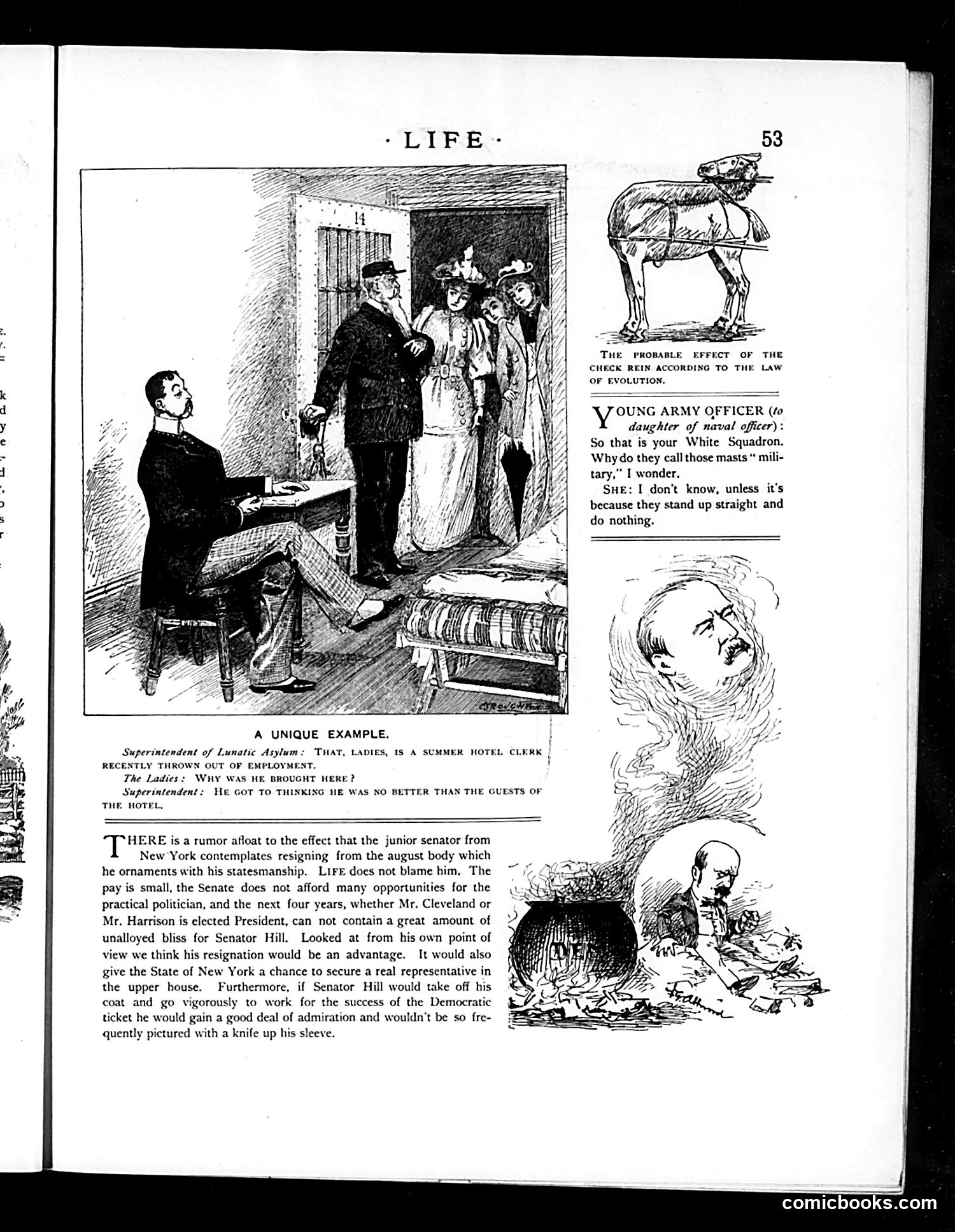
This page satirizes a hotel superintendent who fired a female clerk, claiming she was "no better than the guests." The cartoon mocks his hypocrisy and class assumptions—he judges her harshly while excusing similar behavior from paying customers. The right side includes a separate political item about a junior senator from New York (likely David B. Hill, based on context) considering resigning. Life argues his resignation would be advantageous: it would free him from Senate constraints, help New York secure "a real representative," and improve his public image by removing him from potentially compromising political situations. Both pieces critique inconsistent moral standards—one social, one political.
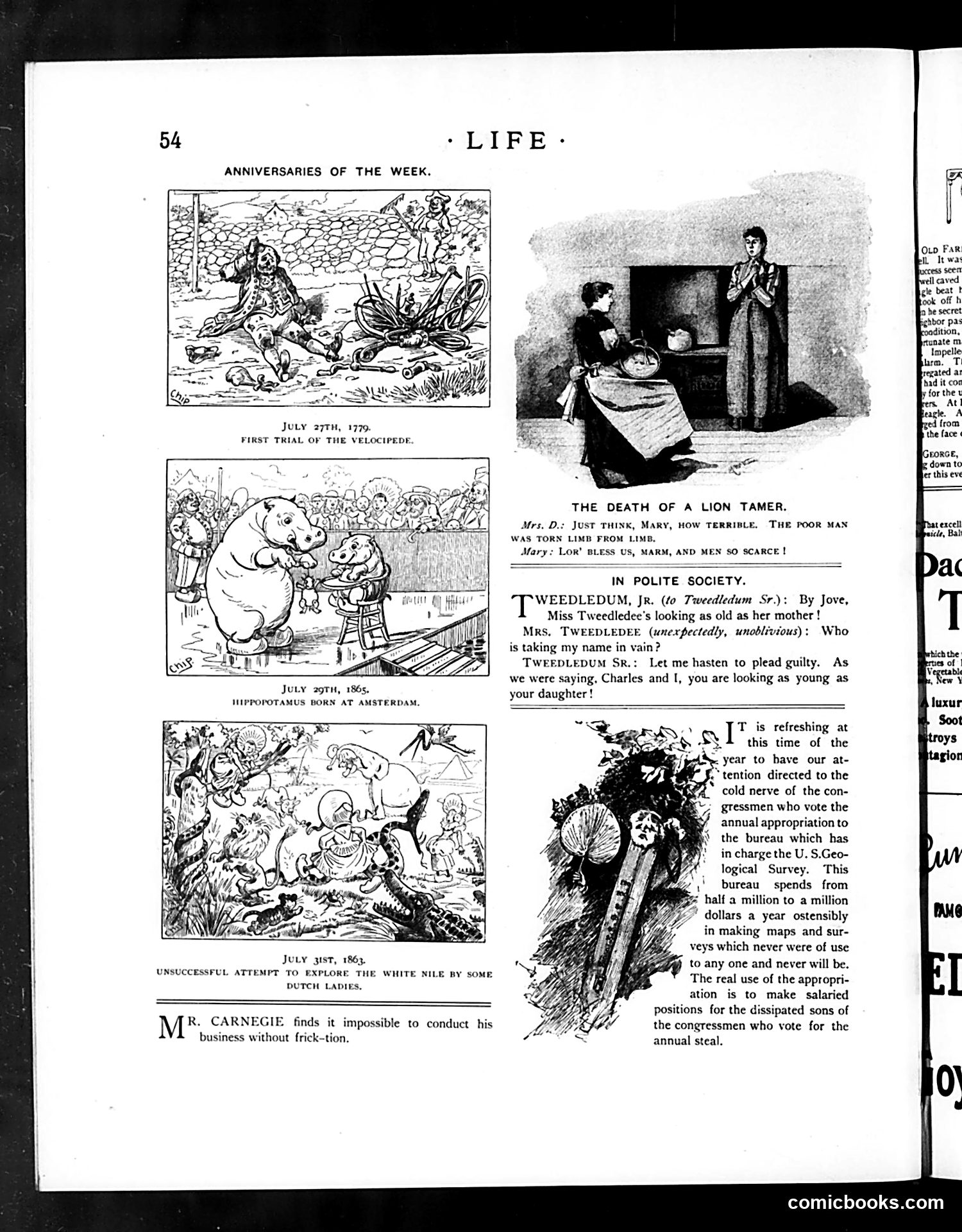
This page contains several distinct satirical items: **Historical Anniversaries**: Three cartoons commemorate absurd historical "anniversaries"—the velocipede's invention (1779), a hippopotamus birth (1865), and a failed Nile exploration attempt (1865). These mock the magazine's tendency to celebrate trivial historical moments. **"Death of a Lion Tamer"**: A dark joke about workplace safety. When a lion tamer is killed, the servant Mary's concern is merely that "men are scarce"—prioritizing available bachelors over human tragedy. This satirizes callous attitudes toward labor deaths and women's limited social options. **"In Polite Society"**: A joke about social dishonesty. A man insults a woman's age, then immediately flatters her when caught. The satire targets the hypocrisy and artificial politeness of upper-class interactions. **Geological Survey Critique**: The text attacks congressional spending on the U.S. Geological Survey, claiming funds ostensibly for mapping actually create sinecures for congressmen's unemployed sons—a direct jab at political patronage and government waste.
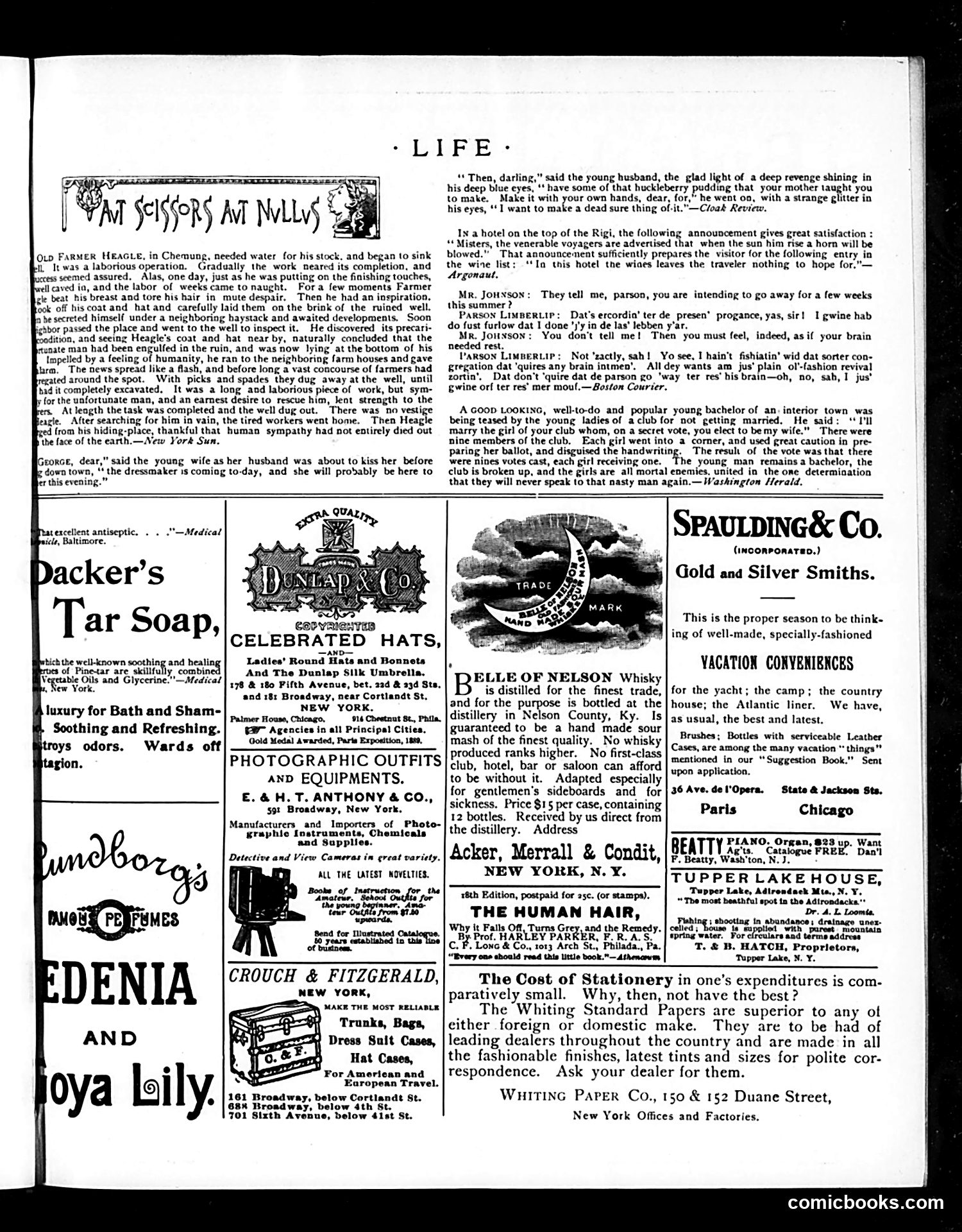
This page contains several humorous short stories typical of *Life* magazine's satirical content: **"Farmer Heagle's Well"** is a practical joke story: A farmer fakes his own death by the well he's been digging, leaving his coat and hat nearby. Sympathetic neighbors excavate the entire well searching for his body, completing his labor for him. The satire targets human gullibility and the ironic outcome where the farmer gets his work done through deception rather than honest effort. **"The Young Wife's Revenge"** is a domestic comedy: A husband, learning his wife's dressmaker is visiting, requests his mother-in-law's huckleberry pudding—implying he'll deliberately make himself sick to ruin the dressmaker's visit (preventing his wife from ordering expensive clothes). The satire mocks marital financial conflicts and passive-aggressive domestic warfare. The remaining stories are brief comedic anecdotes about mountain hotel wine, a Black preacher avoiding intellectual labor, and a bachelor's marriage bet where all nine club members vote for themselves. The page is primarily **advertising** (Spalding & Co., Whiting Paper, etc.) with these stories interspersed.
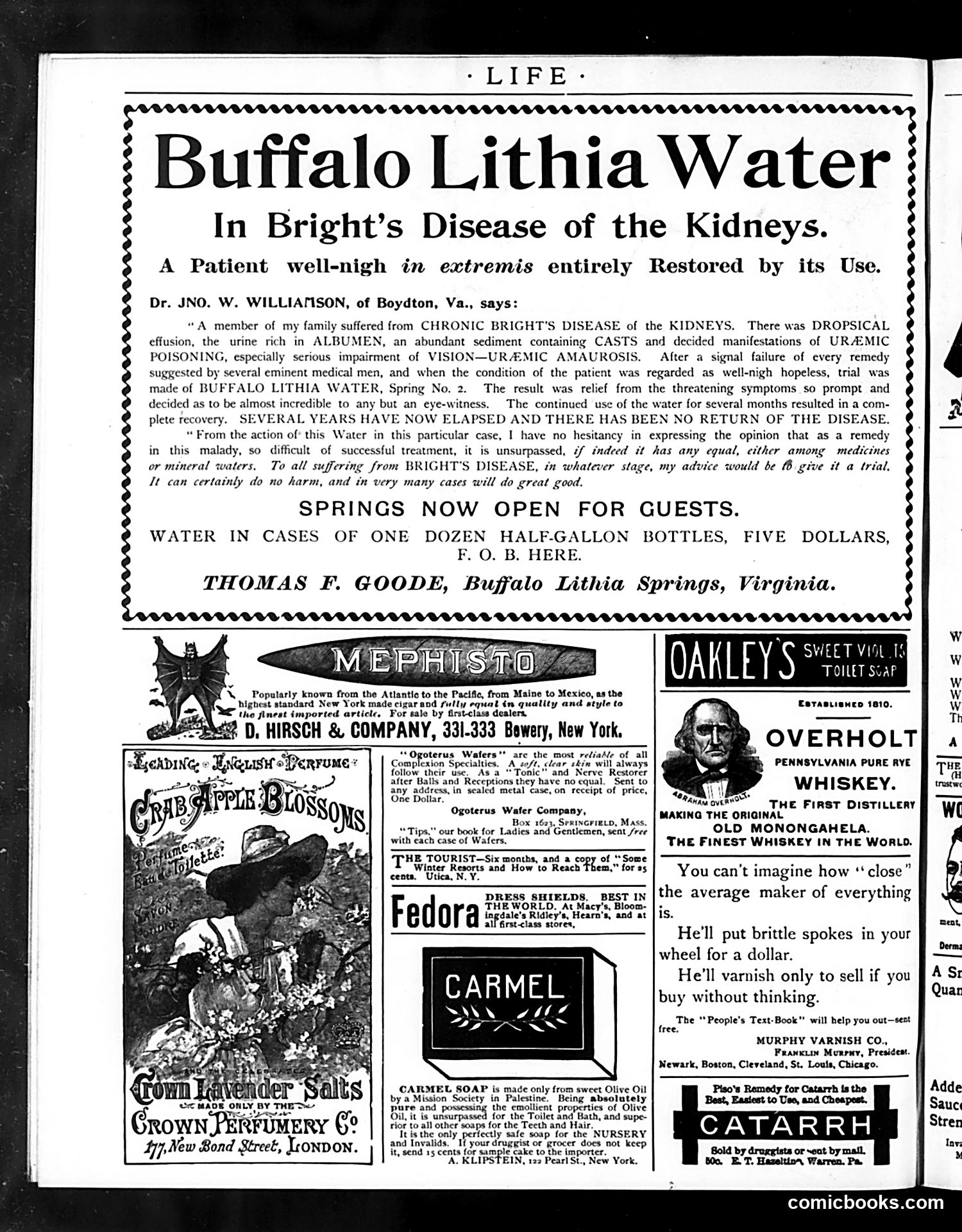
This page is primarily **advertising**, not satire or political commentary. The dominant feature is a testimonial advertisement for Buffalo Lithia Water, claiming to cure Bright's Disease (a kidney ailment). Dr. J.W. Williamson of Virginia testifies that mineral water from Buffalo Lithia Springs completely cured a family member's chronic kidney disease after conventional medicine failed. The remaining space contains product advertisements typical of late 19th-century American magazines: cigars, perfume, soap, whiskey, dress shields, and patent medicines. These ads exploit period anxieties about health and appearance, making exaggerated curative claims common to the era. **The satire is implicit**: Life magazine printed these ads while simultaneously mocking such dubious health claims in its editorial content. The magazine was known for satirizing quack medicine and false advertising—a tension visible on pages like this.
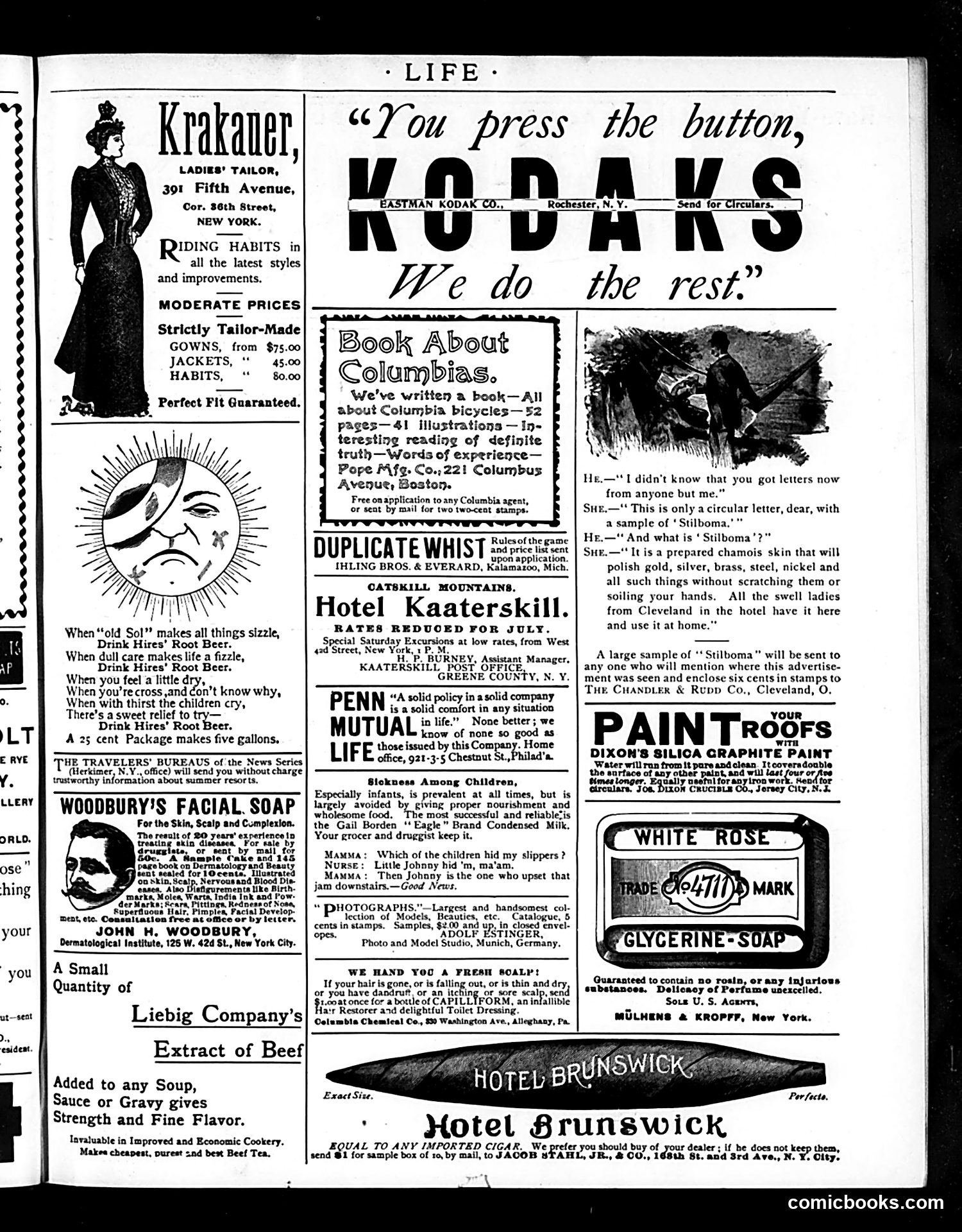
This page is primarily **advertising**, typical of *Life* magazine's revenue model. Key content includes: **Main Advertisement:** Kodak's famous slogan "You press the button, we do the rest"—explaining their revolutionary simple camera technology to consumers accustomed to complex photography. **Social Context:** The ads reflect turn-of-century concerns: Woodbury's Facial Soap addresses "skin diseases"; Liebig's Extract of Beef promises nutrition; Gail Borden's condensed milk emphasizes child health and food safety—issues of genuine concern in an era before modern sanitation. **Notable Humor:** A brief domestic joke depicts a wife explaining "Stilboma" (a polishing cloth) to her husband, with mild satire on circular advertising and marital dynamics. **Class Markers:** Krakauer's ladies' tailor ($75+ gowns), Catskill resort advertisements, and Columbia bicycles target middle-to-upper-class readers. The page captures early advertising's educational tone—products required explanation to unfamiliar consumers.
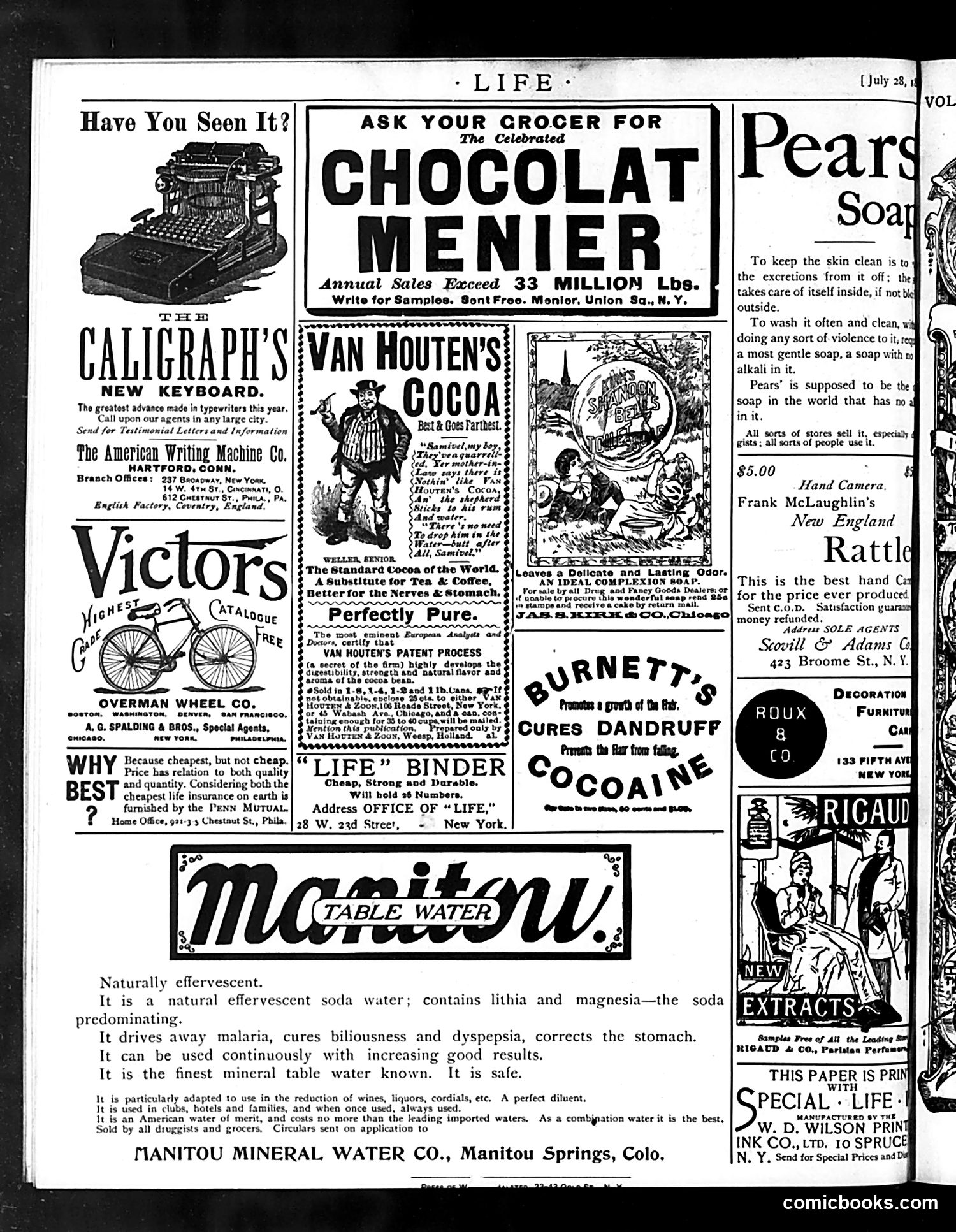
This is primarily an **advertisement page** from Life magazine (July 28, circa 1890s), containing no political cartoons or satirical content requiring historical interpretation. The page showcases **period consumer products** typical of the late Victorian era: - **Chocolat Menier** cocoa (claiming 33 million pounds in annual sales) - **Van Houten's Cocoa** with a Dutch figure in traditional dress - **Typewriters** (Caligraph's "new keyboard") - **Bicycles** (Victor brand) - **Mineral water** (Manitou brand, marketed for health benefits like curing malaria and dyspepsia) - **Pears' soap** (positioning itself as gentler than alkaline alternatives) - **Hand cameras** and various other goods The ads reflect contemporary attitudes: products are marketed with exaggerated health claims (mineral water "cures" diseases), and there's heavy use of ethnic/national imagery (Dutch cocoa vendor) to suggest authenticity and quality. This represents standard late-19th-century advertising conventions rather than satire.