
Life, 1892-07-28 · page 4 of 16
Life — July 28, 1892 — page 4: what you’re looking at
What you’re looking at
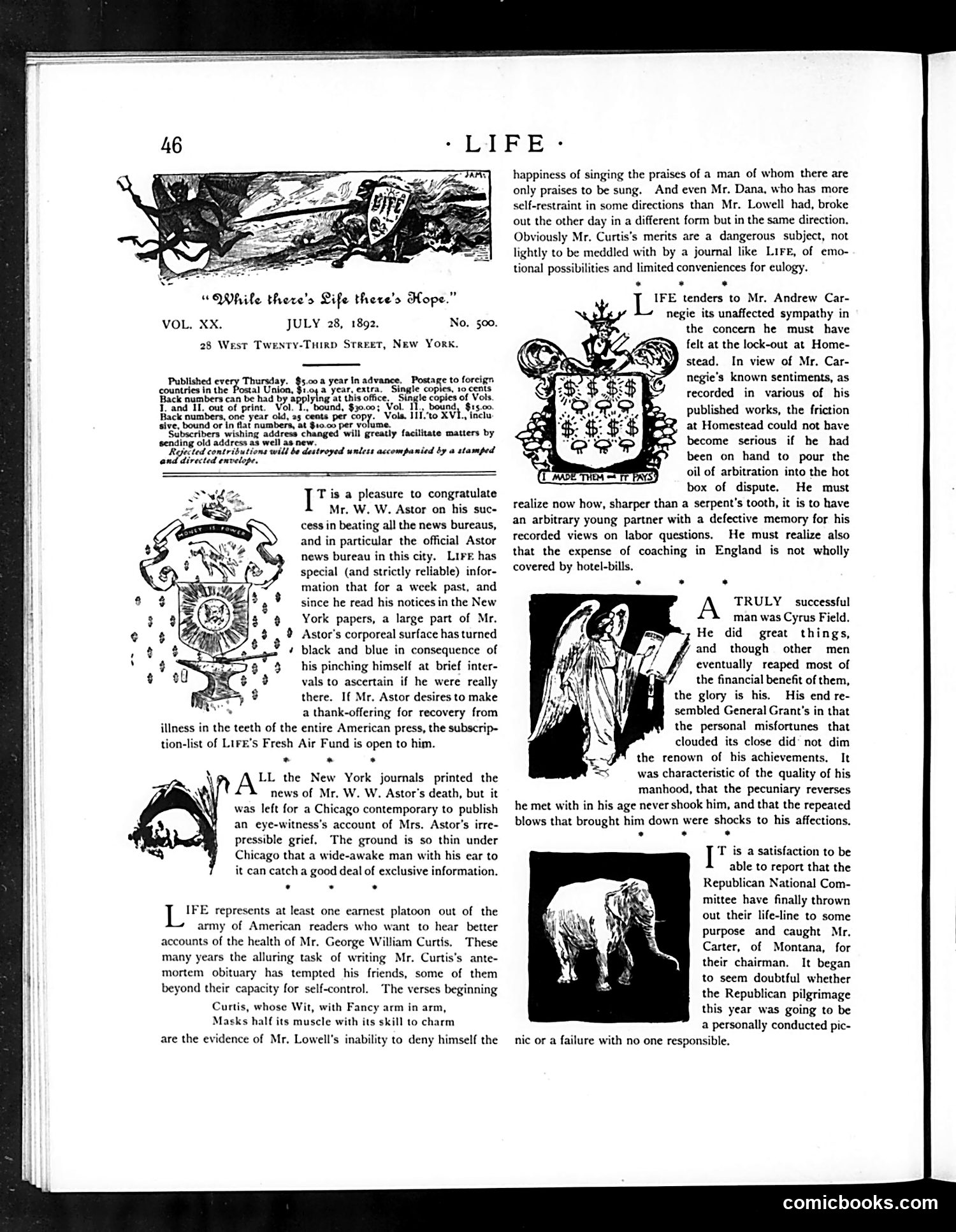
This page contains editorial commentary rather than traditional political cartoons. The main topics appear to be: 1. **W.W. Astor's death**: Life congratulates Astor on his newspaper success, then reports his death with some irony about Chicago papers getting the scoop on his "irreressible grief." 2. **Curtis's merit as a subject**: The editors critique George William Curtis's writing about labor issues, suggesting his views are too arbitrary and that hotel bills shouldn't cover coaching expenses in England—apparently a controversy within LIFE's editorial circles. 3. **Cyrus Field**: Described as a "truly successful man" whose achievements weren't dimmed by personal misfortunes, contrasting with General Grant's decline. 4. **Republican National Committee**: Brief mention of replacing their chairman, Mr. Carter of Montana, with uncertainty about the pilgrimages' success that year. The illustrations are decorative mastheads rather than satirical commentary.
📄 Transcribed text from this page (OCR, searchable)
Machine-transcribed from the original scan — historical spelling and the odd misread are preserved.
> LIFE © “Mile there's Life there’s Hope.” VOL. XX. JULY 28, 1892. 28 West Twenty-Tuirp Street, New York. No. 500. Published every Thursday. $3.00 a year In advance. Postage to foreign countries in the Postal Union, $1.04 a year, extra. Single copies, 10 cents Back numbers can be had by applying at this office. Single copies of Vols. 1. and II. out of print. Vol. I., bound, $30.00; Vol. IT., bound, $15.00. Back numbers, one year old, 25 cents per copy.’ Vols. I1i."to XVI., inclu sive, bound or in flat numbers, at $10.00 per volume. Subscribers wishing address changed will greatly facilitate matters by sending old address as well as new. iS Rejected contributions will be destroyed untess accompanied by a stamped and directed envelope. a = I" is a pleasure to congratulate Mr. W. W. Astor on his suc- cess in beating all the news bureaus, and in particular the official Astor news bureau in this city. Lire has special (and strictly reliable) infor- mation that for a week past, and since he read his notices in the New York papers, a large part of Mr. Astor's corporeal surface has turned black and blue in consequence of his pinching himself at brief inter- vals to ascertain if he were really there. If Mr. Astor desires to make a thank-offering for recovery from illness in the teeth of the entire American press, the subscrip- tion-list of LIFE’s Fresh Air Fund is open to him. * * . \ LL the New York journals printed the news of Mr. W. W. Astor's death, but it was left for a Chicago contemporary to publish an eye-witness’s account of Mrs. Astor's irre- pressible grief. The ground is so thin under Chicago that a wide-awake man with his ear to it can catch a good deal of exclusive information. IFE represents at least one earnest platoon out of the army of American readers who want to hear better accounts of the health of Mr. George William Curtis. These many years the alluring task of writing Mr. Curtis's ante- mortem obituary has tempted his friends, some of them beyond their capacity for self-control. ‘The verses beginning Curtis, whose Wit, with Fancy arm in arm, Masks half its muscle with its skill to charm are the evidence of Mr. Lowell's inability to deny himself the happiness of singing the praises of a man of whom there are only praises to be sung. And even Mr. Dana, who has more self-restraint in some directions than Mr. Lowell had, broke out the other day in a different form but in the same direction. Obviously Mr. Curtis's merits are a dangerous subject, not lightly to be meddled with by a journal like LIFE, of emo- tional possibilities and limited conveniences for eulogy. . . . IFE tenders to Mr. Andrew Car- negie its unaffected sympathy in the concern he must have felt at the lock-out at Home- stead. In view of Mr. Car- negie’s known sentiments, as recorded in various of his published works, the friction at Homestead could not have become serious if he had been on hand to pour the oil of arbitration into the hot box of dispute. He must realize now how, sharper than a serpent's tooth, it is to have an arbitrary young partner with a defective memory for his recorded views on labor questions. He must realize also that the expense of coaching in England is not wholly covered by hotel-bills. . . TRULY successful man was Cyrus Field. He did great things, and though other men eventually reaped most of the financial benefit of them, the glory is his. His end re- sembled General Grant's in that the personal misfortunes that clouded its close did’ not dim the renown of his achievements. It was characteristic of the quality of his manhood, that the pecuniary reverses he met with in his age never shook him, and that the repeated blows that brought him down were shocks to his affections. . T is a satisfaction to be able to report that the Republican National Com- mittee have finally thrown out their life-line to some purpose and caught Mr. Carter, of Montana, for their chairman. It began to seem doubtful whether the Republican pilgrimage this year was going to be a personally conducted pic- nic or a failure with no one responsible. comicbooks.com