A complete issue · 16 pages · 1892
Life — July 21, 1892
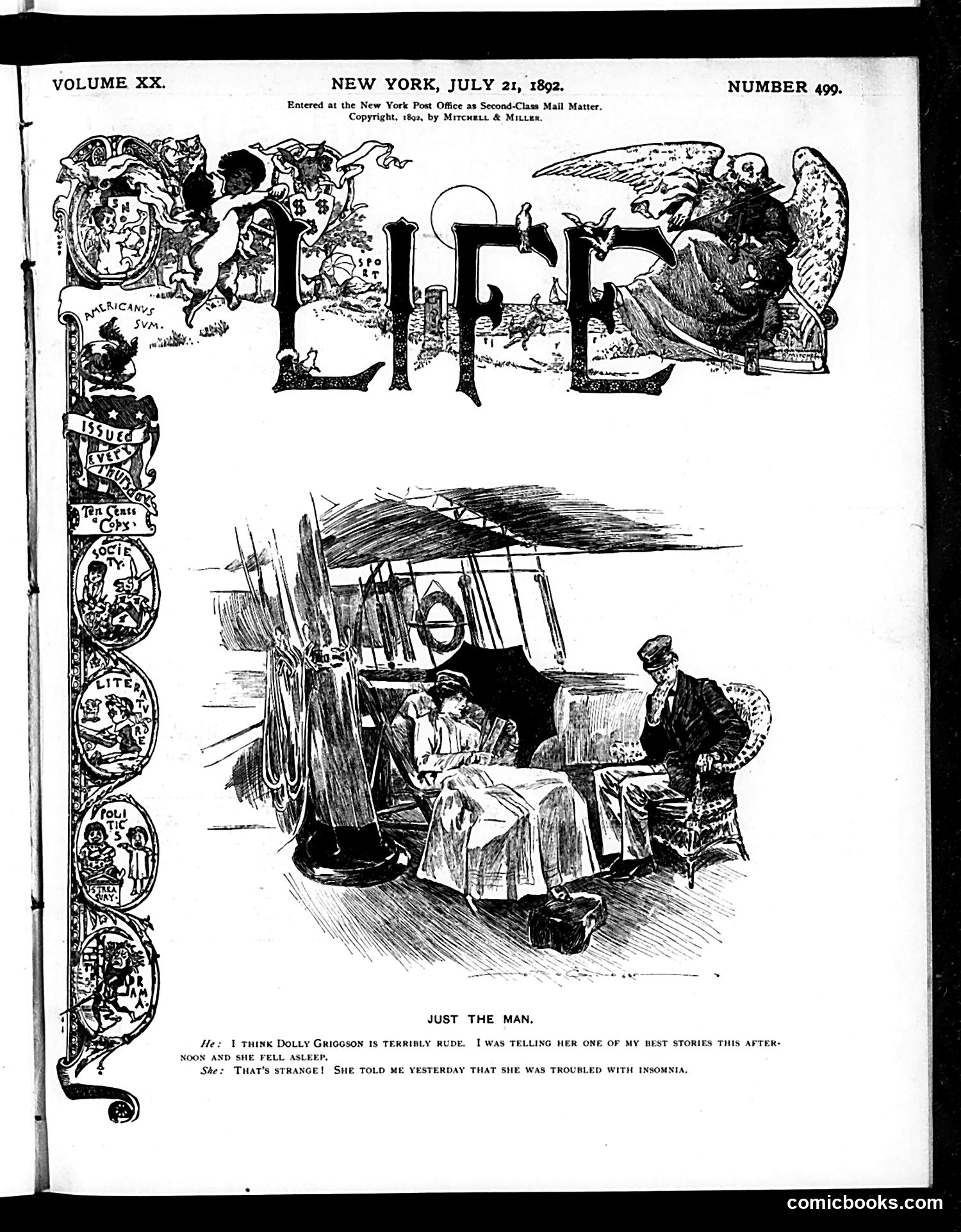
This short comic sketch depicts a social awkwardness joke with no apparent political content. Two men are having a conversation in what appears to be a tent or temporary shelter. The humor centers on a contradiction: one man claims Dolly Griggson is "terribly rude" because she fell asleep while he told her one of his best stories that afternoon. The other man responds that Griggson told him yesterday she suffered from insomnia. The joke's point is obvious—the woman's rudeness wasn't genuine rudeness but rather exhaustion from her sleep disorder. The title "Just the Man" likely refers to the first speaker being exactly the type of boring raconteur whose tedious stories would put anyone to sleep, making him the perfect target for such irony.
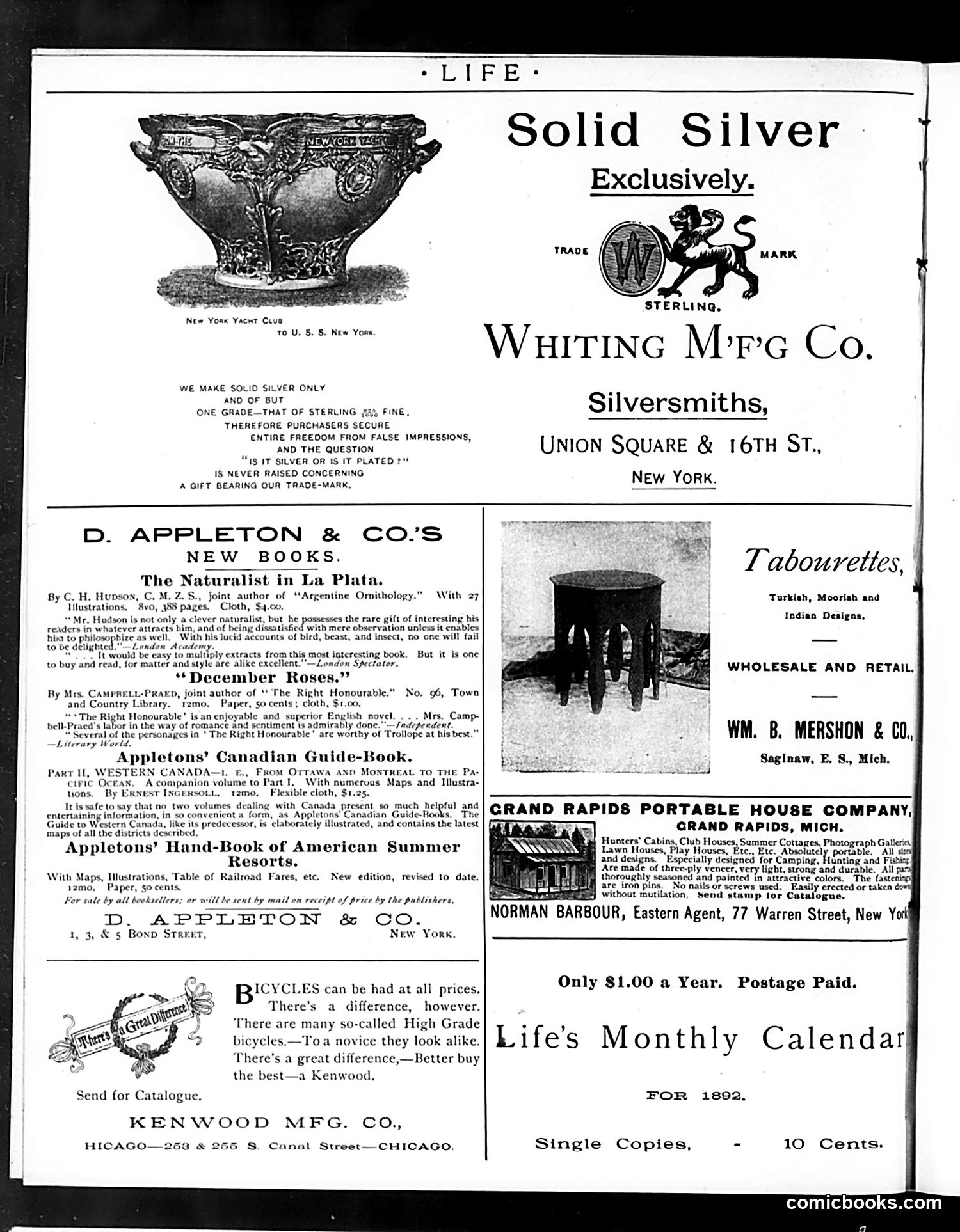
This page is primarily **advertising**, not satirical content. It features multiple commercial advertisements from the 1890s era: - **Whiting Manufacturing Co.** advertises solid sterling silver goods for silversmiths in New York - **D. Appleton & Co.** promotes books including "The Naturalist in La Plata" and "December Roses" - **Tabourettes** (decorative stools) are advertised by Wm. B. Mershon & Co. - **Grand Rapids Portable House Company** markets prefabricated portable structures - **Kenwood Manufacturing Co.** sells bicycles, emphasizing their quality as "High Grade" - **Life's Monthly Calendar** for 1892 is offered for $1.00 annually The page contains no political cartoons or satirical commentary—it's a standard magazine advertising section typical of the era, showcasing consumer goods and services available to late-Victorian American readers.
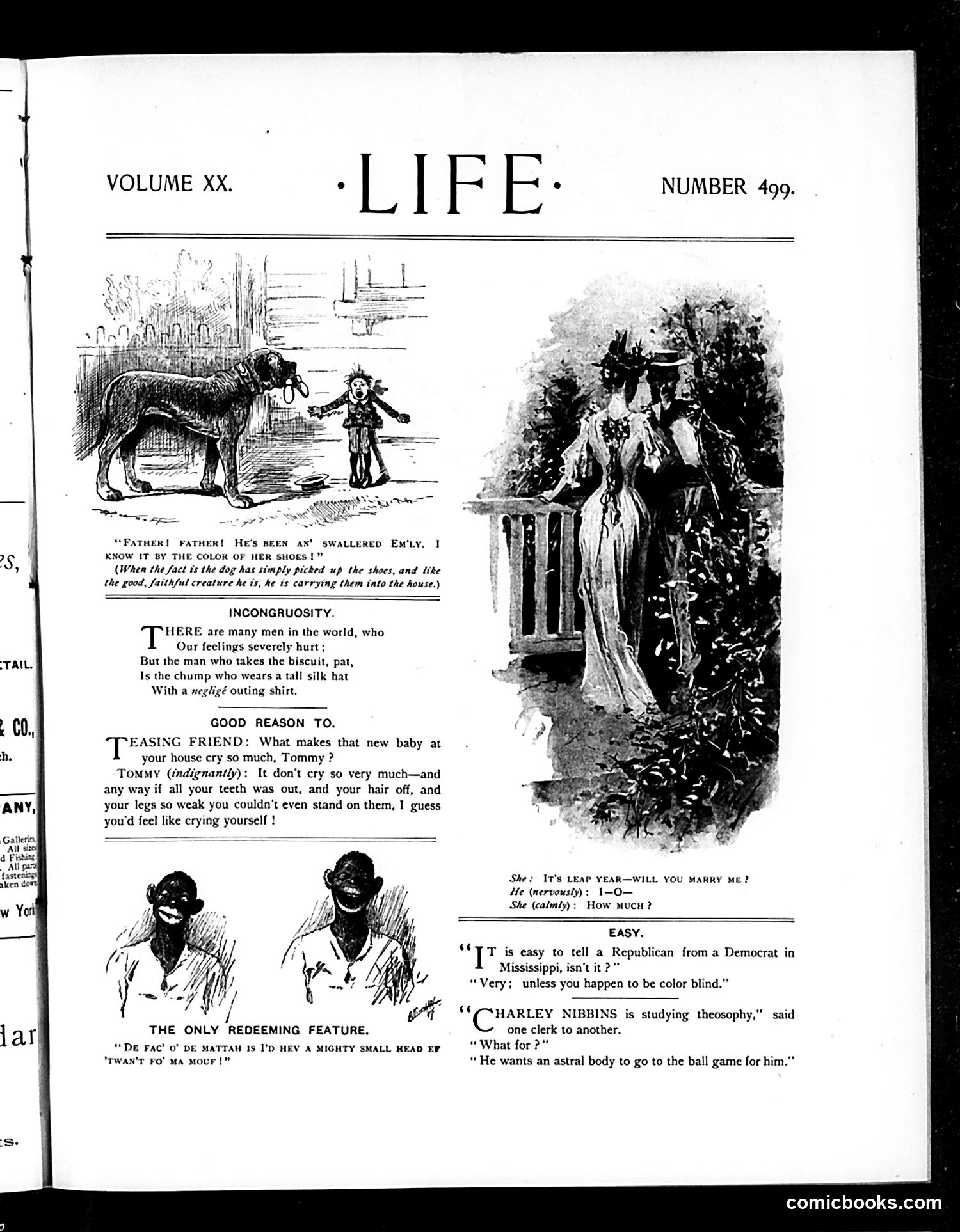
This page contains several humor pieces typical of early 20th-century Life magazine: **Top cartoon**: Shows a large dog tracking mud into a home while a child appeals to his father. The joke relies on the dog being an "Early" (possibly a proper name or breed reference) who has gotten dirty—the humor playing on domestic chaos and parental exasperation. **Middle section**: Contains brief jokes and witticisms, including one about Republican/Democrat distinctions and another about someone named Charley Nibbins studying theosophy (a spiritual movement popular in that era). **Right illustration**: Appears to be a romantic or dramatic scene, likely accompanying a separate story. **Bottom cartoons**: Show caricatured faces with crude exaggeration typical of the era's editorial cartooning style. The overall tone reflects LIFE's satirical approach to domestic life, politics, and social commentary of its time period.
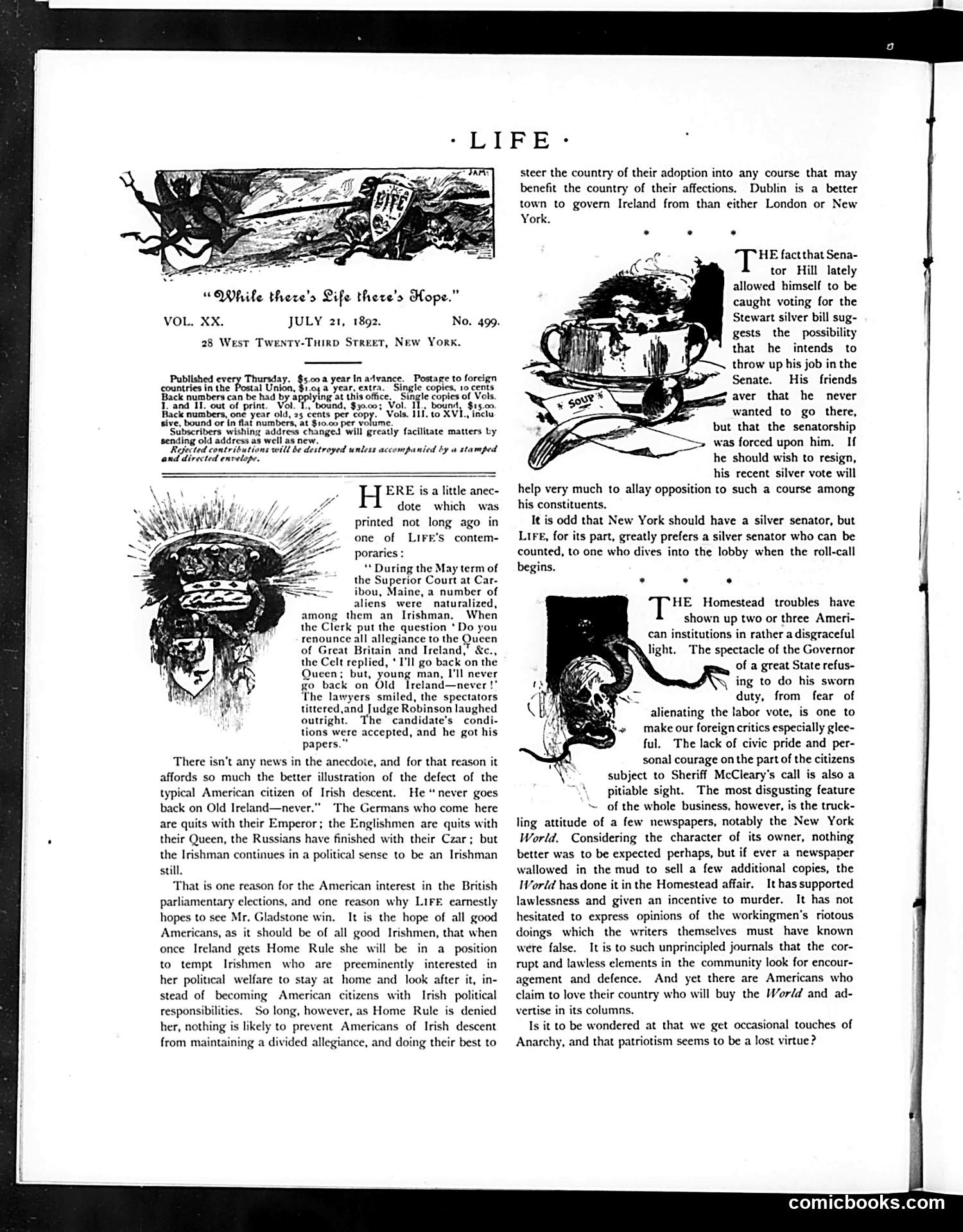
This page critiques Irish-American political behavior and American governance. The left cartoon depicts an Irish immigrant's exaggerated facial features and expression—a common racist caricature of the era—accompanying a story about Irish naturalization candidates being asked about loyalty to Britain and Ireland during a Maine court proceeding. The right section attacks the "Homestead troubles" (likely referring to the violent 1892 Homestead Steel Strike) and criticizes newspapers, particularly the *New York World*, for irresponsible coverage that encourages lawlessness. The text condemns citizens who don't support their adopted country and accuses some papers of fomenting "Anarchy." The satire reflects xenophobic anxieties about Irish immigrants' divided loyalties and contemporary debates about labor violence and press responsibility.
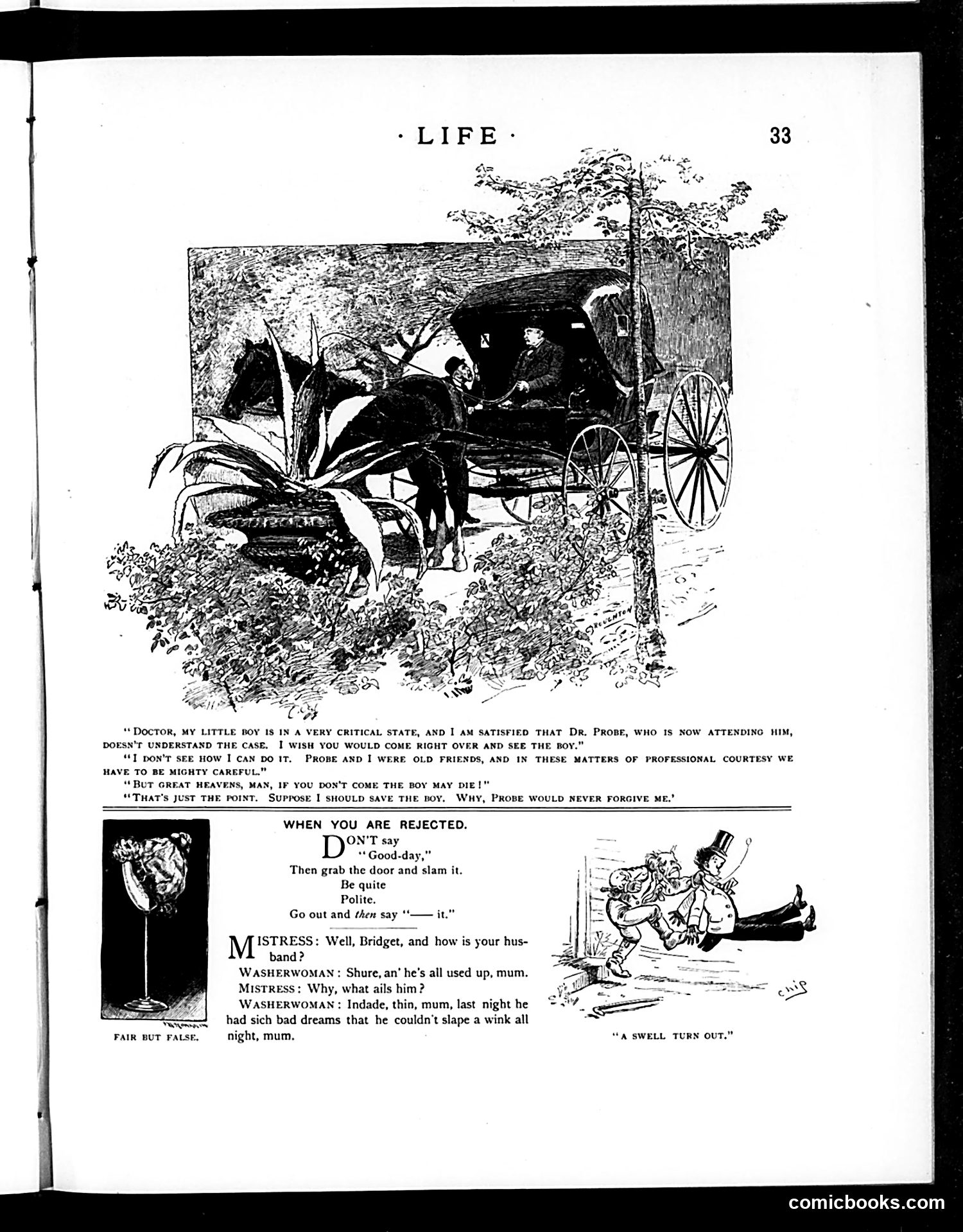
**Main Cartoon (top):** Depicts a horse-drawn carriage with a doctor visiting a critically ill boy. The dialogue concerns a physician named Dr. Probe attending to the patient, with tension over whether professional courtesy requires the doctor to visit without charge. The satire critiques medical ethics and professional obligations—specifically, whether doctors should treat patients for free based on friendship or professional relationships. **Bottom Section:** Two separate sketches with social commentary. "Fair but False" (left) and "A Swell Turn Out" (right) appear to satirize romantic rejection and courtship customs. The middle dialogue between a mistress and washerwoman mocks working-class marital discord, with the husband suffering from insomnia and stress. These pieces reflect early 20th-century American social anxieties about class, professionalism, and domestic life.
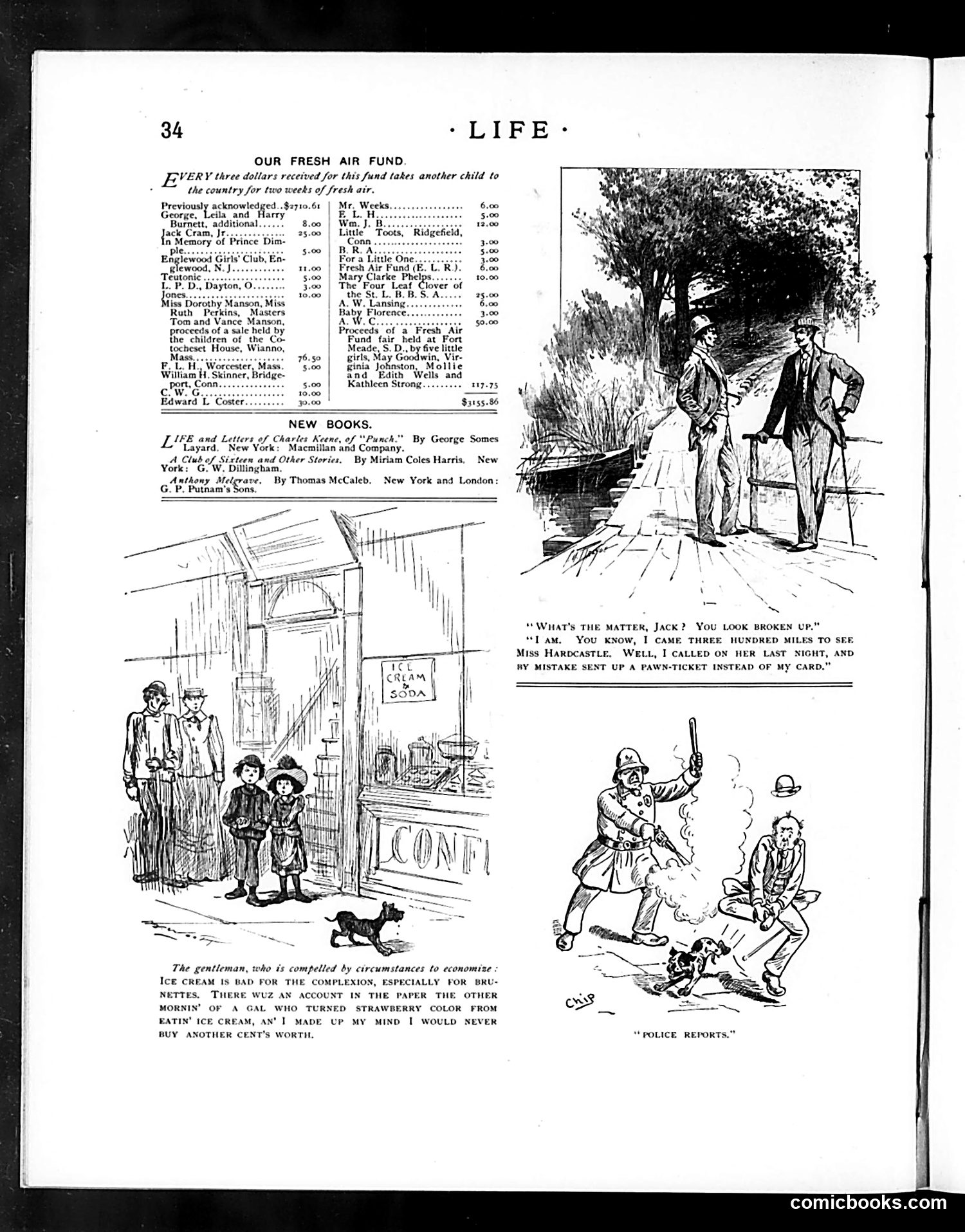
This page contains two distinct cartoons with social commentary: **Left cartoon**: Depicts a gentleman with children outside an ice cream shop. The caption satirizes his false economy—he refuses to buy ice cream for a child, claiming concern about complexion damage (a period beauty standard), yet this miserliness contradicts his gentleman status. The joke mocks middle-class hypocrisy: pretending refined concerns about appearance while being stingy. **Right cartoon**: Titled "Police Reports," shows what appears to be a baseball scene with an officer interrupting play. The joke likely references police enforcement of laws or regulations affecting public recreation—possibly commenting on Prohibition-era enforcement or municipal restrictions on leisure activities that disrupted ordinary citizens' activities. Both cartoons satirize social pretension and government overreach affecting everyday life.
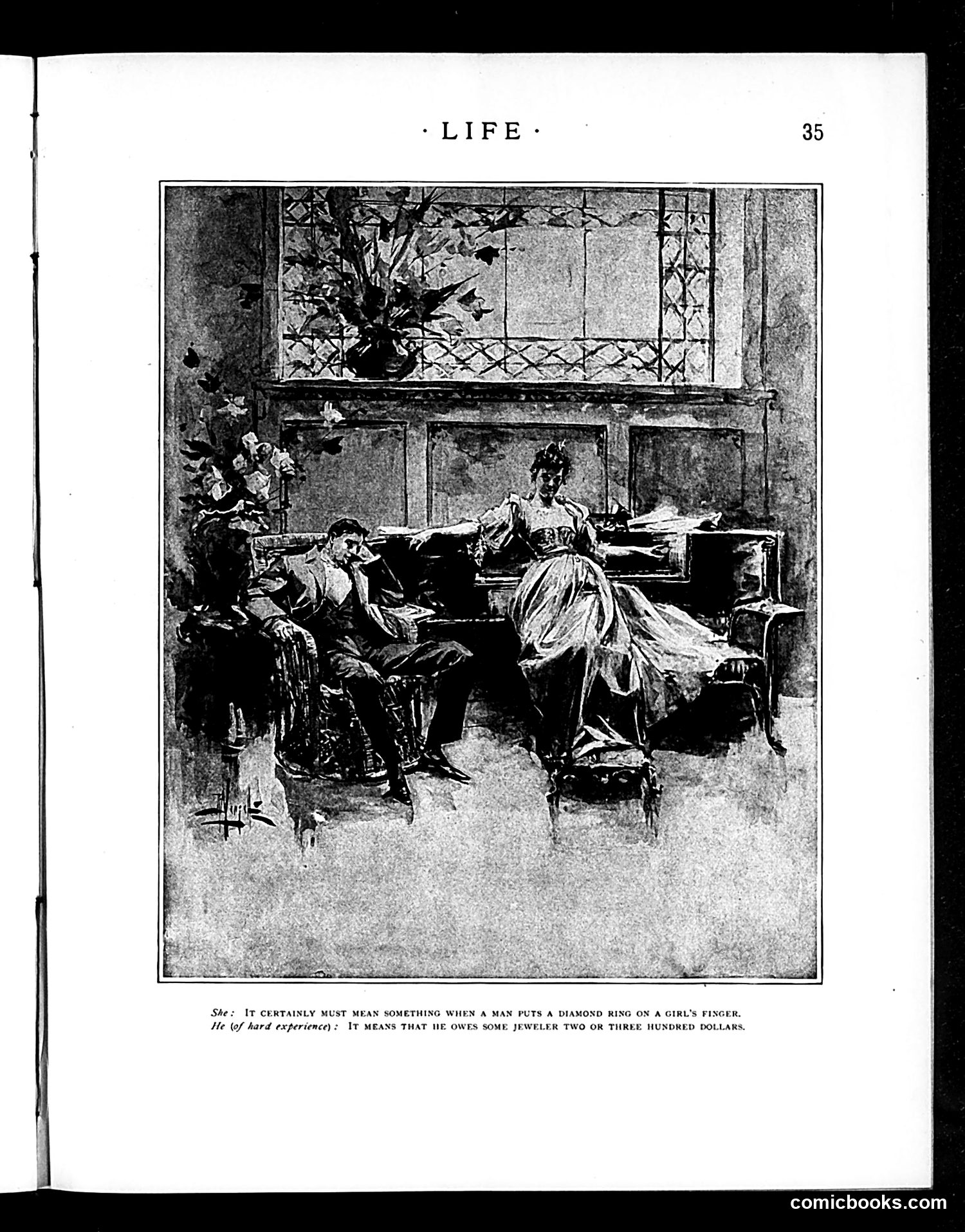
This is a satirical illustration from *Life* magazine (page 35) depicting a domestic scene with social commentary on marriage and financial expectations. The caption presents a dialogue about a diamond ring: a woman states it "certainly must mean something" when a man gives one to a girl, implying commitment. The man, described as having "hard experience," cynically responds that it merely means he owes a jeweler "two or three hundred dollars." The satire targets early 20th-century marriage conventions and materialism—specifically the tension between romantic gestures and their actual economic burden. The illustration shows an elegant interior with a woman in formal dress and a man in dark clothing, likely representing upper-middle-class courtship. The joke mocks both the commercialization of romance and men's financial obligations in courtship rituals.
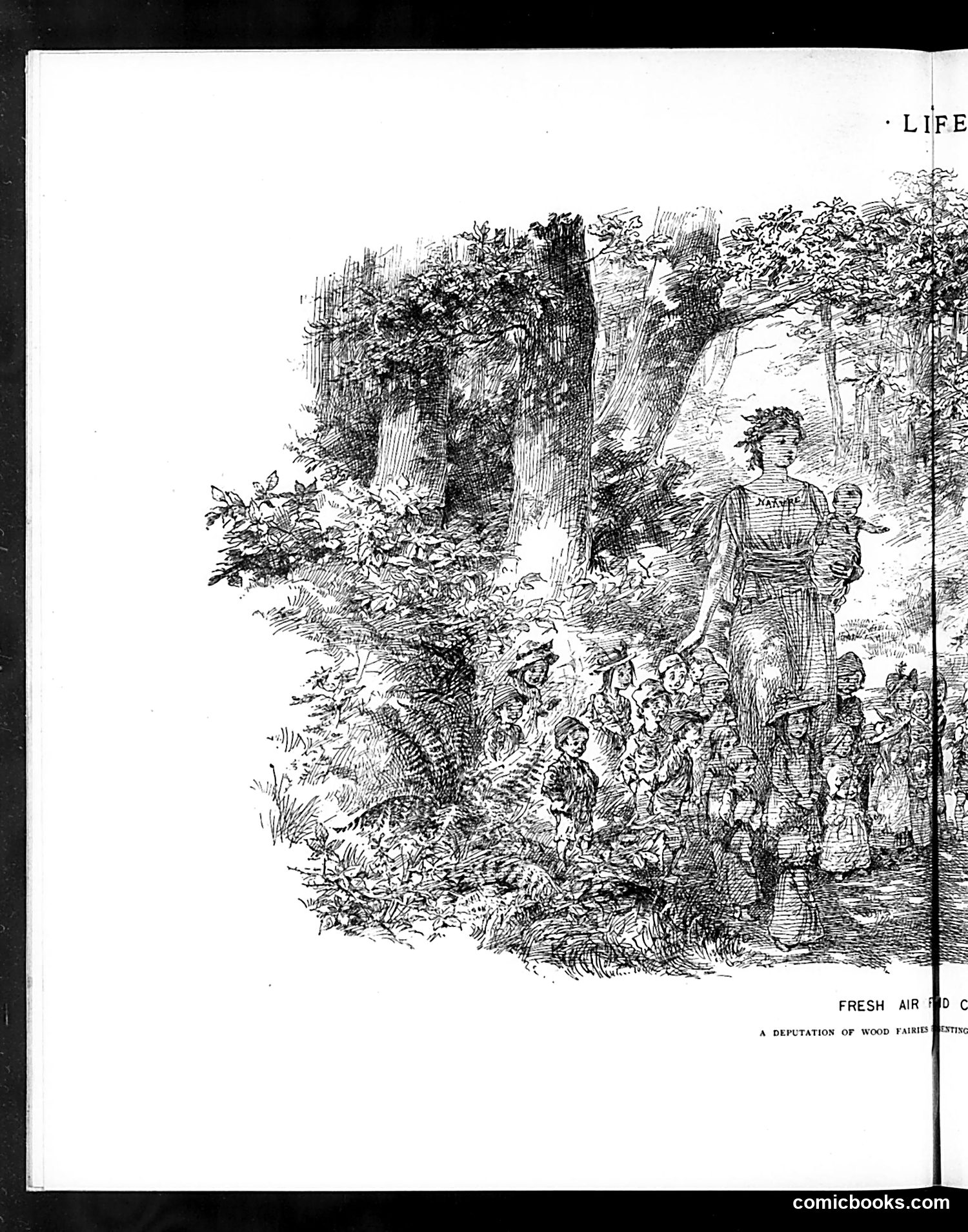
This is a satirical illustration titled "Fresh Air" with the subtitle "A Deputation of Wood Fairies Visiting" (text appears cut off). The image shows a woman in Victorian-era dress standing with a group of children in a wooded setting. The satire appears to mock the romantic, sentimental notion of "wood fairies"—likely critiquing either idealized children's literature or perhaps the upper-class practice of bringing children to nature as a supposedly transformative, magical experience. The term "Fresh Air" combined with "wood fairies" suggests ridicule of Victorian sentimentality about nature and childhood innocence. The children's somewhat awkward positioning and the woman's formal dress amid the wilderness may emphasize the artificial quality of such arranged encounters with nature. Without additional context, the specific target remains unclear, but the satire clearly undermines romanticized views of childhood and nature popular in that era.
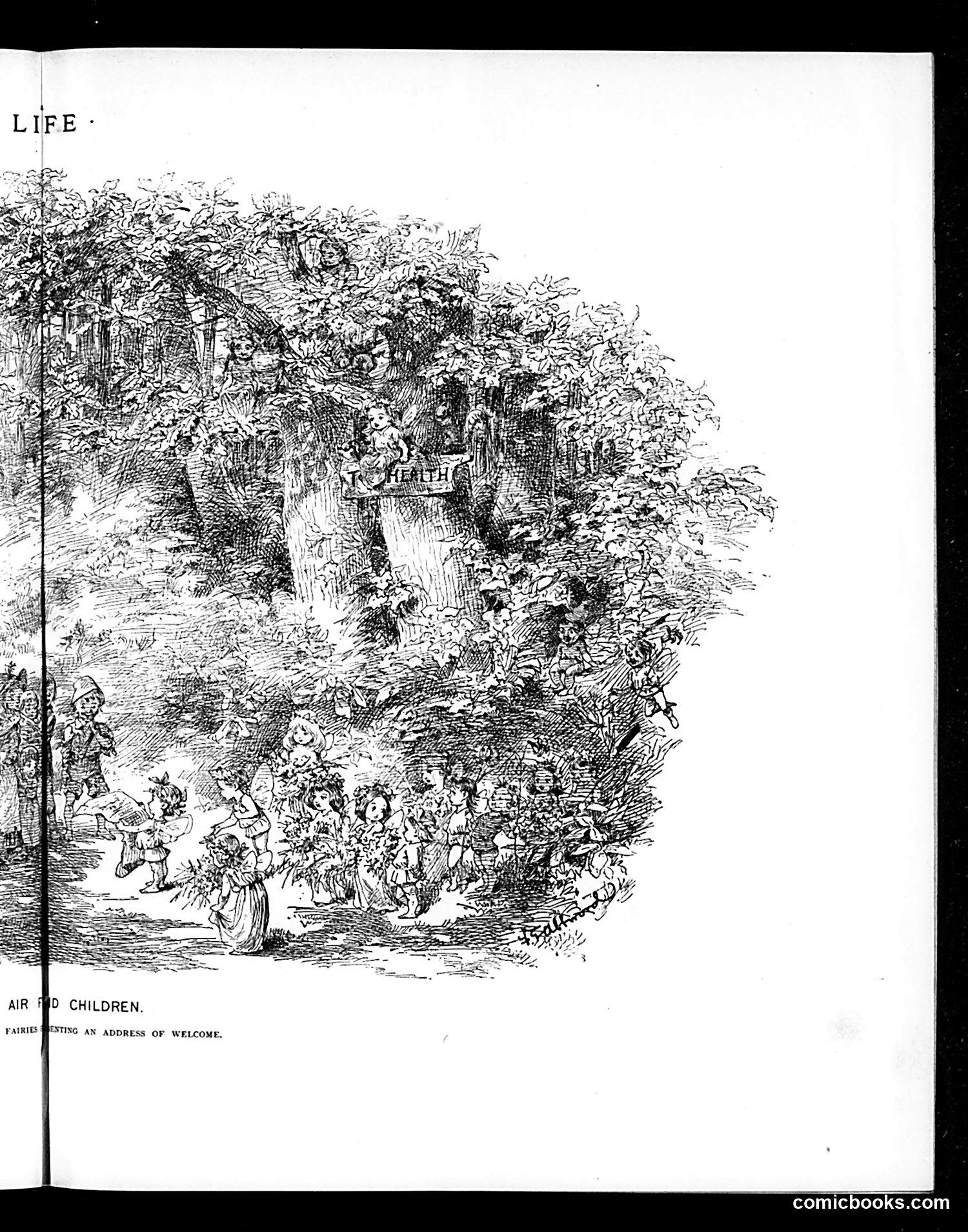
This page from *Life* magazine features an illustration titled "Air and Children" with a subtitle indicating it shows "Fairies Resting an Address of Welcome." The engraving depicts a woodland scene with a large, gnarled tree dominating the composition. Numerous small figures—appearing to be children and fairy-like creatures—gather beneath it in a naturalistic setting. The satire likely targets Victorian sentimentality about childhood innocence and nature. By depicting "fairies" addressing children in an idealized forest, the cartoon probably mocks the era's romantic idealization of nature and childhood, or perhaps satirizes literature and educational materials promoting such ideals. Without additional context about the specific issue's date or contributors, the precise satirical target remains unclear, though it appears to critique sentimental cultural attitudes toward children and the natural world.
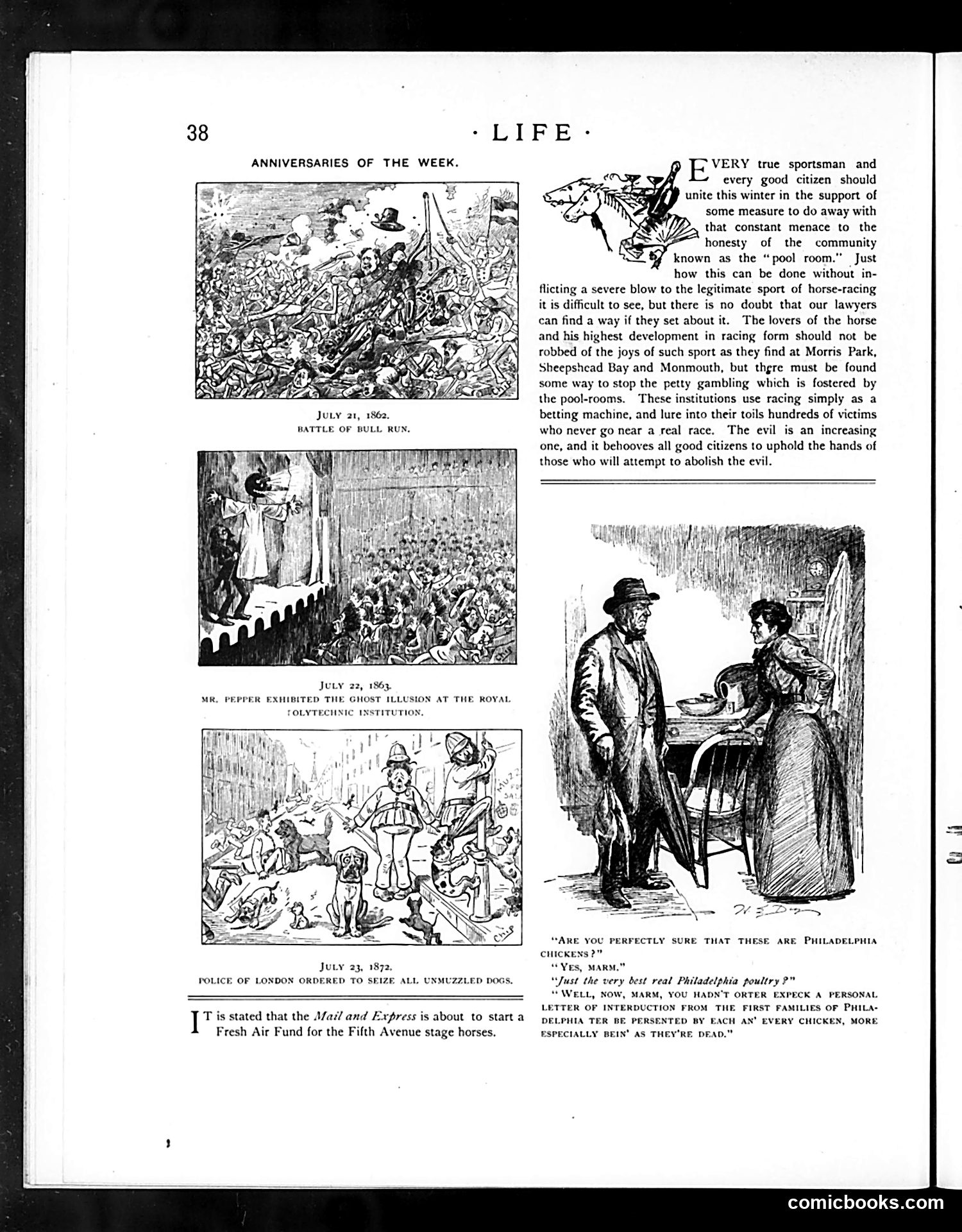
This page contains historical anniversary engravings and a satirical dialogue about Philadelphia chickens. **The Engravings** illustrate past events (Battle of Bull Run, 1862; Mr. Pepper's ghost illusion, 1863; police seizing unmuzzled dogs, 1872)—standard historical retrospectives for the magazine. **The Main Cartoon** depicts a man inquiring whether certain birds are "Philadelphia chickens." The woman confirms they are, noting they're "the very best real Philadelphia poultry." The satire mocks Philadelphia's reputation for producing superior chicken breeds—a source of civic pride. The dialogue humorously emphasizes the "personal letter of introduction from the first families" accompanies each chicken, poking fun at Philadelphia's snobbish upper-class pretensions and their obsession with pedigree and social status.
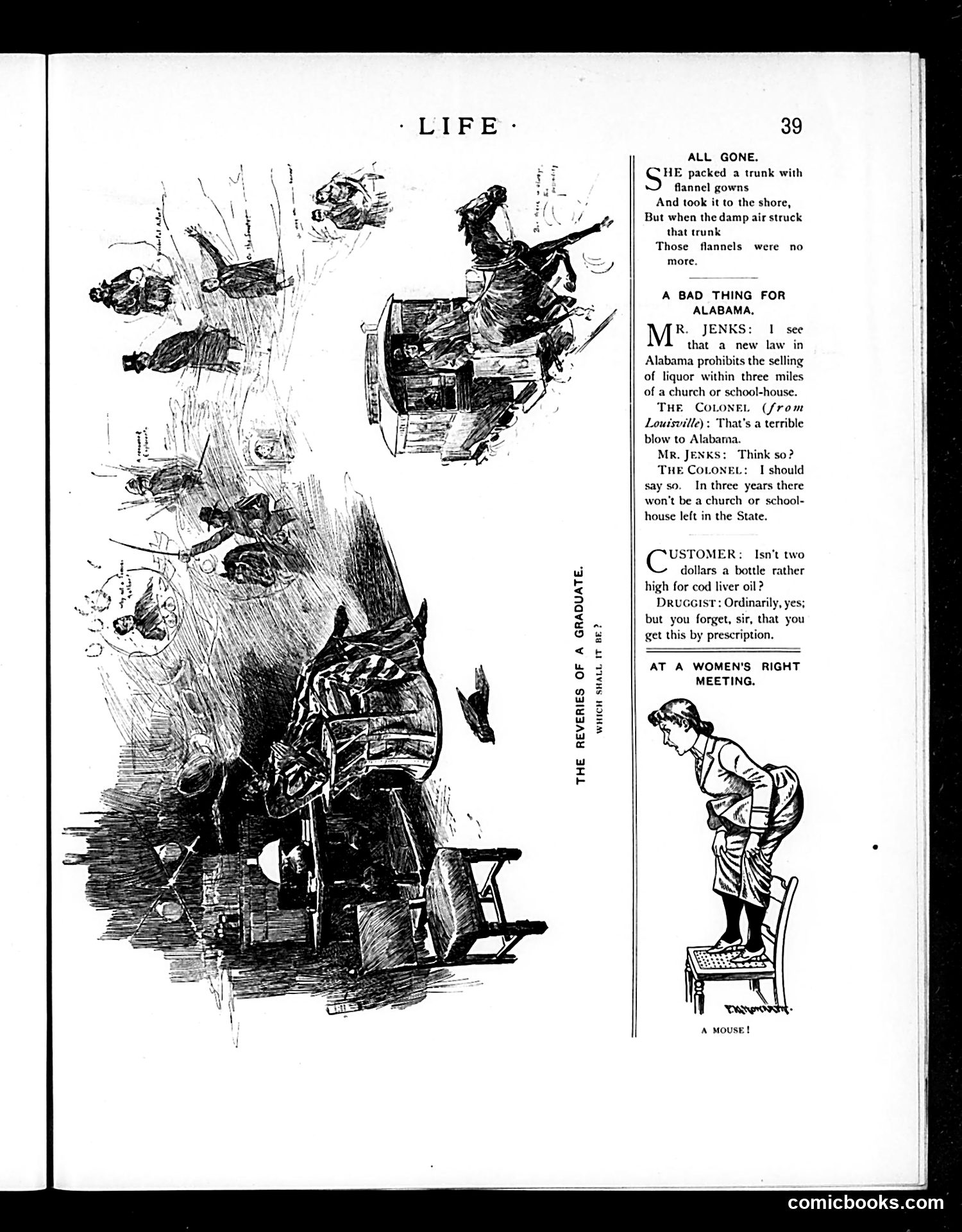
The large left illustration depicts "The Revels of a Graduate When It Snows It" — a chaotic winter scene showing well-dressed figures engaged in rowdy behavior (sledding, throwing snowballs), rendered in exaggerated, energetic sketch style to mock youthful excess. The right column contains three brief satirical dialogues: 1. **"All Gone"** — mocks a woman who packed expensive flannel gowns for a shore trip, only to lose them when dampness ruined the trunk. 2. **"A Bad Thing for Alabama"** — criticizes Alabama's new liquor prohibition law within three miles of churches/schools, with a Colonel sardonically noting that enforced temperance destroyed all schoolhouses within three years. 3. **"At a Women's Right's Meeting"** — a cartoon of a woman standing on a chair, captioned "A Mouse!" — likely satirizing women's rights advocates as hysterically fearful.
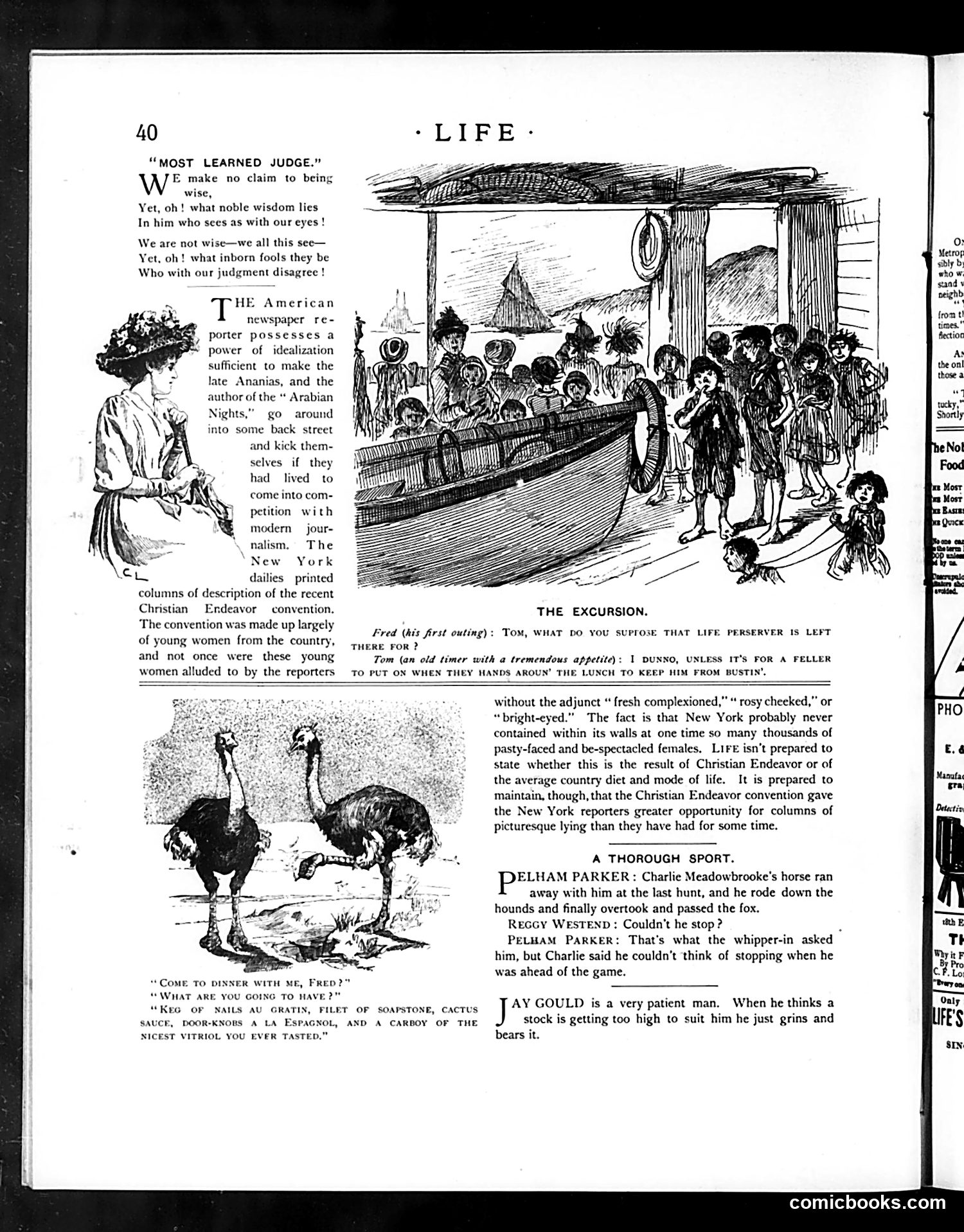
This page satirizes American journalism's exaggeration and dishonesty. The opening poem mocks people who blindly accept others' opinions as wisdom. The main article critiques New York newspaper reporters covering a Christian Endeavor convention (a young Christian organization's gathering). The reporters dramatically idealized the mostly rural young women attendees, describing them with flattering adjectives ("fresh complexioned," "rosy cheeked") when Life claims they actually appeared "pasty-faced and be-spectacled." Life argues journalists prioritized sensational, falsified descriptions over accuracy. Below are lighter humor pieces: a joke about overeating on an excursion, and anecdotes about wealthy sportsmen (Pelham Parker, Reggy Westend, Jay Gould) and their absurd behavior. The overall theme criticizes press dishonesty while poking fun at society figures.
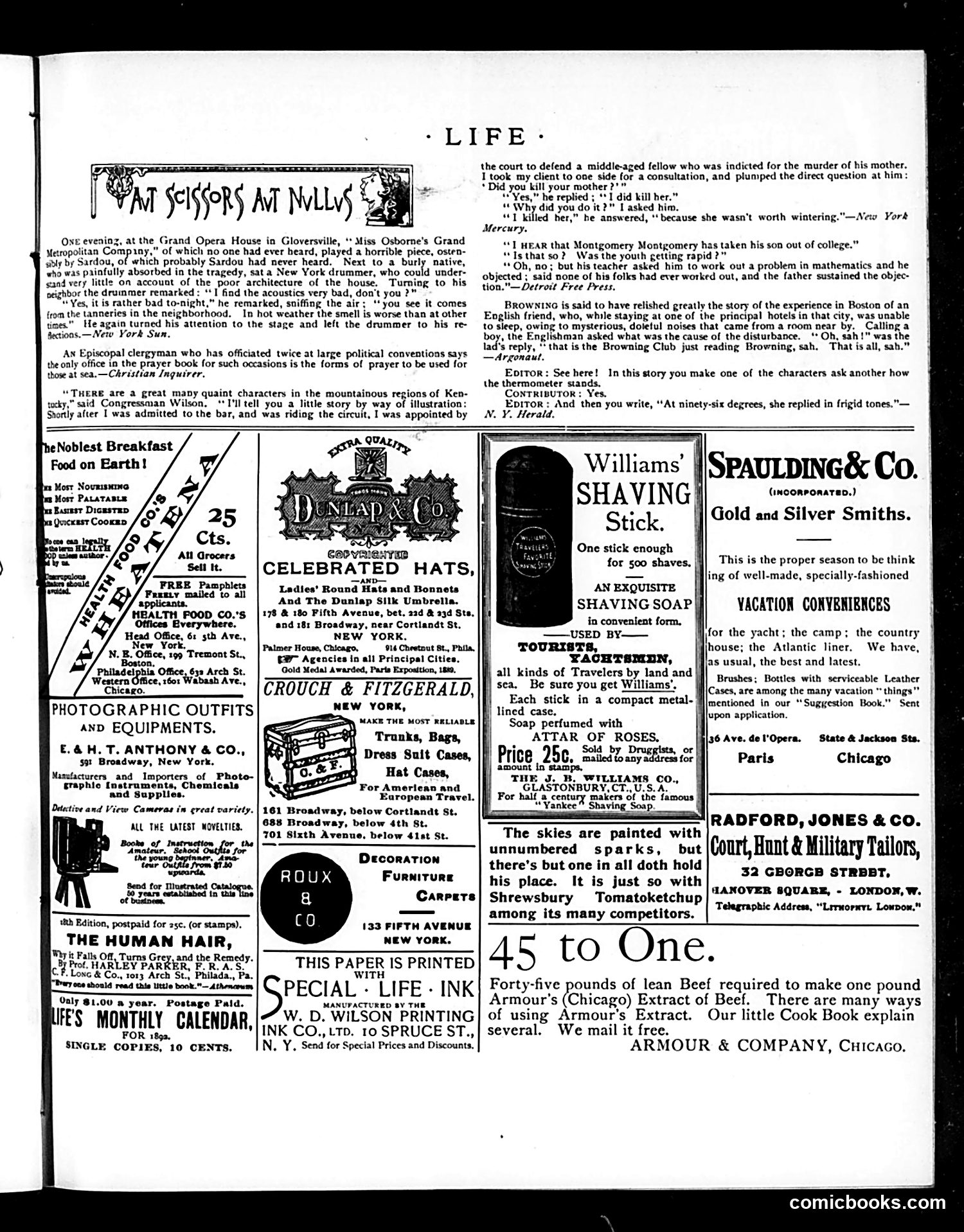
This page is primarily **advertising and humor anecdotes** rather than political cartoons. The satirical content consists of three brief jokes: 1. **The Acoustics Joke**: A drummer at a theater complains about bad sound; a local reveals the real problem is smell from nearby tanneries—a joke about rural industrial odors being mistaken for architectural failure. 2. **The Matricide Defense**: A lawyer asks his client why he killed his mother; the answer is she "wasn't worth wintering"—dark humor about utilitarian murder justification. 3. **The Browning Club**: An Englishman in Boston can't sleep from mysterious noise; it's a literary club reading Browning poetry loudly—a jab at intellectual pretension and tedious literary societies. The remaining content is **period advertisements** for hats, photographic equipment, hair treatments, and other Victorian-era products. No identifiable political figures or events are referenced. The humor relies on observational satire about American manners, rural attitudes, and intellectual affectation typical of 1890s Life magazine.
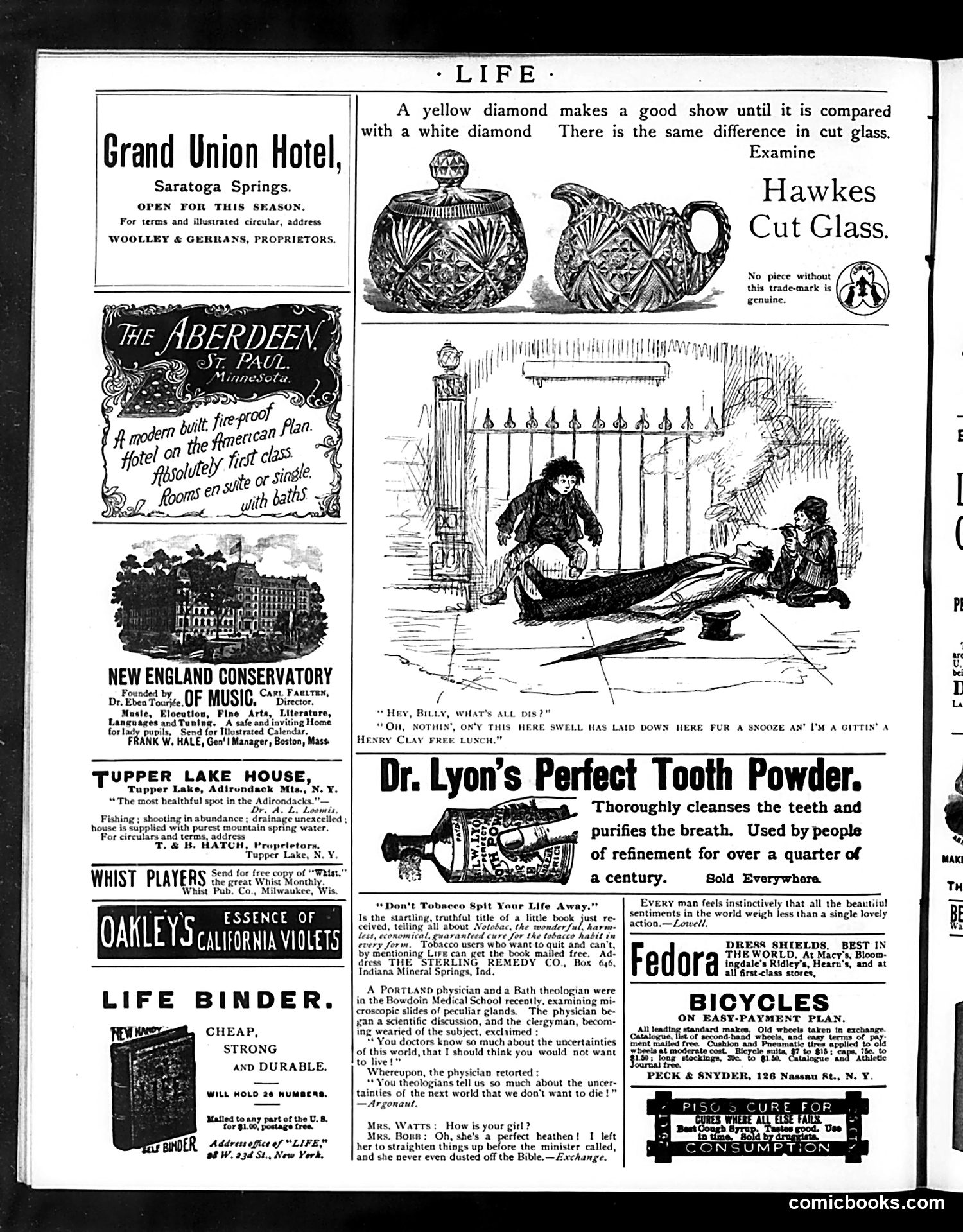
This page is primarily **advertisements and filler content** rather than editorial material or political cartoons. The dominant elements are ads for hotels, music conservatories, cut glass, tooth powder, bicycles, and other period products. The only cartoon present is a small illustration accompanying a humorous anecdote titled "HEY, BILLY, WHAT'S ALL DIS?" It depicts two figures—apparently a working-class man and an upper-class gentleman lying on the ground—with dialogue suggesting the working man is about to rob the unconscious wealthy man for lunch money. The joke relies on class-based humor common to the era: depicting poverty-stricken laborers as opportunistic around wealthy people. The page also includes brief jokes at the bottom, including one mocking a woman's ignorance about the Bible, typical of period humor. Overall, this represents a typical turn-of-the-century *Life* page mixing commercial advertisements with light, class-conscious humor.
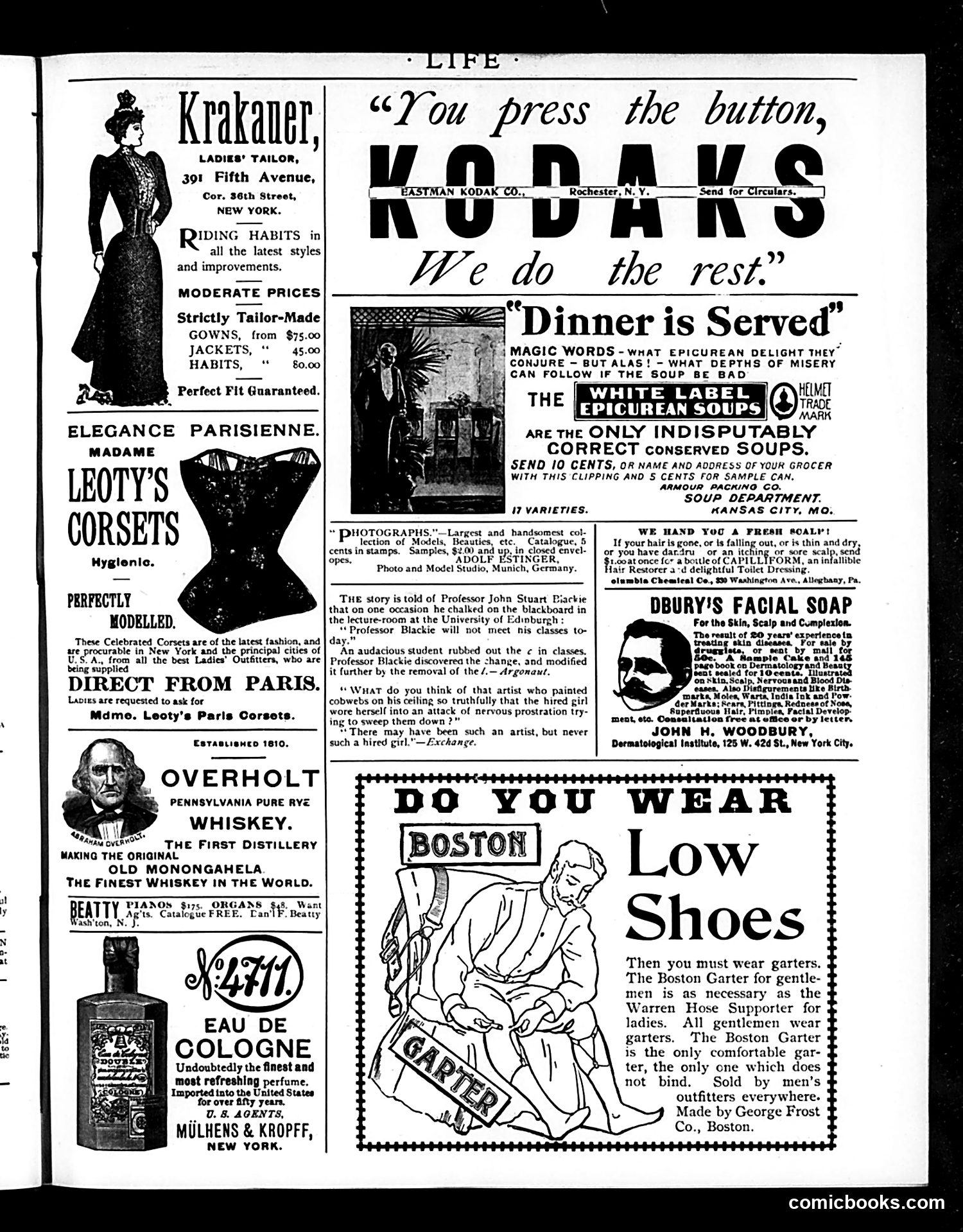
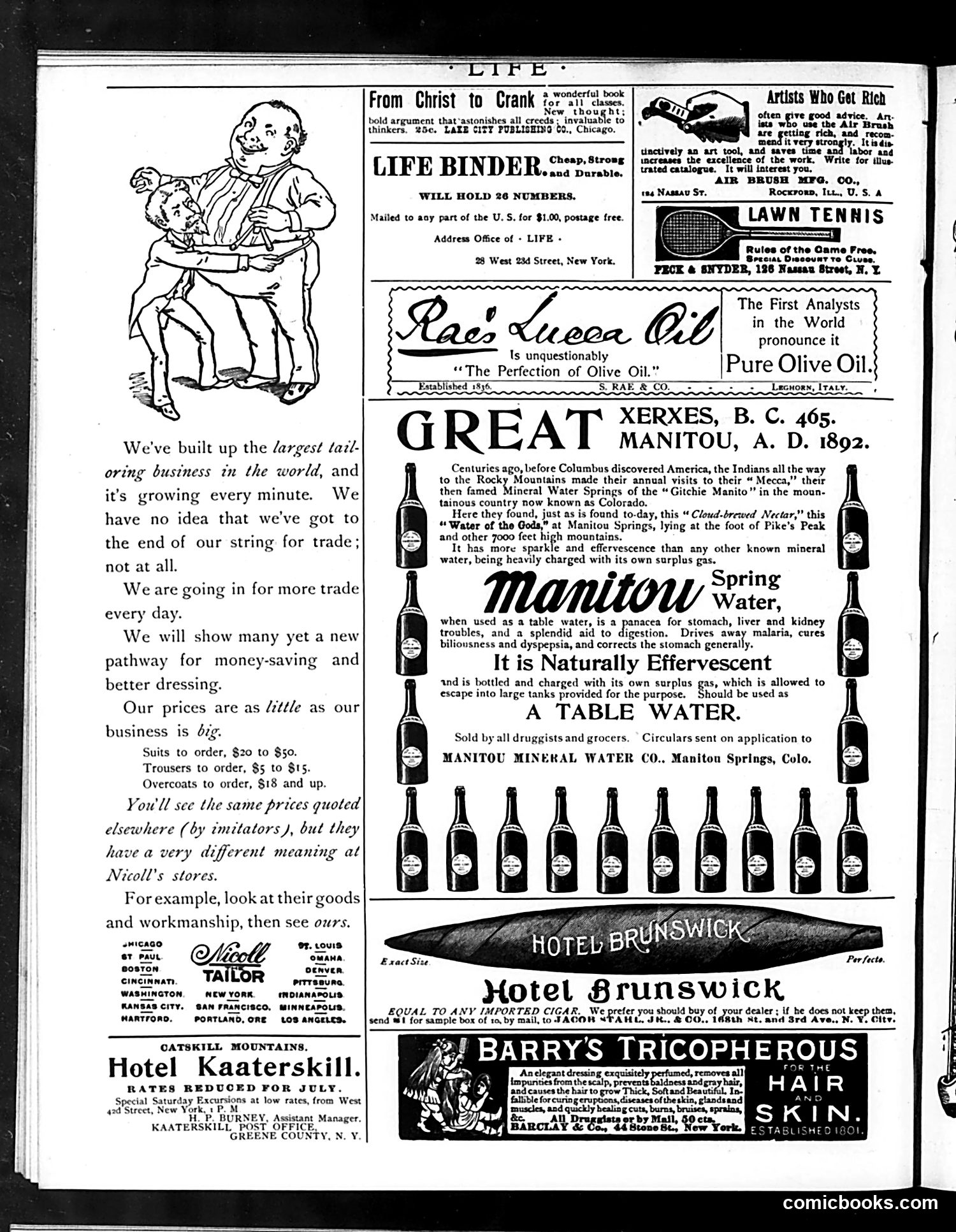
This page is primarily **advertising**, not political satire. It contains various late-19th/early-20th-century product advertisements aimed at middle and upper-class readers. Notable ads include: - **Kodak cameras** ("You press the button, we do the rest") — their famous slogan emphasizing ease of use - **Ladies' fashion** (tailoring, corsets, riding habits) reflecting strict Victorian/Edwardian dress codes - **Canned soups and toiletries** — emerging convenience products - **Whiskey and cologne** — luxury goods - **Boston Garters** — an advertisement noting that gentlemen wearing low shoes "must wear garters" to hold up stockings, reflecting period menswear conventions The page includes two brief **humorous anecdotes** (about Professor Blackie and a deceptive artist), typical of Life's satirical humor, but these are minor editorial content amid commercial material. The overall effect shows consumer culture and gendered fashion standards of the Gilded Age period.