
Life, 1892-07-21 · page 4 of 16
Life — July 21, 1892 — page 4: what you’re looking at
What you’re looking at
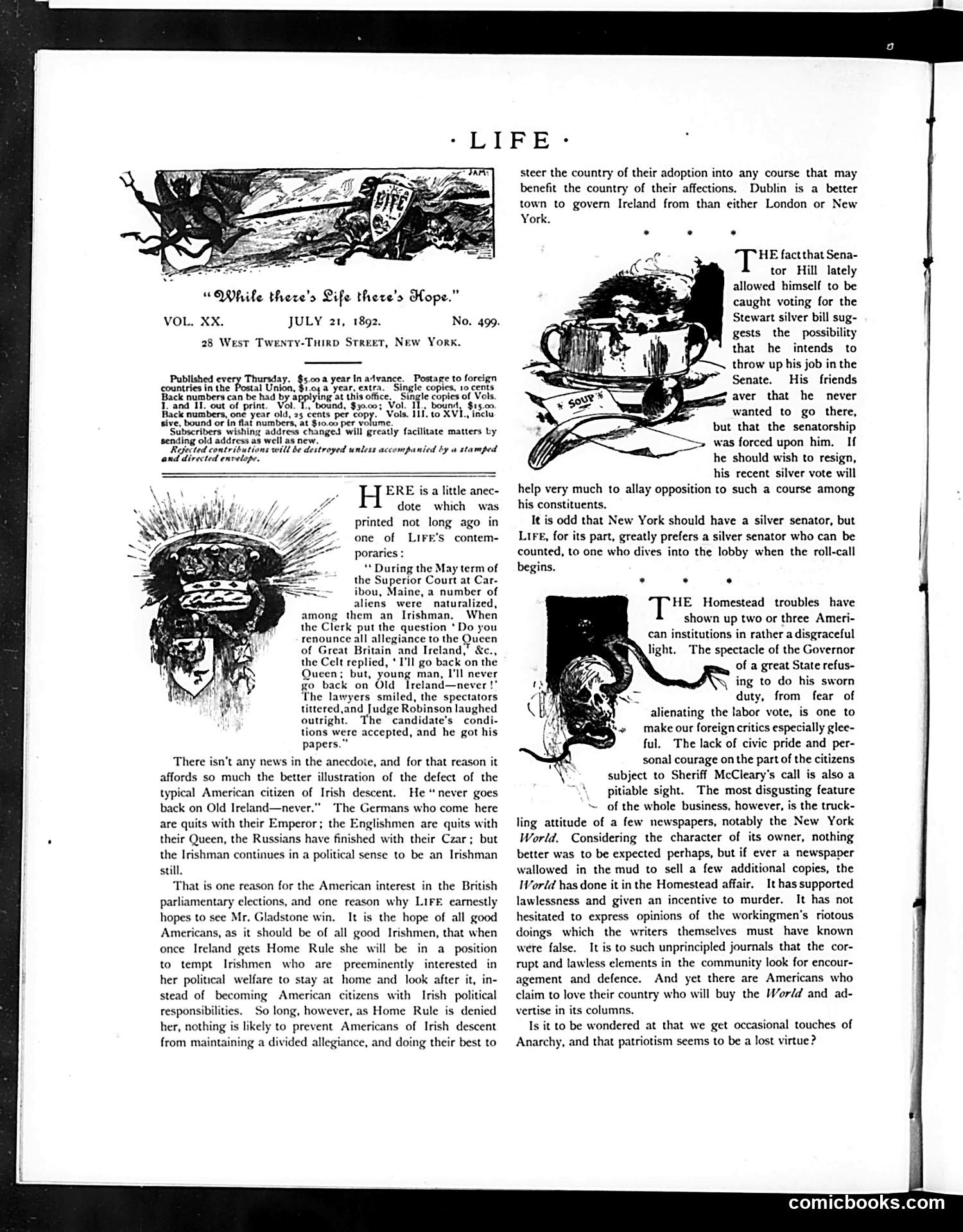
This page critiques Irish-American political behavior and American governance. The left cartoon depicts an Irish immigrant's exaggerated facial features and expression—a common racist caricature of the era—accompanying a story about Irish naturalization candidates being asked about loyalty to Britain and Ireland during a Maine court proceeding. The right section attacks the "Homestead troubles" (likely referring to the violent 1892 Homestead Steel Strike) and criticizes newspapers, particularly the *New York World*, for irresponsible coverage that encourages lawlessness. The text condemns citizens who don't support their adopted country and accuses some papers of fomenting "Anarchy." The satire reflects xenophobic anxieties about Irish immigrants' divided loyalties and contemporary debates about labor violence and press responsibility.
📄 Transcribed text from this page (OCR, searchable)
Machine-transcribed from the original scan — historical spelling and the odd misread are preserved.
LIFE “OMhife there's Life there's Hope.” VOL. XX. JULY 21, 1892. No. 499. 28 West Twenty-Tuirp Street, New York. Published every Thursday. countries in the tal Union, Back numbers can be had by. 7 appl ‘and II. out of print bound, $30.00; Hine numbers, ond year olde os cents per copy. sive, bound or in flat numbers, at $10.00 per v Subscribers wishing address change! will greatly facilitate matters by sending old address as well as new. be destroyed unless accompanied by a stamped 008 year In advange, Postage to forcign 4 8 year. extra. ing at this office. 1., bound, * Vols i. to XV, Single copies, 10 cents neligic cones of Vols. $15.00. inclu Rejected contributions te and directed envelope. ERE isa little anec- dote which was printed not long ago in one of LIFE’s contem- poraries : ‘* During the May term of the Superior Court at Car- ibou, Maine, a number of aliens were naturalized, among them an Irishman. When the Clerk put the question ‘Do you renounce all allegiance to the Queen of Great Britain and Ireland,” & the Celt replied, ‘I'll go back on th Queen; but, young man, I'll never 0 back on’ Old Treland—never !’ ¢ lawyers smiled, the spectators tittered,and Judge Robinson laughed outright. The candidate's condi- tions were accepted, and he got his papers.” There isn’t any news in the anecdote, and for that reason it affords so much the better illustration of the defect of the typical American citizen of Irish descent. He “never goes back on Old Ireland—never.” The Germans who come here are quits with their Emperor; the Englishmen are quits with their Queen, the Russians have finished with their Czar; but the Irishman continues in a political sense to be an Irishman still. That is one reason for the American interest in the British parliamentary elections, and one reason why LIFE earnestly hopes to see Mr. Gladstone win, It is the hope of all good Americans, as it should be of all good Irishmen, that when once Ireland gets Home Rule she will be in a_ position to tempt Irishmen who are preeminently interested in her political welfare to stay at home and look after it, in- stead of becoming American citizens with Irish political responsibilities. So long, however, as Home Rule is denied her, nothing is likely to prevent Americans of Irish descent from maintaining a divided allegiance, and doing their best to steer the country of their adoption into any course that may benefit the country of their affections. Dublin is a better town to govern Ireland from than either London or New York. HE factthat Sena- tor Hill lately allowed himself to be caught voting for the Stewart silver bill sug- gests the possibility that he intends to throw up his job in the Senate. His friends aver that he never wanted to go there, but that the senatorship was forced upon him. If he should wish to resign, his recent silver vote will help very much to allay opposition to such a course among his constituents. It is odd that New York should have a silver senator, but LiFe, for its part, greatly prefers a silver senator who can be counted, to one who dives into the lobby when the roll-call begins. . . . HE Homestead troubles have shown up two or three Ameri- can institutions in rather a disgraceful light. The spectacle of the Governor of a great State refus- ing to do his sworn duty, from fear of alienating the labor vote, is one to make our foreign critics especially glee- ful. The lack of civic pride and per- sonal courage on the part of the citizens subject to Sheriff McCleary's call is also a pitiable sight. The most disgusting feature ~ of the whole business, however, is the truck- ling attitude of a few newspapers, notably the New York World. Considering the character of its owner, nothing better was to be expected perhaps, but if ever a newspaper wallowed in the mud to sell a few additional copies, the World has done it in the Homestead affair. It has supported lawlessness and given an incentive to murder. It has not hesitated to express opinions of the workingmen’s riotous doings which the writers themselves must have known were false. It is to such unprincipled journals that the cor- rupt and lawless elements in the community look for encour- agement and defence. And yet there are Americans who claim to love their country who will buy the World and ad- vertise in its columns. Is it to be wondered at that we get occasional touches of Anarchy, and that patriotism seems to be a lost virtue? \ comicbooks.com