
A complete issue · 16 pages · 1892
Life — June 9, 1892
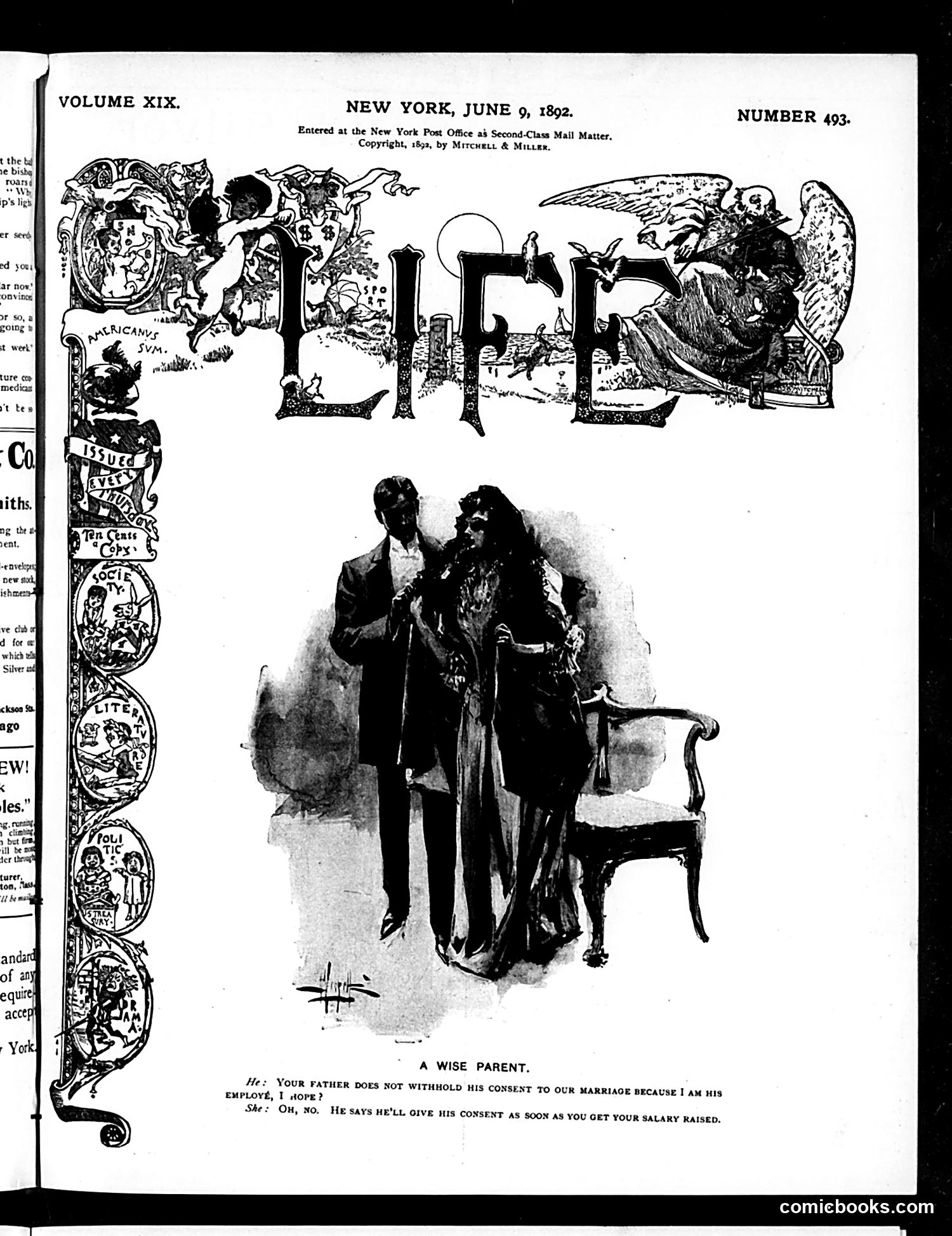
This page features a cartoon titled "A Wise Parent" depicting a domestic negotiation scene. A well-dressed man and woman (appearing to be a couple) sit together while conversing with what seems to be her father or guardian figure standing nearby. The dialogue reveals the satire: the man claims the father won't consent to their marriage because he's the employer, and hopes this will change. The father responds he'll grant consent once the man receives a salary raise. The joke mocks working-class economic anxiety and paternal gatekeeping—the father's consent is explicitly conditional on improved financial prospects. This reflects 1890s concerns about marriage, employment security, and parental authority over their adult children's romantic choices, particularly regarding economic stability as a prerequisite for matrimony.
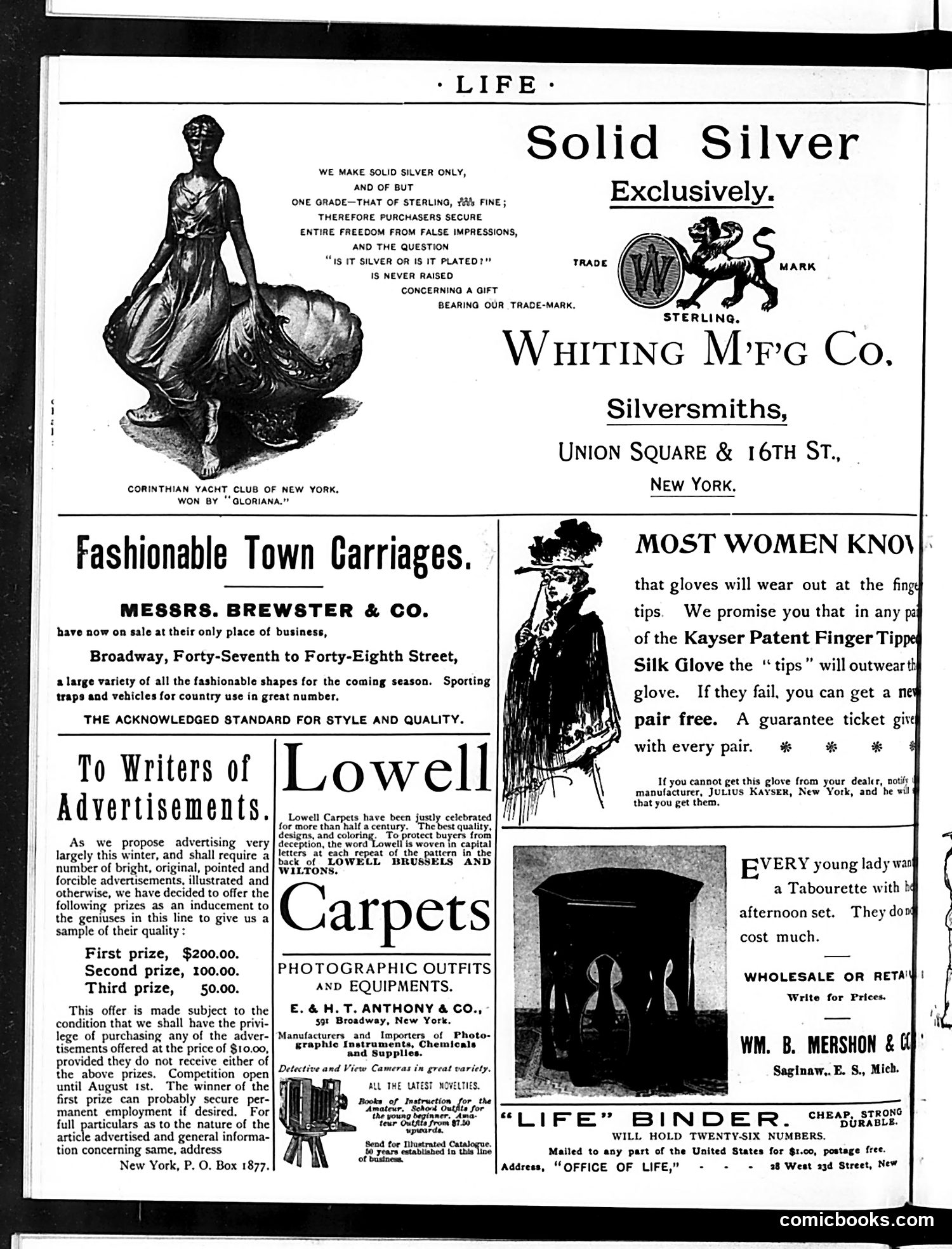
This page is predominantly **advertisements** rather than satirical content. The main items include: - **Whiting Mfg Co.** (silversmiths): Advertisement emphasizing their solid sterling silver goods, with their trade mark featuring a lion - **Brewster & Co.**: Fashionable town carriages on Broadway - **Lowell Carpets**: Large advertisement highlighting the brand's century-long reputation - **E. & H.T. Anthony & Co.**: Photographic equipment and supplies - **Kayser Gloves**: Advertisement promoting durable silk gloves with a guarantee - **"Life" Binder**: Binding service for Life magazine issues The single illustrated element—the classical female figure with a ship model—appears to be the Corinthian Yacht Club's trophy, captioned "won by 'Gloriana.'" **This is a commercial advertising page with minimal satirical content.**
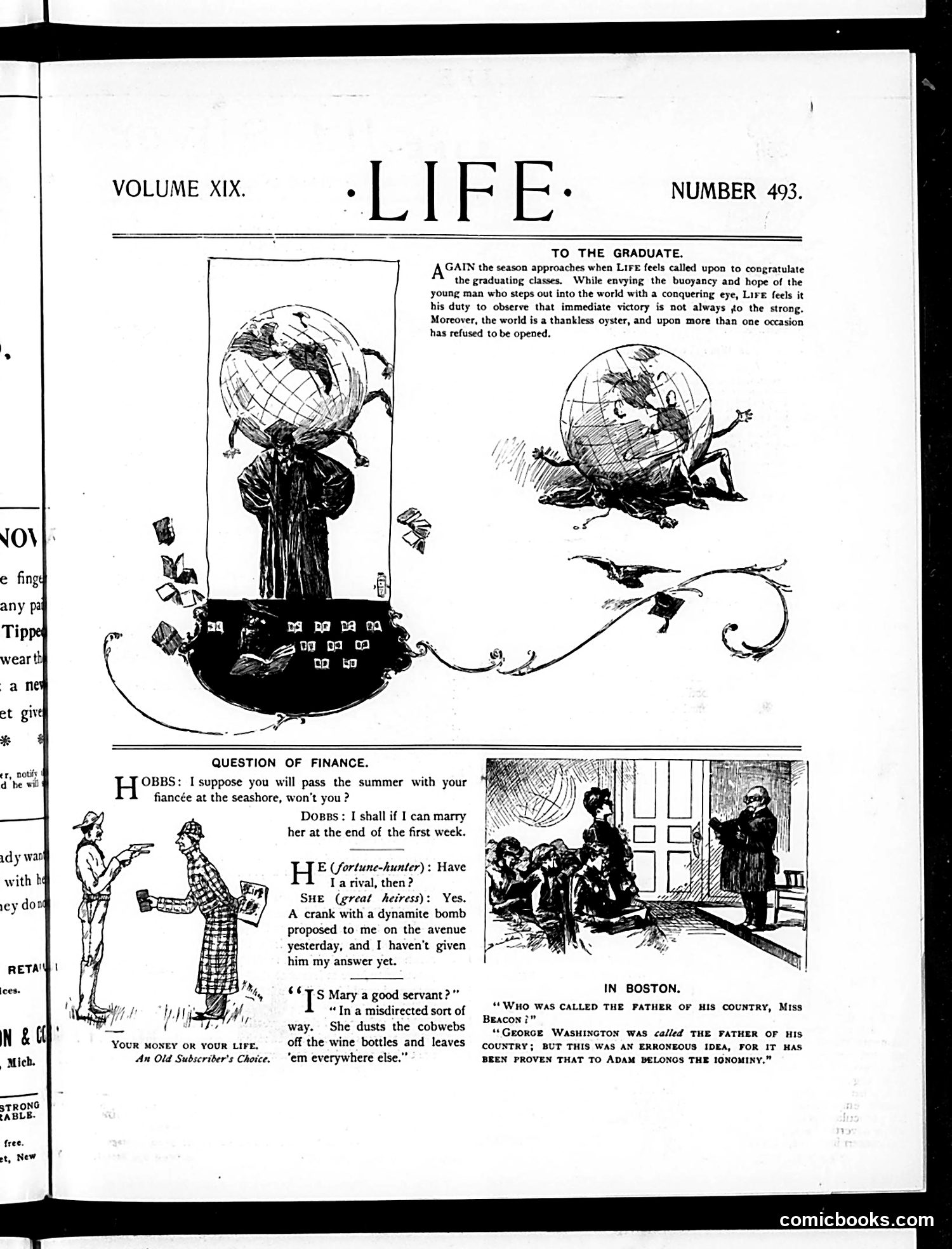
**Top Section - "To the Graduate":** A satirical illustration showing a figure holding a globe, with the globe appearing to crack or collapse. The accompanying text warns graduating students that immediate victory isn't guaranteed in life, and the world is "a thankless oyster" that often refuses to open—tempering youthful optimism with harsh realism. **Middle Section - "Question of Finance":** A dialogue joke about summer plans and marriage, featuring characters named Hobbs, Dorris, and a "Fortune-Hunter." The humor centers on financial precarity and romantic prospects tied to money. **Bottom - "In Boston":** A humorous anecdote about George Washington's nickname and a servant's poor housekeeping skills—appears to be a period joke playing on regional reputation or historical reference. The page blends graduation advice, romantic/financial comedy, and historical humor typical of early 20th-century satirical magazines.
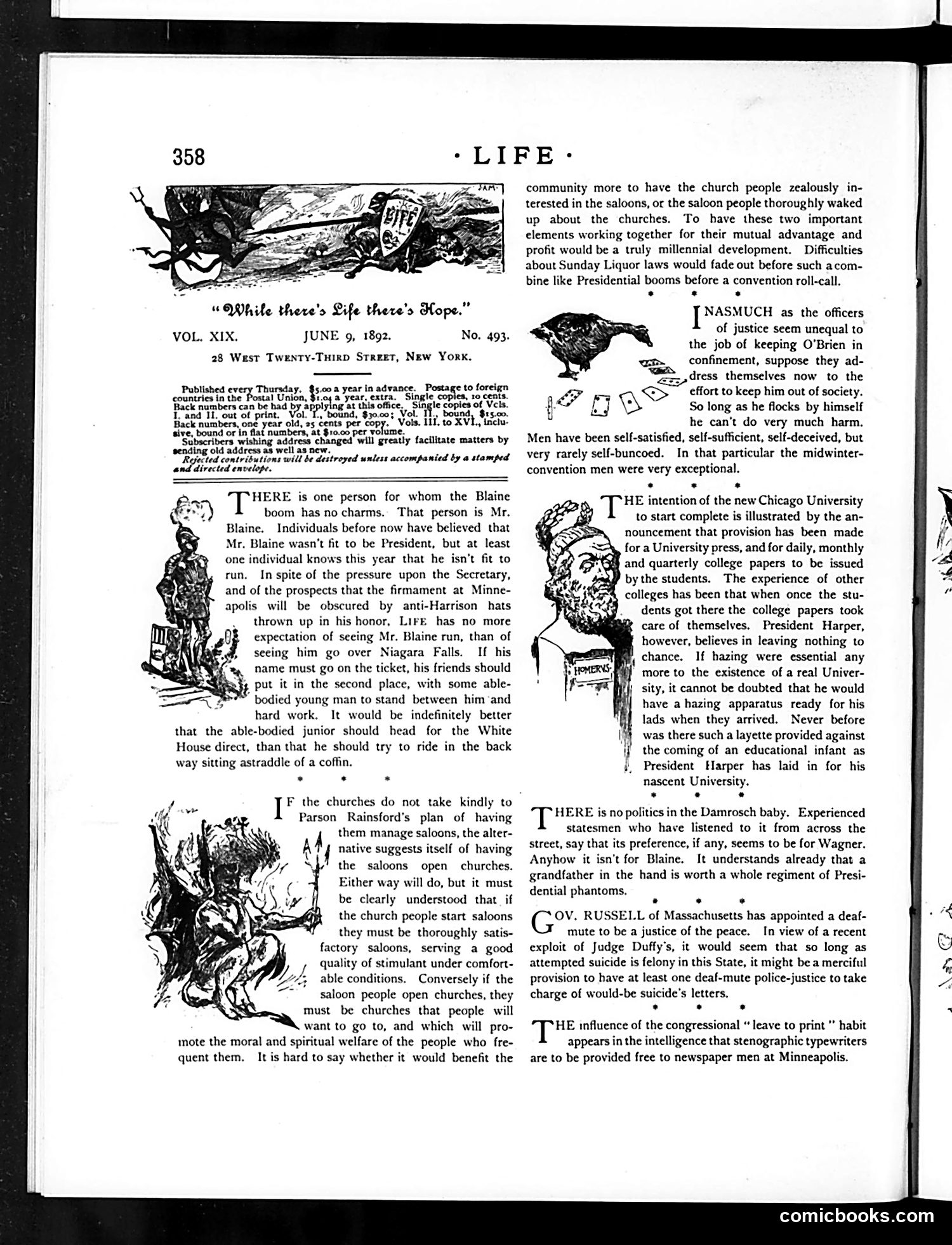
This page contains three political cartoons criticizing various figures and issues of 1892: 1. **Top cartoon**: "While there's Life there's Hope" - appears to reference James G. Blaine's political prospects despite recent setbacks. 2. **Middle cartoon**: Satirizes the tension between churches and saloons in American communities, suggesting both institutions should cooperate rather than conflict, as both serve important social functions. 3. **Bottom sections**: Brief satirical commentary on contemporary issues including: - Governor Russell of Massachusetts appointing a deaf-mute justice of the peace - Congressional "leave to print" privileges for stenographic typewriters in Minneapolis - The Damrosch baby and Wagner references (likely cultural gossip) The overall tone is typical of *Life*'s irreverent commentary on politics, social reform, and public figures.
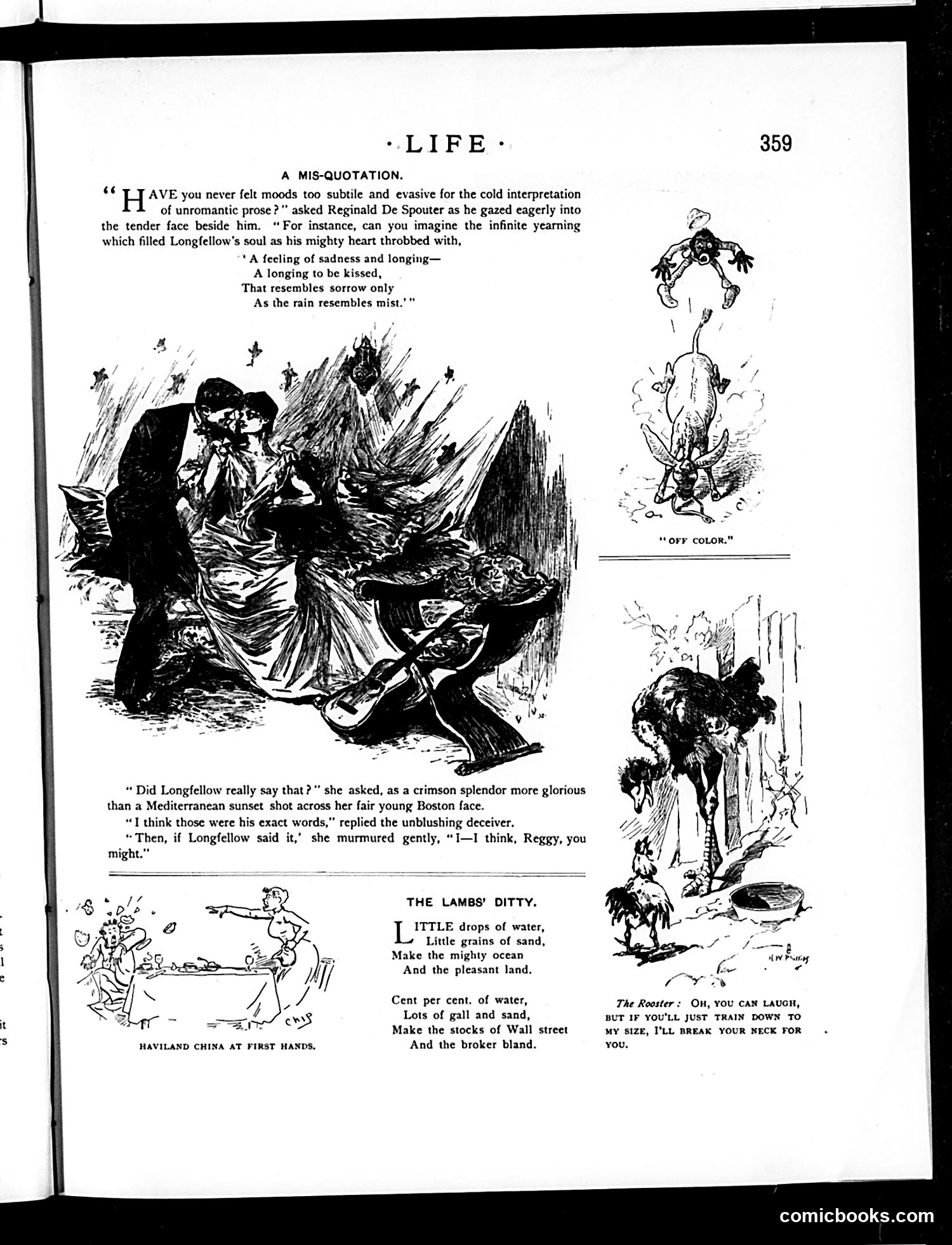
**"A Mis-Quotation"** depicts a romantic scene where a man quotes poetry to a woman. The dialogue reveals he's misattributed romantic verse to "Longfellow" when the woman questions whether Longfellow "really said that." The joke satirizes pretentious men who deploy famous literary quotations to impress romantic interests—a common Victorian-era courtship tactic. The woman's skeptical response ("Did Longfellow really say that?") unmasks his deception. **"The Lambs' Ditty"** is a humorous poem about how small amounts accumulate into larger sums—a metaphor for Wall Street finance and stock brokers ("the broker bland"). It mocks how minor financial transactions collectively build wealth. The smaller cartoons appear to be unrelated satirical illustrations typical of Life's format.
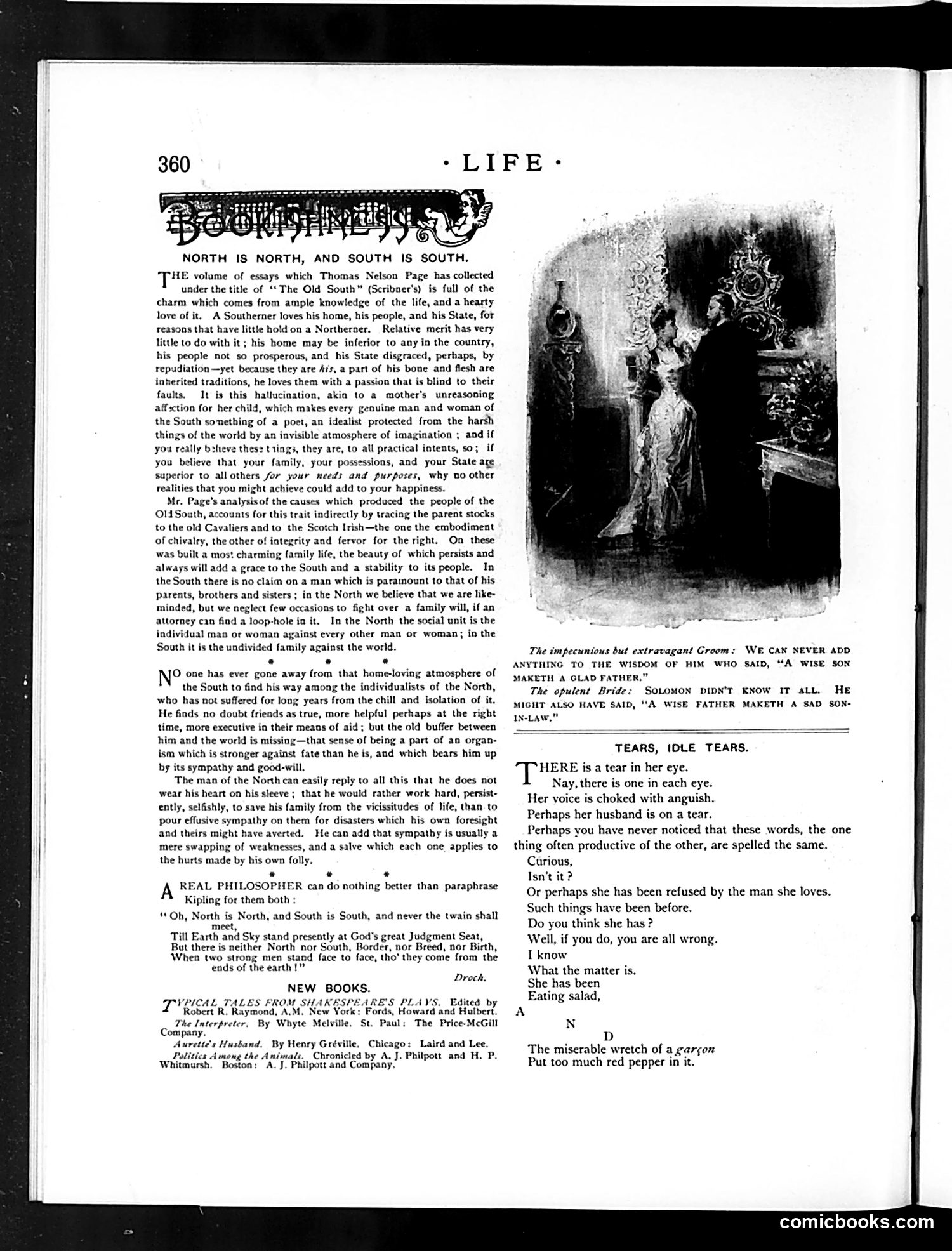
This page contains **no political cartoon**. Instead, it features: 1. **"North is North, and South is South"** — an essay defending Southern character and loyalty, arguing Southerners' attachment to their homeland and family bonds transcends regional differences. It references Scottish and Irish ancestry to establish aristocratic lineage. 2. **"Tears, Idle Tears"** — a humorous dialogue-poem about a woman crying over a rejected suitor, playing on the cliché that women cry over failed romance. The joke relies on dismissive stereotyping of female emotionalism. 3. **"New Books"** section listing recent publications. The page primarily offers **social commentary through prose satire** rather than visual cartoons, typical of *Life* magazine's editorial content from this era.
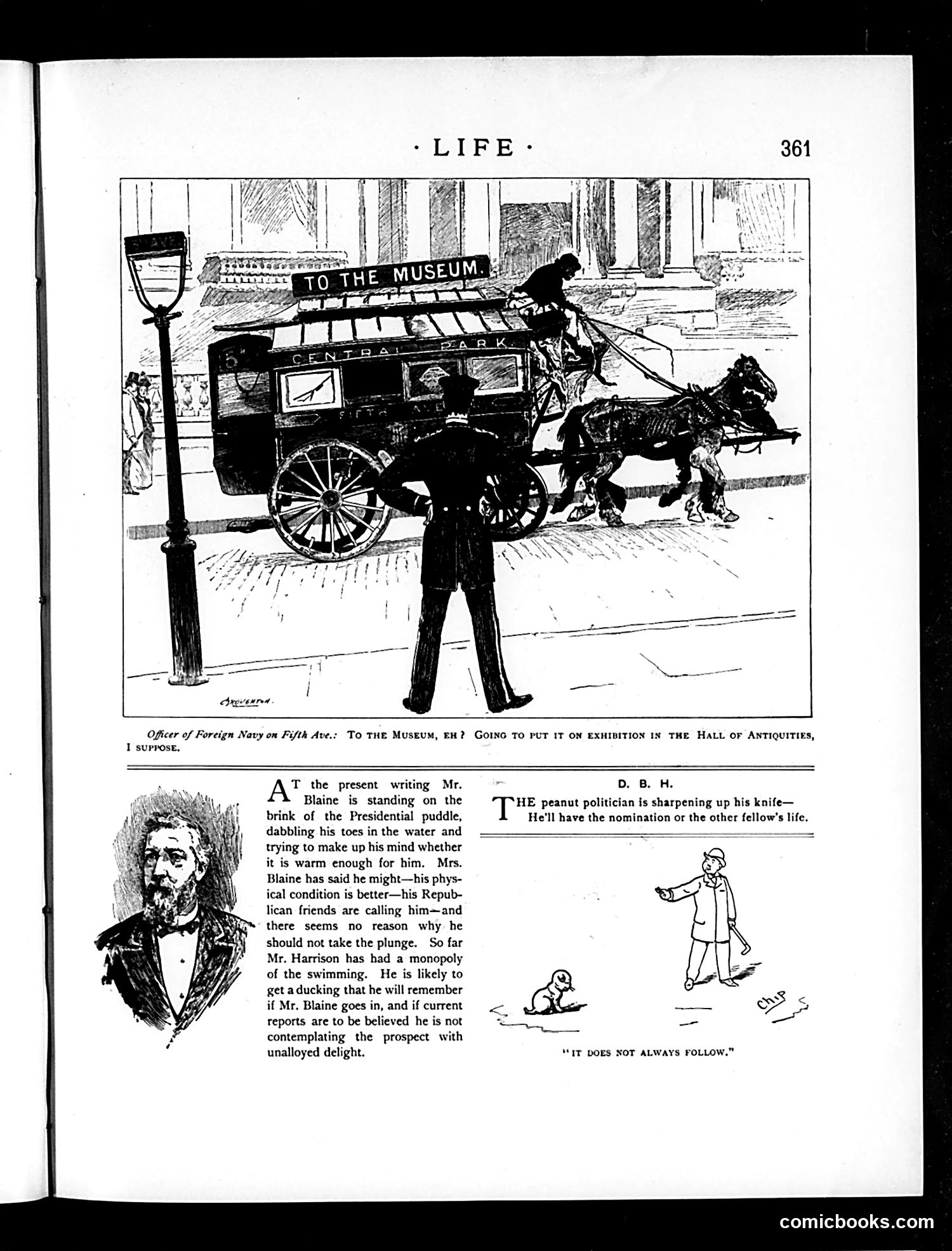
The page contains two satirical pieces from *Life* magazine about late 19th-century American politics. **Top cartoon**: Shows a horse-drawn wagon labeled "Central Park" heading "To the Museum," carrying what appears to be an oversized artifact. The caption references an "Officer of Foreign Navy on Fifth Ave." The joke seems to satirize New York's museum collections and perhaps the absurdity of what gets preserved as historical relics. **Bottom section**: Text discusses Mr. Blaine (likely James G. Blaine, prominent Republican politician) standing in water at the Presidential puddle, debating whether to take a political "plunge." The piece mocks his hesitation about swimming and compares it to political indecision. A small cartoon shows a peanut politician sharpening his knife—political rivalry depicted through crude humor. "It does not always follow" suggests unpredictable political outcomes.
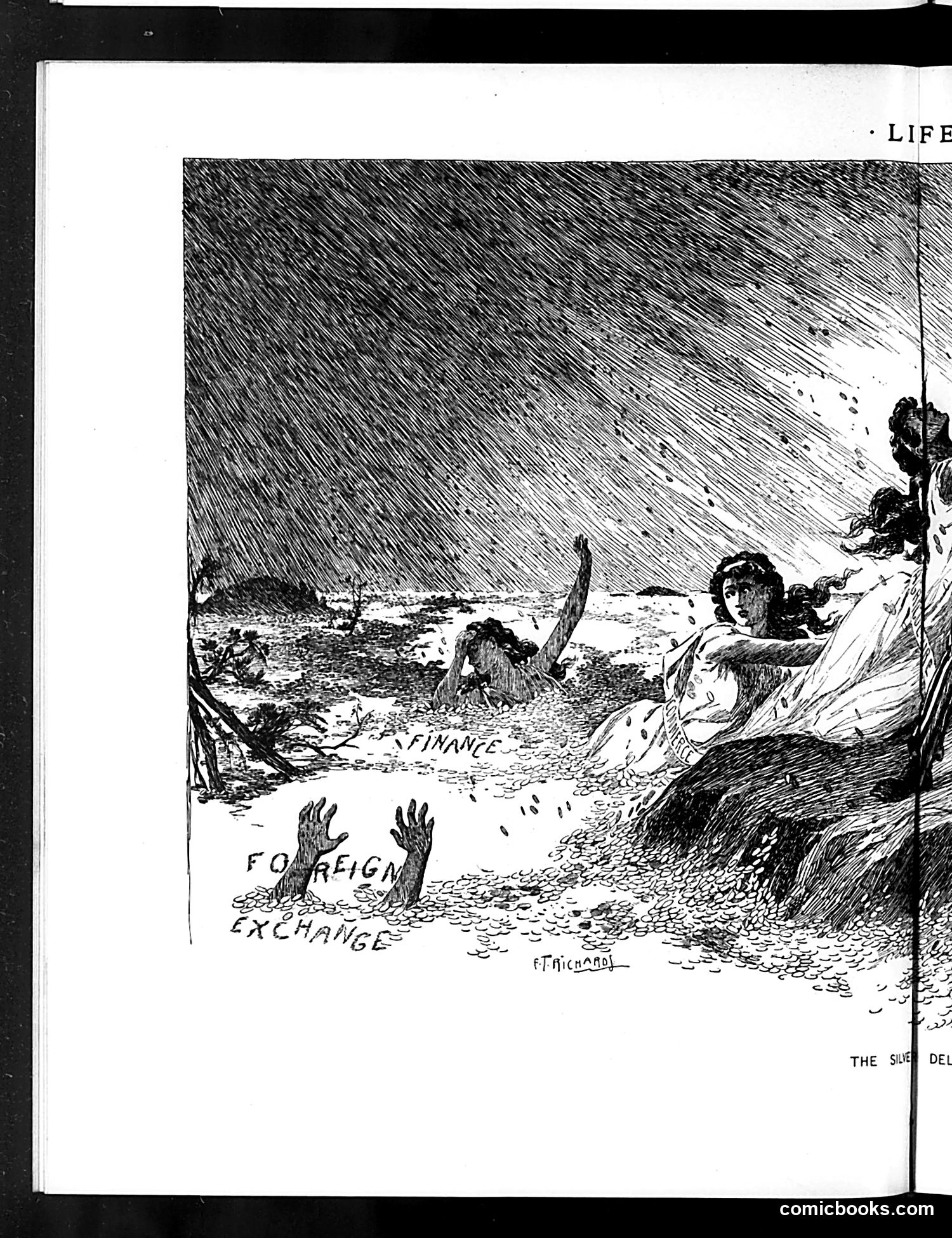
This is a satirical cartoon depicting the concept of "Foreign Exchange" — likely referencing international trade or financial relations. The composition shows figures on a beach or shore, with two hands emerging from sand labeled "Foreign Exchange" in the foreground, appearing to be drowning or struggling. The cartoon suggests foreign exchange is literally sinking or failing. On the right, observers (possibly representing American or domestic interests) watch from safety on higher ground. The artist's signature appears to be "F. Michaelis." The satire criticizes how foreign exchange — the mechanism for international monetary transactions — is portrayed as a dangerous or failing system that threatens those involved in it, while observers remain detached from the crisis. This likely reflects 1920s-1930s economic anxieties about international trade.
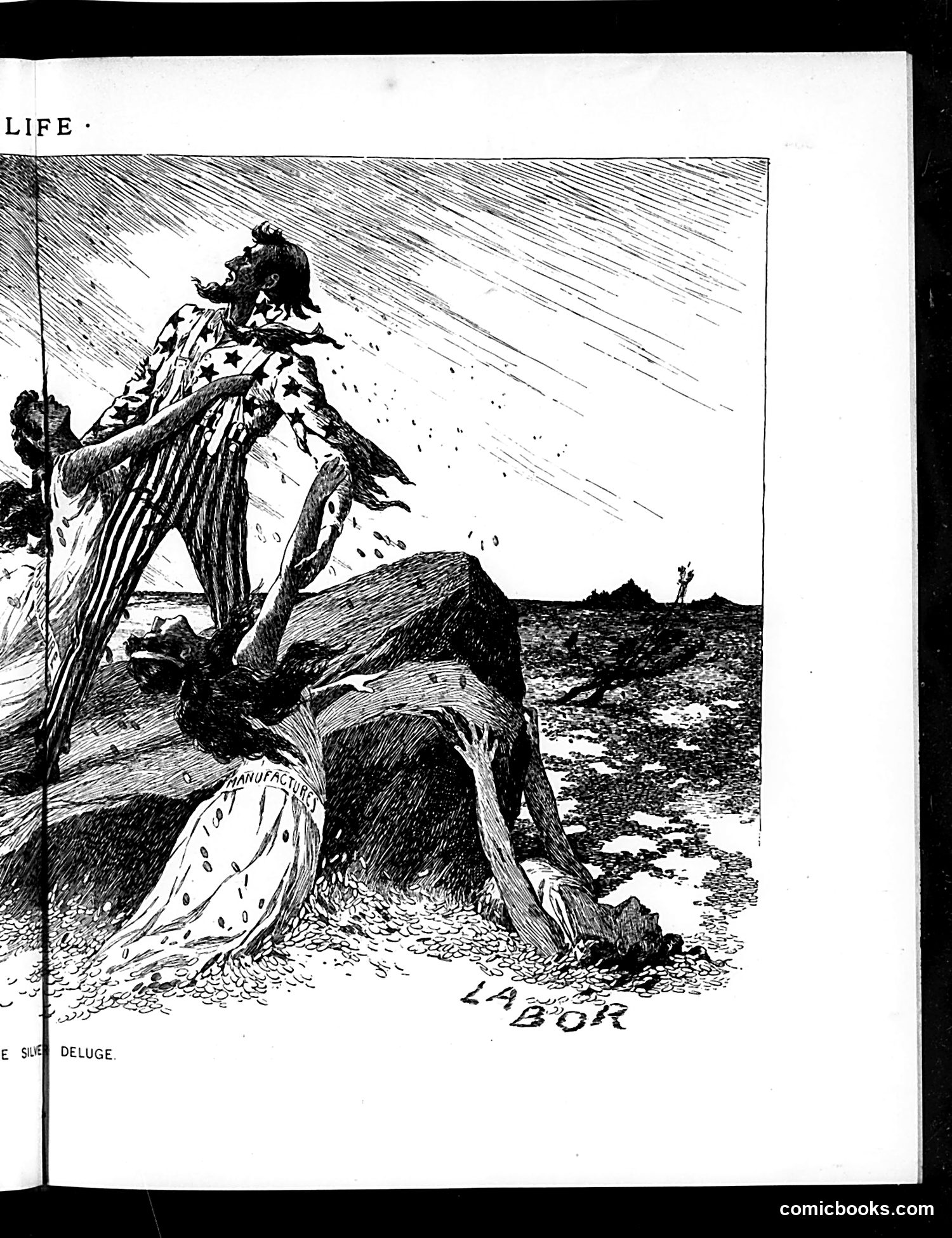
This appears to be a satirical engraving titled "Deluge" depicting **Labor** as a figure being overwhelmed or destroyed. The central figure—wearing period clothing with stars and stripes (suggesting American identity)—stands amid chaos with rain or debris falling heavily from above. A prone, defeated figure labeled "LABOR" lies below. The cartoon critiques labor conditions or labor unrest, suggesting that workers face catastrophic circumstances—a "deluge" of hardship. The style and composition evoke classical allegory, with Labor personified as a victim of overwhelming force. Without the publication date visible, the precise historical context (labor strikes, economic depression, industrial conflict) cannot be definitively stated, though this appears critical of how labor conditions or workers are treated.
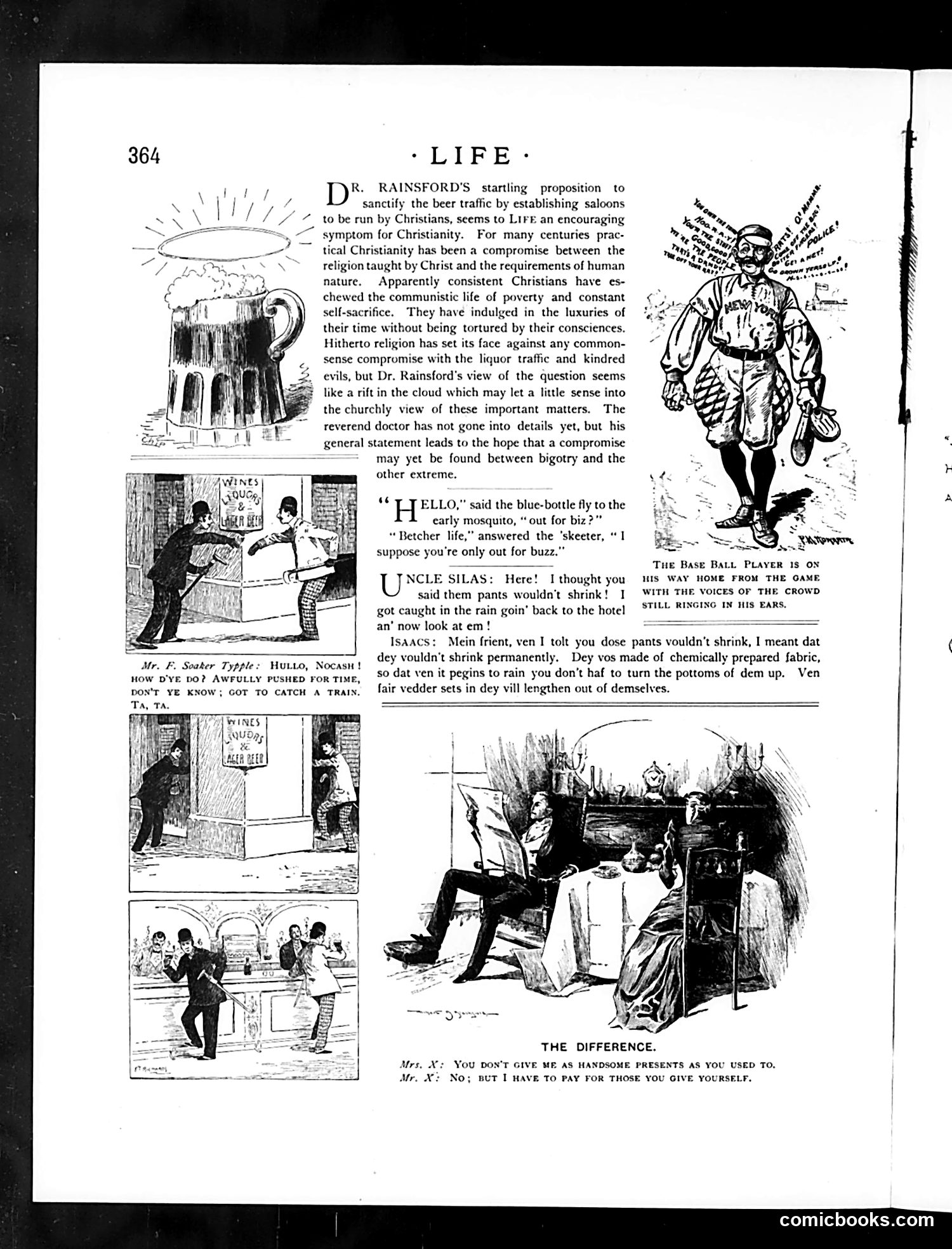
This page contains satirical commentary on Christianity and alcohol, plus humorous domestic comics. **Main article**: Dr. Rainsford's proposal to combat beer trafficking by establishing saloons run by Christians is critiqued as a compromise between religious ideals and practical reality. The satire suggests this position is contradictory—Christianity traditionally opposes alcohol, yet here proposes "managing" the problem rather than opposing it outright. **Comic strip dialogue**: Features exchanges between characters about rain-soaked pants and shrinking clothing, with ethnic humor (appearing to mock German/immigrant speech patterns through phonetic spelling like "ven" for "when"). **"The Difference" illustration**: Depicts a social commentary on gift-giving between wealthy and working-class relationships—one party receives expensive presents, the other must repay with labor rather than gifts.
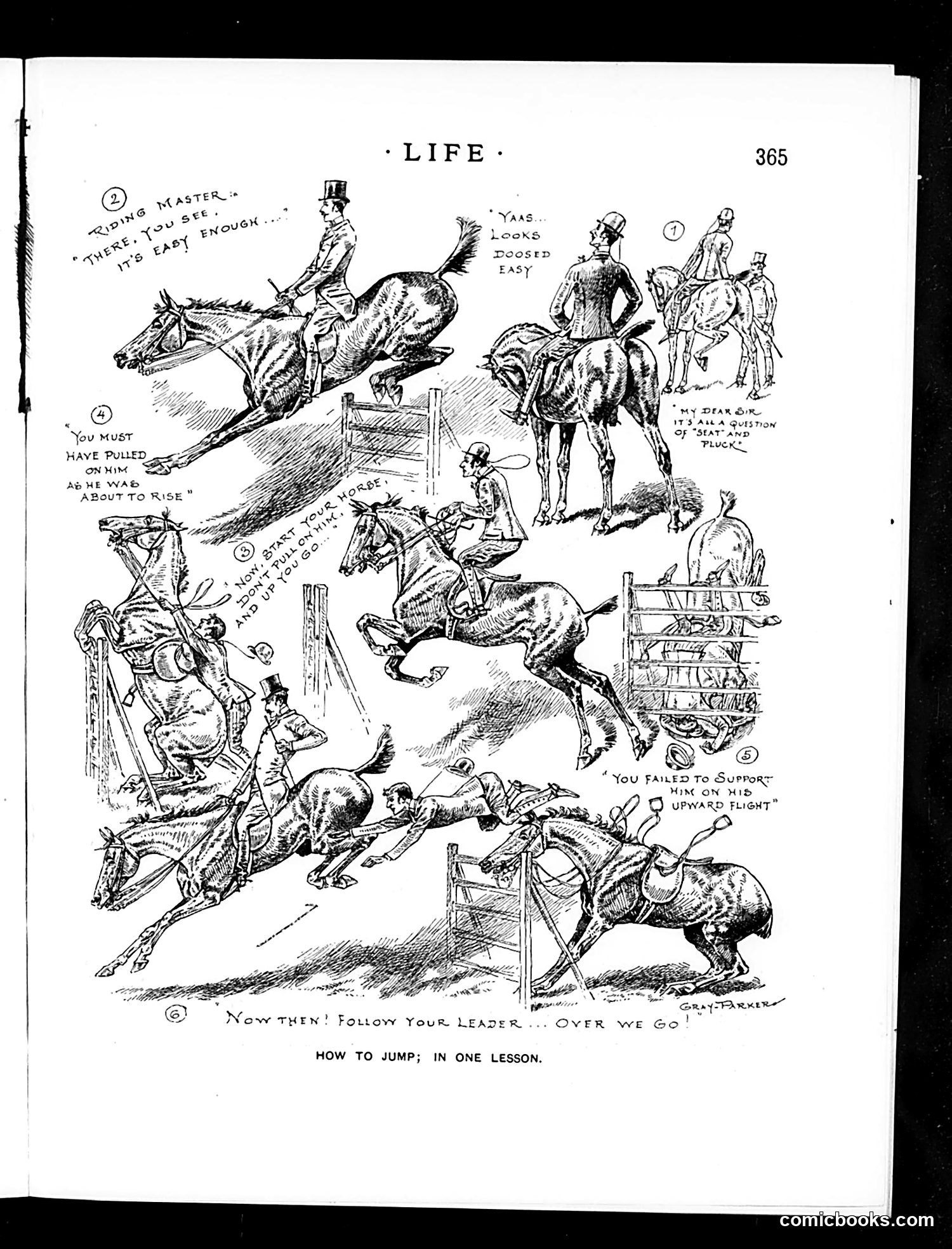
This page from *Life* magazine presents a humorous instructional cartoon about horseback riding, specifically teaching someone to jump over fences. The seven numbered panels mock a novice rider's progressive failures and mishaps—falling off, losing control, crashing through obstacles—before finally succeeding by "following your leader over." The satire targets the pretensions of amateur equestrians attempting a difficult skill. The exaggerated falls and comedic violence lampoon both the riders' incompetence and the condescending attitude of instructors offering simplistic advice ("it's easy enough"). This reflects *Life*'s satirical style mocking upper-class recreational pursuits and the gap between confident instruction and humbling reality. The cartoon's humor relies on physical comedy and the universal experience of failing at something presented as simple.
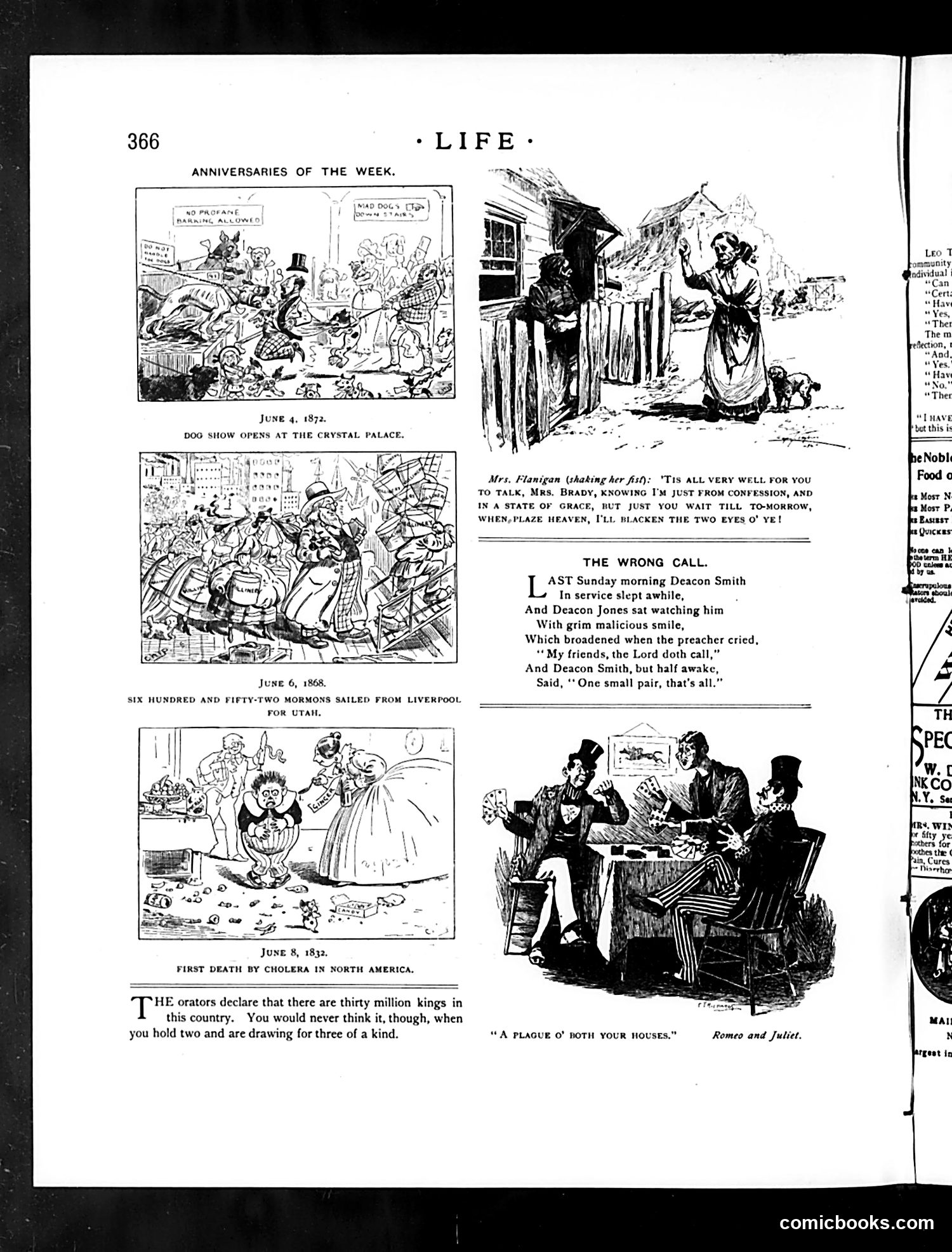
This page contains multiple satirical cartoons and humorous pieces reflecting 1870s American life: **"Dog Show Opens at the Crystal Palace"**: Two working-class Irish women (identifiable by dialect and names like "Flanigan" and "Brady") threaten each other with violence. The satire mocks both their volatility and their hypocrisy—one just confessed her sins but immediately vows revenge, undermining her claimed "state of grace." **"The Wrong Call"**: A sleeping deacon mishears the preacher's spiritual call ("the Lord doth call") as a poker hand call, muttering "One small pair, that's all." The joke satirizes inattention in church and gambling culture. **"Mormon Migration/Cholera Death"**: Brief historical notes accompanying cartoons about mass Mormon emigration to Utah and the first North American cholera death—contemporary events presented as backdrop. **Poker Commentary**: The final text mocks American egalitarianism ironically: claiming thirty million "kings" (equal citizens) yet acknowledging that actual power depends on luck, not equality. The overall tone is satirical toward working-class Irish immigrants, religious hypocrisy, and American democratic pretense.
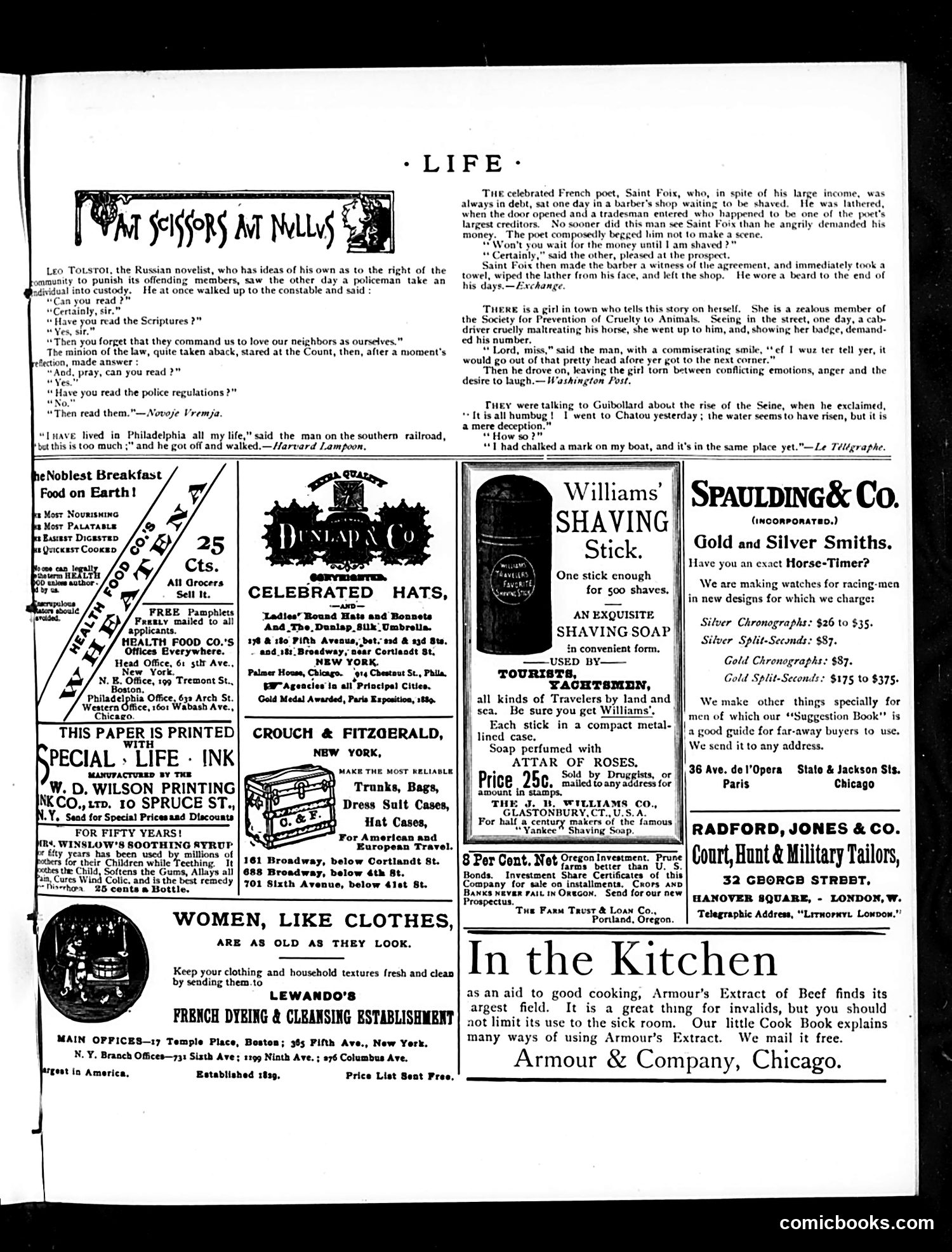
This page from *Life* magazine consists primarily of humorous anecdotes rather than political cartoons. The title "Scissors at Nulls" (likely "Nullities") suggests these are brief, witty observations. The stories mock social pretension and hypocrisy: 1. **Tolstoy and the Policeman**: A Russian novelist invokes Christian scripture to criticize law enforcement, only to be asked if he can read police regulations—deflating moral superiority with practical authority. 2. **The Debt Collector**: A French poet escapes a creditor by shaving his beard, exploiting a legal witness to his agreement. 3. **The Animal Rights Activist**: A woman demanding a cab driver's identification for horse cruelty is told she's too pretty for such concerns—mocking both the driver's condescension and her ineffectual activism. 4. **The Seine River**: A man insists the river didn't rise because a chalk mark remained in place—absurd literalism about natural phenomena. The humor targets hypocrisy, pretension, and the collision between ideals and reality.
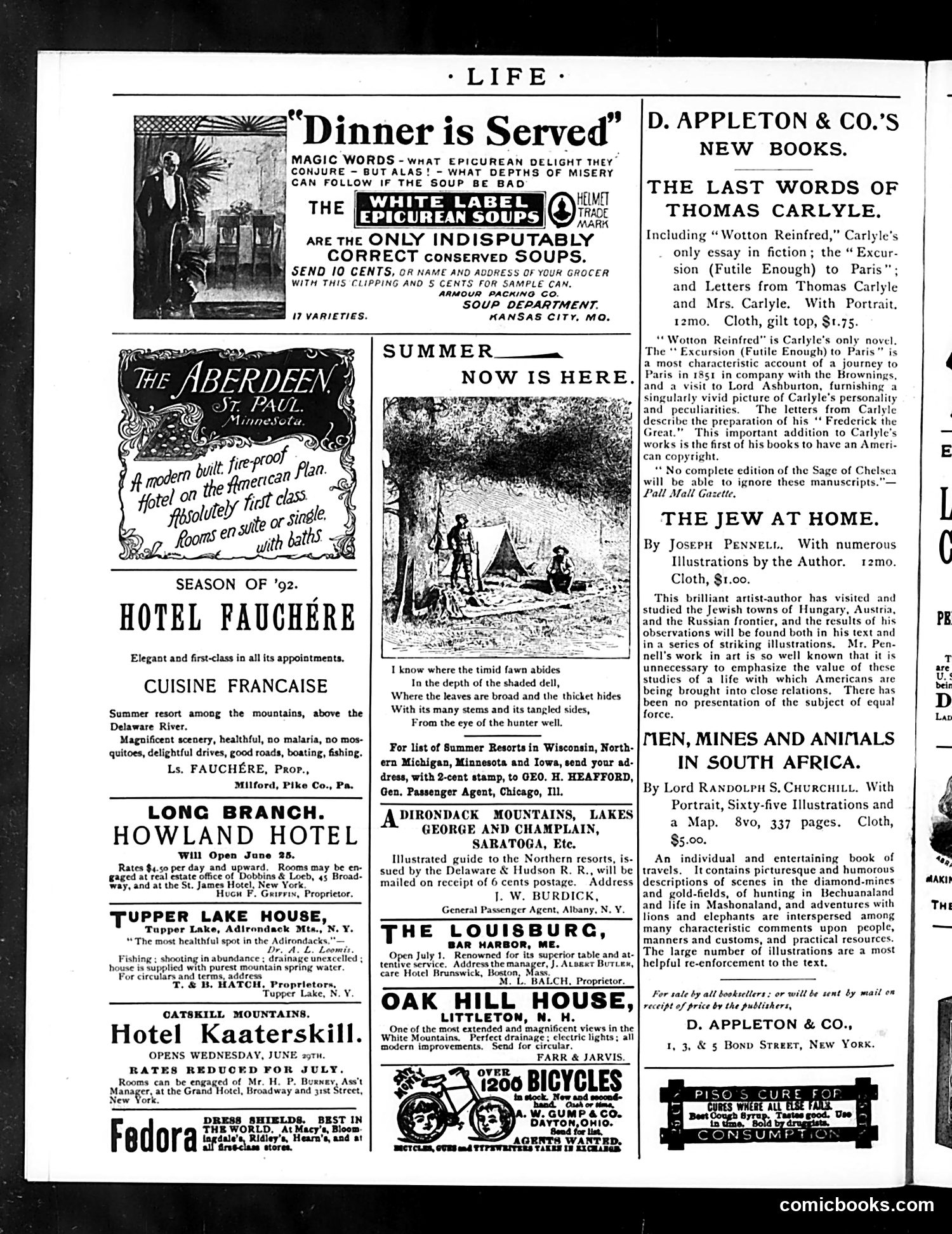
This is primarily a **page of advertisements and book announcements** from Life magazine (circa 1892, based on "Season of '92"). **The cartoon content** appears only at the top left—a small illustration titled "Dinner is Served," showing a well-dressed man in formal attire. The text above it is satirical: it notes that while the phrase conjures "epicurean delight," dinner's quality depends entirely on the soup. **The joke is straightforward**: a bad soup can ruin an entire meal, suggesting that opening impressions (or foundations) matter greatly. This functions as an advertisement for White Label Epicurean Soups, which claims to be "the only indisputably correct conserved soups." **The rest of the page** consists of: - Hotel and resort advertisements for upscale summer destinations (Catskills, Adirondacks, Bar Harbor, Long Branch) - Book announcements for new publications - A bicycle advertisement There is no political satire here—this is essentially a **commercial/lifestyle page** reflecting 1890s leisure culture and publishing.
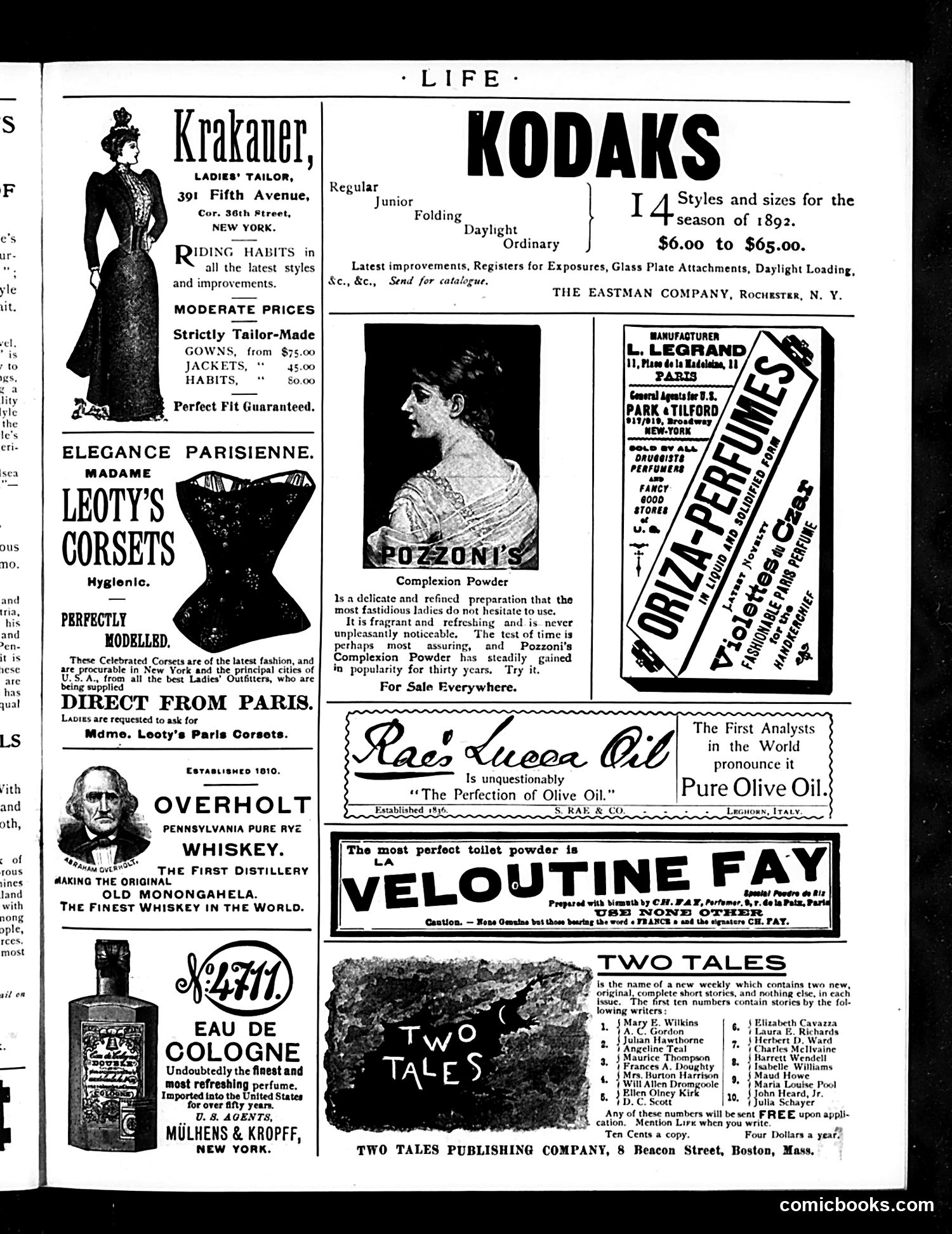
This is predominantly an **advertising page** with no political cartoons or satire. It features period product advertisements typical of 1890s American magazines: **Notable ads include:** - **Kodak cameras** (14 styles, $6-$65)—promoting the newly accessible amateur photography market - **Women's fashion/tailoring** services and **corsets**—reflecting Victorian-era women's fashion standards - **Toiletries**: Pozzoni's Complexion Powder, Ras Lucca Oil (olive oil), Veloutine Fay powder—beauty products marketed to wealthy women - **Spirits**: Overholt Whiskey and #4711 Eau de Cologne—luxury imported goods - **Two Tales magazine** promotional notice—a new weekly fiction publication The page reflects the consumer culture and advertising strategies of the Gilded Age, targeting affluent urban readers with luxury imported goods, modern technology, and beauty/grooming products. There is **no satirical content** visible.
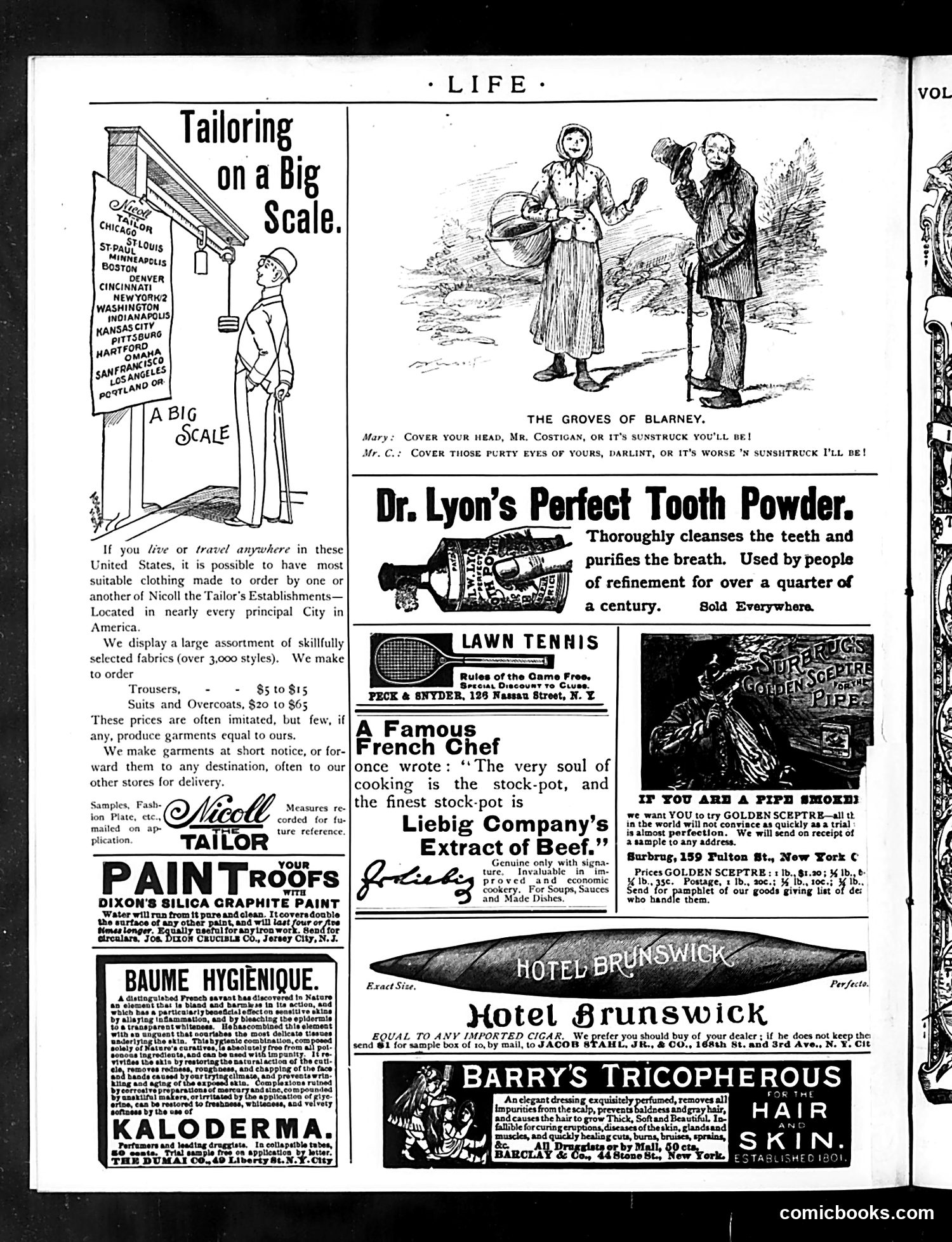
This cartoon depicts a flirtation scene set in Ireland (Blarney is a famous castle in County Cork known for the "Blarney Stone," which supposedly grants eloquence). The two figures—Mary and Mr. Costigan—are engaged in playful, Irish-accented banter. Mary warns him to cover his head against sunstroke; he responds by warning *her* to cover her eyes, claiming exposure to her beauty is worse than sunstroke. The humor relies on ethnic stereotyping: the exaggerated Irish brogue ("DARLINT," "PURTY"), the pastoral setting, and the flirtation itself play on period American stereotypes of Irish people as romantic, quick-witted, and given to florid compliments. The "Blarney" reference reinforces this—the ability to charm with smooth talk. For modern readers, this represents early 20th-century American magazine humor that casually deployed ethnic caricature as entertainment. The satire targets no political issue but rather treats Irishness itself as inherently comic material.