
Life, 1892-06-09 · page 6 of 16
Life — June 9, 1892 — page 6: what you’re looking at
What you’re looking at
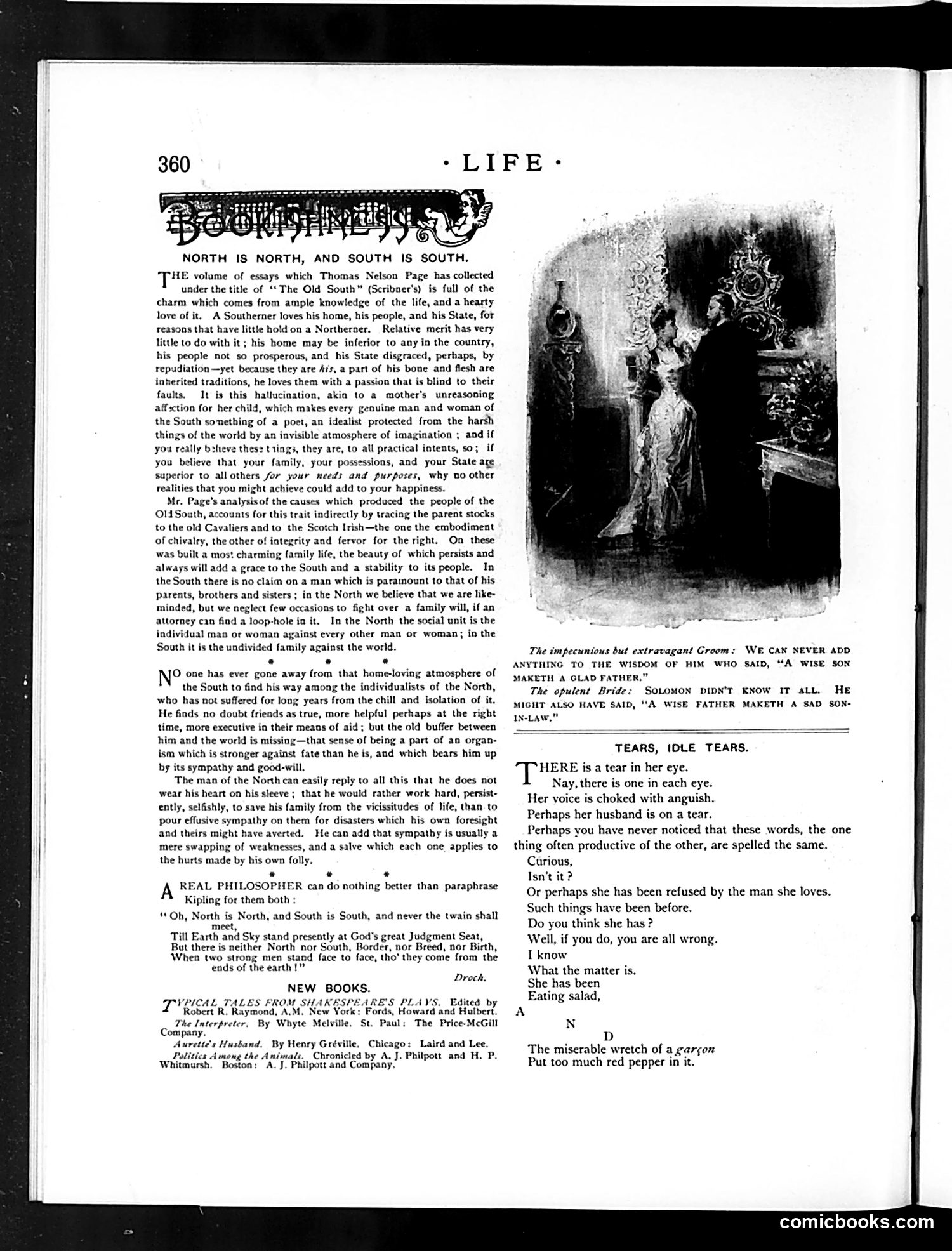
This page contains **no political cartoon**. Instead, it features: 1. **"North is North, and South is South"** — an essay defending Southern character and loyalty, arguing Southerners' attachment to their homeland and family bonds transcends regional differences. It references Scottish and Irish ancestry to establish aristocratic lineage. 2. **"Tears, Idle Tears"** — a humorous dialogue-poem about a woman crying over a rejected suitor, playing on the cliché that women cry over failed romance. The joke relies on dismissive stereotyping of female emotionalism. 3. **"New Books"** section listing recent publications. The page primarily offers **social commentary through prose satire** rather than visual cartoons, typical of *Life* magazine's editorial content from this era.
📄 Transcribed text from this page (OCR, searchable)
Machine-transcribed from the original scan — historical spelling and the odd misread are preserved.
NORTH IS NORTH, AND SOUTH IS SOUTH. THE volume of essays which Thomas Nelson Page has collected under the title of ‘The Old South” (Scribner's) is full of the charm which comes from ample knowledge of the life, and a hearty love of it. A Southerner loves his home, his people, and his State, for reasons that have little hold on a Northerner. Relative merit has very little to do with it ; his home may be inferior to any in the country, his people not so prosperous, and his State disgraced, perhaps, by repudiation —yet because they are Az, a part of his bone and flesh are inherited traditions, he loves them with a passion that is blind to their faults, It is this hallucination, akin to a mother’s unreasoning affsction for her child, which makes every genuine man and woman of the South something of a poet, an idealist protected from the harsh things of the world by an invisible atmosphere of imagination ; and if you really bsheve these t rings, they are, to all practical intents, so; if you believe that your family, your possessions, and your State age superior to allothers for your needs and purposes, why no other realities that you might achieve could add to your happiness. Mr. Page's analysisof the causes which produced the people of the O14 South, accounts for this trait indirectly by tracing the parent stocks to the old Cavaliers and to the Scotch Irish—the one the embodiment of chivalry, the other of integrity and fervor for the right. On these was built a most charming family life, the beauty of which persists and always will add a grace to the South and a stability to its people. In the South there is no claim on a man which is paratnount to that of his parents, brothers and sisters ; in the North we believe that we are like- minded, but we neglect few occasions to fight over a family will, if an attorney can find a loop-hole ia it. In the North the social unit is the individual man or woman against every other man or woman; in the South it is the undivided family against the world. . . « NO one has ever gone away from that home-loving atmosphere of the South to find his way among thi vidualists of the North, who has not suffered for long years from the chill and isolation of it. He finds no doubt friends as true, more helpful perhaps at the right time, more executive in their means of aid; but the old buffer between him and the world is missing—that sense of being a part of an organ- ism which is stronger against fate than he is, and which bears him up by its sympathy and good-will, The man of the North can easily reply to all this that he does not wear his heart on his sleeve ; that he would rather work hard, persist- ently, selfishly, to save his family from the vicissitudes of life, than to pour effusive sympathy on them for disasters which his own foresight and theirs might have averted. He can add that sympathy is usually a mere swapping of weaknesses, and a salve which each one, applies to the hurts made by his own folly. . * * A REAL PHILOSOPHER can do nothing better than paraphrase Kipling for them both : “Oh, North is North, and $ meet, Till Earth and Sky stand presently at God's great Judgment Seat, But there is neither North nor South, Border, nor Breed, nor Birth, ‘When two strong men stand face to face, tho’ they come from the ends of the earth!" NEW BOOKS. YPICAL TALES FROM SHAKE: ARES PLAYS. Edited by Robert R. Raymond, A.M. New York: Fords, Howard and Hulbert. The Interpreter, By Whyte Melville. St. Paul: The Price-McGill Company. Aurette’s Husband. By Henry Gréville, Chicago: Laird and Lee. Politics Among the Animals. Chronicled by A. J. Philpott and H. P. Whitmursh. Boston: A. J. Philpott and Company. uth is South, and never the twain shall Droch. The impecunious but extravagant Groom: WE CAN NEVER ADD ANYTHING TO THE WISDOM OF HIM WHO SAID, “A WISE SON MAKETH A GLAD FATHER.’ The opulent Bride: SOLOMON DIDN'T KNOW IT ALL. HE MIGHT ALSO HAVE SAID, “A WISE FATHER MAKETH A SAD SON- IN-LAW," TEARS, IOLE TEARS. HERE is a tear in her eye. Nay, there is one in each eye. Her voice is choked with anguish. Perhaps her husband is on a tear. Perhaps you have never noticed that these words, the one thing often productive of the other, are spelled the same. Curious, Isn't it ? Or perhaps she has been refused by the man she loves. Such things have been before. Do you think she has ? Well, if you do, you are all wrong. I know What the matter is. She has been Eating salad, D The miserable wretch of a gargon Put too much red pepper in it. comicbooks.com