
A complete issue · 18 pages · 1892
Life — May 26, 1892
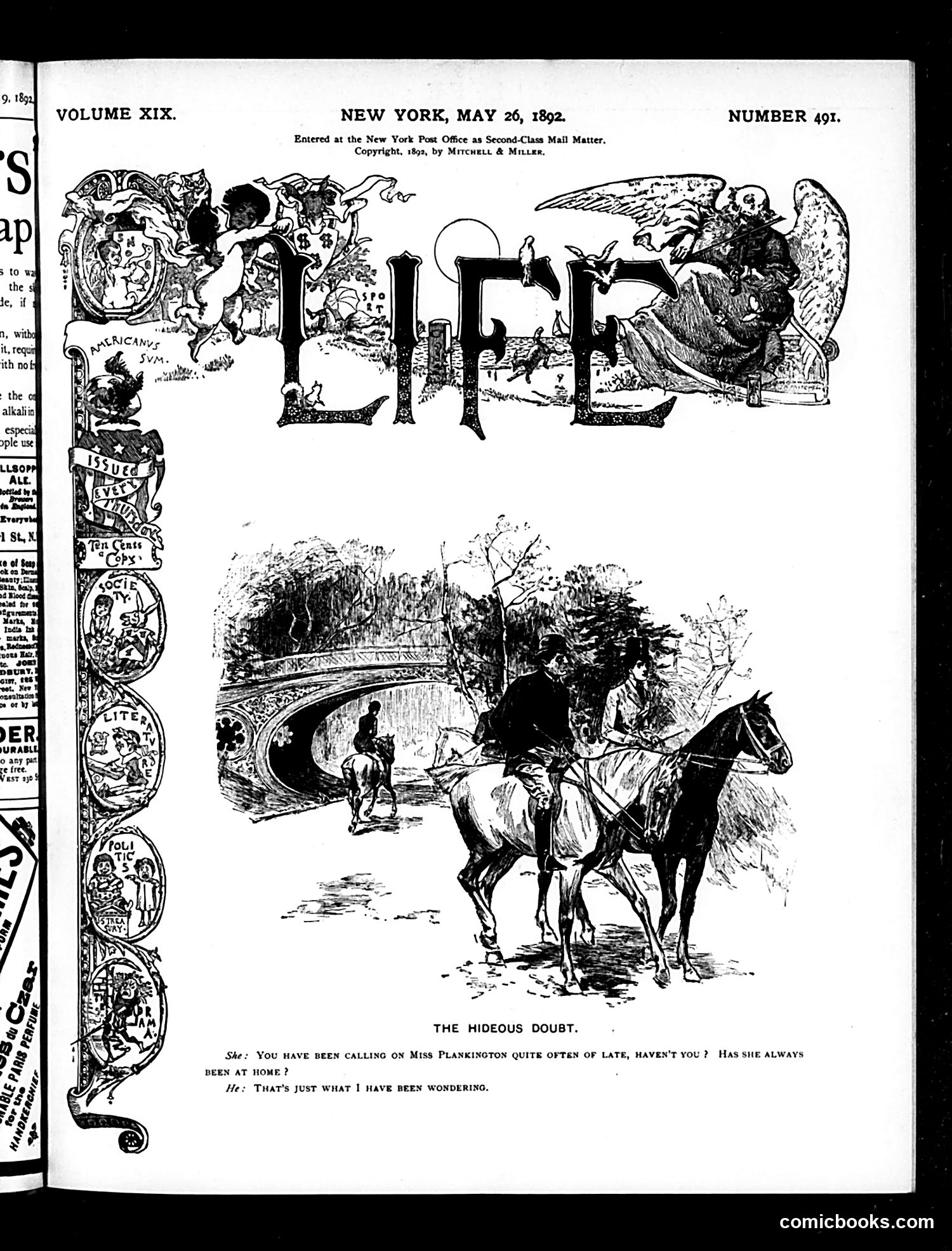
This cartoon depicts a romantic scenario with a clear gender-politics joke. A man on horseback approaches a woman (presumably Miss Plankington), and the caption reveals the humor: he's been calling on her frequently, but she's always been home when he visits. He expresses relief that she's finally available, but she reveals the actual situation—her repeated "at home" responses don't indicate her actual presence; rather, she's been deliberately avoiding him by being out. The joke satirizes Victorian courtship conventions, where a woman's claimed availability masked her actual whereabouts. The "hideous doubt" is his sudden realization that her formal excuses concealed genuine disinterest. It's social commentary on the gap between polite social rituals and honest romantic communication.
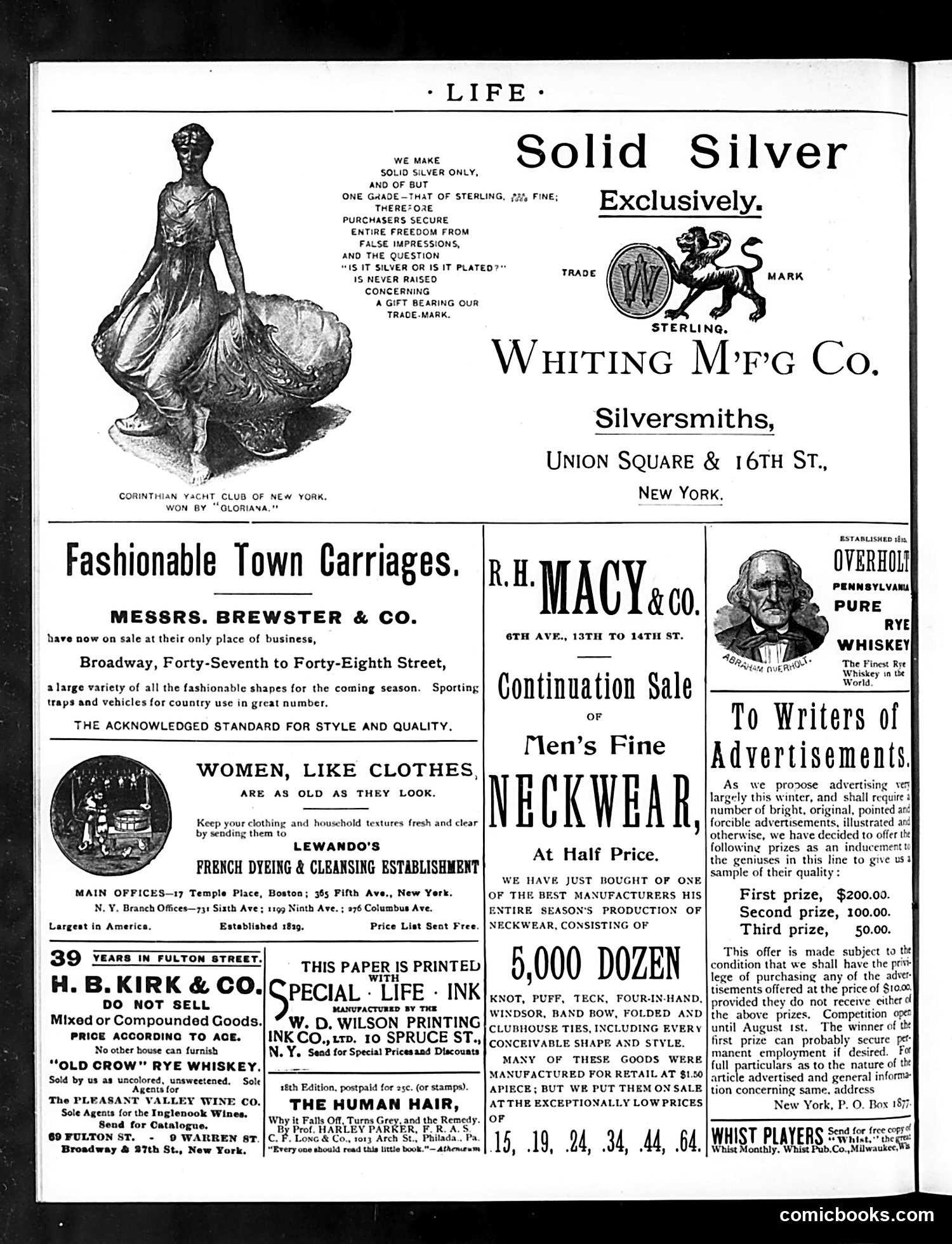
This page is **primarily advertising**, not satirical content. The layout features commercial notices for luxury goods and services typical of the Gilded Age: fine silver from Whiting M'fg Co., carriages from Brewster & Co., clothing from R.H. Macy & Co., and various other establishments. The only illustration with potential cultural commentary is the classical female figure atop a large shell (left side), labeled as the "Corinthian Yacht Club of New York" trophy won by "Gloriana." This appears to be a society/sporting notice rather than political satire—it reflects the elite recreational culture of wealthy New Yorkers. The remaining content consists of service advertisements: French dry cleaning, printing ink, whiskey, wine, and hair products. No clear political satire or caricature is evident on this page.
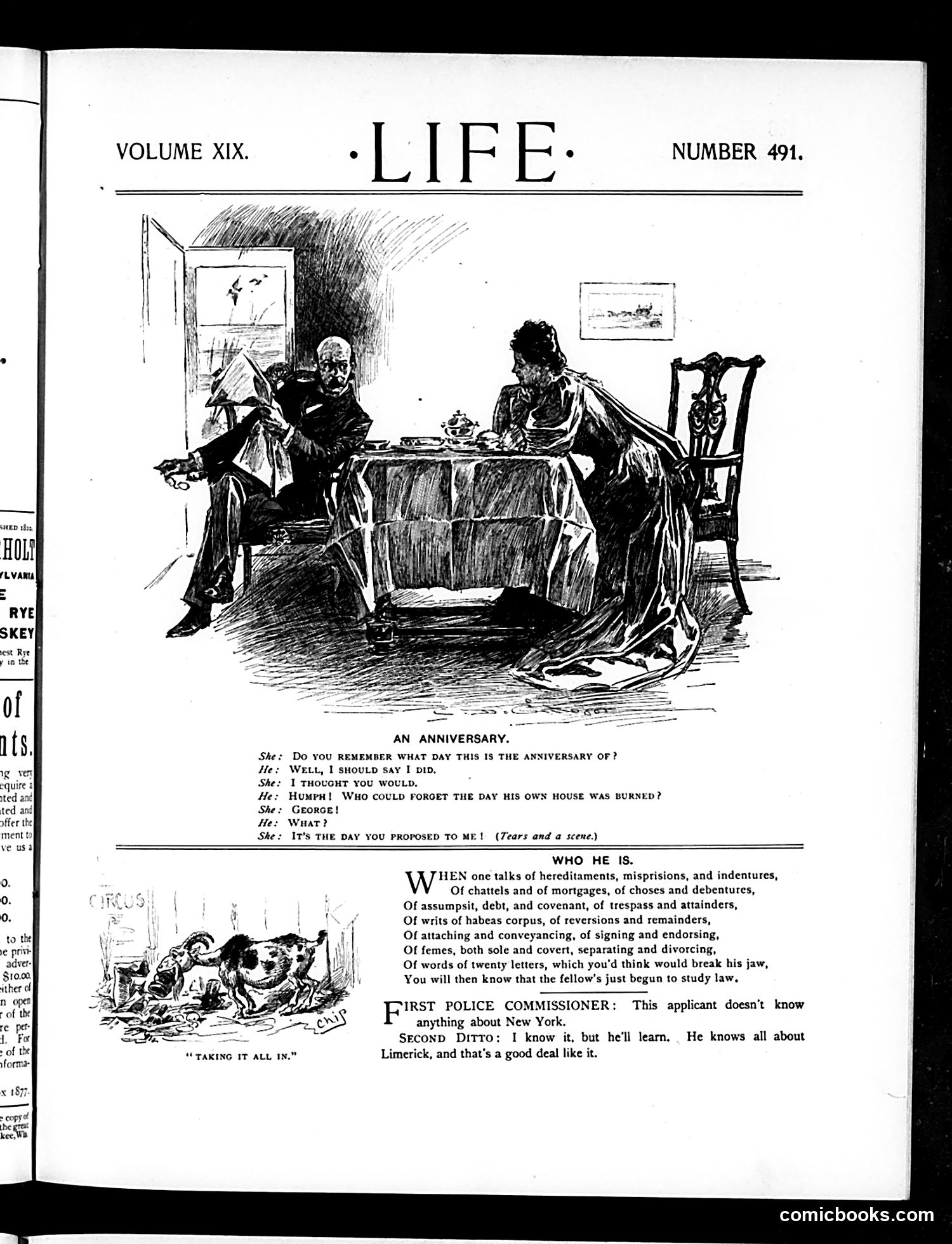
This page from *Life* magazine (Volume XIX, Number 491) contains two satirical pieces: **"An Anniversary"** (top cartoon): A couple argues over a forgotten wedding anniversary. The husband claims he'd "remember" while making excuses about his house burning down. The wife sarcastically reminds him "it's the day you proposed to me," suggesting his selective memory about romantic milestones versus domestic disasters. **"Who He Is"** (bottom section): This appears to be commentary on a lawyer or legal professional, listing his expertise in litigation, contracts, and various legal matters. The "First Police Commissioner" and "Second Ditto" dialogue suggests satire about New York municipal positions or appointments, possibly mocking someone's claimed qualifications for public office. The humor relies on domestic irony and institutional incompetence typical of *Life*'s satirical style.
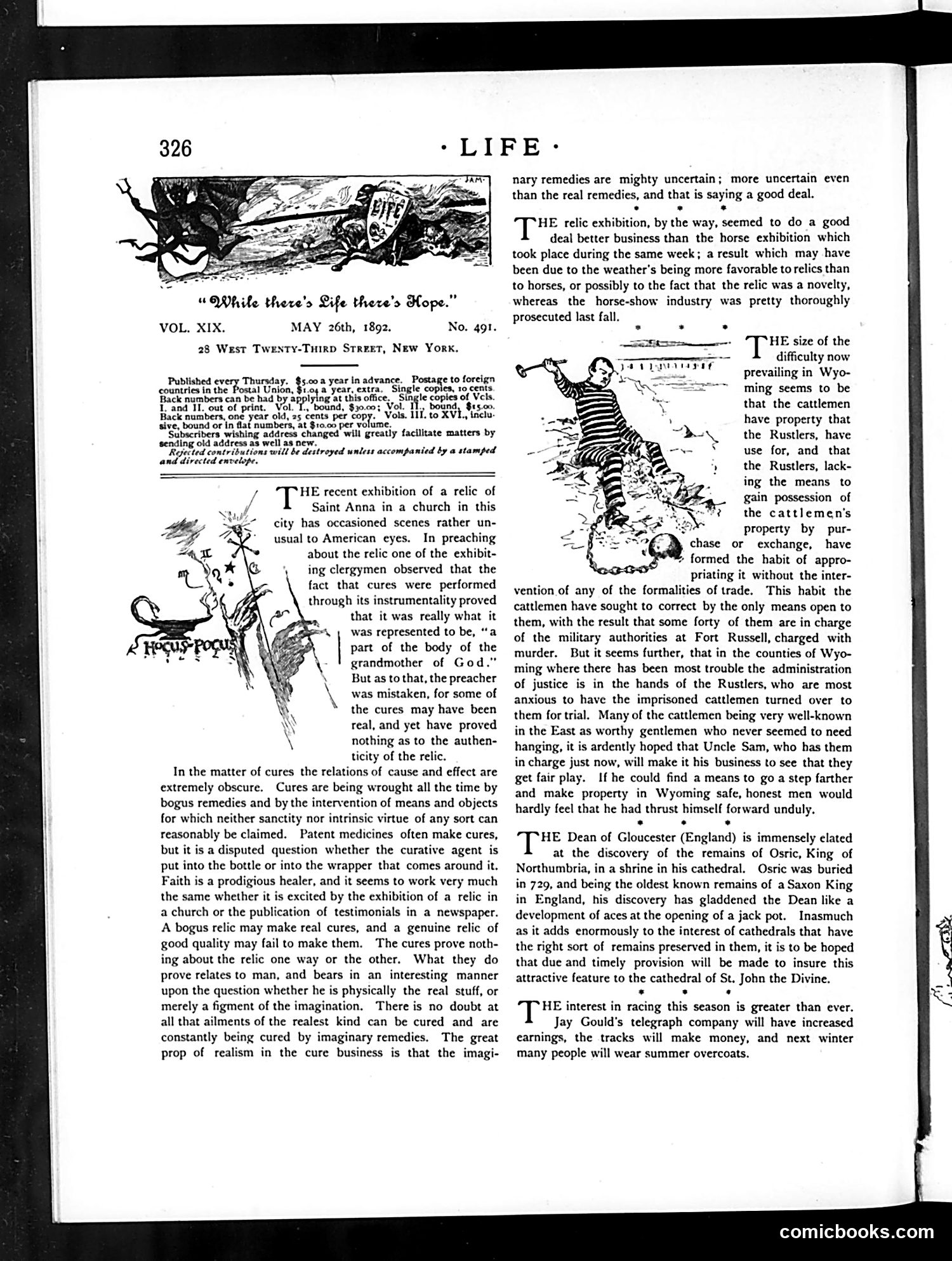
The page contains three distinct sections: 1. **Top illustration**: A decorative header showing a cherub or classical figure with "While there's Life there's Hope"—a standard motto. 2. **Left cartoon**: An ornate illustration labeled "Aesculapius" (the Roman god of medicine), depicting medical/pharmaceutical themes. This accompanies text mocking the uncertain efficacy of medical remedies and the public's faith in relics and imaginary cures. 3. **Right illustration**: A figure in striped clothing riding what appears to be a horse or mechanical device, likely satirizing either a sporting pursuit or fashionable craze of the era. The text discusses relics (particularly Saint Anna), faith healing, Wyoming cattle rustlers, and horse racing—reflecting 1892's mix of frontier lawlessness, religious skepticism, and sporting enthusiasm. The satire targets credulous belief in both religious relics and unproven medicines.
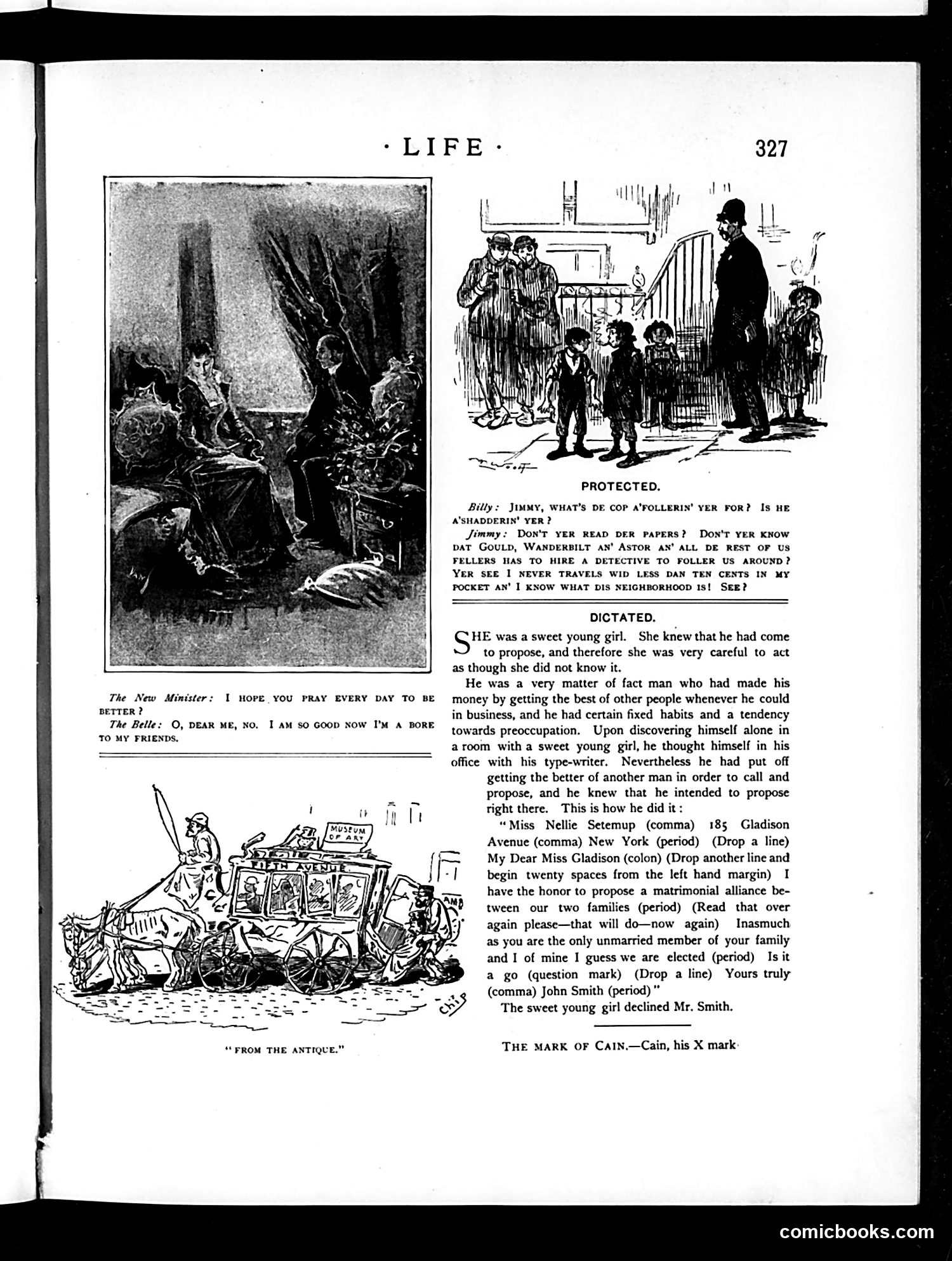
This page contains three distinct pieces of period humor: 1. **"Protected"** (top right): A street-level scene where a detective follows children, satirizing wealthy families' hiring of private investigators to monitor their children's movements and associations—apparently a common practice among the affluent. 2. **"Dictated"** (main text): A romantic rejection story mocking formal courtship rituals. A businessman meticulously plans a proposal using a typewritten letter with precise formatting marks, only to be rejected by a young woman who finds his mechanical approach absurd. 3. **"From the Antique"** (bottom): A humorous illustration of a junk collector, likely satirizing consumerism or waste. The overall theme appears to be satirizing upper-class social pretension and the increasingly bureaucratic nature of modern life.
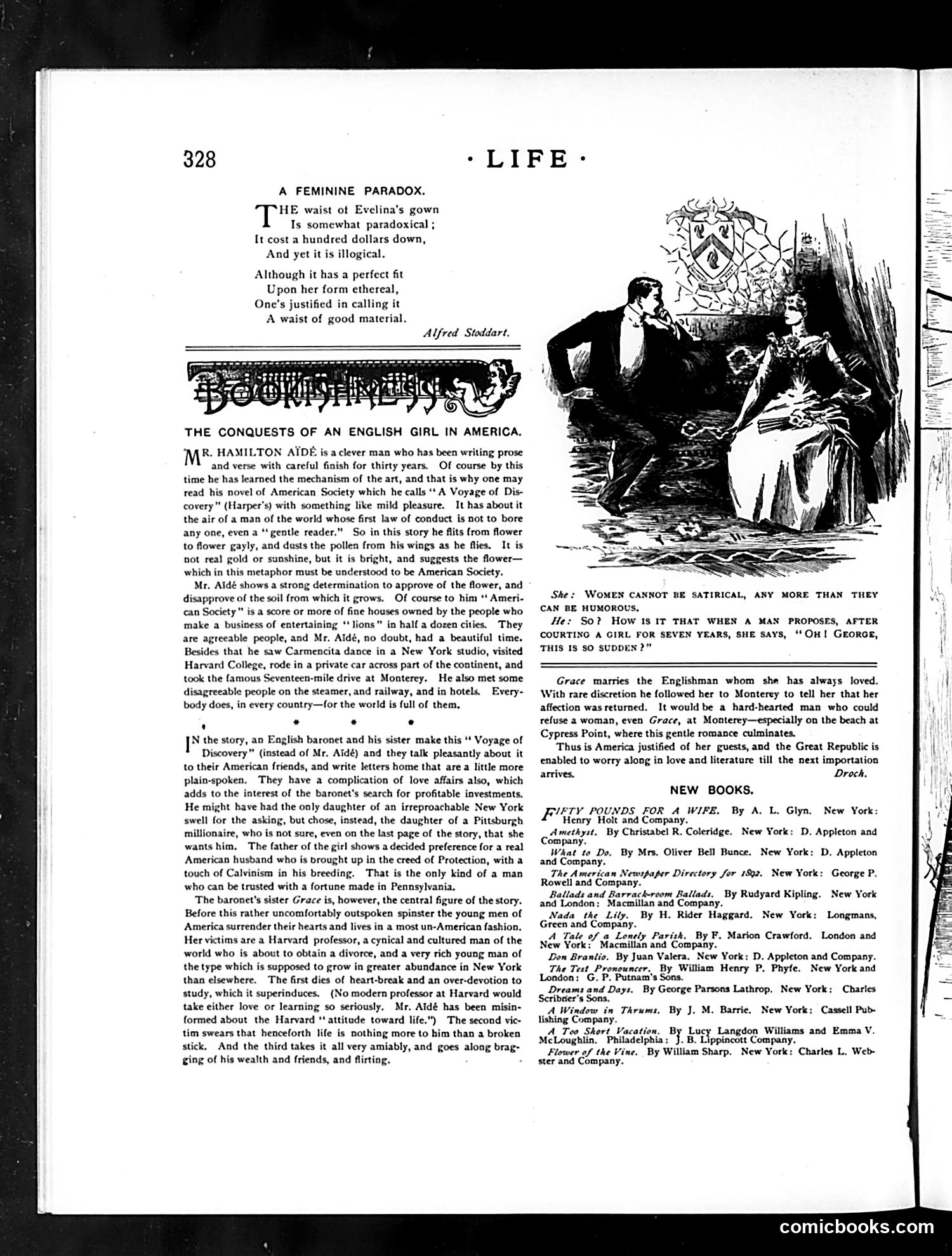
This satirical poem by Alfred Stodart mocks the expense and impracticality of women's fashionable clothing, specifically Evelina's gown. The verse notes the paradox: her waist-cinching dress costs "a hundred dollars down" yet is "illogical"—it's expensive but poorly constructed, fitting perfectly only because of its wasteful material. The accompanying illustration shows a man and woman in conversation, with the woman displaying her elaborate dress. The satire targets both wasteful female fashion consumption and the masculine disapproval of such expenditures—a common theme in period satire about gender relations and consumer culture. The "New Books" section below reviews contemporary literature, including Hamilton Aide's "A Voyage of Discovery," which appears to be the satirical subject matter referenced in the article text above.
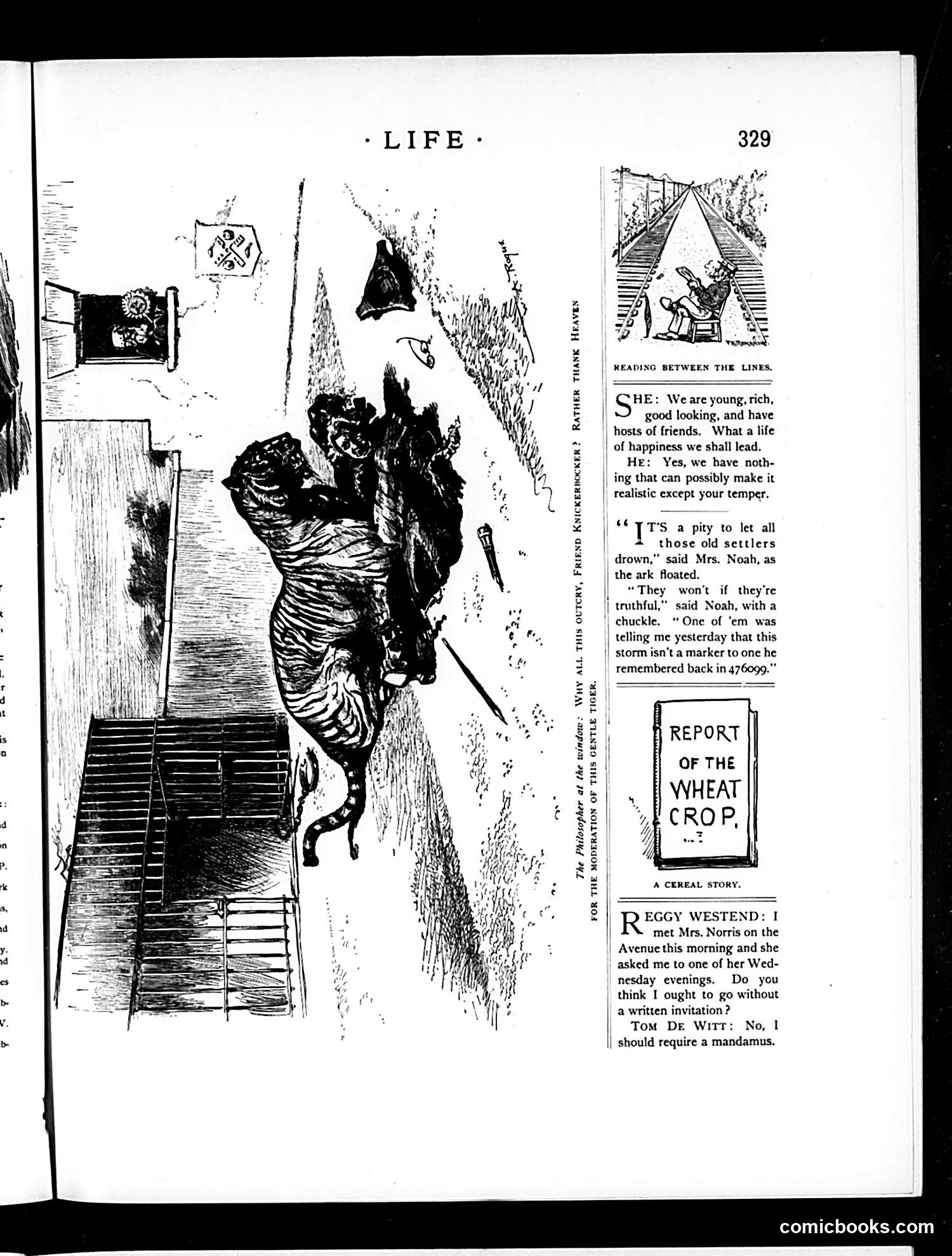
The large central illustration appears to be a political cartoon depicting a rotund figure (likely representing a wealthy industrialist or politician) being carried or supported by workers or laborers, suggesting commentary on economic inequality or labor exploitation—a common satirical theme in early 20th-century American magazines. The "Reading Between the Lines" dialogue mocks naive optimism about wealth and happiness, with the response deflating such dreams as unrealistic. The "Report of the Wheat Crop" section contains banter between characters (Peggy Westend, Tom De Witt, Mrs. Norris) discussing social etiquette and weather folklore—typical light social satire of the era. Overall, this page mixes economic/class critique with genteel social humor, reflecting Life's role as commentary on both serious issues and upper-class manners.
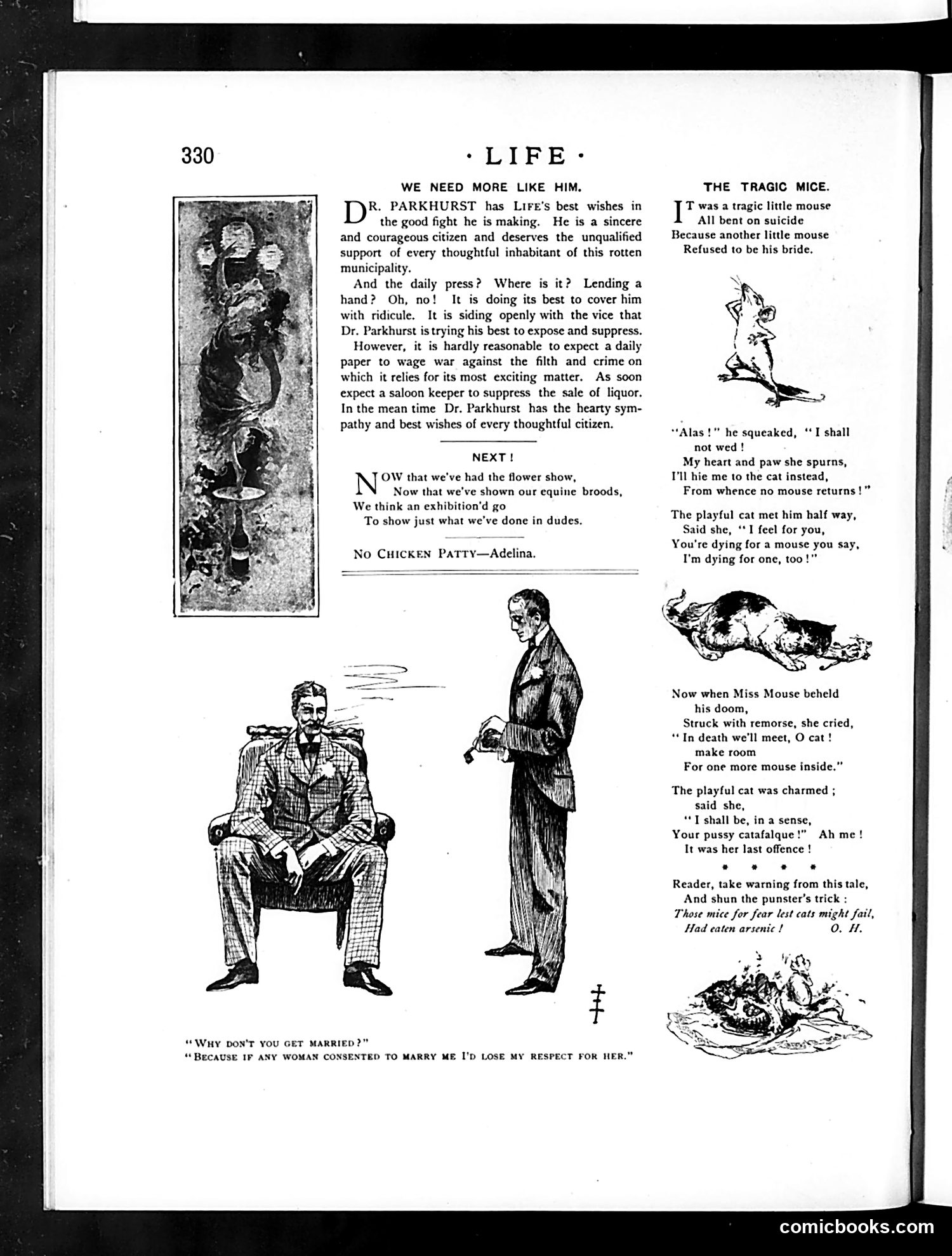
**"We Need More Like Him"** features Dr. Parkhurst, a real reformer whom Life endorses for fighting corruption and vice in New York City. The editorial criticizes newspapers for covering his anti-corruption efforts with ridicule rather than support, comparing this to expecting saloon keepers to suppress liquor sales. **"The Tragic Mice"** is a humorous poem about star-crossed rodent lovers. A male mouse refuses marriage to his beloved because "another little mouse / Refused to be his bride," leading to tragic deaths. The cat observes their doom with ironic sympathy. The bottom cartoon shows two men discussing marriage—one seated, one standing with a watering can—captioned with a cynical joke about losing self-respect if married.
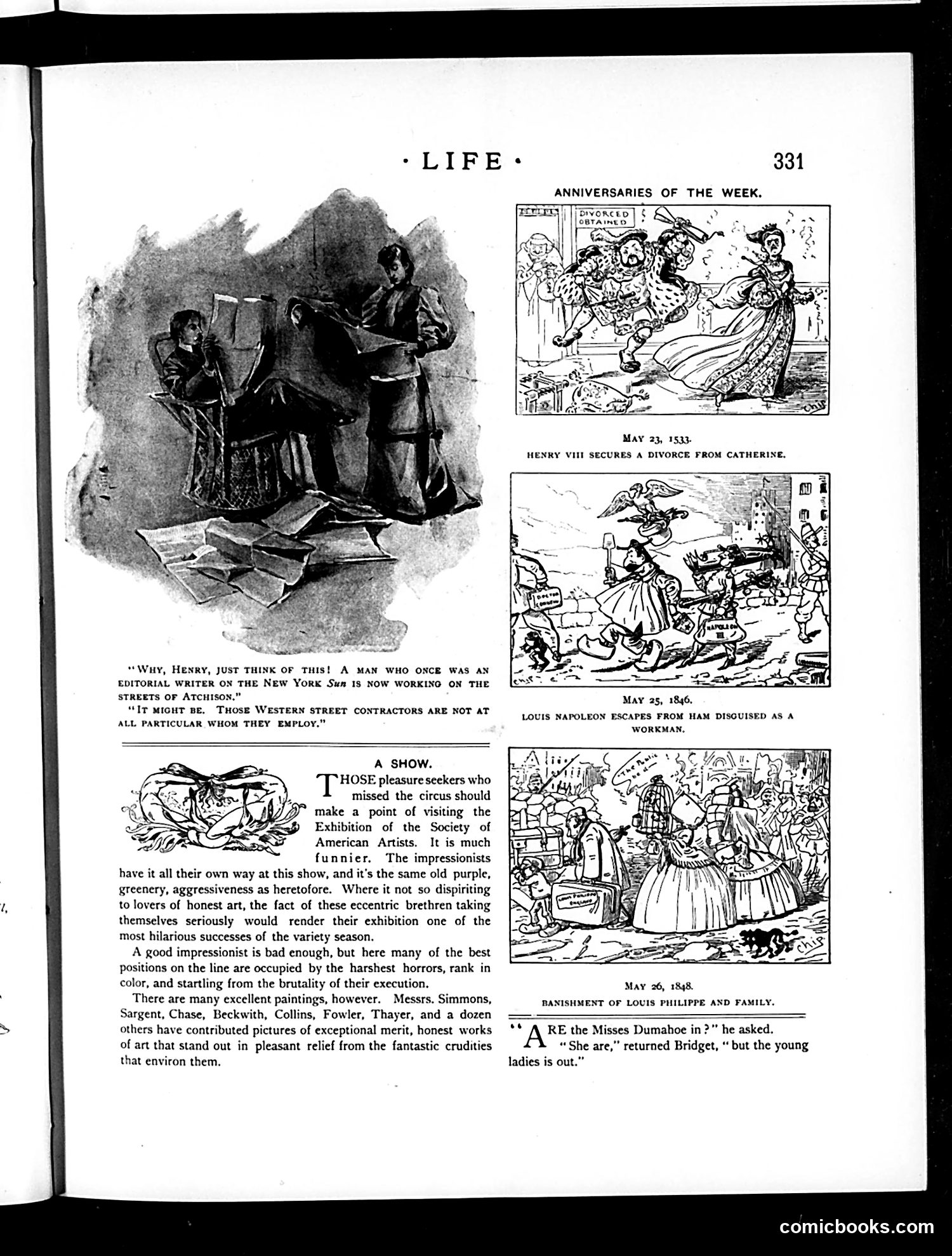
This *Life* magazine page (p. 331) contains historical anniversary illustrations and a critical review of an artists' exhibition. **Top section:** Three "Anniversaries of the Week" engravings commemorate historical events: Henry VIII's 1533 divorce from Catherine of Aragon, Napoleon's 1846 escape from Ham disguised as a workman, and the 1848 banishment of Louis Philippe and family. **Main article ("A Show"):** Reviews the Society of American Artists exhibition, criticizing the Impressionists' work as "purple, greenery, aggressiveness" and lacking honest technique. However, the reviewer praises specific artists (Simmons, Sargent, Chase, Beckwith, Collins, Fowler, Thayer) whose realistic paintings offer "pleasant relief from the fantastic crudities" of the avant-garde. The review reflects late-19th-century artistic conservatism resisting modernist movements.
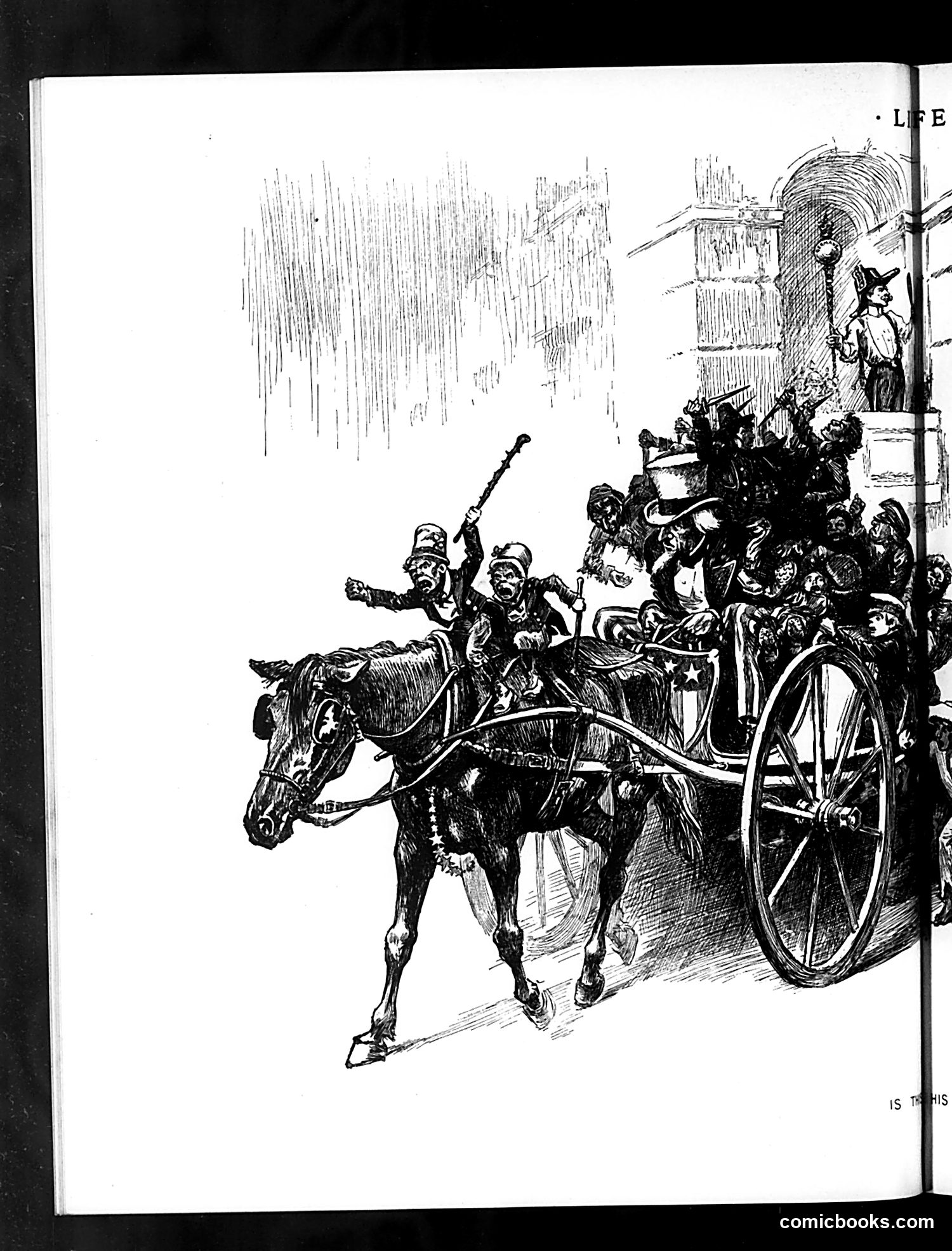
This political cartoon depicts a dramatic scene of military or police figures in uniform riding in a carriage, with soldiers on horseback alongside it. The figures are gesturing wildly and appear agitated or celebratory. The style and uniforms suggest this is European, likely early 20th century. Without clearer text identifying the specific figures or event, I cannot definitively state which historical incident this satirizes. The scene appears to reference some kind of military action, coup, or dramatic political event involving uniformed personnel. The exaggerated, theatrical poses suggest *Life* magazine is mocking the participants' behavior or the event itself as absurd or overly dramatic. The precise satirical point—and which historical figures or nations are being caricatured—remains unclear without additional contextual information beyond what's visible on this page.
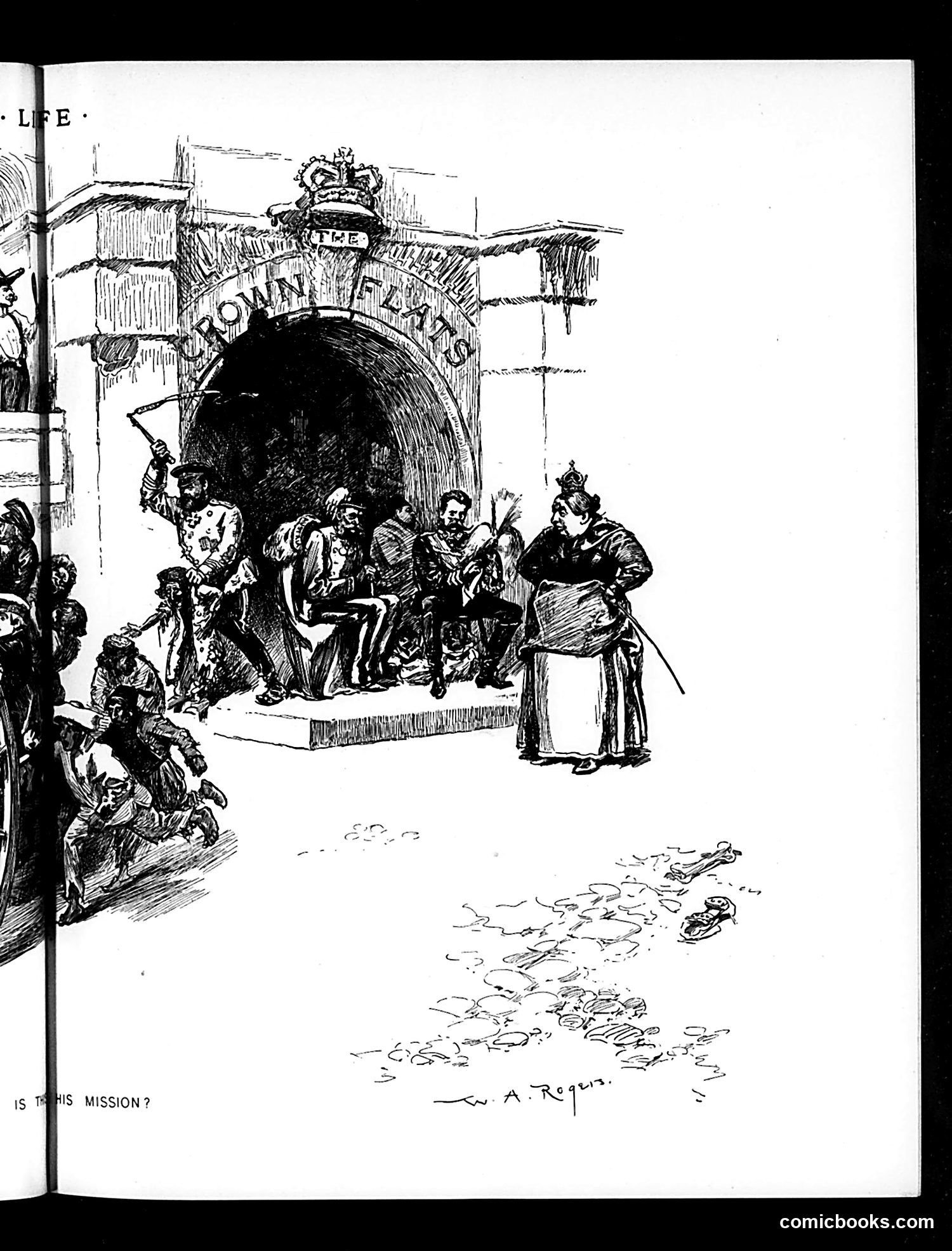
This appears to be a satirical cartoon from *Life* magazine's "Is This Mission?" feature. The image depicts what looks like a formal diplomatic or religious ceremony taking place at an archway labeled "ROMAN FACTS" (or similar). A figure wearing a crown stands prominently on the right, while various other distinguished-looking figures are gathered in formal dress, some seated. The ground is scattered with what appears to be coins or monetary symbols. The satire seems to critique either: diplomatic missions involving financial incentives, religious missions with ulterior motives, or perhaps critiques of wealthy foreign delegations. The scattered coins suggest that money is central to whatever "mission" is being conducted, implying the real purpose is financial rather than noble or humanitarian. Without clearer text attribution, the specific historical event referenced remains unclear.
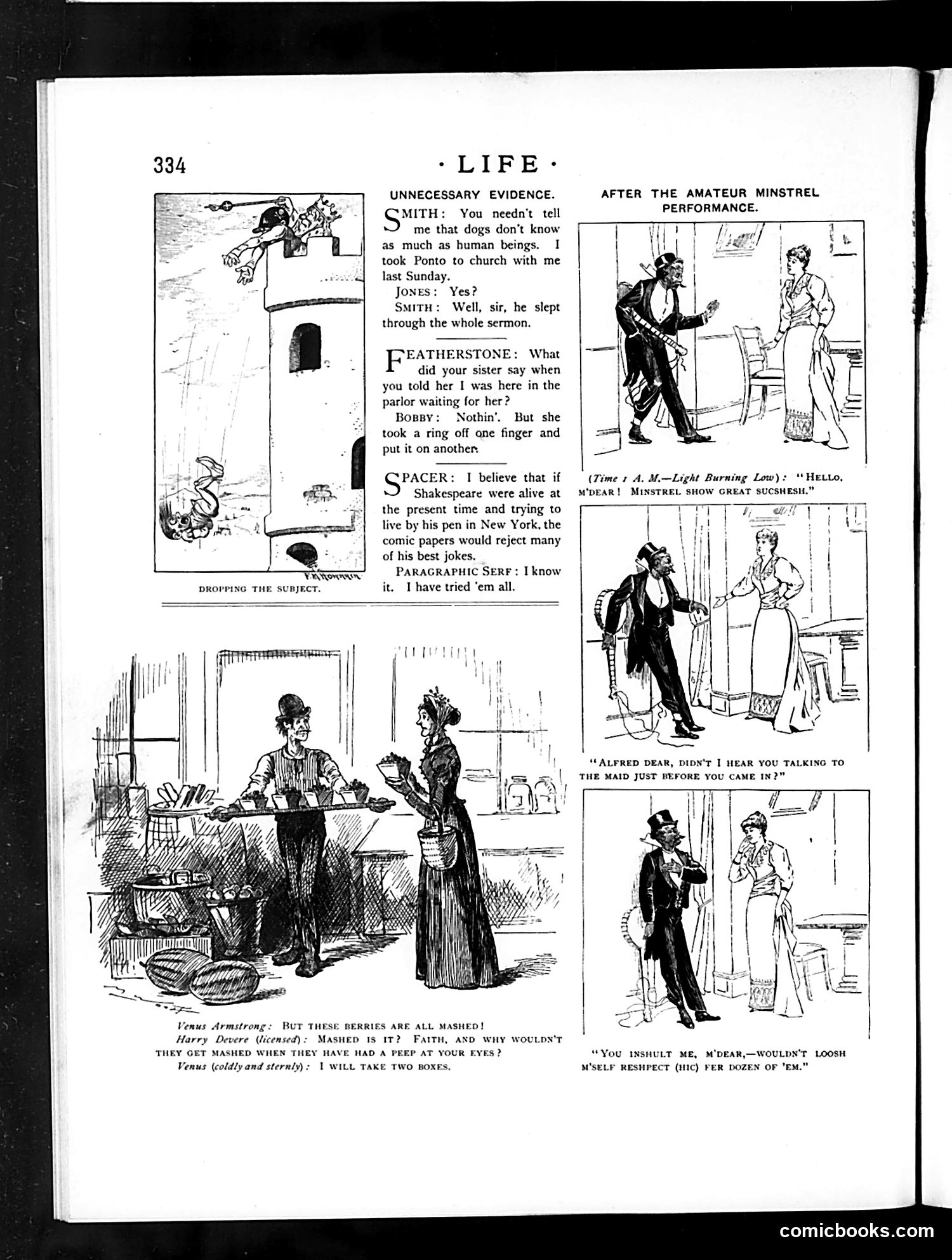
This is a collection of short comedic vignettes typical of early 20th-century American humor magazines. The jokes rely on social observations and wordplay: **"Unnecessary Evidence"** jokes about a dog sleeping through church—implying the sermon was boring enough to put anyone to sleep, a common criticism of religious services. **"After the Amateur Minstrel Performance"** depicts someone returning from a blackface minstrel show (a popular entertainment form), using exaggerated dialect humor typical of the era. The remaining sketches involve romantic misunderstandings and courtship scenarios—a woman removing her ring when told a suitor awaits (suggesting reluctance), marital banter about talking to servants, and overwrought flirtation with berries and eyes. The humor is primarily observational about daily life, relationships, and contemporary entertainment, with heavy reliance on dialect and stereotypes now considered offensive. The page demonstrates Life's satirical approach to middle-class American social conventions of its era.
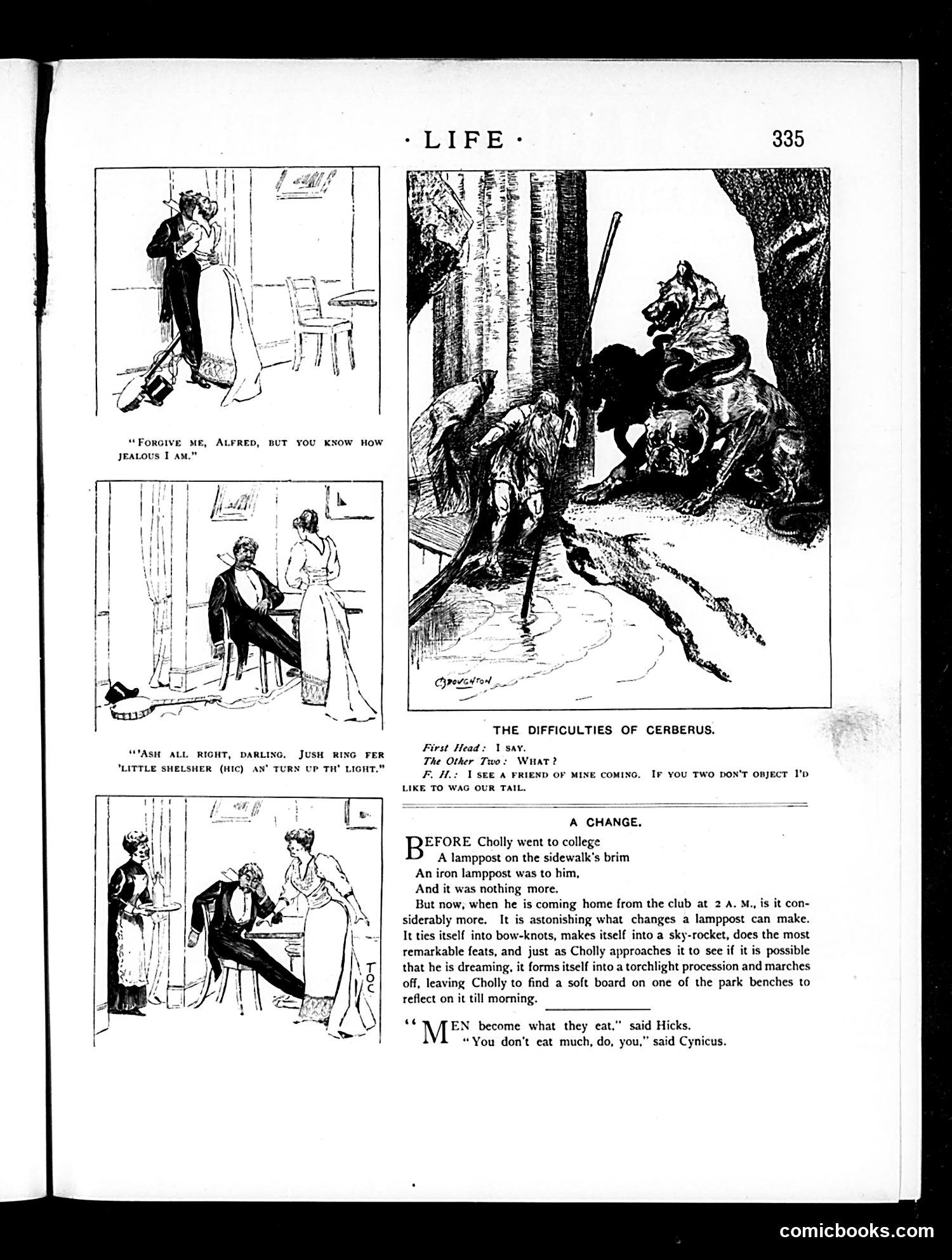
This page contains three separate satirical pieces: **"The Difficulties of Cerberus"**: A visual joke depicting the three-headed dog from Greek mythology. One head wants to wag their shared tail to greet an approaching friend, but the other two heads object—illustrating the absurdity of a three-headed creature trying to coordinate unified action. **"A Change"**: A humorous poem about a young man named Cholly who, after attending college and frequenting clubs, now comes home drunk at 2 A.M. and sees lampposts as animated, shape-shifting objects (sky-rockets, torchlight processions). The satire mocks drunkenness and the transformation of perception alcohol causes. **Philosophy Quip**: A brief witty exchange between characters named Hicks and Cynicus about diet determining character—with the implication that Cynicus eats little, explaining his cynical nature. All three pieces are light, humorous commentary typical of Life's satirical approach to social behavior and human nature.
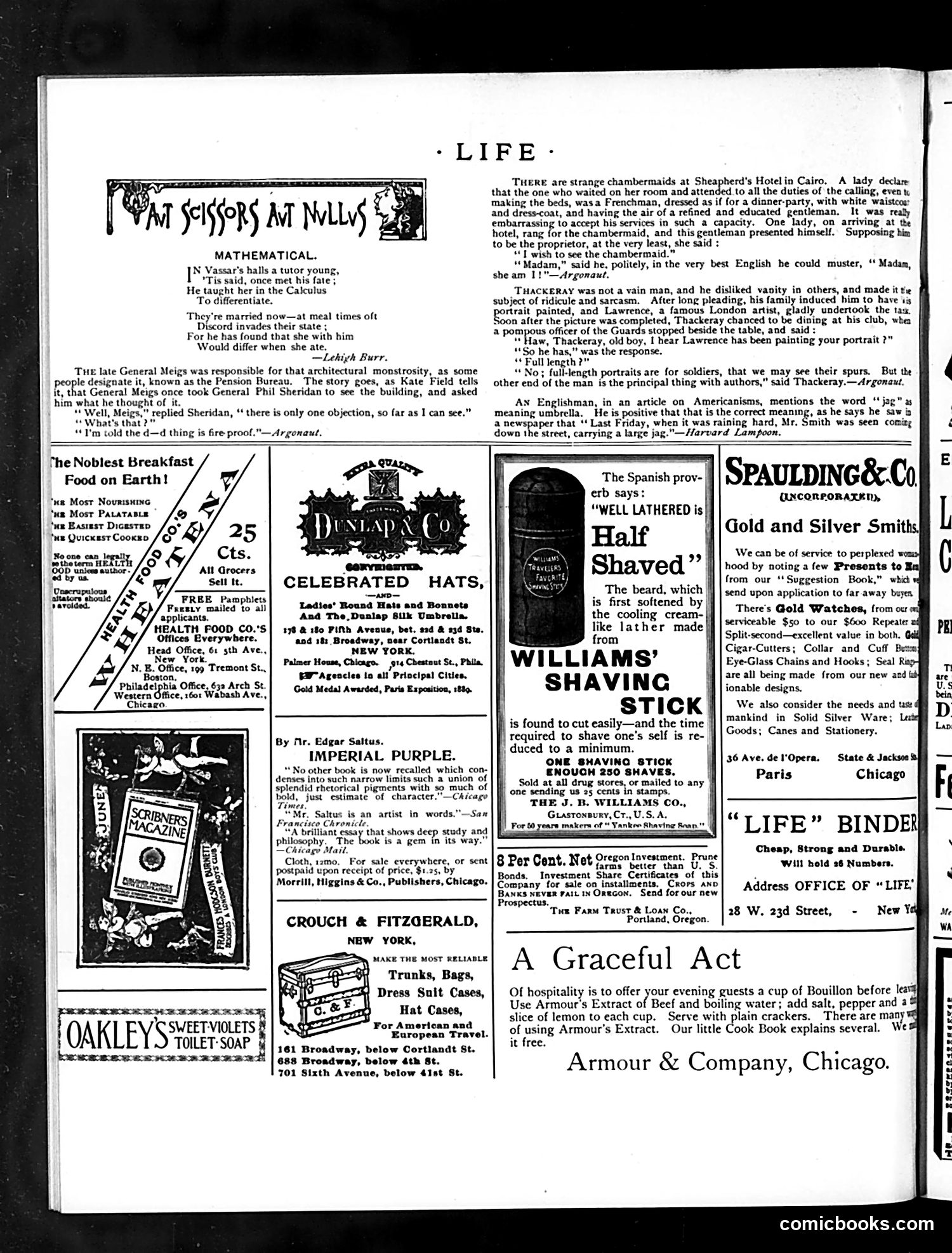
This page is primarily **advertising and miscellaneous content** rather than political satire. The main items are: **"At Scissors at Nulls"** — A mathematical poem (likely nonsensical wordplay) about a tutor and student who marry but "differ" at mealtimes—a pun on calculus differentiation. **Anecdotes**: Three brief humorous stories are presented: 1. General Meigs and Sheridan discussing the Pension Bureau building's fireproofing 2. A Frenchman working as a chambermaid at Cairo's Shepherd's Hotel 3. Thackeray declining a full-length portrait, claiming authors' "other end" is what matters These are genteel Victorian humor—witty wordplay and ironic observations about vanity, professional absurdity, and social pretension—typical of *Life*'s satirical approach. The remainder consists of advertisements for breakfast cereal, hats, shaving products, soap, luggage, and books—standard period advertising with no apparent satirical content.
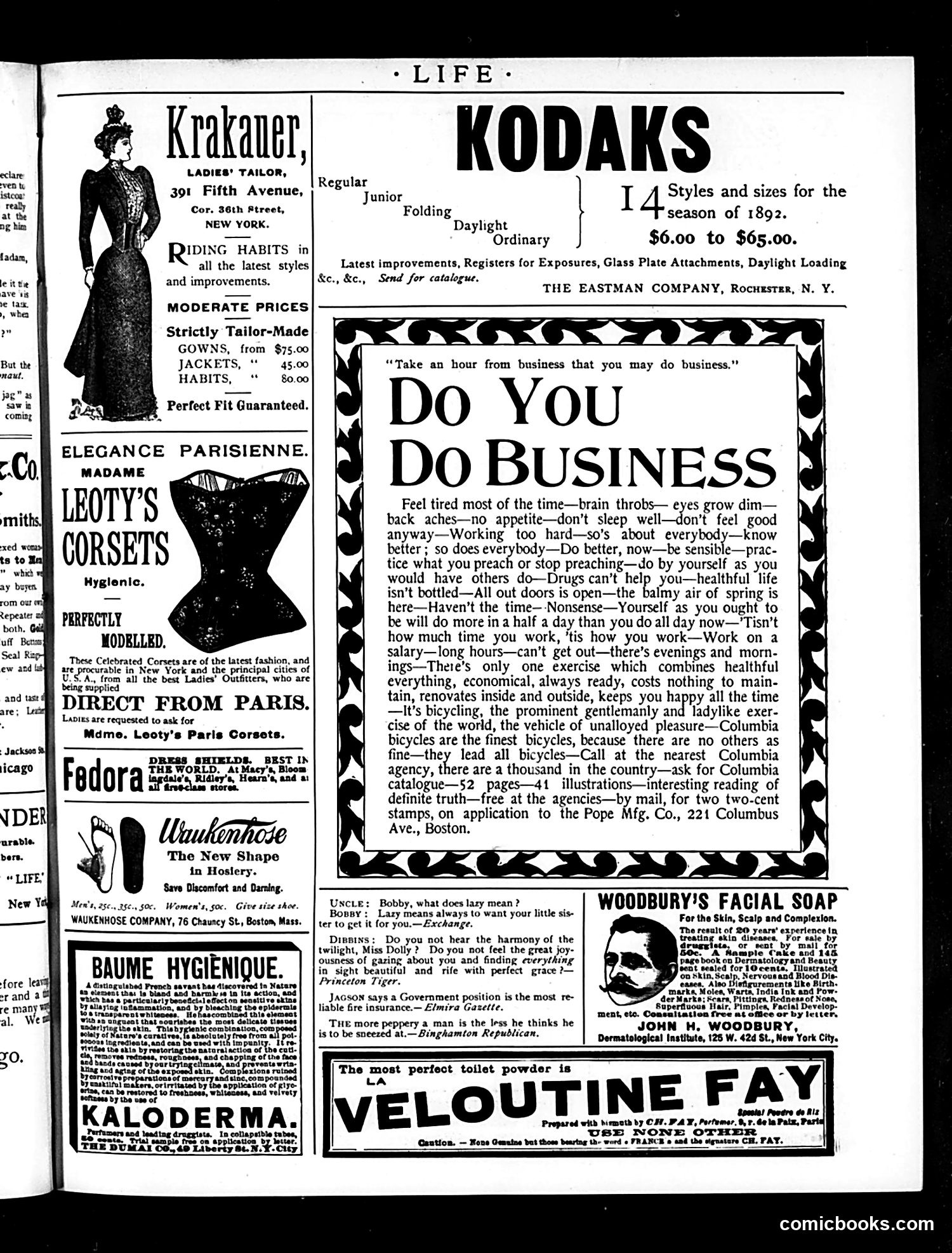
This is primarily an **advertising page** with minimal satirical content. The main editorial piece is a lengthy advertisement disguised as advice, titled "Do YOU Do BUSINESS." ## Key Content: **The Central "Cartoon"** (really an advertorial): Promotes Columbia bicycles as the cure for overworked businesspeople. It uses pseudo-health advice—suggesting cycling combats fatigue, poor sleep, and stress—to market bicycles as a gentleman's and lady's leisure activity. This reflects the 1890s bicycle craze, when cycles symbolized both health and modern respectability. **Minor Humor**: A small Uncle Remus-style joke about a child's definition of "lazy" appears below, typical of Life's filler content. **Surrounding Ads**: The page features period fashion (tailored riding habits, corsets, hosiery) and Kodak cameras—reflecting upper-class consumer culture of 1892. **Social Context**: The bicycling advertisement targets affluent readers who could afford both expensive bikes and leisure time, reflecting emerging American consumer culture and changing attitudes toward exercise and women's mobility.
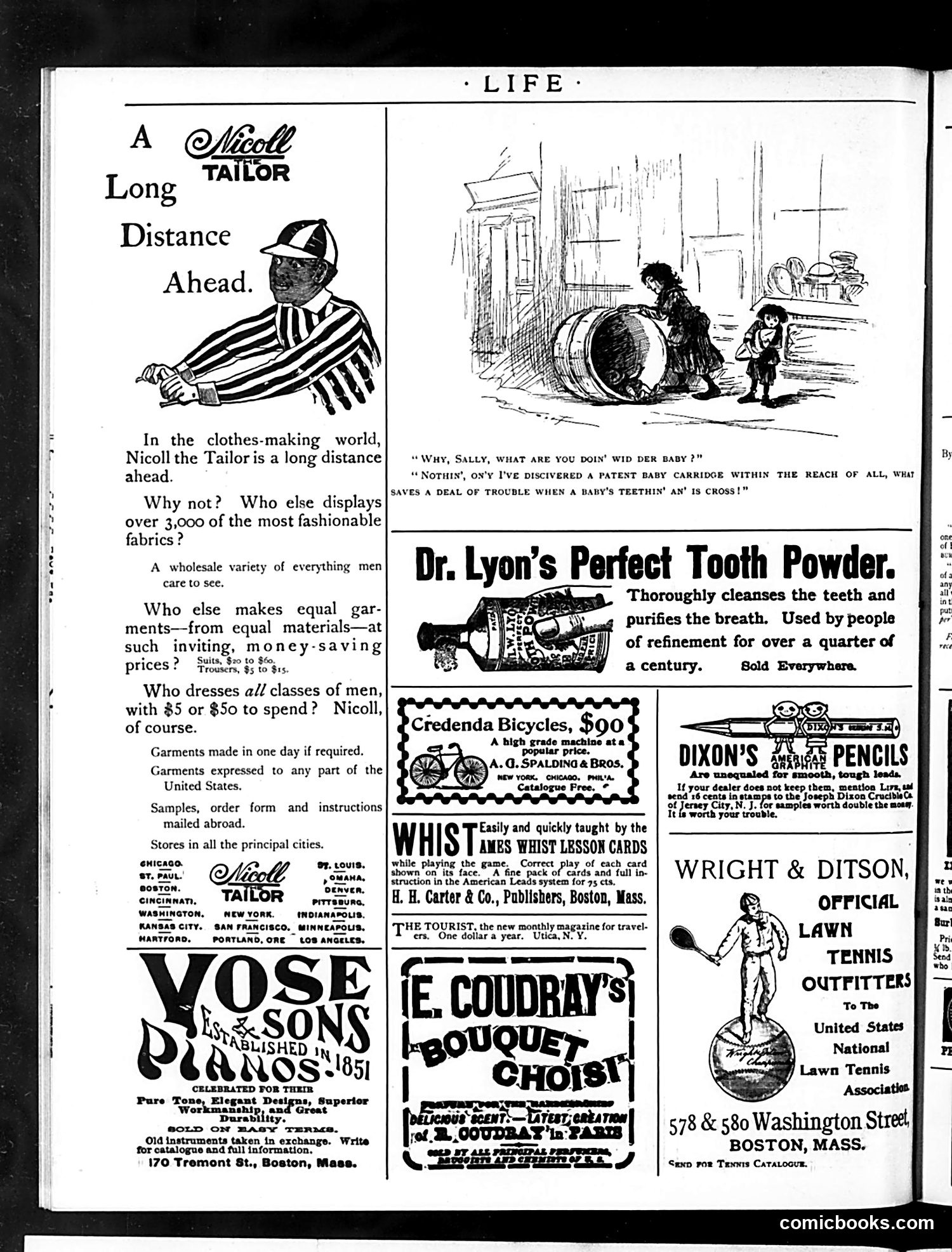
This page is primarily **advertising**, not political satire. The main content promotes Nicoll the Tailor with a small accompanying cartoon about a baby carriage. ## The Cartoon The brief sketch shows two figures (likely working-class parents based on dialect) discussing a "patent baby carriage" that soothes teething babies. The crude dialect ("Wiy der baby?" "Nottin's") reflects period stereotypes of immigrant or working-class speech. The joke is straightforward: a practical invention solves a common domestic problem. ## Context for Modern Readers This reflects late 19th/early 20th-century concerns with **infant care and mechanical solutions** to domestic challenges. The exaggerated accent was considered humorous by contemporary audiences, though it now reads as dismissive ethnic caricature. The remainder of the page features **period advertisements**: tooth powder, bicycles, whist cards, pencils, and lawn tennis equipment—typical consumer goods marketed to middle-class readers. The Nicoll Tailor ad emphasizes affordability and speed ("Garments made in one day"), appealing to working professionals.
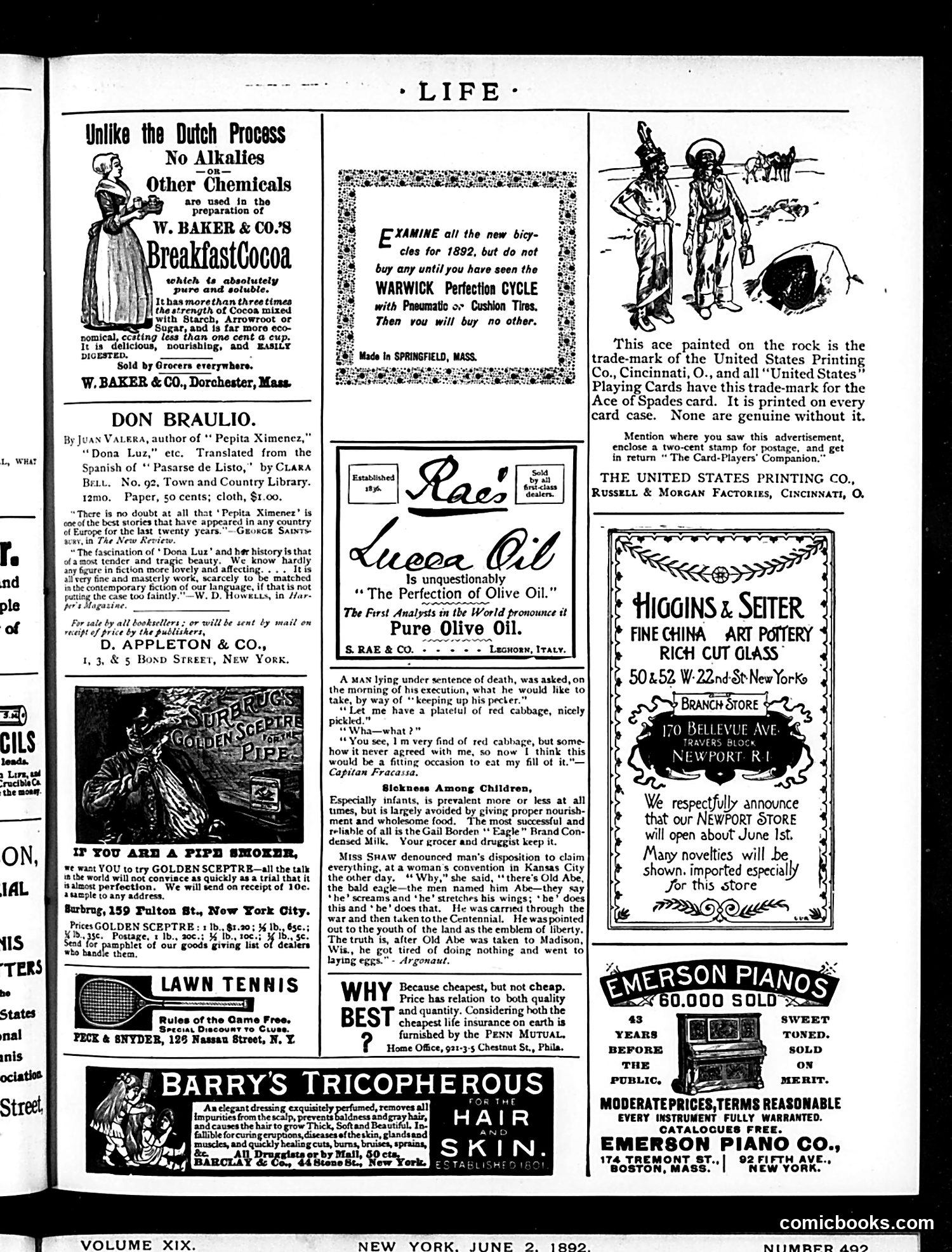
This page is predominantly commercial advertisements typical of 1890s Life magazine. The content includes: **Non-advertising content:** - A brief literary notice for "Don Braulio," a Spanish novel - Two short humorous anecdotes: one about a condemned man requesting red cabbage at his execution, another mocking a woman's speech about an eagle (seemingly criticizing female activism by claiming a bald eagle began laying eggs at the Wisconsin State Fair) **Advertisements:** The page is filled with product pitches: breakfast cocoa, bicycles, olive oil, pipes, lawn tennis equipment, pianos, hair tonic, and insurance. Most ads make exaggerated health or quality claims typical of the era. **No significant political cartoons appear on this page.** The satirical content is limited to the brief anecdotes, which target execution prisoners and female speakers respectively—reflecting period attitudes rather than substantive social commentary. This is primarily a commercial page.
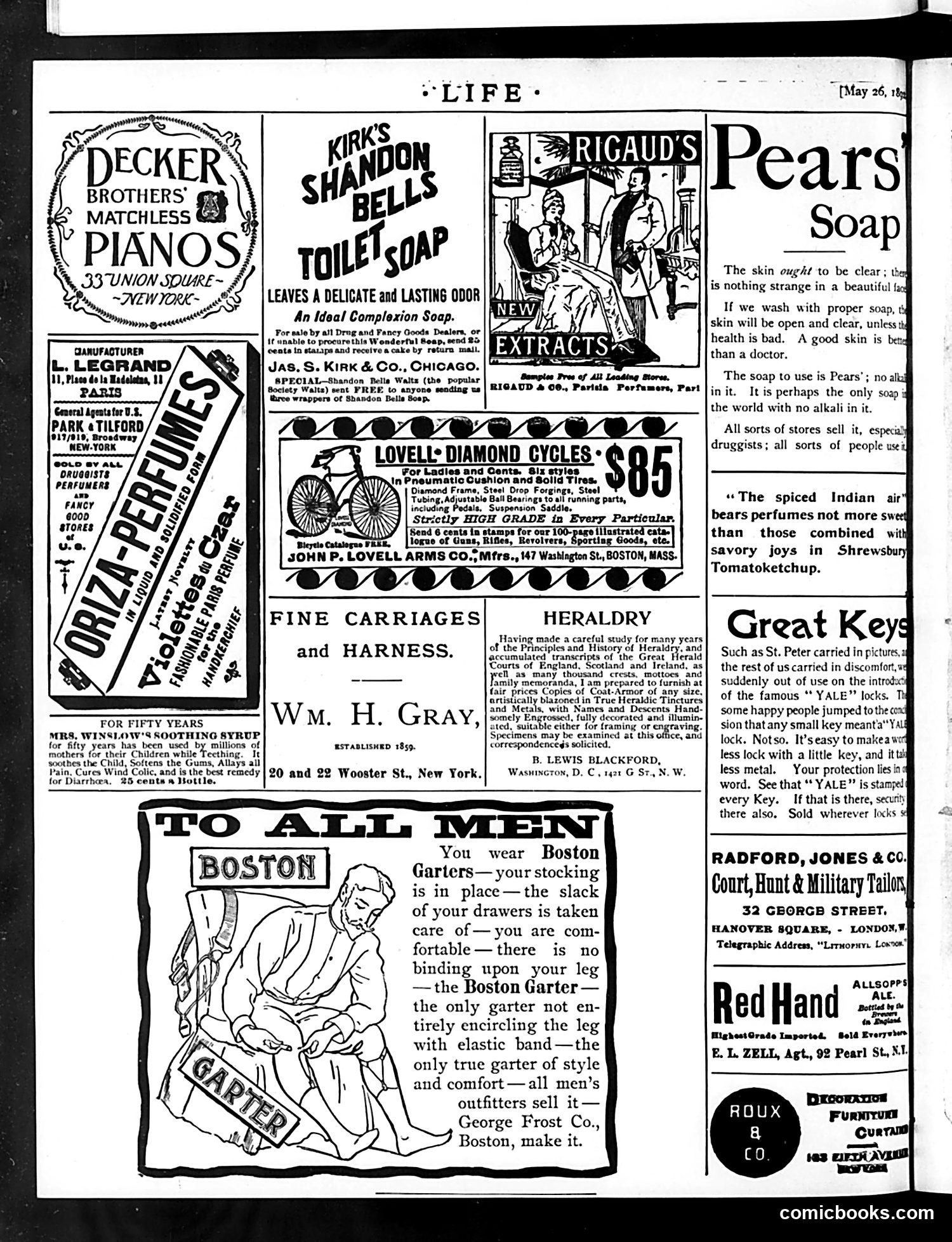
This is primarily a **advertising page** from Life magazine (May 26, 1912), not a political cartoon. The page consists almost entirely of product advertisements typical of the era. Notable content includes: **Boston Garters ad** (bottom left): The only substantial illustrated advertisement shows a man adjusting his garter. The copy emphasizes comfort and style—the Boston Garter supposedly doesn't bind the leg like elastic bands do. This reflects early 20th-century menswear concerns about visible garters beneath trousers. **Other ads** feature period luxury goods: Decker pianos, Kirk's toilet soap, Lovell bicycles ($85), carriages, heraldry services, and Yale locks. **Pears' Soap** (right side) includes pseudo-scientific claims about skin health and soap composition—typical of Edwardian advertising's dubious health assertions. The **Mrs. Winslow's Soothing Syrup** ad (bottom) advertises a nostrum for teething children, now known to contain dangerous substances. These ads collectively reflect early 20th-century consumer culture, class aspirations, and pre-FDA marketing practices.