
Life, 1892-05-26 · page 6 of 18
Life — May 26, 1892 — page 6: what you’re looking at
What you’re looking at
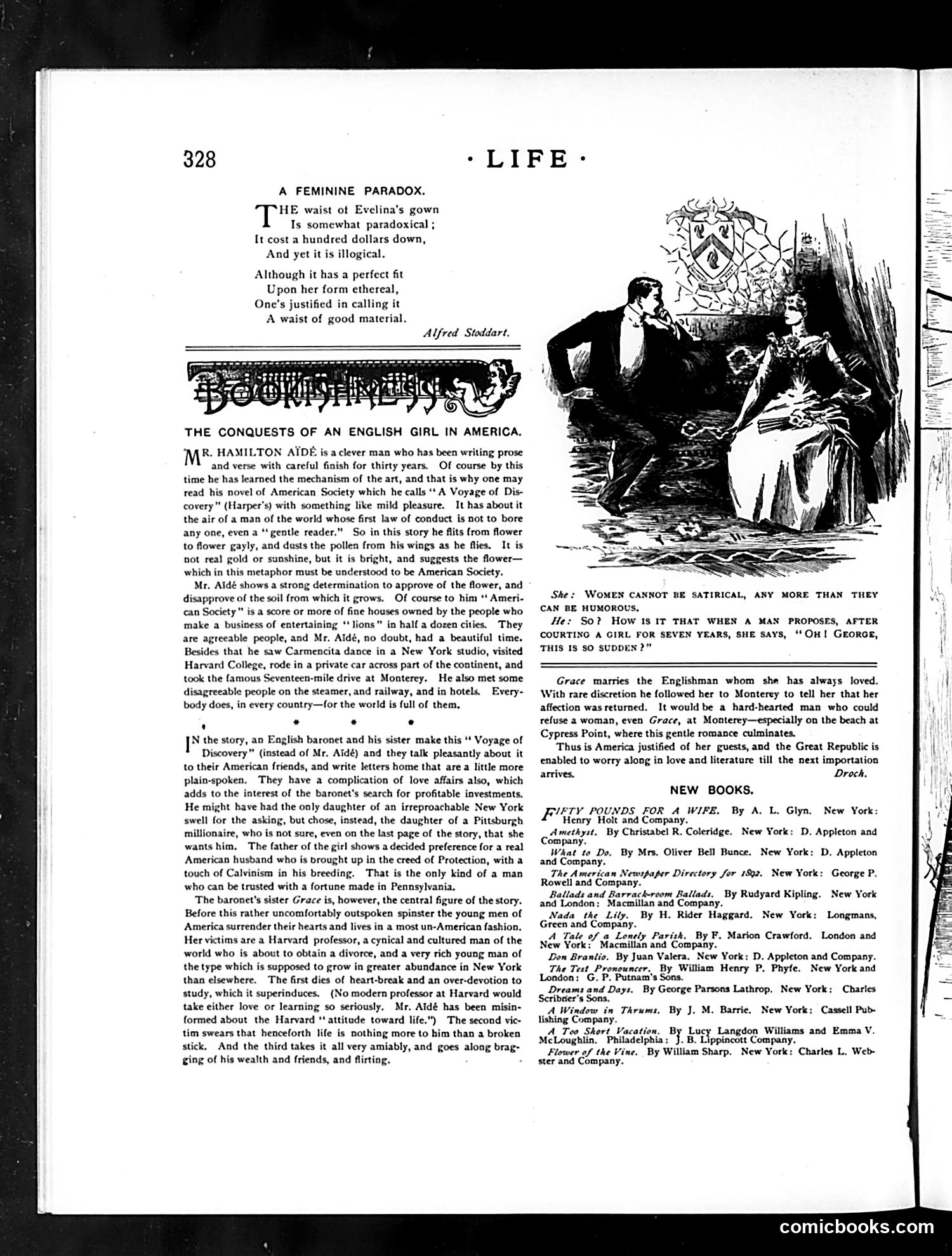
This satirical poem by Alfred Stodart mocks the expense and impracticality of women's fashionable clothing, specifically Evelina's gown. The verse notes the paradox: her waist-cinching dress costs "a hundred dollars down" yet is "illogical"—it's expensive but poorly constructed, fitting perfectly only because of its wasteful material. The accompanying illustration shows a man and woman in conversation, with the woman displaying her elaborate dress. The satire targets both wasteful female fashion consumption and the masculine disapproval of such expenditures—a common theme in period satire about gender relations and consumer culture. The "New Books" section below reviews contemporary literature, including Hamilton Aide's "A Voyage of Discovery," which appears to be the satirical subject matter referenced in the article text above.
📄 Transcribed text from this page (OCR, searchable)
Machine-transcribed from the original scan — historical spelling and the odd misread are preserved.
A FEMININE PARADOX. HE waist of Evelina's gown Is somewhat paradoxical ; It cost a hundred dollars down, And yet it is illogical. Although it has a perfect fit Upon her form ethereal, One's justified in calling it A waist of good material. Alfred Stoddart. THE CONQUESTS OF AN ENGLISH GIRL IN AMERICA. R. HAMILTON AIDE is a clever man who has been writing prose and verse with careful finish for thirty years. Of course by this time he has learned the mechanism of the art, and that is why one may read his novel of American Society which he calls “A Voyage of Dis- covery" (Harper's) with something like mild pleasure. It has about it the air of a man of the world whose first law of conduct is not to bore any one, even a ‘gentle reader." So in this story he flits from flower to flower gayly, and dusts the pollen from his wings as he flies, It is not real gold or sunshine, but it is bright, and suggests the flower— which in this metaphor must be understood to be American Society. Mr. Aldé shows a strong determination to approve of the flower, and disapprove of the soil from which it grows. Of course to him * Ameri- can Society” is a score or more of fine houses owned by the people who make a business of entertaining * lions” in half a dozen cities. They are agreeable people, and Mr. Aidé, no doubt, had a beautiful time. Besides that he saw Carmencita dance in a New York studio, visited Harvard College, rode in a private car across part of the continent, and took the famous Seventeen-mile drive at Monterey. He also met some disagreeable people on the steamer, and railway, and in hotels. Every- body does, in every country—for the world is full of them. ‘ * * . J the story, an English baronet and his sister make this * Voyage of Discovery” (instead of Mr. Aidé) and they talk pleasantly about it to their American friends, and write letters home that are a little more plain-spoken, They have a complication of love affairs also, which adds to the interest of the baronet's search for profitable investments. He might have had the only daughter of an irreproachable New York swell for the asking, but chose, instead, the daughter of a Pittsburgh millionaire, who is not sure, even on the last page of the story, that she wants him, The father of the girl shows a decided preference for a real American husband who is brought up in the creed of Protection, with a touch of Calvinism in his breeding. That is the only kind of a man who can be trusted with a fortune made in Pennsylvania, The baronet's sister Grace is, however, the central figure of the story. Before this rather uncomfortably outspoken spinster the young men of America surrender their hearts and lives in a most un-American fashion. Her victims are a Harvard professor, a cynical and cultured man of the world who is about to obtain a divorce, and a very rich young man of the type which is supposed to grow in greater abundance in New York than elsewhere. The first dies of heart-break and an over-devotion to study, which it superinduces. (No modern professor at Harvard would take either love or learning so seriously, Mr. Aldé has been misin- formed about the Harvard "attitude toward life.") The second vic- tim swears that henceforth life is nothing more to him than a broken stick, And the third takes it all very amiably, and goes along brag- ging of his wealth and friends, and flirting. She: WOMEN CANNOT BE SATIRICAL, ANY MORE THAN THEY CAN BE HUMOROUS. He: So? How 18 if THAT WHEN A MAN COURTING A GIRL FOR SEVEN YEARS, SHE SAYS, ‘THIS 18 SO SUDDEN?” PROPOSES, AFTER “Ox! Georos, Grace marries the Englishman whom she has always loved. With rare discretion he followed her to Monterey to tell her that her affection was returned. It would be a hard-hearted man who could refuse a woman, even Grace, at Monterey—especially on the beach at Cypress Point, where this gentle romance culminates. ‘Thus is America justified of her guests, and the Great Republic is enabled to worry along in love and literature till the next importation arrives. Droch. NEW BOOKS. FIETY POUNDS FOR A WIFE. By A. L. Glyn. New York: Henry Holt and Company. Amethyst, By Christabel R. Coleridge. New York: D. Appleton and Company. What to Do. By Mrs, Oliver Bell Bunce. New York: D. Appleton and Company, The American Newspaper Directory for 182. New York: George P. Rowell and Company. Ballads and Barrack-reom Ballads, and London: Macmillan and Company. Nada the Lily, By H. Rider Haggard. New York: Longmans, Green and Company. A Tale of a Lonely Parish. By F. Marion Crawford. New York: Macmillan and Company. Don Brantio. By Juan Valera. New York: D. Appleton and Company. The Test_Pronouncer. By William Henry P, Phyfe, New York and London: G. P. Putnam's Sons. Dreams and Days, By George Parsons Lathrop. New York: Charles Scribsier’s Sons. A Window in Thrums, By J, M. Barrie. lishing Company. A Teo Short Vacation, By Lucy Langdon Williams and Emma V. McLoughiin. Philadelphia: J. B. Lippincott Company. Flower of the Vine. By William Sharp. New York: Charles L, Web- ster and Company. By Rudyard Kipling. New York London and New York; Cassell Pub- comicbooks.com