
Life, 1892-05-26 · page 4 of 18
Life — May 26, 1892 — page 4: what you’re looking at
What you’re looking at
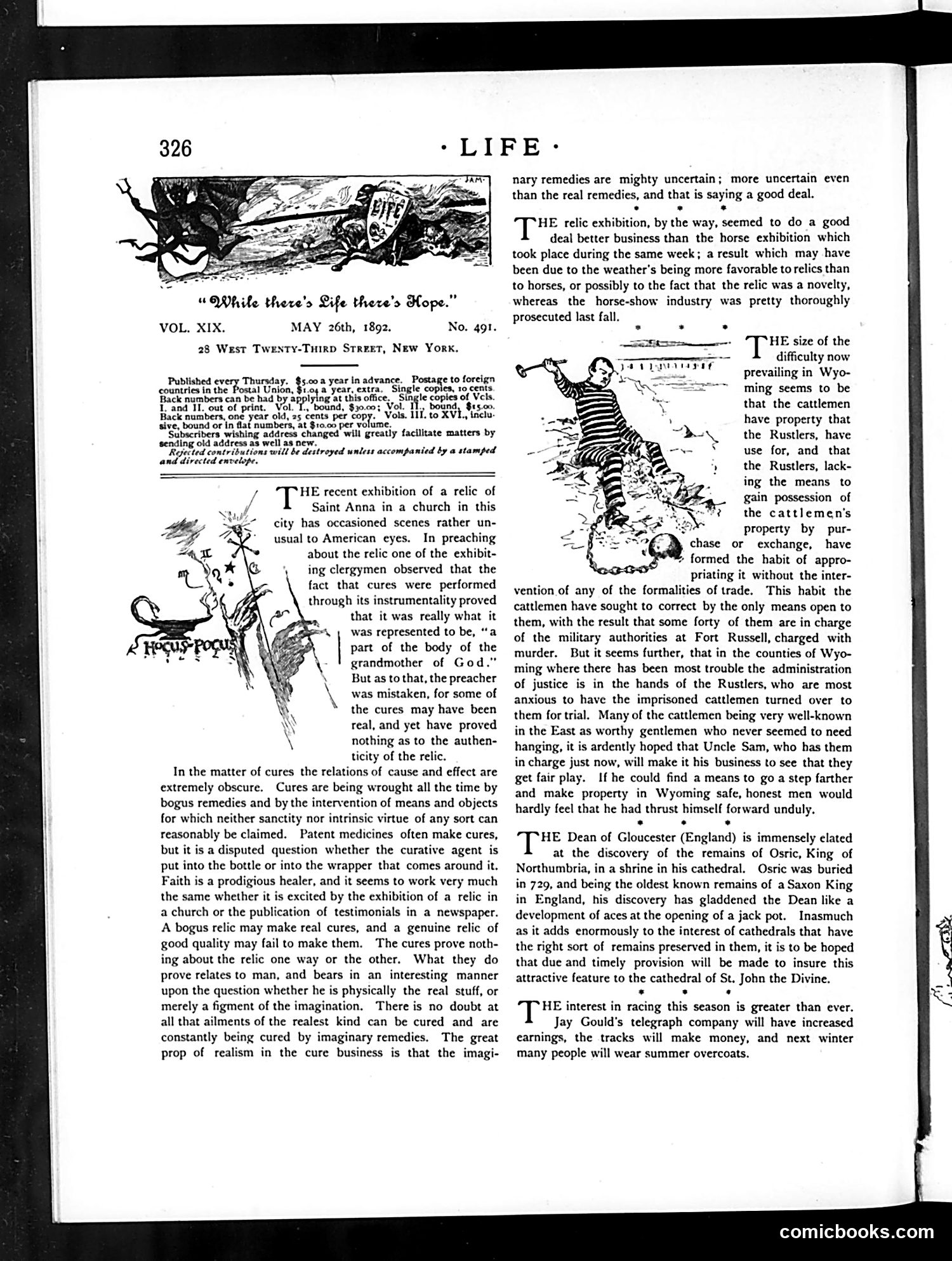
The page contains three distinct sections: 1. **Top illustration**: A decorative header showing a cherub or classical figure with "While there's Life there's Hope"—a standard motto. 2. **Left cartoon**: An ornate illustration labeled "Aesculapius" (the Roman god of medicine), depicting medical/pharmaceutical themes. This accompanies text mocking the uncertain efficacy of medical remedies and the public's faith in relics and imaginary cures. 3. **Right illustration**: A figure in striped clothing riding what appears to be a horse or mechanical device, likely satirizing either a sporting pursuit or fashionable craze of the era. The text discusses relics (particularly Saint Anna), faith healing, Wyoming cattle rustlers, and horse racing—reflecting 1892's mix of frontier lawlessness, religious skepticism, and sporting enthusiasm. The satire targets credulous belief in both religious relics and unproven medicines.
📄 Transcribed text from this page (OCR, searchable)
Machine-transcribed from the original scan — historical spelling and the odd misread are preserved.
LIFE “OPhile there's Life there’s Hope.” VOL. XIX. MAY 26th, 1892. No. 491. 28 West Twesty-Tuirp Street, NEw York. Published ev: Thursday. ooa year in advance. Postage to foreign countries in the Postal Taide, Si a year, extra. Single copies, ro cents. Back numbers can be had by ppiring att this office, thle copie of Vels. I, and II. out of print, Vol. Spo Vol. I1., bound, $15.00. Back numbers, one year old, 25 cents Vols. Ili. to XVI, inclu- sive, bound or in flat numbers, at $10.00 mere ~ hum subscribers wishing address changed will greatly facilitate matters by sending old address as well as new. Rejected contributions will be destroyed unless accompanied by a stamped and directed envelope. HE recent exhibition of a relic of Saint Anna in a church in this city has occasioned scenes rather un- usual to American eyes. In preaching about the relic one of the exhibit- ‘ing clergymen observed that the fact that cures were performed through its instrumentality proved that it was really what it was represented to be, “a part of the body of the grandmother of God.” But as to that, the preacher was mistaken, for some of the cures may have been real, and yet have proved nothing as to the authen- ticity of the relic. In the matter of cures the relations of cause and effect are extremely obscure. Cures are being wrought all the time by bogus remedies and by the intervention of means and objects for which neither sanctity nor intrinsic virtue of any sort can reasonably be claimed. Patent medicines often make cures, but it is a disputed question whether the curative agent is put into the bottle or into the wrapper that comes around it. Faith is a prodigious healer, and it seems to work very much the same whether it is excited by the exhibition of a relic in a church or the publication of testimonials in a newspaper. A bogus relic may make real cures, and a genuine relic of good quality may fail to make them. The cures prove noth- ing about the relic one way or the other. What they do prove relates to man, and bears in an interesting manner upon the question whether he is physically the real stuff, or merely a figment of the imagination. There is no doubt at all that ailments of the realest kind can be cured and are constantly being cured by imaginary remedies. The great prop of realism in the cure business is that the imagi- nary remedies are mighty uncertain; more uncertain even than the real remedies, and that is saying a good deal. . * Tt relic exhibition, by the way, seemed to do a good deal better business than the horse exhibition which took place during the same week; a result which may have been due to the weather's being more favorable to relics than to horses, or possibly to the fact that the relic was a novelty, whereas the horse-show industry was pretty thoroughly prosecuted last fall. . . HE size of the difficulty now prevailing in Wyo- ming seems to be that the cattlemen have property that the Rustlers, have use for, and that the Rustlers, lack- ing the means to gain possession of the cattlemen’s z Property by pur- chase or exchange, have ~ formed the habit of appro- priating it without the inter- vention of any of the formalities of trade. This habit the cattlemen have sought to correct by the only means open to them, with the result that some forty of them are in charge of the military authorities at Fort Russell, charged with murder. But it seems further, that in the counties of Wyo- ming where there has been most trouble the administration of justice is in the hands of the Rustlers, who are most anxious to have the imprisoned cattlemen turned over to them for trial. Many of the cattlemen being very well-known in the East as worthy gentlemen who never seemed to need hanging, it is ardently hoped that Uncle Sam, who has them in charge just now, will make it his business to see that they get fair play. If he could find a means to go a step farther and make property in Wyoming safe, honest men would hardly feel that he had thrust himself forward unduly. . . . oo Te Dean of Gloucester (England) is immensely elated at the discovery of the remains of Osric, King of Northumbria, in a shrine in his cathedral. in 729, and being the oldest known remains of a Saxon King in England, his discovery has gladdened the Dean like a Osric was buried development of aces at the opening of a jack pot. Inasmuch as it adds enormously to the interest of cathedrals that have the right sort of remains preserved in them, it is to be hoped that due and timely provision will be made to insure this attractive feature to the cathedral of St. John the Divine. . . . TH interest in racing this season is greater than ever. Jay Gould's telegraph company will have increased earnings, the tracks will make money, and next winter many people will wear summer overcoats. comicbooks.com