
A complete issue · 18 pages · 1892
Life — May 19, 1892
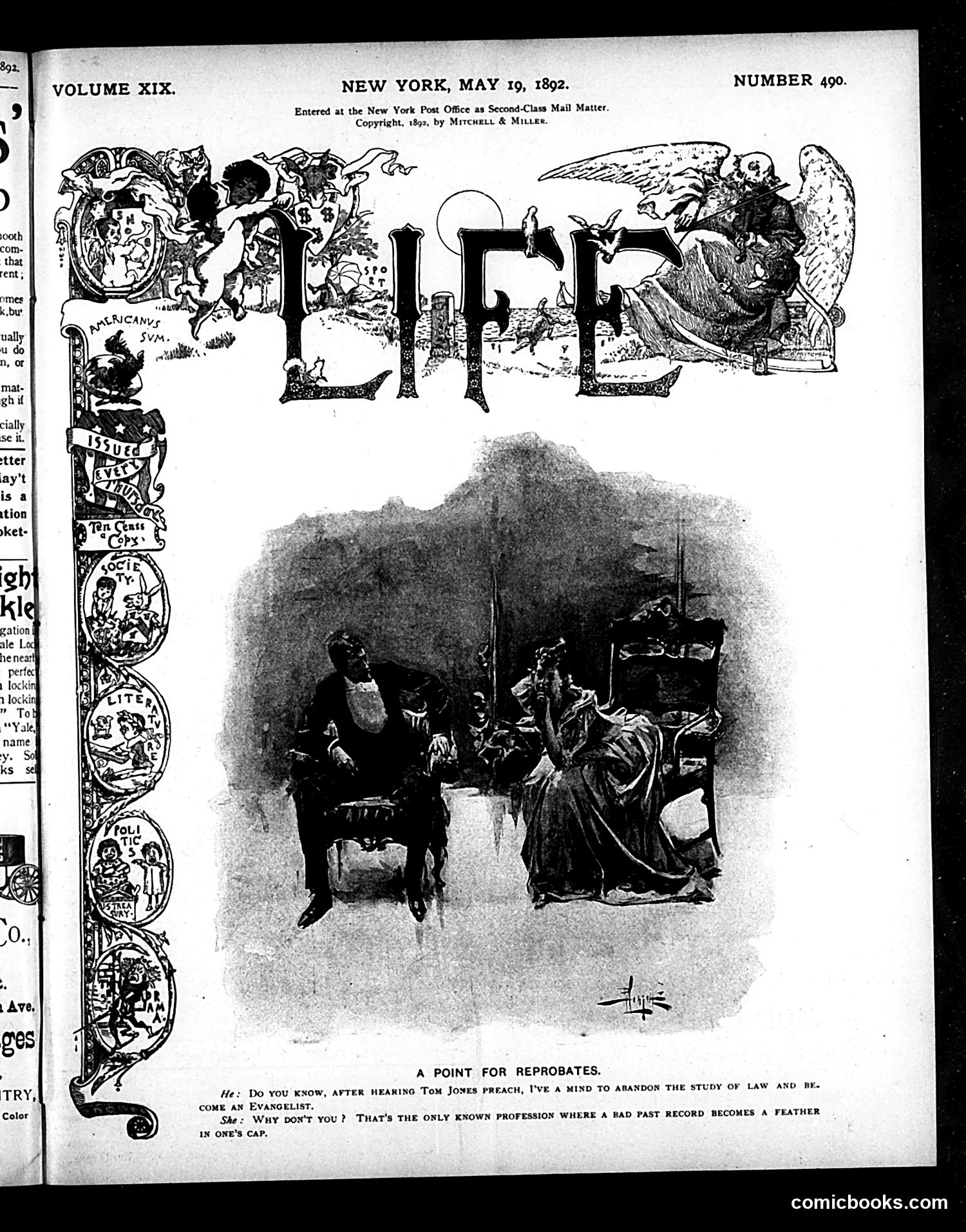
The cartoon titled "A Point for Reproaches" depicts a conversation between two men. The dialogue references Tom Jones's preaching and the study of law and religion. One character suggests that becoming an evangelist is "the only known profession where a bad past record becomes a feather in one's cap." This satirizes the apparent hypocrisy of religious revival preachers of the 1890s—specifically those whose moral or legal histories were questionable yet who could gain credibility and followers through evangelical work. The "point" is that unlike other professions requiring clean credentials, preaching offered redemption and respectability regardless of one's past, making it attractive to morally compromised individuals seeking reinvention.
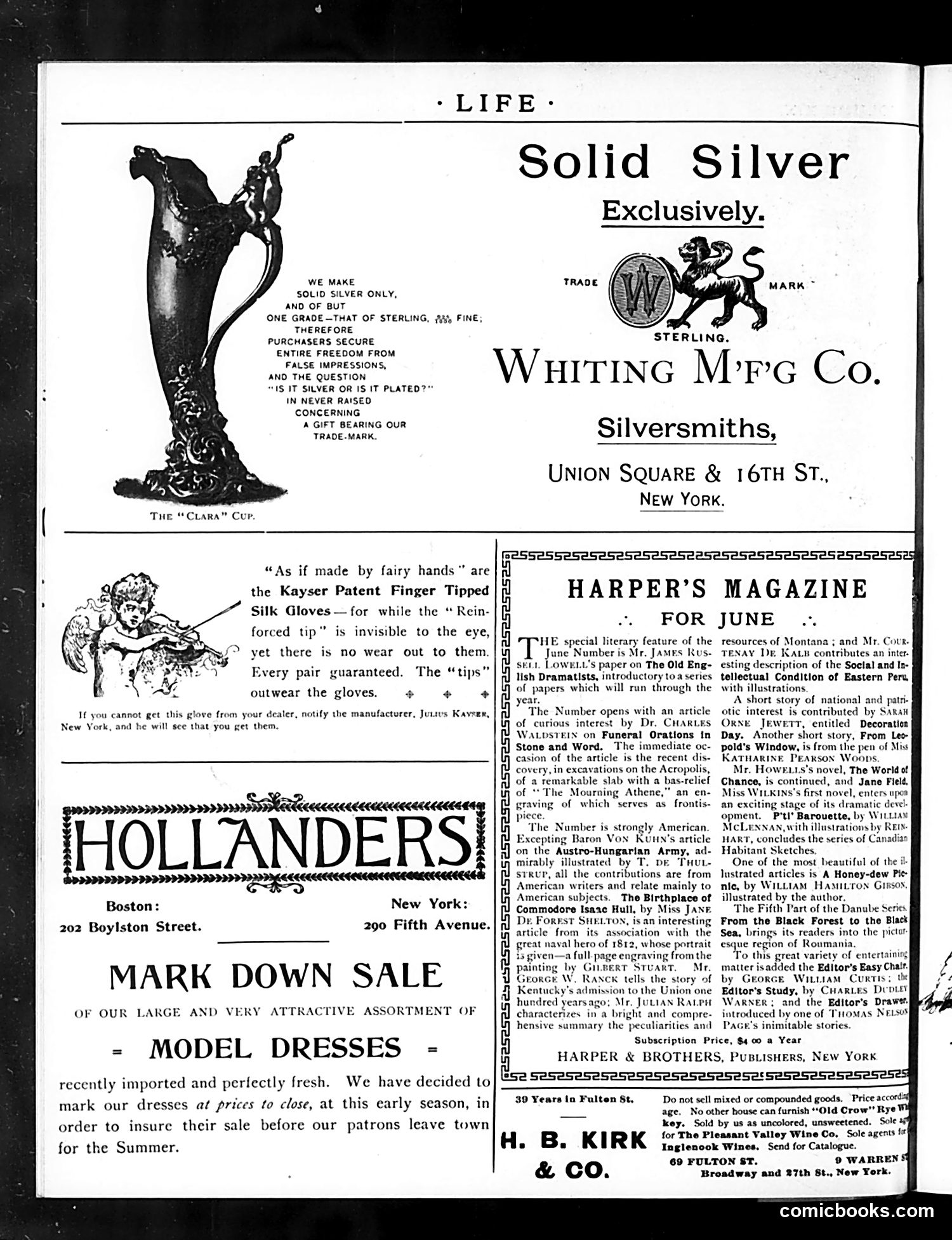
This page is primarily **advertising** rather than political satire or comics. The top half features two luxury product ads: Whiting M'fg Co. advertises solid sterling silver items (the "Clara" Cup shown), and below that, an ad for Kayser Patent Finger Tipped Silk Gloves, which boasts invisible reinforced fingertips. The lower half contains ads for Hollanders (a mark-down dress sale), H.B. Kirk & Co. (wine), and a Harper's Magazine subscription notice. There is **no political cartoon or satirical content** on this page—it's a standard magazine advertising section from an era when Life magazine carried substantial commercial content alongside editorial material. The page appears to date from early 20th century based on typography and product styles.
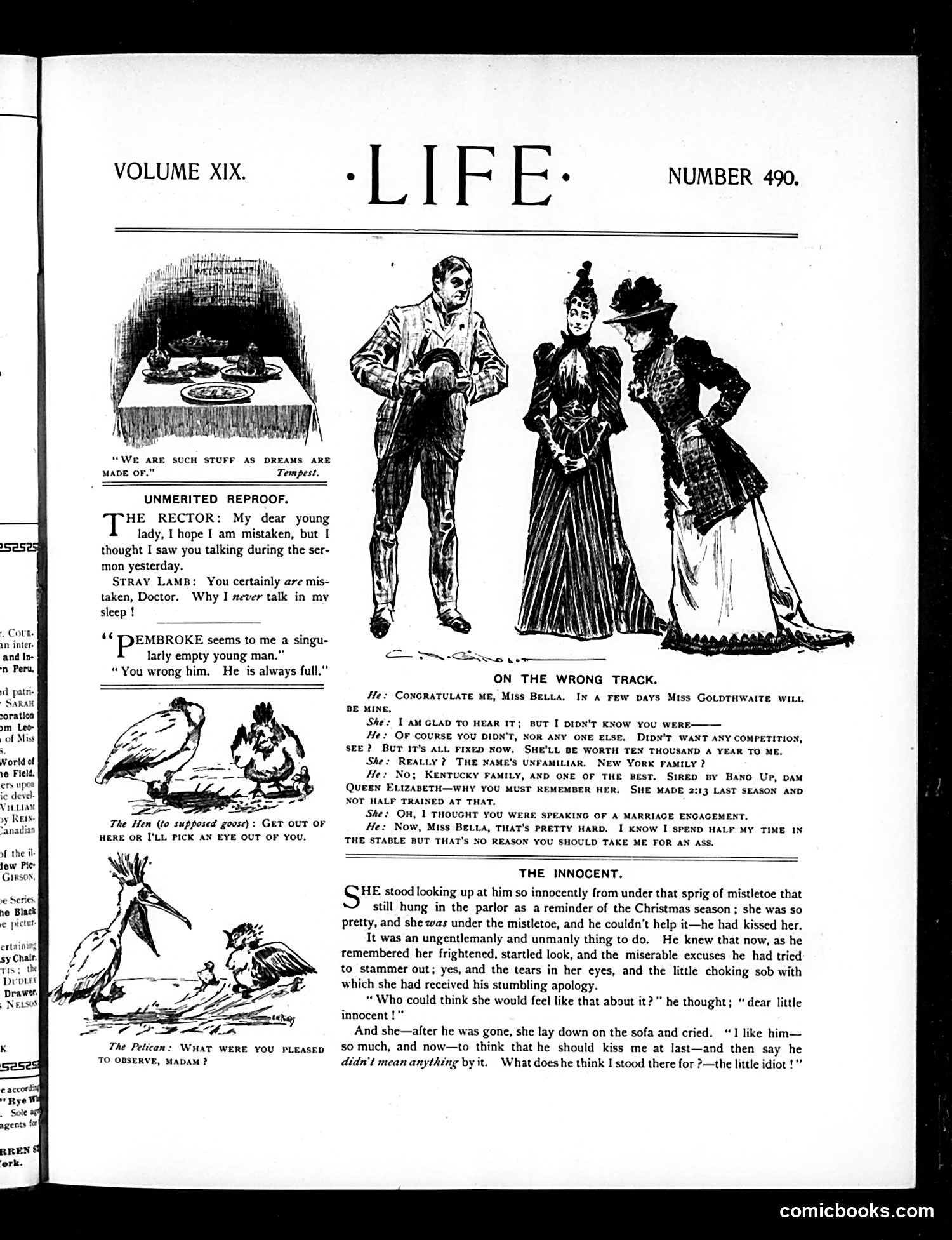
This page contains several satirical vignettes featuring romantic misunderstandings and social commentary. **"Unmerited Reproof"** depicts a rector mistakenly believing a young lady spoke during his sermon, when she actually slept through it—satirizing both clerical vanity and female passivity. **"On the Wrong Track"** shows a man congratulating another on an engagement to Miss Goldsthwaite, only to discover the wrong couple is involved. The dialogue reveals confusion about horses ("Queen Elizabeth"), highlighting how social gossip circulates inaccurately among the wealthy classes. **"The Innocent"** presents a woman resentful that a man kissed her beneath mistletoe without explicit intent, then failed to acknowledge the act afterward—mocking both overly literal interpretations of courtship customs and female expectations of male attentiveness. The animal illustrations (hen, pelican, stork) provide comedic interludes.
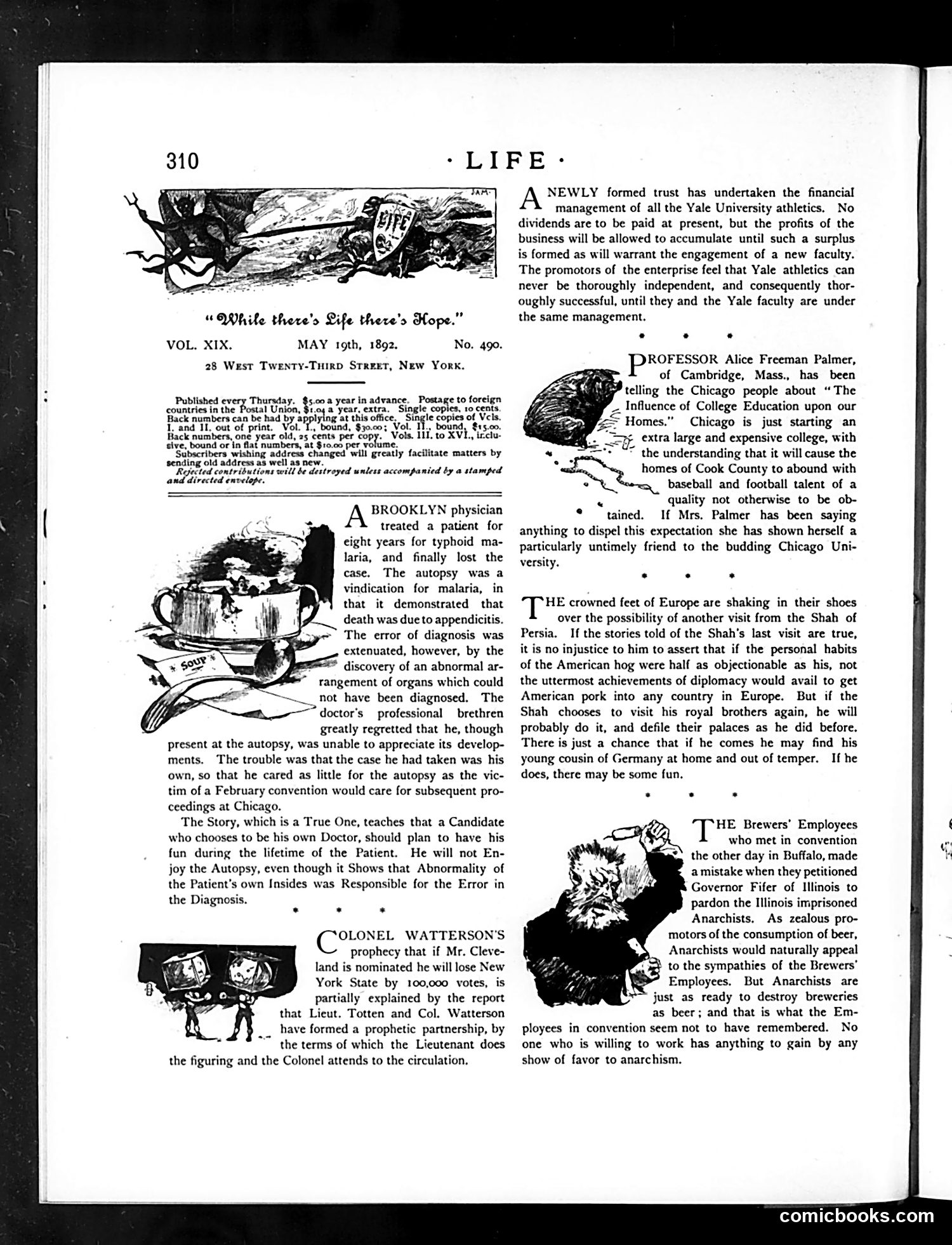
**The main cartoon** (lower left) depicts Colonel Watterson's "prophecy" that Cleveland will lose New York by 100,000 votes. The image shows two figures appearing to manipulate or control something mechanical, satirizing what the magazine presents as a backroom political prediction scheme. Colonel Watterson and Lieutenant Totten apparently formed a "prophetic partnership" where calculations determine electoral outcomes—mocking their claimed ability to predict Cleveland's defeat. **The page's other content** addresses unrelated contemporary issues: a Brooklyn physician's medical diagnosis error; Professor Palmer's educational initiatives for Chicago; Persian diplomatic visits; and brewery employees' labor grievances regarding anarchists. The satirical tone suggests skepticism toward various institutions and their proclamations.
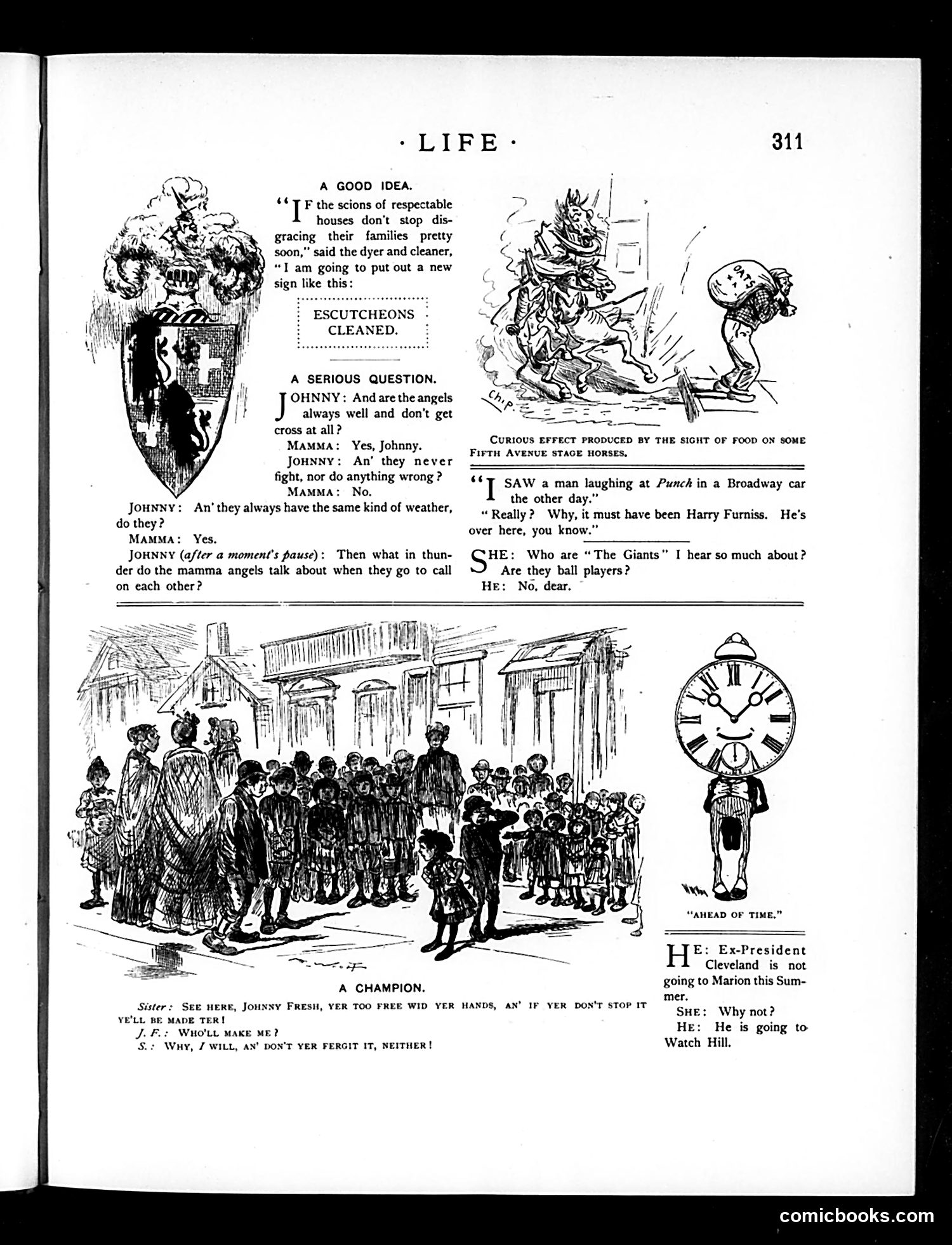
This page contains several unrelated satirical sketches typical of Life's format: 1. **"A Good Idea"**: A dyer/cleaner proposes a sign reading "Escutcheons Cleaned"—a pun playing on the word's double meaning (heraldic shields AND disgraceful family reputations). The joke suggests cleaning away family shame. 2. **"A Serious Question"**: A child's innocent dialogue with his mother about whether angels fight or do wrong, with the mother's exasperated response satirizing childhood logic. 3. **"A Champion"**: A street scene showing a child being advised to control his hands or face consequences—depicting rough urban childhood behavior. 4. Other brief comedic dialogues about theater ("The Giants"), food's effects on stage horses, and Cleveland's summer plans. These represent typical early-20th-century American humor—social commentary through wordplay and domestic situations.
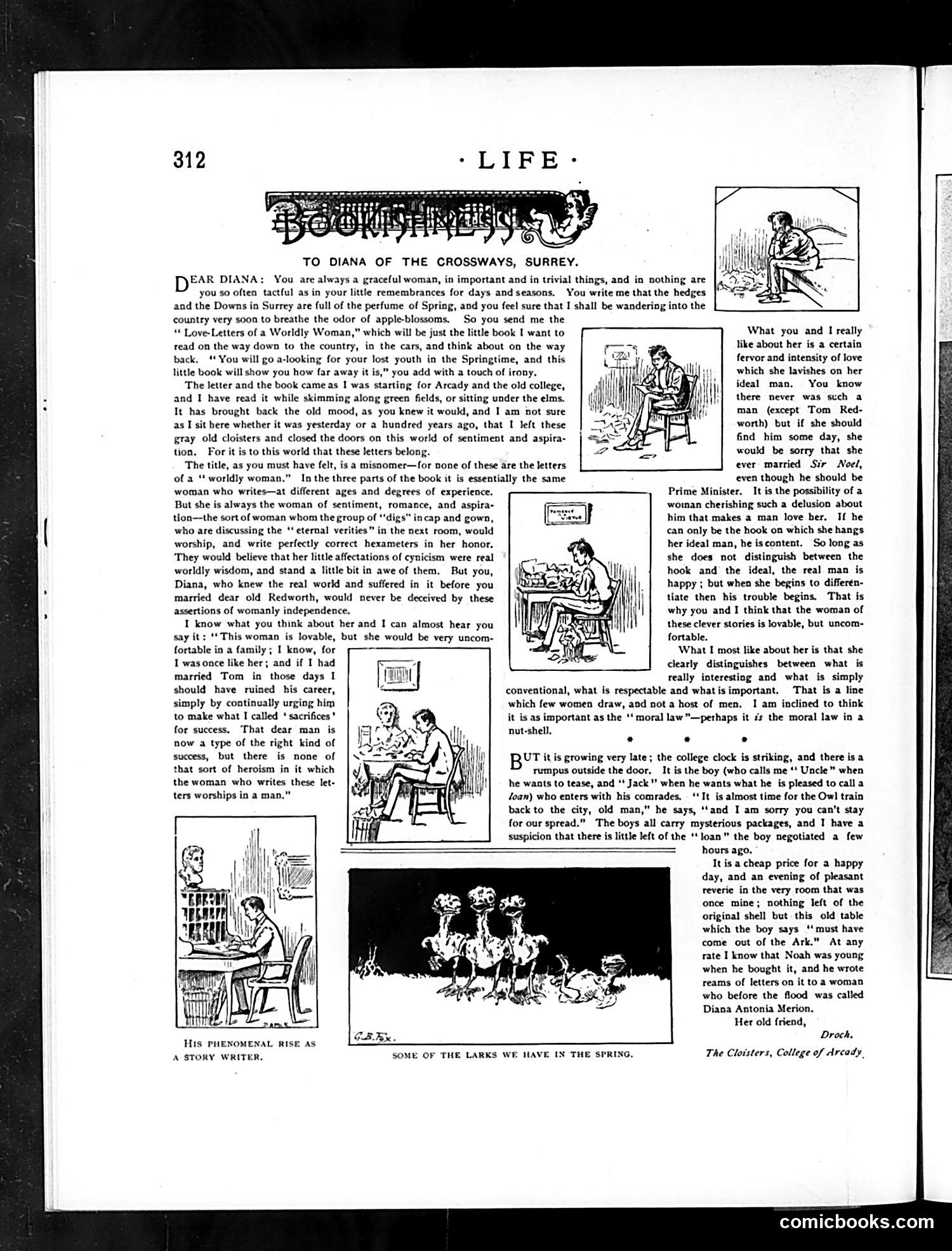
This page consists primarily of a letter to "Diana of the Crossways, Surrey," discussing women's writing and relationships. The accompanying illustrations depict domestic scenes: a woman writing, a man reading, couples in conversation, and what appears to be a story-writer at work (captioned "His phenomenal rise as a story writer"). The satirical focus concerns gender roles and literary merit. The text critiques how women writers are perceived—suggesting society judges them by different standards than male authors. It argues women should be recognized for intellectual substance rather than sentimentality, distinguishing between "conventional" respectability and genuine importance. The illustration captioned "Some of the larks we have in the spring" (showing figures with dogs) appears unrelated thematically but maintains the period's leisured-class perspective.
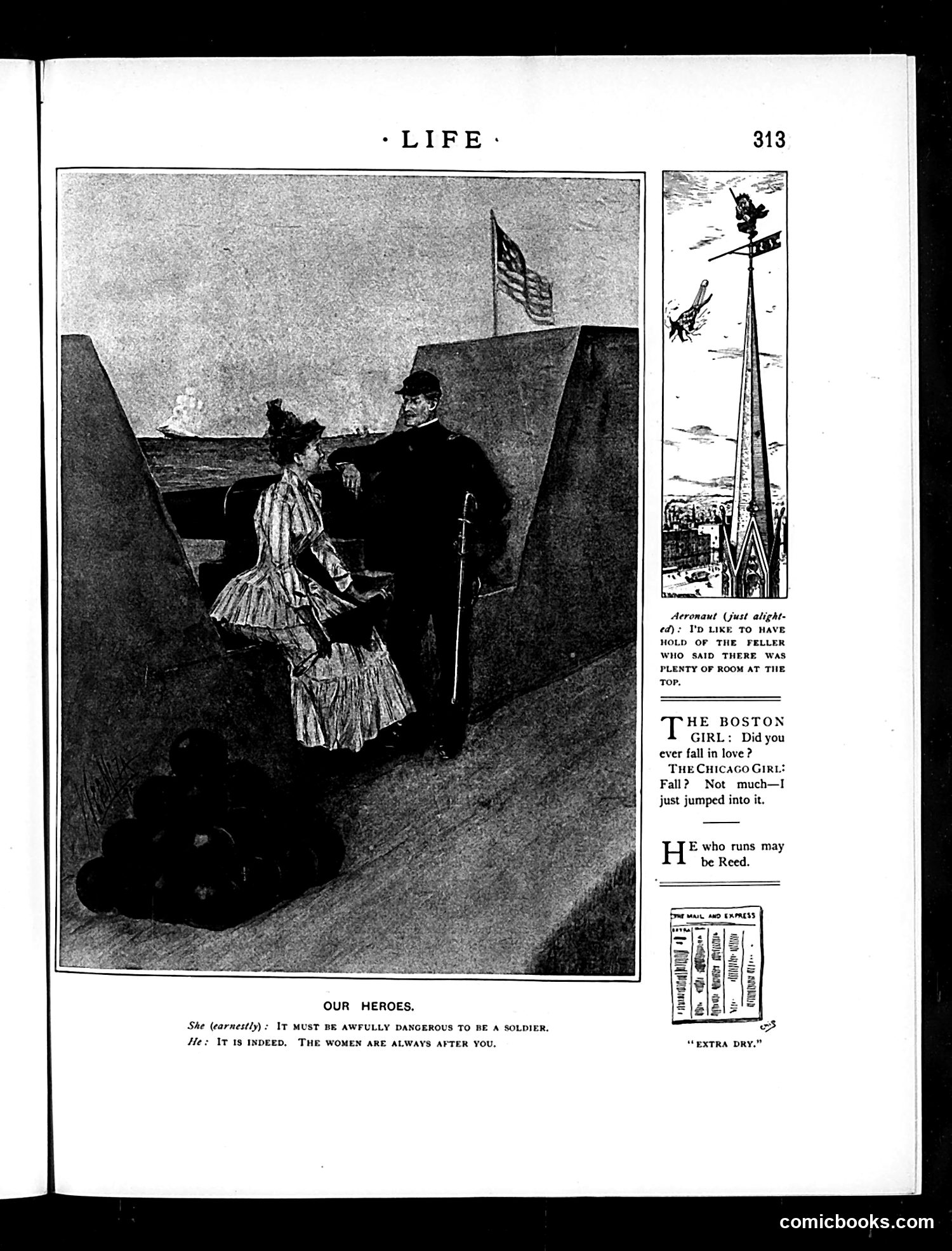
**Main Cartoon ("Our Heroes"):** A soldier and woman stand on a ship's deck beneath an American flag. The caption reads: "She (earnestly): It must be awfully dangerous to be a soldier. He: It is indeed. The women are always after you." This is a flirtation joke playing on the double meaning of "dangerous"—the woman assumes soldiers face combat risk, but the soldier reframes the danger as romantic pursuit by women. It's a lighthearted commentary on wartime social dynamics, suggesting women pursue soldiers, making romance (not war) the real "danger" soldiers face. **Secondary Content:** Other brief exchanges about falling in love and a section titled "He who runs may be Reed" (likely a topical reference, though unclear without more context). An advertisement for "Extra Dry" beverages appears at bottom right.
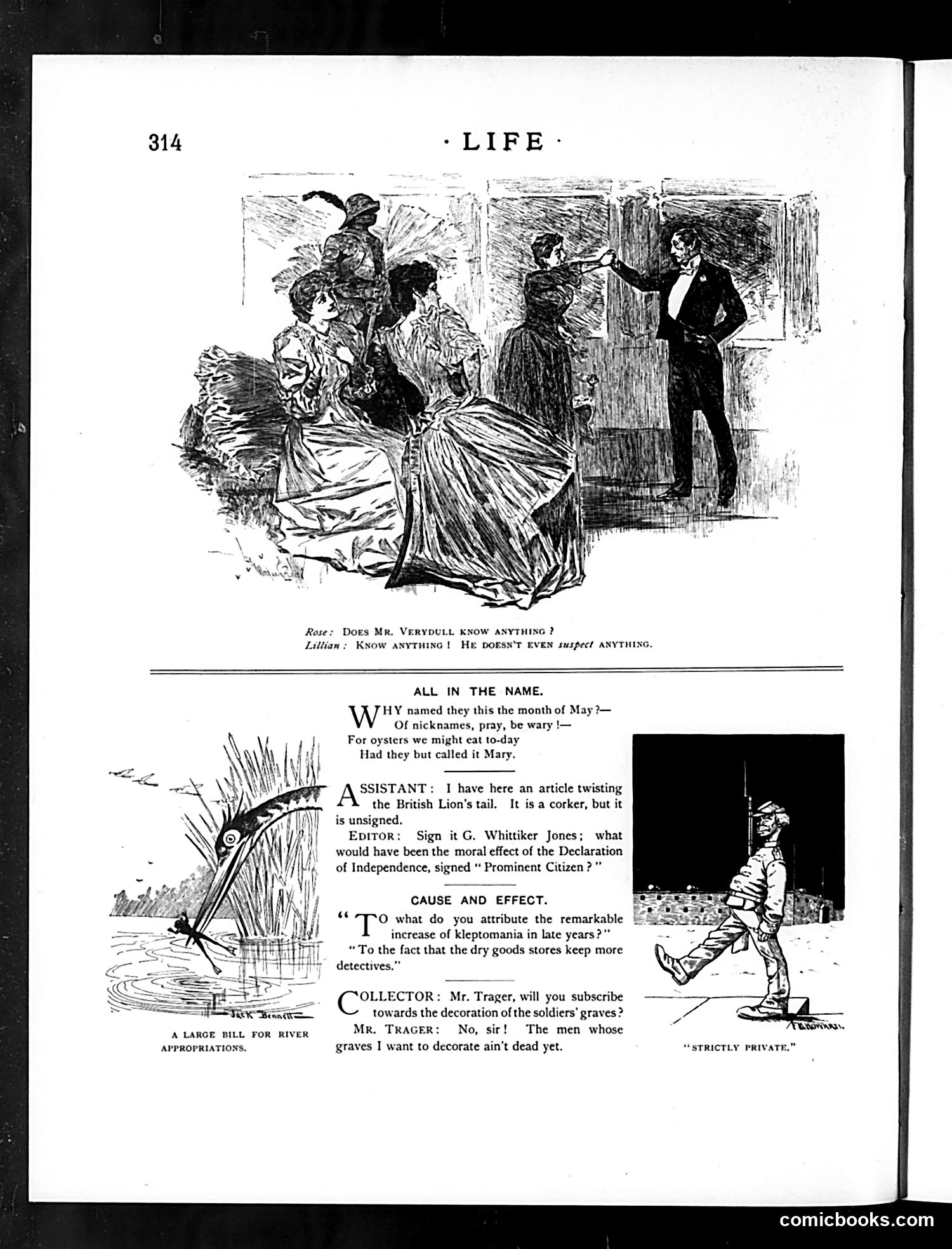
**Top Illustration**: A social scene showing well-dressed people at what appears to be a formal gathering. The dialogue suggests someone named "Mr. Vervuell" is ignorant or uninformed—a common satirical trope mocking pretentious society figures. **"All in the Name"**: A humorous poem questioning why May was named after oysters rather than being called "Mary," playing on wordplay and seasonal associations. **"A Large Bill for River Appropriations"**: A sketch of a large-billed bird (crane or heron) in water—likely political satire about government spending on river infrastructure projects, comparing wasteful appropriations to the bird's oversized bill. **"Cause and Effect"**: A dialogue mocking bureaucratic reasoning about dry goods storage and kleptomania. **"Strictly Private"**: An illustration of a soldier, likely referencing military recruitment or conduct. The page blends social satire with political commentary typical of early 20th-century Life magazine humor.
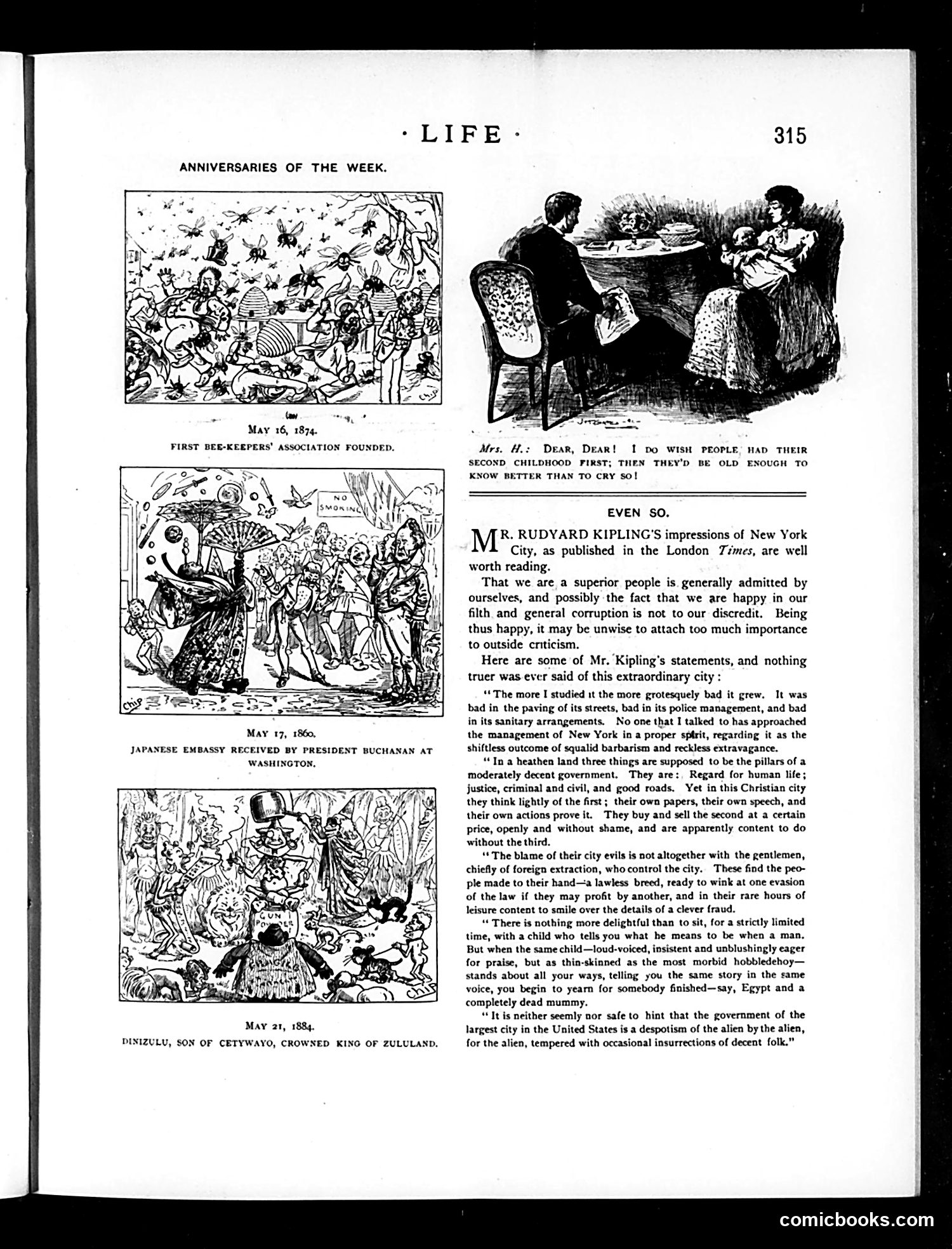
This page features **Rudyard Kipling's critique of New York City**, published in the London *Times*. The accompanying illustration shows a domestic scene where a woman tells a man, "I do wish people had their second childhood first; then they'd be old enough to know better than to cry so!" Kipling's lengthy text attacks New York's governance and corruption, particularly targeting what he calls the city's moral decay. He criticizes municipal mismanagement, police inefficiency, poor sanitation, and street conditions. Kipling sardonically contrasts New York's claims to superiority with its actual dysfunction, suggesting the city's government represents "a despotism of the alien by the alien." The satirical point: American self-regard versus observable reality.
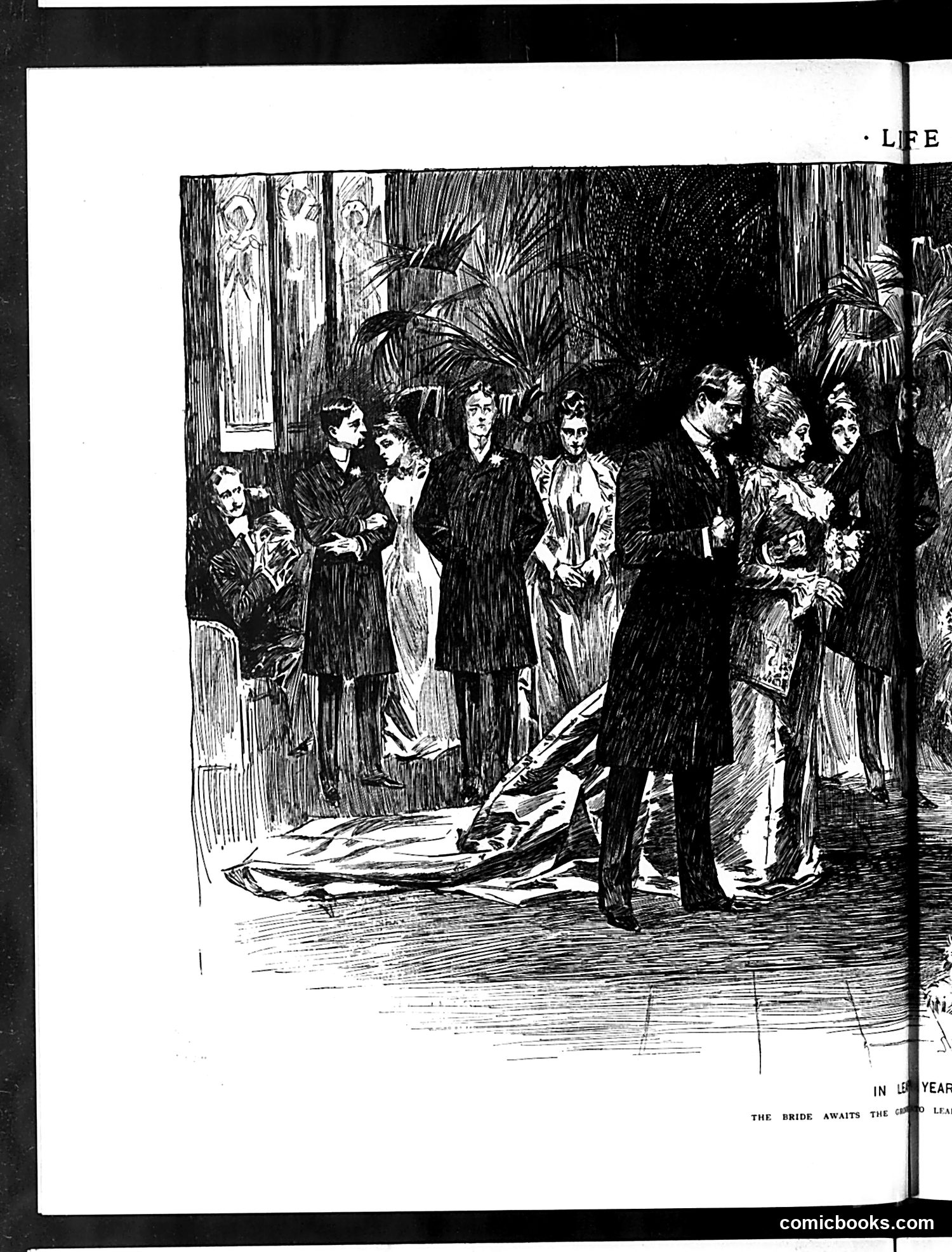
This appears to be an illustration from *Life* magazine captioned "THE BRIDE AWAITS THE GROOM'S ARRIVAL" (visible at bottom). The sketch depicts a Victorian-era indoor scene with numerous formally dressed figures gathered in what seems to be a parlor or drawing room, with potted palms visible in the background. The central focus is a woman in a light-colored dress (the bride) surrounded by other figures in dark formal attire. A man in the foreground appears to be the groom or a central male figure. The illustration's satirical point likely concerns wedding etiquette, social expectations, or marital customs of the era—possibly poking fun at elaborate wedding ceremonies or the anxieties surrounding matrimonial occasions. Without additional context from the article text, the specific social critique remains unclear.
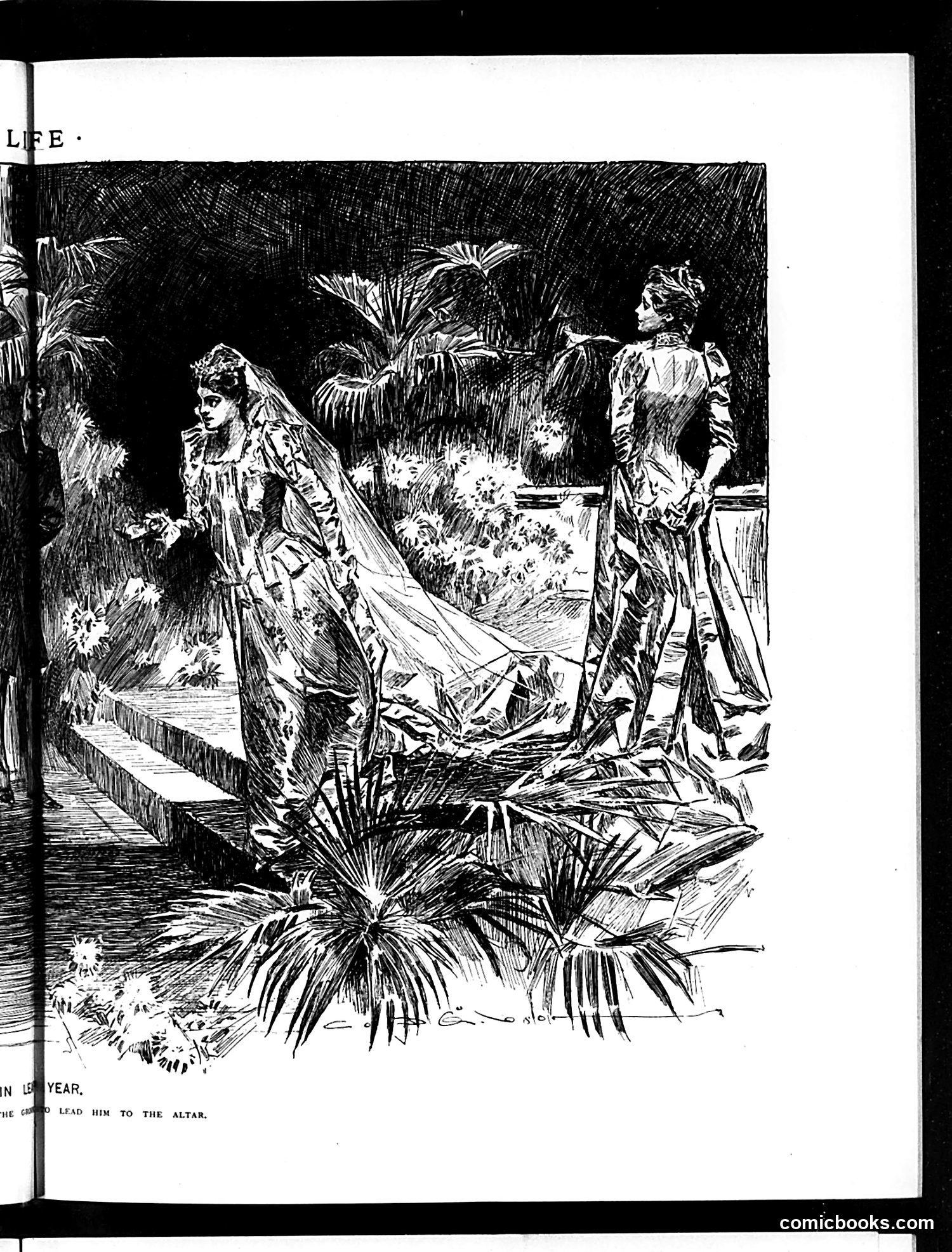
This page from *Life* magazine shows an illustration of what appears to be a formal social scene, likely a wedding or ceremonial event. The image depicts elegantly dressed figures in late 19th or early 20th-century attire in an ornate interior with tropical plants and draped fabrics. The partial OCR text mentions "LEAD HIM TO THE ALTAR," suggesting this cartoon satirizes marriage or courtship customs. Without the complete caption or publication date visible, the specific satirical target remains unclear. The formal dress and elaborate setting suggest commentary on high-society rituals or wedding conventions of the era. The exact political or social critique cannot be definitively determined from the visible text alone.
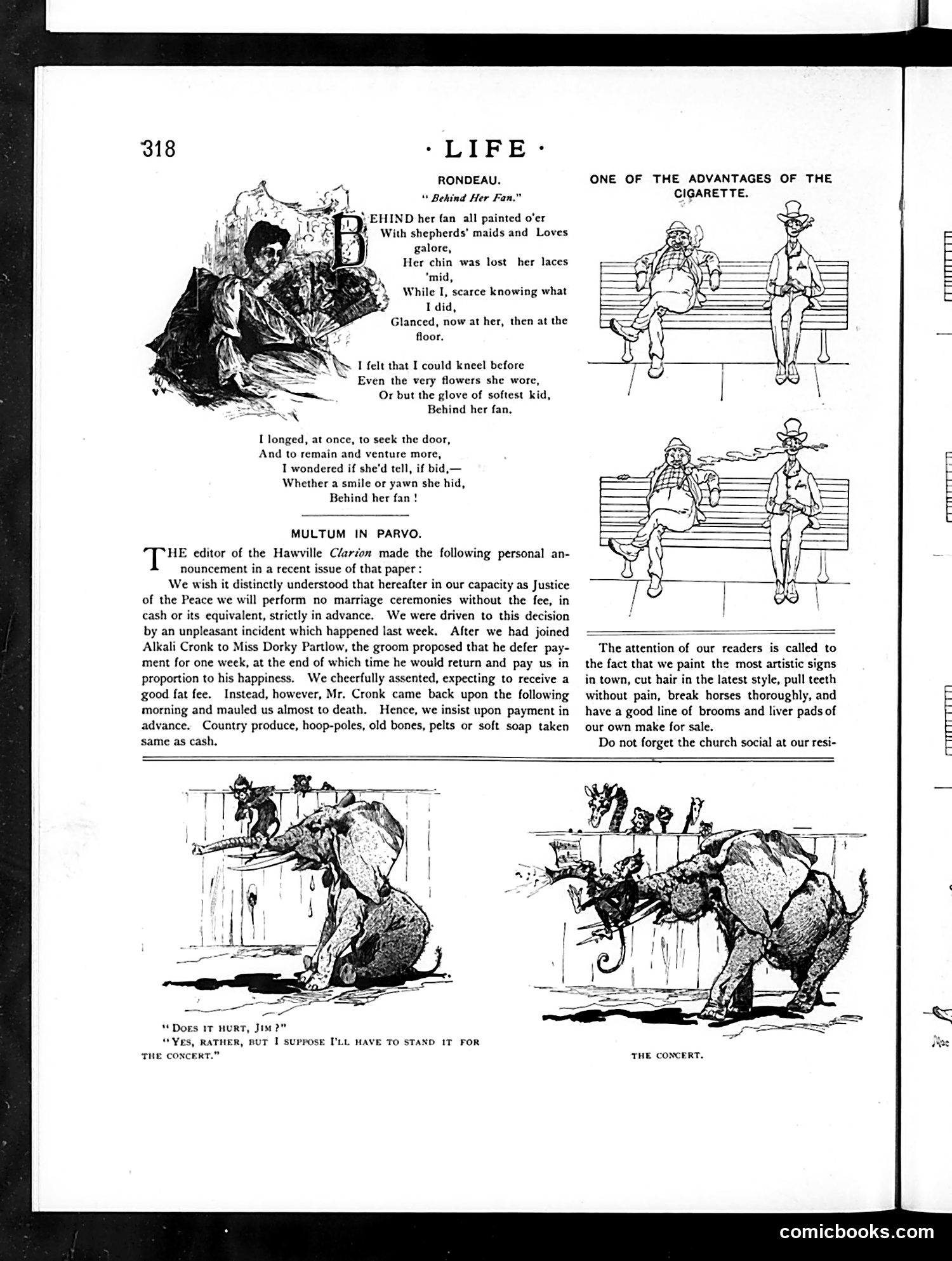
This page contains several satirical pieces typical of early American humor magazines: **"Rondeau: Behind Her Fan"** — A romantic poem mocking Victorian courtship conventions, where a suitor is reduced to yearning glimpses of a woman concealed behind a decorative fan. **"Multum in Parvo"** — A small-town newspaper satire reporting that a justice of the peace now demands payment *before* performing marriages. The joke: a groom named "Alkali Cronk" married "Dorky Partlow" beat the justice nearly to death when asked to pay later, claiming future happiness wouldn't justify the fee—a darkly comic commentary on rural rough justice and questionable marriages. **"One of the Advantages of the Cigarette"** — Two cartoon panels showing men smoking on a bench while avoiding conversation; the "advantage" is apparently that cigarettes excuse social awkwardness. A subtle social commentary. **"The Concert"** — An elephant cartoon showing it suffers physical pain standing upright for entertainment—depicting animals as unwilling performers in circuses, with the dialogue implying resignation to mistreatment. The page reflects turn-of-century American satirical humor targeting rural life, courtship customs, and animal exploitation.
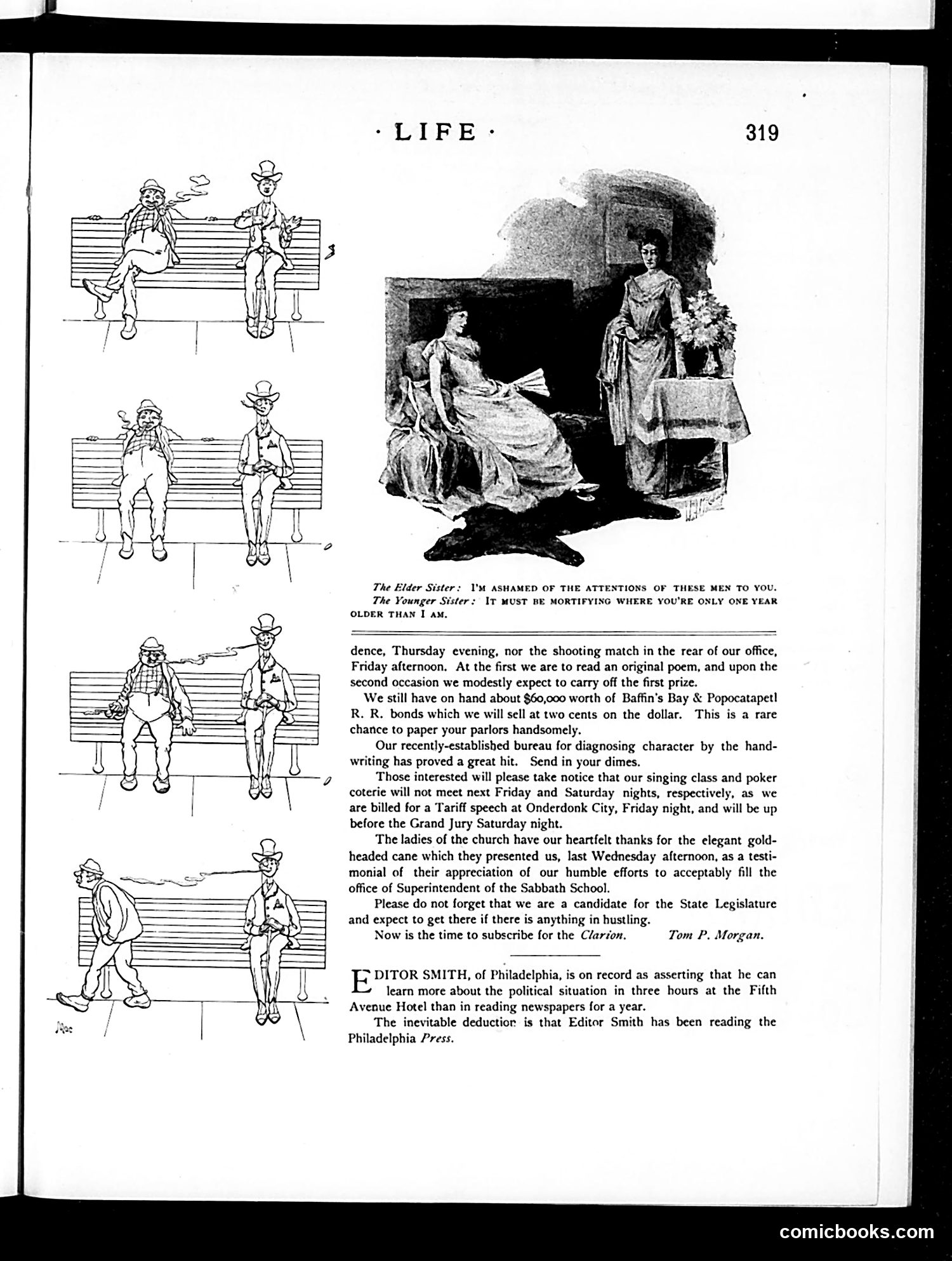
This page contains two satirical pieces typical of Life magazine's humor: **The Illustrated Cartoon (top right):** Shows two sisters discussing male attention, with the younger sister's pointed remark that being only one year older shouldn't make such a difference in romantic interest. This is gentle social satire about vanity and the arbitrary nature of age-based status among women. **The Text Section:** A humorous column from "Tom P. Morgan" satirizes small-town life and local institutions through exaggerated announcements—including worthless railroad bonds "at two cents on the dollar," a character-reading handwriting service, and dubious activities (poker, tariff speeches, Grand Jury appearances). The final paragraph mocks Editor Smith of Philadelphia's reliance on Fifth Avenue Hotel gossip over actual newspapers, with a veiled insult toward the *Philadelphia Press*. The satire targets fraud, small-town pomposity, and journalistic unreliability—typical targets for Life's satirical commentary on American life.
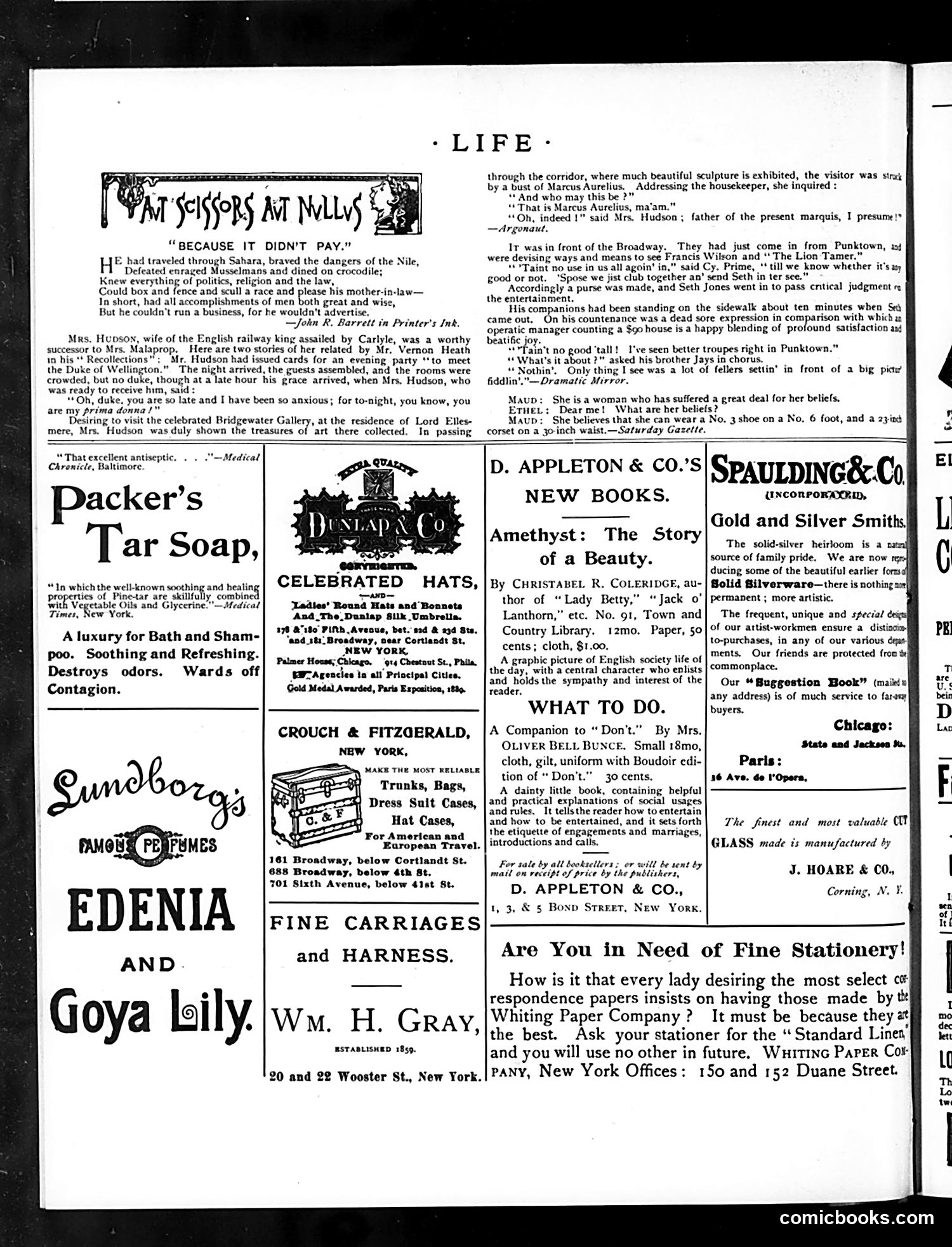
This page from *Life* magazine features satirical content mixed with period advertisements. The main cartoon stories illustrate the era's social humor: **"At Scissors at Wills"** mocks a man who failed in business despite vast accomplishments—the joke being that he wouldn't advertise, making him a cautionary tale for the magazine's business-minded readers. **The Mrs. Hudson anecdotes** satirize a wealthy English railroad magnate's wife as comically ignorant of classical culture. She mistakes Marcus Aurelius for a contemporary aristocrat's father, providing genteel humor about the nouveaux riches. **The Broadway anecdote** jokes about working-class men pooling money to scout a theater production, with their representative returning underwhelmed by what appears to be an orchestra section, mocking both theater-going aspirations and provincial attitudes. **The "Maud" joke** satirizes women's extreme corsetry and shoe-fitting practices, a common target of period satire. The advertisements (soaps, hats, perfumes, carriages) reflect upper and middle-class consumer culture of the era.
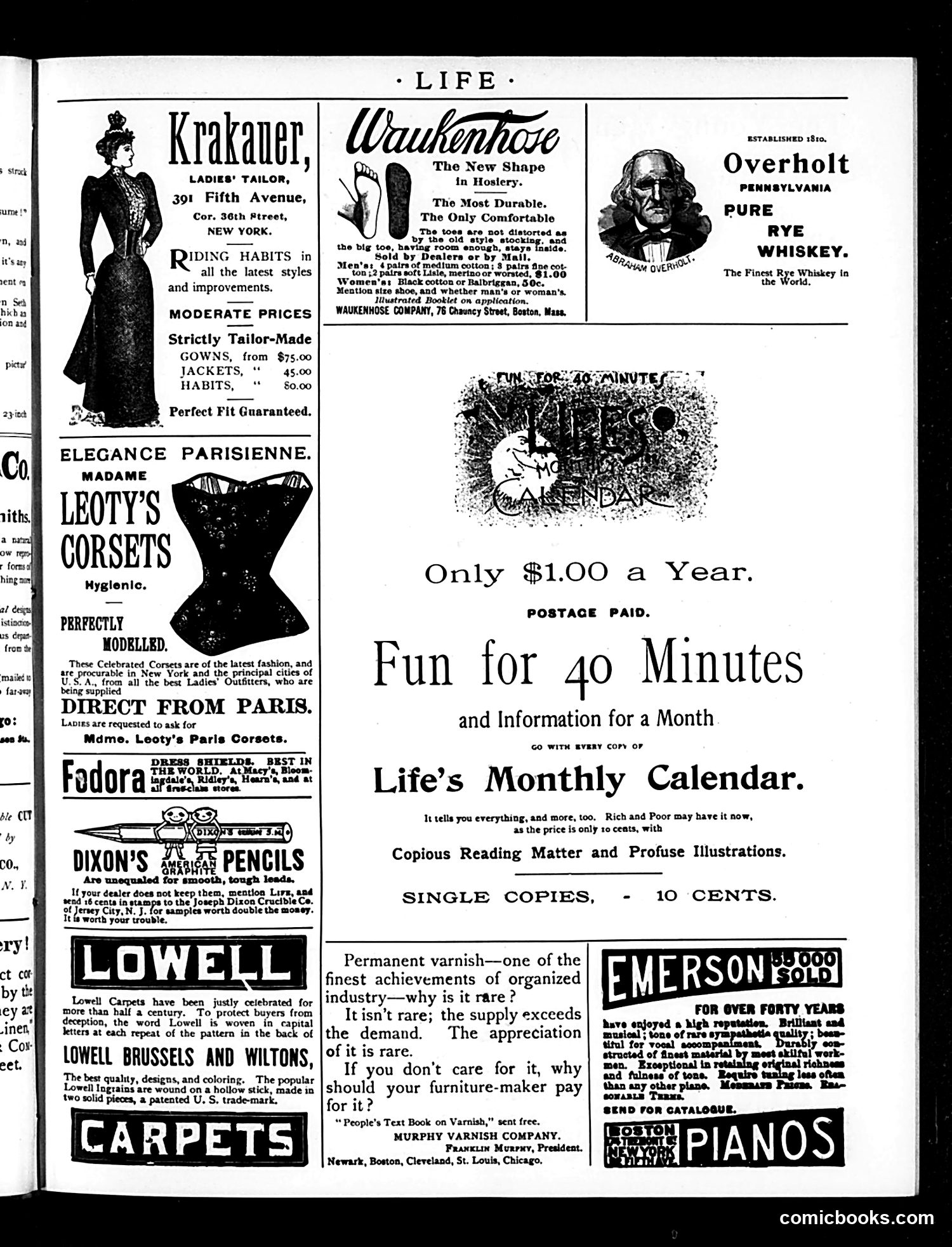
This is primarily an **advertising page** from Life magazine, circa early 1900s, with minimal editorial content. The page contains no political cartoons or satire—instead it features period advertisements for consumer goods and services. The ads reflect Gilded Age consumer culture: tailored women's riding habits and gowns ($45-75), French corsets marketed as "hygienic," whiskey, carpets, pianos, and pencils. Notable is the **Overholt Whiskey ad** featuring what appears to be a historical figure (possibly Andrew Overholt, the distillery's founder), suggesting brand heritage as a selling point. The central promotion advertises **Life's Monthly Calendar** at $1.00/year—a publication offering "fun for 40 minutes and information for a month" with "copious reading matter and profuse illustrations" at 10 cents per copy. The page documents consumer aspirations and marketing strategies of the era, showing how products were sold to middle and upper-class readers through appeals to fashion, refinement, and prestige.
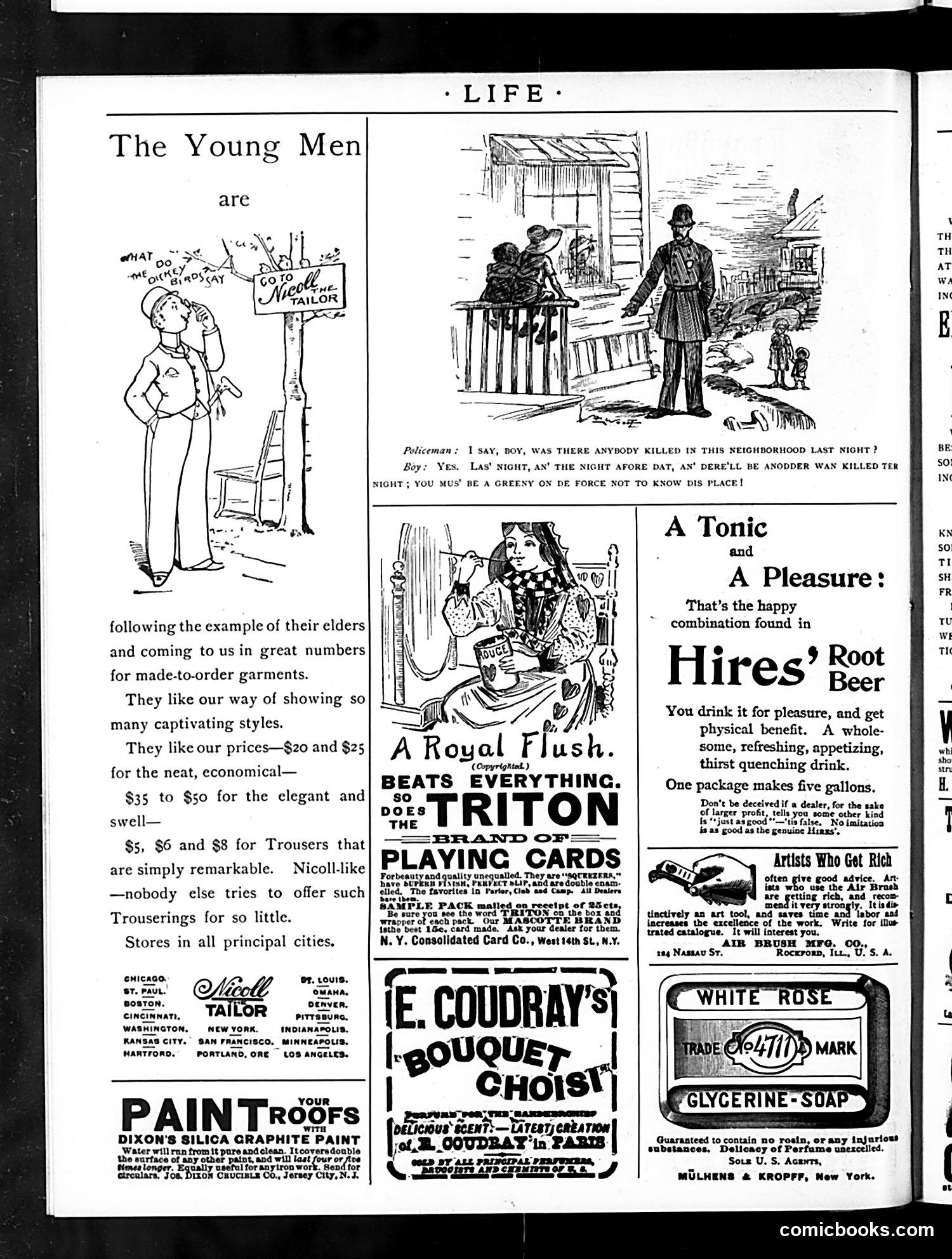
This page is primarily **advertising with one social-commentary cartoon**. The main illustrated content shows a policeman questioning a young boy about neighborhood violence. The boy responds with dark humor, claiming murders happen nightly in his neighborhood and that any cop wouldn't know about it—implying this is routine, expected crime in (likely) a poor, urban immigrant area. The satire critiques **urban crime and police indifference** in early 20th-century American cities. The boy's vernacular speech patterns suggest he's from a working-class immigrant community, a common Life magazine stereotype of the era. The remainder of the page consists of period advertisements: Nicoll Tailor (made-to-order clothing), Dixon's paint, Triton playing cards, Hires' Root Beer, E. Coudray's Bouquet Hoist perfume, and White Rose Glycerine Soap—typical consumer products marketed to middle-class readers.
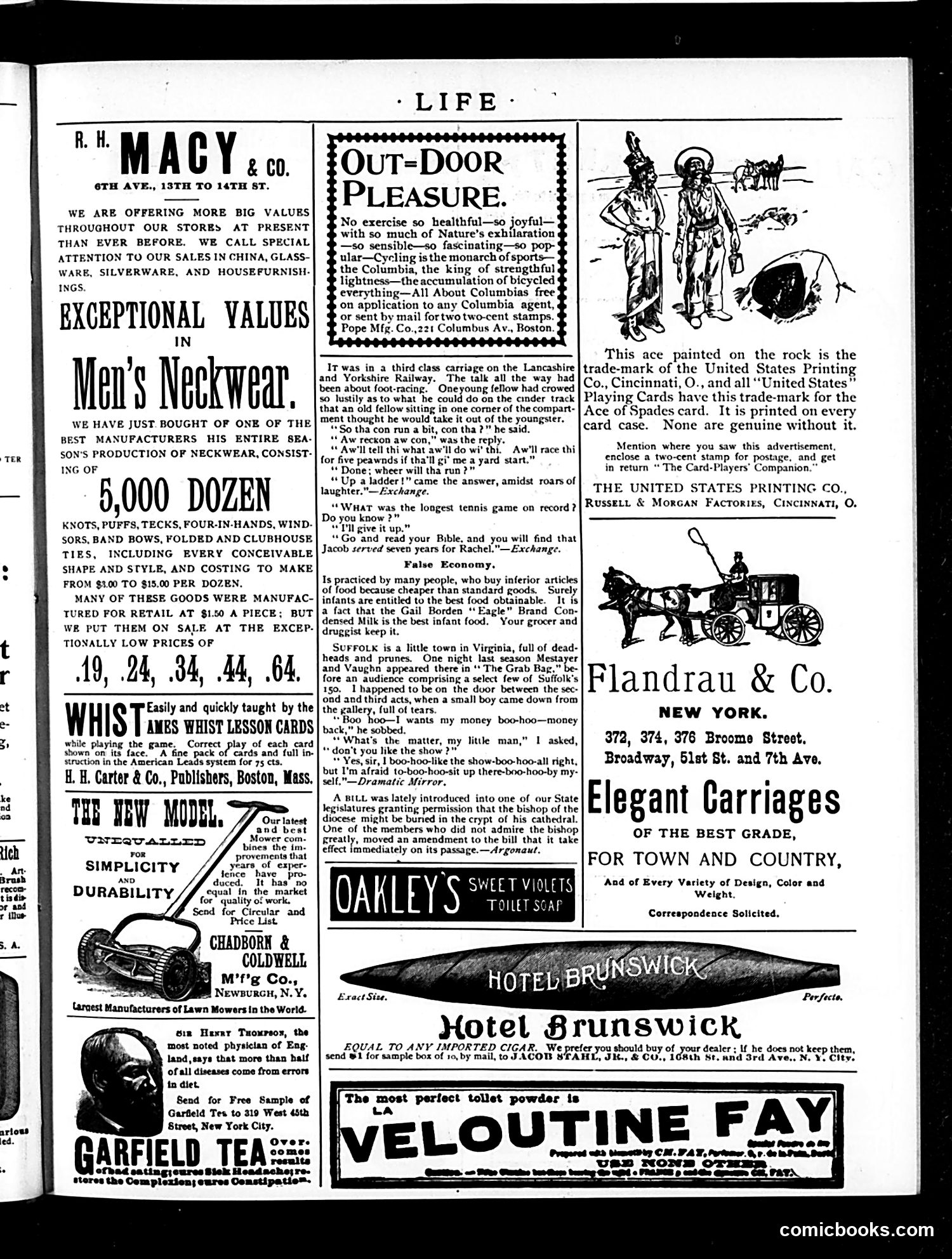
This is primarily an **advertising page** from Life magazine, not a political cartoon. The page consists almost entirely of commercial advertisements for various products and services popular in the early 1900s: Macy's neckwear sale, lawn mowers, tea, whist card lessons, and carriages. Interspersed are short **humorous anecdotes**—brief jokes typical of the era's humor magazines. These include: a railway conversation where a young runner is challenged to race "up a ladder" (a play on Jacob serving seven years in the Bible), and a story about a boy upset at a theater performance, afraid to sit up during acts. The only notable illustration is a small drawing of cyclists promoting Columbia bicycles as healthy outdoor recreation. The page reflects **turn-of-the-century consumer culture** and period entertainment tastes rather than political satire. It shows what products were marketed and what jokes were considered amusing to readers of that era.
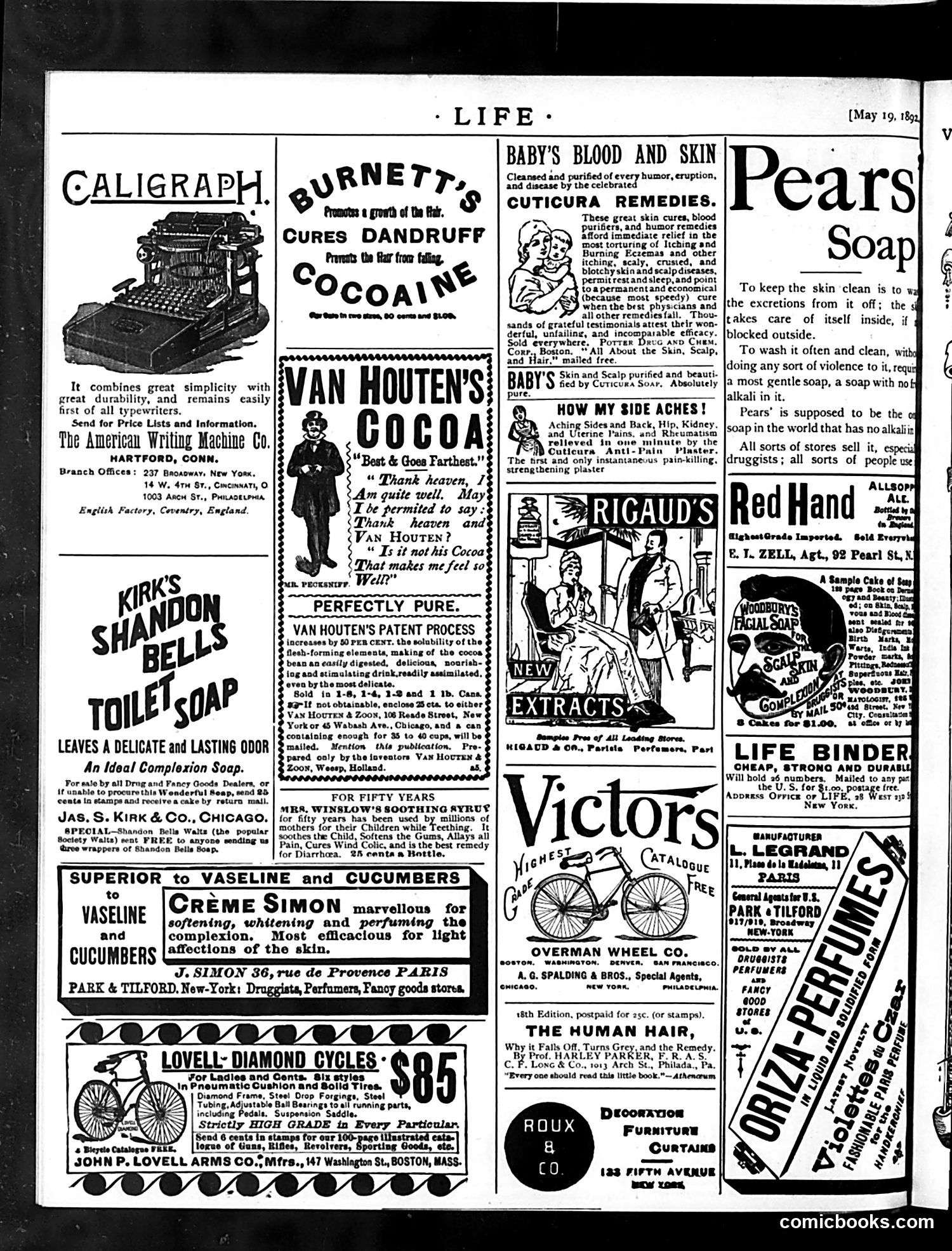
This page is primarily **advertising**, not political satire. It features Victorian-era patent medicines and consumer products typical of the 1890s. Notable content includes: **Health Products:** Advertisements for dubious remedies like Mrs. Winslow's Soothing Syrup (a teething aid), Cuticura treatments (skin conditions), and Van Houten's Cocoa marketed as digestive aid. These products relied on unregulated health claims common before FDA regulation. **Consumer Goods:** Typewriters, bicycles, and soaps dominate—reflecting the era's industrial optimism and emerging consumer culture. **Visual Style:** The page uses repetitive testimonial formats ("Thank heaven...") and pseudo-scientific language to sell products. Illustrations show middle-class domestic scenes. **Historical Context:** The ads reflect genuine 1890s concerns (teething, skin ailments, dandruff) and the period's belief in patent medicines as cure-alls. Modern readers should note these products were largely ineffective and sometimes harmful, yet considered respectable merchandise. This represents commercial advertising's early professionalization, not satirical commentary.