
Life, 1892-05-19 · page 6 of 18
Life — May 19, 1892 — page 6: what you’re looking at
What you’re looking at
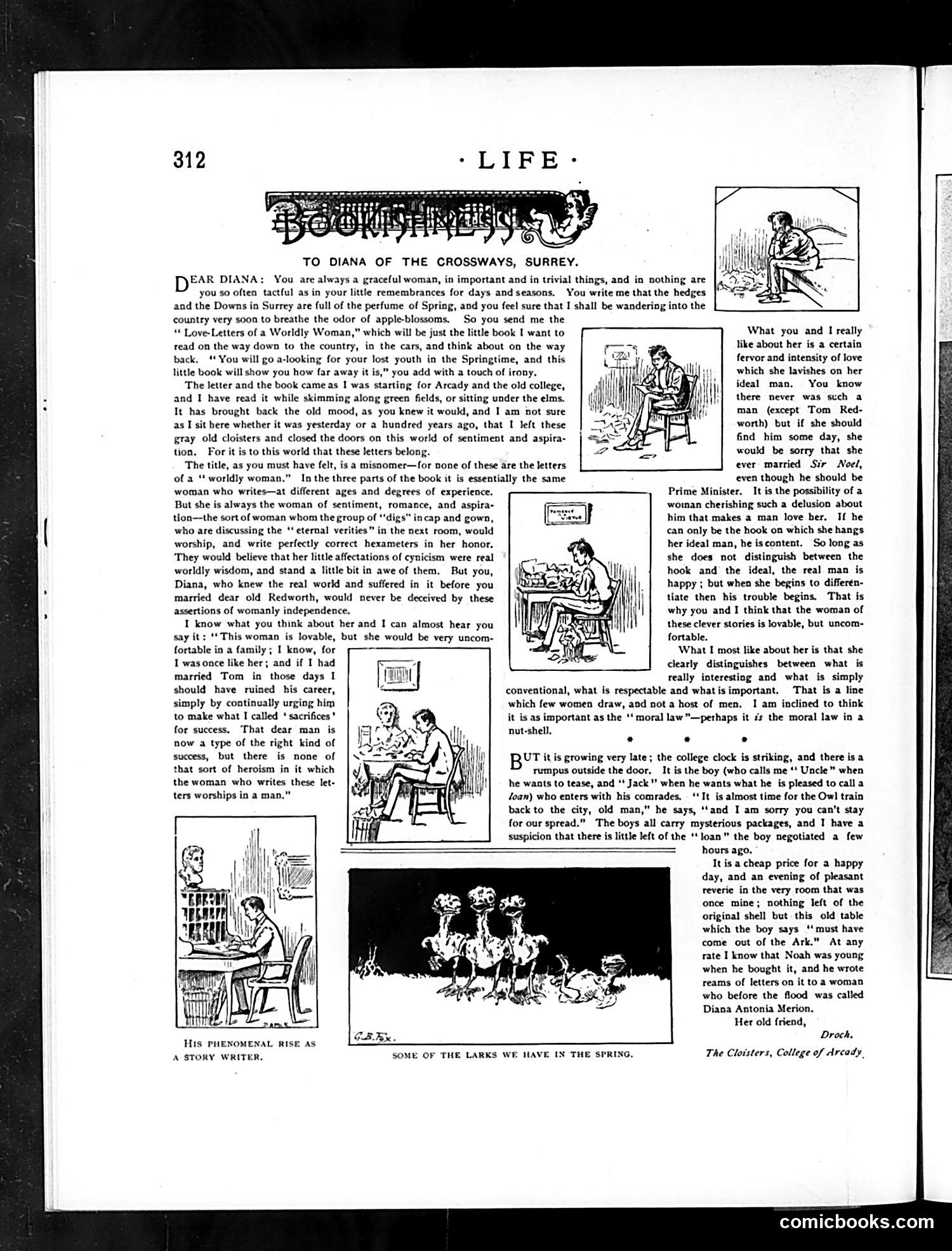
This page consists primarily of a letter to "Diana of the Crossways, Surrey," discussing women's writing and relationships. The accompanying illustrations depict domestic scenes: a woman writing, a man reading, couples in conversation, and what appears to be a story-writer at work (captioned "His phenomenal rise as a story writer"). The satirical focus concerns gender roles and literary merit. The text critiques how women writers are perceived—suggesting society judges them by different standards than male authors. It argues women should be recognized for intellectual substance rather than sentimentality, distinguishing between "conventional" respectability and genuine importance. The illustration captioned "Some of the larks we have in the spring" (showing figures with dogs) appears unrelated thematically but maintains the period's leisured-class perspective.
📄 Transcribed text from this page (OCR, searchable)
Machine-transcribed from the original scan — historical spelling and the odd misread are preserved.
TO DIANA OF THE CROSSWAYS, SURREY. DEAR DIANA: You are always a graceful woman, in important and in trivial things, and in nothing are you so often tactful as in your little remembrances for days and seasons. You write me that the hedges and the Downs in Surrey are full of the perfume of Spring, and you feel sure that I shall be wandering into the country very soon to breathe the odor of apple-blossoms. So you send me the “ Love-Letters of a Worldly Woman,” which will be just the little book I want to What you and I really read on the way down to the country, in the cars, and think about on the way ——. ’ like about her is a certain back. ‘You will go a-looking for your lost youth in the Springtime, and this F , fervor and intensity of love little book will show you how far away it is,” you add with a touch of irony. ul N which she lavishes on her The letter and the book came as I was starting for Arcady and the old college, F us ideal man. You know and I have read it while skimming along green fields, or sitting under the elms. 7 |] there never was such a It has brought back the old mood, as you knew it would, and Iam not sure | Ly) (ap soee man (except Tom Red- as I sit here whether it was yesterday or a hundred years ago, that I left these 4 worth) but if she should gray old cloisters and closed the doors on this world of sentiment and aspira- | 2°" find him some day, she tion. For it is to this world that these letters belong. would be sorry that she The title, as you must have felt, is a misnomer—for none of these are the letters ever married Sir Noel, of a “worldly woman.” In the three parts of the book it is essentially the same even though he should be woman who writes—at different ages and degrees of experience. Prime Minister. It is the possibility of a But she is always the woman of sentiment, romance, and aspira- woman cherishing such a delusion about tion—the sort of woman whom the group of “digs” incap and gown, him that makes a man love her. If he who are discussing the ‘eternal verities” in the next room, would can only be the hook on which she hangs worship, and write perfectly correct hexameters in her honor, her ideal man, he iscontent. So long as ‘They would believe that her little affectations of cynicism were real she does not distinguish between the worldly wisdom, and stand a little bit in awe of them, But you, hook and the ideal, the real man is Diana, who knew the real world and suffered in it before you happy ; but when she begins to differen- married dear old Redworth, would never be deceived by these tiate then his trouble begins. That is assertions of womanly independence. why you and I think that the woman of I know what you think about her and I can almost hear you these clever stories is lovable, but uncom- say it: This woman is lovable, but she would be very uncom- . i fortable. fortable in a family; I know, for I was once like her; and if I had married Tom in those days I should have ruined his career, simply by continually urging him to make what I called ‘ sacrifices for success, That dear man is now a type of the right kind of success, but there is none of that sort of heroism in it which the woman who writes these let- ters worships in a man.” ‘What I most like about her is that she clearly distinguishes between what is really interesting and what is simply conventional, what is respectable and what is important. That is a line which few women draw, aod not a host of men. I am inclined to think it is as important as the ‘‘ moral law"—perhaps it #s the moral law in a nut-shell. * * . BUT itis growing very late; the college clock is striking, and there is a rumpus outside the door. It is the boy (who calls me ‘* Uncle” when he wants to tease, and ‘* Jack "’ when he wants what he is pleased to call a oan) who enters with his comrades, ‘It is almost time for the Owl train back to the city, old man,” he says, ‘and I am sorry you can’t stay for our spread.” The boys all carry mysterious packages, and I have a suspicion that there is little left of the ‘‘ loan" the boy negotiated a few hours ago. It is a cheap price for a happy day, and an evening of pleasant reverie in the very room that was. once mine; nothing left of the original shell but this old table which the boy says must have come out of the Ark.” At any rate I know that Noah was young when he bought it, and he wrote reams of letters on it to a woman who before the flood was called Diana Antonia Merion. Her old friend, Droch. A STORY WRITER. SOME OF THE LARKS WE HAVE IN THE SPRING. The Cloisters, College of Arcady, comicbooks.com