
A complete issue · 16 pages · 1892
Life — February 25, 1892
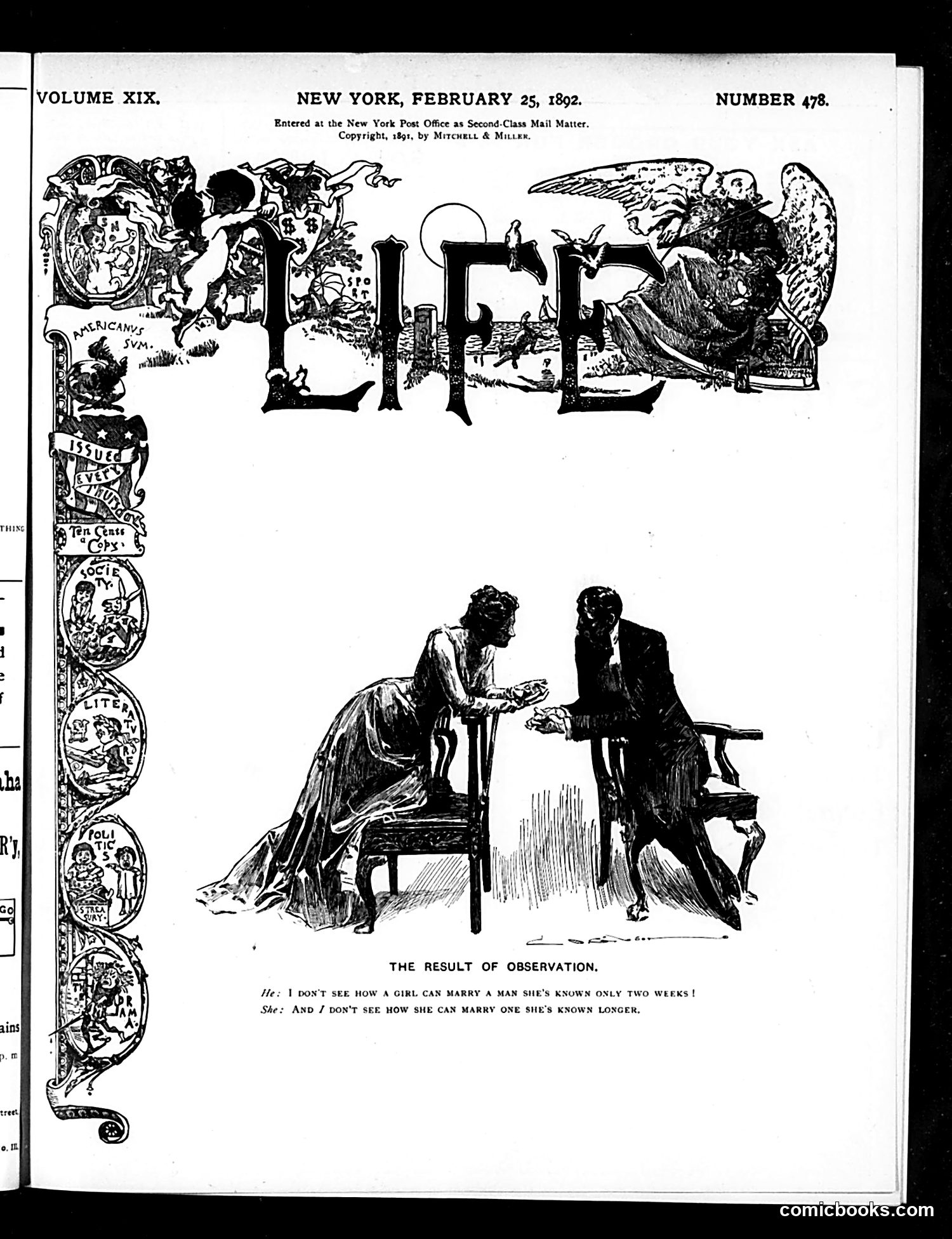
This single-panel cartoon depicts a conversation between a man and woman sitting face-to-face. The caption captures their dialogue about marriage: **He:** "I don't see how a girl can marry a man she's known only two weeks!" **She:** "And I don't see how she can marry one she's known longer." The satire mocks courtship conventions of the era by suggesting marriage is fundamentally a problematic decision—either you know someone too briefly (insufficient time) or too long (familiarity breeds doubt). The cartoon cynically critiques both rushed engagements and prolonged courtships, implying that extended acquaintance actually *worsens* prospects for marital success. This reflects late-Victorian skepticism about marriage as an institution, presenting it as an inherently flawed gamble regardless of courtship duration.
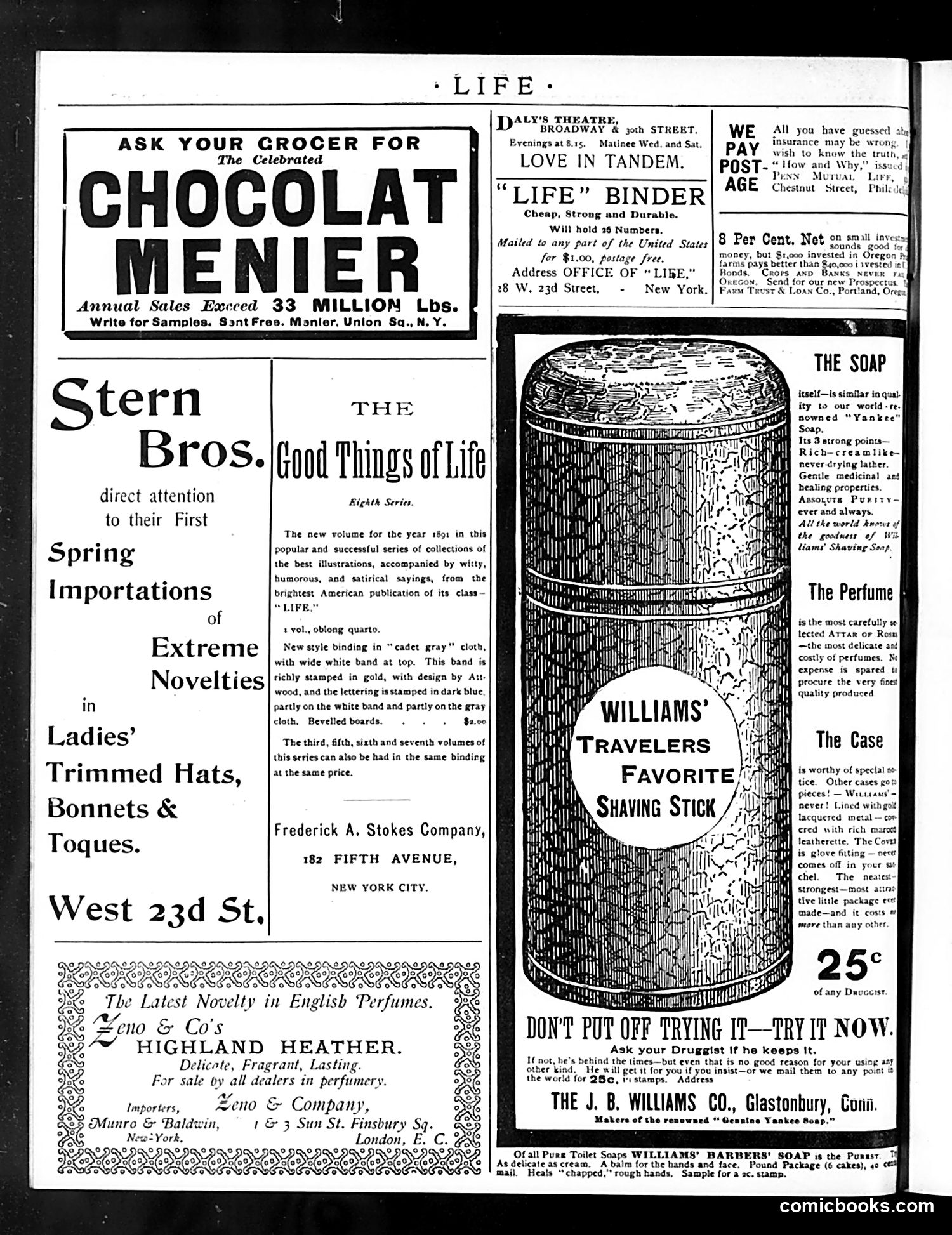
This page is **primarily advertising** with no political cartoons or satirical content. The advertisements promote various consumer goods typical of early 20th-century America: Chocolat Menier chocolate, Stern Bros. ladies' hats and bonnets, "The Good Things of Life" book series, Highland Heather perfume, and Williams' Travelers Favorite Shaving Stick. The only non-advertisement content is a brief theater listing for "Love in Tandem" at Daly's Theatre and an insurance pitch for "Pay-as-You-Go" policies. The page reflects commercial Life magazine content from an era when satirical publications relied heavily on advertising revenue. There are no caricatures, political references, or satire to decode—just period product marketing aimed at affluent urban readers.
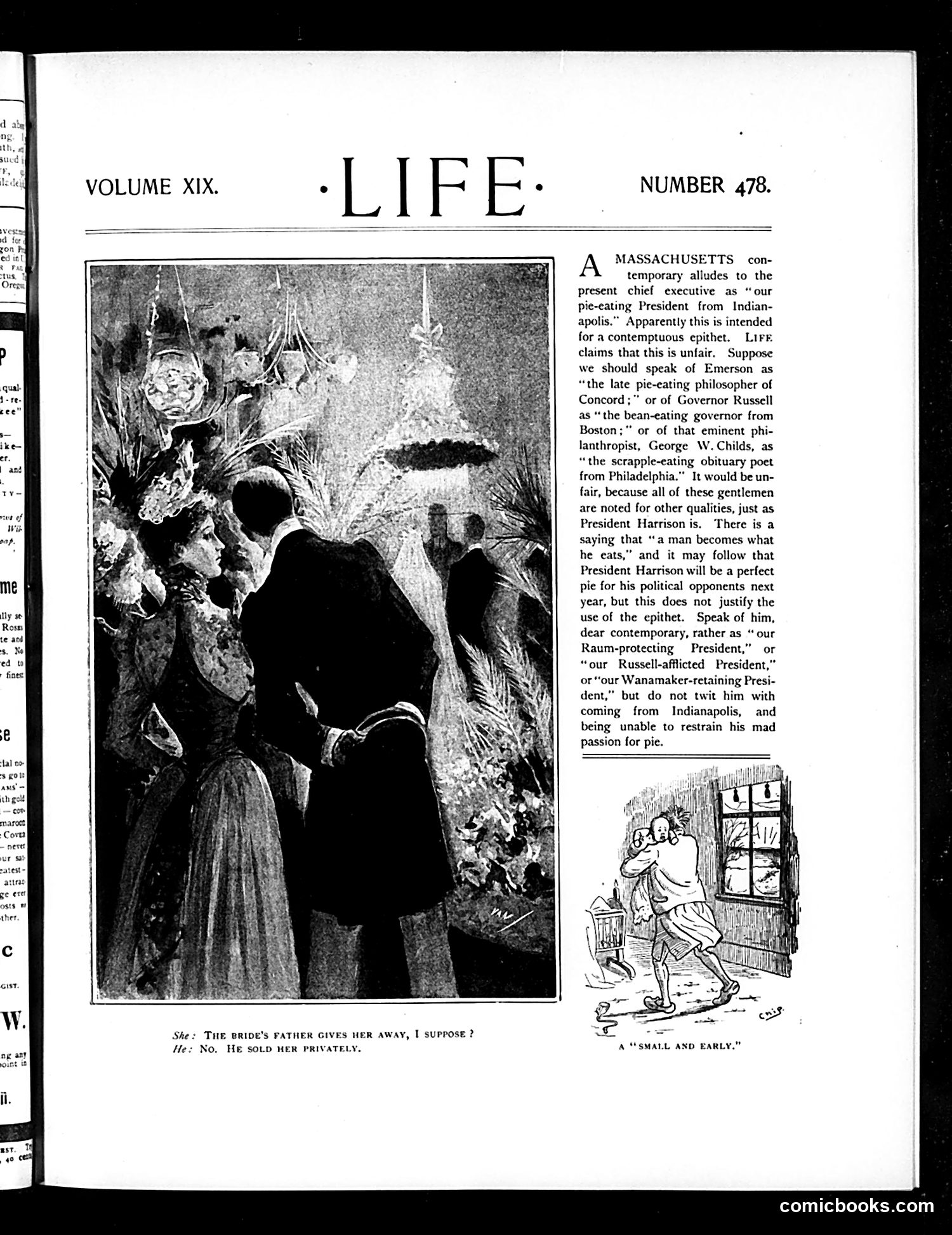
This page satirizes President Harrison's alleged fondness for pie. The main cartoon depicts a wedding scene where the bride's father "sells her privately" rather than giving her away formally—a crude joke implying Harrison treats marriage as a commercial transaction, much like his appetite for pie is uncontrollable. The accompanying text mockingly compares Harrison to other famous men (Emerson, Russell, Childs) but sarcastically suggests he'll be remembered instead as a "pie-eater." The satire warns that Harrison's political opponents will use this epithet against him, despite attempts to rename him with more dignified titles like "Raum-protecting President" or "Russell-afflicted President." The small cartoon "A Small and Early" appears to illustrate a related domestic/moral failing joke.
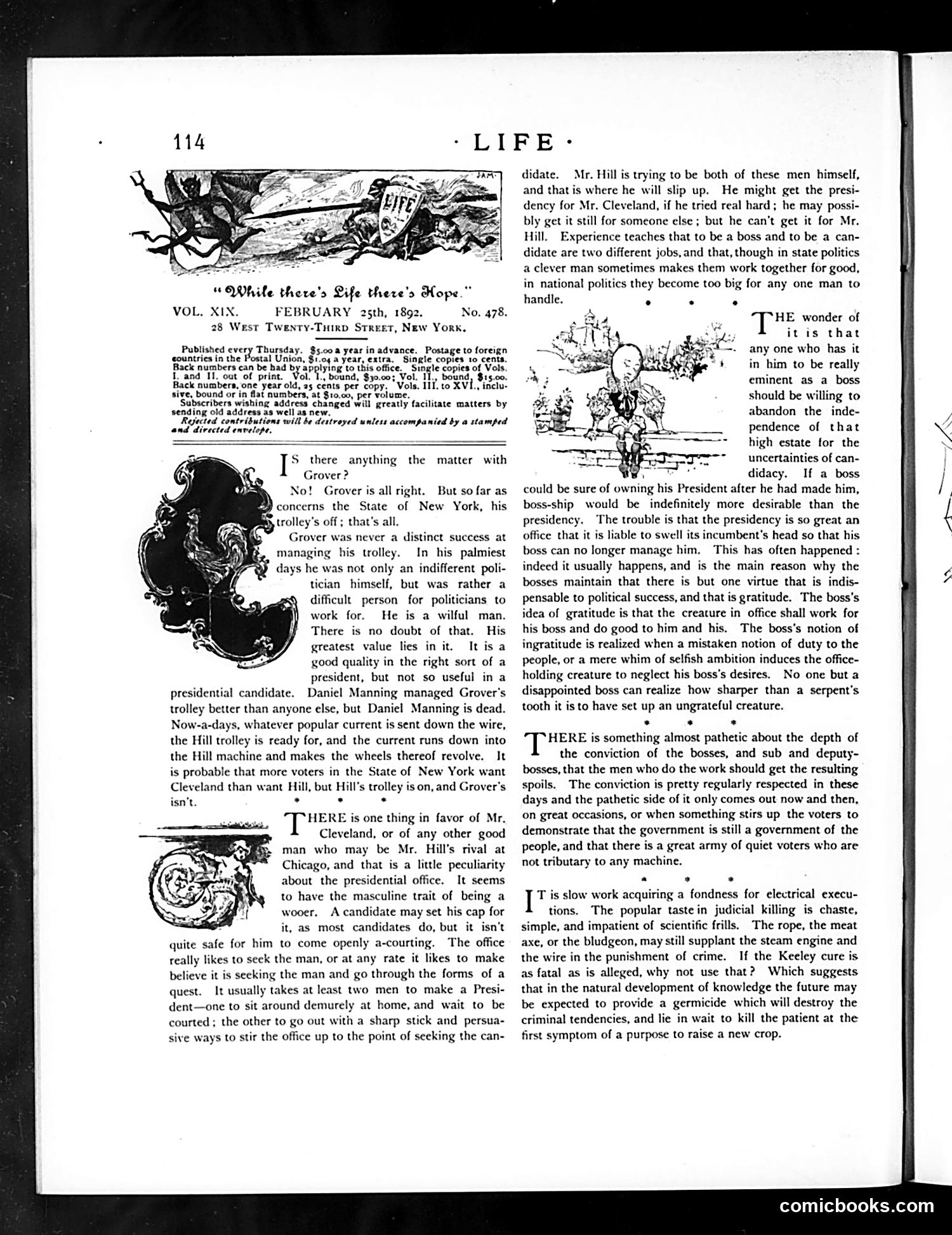
This political commentary discusses New York State politics and the presidential office. The text critiques **Grover Cleveland** versus an alternative candidate (likely **David B. Hill**, New York's governor), examining their fitness for the presidency. The central argument concerns whether a boss should abandon political independence for high office. The author argues that truly eminent bosses are reluctant to seek the presidency because they'd lose control of their political machine—a position offering more reliable power than the presidency itself. The text notes that Hill's political faction currently dominates New York state politics, overshadowing the Cleveland alternative. The piece explores the tension between maintaining local political power versus pursuing higher national office. The illustrated vignettes appear decorative rather than directly representing specific figures.
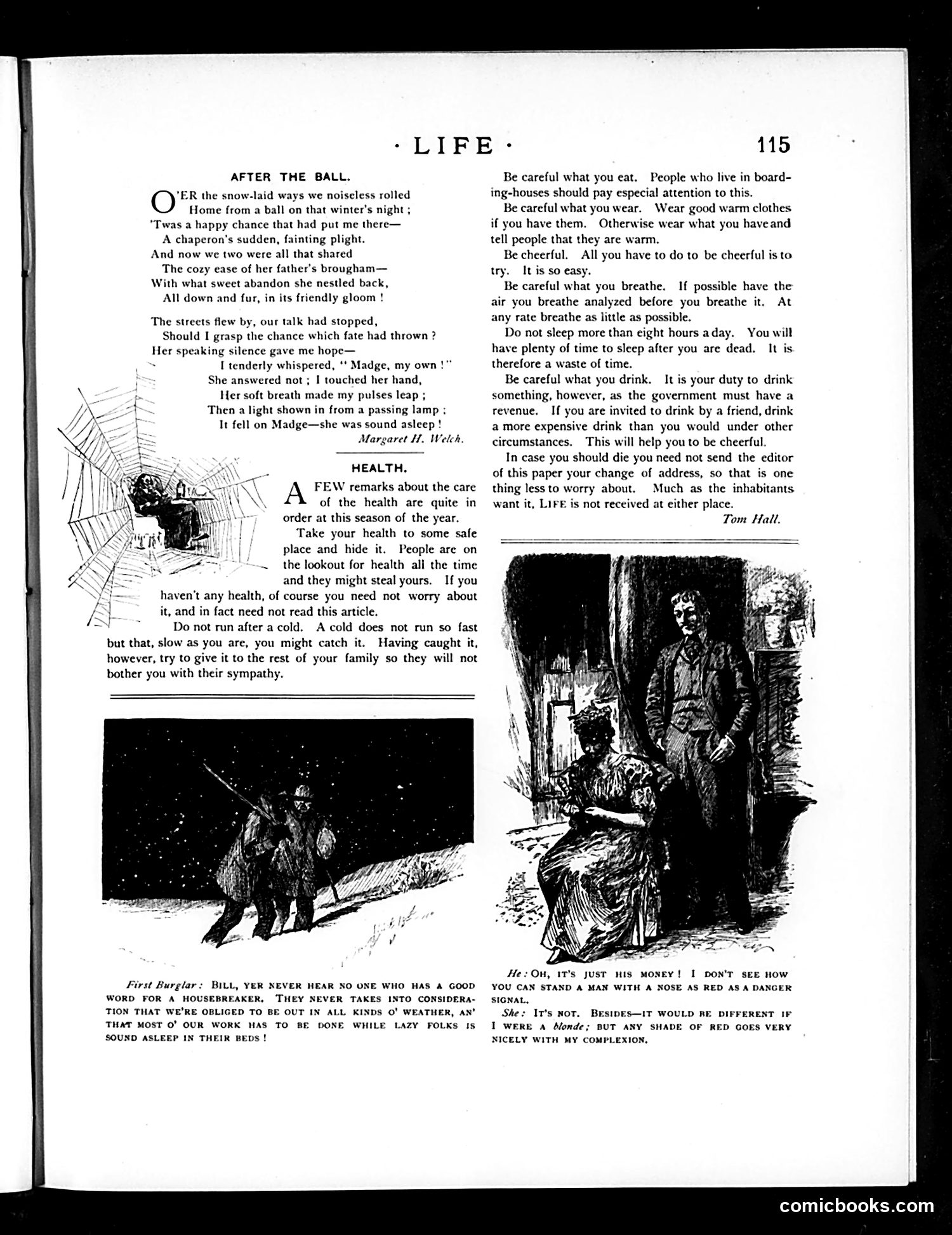
This page contains practical advice columns ("After the Ball" and "Health") alongside two satirical sketches with accompanying dialogue. The lower cartoon depicts a domestic dispute about a husband's red nose. The wife assumes it indicates heavy drinking ("his money"), while the husband protests it's simply his complexion. He sarcastically suggests she'd prefer if he were a "blonde" man with red facial coloring—implying she's being unreasonable about his appearance. The upper sketch shows what appears to be a beggar or vagabond in winter conditions, illustrating the "After the Ball" poem about post-celebration hardship. The humor relies on marital tension and physical appearance stereotypes common to early 20th-century satirical magazines. The specific social context—whether referencing actual contemporary scandals—remains unclear without additional historical documentation.
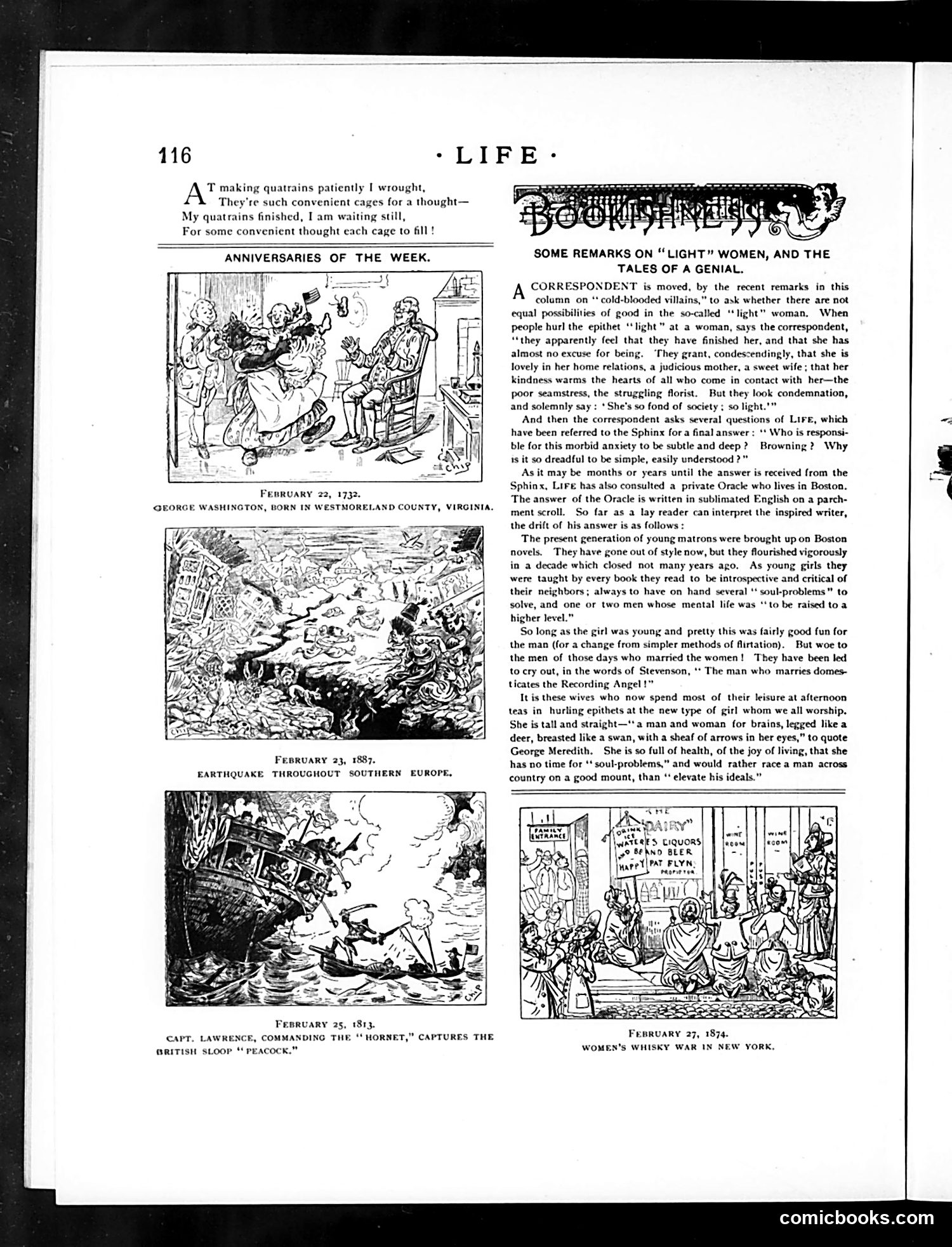
This page contains historical illustrations under "Anniversaries of the Week," commemorating significant events from American and British history: 1. **George Washington's Birth** (Feb. 22, 1732): Shows a domestic colonial scene, likely depicting Washington's family. 2. **European Earthquake** (Feb. 23, 1755): Depicts the Lisbon earthquake's devastation, showing a ship capsizing and destruction. 3. **Naval Battle** (Feb. 25, 1813): Illustrates Capt. Lawrence commanding the "Hornet" capturing the British sloop "Peacock." 4. **Women's Whiskey War** (Feb. 27, 1874): Shows a crowd scene labeled as New York's women's temperance movement, likely referencing the Women's Crusade against alcohol sales. The right column discusses "light" women in literature, analyzing how Boston novels portrayed female characters.
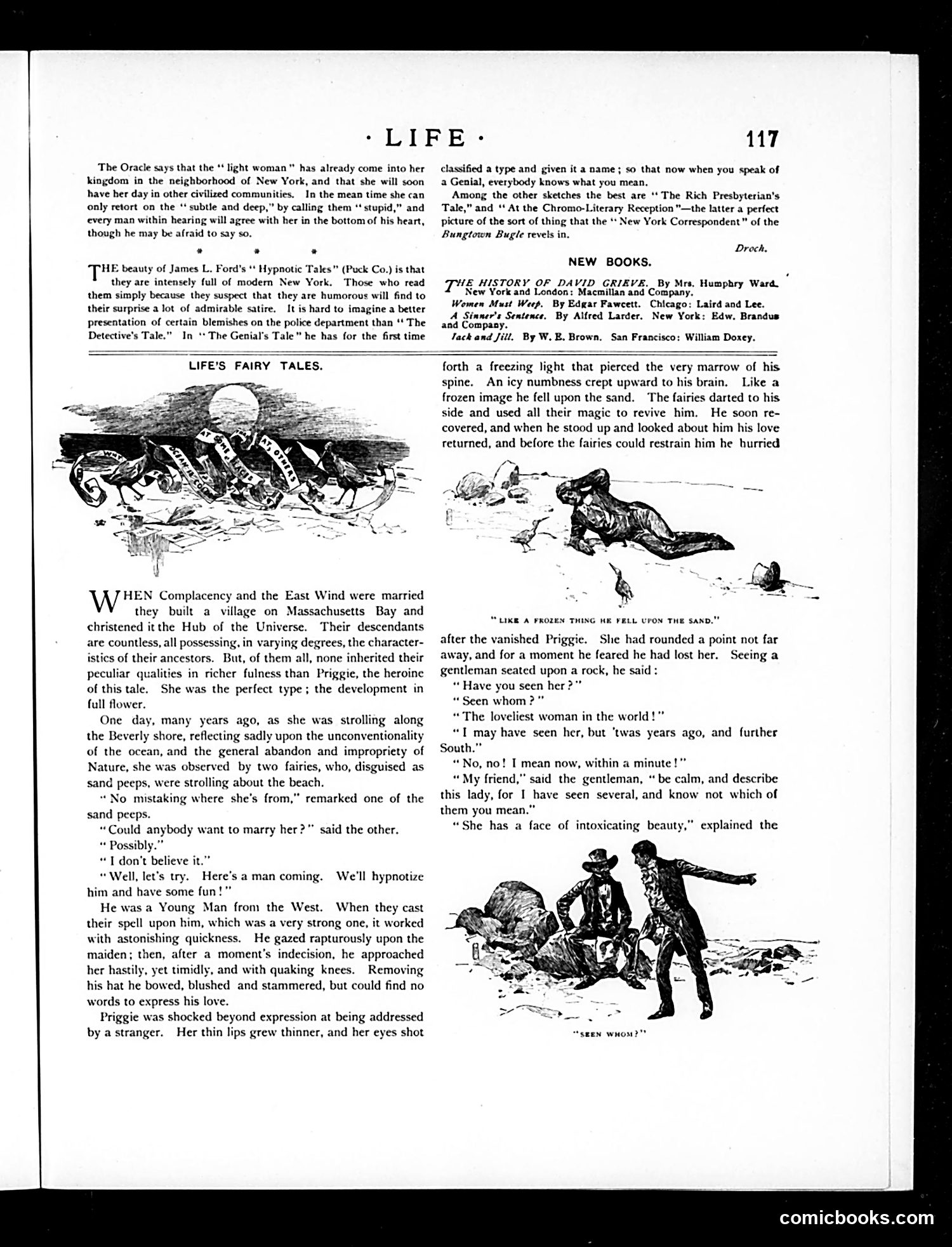
This page contains a fairy tale story titled "Life's Fairy Tales," not political satire. The narrative describes two fairies who observe a young man from the West and cast a spell on him to make him fall in love with a woman named Priggie. The story illustrates romantic mishap through magical intervention—the man becomes instantly enamored while Priggie is shocked and confused by his sudden attention. The accompanying illustrations show the fairies observing from the beach and later the bewildered encounter between the enchanted young man and the reluctant object of his affection. This appears to be humorous fiction exploring themes of unrequited love and magical interference in human relationships, rather than contemporary political commentary.
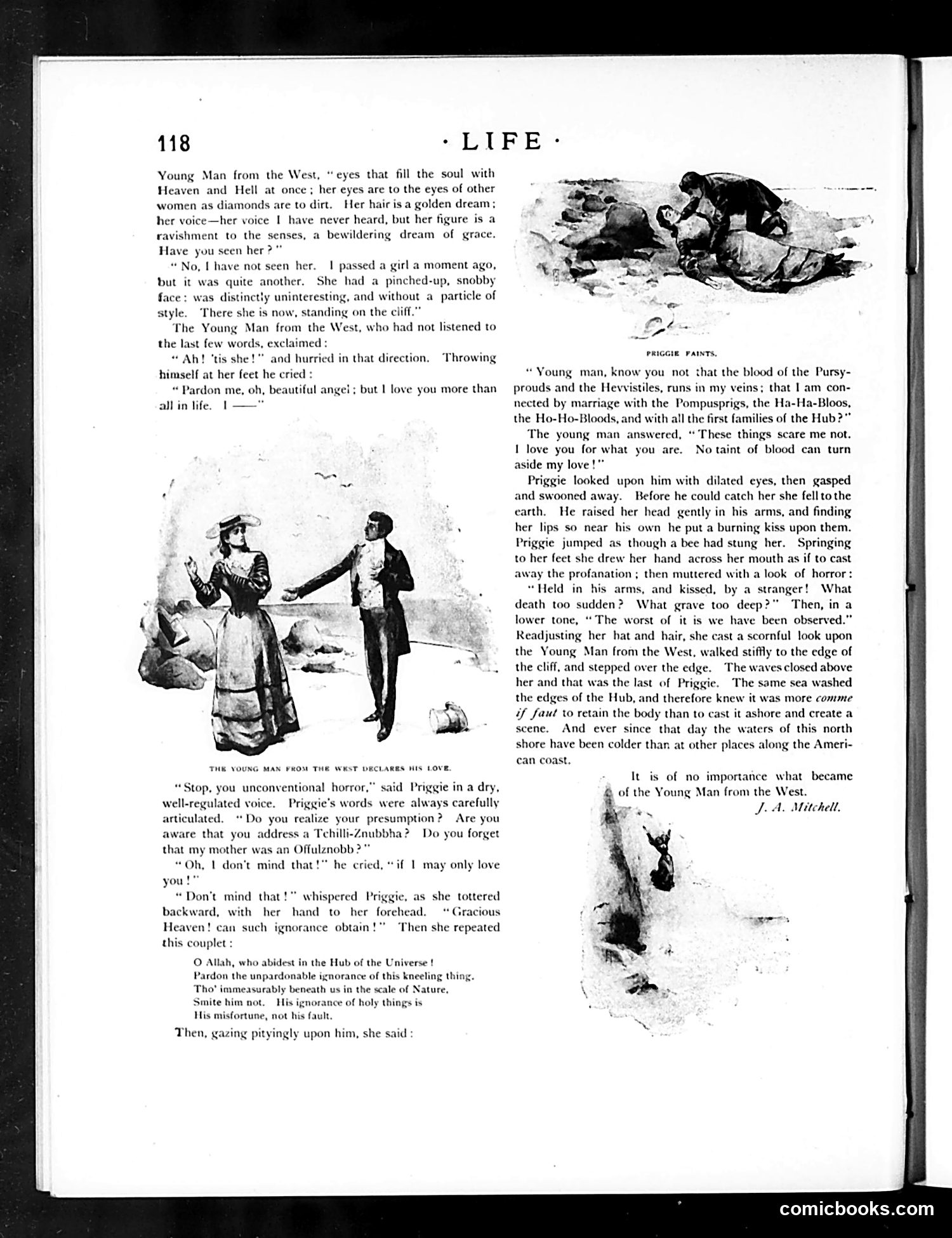
This page presents a romantic narrative rather than political satire. The story depicts a "Young Man from the West" declaring his love to a woman named Priggie, despite her concerns about their differing social backgrounds—she mentions her mother was "an Offizinoubha" and warns of blood relations to various aristocratic families ("Pursyprouds," "Hexivities," "Ha-Ha-bloos," etc.). The central illustration shows the couple in an emotional confrontation on a cliff. The narrative culminates tragically when Priggie jumps to her death rather than accept his love, after which the Young Man also steps over the cliff edge. The page appears to be satirizing romantic melodrama and class-consciousness anxieties of the era, mocking both Priggie's pretentious concern with bloodlines and the overwrought emotional intensity of the lovers' declarations.
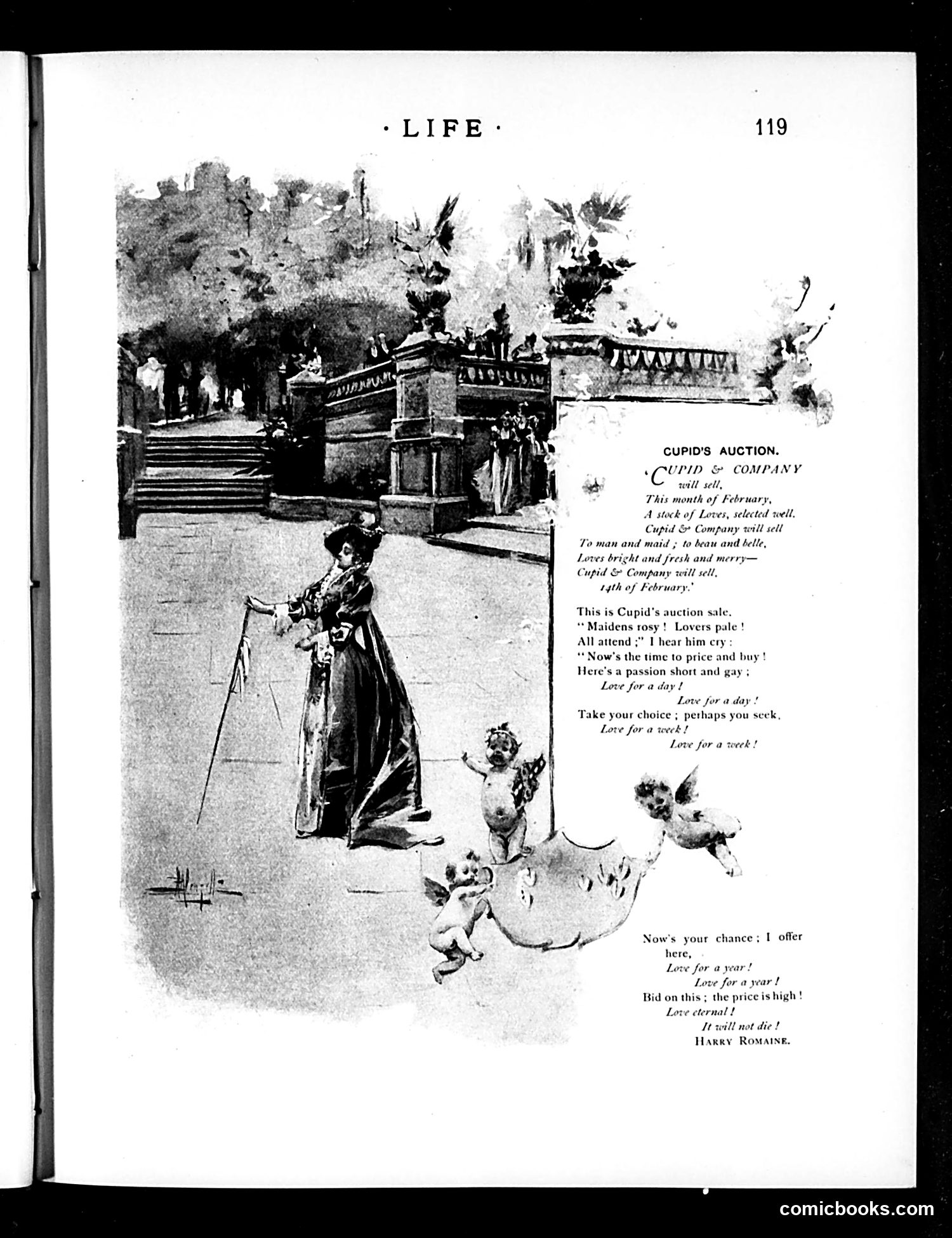
This satirical illustration depicts Cupid (the winged cherub of love) conducting an auction of romantic "love" in a formal garden setting. A fashionable woman in Edwardian dress appears to be the auctioneer or protagonist, while multiple cupids act as the merchandise or bidders. The poem accompanying the image plays on the commercialization of romance and sentiment—treating love as a commodity to be bought and sold at different price points ("Love for a day," "Love for a week," "Love for a year"). The satire mocks both the transactional nature of romantic relationships in society and the ephemeral quality of modern love, suggesting that affection has become standardized and purchasable rather than genuine or eternal. The tone is lighthearted social commentary on turn-of-the-century courtship.
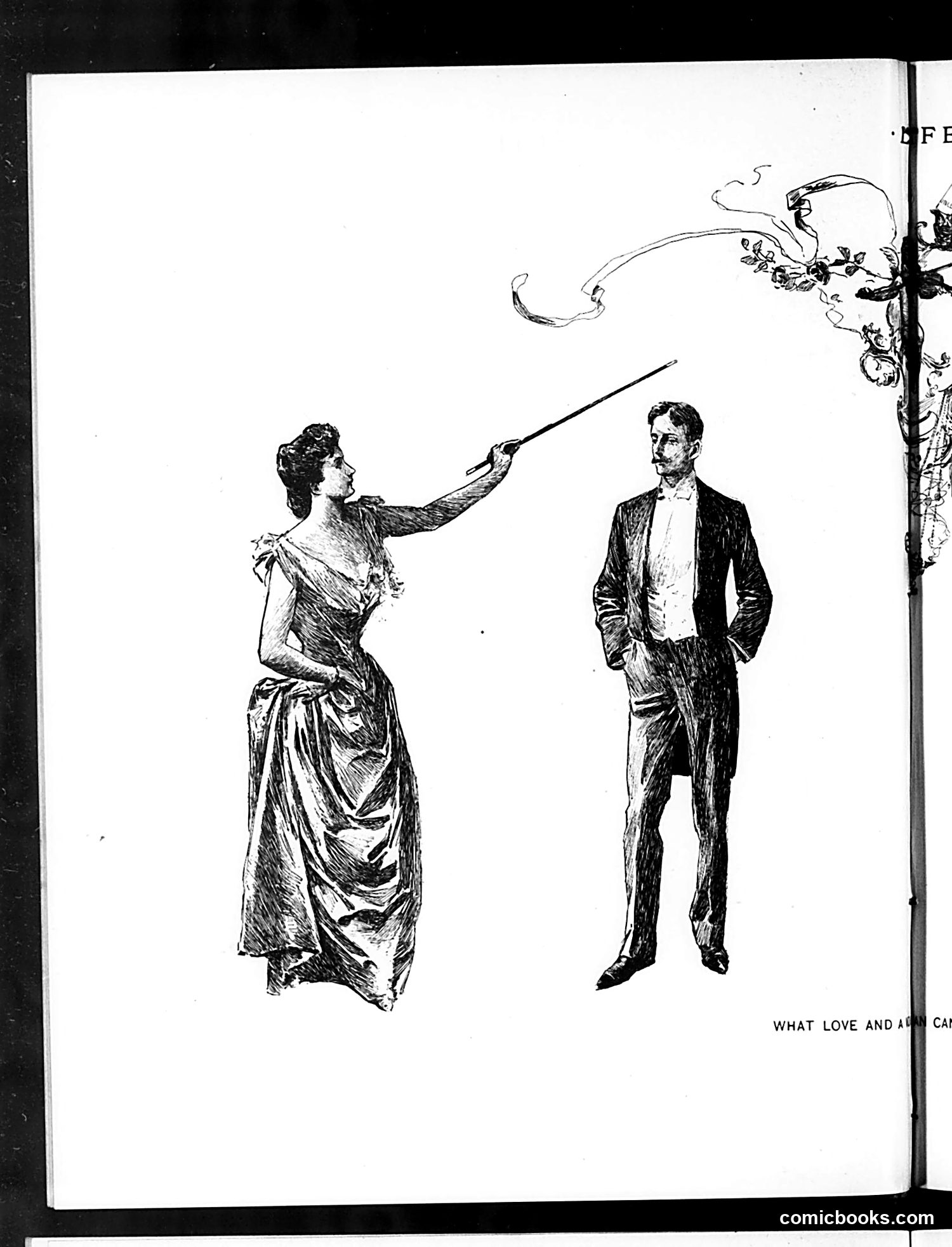
This appears to be a satirical illustration from *Life* magazine showing a domestic scene. A woman in an elegant Edwardian-era dress points a conductor's baton at a man in formal attire who stands passively with hands in pockets. The caption reads "WHAT LOVE AND A..." (text cut off). The satire likely comments on **gender dynamics in marriage or relationships**. The woman "conducting" suggests she controls or dominates the interaction, while the man appears resigned or subordinate. The conductor's baton is a visual metaphor for authority and direction-setting. This reflects early 20th-century anxieties about changing women's roles and the "New Woman" who asserted independence—a common satirical target in *Life* magazine during this period. The joke positions female authority as something humorous or incongruous with traditional gender expectations.
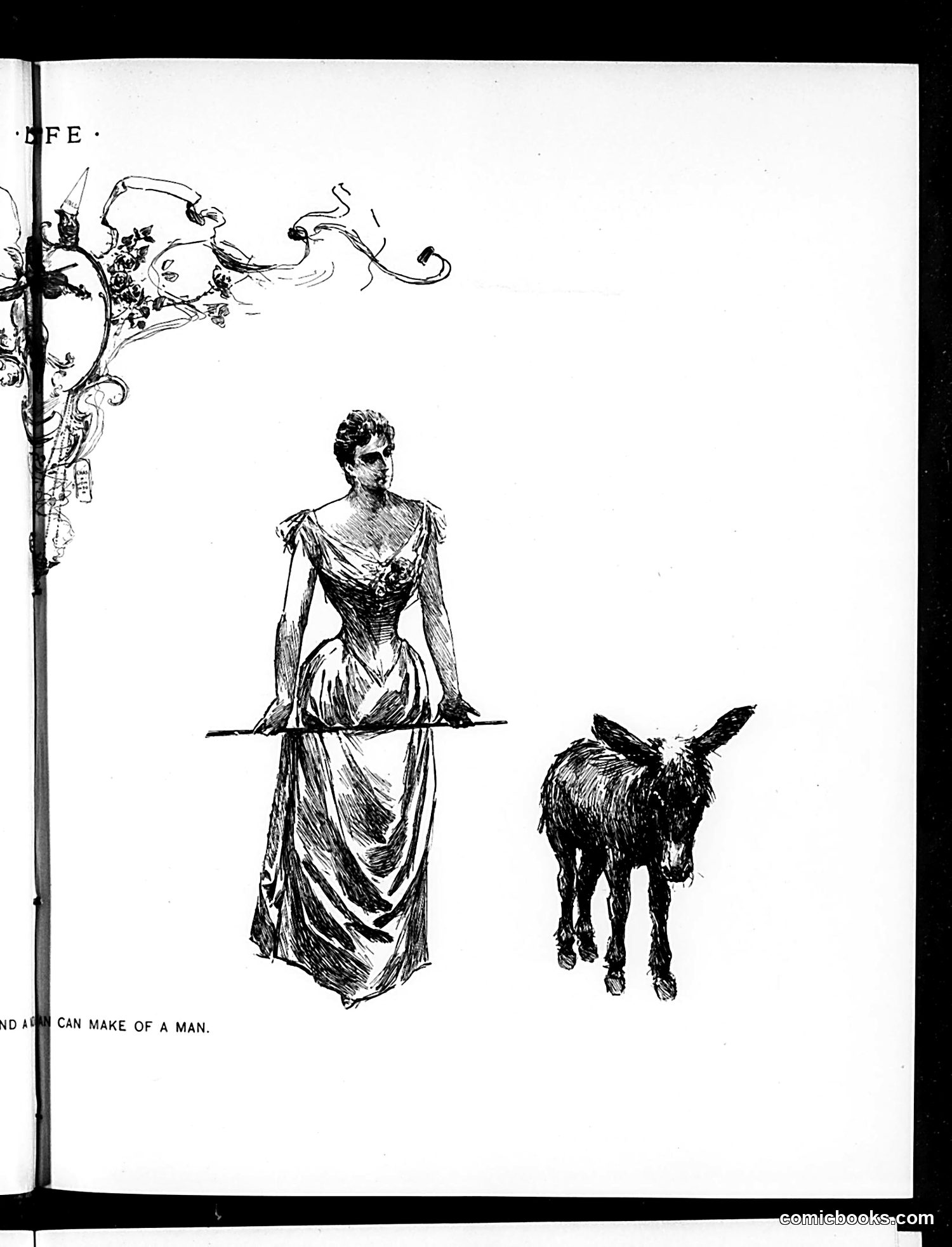
This appears to be a satirical illustration from *Life* magazine featuring a woman in classical Greek or Roman dress holding a sword, standing next to a goat. The visible text fragment reads "...ND AND CAN MAKE OF A MAN," suggesting a critique about what influence or power can do to masculinity. The classical styling and the pairing of a woman warrior with a goat likely constitutes political satire, though without additional context or the complete caption, the specific target remains unclear. The goat may represent foolishness or lust, common symbolic associations in period satire. The woman's commanding pose and weapon suggest commentary on female power or authority—a theme *Life* frequently satirized during the late 19th/early 20th century. The complete meaning requires the full caption text.
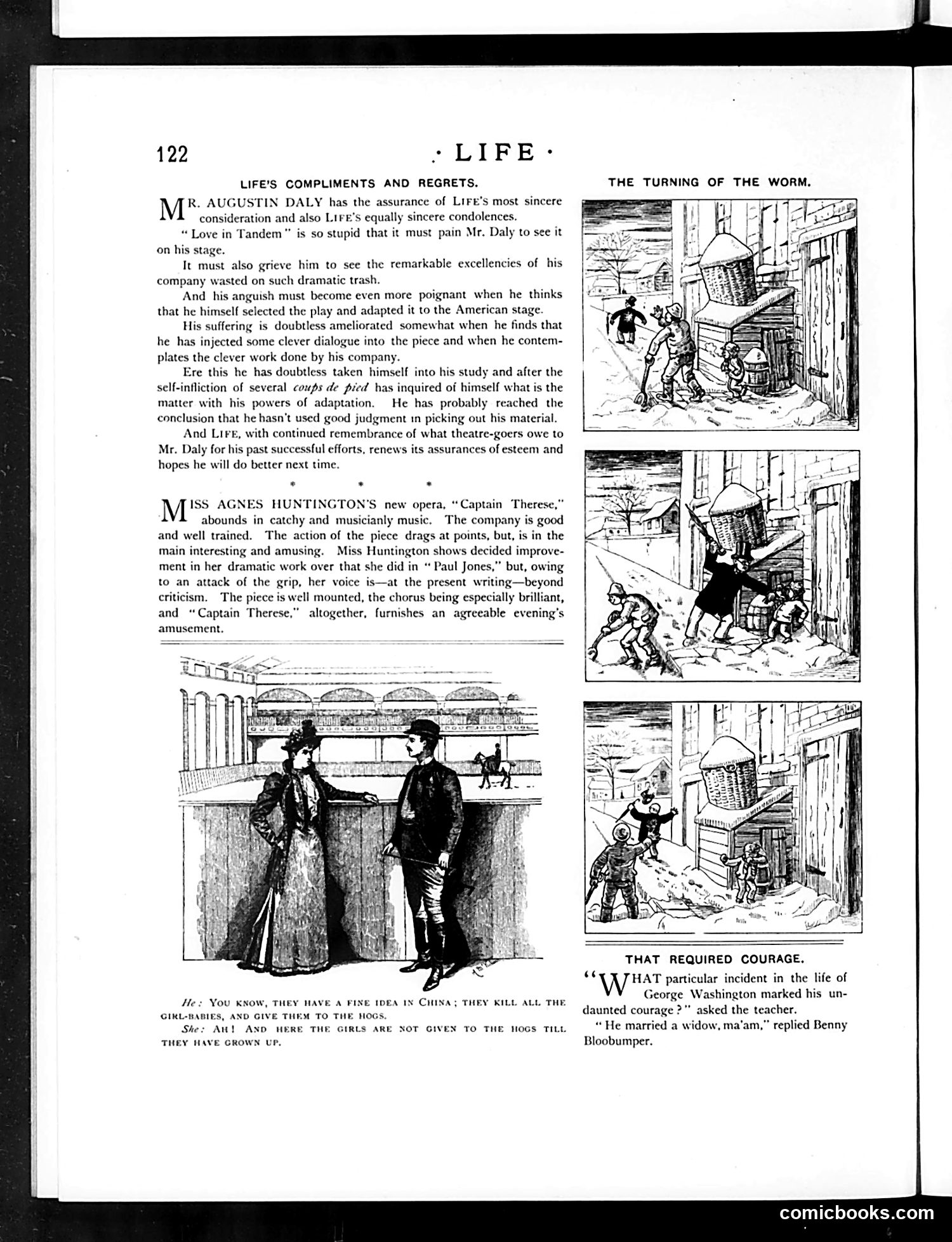
This page contains theatrical criticism and humor typical of Life's satirical approach. **Top section:** Life offers backhanded compliments to theater producer Augustin Daly regarding his play "Love in Tandem," which Life calls "stupid" and "dramatic trash." The satire is that Daly—a respected theater figure—selected and adapted this poor material himself, then injected clever dialogue trying to salvage it. Life's point: even Daly's talent couldn't redeem such weak source material, and he should exercise better judgment selecting plays. **Middle section:** A favorable review of Agnes Huntington's opera "Captain Therese," noting improvements in her acting (compared to "Paul Jones") despite her current voice problems from illness. **Lower cartoons and dialogue:** A crude joke about Chinese practices, and a children's humor section where a student earnestly misinterprets a history question—answering that George Washington showed courage by marrying a widow, rather than understanding the intended serious historical answer. The page reflects late 19th-century Life's blend of theater criticism and genteel satirical humor.
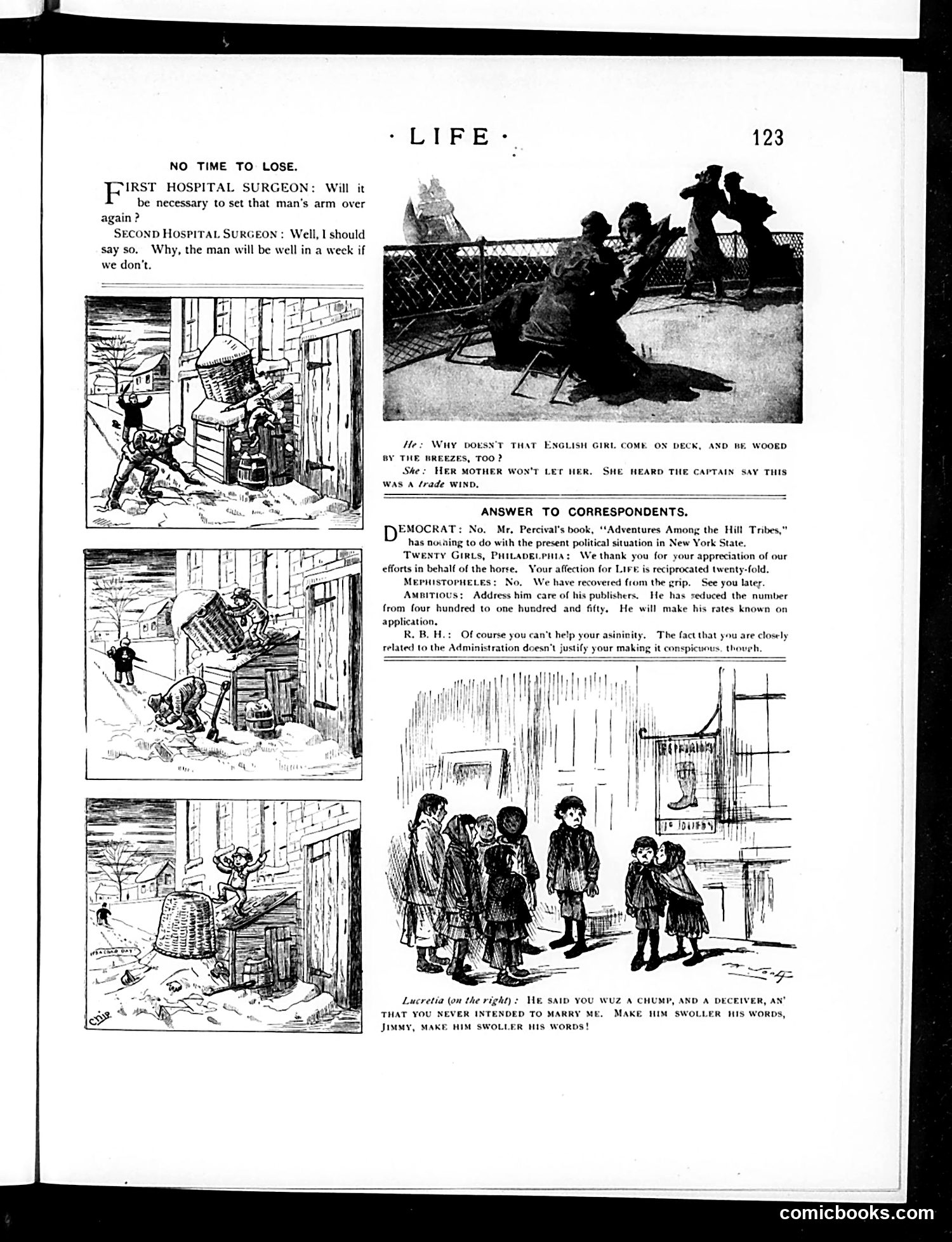
This page from *Life* contains several distinct satirical pieces: **Top dialogue**: Two hospital surgeons debate whether to reset a patient's arm. The joke's dark humor: the second surgeon suggests *not* setting it so the patient recovers faster—absurdist medical logic mocking inefficiency or bureaucratic delay. **Middle section**: A seaside flirtation joke plays on the double meaning of "trade wind"—the woman's mother misinterprets it as literal commerce/impropriety rather than a nautical wind, humorously revealing her protective prudishness. **"Answer to Correspondents"**: A humorous advice column that dismisses reader inquiries with sardonic responses—mocking a politician's book as irrelevant to current events, congratulating supporters, and insulting one correspondent's family connection to "the Administration" (the government). **Bottom illustration**: "Lucretia" confronts a deceiver, demanding he "swallow his words"—a domestic quarrel scene about broken marriage promises, rendered in vernacular dialect ("wuz," "swoller"). The page combines political commentary, social satire, and domestic humor typical of *Life*'s editorial voice.
The main text is a humorous anecdote about a traveling salesman (drummer) who gives a railroad porter a five-dollar gold piece and detailed instructions to wake him at Syracuse. The next morning, the drummer discovers the porter badly injured—bandaged, torn clothes, arm in a sling—in a closet at Rochester, the wrong station. The porter had mistakenly put off a *different* gentleman (a "gemman") at Syracuse instead. The joke relies on racial dialect stereotyping typical of the era: the Black porter's speech ("Wha-at!" and "befoah de Lawd") marks him as the butt of humor. The satire suggests the porter's confusion—or perhaps mishearing—caused the mix-up, played for laughs. Secondary text includes a letter exchange about Edgar Allan Poe autographs, where humorist Horace Greeley jokes that his only Poe memorabilia is a promissory note and endorsement costing him $50.75—a sharp joke about financial loss. The page is primarily filled with period advertisements.
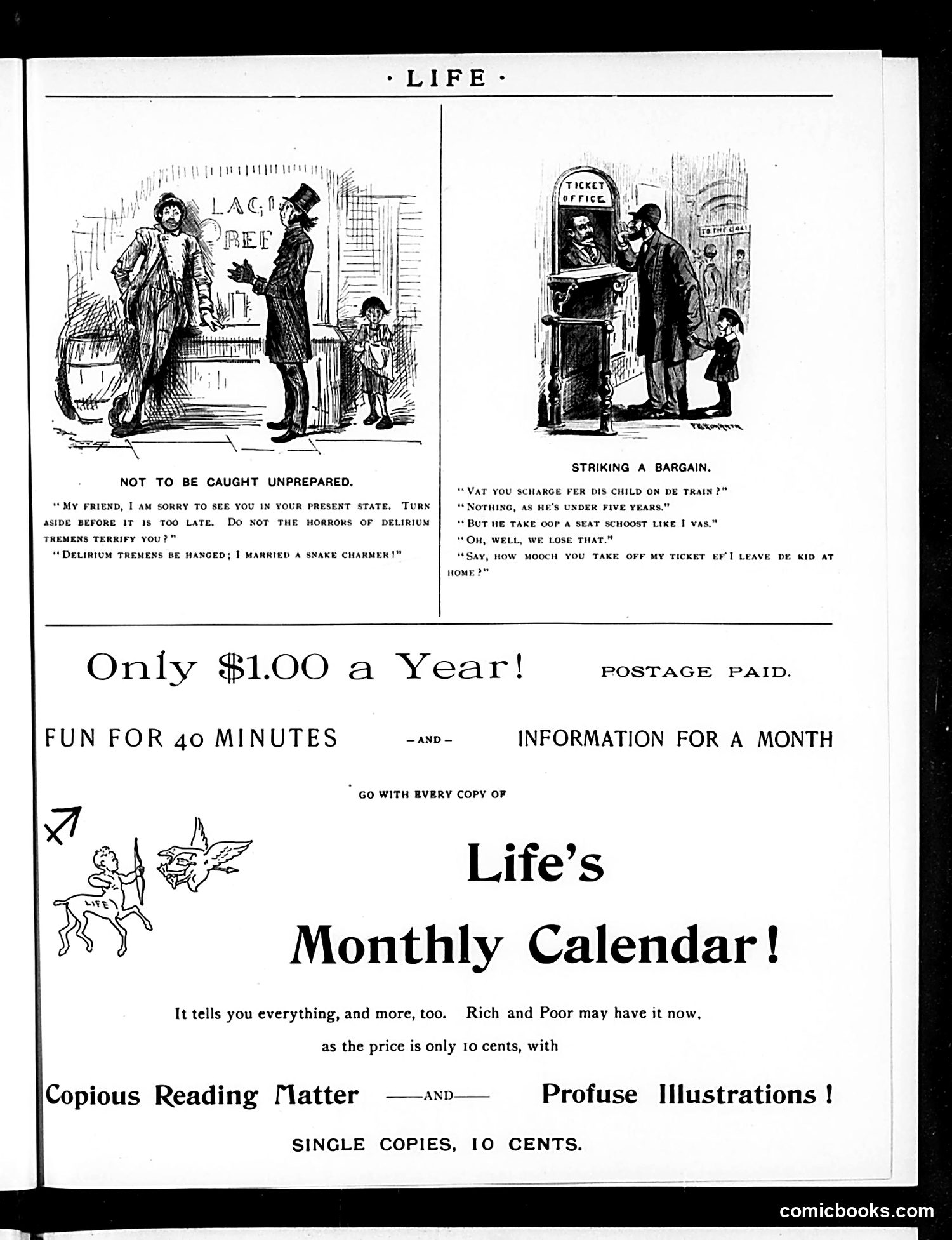
This is primarily an **advertisement page** for Life's Monthly Calendar subscription, with two satirical cartoon vignettes at the top. **Left cartoon ("Not to Be Caught Unprepared")**: A disheveled man tells a concerned friend he needn't worry about delirium tremens because he "married a snake charmer"—dark humor about alcoholism and marital chaos, suggesting his wife is as dangerous as snakes. **Right cartoon ("Striking a Bargain")**: A working-class man (indicated by dialect spelling) at a train ticket office tries to negotiate a discount by leaving his young child at home rather than purchasing a seat. The ticket agent refuses, as the child would still occupy space. The satire targets penny-pinching working people and railway pricing disputes. Both cartoons use **exaggerated immigrant or working-class accents** (phonetic spelling) typical of period satire, mocking lower-class economic anxiety and behavior. The page promotes Life's calendar at $1/year with "40 minutes of fun" and monthly information, targeting both "Rich and Poor."
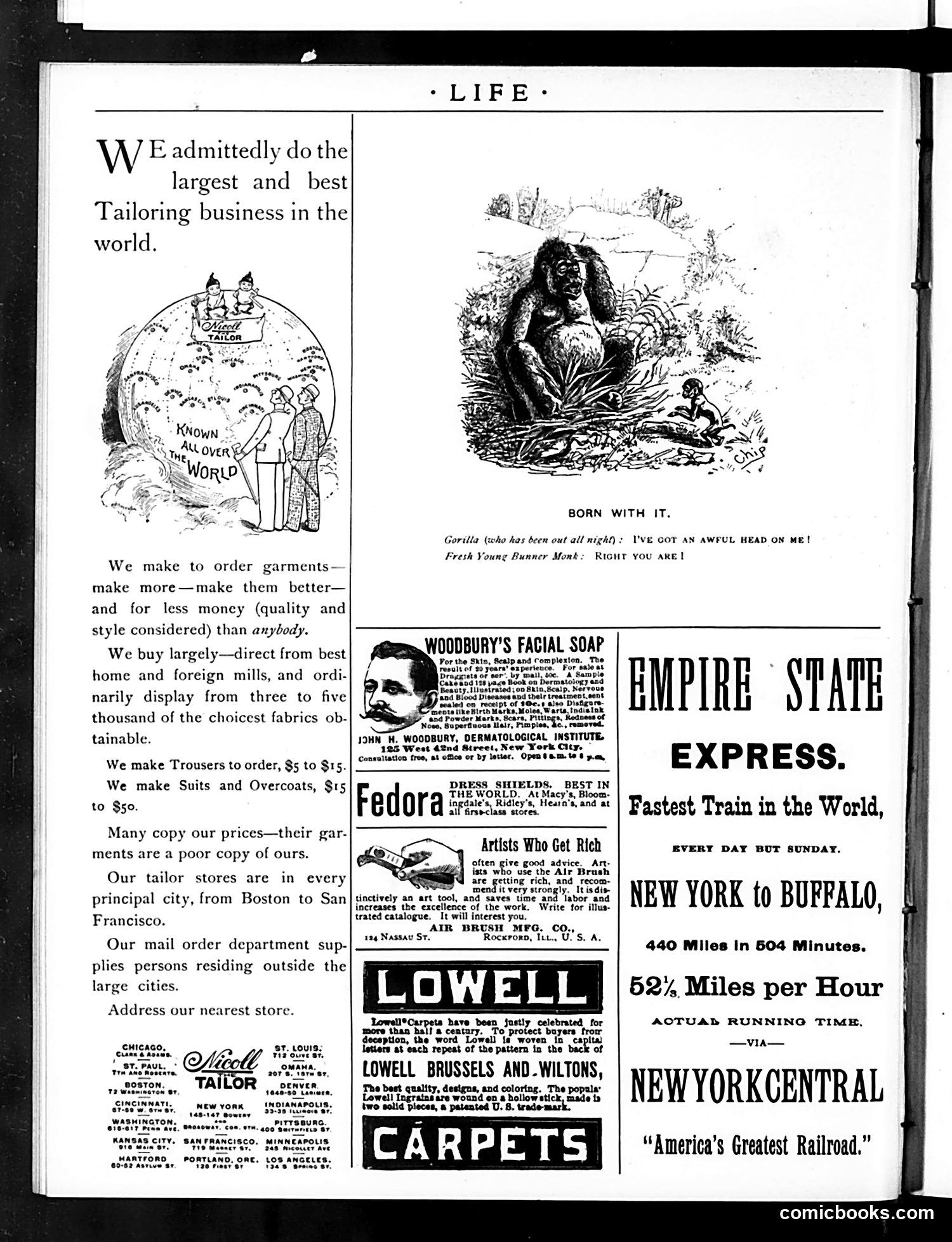
This is primarily an **advertising page** with one small cartoon. The main content comprises ads for tailoring, soap, dress shields, carpets, and trains—typical early 1900s magazine filler. The cartoon labeled "BORN WITH IT" depicts a **gorilla** complaining of a hangover to a "Fresh Young Bunner Monk" (a character type). The humor plays on racial and evolutionary stereotypes prevalent in that era: the joke appears to conflate primates with marginalized human groups, suggesting moral degeneracy is "born with" certain people. This reflects the deeply racist pseudoscience of the period. The cartoon's context—surrounded by beauty and grooming ads—may intensify the satirical contrast, though the exact target remains unclear. The page demonstrates how casual bigotry was normalized in early 20th-century American humor magazines.