
Life, 1892-02-25 · page 6 of 16
Life — February 25, 1892 — page 6: what you’re looking at
What you’re looking at
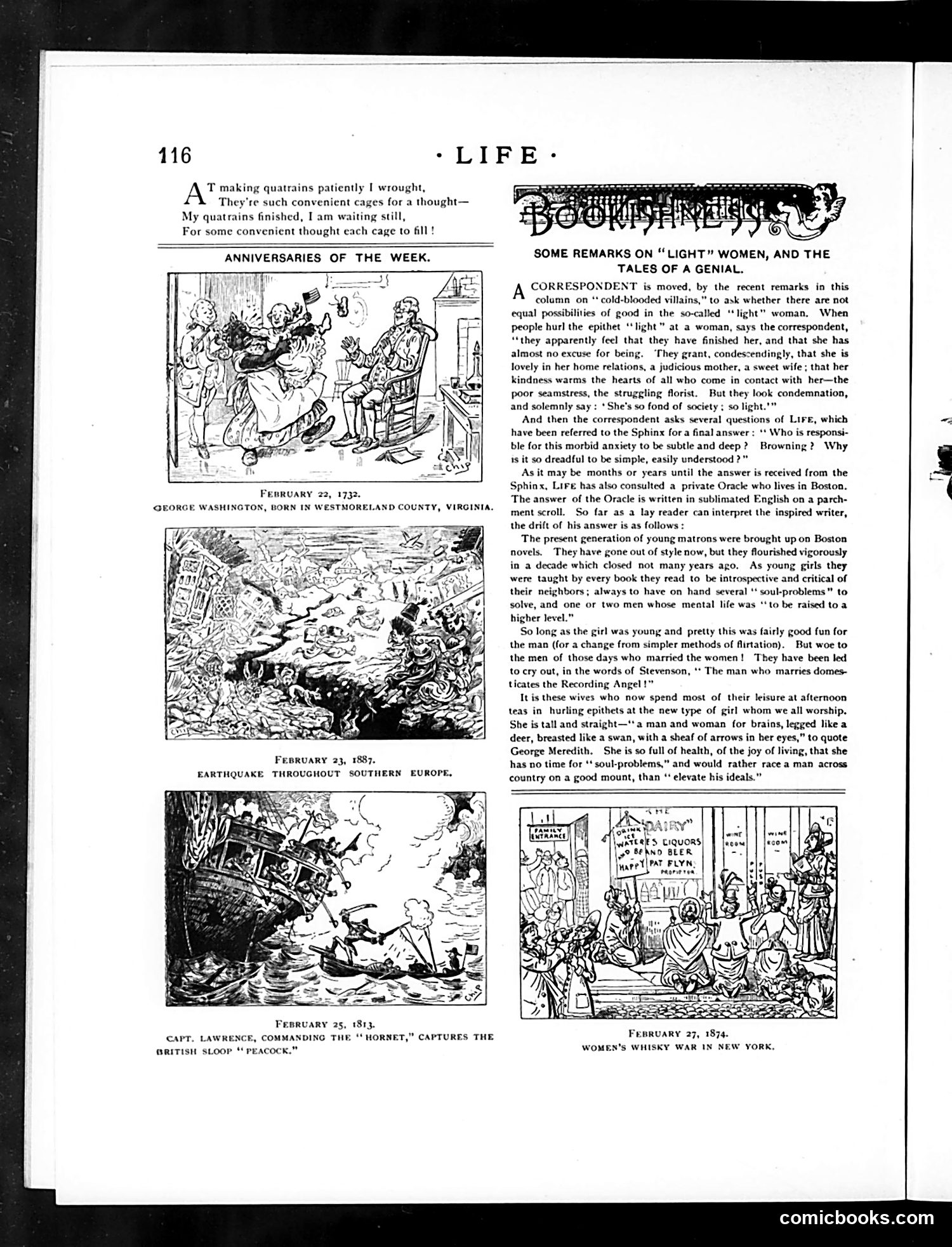
This page contains historical illustrations under "Anniversaries of the Week," commemorating significant events from American and British history: 1. **George Washington's Birth** (Feb. 22, 1732): Shows a domestic colonial scene, likely depicting Washington's family. 2. **European Earthquake** (Feb. 23, 1755): Depicts the Lisbon earthquake's devastation, showing a ship capsizing and destruction. 3. **Naval Battle** (Feb. 25, 1813): Illustrates Capt. Lawrence commanding the "Hornet" capturing the British sloop "Peacock." 4. **Women's Whiskey War** (Feb. 27, 1874): Shows a crowd scene labeled as New York's women's temperance movement, likely referencing the Women's Crusade against alcohol sales. The right column discusses "light" women in literature, analyzing how Boston novels portrayed female characters.
📄 Transcribed text from this page (OCR, searchable)
Machine-transcribed from the original scan — historical spelling and the odd misread are preserved.
116 T making quatrains patiently | wrought, They're such convenient cages for a thought— My quatrains finished, I am waiting still, For some convenient thought each cage to fill! ANNIVERSARIES OF THE WEEK. FeMRuary 22, 1732. GEORGE WASHINGTON, BORN IN WESTMORELAND COUNTY, VIRGID FEBRUARY 23, 1887. EARTHQUAKE THROUGHOUT SOUTHERN EUROPE, Fenrvary 25, 1813. £, COMMANDING THE ‘‘ HORNET,” CAPTURES THE QRITISH SLOOP * PEACOCK SOME REMARKS ON “LIGHT” WOMEN, AND THE TALES OF A GENIAL. CORRESPONDENT is moved, by the recent remarks in this colamn on * cold-blooded villains,” to ask whether there are not equal possibilities of good in the so-called ‘light woman, When people hurl the epithet “light” at a woman, says the correspondent, “they apparently feel that they have finished her, and that she has almost no excuse for being. “They grant, condescendingly, that she is lovely in her home relations, a judicious mother, a sweet wife ; that her kindness warms the hearts of all who come in contact with her—the poor seamstress, the struggling florist. But they look condemnation, and solemnly say : * She's so fond of society ; so light." And then the correspondent asks several questions of Lire, which have been referred to the Sphinx fora final answer : ** Who is responsi- ble for this morbid anxiety to be subtle and deep? Browning? Why 1s it so dreadful to be simple, easily understood ?" As it may be months or years until the answer is received from t Sphinx, LiFe has also consulted a private Oracle who lives in Boston. The answer of the Oracle is written in sublimated English on a parch- ment scroll, So far as a lay reader can interpret the inspired writer, the drift of his answer is as follows : ‘The present generation of young matrons were brought up on Boston novels. They have gone out of style now, but they flourished vigorously in a decade which closed not many years ago. As young girls they were taught by every book they read to be introspective and critical of their neighbors; always to have on hand several ‘ soul-problems” to solve, and one or two men whose meatal life was “to be raised to a higher level.” So long as the girl was young and pretty this was fairly good fun for the man (for a change from simpler methods of flirtation). But woe to the men of those days who married the women! They have been led to cry out, in the words of Stevenson, “* The man who marries domes- ticates the Recording Angel!” It is these wives who now spend most of their leisure at afternoon teas in hurling epithets at the new type of girl whom we all worship. She is tall and straight—* a man and woman for brains, legged like a deer, breasted like a swan, with a sheaf of arrows in her eyes,” to quote George Meredith. She is so full of health, of the joy of living, that she has no time for ** soul-problems,” and would rather race a man across country on a good mount, than “ elevate his ideals.” oar \WAteRles CIQUORS, Ve Behn BEER | PAT F Feprvary 27, 1874. WOMEN'S WHISKY WAR IN NEW YORK, comicbooks.com