
Life, 1892-02-25 · page 4 of 16
Life — February 25, 1892 — page 4: what you’re looking at
What you’re looking at
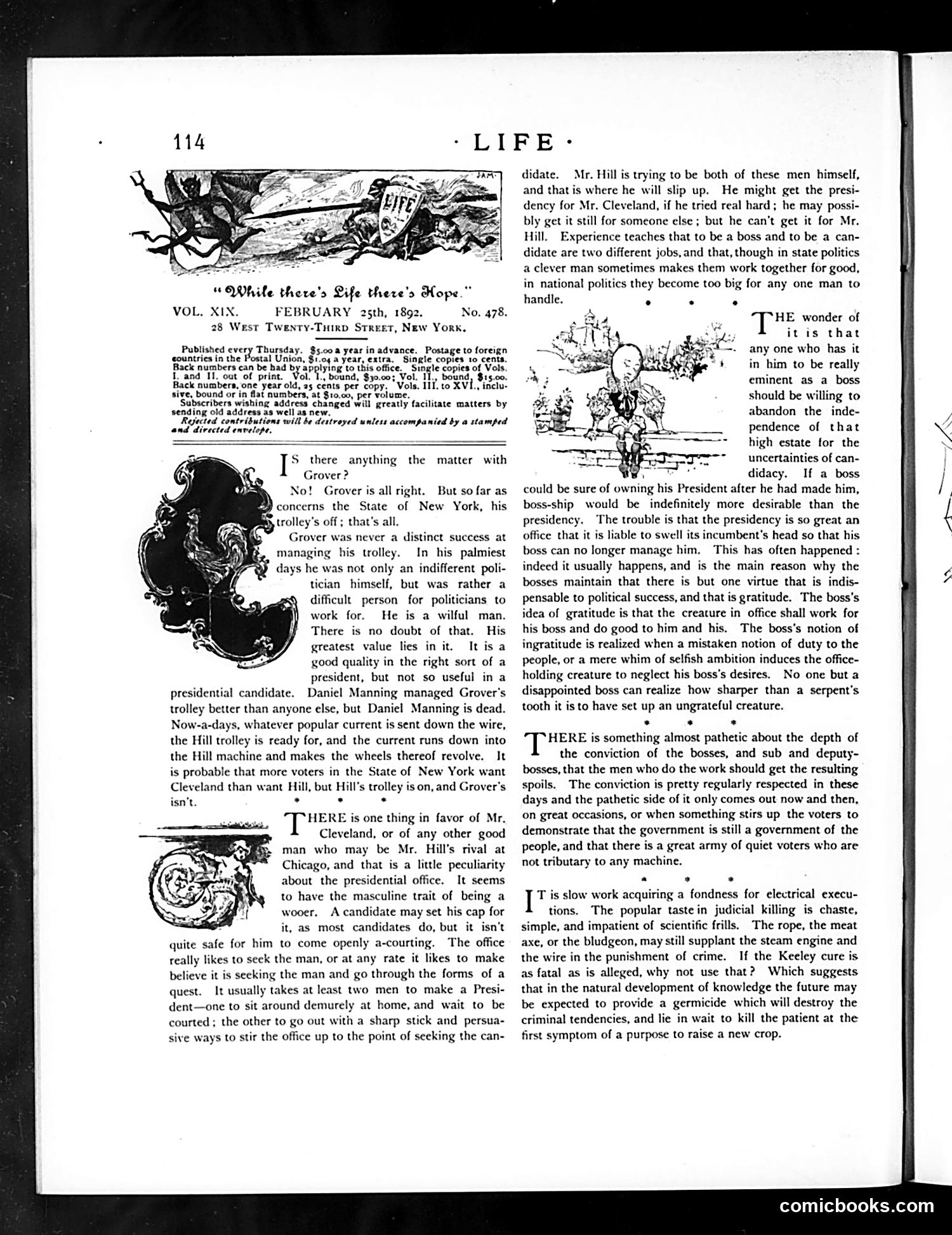
This political commentary discusses New York State politics and the presidential office. The text critiques **Grover Cleveland** versus an alternative candidate (likely **David B. Hill**, New York's governor), examining their fitness for the presidency. The central argument concerns whether a boss should abandon political independence for high office. The author argues that truly eminent bosses are reluctant to seek the presidency because they'd lose control of their political machine—a position offering more reliable power than the presidency itself. The text notes that Hill's political faction currently dominates New York state politics, overshadowing the Cleveland alternative. The piece explores the tension between maintaining local political power versus pursuing higher national office. The illustrated vignettes appear decorative rather than directly representing specific figures.
📄 Transcribed text from this page (OCR, searchable)
Machine-transcribed from the original scan — historical spelling and the odd misread are preserved.
-LIFE- VOL, XIX. FEBRUARY 25th, 1892. No. 478. 28 West Twenty-Tuirp Street, New York. Published every Thursday. $s.ooa year in advance. Postage to foreign countries in the Postal Union, $1.04 a year, extra, Single copies to cents. Back numbers can be bad by applying to this office. Single copies of Vols I. and If. out of print. Vol. 1., bound, $30.00; Vol. II., bound, $15.00. Back numbers, one year old, a5 cents per copy. Vols. III. to XVI, inclu- sive, bound or in flat numbers, at $0.00, per volume. ubscribers wishing address changed will greatly facilitate matters by sending old address as well as new, Rejected contributions will be destroyed unless accompanied by a stamped and directed envelope. ie there anything the matter with Grover ? No! Grover is all right. But so far as concerns the State of New York, his trolley’s off ; that’s all. Grover was never a distinct success at managing his trolley. In his palmiest } days he was not only an indifferent poli- tician himself, but was rather a difficult, person for politicians to work for. He is a wilful man. There is no doubt of that. His greatest value lies in it. It is a good quality in the right sort of a president, but not so useful in a presidential candidate. Daniel Manning managed Grover's trolley better than anyone else, but Daniel Manning is dead. Now-a-days, whatever popular current is sent down the wire, the Hill trolley is ready for, and the current runs down into the Hill machine and makes the wheels thereof revolve. It is probable that more voters in the State of New York want Cleveland than want Hill, but Hill's trolley is on, and Grover's isn’t. bd bd . HERE is one thing in favor of Mr, Cleveland, or of any other good man who may be Mr. Hill’s rival at Chicago, and that is a little peculiarity about the presidential office. It seems to have the masculine trait of being a wooer. A candidate may set his cap for it, as most candidates do, but it isn’t quite safe for him to come openly a-courting. The office really likes to seck the man, or at any rate it likes to make believe it is seeking the man and go through the forms of a quest. It usually takes at least two men to make a Presi- dent—one to sit around demurely at home, and wait to be courted ; the other to go out with a sharp stick and persua- sive ways to stir the office up to the point of seeking the can- didate. Mr. Hill is trying to be both of these men himself, and that is where he will slip up. He might get the presi- dency for Mr. Cleveland, if he tried real hard; he may possi- bly get it still for someone else ; but he can’t get it for Mr. Hill. Experience teaches that to be a boss and to be a can- didate are two different jobs, and that, though in state politics a clever man sometimes makes them work together for good, in national politics they become too big for any one man to handle. ° z HE wonder of itis that any one who has it in him to be really eminent as a boss should be willing to abandon the inde- pendence of that high estate for the uncertainties of can- . didacy. If a boss could be sure of owning his President after he had made him, boss-ship would be indefinitely more desirable than the presidency, The trouble is that the presidency is so great an office that it is liable to swell its incumbent's head so that his boss can no longer manage him, This has often happened : indeed it usually happens, and is the main reason why the bosses maintain that there is but one virtue that is indis- pensable to political success, and that is gratitude. The boss's idea of gratitude is that the creature in office shall work for his boss and do good to him and his. The boss's notion of ingratitude is realized when a mistaken notion of duty to the people, or a mere whim of selfish ambition induces the office- holding creature to neglect his boss's desires. No one but a disappointed boss can realize how sharper than a serpent's tooth it is to have set up an ungrateful creature. . . . HERE is something almost pathetic about the depth of the conviction of the bosses, and sub and deputy- bosses, that the men who do the work should get the resulting spoils. The conviction is pretty regularly respected in these days and the pathetic side of it only comes out now and then, on great occasions, or when something stirs up the voters to demonstrate that the government is still a government of the people, and that there is a great army of quiet voters who are not tributary to any machine. « * . I T is slow work acquiring a fondness for electrical execu- tions. The popular taste in judicial killing is chaste, simple, and impatient of scientific frills. The rope, the meat axe, or the bludgeon, may still supplant the steam engine and the wire in the punishment of crime. If the Keeley cure is as fatal as is alleged, why not use that? Which suggests that in the natural development of knowledge the future may be expected to provide a germicide which will destroy the criminal tendencies, and lie in wait to kill the patient at the first symptom of a purpose to raise a new crop. comicbooks.com AA