
A complete issue · 22 pages · 1892
Life — February 11, 1892
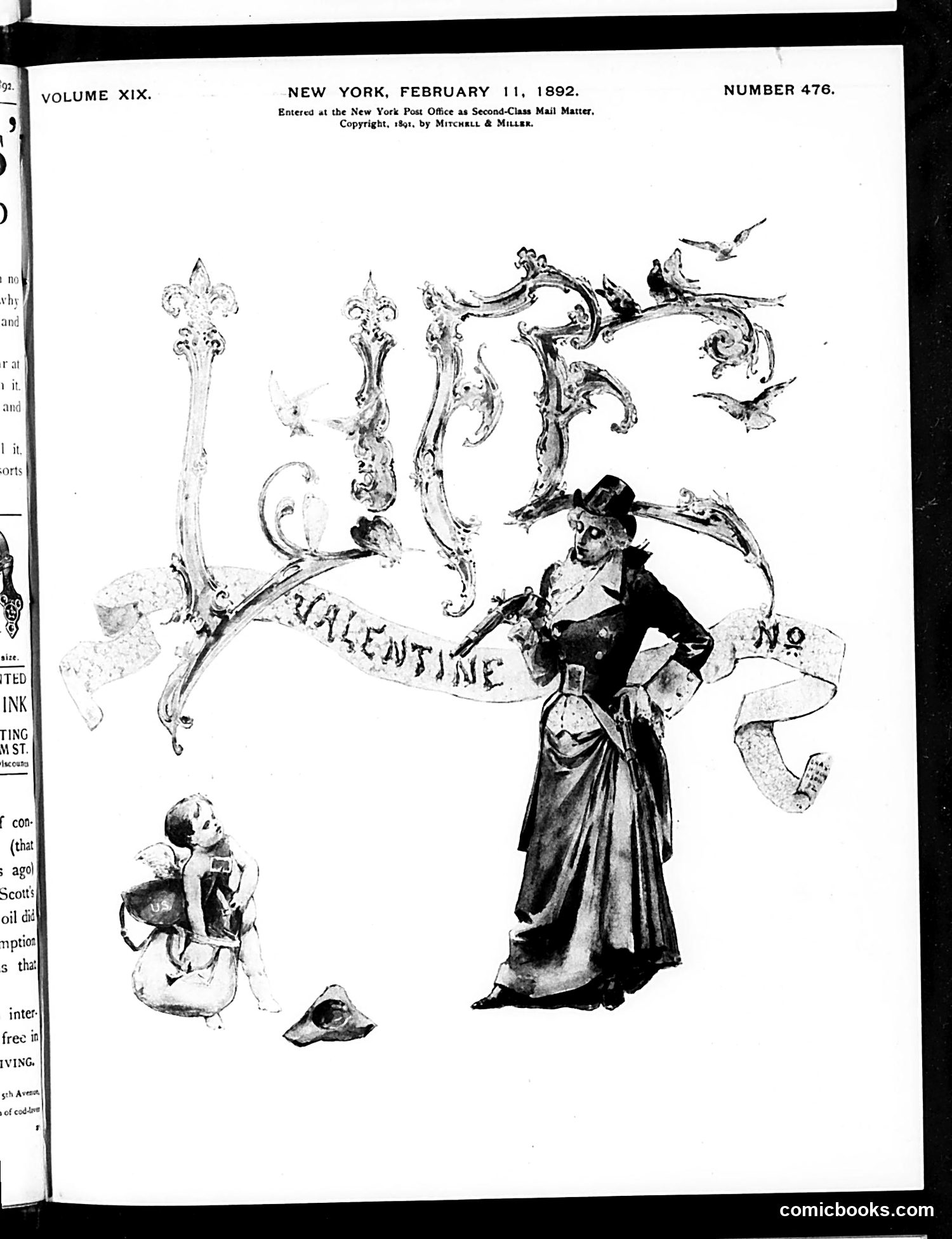
This is a satirical Valentine's Day cartoon from *Life* magazine. A woman in Victorian dress stands holding a large floral arrangement with stylized, thorny branches forming the word "LOVE" above her head. A banner reading "VALENTINE" crosses the composition, with a "No" label visible on the right side. Below, a smaller figure (possibly representing a rejected suitor or disappointed lover) sits dejected. The overall message appears to be a cynical commentary on Valentine's Day romance—juxtaposing the flowery rhetoric of love ("LOVE," "VALENTINE") with rejection and disappointment ("No"). The thorny branches reinforce this ironic contrast between love's idealized presentation and its painful reality.
This page is **primarily advertising** with a decorative illustration at the top rather than editorial political cartoon content. The top illustration depicts a Victorian-era domestic scene—a woman in a chair, a man standing, and a servant with a dog near a fireplace—likely promoting Gorham Manufacturing's chafing dishes and serving ware. The text emphasizes these are "superior quality, constructed of hard metal, silver soldered and very heavily silver-plated." Below are three separate advertisements: Liebig Company's beef extract (showing cattle herding), and Hollanders' dress shop advertising spring/summer fabrics with a note that prices will increase after March 1st. This is a commercial page with no discernible political satire or social commentary—typical of *Life* magazine's mixed editorial and advertising content from the late 19th or early 20th century.
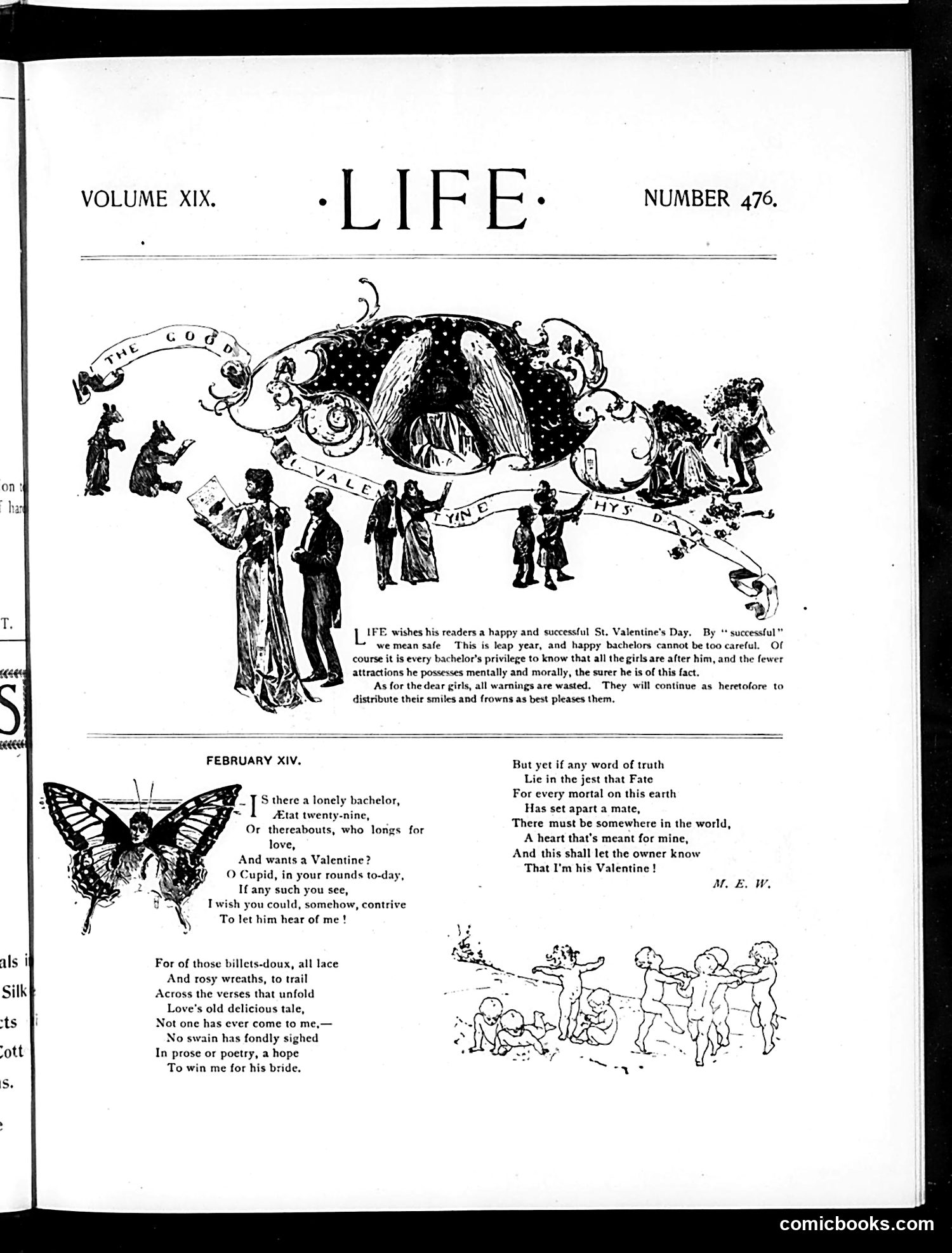
This is a **Valentine's Day special issue** (February 14) of Life magazine. The masthead illustration shows cupids and romantic figures celebrating love. The main content consists of **Valentine's poems and verses** rather than political satire. One poem addresses "a lonely bachelor, / Etat twenty-nine" seeking love, invoking Cupid's help. Another verse expresses hope that romantic gestures—"billets-doux, all lace / And rosy wreaths"—might win someone's heart. The decorative elements include **cherub illustrations** typical of Valentine's Day imagery of that era. Rather than political commentary, this page is **entertainment and romantic humor** aimed at the magazine's readers around the Valentine's Day holiday, with light verse about courtship and bachelor longing.
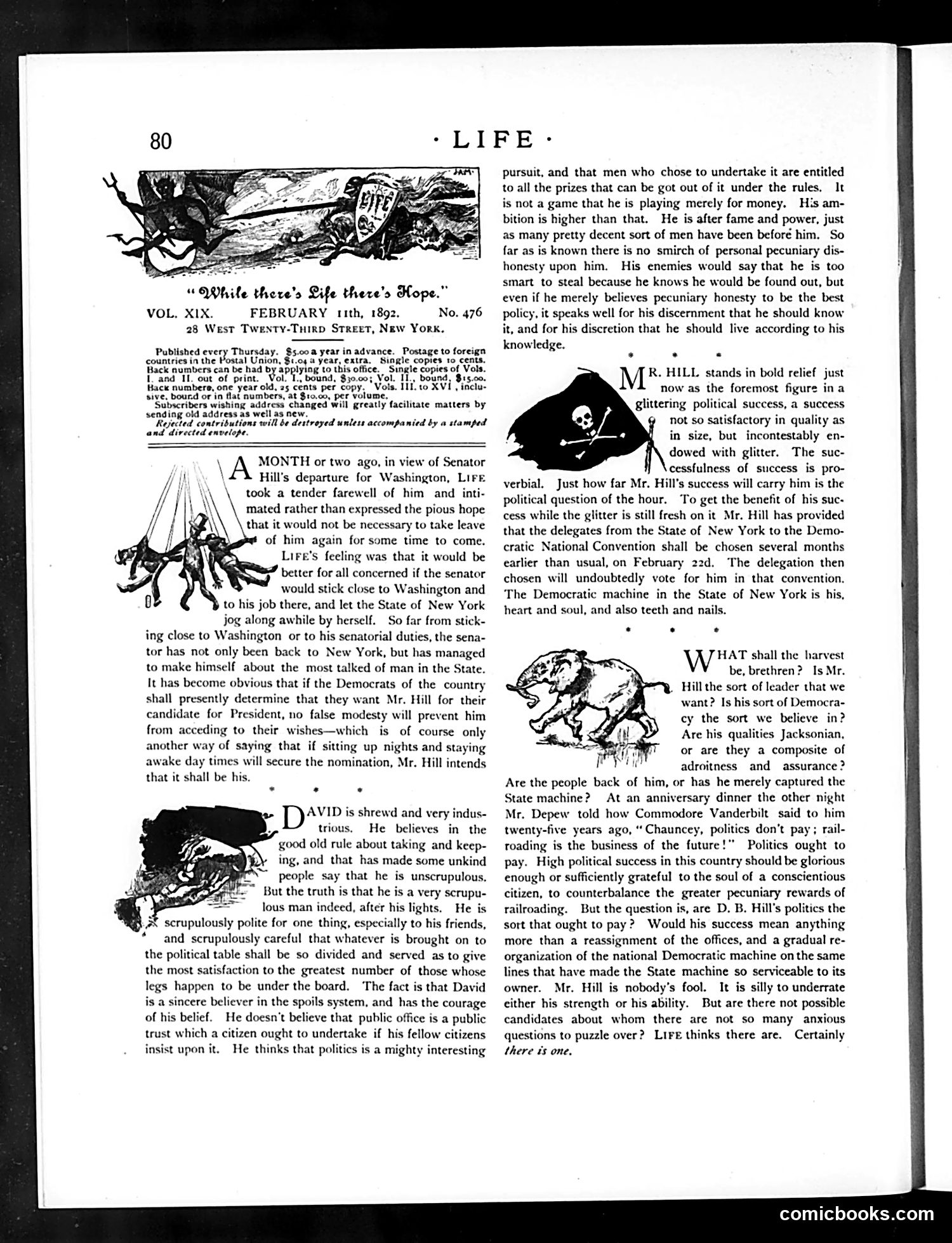
This page discusses Senator David B. Hill of New York, a prominent Democratic politician. The text is decidedly critical of Hill's political ambitions and character. The main cartoon (top left) illustrates Hill's departure for Washington, showing him being pulled in multiple directions—a visual metaphor for his divided loyalties between his Senate duties and State politics. The article questions whether Hill possesses the qualities needed for higher office, particularly the Democratic presidential nomination. The writer expresses skepticism about Hill's integrity, suggesting his political success comes from machine politics rather than genuine leadership or public service. The piece implies Hill is more beholden to New York's Democratic machine than to principled governance, questioning whether such a candidate deserves the party's nomination.
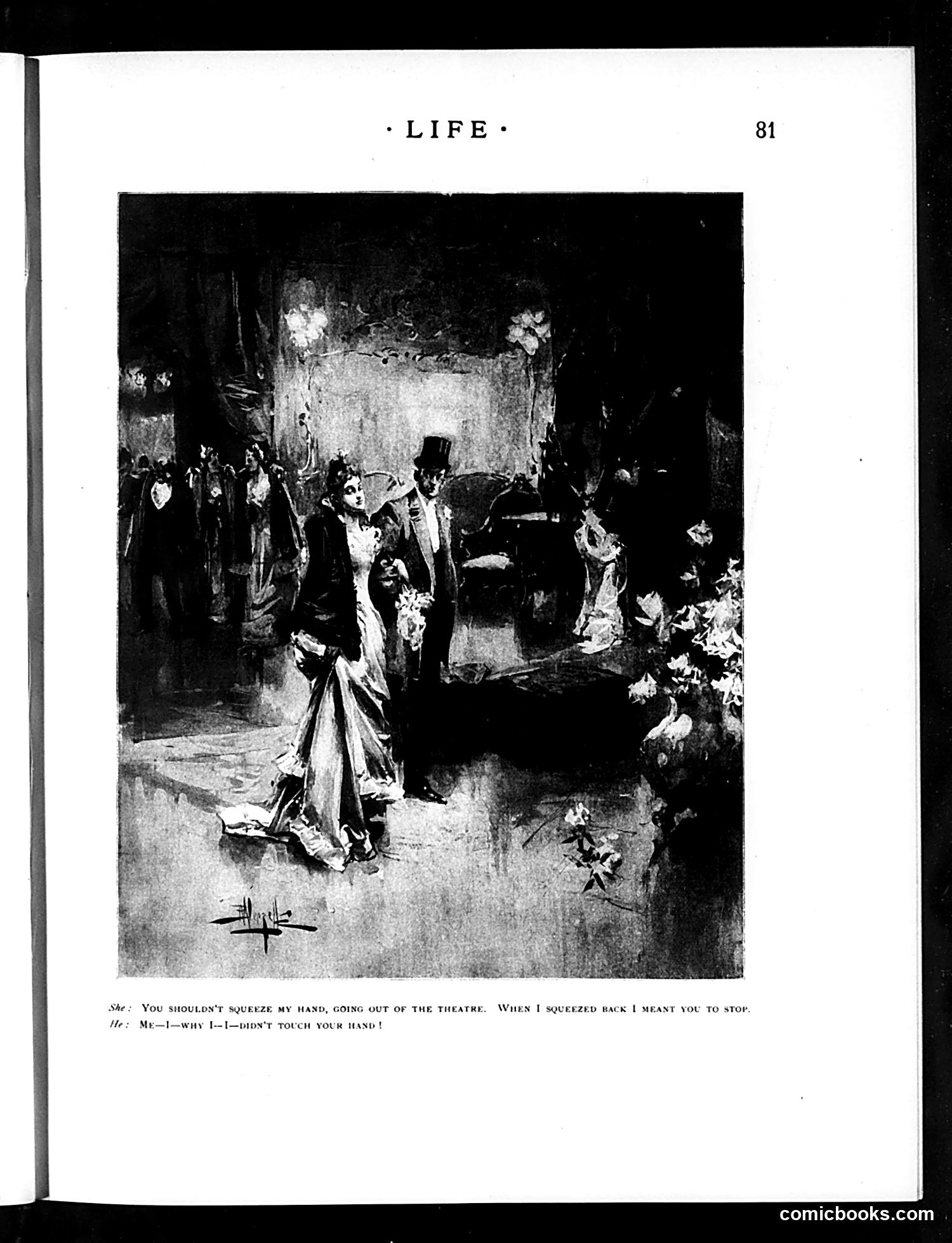
This appears to be a theatrical or social scene illustration from Life magazine's humor section (page 31). The image shows an elegant indoor gathering with multiple figures in formal evening dress, centered on a couple in the foreground. The dialogue below reveals the joke's domestic humor: A woman tells a man "You shouldn't squeeze my hand, going out of the theatre. When I squeezed back I meant you to stop." The man responds, "Me?—Why I—I didn't touch your hand!" This is a classic misunderstanding gag about social awkwardness and miscommunication in courtship. The humor relies on the characters' confusion over whose hand was actually being held—suggesting a third person may have been involved, or highlighting the embarrassment of romantic uncertainty in formal social settings.
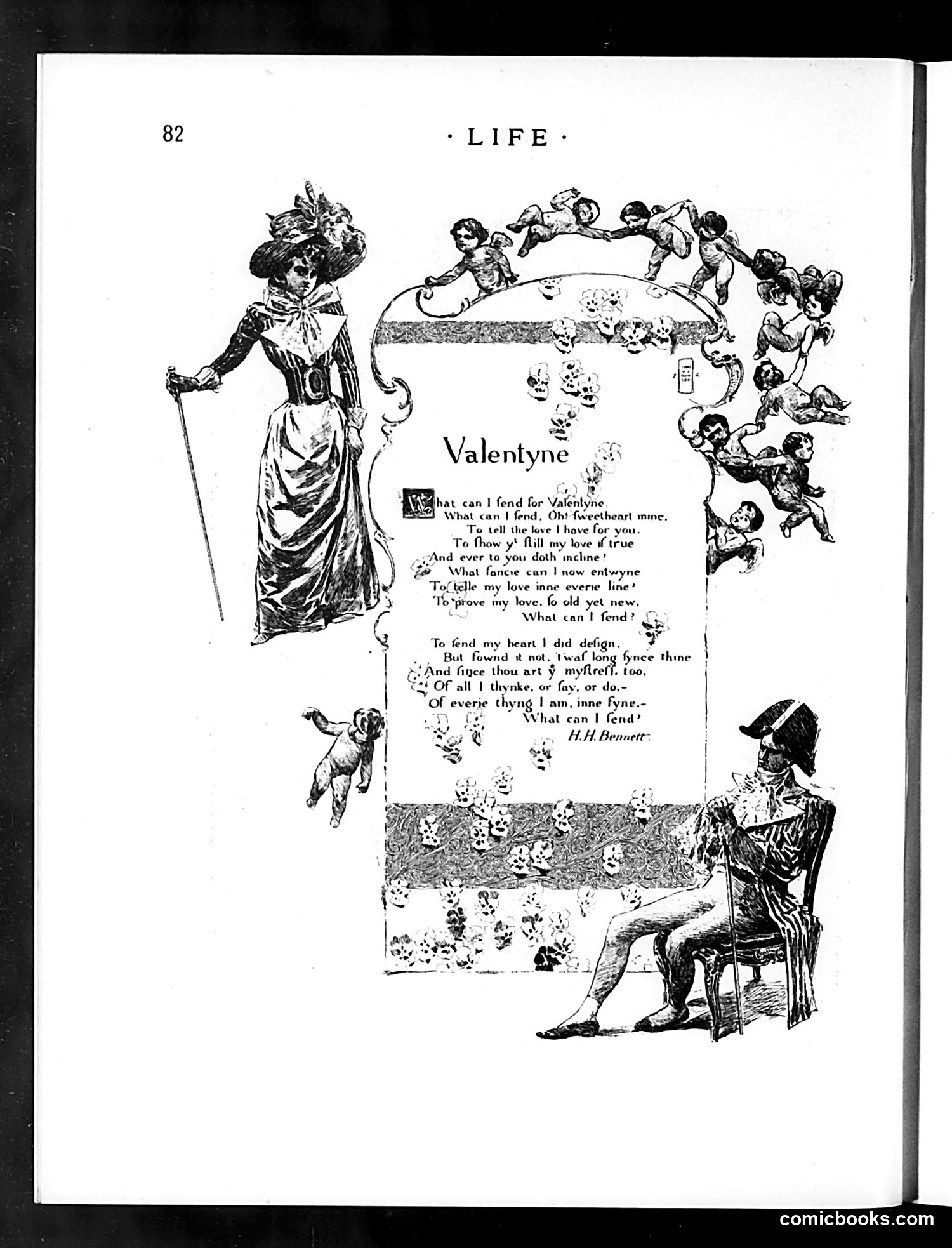
This page presents a Valentine's Day poem by H.H. Bennett titled "Valentyne," playing on the archaic spelling. The illustration depicts a romantic scene with decorative cherubs surrounding a central text panel. The left side shows an elegantly dressed woman in Edwardian fashion holding a fan and cane—typical of early 1900s society lady portraiture. The right side shows a seated gentleman in period dress. Cherubs and cupids frame the composition, reinforcing the Valentine's theme. The poem itself is romantic verse exploring the speaker's inability to adequately express their love: "What can I fend for Valentyne... What can I lend?" The satire lies in the grandiose, flowery language attempting to capture love's complexity, typical of Life's gentle mockery of sentimental conventions.
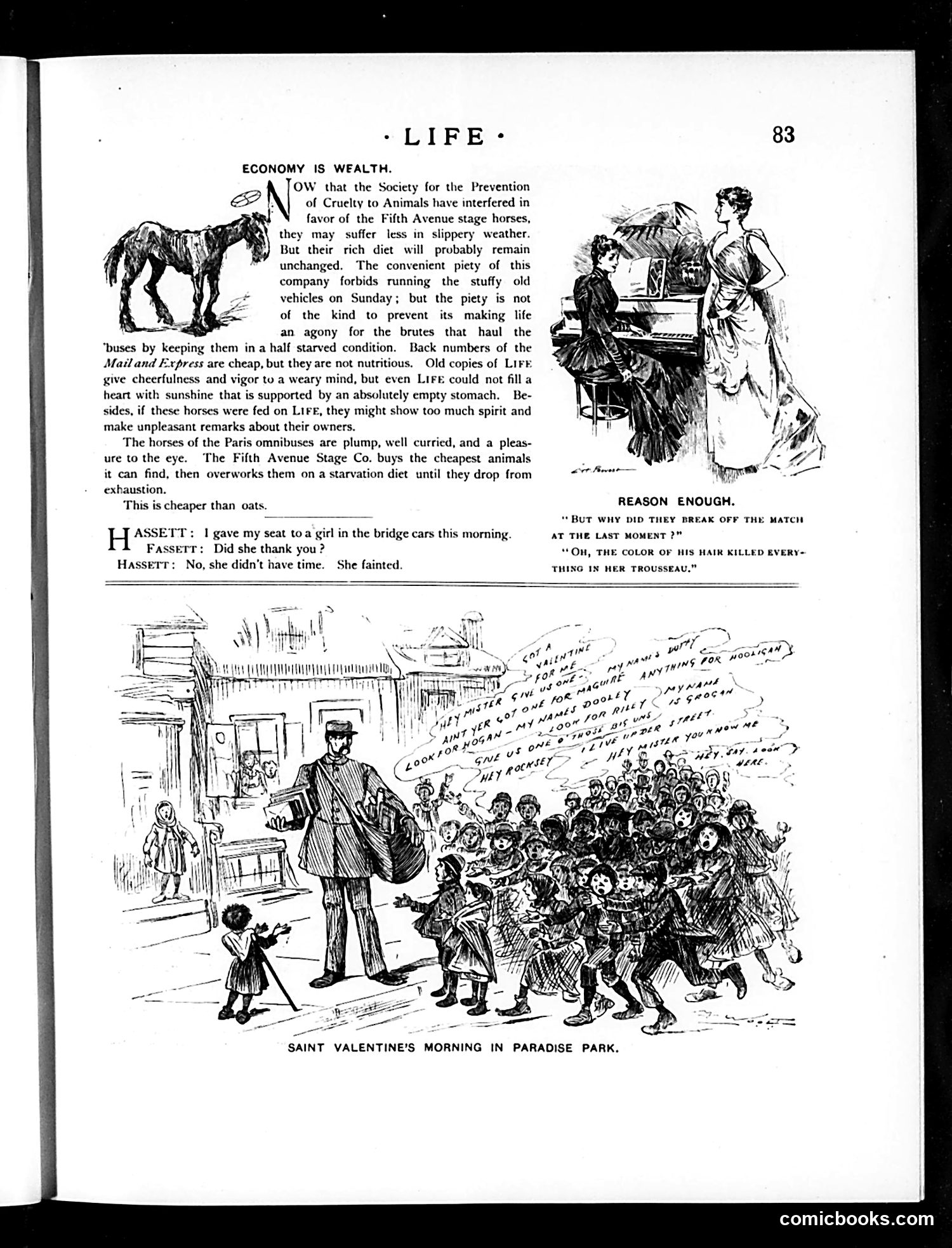
This Life magazine page contains two satirical pieces critiquing animal welfare and urban charity: **Top section** ("Economy is Wealth"): Attacks the Society for the Prevention of Cruelty to Animals for interfering with Fifth Avenue stage horses' working conditions while ignoring their poor diet. The satire suggests the organization's "convenient piety" is performative—concerned with optics rather than substantive animal care. It notes the Fifth Avenue Stage Co. overworks underfed horses cheaply, calling this "cheaper than oats." **Bottom cartoon** ("Saint Valentine's Morning in Paradise Park"): Depicts a well-dressed gentleman distributing small gifts to a crowd of poor children. The satire appears to mock performative charity—the gentleman's generous gesture photographed or publicized, while systemic poverty remains unaddressed. The children's desperate enthusiasm contrasts with the casual nature of token charitable acts. Both pieces target hypocrisy in Progressive-era reform movements.
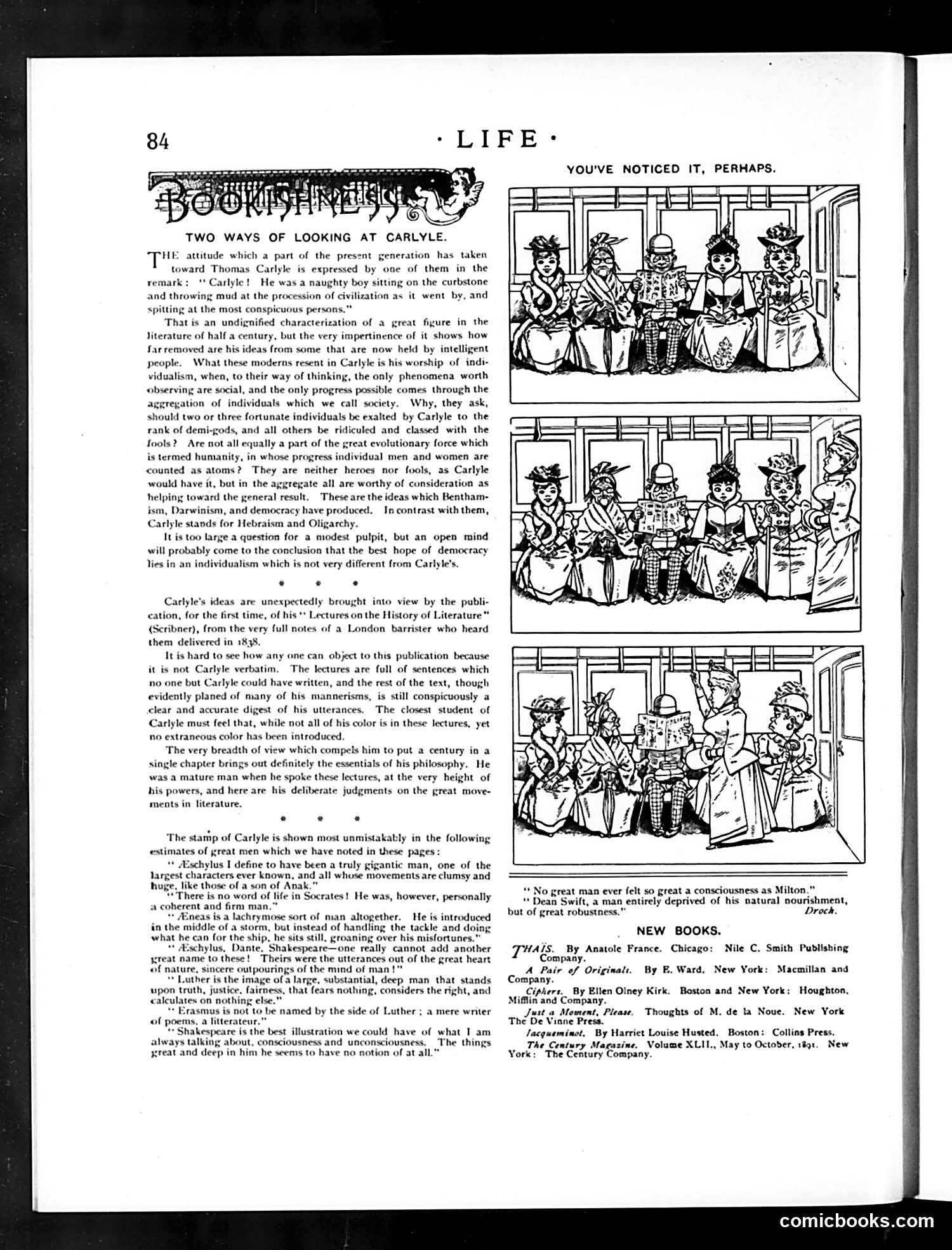
This page discusses **Thomas Carlyle**, the 19th-century Scottish philosopher and historian. The text critiques how modern readers have misunderstood Carlyle's philosophy, particularly his ideas about "great men" and individualism. The three cartoons on the right, titled "TWO WAYS OF LOOKING AT CARLYLE," appear to show the same social scene interpreted differently—likely contrasting Carlyle's elitist "great man" theory of history with a more democratic, egalitarian view. The images show groups of figures in what appears to be a parlor setting, suggesting how one's philosophical perspective shapes interpretation of everyday society. The page concludes with a "NEW BOOKS" section listing recent publications, indicating this is a literary review page from an American satirical magazine.
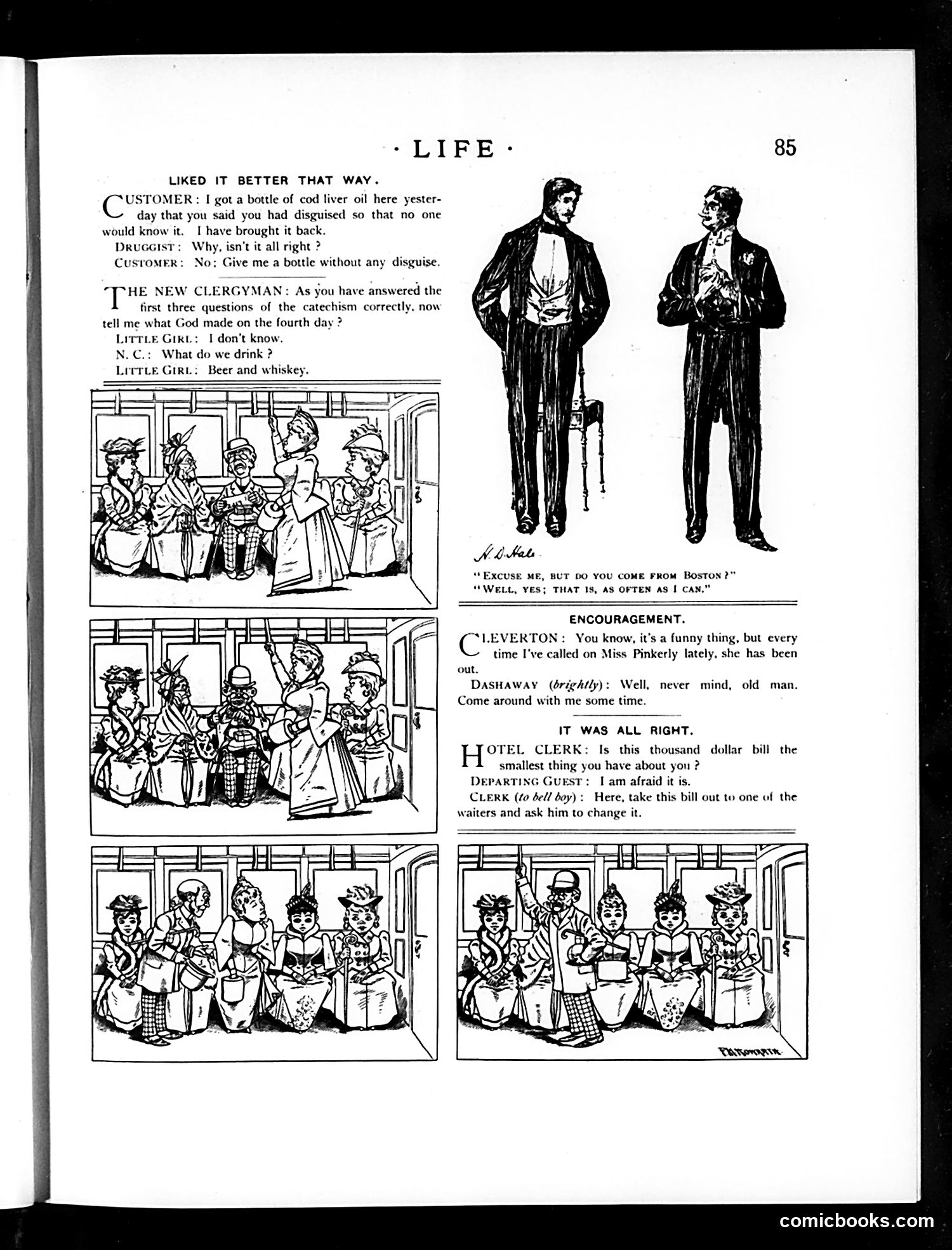
This page contains several unrelated short humor pieces typical of *Life* magazine's format: 1. **"Liked It Better That Way"**: A customer complains about disguised cod liver oil; the druggist refuses to disguise it. Satirizes both commercial deception and the bitter taste of medicinal remedies. 2. **"The New Clergyman"**: A child answers catechism questions about God's creation with "beer and whiskey"—satirizing either poor religious education or implied adult drinking culture affecting children's knowledge. 3. **Four comic strips** show domestic/social scenes with women (appears to be a continuing narrative), though the specific jokes are unclear from this reproduction. 4. Additional brief jokes about clergy visits, hotel clerks, and guest interactions follow standard *Life* format: quick satirical observations on everyday life and social pretense.
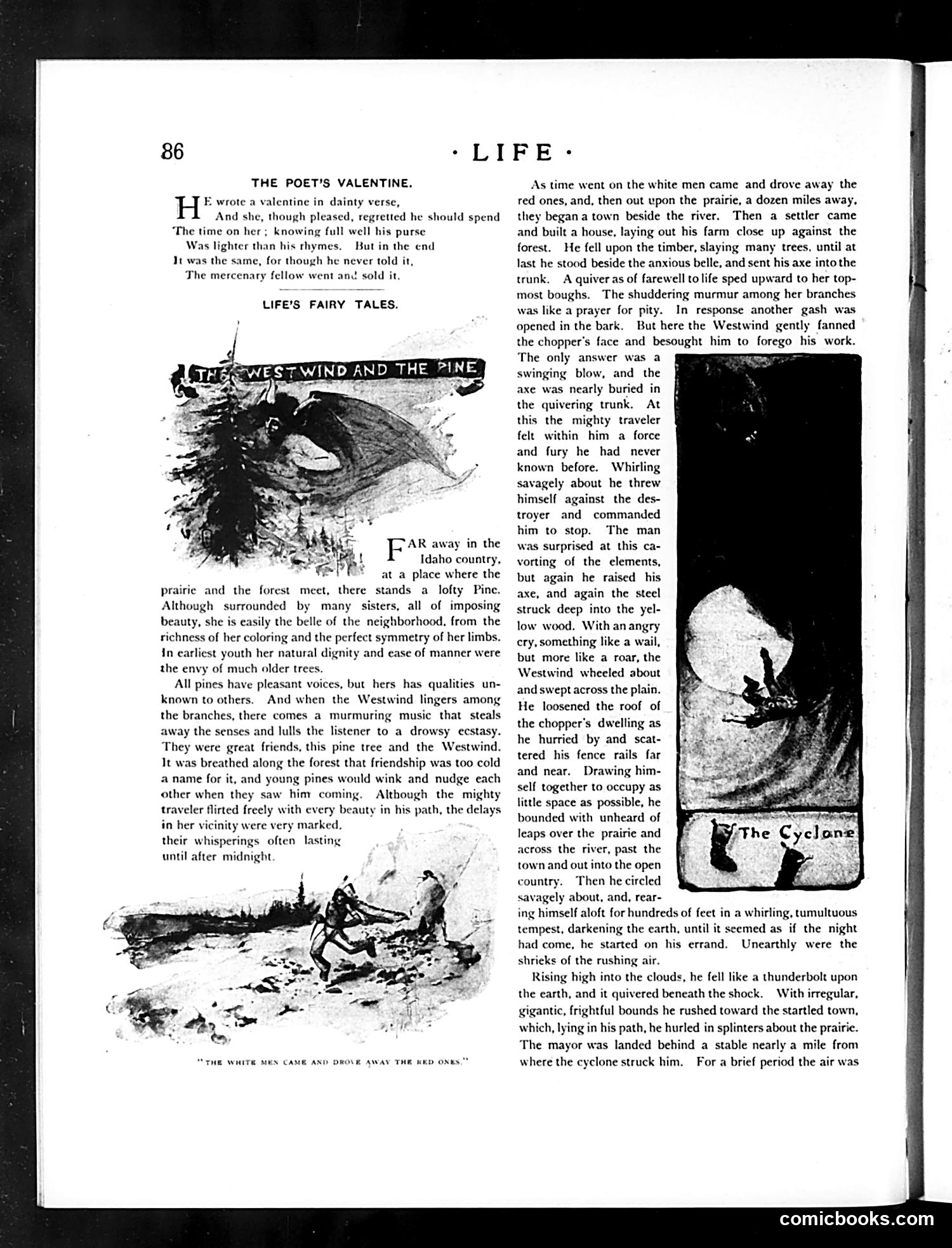
This page contains two distinct pieces of fiction rather than political satire: 1. **"The Poet's Valentine"** - A short romantic poem about a man writing verse to a woman, seemingly light verse commentary on courtship customs. 2. **"Life's Fairy Tales: The West Wind and the Pine"** - A pastoral fantasy story illustrated with engravings. It describes a lofty pine tree in Idaho surrounded by forest, befriended by the West Wind. The narrative follows their relationship and includes dramatic action involving a cyclone that devastates the landscape. Neither piece contains political commentary, caricature, or satire. These appear to be entertainment features typical of *Life* magazine's literary content during this era—offering readers imaginative fiction alongside humor and social observation found elsewhere in the publication.
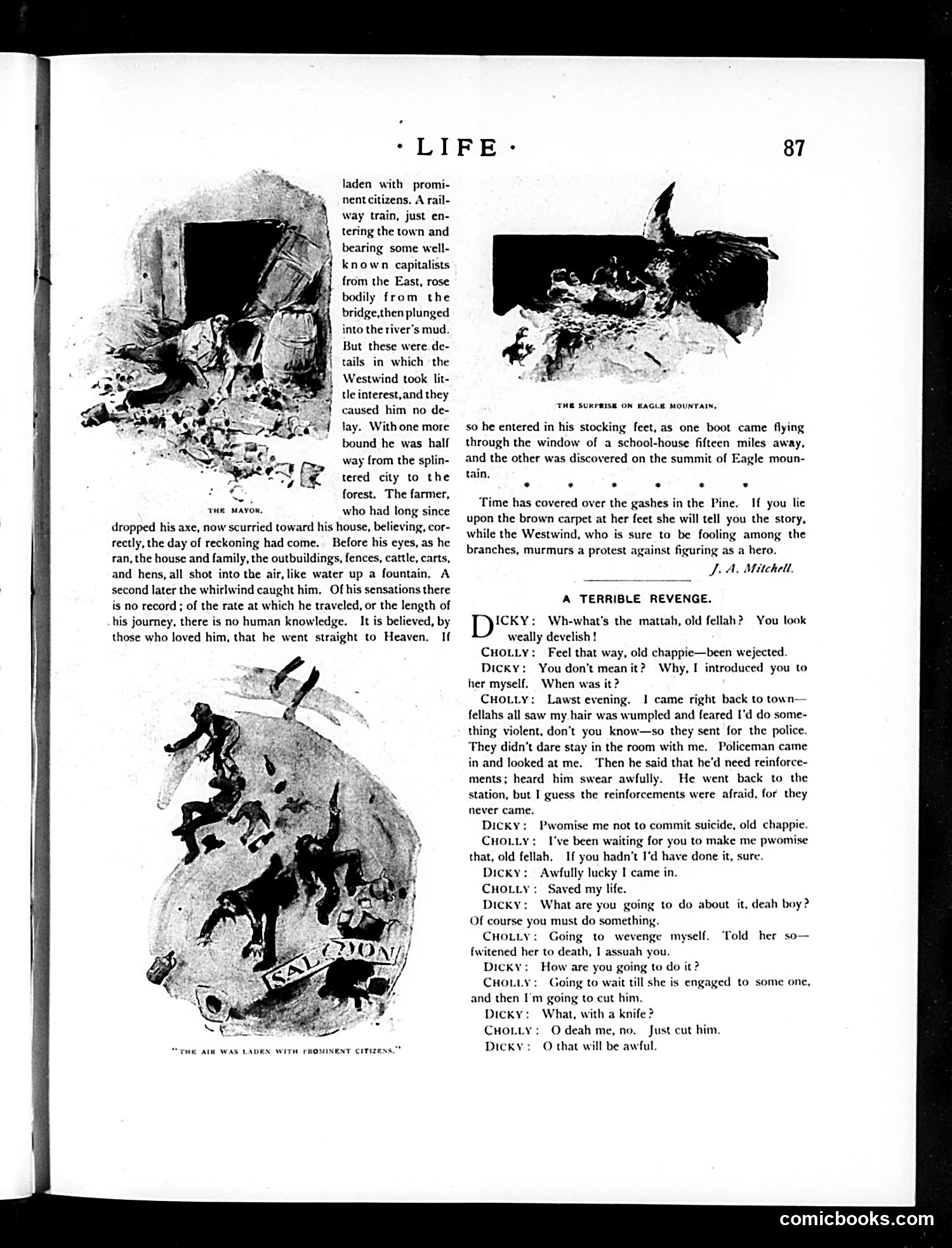
This page contains two illustrated scenes with satirical captions. "The Mayor" depicts a figure dropping an axe near a house, with text describing a farmer's journey from a "splintered city to the forest"—likely satirizing urban corruption or mismanagement forcing citizens to flee. The caption suggests the mayor is complicit in the city's decay. The lower illustration, titled "The Air Was Laden With Prominent Citizens," shows figures falling from an aircraft, accompanying a narrative about a train crash involving "well-known capitalists from the East." The satire mocks wealthy Eastern businessmen, suggesting their prominence doesn't protect them from disaster—a commentary on class vulnerability or divine retribution against the privileged. Both cartoons employ dark humor to critique early 20th-century American social hierarchies.
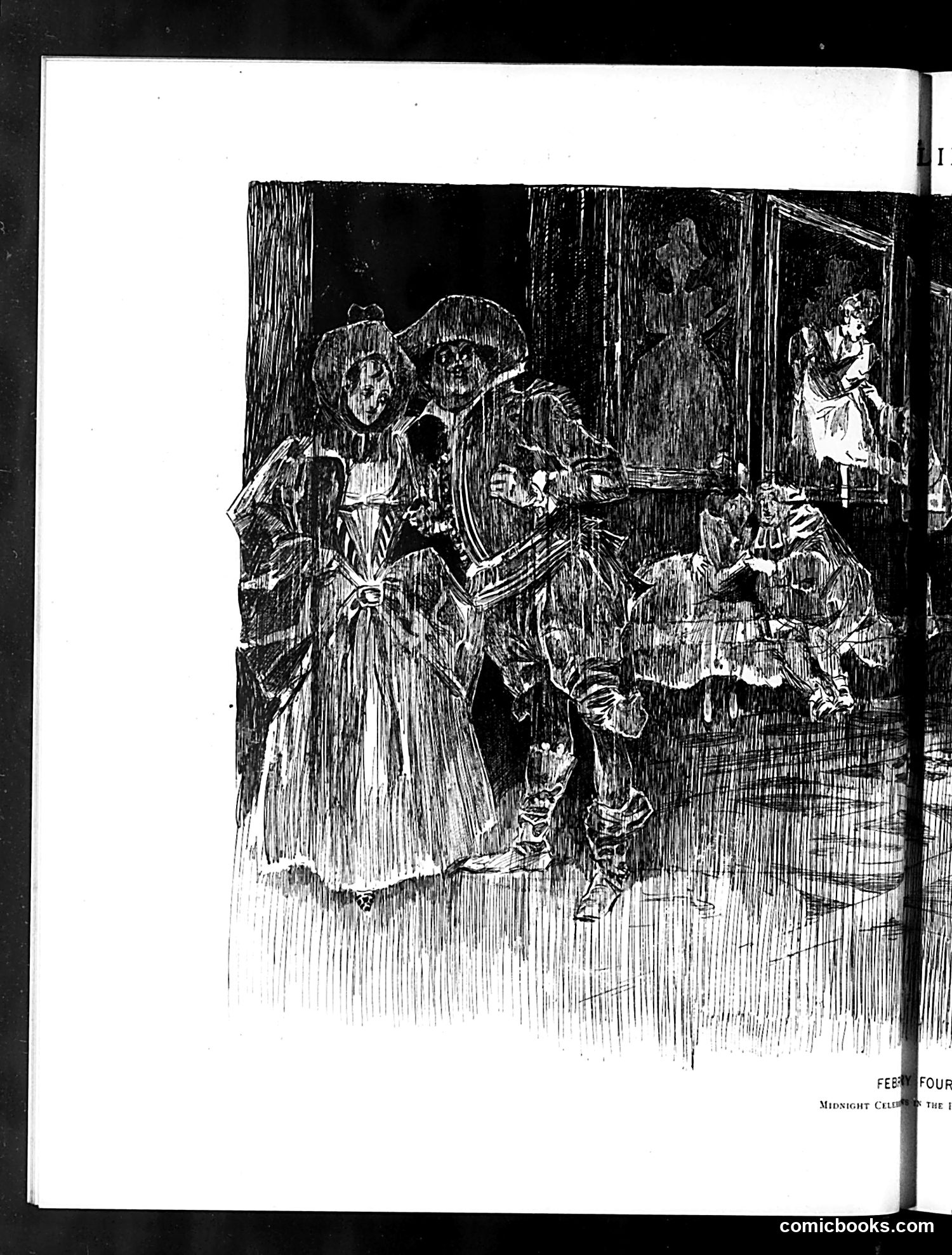
This page appears to be an illustration from Life magazine, though the OCR text provides minimal context. The etching shows a formal indoor scene with multiple figures in period costume (appearing to be 18th or 19th century dress). A woman in an elaborate long dress stands prominently on the left, while military or formal-dressed men surround her. Additional figures are visible in the background, and a woman appears in a doorway at upper right. Without clearer caption text, I cannot definitively identify the specific political or social satire intended. The formal gathering and elaborate costumes suggest this depicts either a historical event, a theatrical scene, or satirizes contemporary high-society behavior. The page reference "FERNY FOUR" and partial text about "MIDNIGHT CLUBS" appear at bottom but are too fragmentary to interpret with confidence.
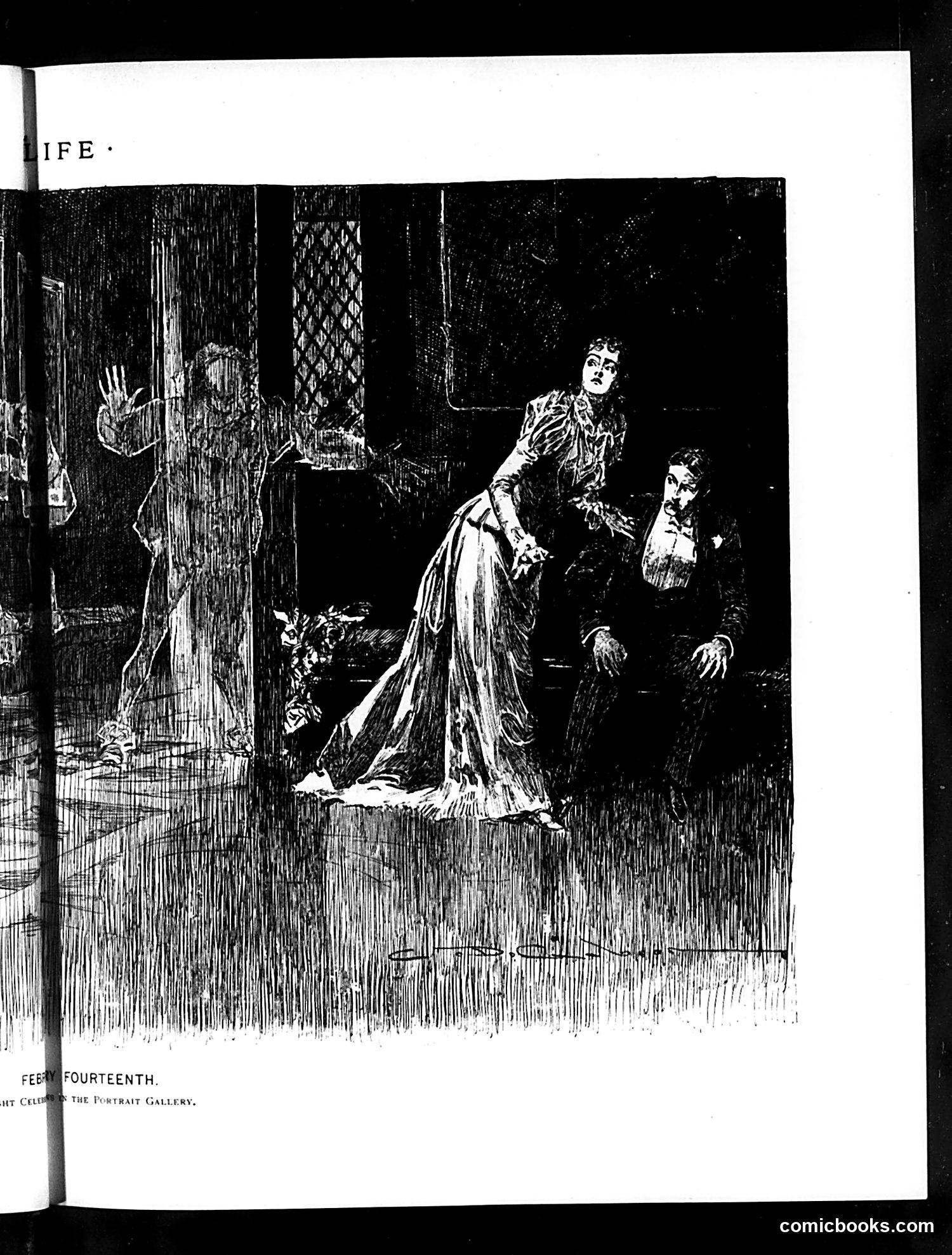
This appears to be a satirical illustration dated February 14th (Valentine's Day), depicting what seems to be an upper-class romantic or social scenario. The engraving shows a woman in an elaborate gown with a train, positioned prominently while a man in formal evening wear sits nearby. A ghostly or ethereal figure appears in the background. The satire likely comments on Valentine's Day courtship rituals among the wealthy, possibly mocking affected romantic gestures or social pretense. The theatrical composition and the contrast between the elegantly dressed figures and the mysterious background figure suggest commentary on Victorian-era romance and upper-class social performances. Without additional context from surrounding pages, the specific targets of the satire remain unclear.
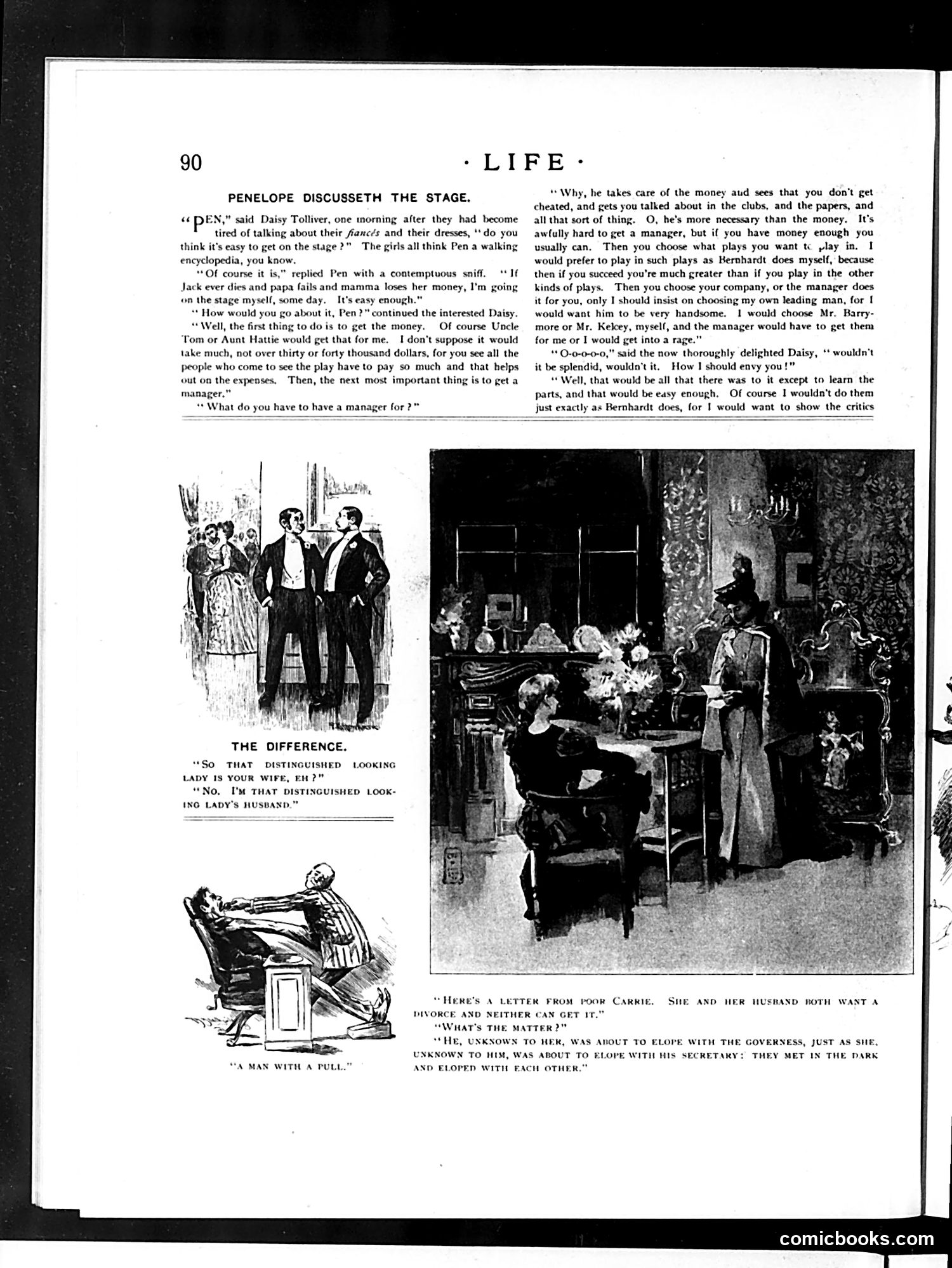
This page contains three separate satirical pieces mocking upper-class pretension and marital dynamics: **"Penelope Discusseth the Stage"** ridicules a wealthy young woman's naive assumptions about theatrical careers. Penelope casually claims entering theater is "easy," then reveals her actual plan: use family money ($30-40k) to hire a famous manager, secure handsome leading men like Barrymore, and upstage Sarah Bernhardt. The satire targets her obliviousness—she thinks money and connections equal talent. **"The Difference"** is a brief joke about social status: the "distinguished looking lady" is actually someone's *wife*, while the "distinguished looking man" is identified by his *husband*—implying women gain status through marriage while men lose it. **"Here's a Letter from Poor Carrie"** satirizes marital infidelity: Carrie's husband unknowingly planned to elope with the governess while Carrie planned to elope with his secretary. They "eloped with each other" instead—a darkly comic resolution where mutual betrayal leads to mutual departure. All three pieces mock wealthy society's superficiality and moral emptiness.
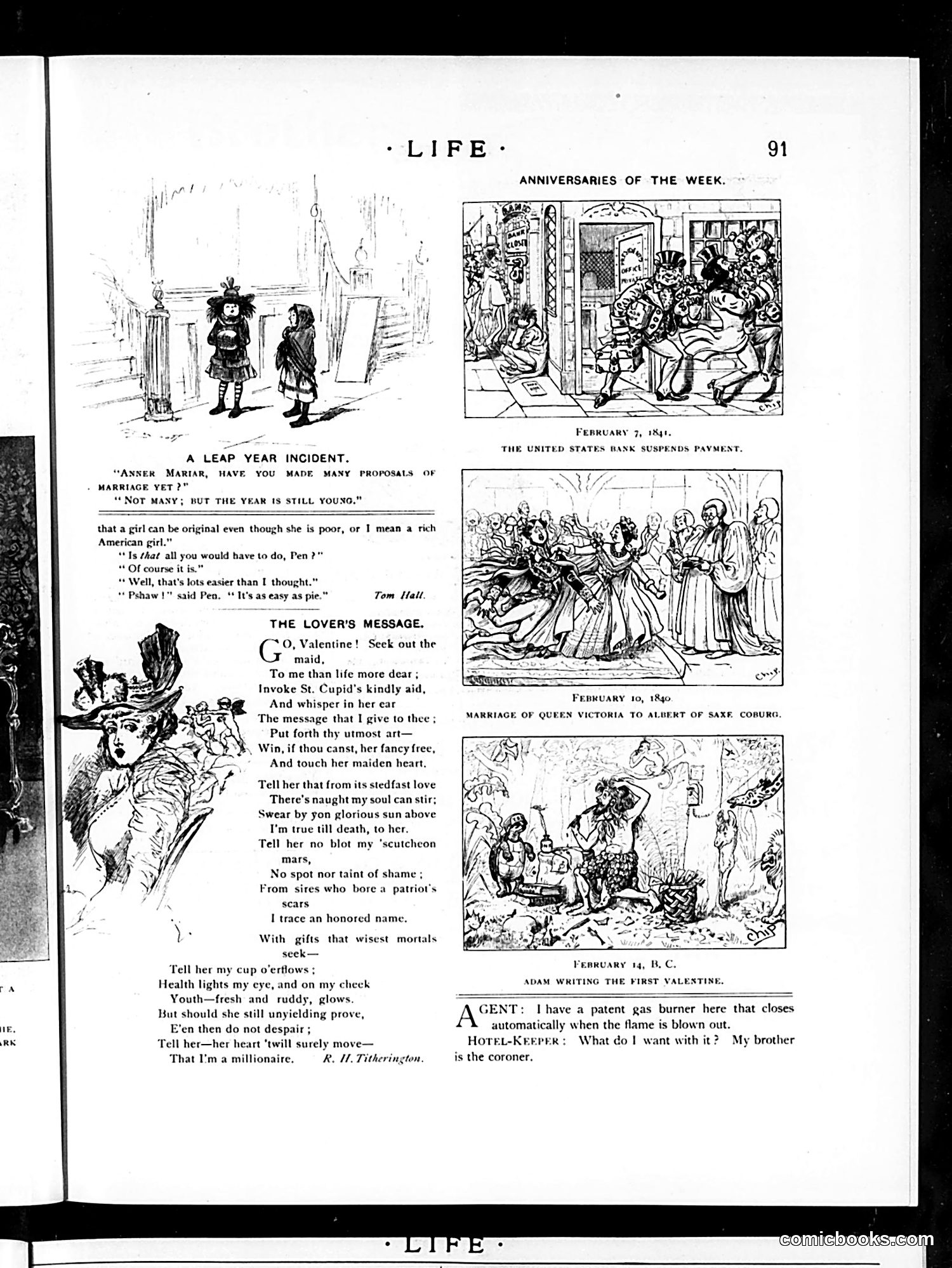
This page from Life combines satirical commentary on courtship customs with historical anniversaries. **"A Leap Year Incident"** jokes about the tradition allowing women to propose to men in leap years. A young woman boasts she's made proposals because "the year is still young," subverting gender norms—though the joke turns on whether she means poor or rich American girls. **"The Lover's Message"** is a Valentine's poem satirizing materialistic courtship. The suitor lists virtues—noble ancestry, health, youth—but the punchline reveals his real appeal: "That I'm a millionaire." This mocks how wealth trumps genuine romantic merit. The page's "Anniversaries of the Week" mark significant dates: the 1841 bank suspension (financial panic), Queen Victoria's 1840 marriage (celebrity culture), and "Adam Writing the First Valentine" (B.C. dating is obviously absurd). The bottom cartoon shows a hotel-keeper unimpressed by a salesman's gas burner invention, dismissing it because "my brother is the coroner"—implying the device's failure would be profitable for undertakers.
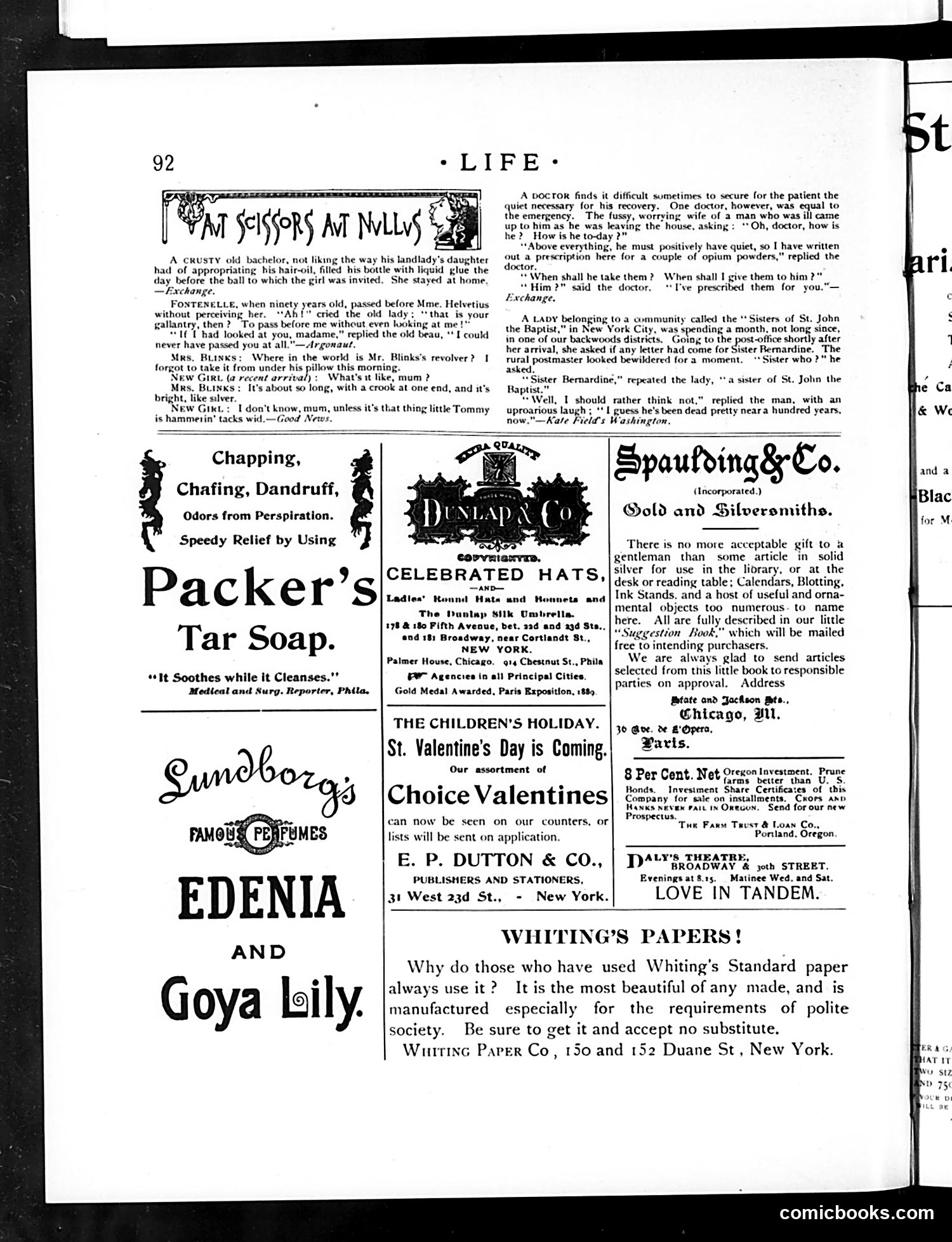
This page contains three brief satirical anecdotes with a distinctly Victorian sensibility, plus period advertising. **The cartoons/jokes:** 1. **"Scissors at Nully's"**: A bachelor fills his landlady's daughter's hair-oil bottle with glue to punish her for taking it without permission. She stays home from a ball with sticky hair—the satire targets the inconvenience and pettiness of the prank rather than its cruelty. 2. **The revolver anecdote**: A new servant mistakes a gun for silverware, satirizing class confusion and the hazards of hiring inexperienced household help. 3. **The doctor's prescription**: A physician prescribes opium powders "for" the patient's fussy wife (not the patient), wryly suggesting wives are the real problem needing sedation—reflects contemporary anxiety about meddling spouses. 4. **The nun joke**: A backwoods postmaster confuses "Sister Bernardine" with a historical figure dead a century, mocking rural ignorance of urban institutions. The page is primarily **advertising** (Packer's Tar Soap, Dunlap Hats, Spalding silverware, etc.).
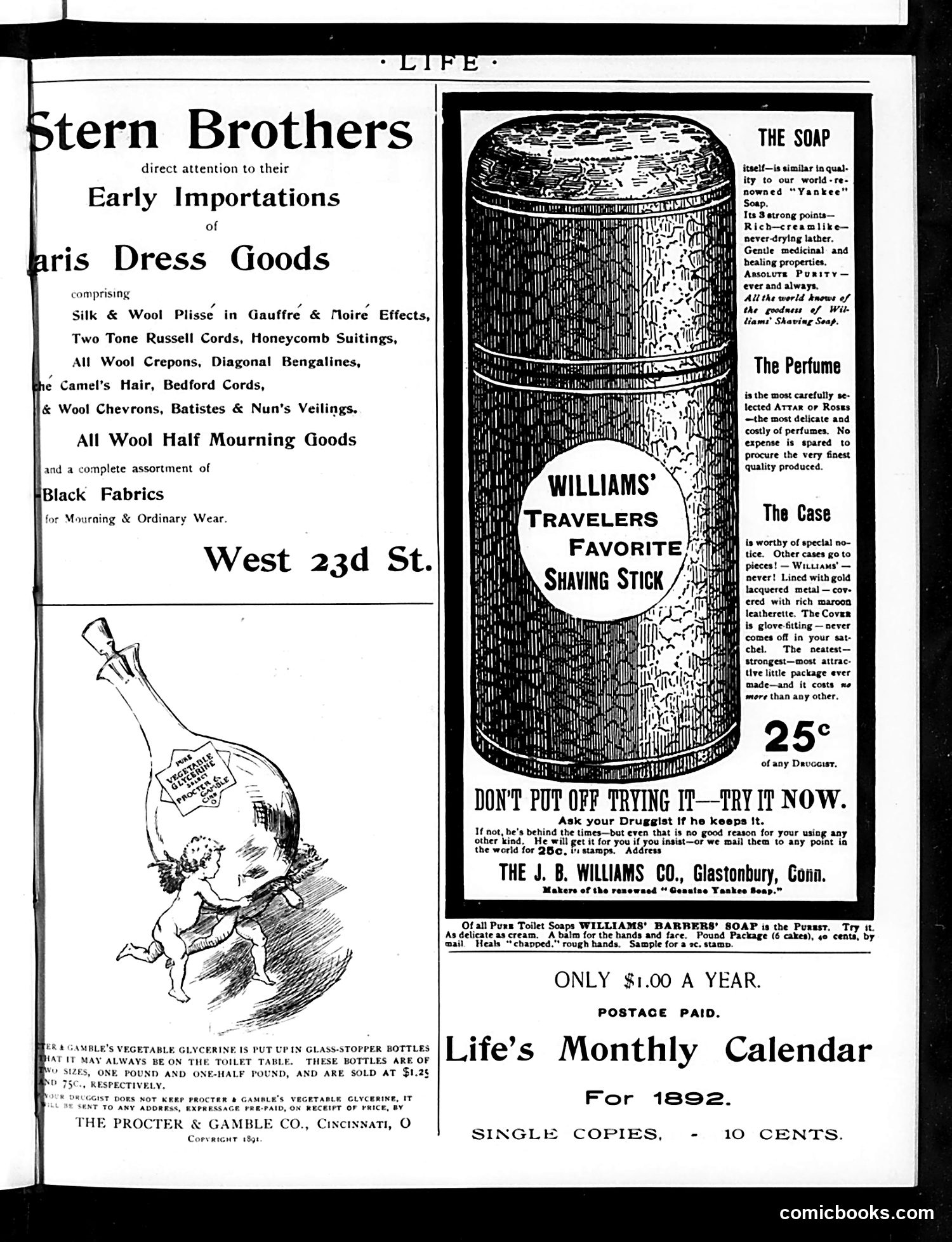
This page is primarily **advertising**, not political satire. It contains: **Left side:** Stern Brothers advertisement for imported Paris dress fabrics (silks, wools, crepe, mourning wear) sold on West 23rd Street, plus a Procter & Gamble glycerine product ad with an illustration of a bottle. **Right side:** Large advertisement for Williams' Travelers Favorite Shaving Stick (25¢), emphasizing its soap quality, perfume, and gold-lined case. The product promises convenience for travelers. **Bottom:** Subscription information for Life's Monthly Calendar for 1892 ($1.00/year). The illustrations are product advertisements rather than political cartoons. The small bottle drawing is simply meant to showcase the glycerine product. This represents typical late-19th-century magazine advertising, combining detailed product descriptions with illustrations to appeal to middle-class consumers.
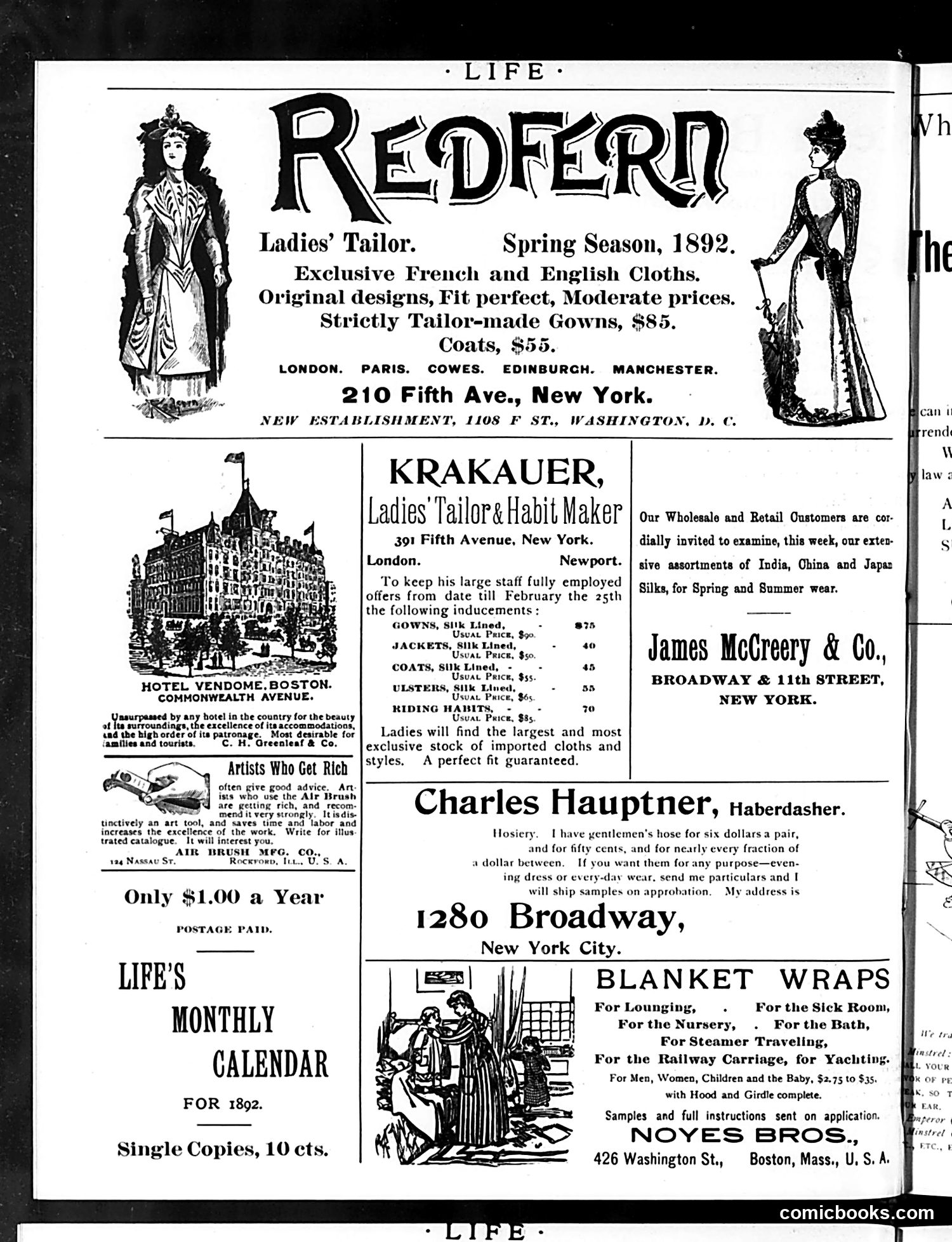
This is not a satirical or editorial page—it's an advertising section from Life magazine's 1892 spring issue. The page contains no political cartoons or social satire. Instead, it features commercial advertisements for upscale women's clothing and accessories typical of the Gilded Age: tailor shops (Redfern, Krakauer), department stores (James McCreery), haberdashery, and specialty items like blanket wraps. Prices reflect wealthy clientele—$85 for tailored gowns was substantial in 1892. There's one small illustrated feature ("Artists Who Get Rich") promoting the air brush tool, but it's commercial promotion, not satire. The only notable element is Life's own self-promotion for its 1892 Monthly Calendar at the bottom left. This represents how 19th-century magazines funded themselves: editorial content subsidized by luxury advertising.
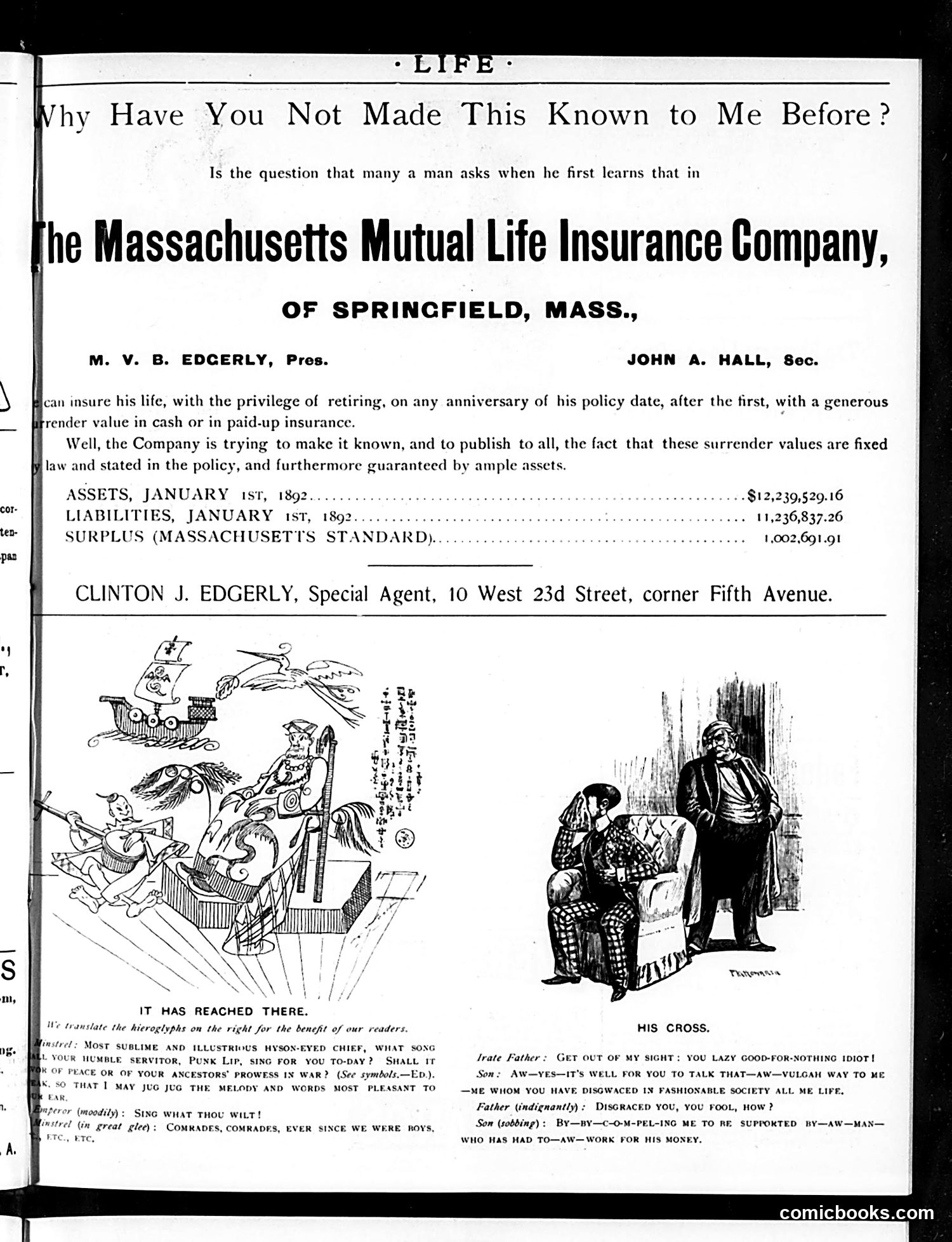
This page contains an insurance advertisement for Massachusetts Mutual Life Insurance Company, framed with two satirical cartoons. **"It Has Reached There"** (left): A fantastical Asian-inspired scene depicting a servant presenting entertainment options to a ruler, with hieroglyphic symbols. The caption suggests the insurance company's message has reached even exotic, distant lands. **"His Cross"** (right): A domestic scene showing a well-dressed father confronting his son. The dialogue reveals the son's complaint: he's been forced to work for money and support himself, disgracing the family in fashionable society. The father dismisses him as lazy. **The satire**: The juxtaposition mocks both the insurance ad's grandiose claims about its reach and the son's complaint—implying that requiring a young man to work is actually reasonable, not a disgrace. The cartoon uses the "lazy youth" trope common to Gilded Age humor, contrasting social pretension with practical necessity. The page date appears to be from 1892 based on the financial statement shown.
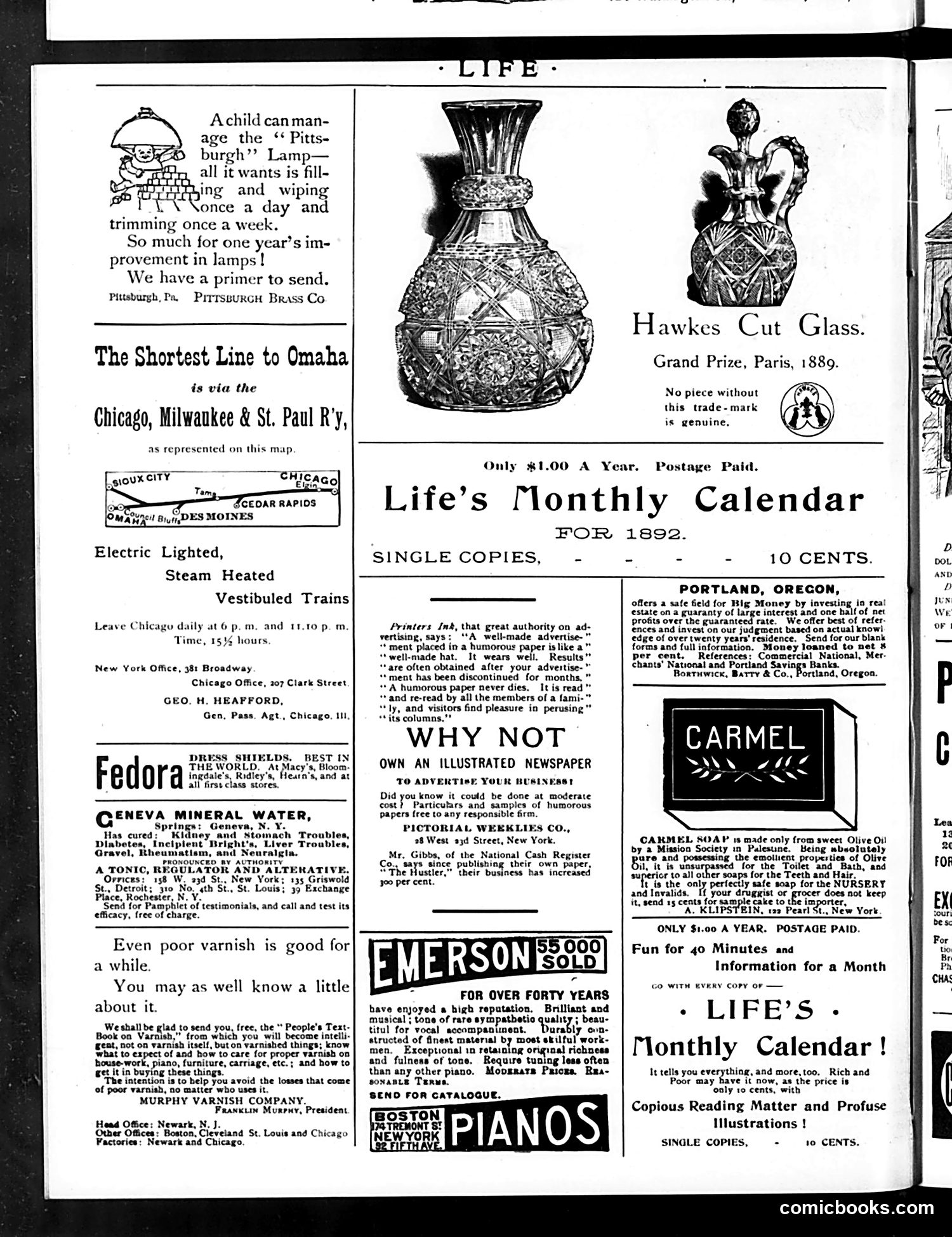
This is primarily an **advertising page**, not a political cartoon. The content consists almost entirely of commercial advertisements typical of 1892, including: **Products advertised:** Pittsburgh brass lamps, railroad service to Omaha, dress shields, mineral water, varnish, and pianos—reflecting late-Victorian consumer goods. **Notable features:** An ad for *Life's Monthly Calendar* (the magazine's own publication at $1/year), and a section titled "Why Not Own an Illustrated Newspaper to Advertise Your Business," promoting humorous papers as advertising vehicles. A testimonial mentions the National Cash Register Company's success publishing their own paper, "The Hustler." **Social context:** These ads reveal what middle-class Americans valued: home improvement products, travel, health remedies (mineral water for ailments), and business innovation. There are **no political cartoons or satirical commentary** visible on this particular page—it's a straightforward commercial section of the magazine.
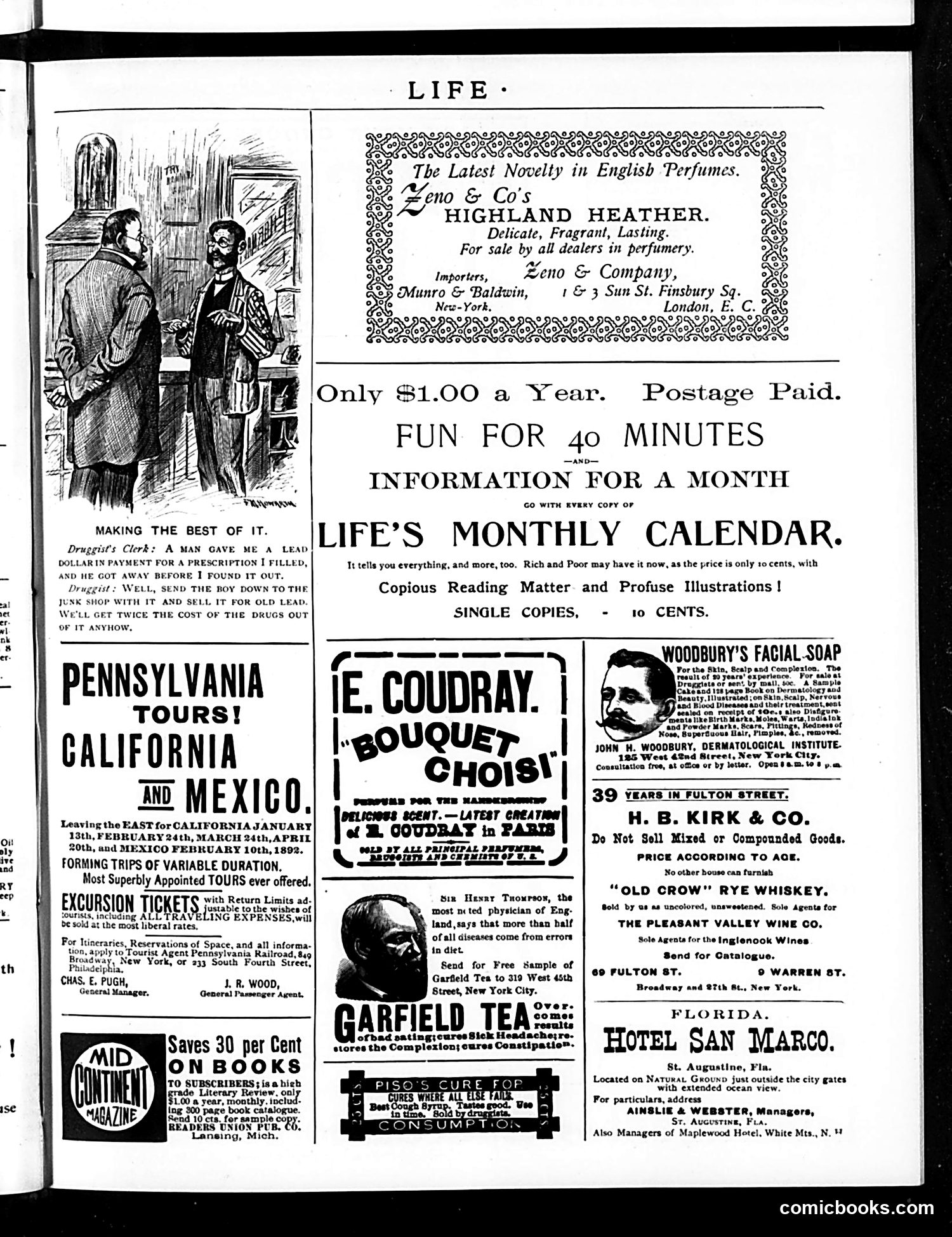
This cartoon satirizes a common medical practice of the era. A druggist (left) has just sold a man an expensive prescription, and now the man's boy returns to the drugstore to sell the unused medicine back. The humor relies on the caption's ironic dialogue: the druggist gave a lead dollar as payment for the prescription, filled it out and sent the boy down to the drugstore to sell it and get the lead. They'll "get twice the cost of the drugs out of it anyhow." The satire targets two things: (1) the inflated cost of prescription medications in that period, and (2) the implication that drugstores profited excessively by reselling returned medicines. It suggests ordinary people viewed prescriptions cynically as wasteful expenses that could be recouped.
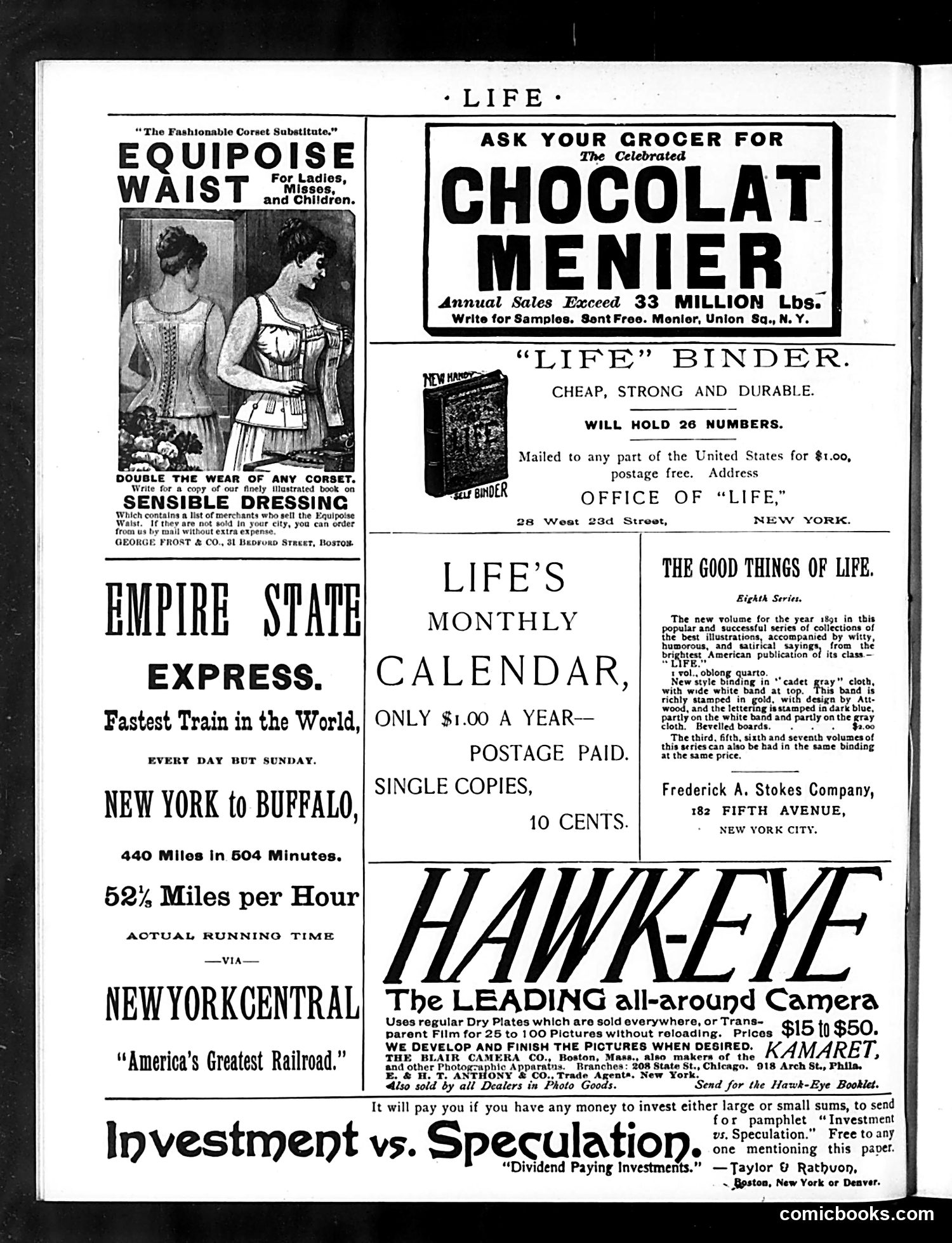
This is primarily an **advertising page**, not a satirical cartoon page. The content reflects late 19th-century consumer goods and services: **Key Advertisements:** - **Equipoise Waist**: A corset substitute marketed as "sensible dressing" for women and children—reflecting contemporary debates about women's fashion and health - **Empire State Express**: A railroad advertisement emphasizing speed (52½ mph was notable then) - **Chocolat Menier**: European chocolate with massive annual sales figures - **Life Magazine products**: Binders, calendars, and bound collections of the magazine itself - **Hawk-Eye Camera**: Photography equipment representing emerging consumer technology - **Investment advisory**: Financial services promoting "dividend-paying" stocks **For modern readers**: This page shows how Life magazine funded itself through advertising while also promoting itself as a cultural product. The prominence of corset alternatives and cameras reflects Victorian-era concerns about women's health and the novelty of accessible photography. The investment ad at bottom suggests readership included the financially interested middle class.