
Life, 1892-02-11 · page 8 of 22
Life — February 11, 1892 — page 8: what you’re looking at
What you’re looking at
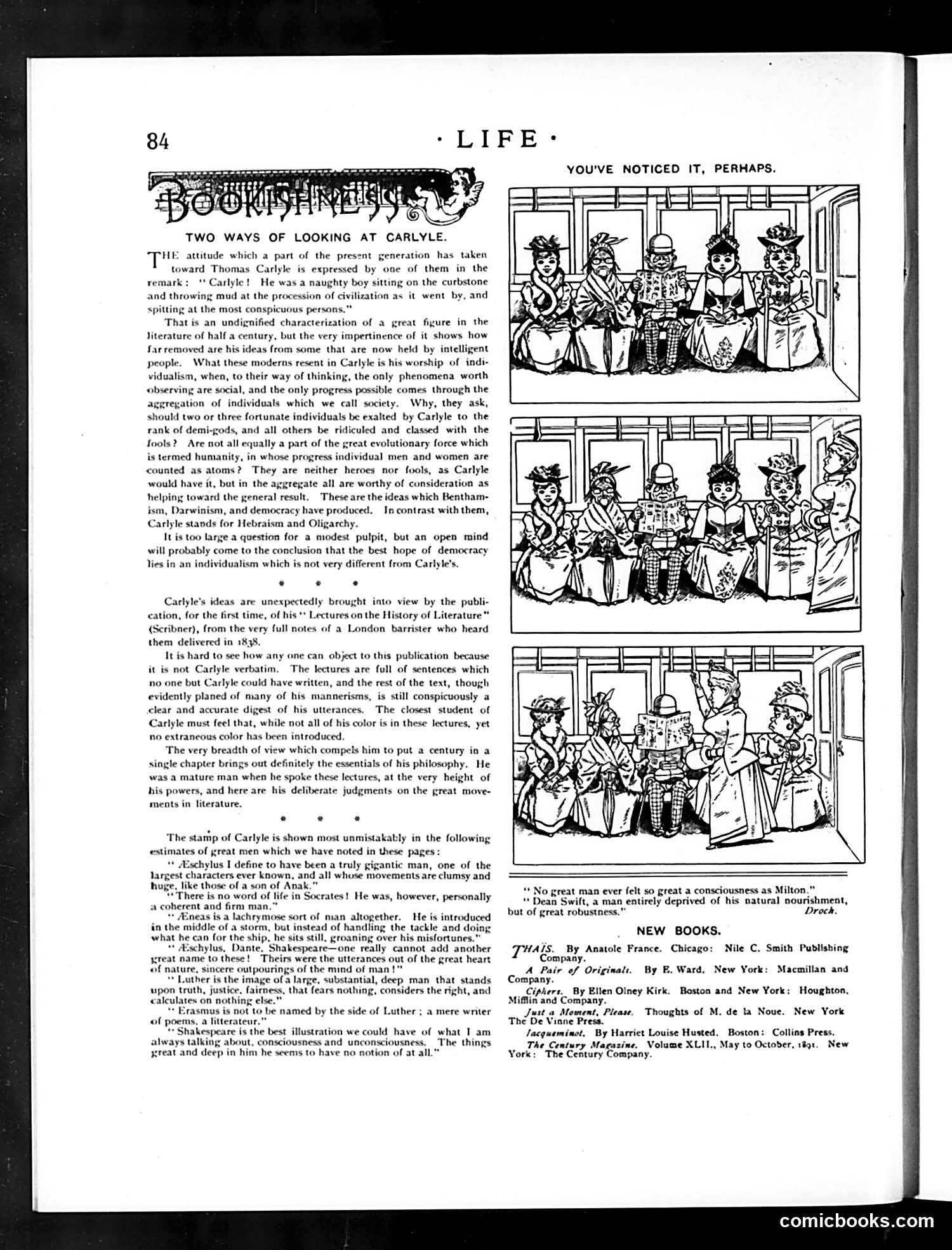
This page discusses **Thomas Carlyle**, the 19th-century Scottish philosopher and historian. The text critiques how modern readers have misunderstood Carlyle's philosophy, particularly his ideas about "great men" and individualism. The three cartoons on the right, titled "TWO WAYS OF LOOKING AT CARLYLE," appear to show the same social scene interpreted differently—likely contrasting Carlyle's elitist "great man" theory of history with a more democratic, egalitarian view. The images show groups of figures in what appears to be a parlor setting, suggesting how one's philosophical perspective shapes interpretation of everyday society. The page concludes with a "NEW BOOKS" section listing recent publications, indicating this is a literary review page from an American satirical magazine.
📄 Transcribed text from this page (OCR, searchable)
Machine-transcribed from the original scan — historical spelling and the odd misread are preserved.
- LIFE: TWO WAYS OF LOOKING AT CARLYLE. HE attitude which a part of the present generation has taken toward Thomas Carlyle is expressed by one of them in the remark: ‘Carlyle! He was a naughty boy sitting on the curbstone and throwing mud at the procession of civilization as it went by, and spitting at the most conspicuous persons.” That is an undignified characterization of a great figure in the literature of half a century, but the very impertinence of it shows how far removed are his ideas from some that are now held by intelligent people, What these moderns resent in Carlyle is his worship of indi- vidualism, when, to their way of thinking, the only phenomena worth observing are social, and the only progress possible comes through the aggregation of individuals which we call society. Why, they ask, should two or three fortunate individuals be exalted by Carlyle to the rank of demi-gods, and all others be ridiculed and classed with the fools? Are not all equally a part of the great evolutionary force which is termed humanity, in whose progress individual men and women are counted as atoms? They are neither heroes nor fools, as Carlyle would have it, but in the aggregate all are worthy of consideration as helping toward the general result. These are the ideas which Bentham- ism, Darwinism, and democracy have produced. In contrast with them, Carlyle stands for Hebraism and Oligarchy. It is too large a question for a modest pulpit, but an open mind will probably come to the conclusion that the best hope of democracy lies in an individualism which is not very different from Carlyle's. Carlyle’s ideas are unexpectedly brought into view by the publi- cation, for the first time, of his ** Lectures on the History of Literature" (Scribner), from the very full notes of a London barrister who heard them delivered in 1838. It is hard to see how any one can object to this publication because it is not Carlyle verbatim, The lectures are full of sentences which no one but Carlyle could have written, and the rest of the text, though evidently planed of many of his mannerisms, is still conspicuously a clear and accurate digest of his utterances, The closest student of Carlyle must feel that, while not all of his color is in these lectures, yet no extraneous color has been introduced. The very breadth of view which compels him to put a century in a single chapter brings out definitely the essentials of his philosophy. He was a mature man when he spoke these lectures, at the very height of his powers, and here are his deliberate judgments on the great move- ments in literature, . « . ‘The stamp of Carlyle is shown most unmistakably in the following estimates of great men which we have noted in these pages : “+ Aeschylus I define to have been a truly gigantic man, one of the largest characters ever known, and all whuse movements are clumsy and huge, like those of a son of Anak.” "There is no word of life in Socrates! He was, however, personally a coherent and firm man.” eas is a lachrymose sort of man altogether. He is introduced in the middle of a storm, but instead of handling the tackle and doing what he can for the ship, he sits still, groaning over his misfortunes.” “ €schylus, Dante, Shakespeare—one really cannot add another great name to these! Theirs were the utterances out of the great heart ‘of nature, sincere outpourings of the mind of man!" “+ Luther is the image of a large, substantial, deep man that stands upon truth, justice, fairness, that fears nothing, considers the right, and calculates on nothing else. + Erasmus is not to be named by the side of Luther ; a mere writer ‘of poems, a litterateur. ** Shakespeare is the best illustration we could have of what I am always talking about, consciousness and unconsciousness. The things xreat and deep in him he seems to have no notion of at all.” YOU'VE NOTICED IT, PERHAPS. * No great man ever felt so great a consciousness as Milton.” “ Dean Swift, a man entirely deprived of his natural nourishment, but of great robustness.” Drock. NEW BOOKS. THAIS. By Anatole France. Chicago: Company. A Pair of Originals. Company. Ciphers. By Ellen Olney Kirk, Boston and New York: Houghton, Miffin and Company. Just a Moment, Please, Thoughts of M. de ta Noue. The De Vinne Press. Jacqueminot, By Harriet Louise Husted. Boston: Collins Press. The Century Magazine. Volume XLII., May to Octoder, 1891. New York: The Century Company Nile C, Smith Publishing By E. Ward, New York: Macmillan and New York comicbooks.com