
Life, 1892-02-11 · page 4 of 22
Life — February 11, 1892 — page 4: what you’re looking at
What you’re looking at
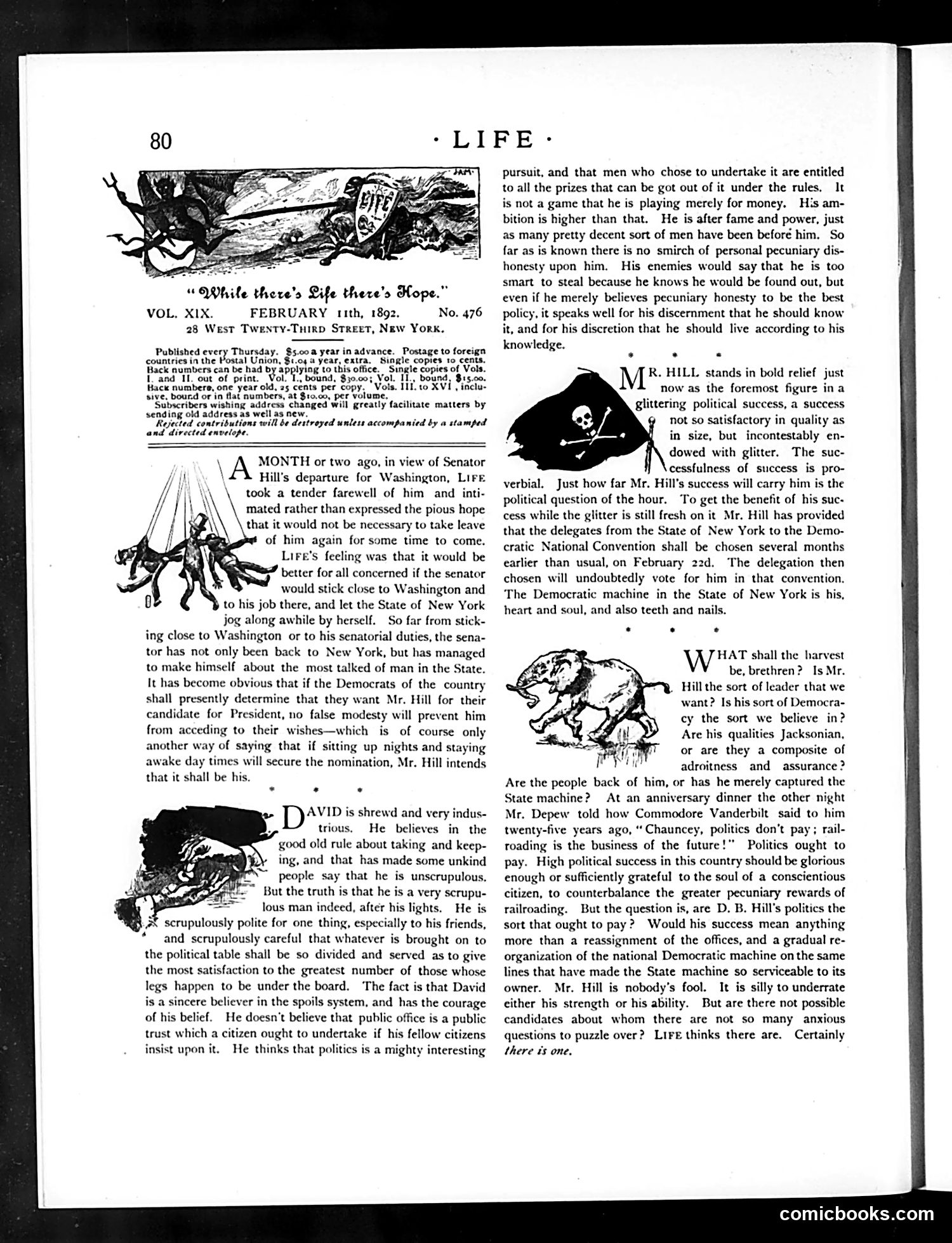
This page discusses Senator David B. Hill of New York, a prominent Democratic politician. The text is decidedly critical of Hill's political ambitions and character. The main cartoon (top left) illustrates Hill's departure for Washington, showing him being pulled in multiple directions—a visual metaphor for his divided loyalties between his Senate duties and State politics. The article questions whether Hill possesses the qualities needed for higher office, particularly the Democratic presidential nomination. The writer expresses skepticism about Hill's integrity, suggesting his political success comes from machine politics rather than genuine leadership or public service. The piece implies Hill is more beholden to New York's Democratic machine than to principled governance, questioning whether such a candidate deserves the party's nomination.
📄 Transcribed text from this page (OCR, searchable)
Machine-transcribed from the original scan — historical spelling and the odd misread are preserved.
- LIFE: “OMhile there's Life there's Hope.” VOL, XIX. FEBRUARY ith, 1892. No. 476 28 West Twenty-Tuirp Street, New York. Published every Thursday. $s.coa year in advance. Postage to foreign countries in the Postal Union, $1.04 year, extra. Single copies to cents. Back aumbers can be had by applying to this office. Single copies of Vols. I. and Il. out of print. Vol. 1., bound, $30.00; Vol. II., bound, $15.00. Hack numbere, one year old, 25 cents per copy. "Vols. IIT. to XVI , inclu- sive, bourd or in flat numbers, at $10.0, per volume, Subscribers wishing address changed will greatly facilitate matters by sending old address as well as new. Rejected contributions will be destroyed untess accompanied by a stamped and directed envelope. MONTH or two ago, in view of Senator Hill's departure for Washington, Lire took a tender farewell of him and inti- mated rather than expressed the pious hope that it would not be necessary to take leave of him again for some time to come. Lire’s feeling was that it would be better for all concerned if the senator would stick close to Washington and to his job there, and let the State of New York jog along awhile by herself. So far from stick- ing close to Washington or to his senatorial duties, the sena- tor has not only been back to New York, but has managed to make himself about the most talked of man in the State. It has become obvious that if the Democrats of the country shall presently determine that they want Mr. Hill for their candidate for President, no false modesty will prevent him from acceding to their wishes—which is of course only another way of saying that if sitting up nights and staying awake day times will secure the nomination, Mr. Hill intends that it shall be his. . . . AVID is shrewd and very indus- trious. He believes in the good old rule about taking and keep- ing, and that has made some unkind re people say that he is unscrupulous, ~ But the truth is that he is a very scrupu- lous man indeed, after his lights. He is 4. scrupulously polite for one thing, especially to his friends, and scrupulously careful that whatever is brought on to the political table shall be so divided and served as to give the most satisfaction to the greatest number of those whose legs happen to be under the board. ‘The fact is that David is a sincere believer in the spoils system, and has the courage of his belief. He doesn’t believe that public office is a public trust which a citizen ought to undertake if his fellow citizens insist upon it. He thinks that politics is a mighty interesting pursuit, and that men who chose to undertake it are entitled to all the prizes that can be got out of it under the rules. It is not a game that he is playing merely for money. His am- bition is higher than that. He is after fame and power, just as many pretty decent sort of men have been before him. So far as is known there is no smirch of personal pecuniary dis- honesty upon him. His enemies would say that he is too smart to steal because he knows he would be found out, but even if he merely believes pecuniary honesty to be the best policy, it speaks well for his discernment that he should know it, and for his discretion that he should live according to his knowledge. . . . R. HILL stands in bold relief just now as the foremost figure in a glittering political success, a success not so satisfactory in quality as in size, but incontestably en- dowed with glitter. The suc- cessfulness of success is pro- verbial. Just how far Mr. Hill's success will carry him is the political question of the hour. To get the benefit of his suc- cess while the glitter is still fresh on it Mr. Hill has provided that the delegates from the State of New York to the Demo- cratic National Convention shall be chosen several months earlier than usual, on February 22d. The delegation then chosen will undoubtedly vote for him in that convention. The Democratic machine in the State of New York is his, heart and soul, and also teeth and nails. HAT shall the harvest be, brethren? Is Mr. . Hill the sort of leader that we want? Is his sort of Democra- cy the sort we believe in? Are his qualities Jacksonian, or are they a composite of adroitness and assurance ? Are the people back of him, or has he merely captured the State machine? At an anniversary dinner the other night Mr. Depew told how Commodore Vanderbilt said to him twenty-five years ago, “Chauncey, politics don’t pay; rail- roading is the business of the future!” Politics ought to pay. High political success in this country should be glorious enough or sufficiently grateful to the soul of a conscientious citizen, to counterbalance the greater pecuniary rewards of railroading. But the question is, are D. B. Hill's politics the sort that ought to pay? Would his success mean anything more than a reassignment of the offices, and a gradual re- organization of the national Democratic machine on the same lines that have made the State machine so serviceable to its owner. Mr. Hill is nobody’s fool. It is silly to underrate either his strength or his ability. But are there not possible candidates about whom there are not so many anxious questions to puzzle over? Lire thinks there are. Certainly there ts one. comicbooks.com