
A complete issue · 16 pages · 1892
Life — January 7, 1892
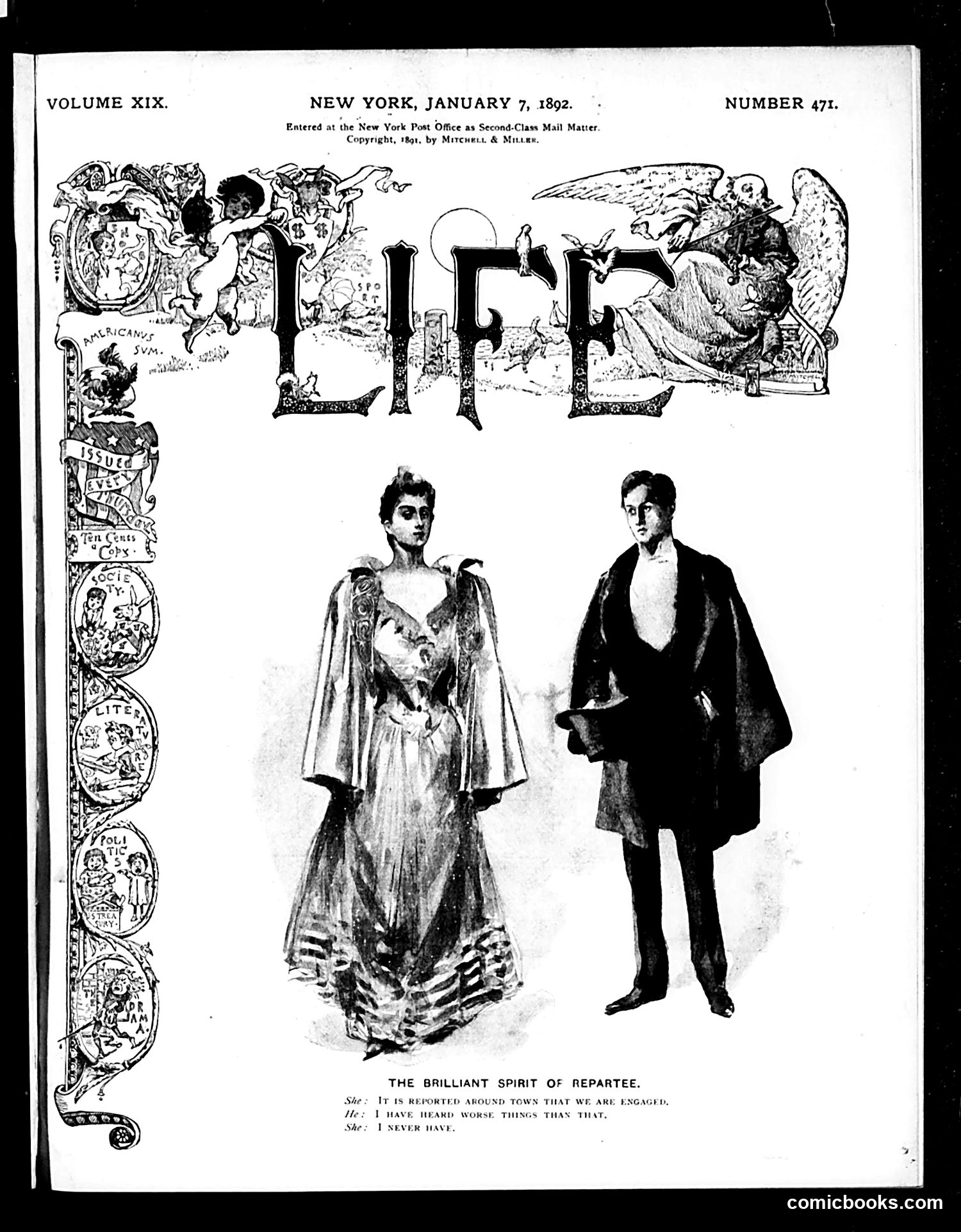
This 1892 *Life* magazine page satirizes social conversation and gender dynamics of the era. The illustration shows a woman in an elegant evening gown with a man in formal attire. The dialogue below reads: **She:** "It is reported around town that we are engaged." **He:** "I have heard worse things than that." **She:** "I never have." The humor derives from the woman's witty comeback—she implies that being engaged to him is the *worst* thing she's heard about. The title "The Brilliant Spirit of Repartee" ironically praises her sharp verbal riposte. This reflects Victorian-era anxieties about women's increasing wit and independence, mocking both courtship conventions and women who challenge male social dominance through clever retorts.
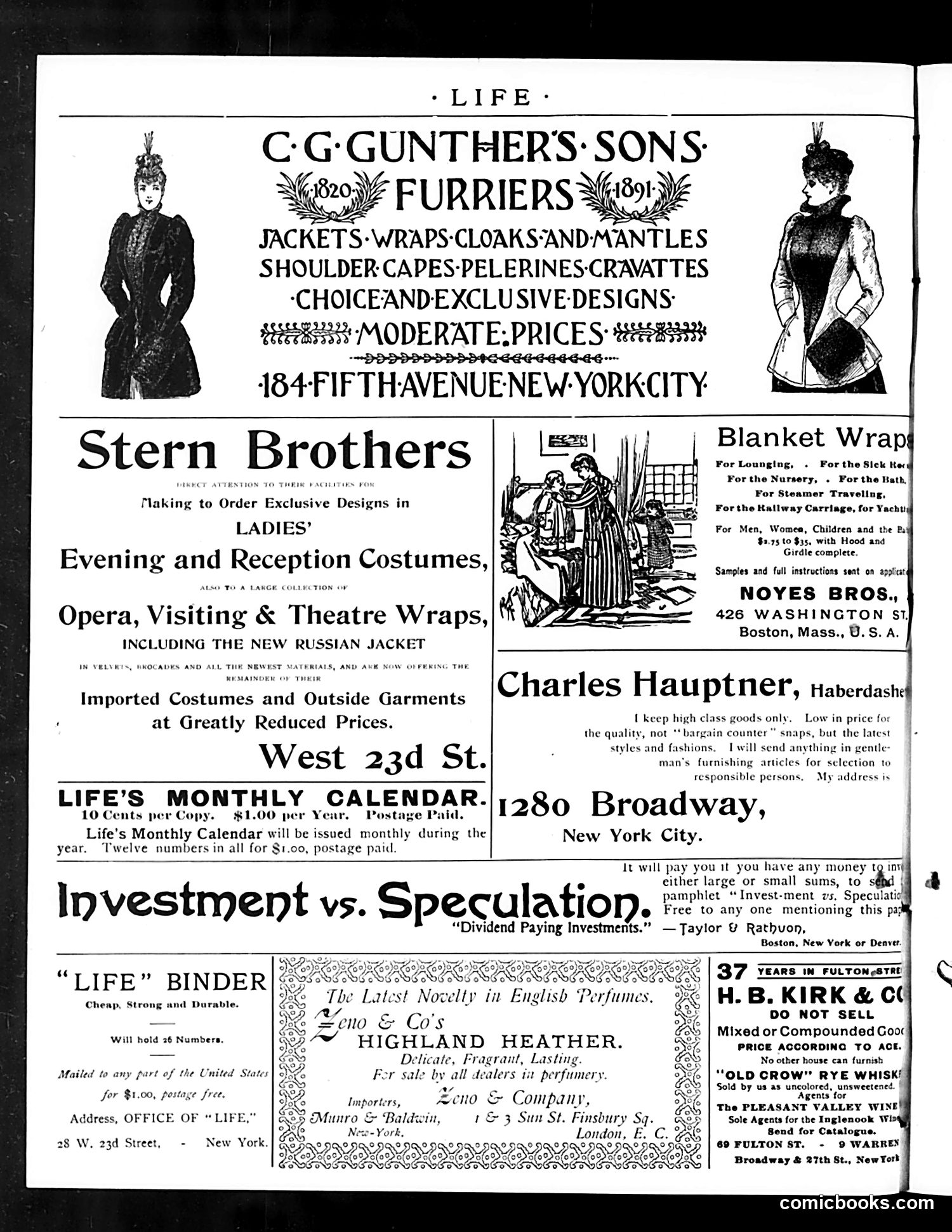
This page is primarily **advertising**, not political satire or commentary. It contains multiple fashion and commercial advertisements from the 1890s era, including: - C.G. Gunther's Sons Furriers (top), advertising women's furs and cloaks - Stern Brothers (left), promoting ladies' evening wear and theater wraps - Noyes Bros. (center-right), selling blanket wraps - Charles Hauptner (right), advertising men's furnishings - Life's Monthly Calendar subscription offer - Various product advertisements for perfume, whiskey, and other goods The only illustration beyond fashion sketches shows a domestic scene of someone receiving a blanket wrap. There is no political cartoon or satirical commentary visible on this page—it functions as a standard magazine advertisement section typical of late-19th-century publications.
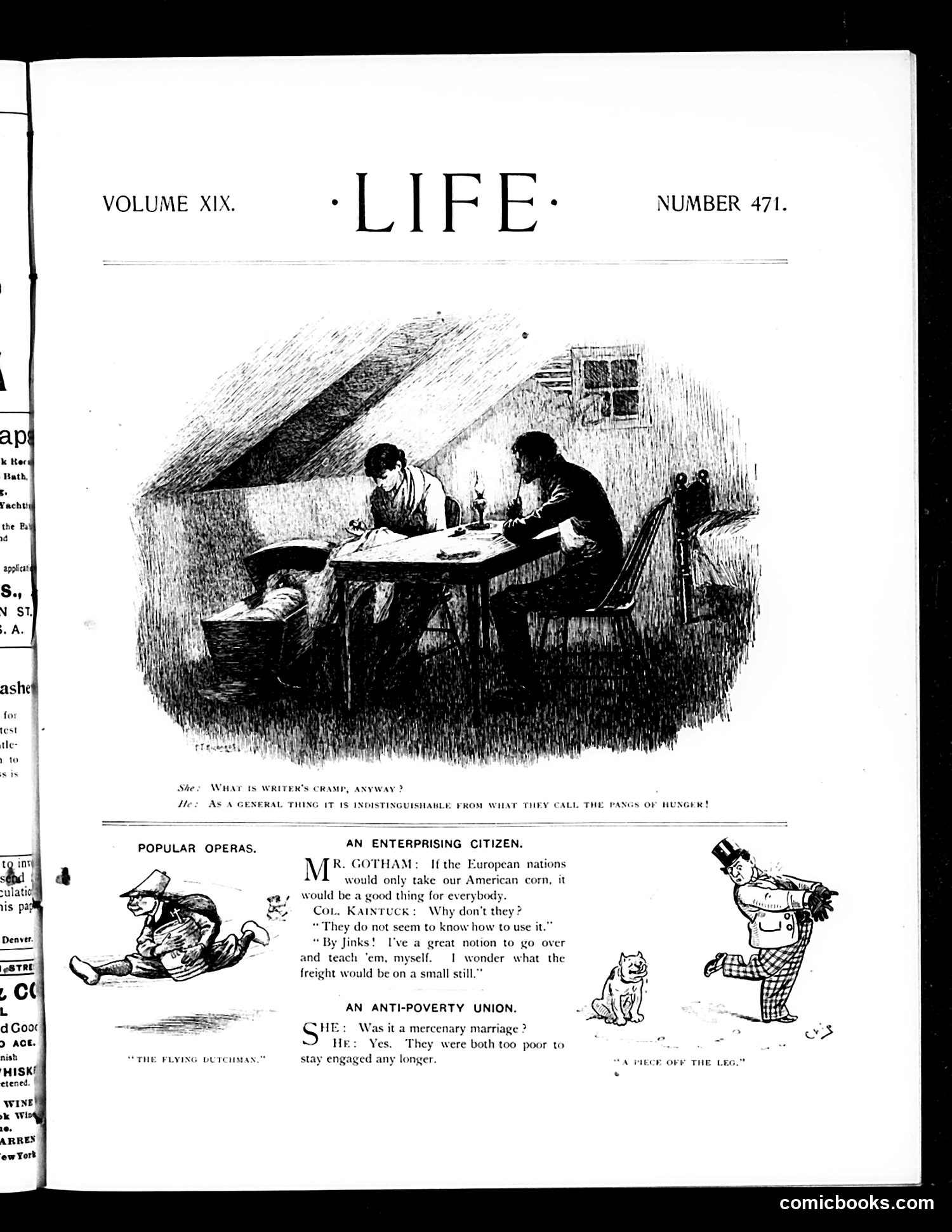
This page from *Life* magazine (Volume XIX, Number 471) contains three brief satirical sketches: 1. **Main illustration**: Two men at a table in an attic setting with caption about "writer's cramp" and hunger's "pangs"—a joke about starving writers. 2. **"An Enterprising Citizen"**: Col. Kaystuck proposes teaching Americans to use corn as food and export it. The humor mocks agricultural economics and American resourcefulness. 3. **"An Anti-Poverty Union"**: A couple's mercenary marriage dissolves because both are poor—satirizing marriages of convenience and economic desperation. 4. **Small cartoons**: "The Flying Dutchman" and "A Piece off the Leg" appear to be separate comic vignettes (unclear without more context). The page emphasizes economic hardship and satirizes American attitudes toward poverty, work, and marriage through humor typical of early 20th-century satirical journalism.
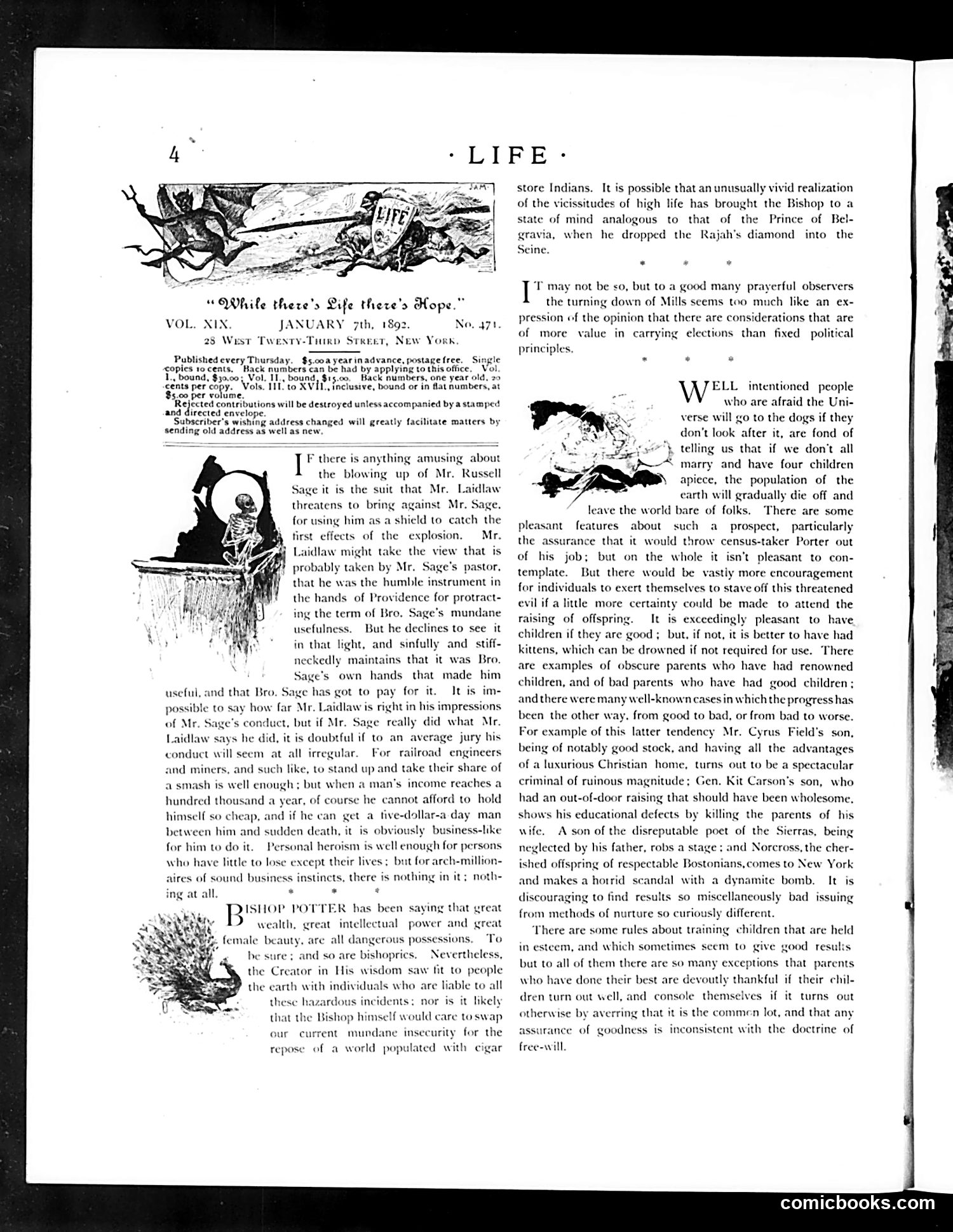
This page contains two editorial cartoons and accompanying commentary on contemporary social issues. The **top cartoon** appears to satirize a legal dispute involving Mr. Russell Sage and Mr. Laidlaw, related to explosives. The text discusses Mr. Laidlaw's attempt to use Sage as a shield against bomb blasts, mocking both men's conduct in what seems a business or legal conflict. The **bottom cartoon** shows Bishop Potter commenting on wealth and social danger. The accompanying editorial discusses whether wealthy individuals like the Bishop should swap their "current murderous insecurity" for concerns about the poor. The text addresses child-rearing, inheritance, and moral responsibility among the privileged classes. Both pieces critique wealthy New Yorkers' conduct and social attitudes of the Gilded Age.
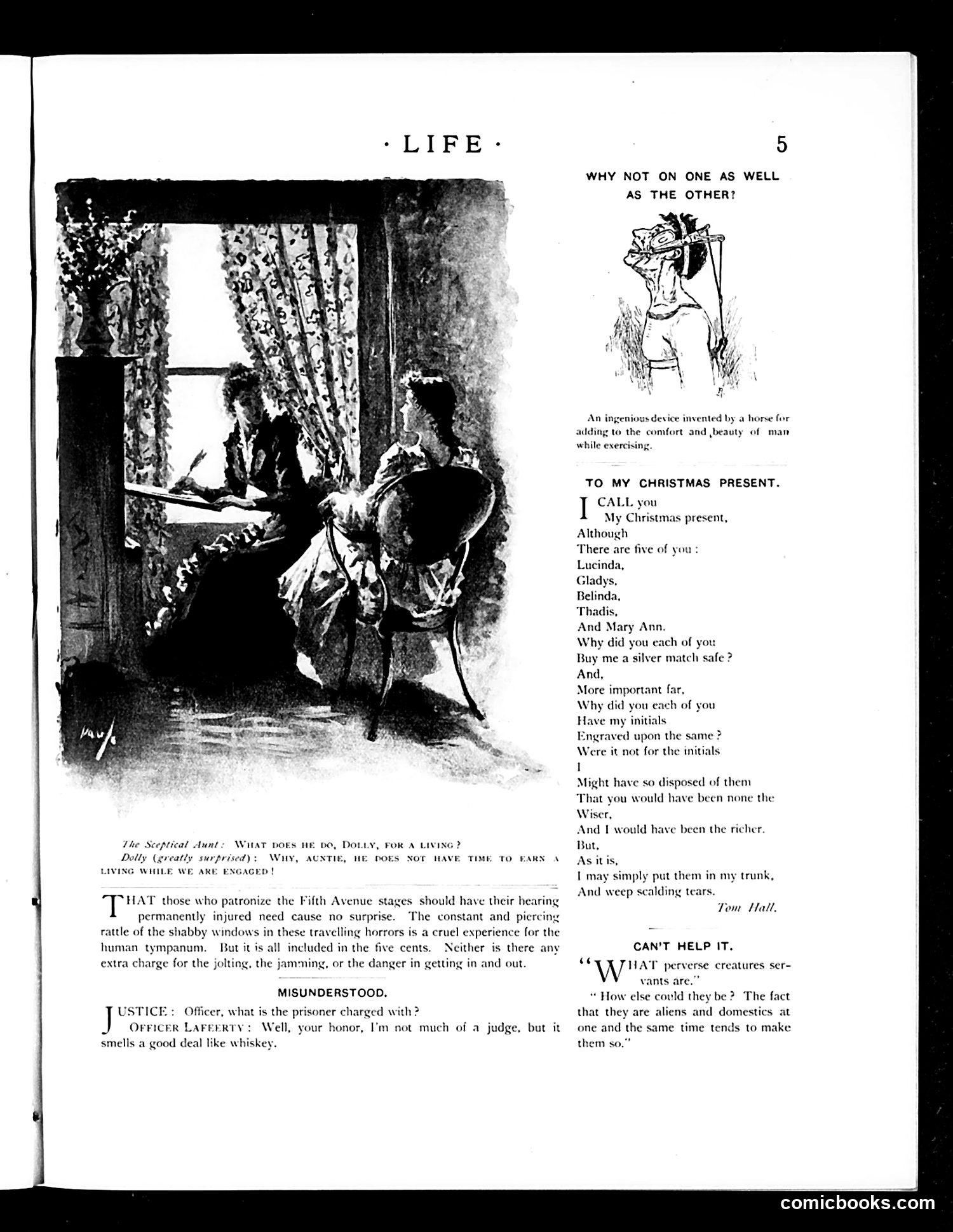
This page contains three separate humor pieces: 1. **"Why Not On One As Well As The Other?"** - A satirical cartoon showing a woman exercising with a device, mocking an "ingenious device invented by a horse for adding to the comfort and beauty of man while exercising." The joke criticizes overly complicated fitness contraptions. 2. **"The Skeptical Aunt"** - A cartoon dialogue questioning why an aunt isn't present at a social gathering while engaged elsewhere, poking fun at social excuses and priorities. 3. **"Misunderstood"** - A brief joke where a judge mistakes a prisoner's offense, with a punchline about whiskey, typical courtroom humor of the era. 4. **"To My Christmas Present"** and **"Can't Help It"** - Poetry and comic observations about gift-giving and human nature. The page reflects early 20th-century domestic and social satire targeting middle-class manners and conventions.
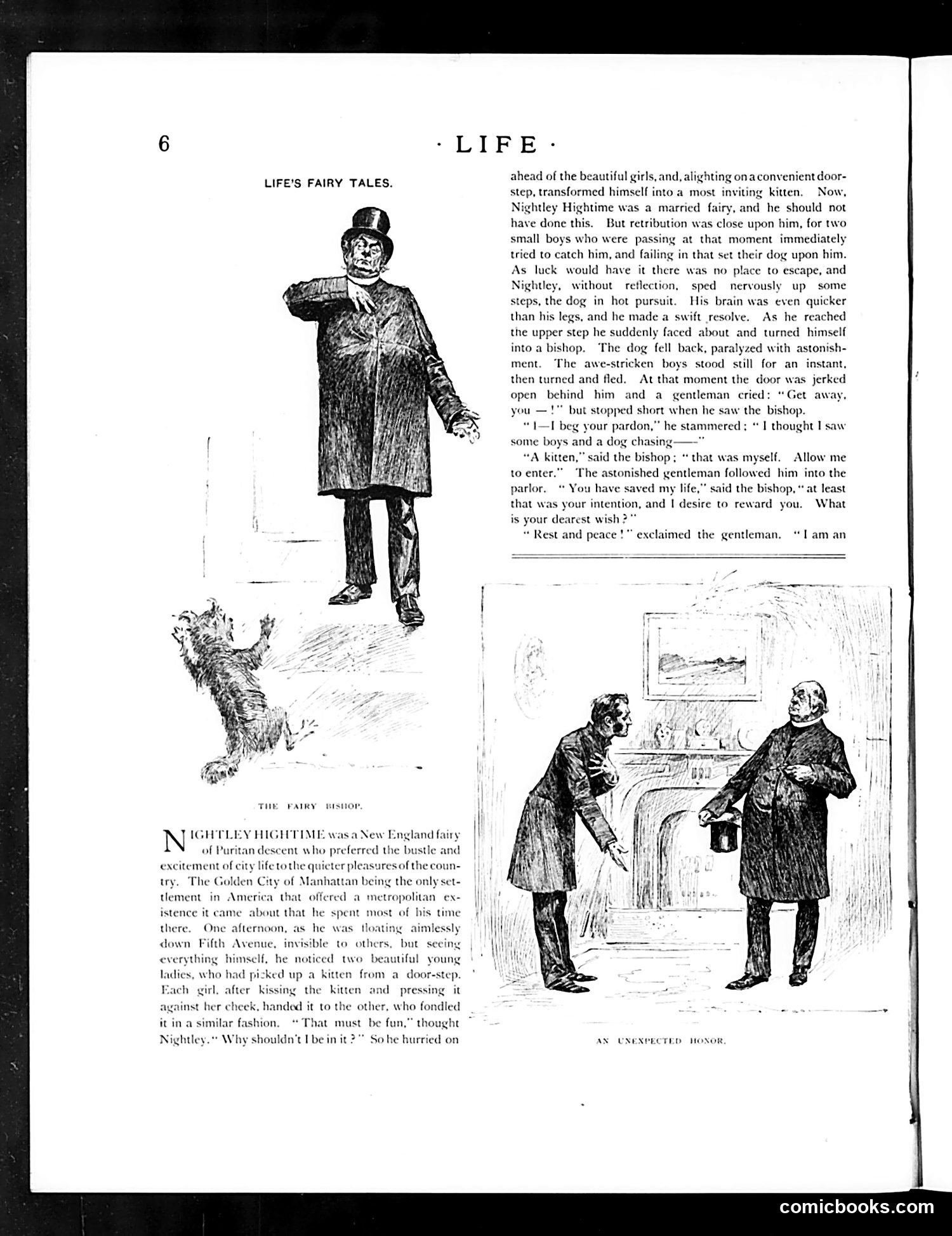
This page presents a whimsical fairy tale titled "The Fairy Bishop." The story follows Nightley Hightime, a Puritan-descended New York fairy who prefers city life to countryside pleasures. One afternoon, Nightley transforms himself into a kitten to pursue two young women. When boys and a dog chase him, he shapeshifts into a bishop to escape. The satire appears to mock religious hypocrisy and the arbitrary nature of moral authority. By having a frivolous character assume clerical dignity merely as a convenient escape tactic—and being immediately granted respect and shelter—the tale suggests that bishops' authority is superficial costume rather than genuine virtue. The bishop's stated desire for "rest and peace" undercuts his credibility further, implying clergy seek comfort rather than spiritual purpose.
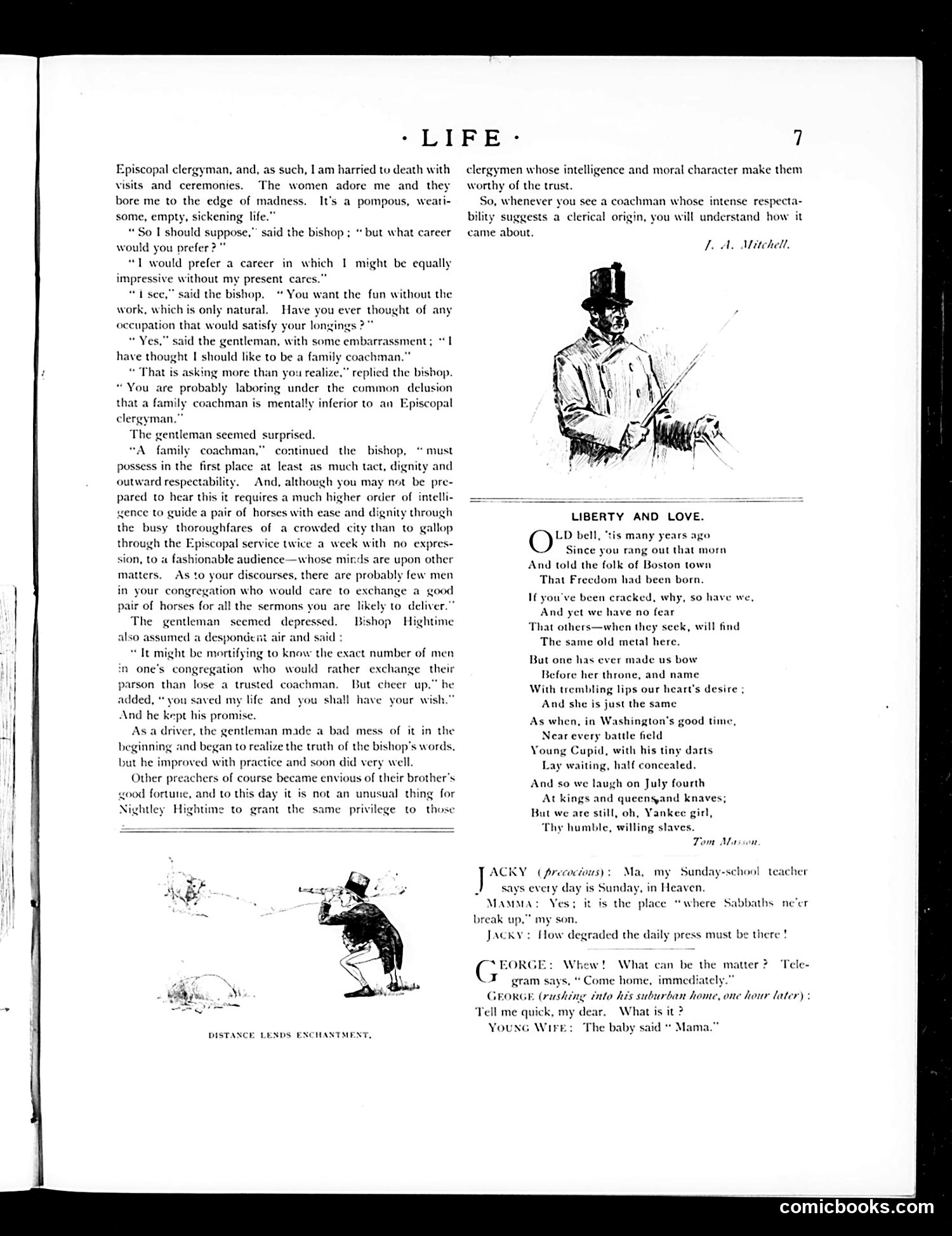
This page contains two distinct pieces: **Upper section:** A dialogue between a bishop and a gentleman about career choices. The bishop argues that a "family coachman" requires significant skill and dignity—managing horses through city traffic demands intelligence comparable to leading an Episcopal congregation. The satire mocks both the bishop's pomposity and social pretension, suggesting clergy inflate their importance while undervaluing working-class professions. **"Liberty and Love"** poem celebrates American freedom and independence, referencing Boston and the Revolutionary War ("Freedom had been born"). **Lower cartoons:** Simple illustrated vignettes labeled "Distance Lends Enchantment" showing figures at a distance—likely satirizing how perspective distorts perception or reality. The overall page satirizes class hierarchies and professional snobbery typical of Gilded Age American society.
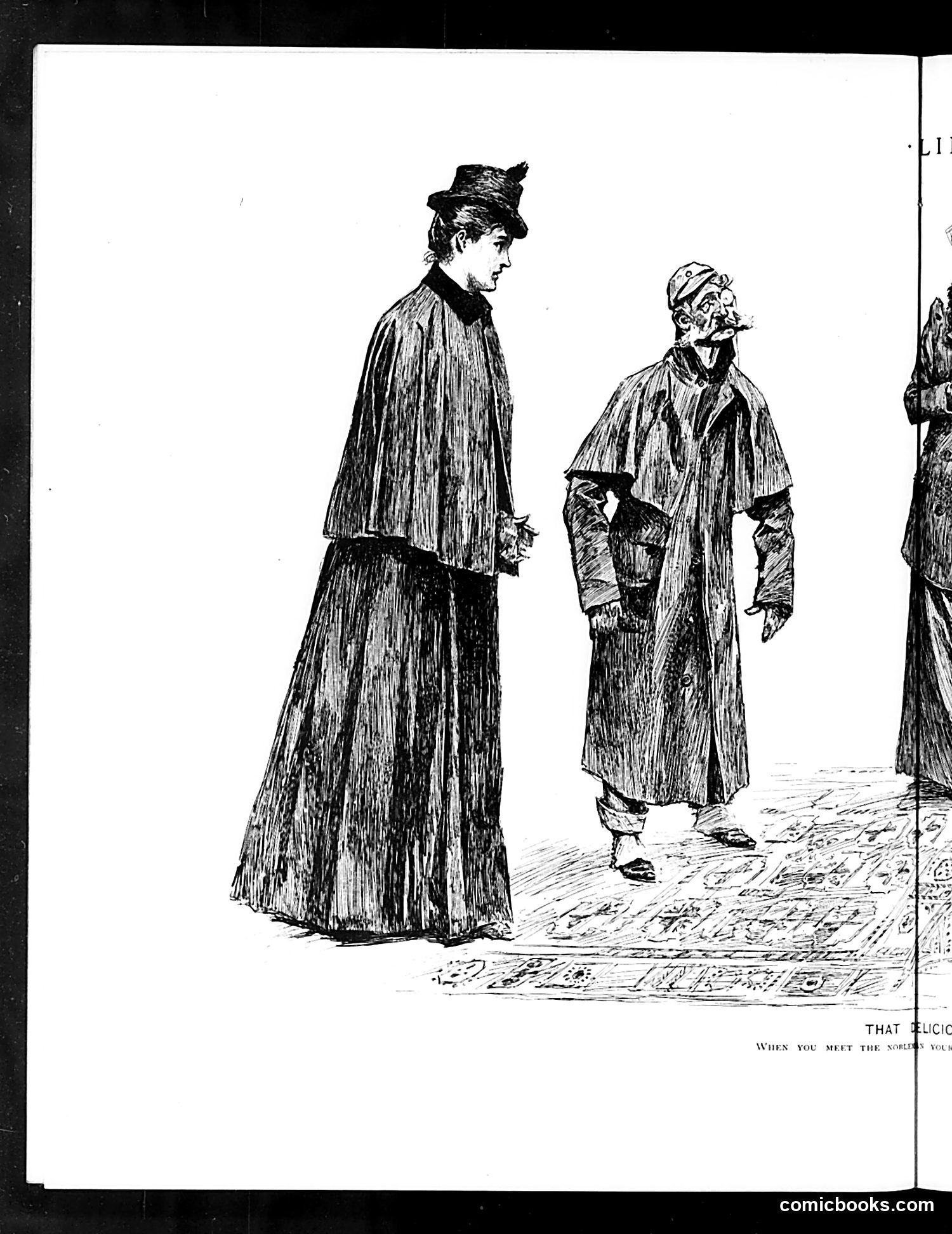
This appears to be a fashion or social commentary illustration from *Life* magazine. The image shows two figures in long coats on what appears to be a patterned floor. The partially visible caption reads "THAT SILICI[OUS]" and "WHEN YOU MEET THE NOBLE YOU—" The sketch depicts what seems to be a social encounter, likely satirizing fashionable dress or social pretension of the era. The tall figure on the left wears an elegant long coat and hat, while the shorter figure on the right appears differently dressed, suggesting a commentary on class distinctions or the absurdity of fashionable clothing. However, without the complete caption and more context about the specific historical moment, the exact target of satire remains unclear. It may relate to contemporary fashion trends or social attitudes, but precise identification requires additional information.
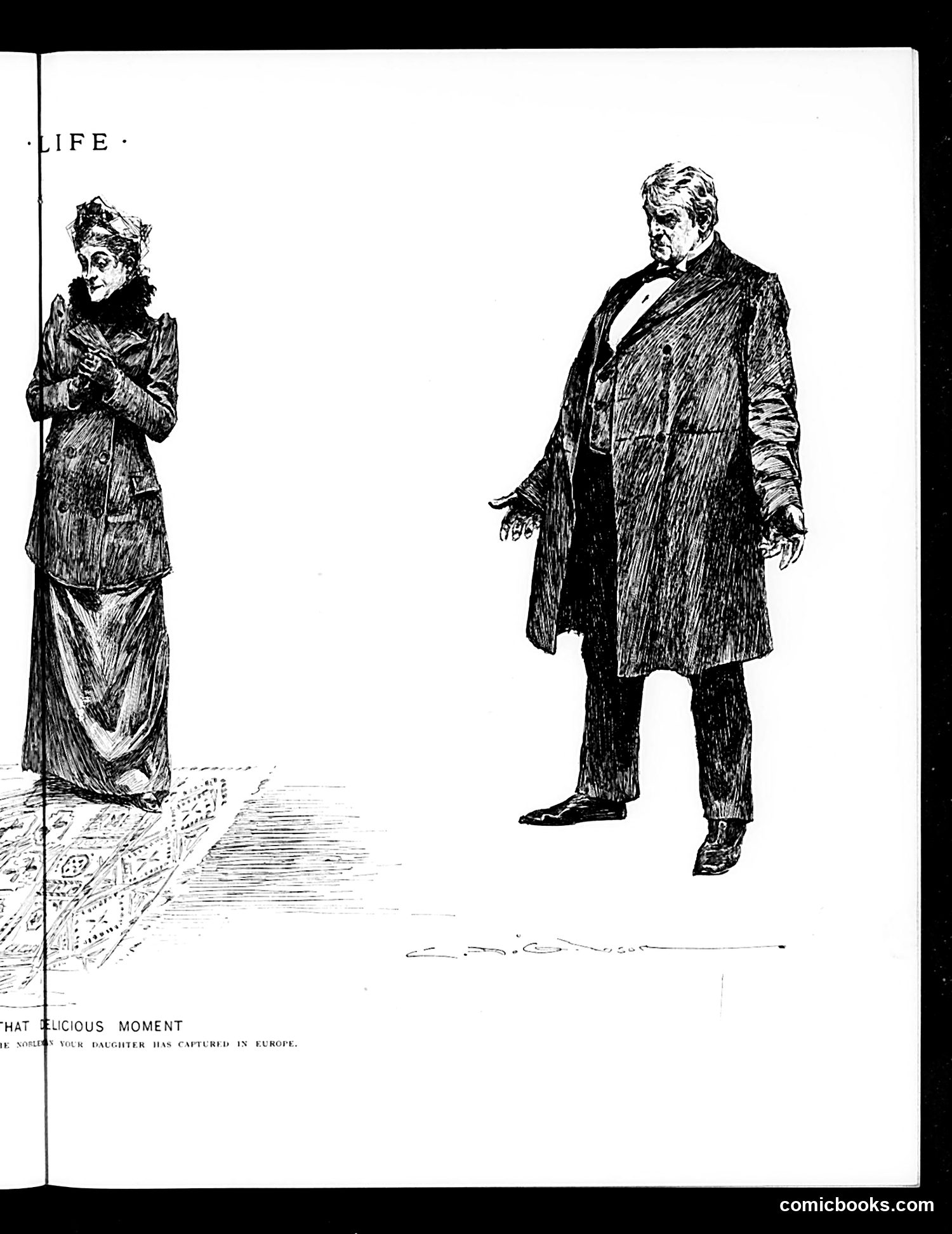
This illustration depicts a tense domestic scene between a man and woman, captioned "That Delicious Moment" with subtitle text referencing "Your Daughter Has Captured in Europe." The cartoon appears to satirize upper-class American anxieties about young women traveling abroad—likely during the late 19th or early 20th century. The woman's elegant dress and the man's formal attire suggest wealth. The "delicious moment" likely refers to dramatic tension: the man appears confrontational or disapproving, while the woman seems defiant or nervous. The joke targets parental concern about daughters' independence and European experiences—suggesting wealthy fathers fear their daughters' social freedoms or romantic entanglements abroad. The satirical "delicious" framing inverts the actual tension into supposed pleasure, mocking overwrought domestic drama among the well-to-do.
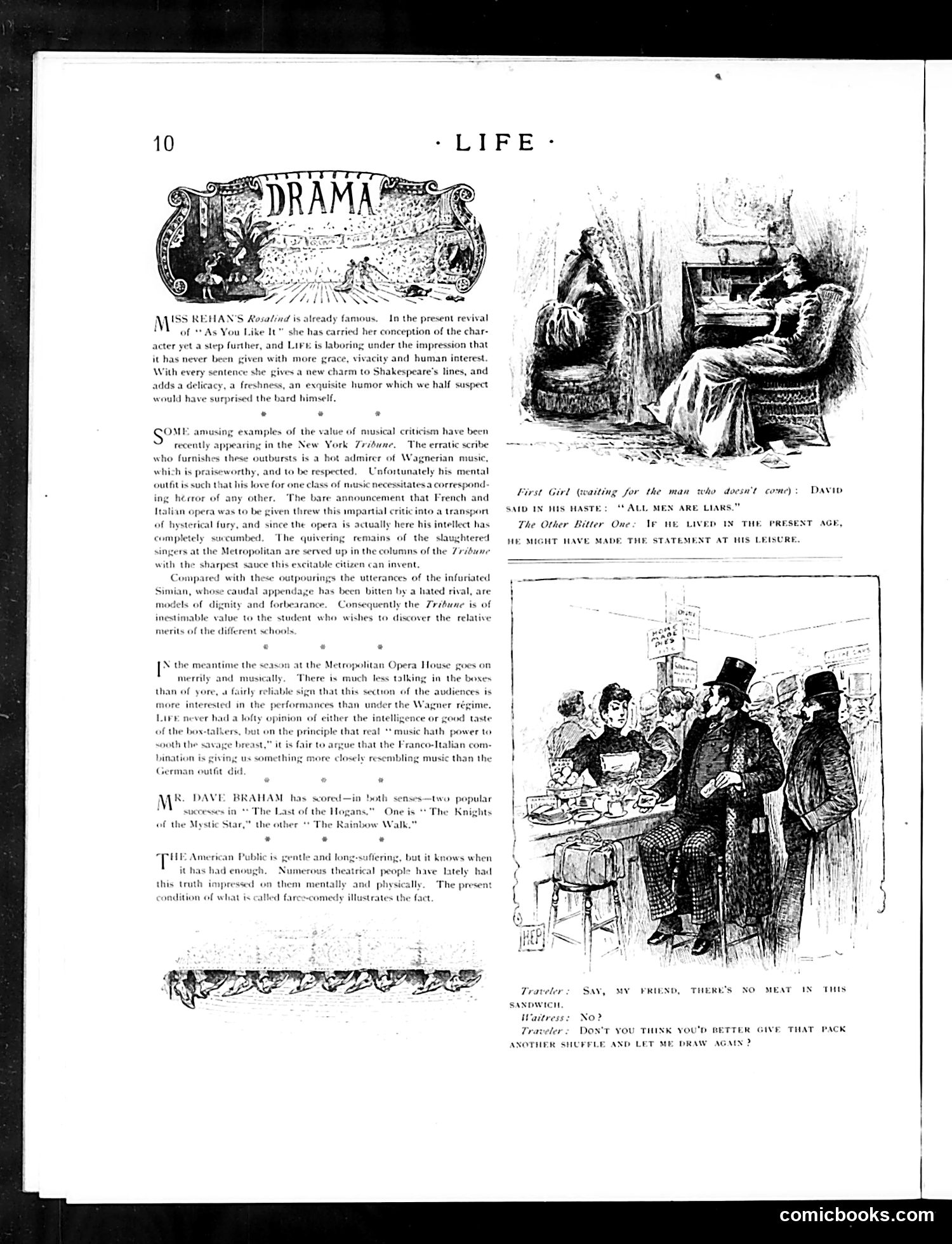
This page reviews theatrical productions, primarily discussing Miss Rehan's revival of Shakespeare's *Rostand* and praising her performance. The text critiques operatic music criticism and discusses Mr. Dave Braham's theatrical scores. The two sketches illustrate scenes from plays: 1. **Upper right**: A domestic scene showing a woman waiting for a man, captioned "First Girl (waiting for the man who doesn't come)" with a quote attributed to David: "All men are liars." 2. **Lower illustration**: A restaurant/dining scene showing a waiter and customers in conversation about a sandwich with no meat—apparently a comedic commentary on poor restaurant service or food quality. Both cartoons use humor to satirize everyday social frustrations typical of the period.
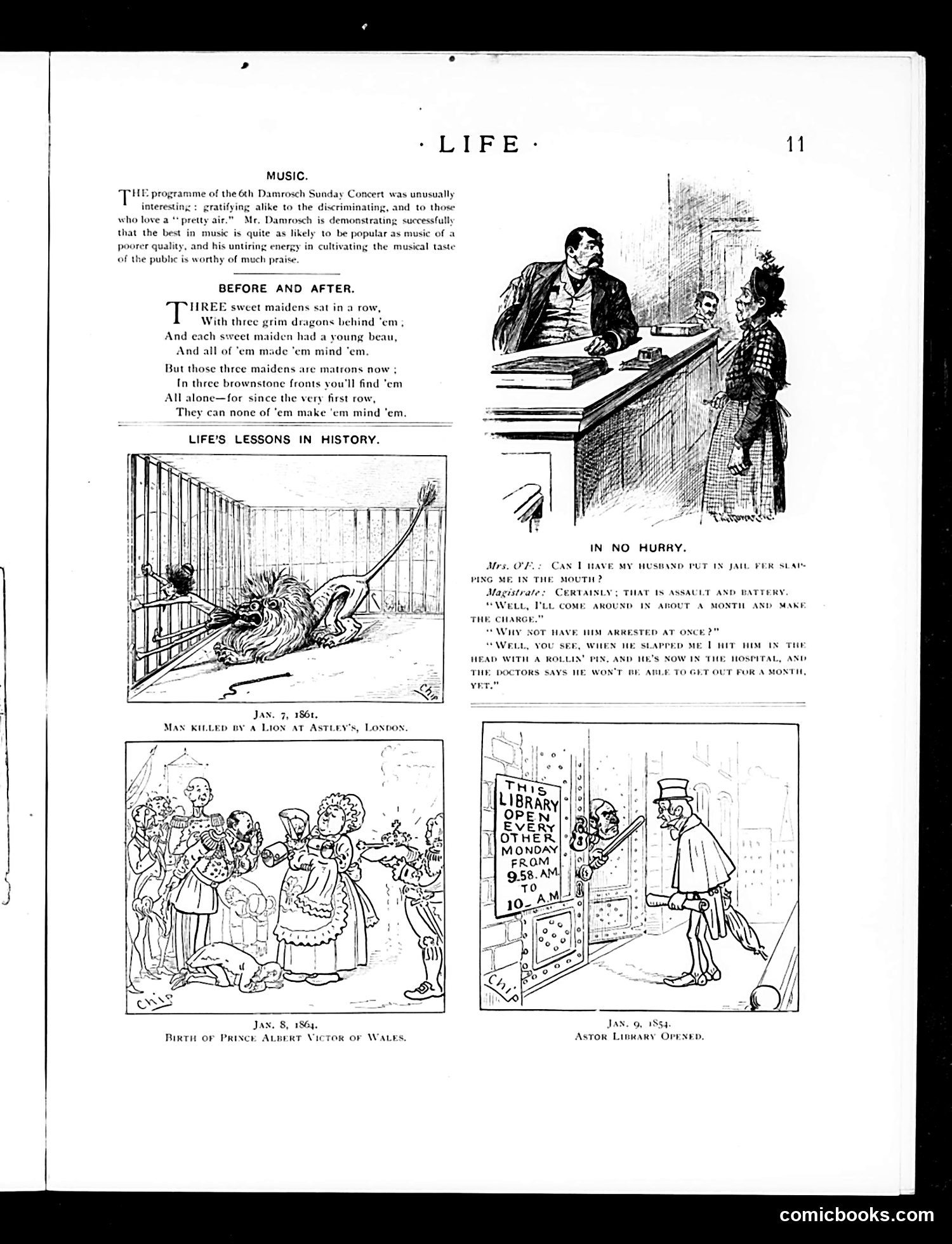
This page contains three historical cartoons with satirical commentary: 1. **"Music"** (top): A poem and illustration about musical taste, suggesting that popular music often appeals to the masses rather than discriminating audiences. 2. **"Life's Lessons in History"** (left): Shows a lion killing a man at Ashley's London menagerie (Jan. 7, 1861), illustrating life's dangers. 3. **"Before and After"** (center): A domestic dispute scene titled "In No Hurry," where a woman complains about her husband's arrest for assault. The magistrate's response mocks the delayed justice system. 4. **"Astor Library Opened"** (right, Jan. 9, 1864): Depicts the opening of New York's Astor Library, a significant cultural institution. The page satirizes social issues: musical taste, public safety, domestic violence, and cultural progress.
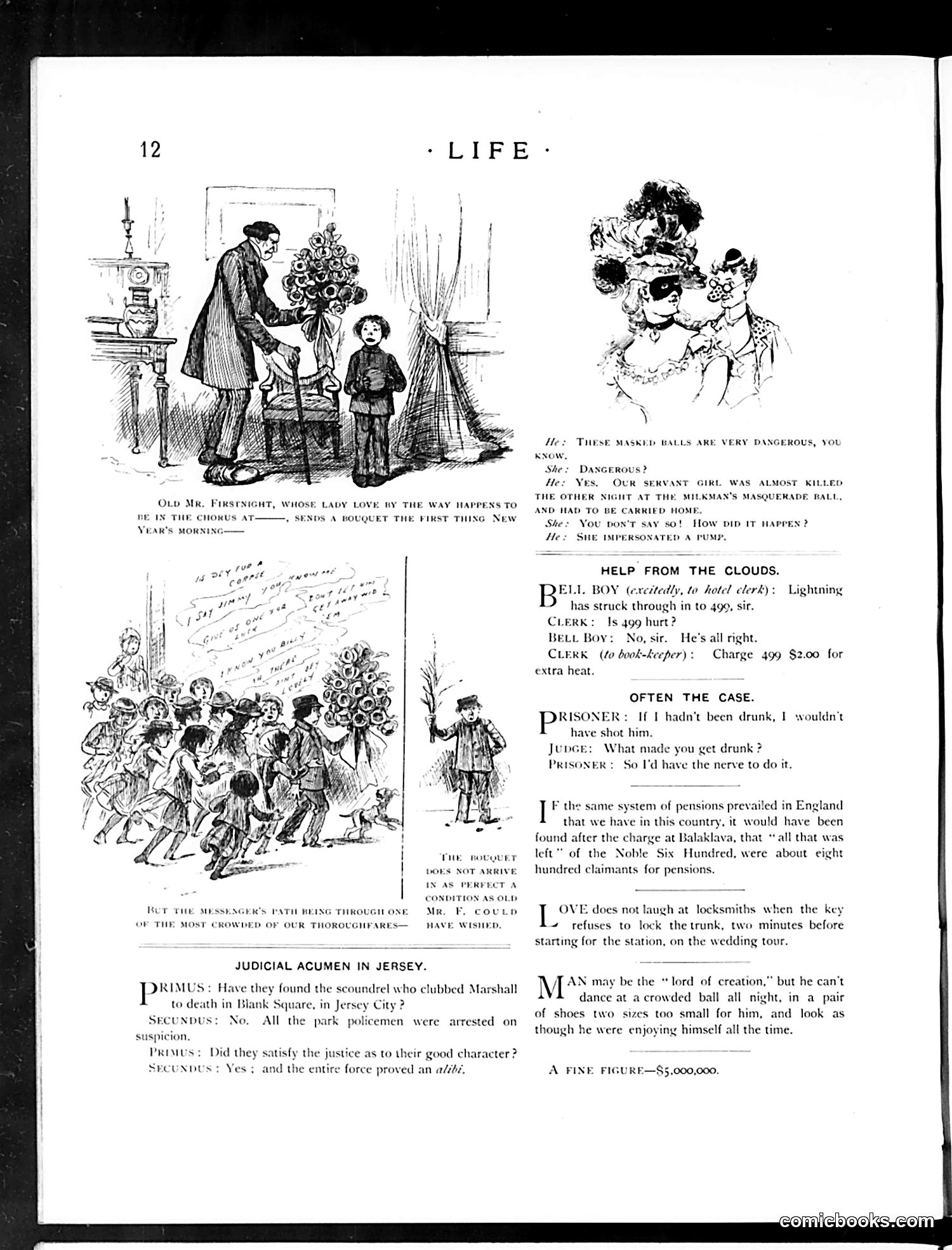
This page from *Life* (an American humor magazine, likely late 19th century) collects several brief satirical sketches: **Top left**: A man sends flowers to his mistress in the chorus; they arrive damaged after traveling through crowded streets—mocking infidelity and the fragility of illicit romance. **Jersey City sketch**: Police arrest all park officers after one clubbed a man, then declare them all of "good character"—satirizing corrupt or absurd municipal justice. **Masked ball anecdote**: A servant girl impersonates a pump at a masquerade and is nearly killed—mocking the dangers of costume balls and mistaken identity. **Hotel lightning strike**: A guest survives lightning; the clerk charges extra for "heat"—dark humor about profiteering. **Prison dialogue**: A prisoner admits drinking gave him courage to shoot—satirizing illogical criminal reasoning. **Balaklava reference**: Mocking pension fraud; the famous Crimean War cavalry charge killed hundreds, yet "eight hundred claimants" for pensions would emerge—suggesting fraudulent pension applications. The page satirizes Victorian society's absurdities: corruption, social hypocrisy, and bureaucratic incompetence.
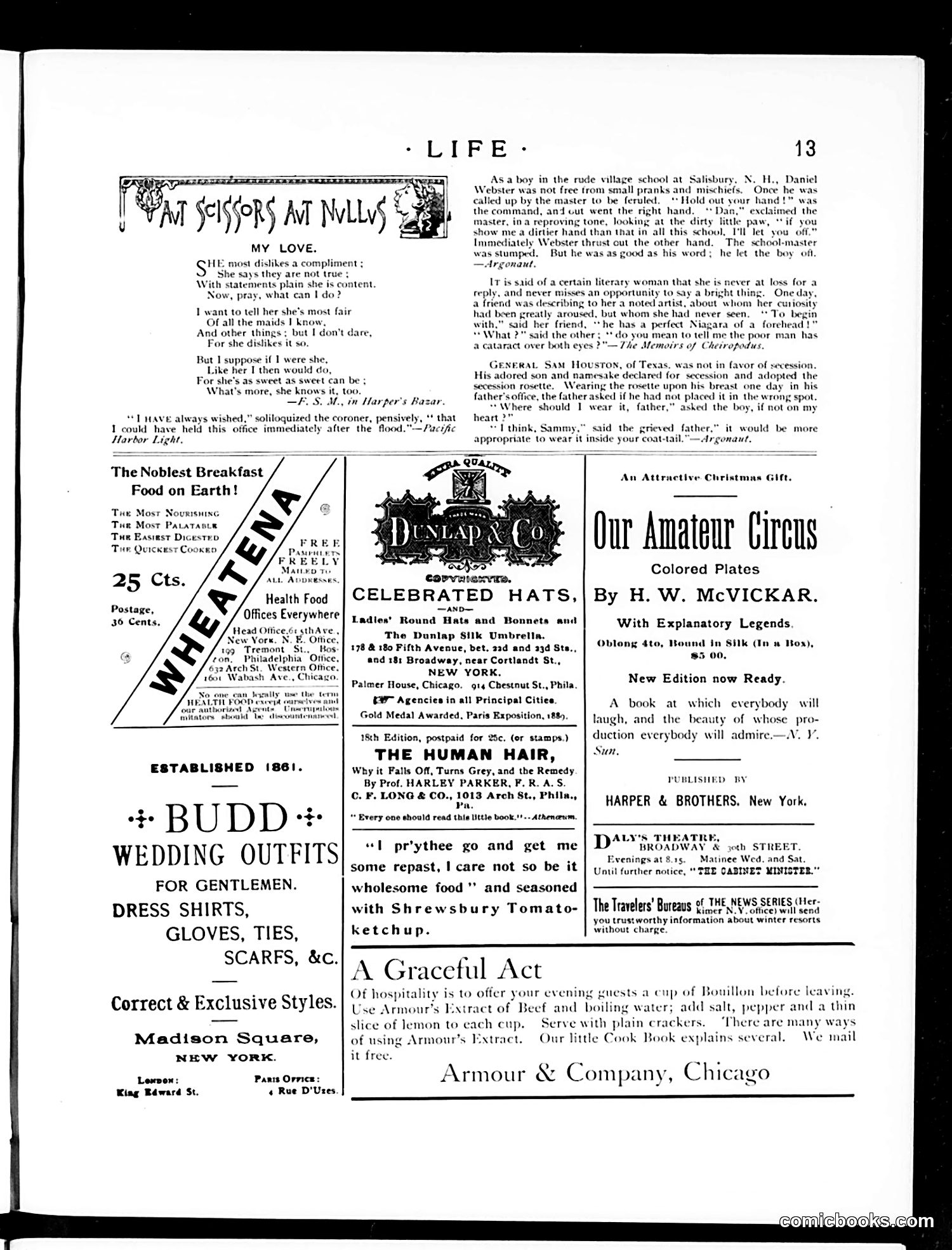
This page is primarily **advertisements and filler content**, not political satire. The cartoons present are brief, lighthearted anecdotes rather than political commentary: **"Oom Scissors at Nullus"** (top): A humorous poem about a woman who dislikes compliments and refuses flattery—a gentle satire on affected modesty. **The Daniel Webster anecdote**: A historical story about the young future statesman outwitting his schoolmaster by producing his dirtier hand when challenged—presented as character-building humor rather than satire. **The literary woman joke**: An anecdote about a woman who never misses opportunity for witty remarks, likely mocking intellectual pretension. The page is dominated by **Victorian-era advertisements** for breakfast cereals, hats, clothing, books, and patent medicines—typical Life magazine filler. The small illustrations accompanying these ads are generic commercial art rather than satirical cartoons. There is **no clear political content** on this page.
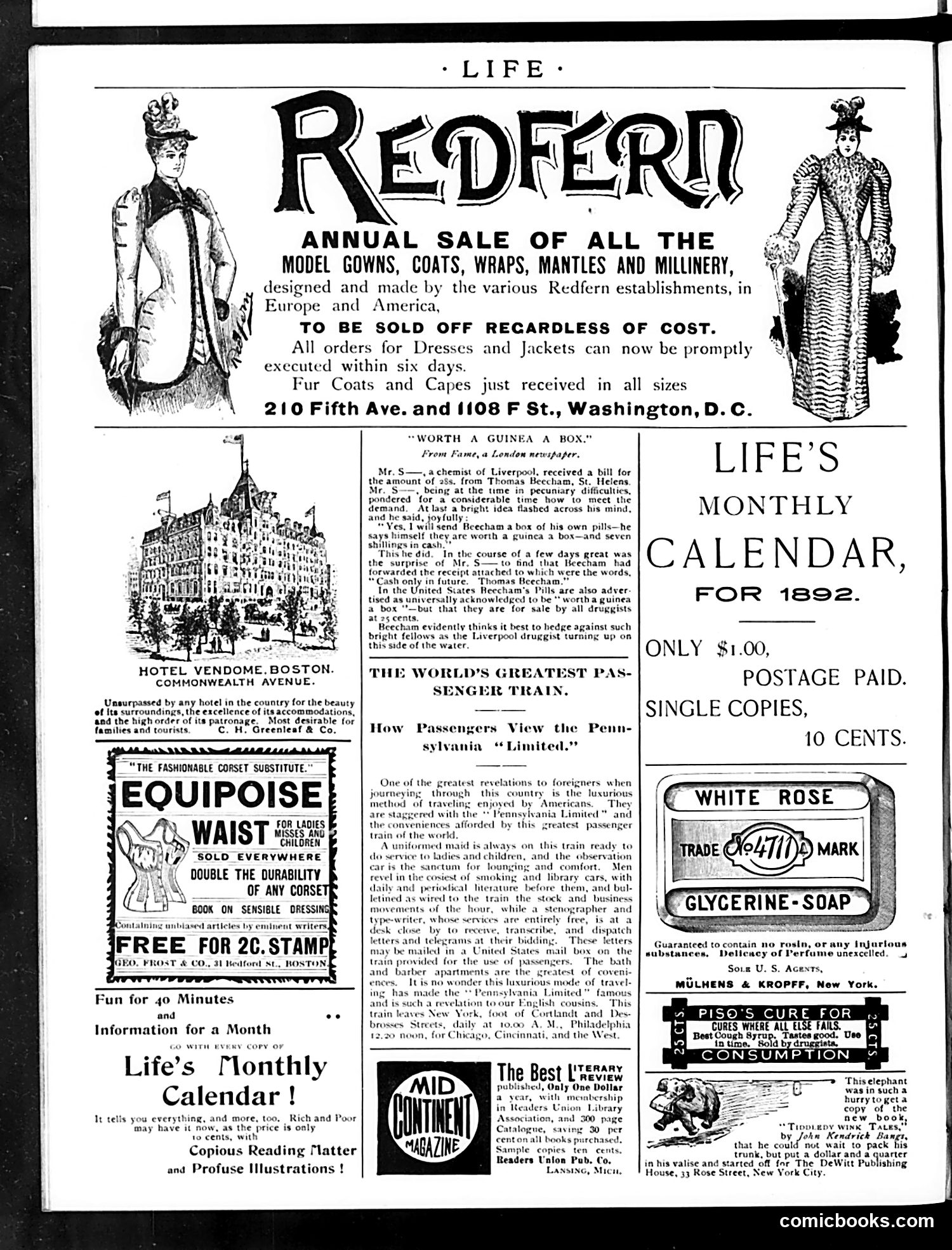
This is primarily an **advertising page** rather than satirical content. However, one notable item is the anecdote titled "Worth a Guinea a Box," which satirizes **Beecham's Pills** marketing. The joke: A Liverpool chemist, unable to pay his bill to Thomas Beecham (a patent medicine manufacturer), sends Beecham a box of his own pills with a note claiming they're "worth a guinea a box"—referencing Beecham's own advertising slogan. He includes only seven shillings in cash, expecting the pill value to cover the debt. Beecham responds by demanding "cash only in future," exposing the absurdity: the same pills advertised as worth a guinea in Britain sell for 25 cents in America. **The satire targets**: Deceptive patent medicine advertising and the gap between inflated British marketing claims and American pricing—suggesting consumers are being duped by exaggerated valuations. The remainder of the page contains straightforward period advertisements for fashion, hotels, corsets, and Life's monthly calendar.
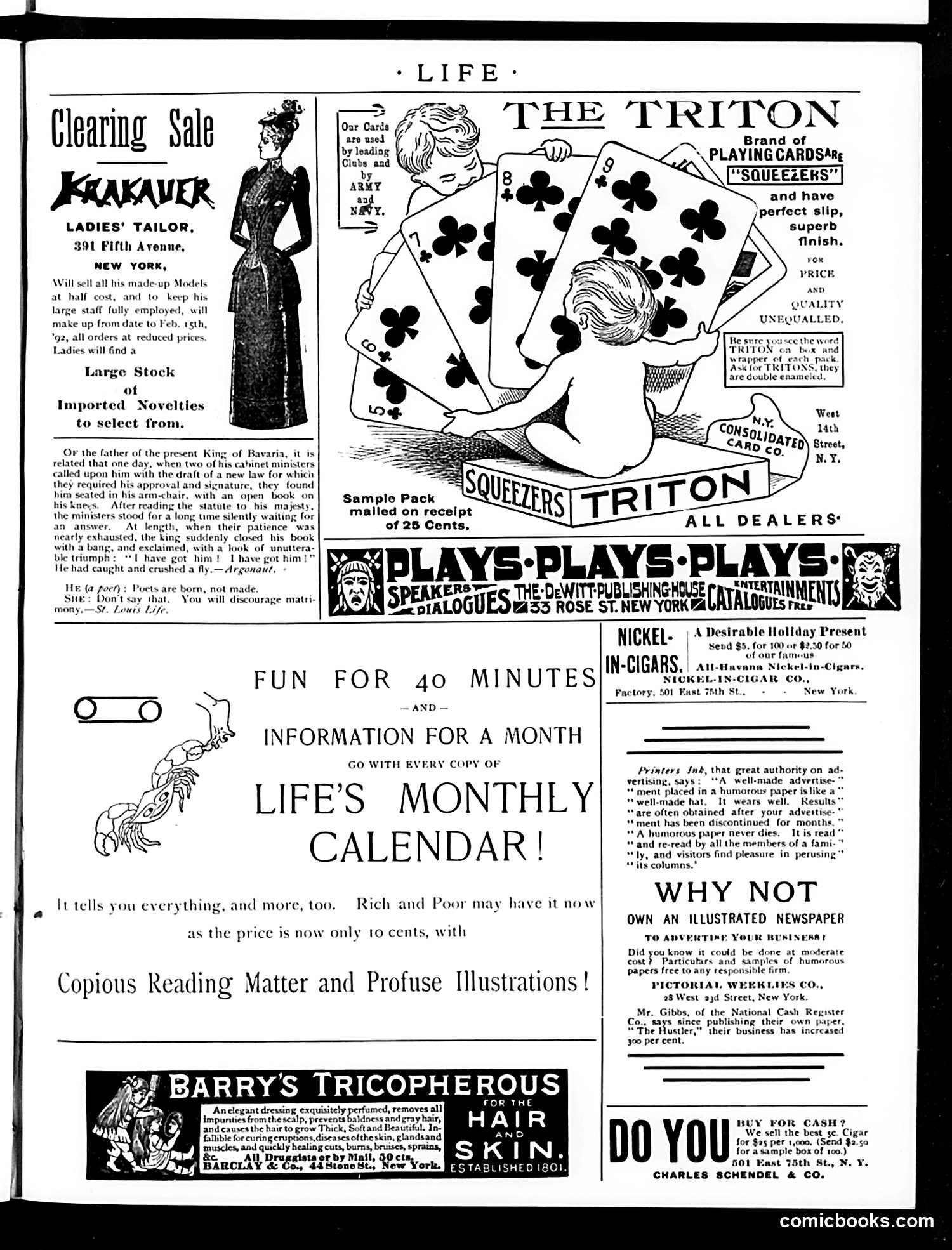
This page is primarily **advertisements and filler content** rather than political satire or editorial cartoons. The main illustrated content is a **Triton playing cards advertisement** featuring a cherub or cupid figure surrounded by club-suited cards—a straightforward product advertisement with no satirical intent. The sole narrative content with potential satirical value is a brief anecdote about the **King of Bavaria**, which ridicules royal dignity by recounting how the monarch becomes intensely preoccupied with catching a fly, treating this trivial act as a great triumph. This appears designed as mild humor rather than pointed political commentary—it satirizes the disconnect between the grandiose self-importance of royalty and mundane reality. The remainder of the page consists of commercial advertisements for tailoring services, hair products, cigars, newspapers, and other goods typical of late-19th-century periodical advertising. There are no identifiable political figures, caricatures, or current events referenced—just generic royal mockery and consumer products.
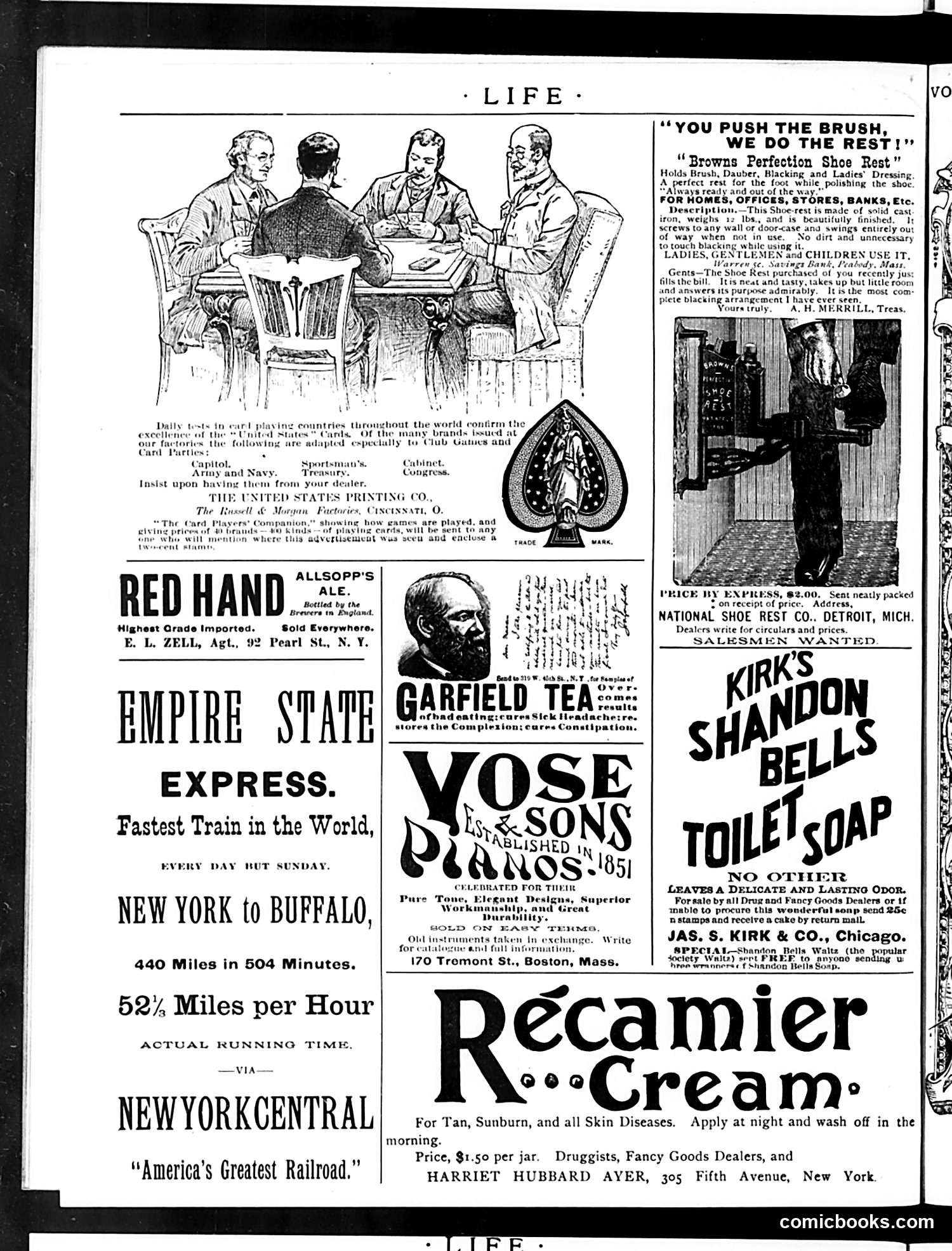
This page is primarily **advertising**, not political satire. It contains multiple product advertisements typical of early 20th-century American commerce. The top illustration shows four men at a dining table, likely depicting gentlemen enjoying cards or conversation—a generic scene supporting an advertisement for playing cards from the U.S. Printing Company in Cincinnati. The remaining content advertises various products: Allsopp's Ale (imported beer), the Empire State Express (a high-speed train claiming 52½ miles per hour), Vose & Sons Pianos, Red Hand Ale, Garfield Tea, Kirk's Shandon Bells Toilet Soap, Brown's Perfection Shoe Rest, and Recamier Cream (a skin treatment). There is **no political cartoon or satire visible**. The page represents standard period advertising aimed at middle and upper-class readers, emphasizing quality imports, modern transportation, and personal care products. The modest illustration is purely decorative, not satirical commentary.