
Life, 1892-01-07 · page 4 of 16
Life — January 7, 1892 — page 4: what you’re looking at
What you’re looking at
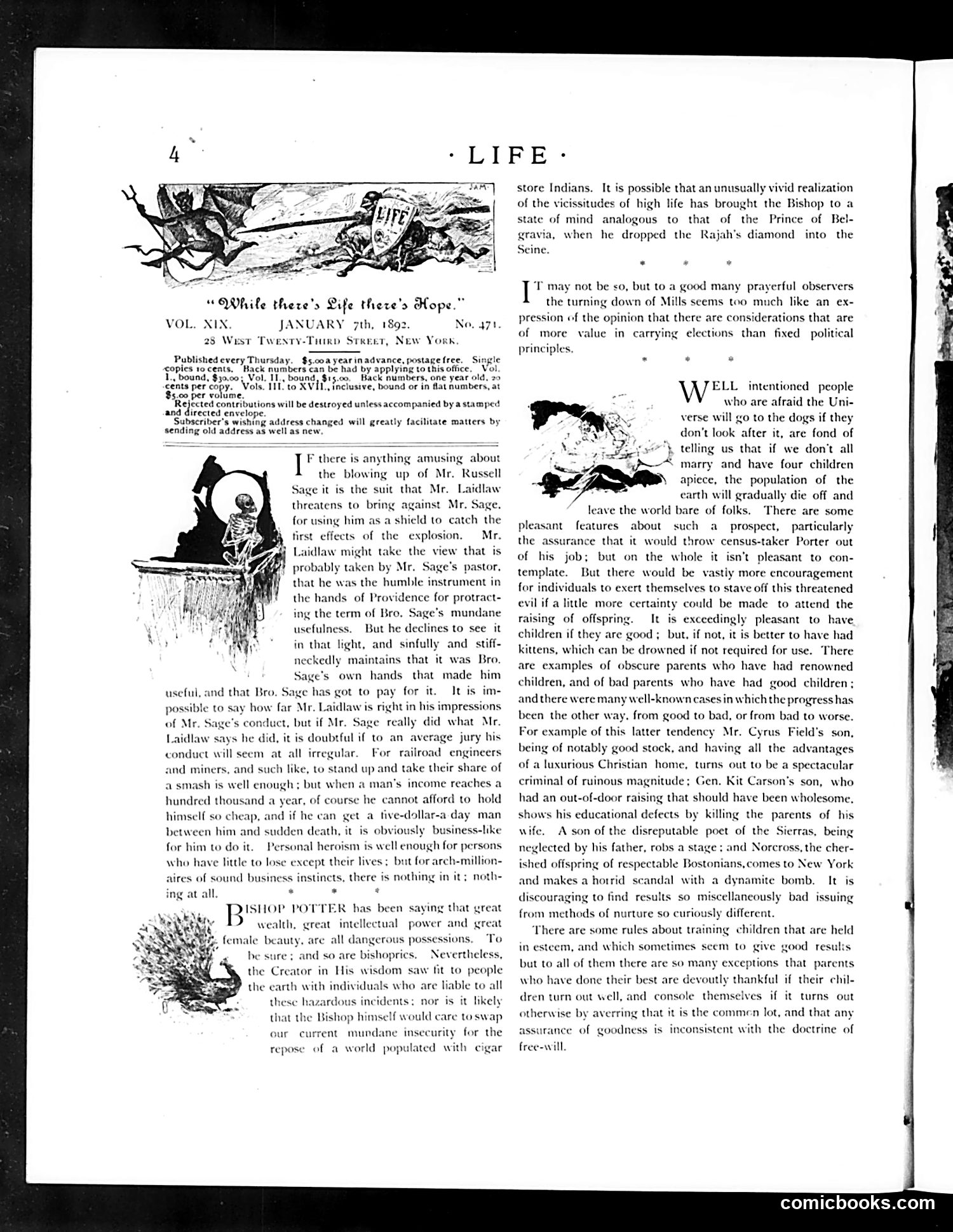
This page contains two editorial cartoons and accompanying commentary on contemporary social issues. The **top cartoon** appears to satirize a legal dispute involving Mr. Russell Sage and Mr. Laidlaw, related to explosives. The text discusses Mr. Laidlaw's attempt to use Sage as a shield against bomb blasts, mocking both men's conduct in what seems a business or legal conflict. The **bottom cartoon** shows Bishop Potter commenting on wealth and social danger. The accompanying editorial discusses whether wealthy individuals like the Bishop should swap their "current murderous insecurity" for concerns about the poor. The text addresses child-rearing, inheritance, and moral responsibility among the privileged classes. Both pieces critique wealthy New Yorkers' conduct and social attitudes of the Gilded Age.
📄 Transcribed text from this page (OCR, searchable)
Machine-transcribed from the original scan — historical spelling and the odd misread are preserved.
“OMhile there's Life there's Hope.” VOL. XIX JANUARY 7th, 1892. No, 471. 28 West Twenty-Tiuirp Street, New York. Published every Thursday. $5.00a year inadvance, postage free. Si copies 10 cents, Back numbers can be had by applying to this office, Vol 1., bound, $39.00; Vol. I1., bound, $15.00, Back numbers, one year old, 20 cents per copy. Vols. III. to XVII, inclusive, bound or in flat numbers, at $5.00 per volume. Rejected contributions will be destroyed unless accompanied by astamped and directed envelope Subscriber's wishing address changed will greatly facilitate matters by sending old address F there is anything amusing about the blowing up of Mr. Russell Sage it is the suit that Mr. Laidlaw threatens to bring against Mr. Sage, for using him as a shield to catch the first effects of the explosion, — Mr. Laidlaw might take the view that is probably taken by Mr. Sage’s pastor. that he was the humble instrument in the hands of Providence for protract- ing the term of Bro, Sage’s mundane usefulness. But he declines to see it in that light, and sinfully and. stiff- neckedly maintains that it was Bro. Saye’s own hands that made him useful, and that Bro. Sage has got to pay for it. It is im- possible to say how far Mr. Laidlaw is right in his impressions of Mr. Sage’s conduct, but if Mr. Sa really did what Mr. Laidlaw says he did, it is doubtful if to an average jury his conduct will seem at all irregular. For railroad engineers and miners, and such like, to stand up and take their share of a smash is well enough; but when a man’s income reaches a hundred thousand a year, of course he cannot afford to hold himself so cheap, and if he can get a tive-dollar-a day man between him and sudden death, it is obviously business-like for him to do it. Personal heroism is well enough for persons who have little to lose except their lives ; but for areh-million- ires of sound business instincts, there is nothing in it; noth- * * * ISHOP POTTER bas been saying that great Ay wealth, great intellectual power and gr “wis. female beauty, are all dangerous possessions. he sure; and so are bishoprics. Nevertheless the Creator in His wisdom saw fit to people the earth with individuals who are liable to all these hazardous incidents: nor is it likely that the Bishop himself would care toswap current mundane insecurity for the repose of a world populated with cigar our store Indians. It is possible that an unusually vivid realization of the vicissitudes of high life has brought the Bishop to a state of mind analogous to that of the Prince of Bel- gravia, Seine. when he dropped the Rajah’s diamond into the I T may not be so, but to a good many prayerful observers the turning down of Mills seems too much like an ex- pression of the opinion that there are considerations that are of more value in carrying elections than fixed political principles. ZLL intentioned people who are afraid the Uni- verse will go to the dogs if they don’t look after it, are fond of telling us that if we don’t all marry and have four children apiece, the population of the earth will gradually die off and leave the world bare of folks. There are some features about prospect, particularly the assurance that it would throw census-taker Porter out of his job; but on the whole it isn’t pleasant to con- template. pleasant such a But there would be vastiy more encouragement for individuals to exert themselves to stave off this threatened evil if a little more certainty could be made to attend the raising of offspring. It is exceedingly pleasant to. have children if they are good ; but, if not, it is better to have had kittens, which can be drowned if not required for use. There are examples of obscure parents who have had renowned children, and of bad parents who have had good children; and there were many well-known cases in which the progress has been the other way, from good to bad, or from bad to worse. For example of this latter tendency Mr. Cyrus Field's son, being of notably good stock, and having all the advantages of a luxurious Christian home, turns out to be a spectacular criminal of ruinous magnitude; Gen. Kit Carson's son, who had an out-of-door raising that should have been wholesome, shows his educational defects by killing the parents of his wife. A son of the disreputable poet of the Sierras, being neglected by his father, robs a stage ; and Norcross, the cher- ‘omes to New York and makes a horrid scandal with a dynamite bomb. It is ished offspring of respectable Bostonians, discouraging to find results so miscellaneously bad issuing from methods of nurture so curiously different. ‘There are some rules about training children that are held in esteem, and which sometimes seem to give good resulis but to all of them there are so many exceptions that parents who have done their best are devoutly thankful if their chil- dren turn out well, and console themselves if it turns out otherwise by averring that it is the commen lot, and that any assurance of goodness is inconsistent with the doctrine of free-will. comicbooks.com